
- Paddle is a true merchant of record, but that bundled tax handling comes with a revenue share that compounds quickly at scale.
- Several alternatives handle global VAT and sales tax as the MoR, including FastSpring, PayPro Global, and 2Checkout (now Verifone), each with different contract structures and geographic coverage.
- If tax compliance is your only concern, Stripe Tax plus a standalone billing layer is cheaper for many mid-market SaaS teams than a full MoR.
- The right choice depends on four variables: your revenue volume, checkout ownership requirements, enterprise billing complexity, and how aggressively you sell into the EU and Asia-Pacific.
- Some alternatives are better for product-led growth; others are built for direct sales with custom contracts and invoicing. Knowing which motion you run determines half the decision.
The best Paddle alternatives for B2B SaaS teams are FastSpring for enterprise software sales, PayPro Global for global MoR coverage with multi-currency support, 2Checkout (Verifone) for high-volume businesses that need both MoR and a payment gateway, Lemon Squeezy for lightweight digital product sales, and Stripe with Stripe Tax for teams that want payment control without a full MoR. Each solves a different version of the “handle my taxes globally” problem, at meaningfully different cost structures and checkout ownership trade-offs. For B2B SaaS founders evaluating Paddle alternatives, the platform decision is ultimately about which trade-offs your business can absorb.
Why Are B2B SaaS Teams Looking for Paddle Alternatives?
Paddle’s core pitch is simple: they become the merchant of record on your transactions, handle VAT registration across the EU, collect and remit sales tax in US states, and let you focus on the product. For early-stage SaaS teams with no finance infrastructure, that is genuinely compelling. Most teams do not discover the friction until they try to customize checkout, negotiate enterprise contracts, or run usage-based billing against Paddle’s model.
The revenue share structure is the most common trigger for the switch. As a company crosses $1M or $2M ARR, the percentage-based fee on every transaction becomes a meaningful line item. Teams that modeled this at $50K MRR often find it looks very different at $500K MRR, and Paddle’s published pricing does not make the math easy to run in advance. For more detail on where those margin surprises come from, the FintechSpecs breakdown of hidden costs killing fintech SaaS margins maps this category well.
Three other friction points drive the search for alternatives. First, Paddle limits checkout customization in ways that frustrate product teams trying to run conversion optimization. Second, Paddle’s invoice and contract tooling is not built for enterprise direct sales, where custom payment terms, PO-based billing, and multi-year contracts are standard. Third, some teams find that Paddle’s dispute resolution process , where Paddle owns the merchant relationship , leaves them without direct recourse when refund or chargeback policies affect retention.
What Should You Evaluate Before Switching MoR Platforms?
Most evaluation frameworks for MoR platforms collapse into a feature checklist. That approach misses the variables that actually determine fit. Below is what FintechSpecs calls the MoR Stack Fit Test, a four-part evaluation methodology for B2B SaaS teams reviewing merchant of record pricing alternatives.
Tax Geography Coverage
Does the vendor register and remit in the specific jurisdictions where you have customers, not just the ones on a marketing page? EU VAT, US sales tax (economic nexus by state), Canadian GST/HST, Australian GST, and VAT in the UK, India, and Singapore are the most common gaps. Ask for the current list of registered jurisdictions, not the “supported” list.
Checkout Ownership and Conversion Control
True MoR platforms vary widely on how much of the checkout flow the vendor controls versus the merchant. If you need A/B test access on pricing page CTAs, localized payment method display, or embedded in-app purchasing, confirm the vendor’s actual API surface rather than their marketing language.
Billing Model Compatibility
Usage-based pricing, hybrid seat plus consumption billing, and enterprise annual contracts all stress-test MoR platforms differently. Platforms built primarily for one-time digital sales often struggle with metered billing or multi-year deal structures. Confirm whether the platform natively handles mid-cycle upgrades, proration, and contract amendments, or whether that lives entirely on your side.
Fee Structure at Your Current and Projected Volume
Build the comparison on three numbers: your current MRR, your projected MRR in 18 months, and your average transaction value. Percentage-based fees look very different across these scenarios. A platform charging 3.9% plus 45 cents per transaction costs meaningfully more than one at 2.9% plus 30 cents as volume climbs, even if the base feature set is identical.
11 Paddle Alternatives for B2B SaaS Teams
| Platform | True MoR? | Best For | Public Pricing |
|---|---|---|---|
| FastSpring | Yes | Enterprise software, global licensing | Revenue share, contact for rate |
| PayPro Global | Yes | Global SaaS, 140+ currencies | Revenue share, contact for rate |
| 2Checkout (Verifone) | Yes (via 2Sell/2Subscribe plans) | High-volume SaaS, global payments | Tiered plans from 3.5% + $0.35 |
| Stripe + Stripe Tax | No (PSP) | Engineering-led teams, low base fees | 2.9% + $0.30 standard; tax add-on |
| Lemon Squeezy | Yes | Indie SaaS, early-stage products | From 5% + $0.50 per transaction |
| Chargebee | No | Subscription billing depth, enterprise | Tiered plans, Launch plan free to $100K ARR |
| Cleverbridge | Yes | Enterprise SaaS, channel sales | Contact for pricing |
| Digital River | Yes | Large enterprise, regulated markets | Contact for pricing |
| Recurly | No | Subscription management, churn tools | From $249/month + 0.9% over $10K |
| Gumroad | Yes | Simple digital products, creators | 10% flat per sale (public pricing page) |
| Zuora | No | Enterprise quote-to-cash, CPQ | Contact for pricing |
1. FastSpring

FastSpring is the most direct Paddle competitor for software businesses with active license management needs. As a true MoR, they handle VAT, sales tax, and local payment methods across a large number of countries. The checkout is more customizable than Paddle’s for companies selling via embedded storefronts or partner channels, and they have stronger support for perpetual license plus maintenance subscription models.
The trade-off is enterprise focus. FastSpring suits teams selling through direct and channel motions more than pure product-led growth plays. Pricing is revenue-share based and requires a direct conversation, which itself signals where they sit in the market. Teams building product-led acquisition funnels with high transaction volume at low ACV often find the economics less favorable than Stripe-based stacks.
2. PayPro Global
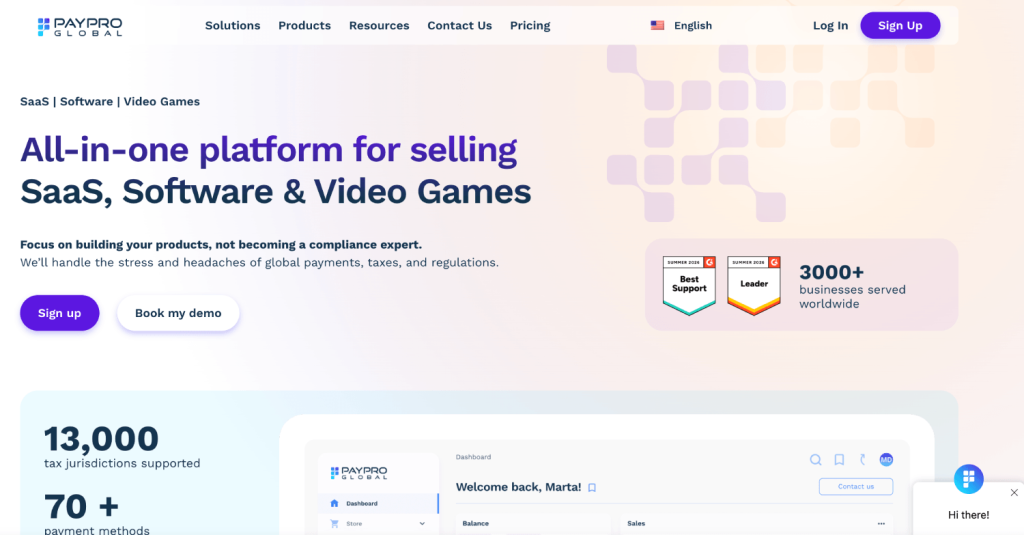
PayPro Global covers 140+ currencies and 70+ payment methods according to their public site, which makes them a strong choice for SaaS businesses with significant Asia-Pacific or Latin America revenue. Their MoR structure handles VAT, GST, and digital service taxes in a broad set of jurisdictions, and they offer multilingual checkout support out of the box.
The integration and customization surface is more limited than Stripe’s for engineering-led teams. PayPro is better suited for teams that want to hand off tax operations completely and accept some checkout constraint in exchange, particularly teams without a dedicated payments engineer.
3. 2Checkout (Now Verifone)

2Checkout was acquired by Verifone and now operates under that brand, though the platform continues to be marketed as 2Checkout in many contexts. Their tiered plan structure (2Sell, 2Subscribe, 2Monetize) lets SaaS teams start without full MoR status and add it as needed, which is a genuinely useful structure for companies in earlier stages of international expansion.
The 2Monetize plan is their full MoR offering, covering global tax compliance. Public plan pricing starts at 3.5% plus $0.35 per transaction for 2Sell, with higher tiers disclosed on contact. The recurring billing tooling is more mature than what Paddle offers for companies running hybrid one-time and subscription revenue streams.
4. Stripe + Stripe Tax

Stripe is not a merchant of record. That distinction matters for teams who need the MoR to legally own the transaction and remit tax on their behalf. With Stripe, tax liability remains with you. What Stripe Tax provides is automatic calculation and reporting support to help you file correctly, but you are still the merchant, and you need to register in each jurisdiction separately.
That said, Stripe’s base fee of 2.9% plus 30 cents (per their public pricing page) is lower than most MoR platforms, and the engineering surface is far deeper. For teams with a payments engineer and a tax advisor (or a tool like Avalara or TaxJar), the Stripe-plus-tax-tooling stack frequently comes out cheaper than a full MoR at mid-market scale. The FintechSpecs comparison of Stripe vs Paddle vs Lemon Squeezy vs Polar runs this math in more detail.
5. Lemon Squeezy
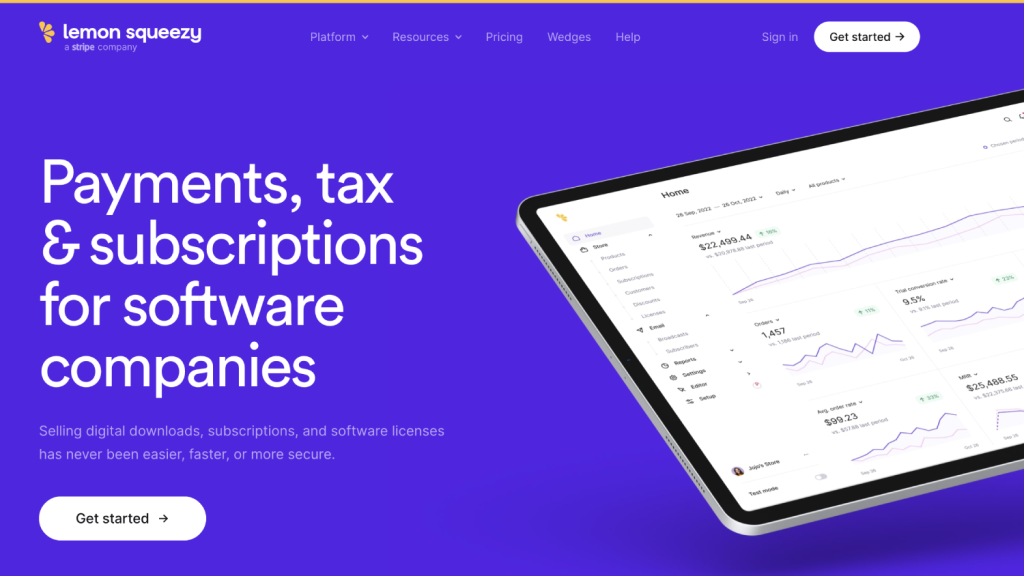
Lemon Squeezy is a true MoR built for indie developers and small SaaS teams who want zero tax infrastructure overhead. At 5% plus 50 cents per transaction (public pricing page), it is expensive at scale by design. The product is genuinely easy to set up and is the fastest path to accepting payments globally with tax handled for a new product.
The limitations are real for B2B SaaS past seed stage. Billing model flexibility is limited, enterprise invoicing does not exist in a meaningful way, and checkout customization is constrained. Lemon Squeezy is a starting point, not a growth platform for teams targeting direct enterprise sales.
6. Chargebee
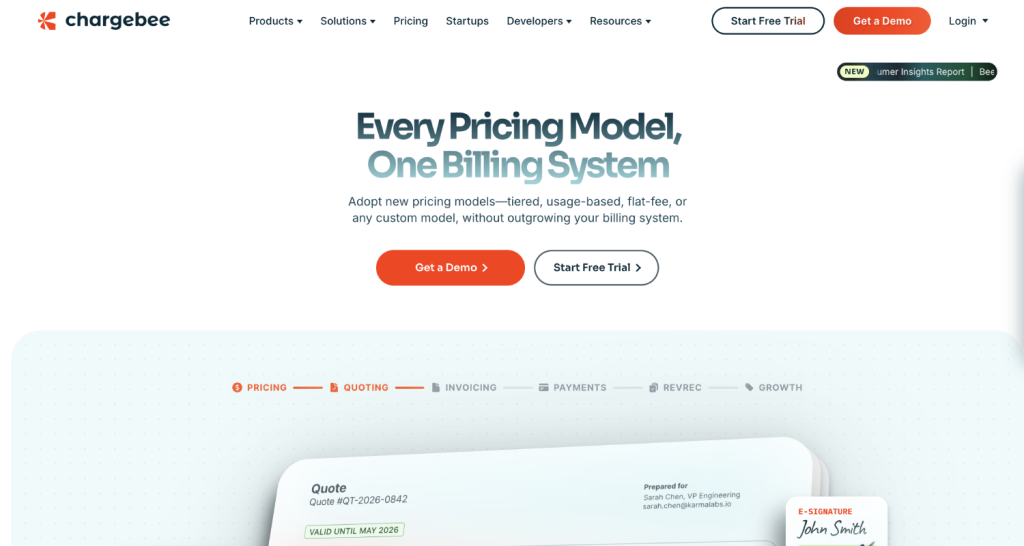
Chargebee is not an MoR, which means it handles billing orchestration but does not own the transaction or remit tax. For that reason it belongs on this list only for teams whose primary need is subscription billing depth rather than tax liability offload. Their Launch plan is free up to $100K ARR (per their public pricing), which makes it genuinely accessible for early-stage teams.
Where Chargebee earns its place is in complex subscription architectures. Multiple pricing models, mid-cycle upgrades, dunning automation, revenue recognition support, and CRM integrations are all deeper than what Paddle offers. Teams who have solved their tax problem separately and need serious billing infrastructure often choose Chargebee over Paddle specifically because of this depth.
7. Cleverbridge

Cleverbridge is a full MoR with a heavy focus on enterprise software licensing, including seat-based and consumption-based contracts for companies with channel and reseller programs. They handle tax compliance globally and have compliance experience in regulated software categories including cybersecurity and enterprise IT.
This is not a self-serve platform. Implementation requires a direct engagement, and the product is built for deal sizes and contract structures that make that onboarding worthwhile. Teams at Series B or later with $5M-plus ARR and significant enterprise direct sales motion tend to find more value here than earlier-stage companies.
8. Digital River
Digital River is one of the oldest MoR providers in the market, with deep compliance infrastructure across dozens of countries and strong experience in regulated verticals. They have historically served larger software companies and consumer electronics brands, and their platform reflects that enterprise-first lineage.
For most B2B SaaS teams at seed-to-Series B, Digital River is almost certainly over-engineered and overpriced relative to what they need. For large-scale software businesses with complex global tax situations, government contracts, or significant exposure to regulated markets in the EU and Asia, it merits evaluation.
9. Recurly
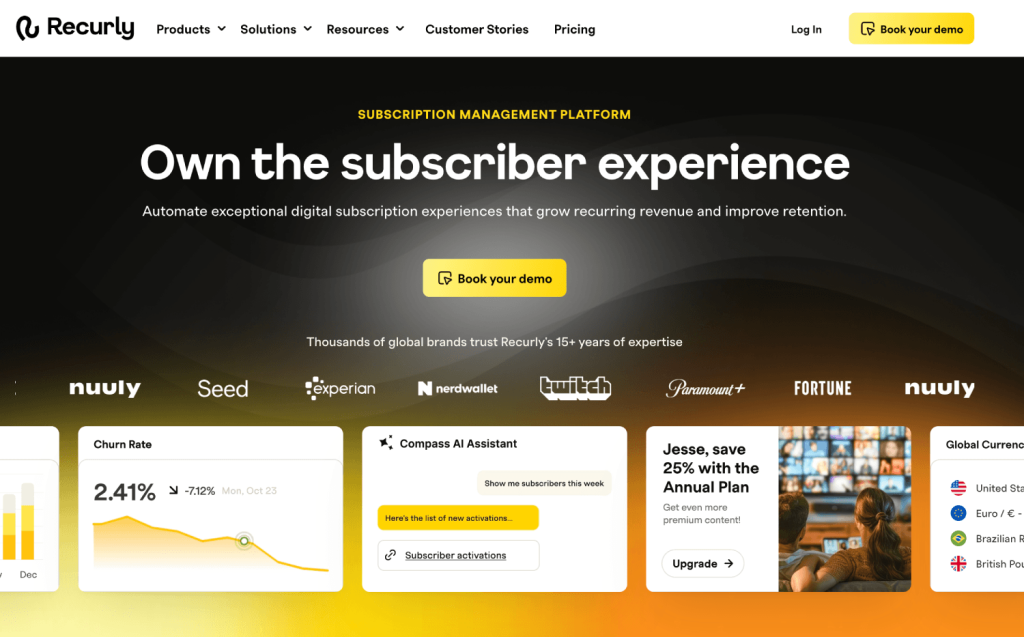
Like Chargebee, Recurly is a subscription billing platform rather than a true MoR. It pairs with a payment gateway (typically Stripe, Braintree, or Adyen) and provides subscription management, dunning, analytics, and revenue recovery tooling on top. Public pricing starts at $249 per month plus a percentage fee above $10K in monthly revenue.
Recurly’s churn recovery tooling is notably strong, and the platform has a longer track record in media and consumer subscription businesses than Chargebee. For pure B2B SaaS with enterprise billing needs, Chargebee tends to win on flexibility, but Recurly holds an edge for teams with high transaction volume and failed payment recovery as a primary pain point.
10. Gumroad

Gumroad functions as a true MoR and charges a flat 10% per transaction per their public pricing page. For B2B SaaS, this is almost certainly not the right platform at any meaningful scale. Gumroad is designed for creators selling digital downloads, courses, and simple software, not for recurring subscription businesses with CRM integration or usage-based pricing needs.
It belongs on this list because teams at the very earliest stage, pre-revenue or sub-$5K MRR, sometimes find Gumroad a faster path to global sales than setting up a proper billing stack. The 10% fee is steep but the setup friction is essentially zero.
11. Zuora

Zuora is enterprise billing infrastructure, not an MoR. It handles the entire quote-to-cash process for companies with complex CPQ (configure, price, quote) requirements, multi-entity structures, and revenue recognition obligations under ASC 606 or IFRS 15. Companies choose Zuora when their billing requirements have outgrown what any standard SaaS billing platform can handle.
Implementation is measured in months and costs are substantial. Zuora makes sense when billing complexity itself has become an engineering and finance team bottleneck, typically at $10M ARR and above with multiple products, geographies, and contract types running simultaneously. Teams thinking about that stage of infrastructure should also review the fintech SaaS scale checklist for what else typically breaks at that revenue mark.
What Does “True Merchant of Record” Actually Mean for Tax Liability?
The MoR distinction is not just a legal technicality. When a platform is the merchant of record, they are legally the seller of the product in the eyes of the tax authority. They collect the tax, hold the registration in each jurisdiction, and remit directly to the government. Your company receives revenue net of taxes already withheld.
When you use a non-MoR platform like Stripe or Chargebee, you remain the seller of record. You are responsible for determining whether a sale is taxable in a given jurisdiction, registering once you hit economic nexus thresholds (which in most US states is $100K in annual sales or 200 transactions), collecting the correct rate, and remitting it yourself. For a deeper breakdown of this distinction, the FintechSpecs explainer on merchant of record vs payment processor covers where teams consistently get this wrong.
The MoR structure is not free, even when it looks like it. The vendor prices their revenue share to cover their own tax compliance costs, fraud liability, and chargeback exposure. You are paying for those services through every transaction. At low volume, that bundled cost is often worth it for the operational simplicity. At higher volume, many teams find that unbundling those services and managing them separately is meaningfully cheaper.
Paddle vs Stripe: Which Is Actually Cheaper for B2B SaaS?
Note: The scenario below uses illustrative rates to show how the cost comparison works in practice. Paddle does not publish its rates publicly , actual pricing is disclosed during their sales process and varies by volume and contract. Model this with real quotes from both sides before making any decision.
Consider a company at $200K MRR with an average deal size of $300 per transaction. On Stripe’s standard published rate of 2.9% plus 30 cents, each transaction costs roughly $9. Add Stripe Tax at 0.5% per transaction, and you are at approximately $10.50 per transaction. For 667 monthly transactions (to hit $200K MRR at $300 average), that is about $7,000 per month in processing cost, not counting your billing platform.
A Paddle-equivalent rate of 5% plus 50 cents on the same transaction costs $15.50, totaling roughly $10,300 per month. That is a $3,300 per month difference, or about $40,000 per year, at that volume. The gap widens as MRR grows.
The Stripe scenario also requires you to manage tax registration, which is a real operational cost. If you have a finance team member who can handle that (or use a tool like Avalara), the math often still favors Stripe at scale. If you do not, the Paddle model covers a genuine operational burden that has real dollar value. Pricing models in fintech SaaS are rarely as straightforward as they appear on the surface, a point covered in detail in the best pricing models in fintech SaaS breakdown.
Which Paddle Alternative Is Best for Enterprise B2B Sales Motions?
Product-led and sales-led SaaS businesses have fundamentally different needs from an MoR platform. PLG teams need low-friction self-serve checkout, trial-to-paid conversion tooling, and webhook-driven upgrade flows. Sales-led teams need custom invoicing, multi-year contracts, PO-based payments, and the ability to negotiate payment terms with procurement.
Paddle is primarily built for the PLG motion. For enterprise direct sales, FastSpring and Cleverbridge are the strongest MoR options because both support custom contract structures and channel billing. If tax handling is not the primary concern and billing flexibility is, Chargebee or Zuora with a separate tax tool is often more practical for enterprise deals above $20K ACV.
One underappreciated factor: enterprise buyers frequently require invoicing in their local currency with payment via wire transfer or ACH, not a credit card checkout. Most MoR platforms handle this poorly because they are optimized for card transactions. Confirming that your chosen platform supports non-card payment methods for enterprise buyers is worth doing early in the evaluation. For a broader look at payment infrastructure trade-offs, the FintechSpecs roundup of payment infrastructure tools for SaaS founders covers the options in more detail.
Frequently Asked Questions
Is Paddle cheaper than Stripe for B2B SaaS?
At low transaction volume, Paddle can be comparable in total cost once you factor in the engineering and operational work of managing tax compliance yourself with Stripe. At higher volume, typically above $100K MRR, Stripe’s lower base processing rate plus a tax tool like Avalara or Stripe Tax tends to produce lower total cost. The crossover point depends on your average deal size, transaction volume, and whether you have internal finance capacity to manage tax registration.
Do I need a merchant of record for my SaaS business?
You need an MoR if you want a third party to own the legal tax liability on your transactions. If you are selling into multiple US states or the EU and do not want to manage VAT registration and sales tax remittance yourself, an MoR removes that obligation. If you have a finance function that can manage those filings, or use a dedicated tax compliance tool, a standard payment processor is sufficient and typically cheaper at scale.
What is the difference between Paddle and Chargebee?
Paddle is a merchant of record that processes payments and handles tax compliance on your behalf. Chargebee is a subscription billing platform that manages recurring billing logic but does not own the merchant relationship or handle tax remittance. You connect Chargebee to a payment gateway like Stripe. Paddle is a better fit if you want to offload tax liability. Chargebee is better if you need complex subscription billing logic and are comfortable managing tax separately.
Which Paddle alternative handles EU VAT best?
FastSpring, PayPro Global, and Cleverbridge all have strong EU VAT coverage as true merchants of record. PayPro Global advertises 140+ currencies and 70+ payment methods, which covers most EU jurisdictions. FastSpring has a long track record with EU VAT, including the OSS (One Stop Shop) scheme. For teams primarily concerned with EU digital services tax, any of the three will handle registration and remittance, though the contract terms and pricing models differ significantly.
Can Stripe replace Paddle as a merchant of record?
No. Stripe is a payment processor, not a merchant of record. When you use Stripe, you remain the seller of record and retain legal responsibility for tax collection and remittance. Stripe Tax helps you calculate and track tax obligations, but you still need to register in each jurisdiction and file returns. Teams replacing Paddle with Stripe should budget for tax compliance tooling and either internal or outsourced tax filing support.
What is the best Paddle alternative for small SaaS teams?
Lemon Squeezy is the most comparable MoR for small teams and indie SaaS products, with zero setup friction and global tax handling built in. The 5% plus 50 cent per transaction fee is high relative to other platforms, but operational overhead is minimal. For teams past $10K MRR with growth momentum, the fee structure warrants comparison against PayPro Global or 2Checkout, both of which offer more billing flexibility at similar or lower cost.
Does Recurly or Chargebee handle global tax compliance?
Neither Recurly nor Chargebee is a merchant of record, so neither handles global tax compliance natively. Both integrate with third-party tax tools. Chargebee integrates with Avalara and TaxJar for automated tax calculation and supports integration with Stripe Tax. Recurly has similar integrations. For teams using either platform, tax compliance remains the merchant’s responsibility and requires a separate tool or service in addition to the billing platform.
What should I check in a Paddle alternatives contract before signing?
Four contract terms warrant close review. First, confirm the revenue share rate is locked or has a defined cap as volume scales, since some platforms renegotiate rates only when you ask. Second, check chargeback liability: some MoR platforms absorb it, others pass it back to the merchant above a threshold. Third, confirm data portability, specifically whether you can export your full subscriber list and billing history if you switch platforms. Fourth, review termination terms and the timeline for fund disbursement after account closure.
The Decision Actually Comes Down to Two Variables
After running through eleven platforms, the decision logic compresses into two questions. First: do you need a third party to legally own your tax liability, or do you have the capacity to manage it yourself? If you genuinely need MoR status, your shortlist is FastSpring, PayPro Global, 2Checkout, Cleverbridge, or Paddle itself, depending on your deal size and geographic mix. If you can manage tax separately, Stripe or Chargebee with a tax tool almost always wins on cost and flexibility at mid-market scale.
Second: is your sales motion product-led or sales-led? PLG teams benefit from MoR platforms with clean self-serve checkout and trial tooling. Sales-led teams with enterprise ACV above $10K need invoicing, PO support, and contract flexibility that most MoR platforms simply were not built to handle well. Mixing up these two requirements is the most common reason teams pick the wrong platform and spend six months discovering it. The infrastructure considerations behind that distinction connect directly to the critical mistakes teams make when choosing fintech infrastructure.
Paddle remains a capable platform for a specific profile: early-to-mid stage SaaS, product-led motion, global customer base, no dedicated finance team. Outside that profile, the market has better-fitted alternatives at nearly every point on the spectrum from indie to enterprise. The existence of real competition in this space is ultimately good for buyers, but only if they evaluate on the right criteria rather than defaulting to the most marketed option.