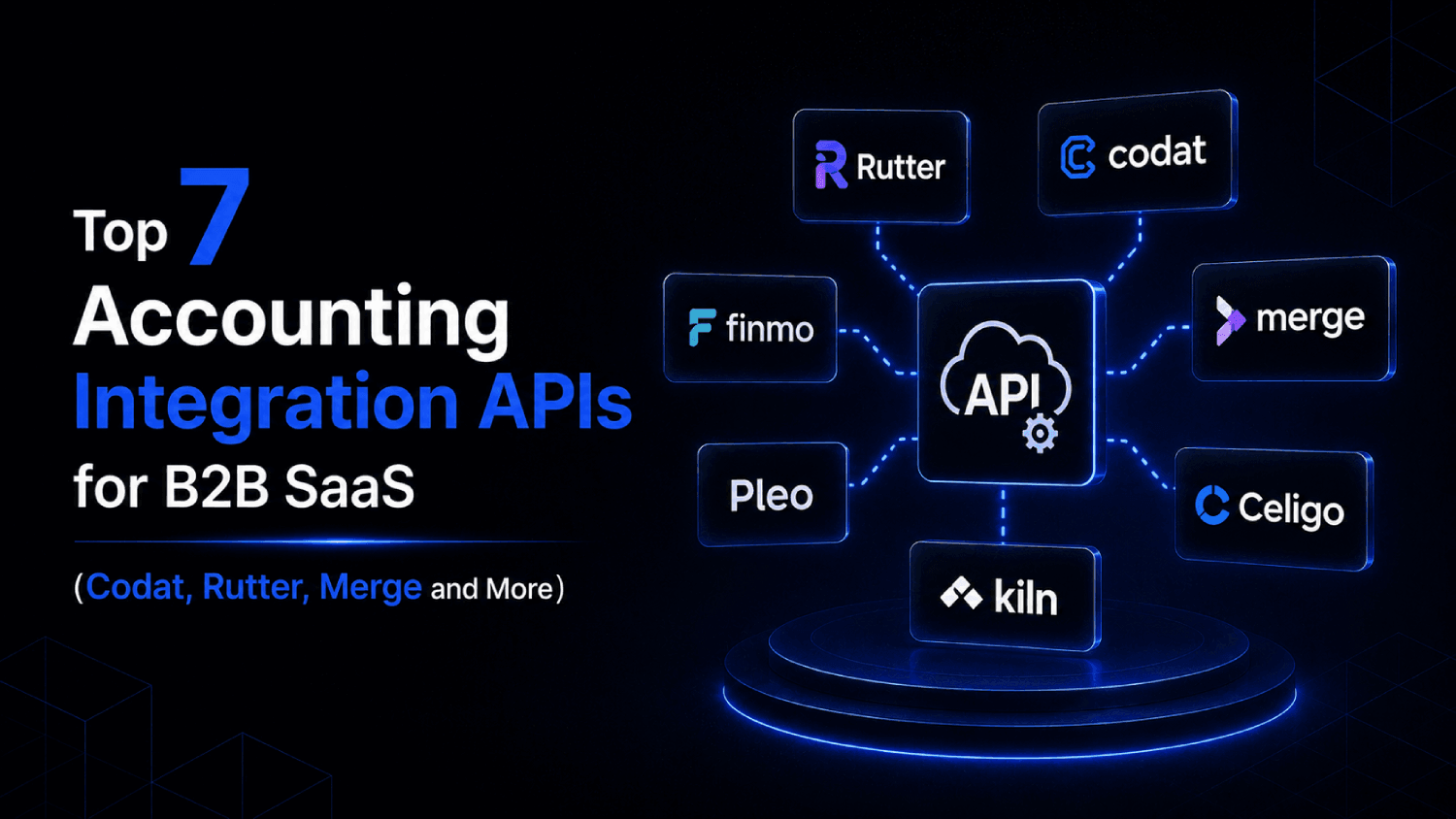

- Unified accounting APIs are not interchangeable. Coverage depth, write support, and sandbox quality vary enough to affect your integration roadmap by months.
- Codat, Rutter, and Merge each dominate a different use case: Codat for financial services and lending, Rutter for commerce and ERP breadth, Merge for HR-plus-accounting product teams.
- Building native integrations to QuickBooks, Xero, and NetSuite in-house costs more than most engineering teams estimate, especially once you account for maintenance across API version changes.
- For underwriting and credit decisioning, the critical question is whether the API returns normalized journal entries and income statements, not just invoice lists.
- Read-only access is table stakes. Which provider lets you write back to the ledger without custom middleware determines whether you can automate reconciliation or just display data.
The best accounting integration API for most B2B SaaS companies is a unified layer like Codat, Rutter, or Merge rather than direct integrations built in-house. Codat fits lending and financial services teams that need normalized financial statements for underwriting. Rutter fits platforms with broad ERP coverage needs, including NetSuite read and write. Merge fits product teams already using its HR or CRM integrations who want to add accounting without a second vendor. Apideck and Nango are credible alternatives for cost-sensitive early-stage teams.
Why Most Teams Underestimate What an Accounting Integration Actually Does
Most product teams assume an accounting integration API is a thin connector that moves data between two systems. It is not. A production-grade integration has to handle OAuth token rotation, rate limit backoff, webhook delivery guarantees, schema normalization across wildly different data models, and error observability when a sync fails at 2 a.m. on month-end close.
QuickBooks Online, Xero, and NetSuite each model the same concept differently. An invoice in QuickBooks is not structurally identical to a bill in NetSuite. A unified accounting API abstracts those differences into a single normalized schema, so your application code does not have to branch on platform. That abstraction is the product. The connector is just plumbing.
The cost of getting this wrong shows up slowly. Engineers ship the first version of a QuickBooks integration in a sprint. Then Intuit updates their API. Then a customer runs NetSuite. Then another runs Sage Intacct. Eighteen months later, one engineer is effectively full-time on accounting connector maintenance. This is the core build-vs-buy problem, and it is covered in more detail below.
Should You Build Accounting Integrations or Buy a Unified API?
Build if your integration surface is one platform, you have deep domain expertise in that platform’s API, and your use case requires write access patterns that no unified layer supports yet. This describes a small number of teams.
Buy if you need to support more than two accounting platforms, your customers include mid-market companies on NetSuite or Sage Intacct, or your core product is not the accounting integration itself. For most B2B SaaS companies, maintaining native integrations with QuickBooks, Xero, NetSuite, FreshBooks, and Sage simultaneously is a two-engineer job indefinitely. A unified API collapses that to one.
Consider a Series A spend management company with 200 customers. Say 60% run QuickBooks Online, 20% run Xero, 12% run NetSuite, and 8% run something else. Building QuickBooks and Xero natively gets you 80% coverage in one quarter. Getting to 92% means building a NetSuite integration, which involves REST and SOAP endpoints, OAuth 2.0 with token-based auth, and a data model that differs substantially from the SMB platforms. That last 12% of customers is often disproportionately large in revenue terms because NetSuite correlates with mid-market contract sizes. The unified API earns its cost at that crossover point. For more on infrastructure decision-making at this stage, see critical mistakes when choosing fintech infrastructure.
The FintechSpecs Accounting API Stress Test
Before evaluating any unified accounting API, run it through four checks. We call this the FintechSpecs Accounting API Stress Test. It is not a certification framework, it is a practical filter developed from watching teams discover coverage gaps six months into production. Apply it before you sign a contract, not after.
- Coverage depth, not just breadth. Does the provider support the specific objects your use case needs? A vendor that lists “NetSuite” as supported may only return customer records, not journal entries or trial balances.
- Write support parity. Can you push data back to the ledger, or only read from it? Write support is rarer, harder to maintain, and critical for reconciliation automation.
- Sandbox fidelity. Does the sandbox use real OAuth flows and realistic rate limits, or is it a static mock that breaks the moment you go to production?
- Failure observability. When a sync fails, can you see which field failed, why, and for which customer record? Without this, debugging a broken integration for a specific enterprise customer is guesswork.
Most vendors pass on breadth and fail on at least two of the other three. That failure pattern is what separates a working demo from a production-ready integration. The Stress Test forces a direct answer on each dimension before a vendor’s integration count or marketing page can obscure the gaps that matter.
Accounting API Coverage and Feature Comparison
| Provider | QuickBooks Online | Xero | NetSuite | Sage Intacct | Write Support | Sandbox Quality | Best For |
|---|---|---|---|---|---|---|---|
| Codat | Read + Write | Read + Write | Read + Write | Read + Write | Strong | High (OAuth flows, realistic) | Lending, underwriting, financial services |
| Rutter | Read + Write | Read + Write | Read + Write | Read | Strong (ERP focus) | High | Commerce, ERP-heavy customer bases |
| Merge | Read + Write | Read + Write | Read (limited write) | Read | Moderate | High | Multi-category teams (HR + accounting) |
| Apideck | Read + Write | Read + Write | Read | Read | Moderate | Medium | Cost-sensitive early-stage teams |
| Nango | Read + Write | Read + Write | Read | Read | Moderate (open source base) | Medium | Teams that want infrastructure control |
| Chift | Read + Write | Read + Write | Limited | Limited | Moderate | Medium | European SaaS, EU accounting platforms |
| SoftLedger | Via API | Via API | Via API | Via API | Native ledger (different model) | High (it is the ledger) | Embedded accounting, not connector use cases |
Note: Coverage details reflect publicly documented capabilities. Always verify specific object support against each vendor’s current API documentation before committing to a contract, since coverage depth changes as providers add endpoints.
1. Codat: Best Accounting Integration API for Lending and Financial Services
Codat is purpose-built for financial services companies that need to read and analyze customer accounting data, not just display it. Its normalized data model covers profit and loss statements, balance sheets, and cash flow statements as first-class objects, which makes it the most practical choice for credit underwriting, revenue-based financing, and financial health monitoring.
Codat’s integration with QuickBooks Online and Xero is among the deepest available. It handles OAuth connection management, token refresh, and incremental data syncs, and exposes a Lending API specifically designed to return financial ratios and enhanced financials derived from the underlying ledger data. Few unified APIs treat financial statement objects as a native output rather than an afterthought, Codat’s Lending API is one of them.
The trade-off is price and complexity. Codat is not the cheapest option, and its data model is opinionated, which is a feature if you are building a lending product and a friction point if you are building something more general-purpose. Pricing is not publicly listed; teams report that enterprise contracts are required at meaningful volumes. If you are evaluating Codat for underwriting use cases, also read the best data enrichment APIs for fintech underwriting to understand what accounting data can and cannot replace in a credit model.
2. Rutter: Best Unified Accounting API for ERP Coverage and Write Operations
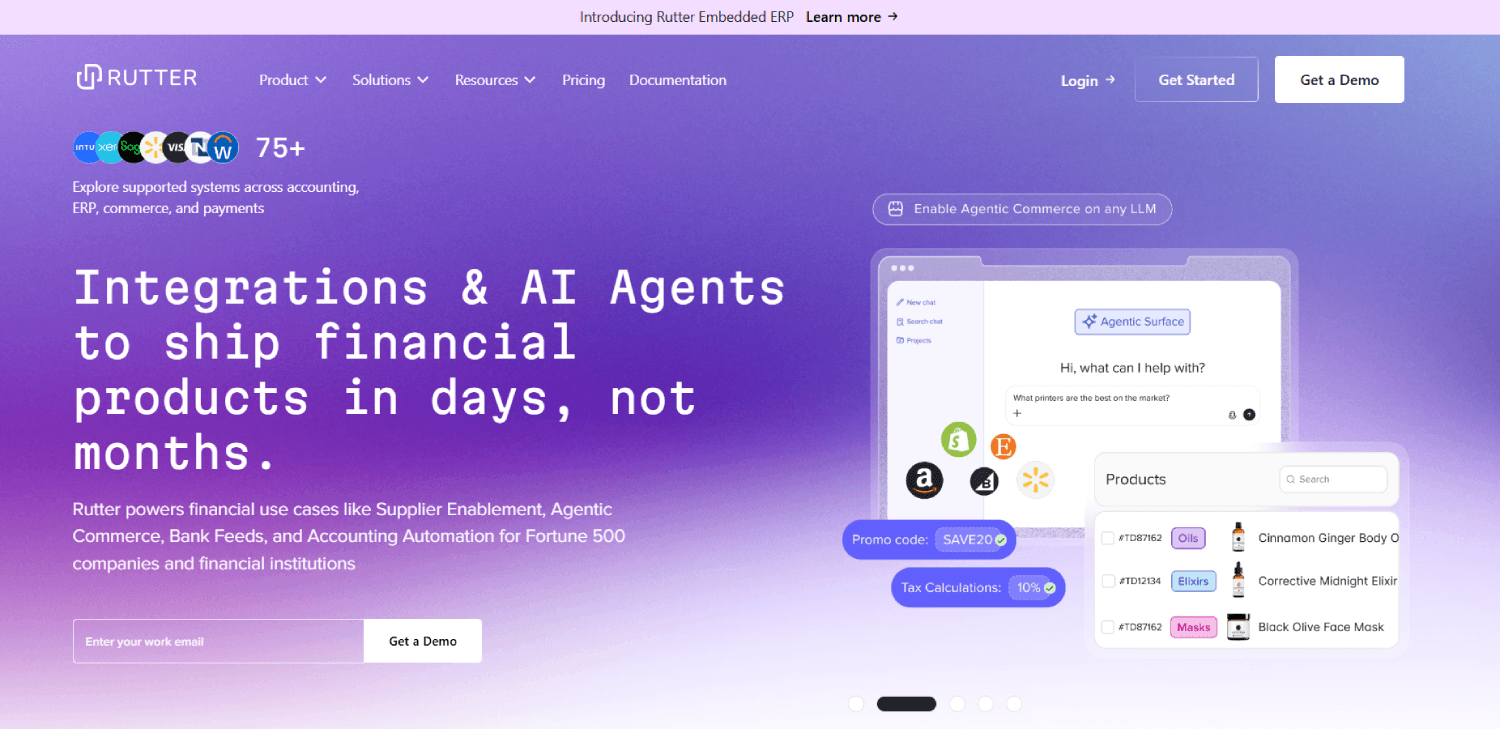
Rutter started in e-commerce data and has expanded aggressively into accounting and ERP integrations. Its NetSuite support is notably stronger than most alternatives, with read and write capabilities across invoices, bills, journal entries, and vendor records. For SaaS companies with enterprise customers on NetSuite, that distinction matters.
According to Rutter’s documentation, the platform supports reading and writing data to all major accounting platforms through a single unified API, with the goal of shipping new integrations in hours rather than months. That claim holds up better for reading than writing, but Rutter’s write support across the major platforms is more consistent than Merge’s at this stage.
Rutter’s developer experience is strong. The sandbox environment uses real OAuth flows, and the API documentation covers edge cases like partial syncs and conflict resolution more thoroughly than most competitors. Pricing is not public; it is volume-based and negotiated. Rutter fits best for platforms where customers include a meaningful percentage of mid-market companies on NetSuite or Sage Intacct.
3. Merge: Best for Product Teams Managing Multiple Integration Categories
Merge is a unified API platform that covers HR, ATS, CRM, ticketing, and accounting under one roof. If your team is already using Merge for HRIS integrations and wants to add accounting without bringing in a second vendor, the case for staying on Merge is straightforward: one SDK, one contract, one integration monitoring dashboard.
Merge’s accounting coverage includes QuickBooks Online, Xero, FreshBooks, and others, with read and write support for core objects like accounts, contacts, invoices, and journal entries. NetSuite write support is limited compared to Rutter. The normalized Accounting data model is clean and well-documented, and Merge’s Supplemental Data feature lets you pull platform-specific fields that fall outside the unified schema, which solves a common pain point with unified APIs.
Merge publishes tiered pricing on its website. As of its public pricing page, the free tier supports up to 3 linked accounts, which is useful for development and testing but not production. Paid plans are available, though enterprise pricing for high-volume accounting integrations requires a direct conversation. Merge is the right call for multi-category integration needs, but teams whose primary use case is accounting-only will find Codat or Rutter more purpose-built.
4. Apideck: Best Low-Cost Unified Accounting API for Early-Stage Teams
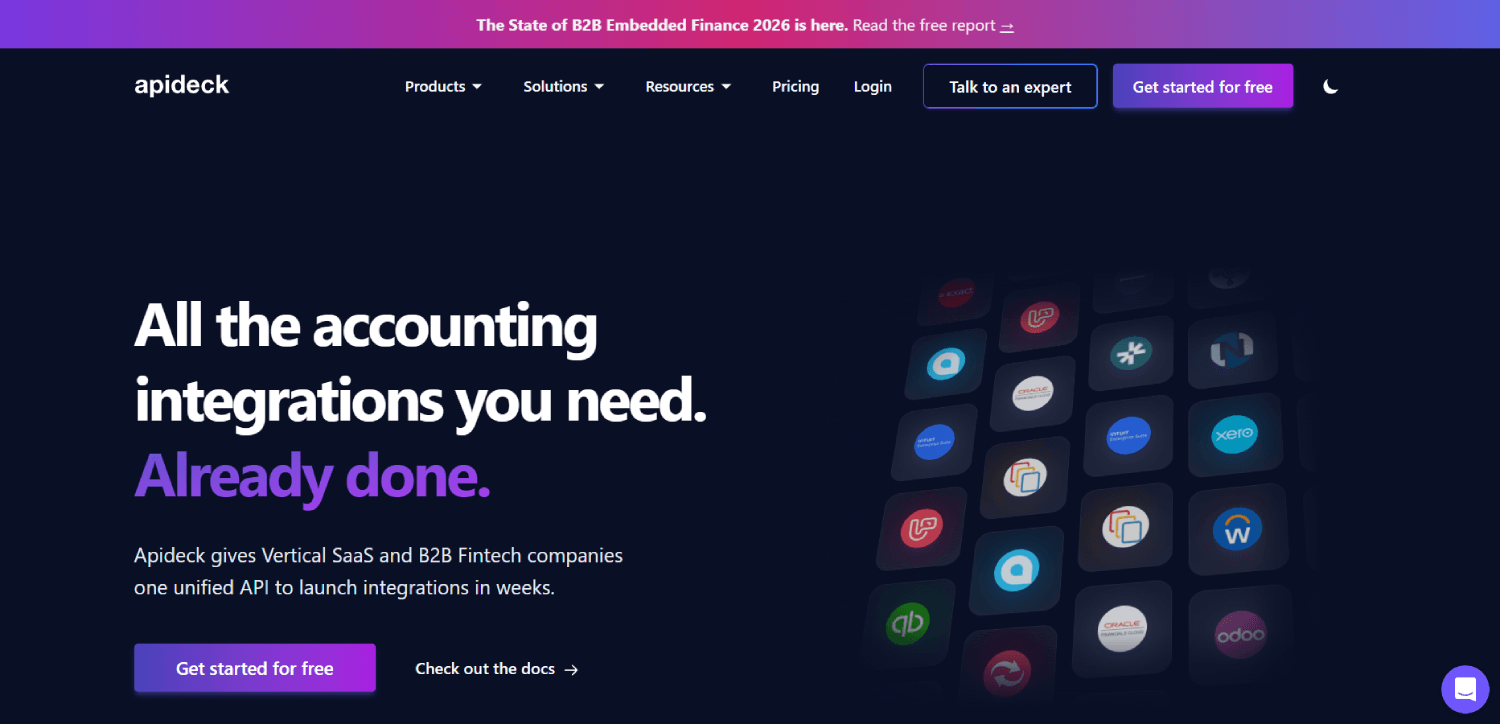
Apideck offers a unified API for accounting, CRM, file storage, and other categories with a developer-friendly free tier and transparent pricing at lower volumes. Its accounting connector supports QuickBooks Online, Xero, FreshBooks, and several others, with read and write operations for standard objects.
Where Apideck wins is accessibility. The developer documentation is clear, the sandbox is available without a sales call, and the pricing model makes it possible for a seed-stage company to ship a QuickBooks integration without a five-figure contract. NetSuite support exists but is more limited than Rutter or Codat in write depth.
For teams that need to validate market demand for an accounting integration before committing to a larger vendor, Apideck is a reasonable starting point. The risk is that you may outgrow its coverage or observability tooling and face a migration later. That migration cost is real, so factor it in if your target customer base skews toward mid-market.
5. Nango: Best Accounting API for Teams That Want Infrastructure Control
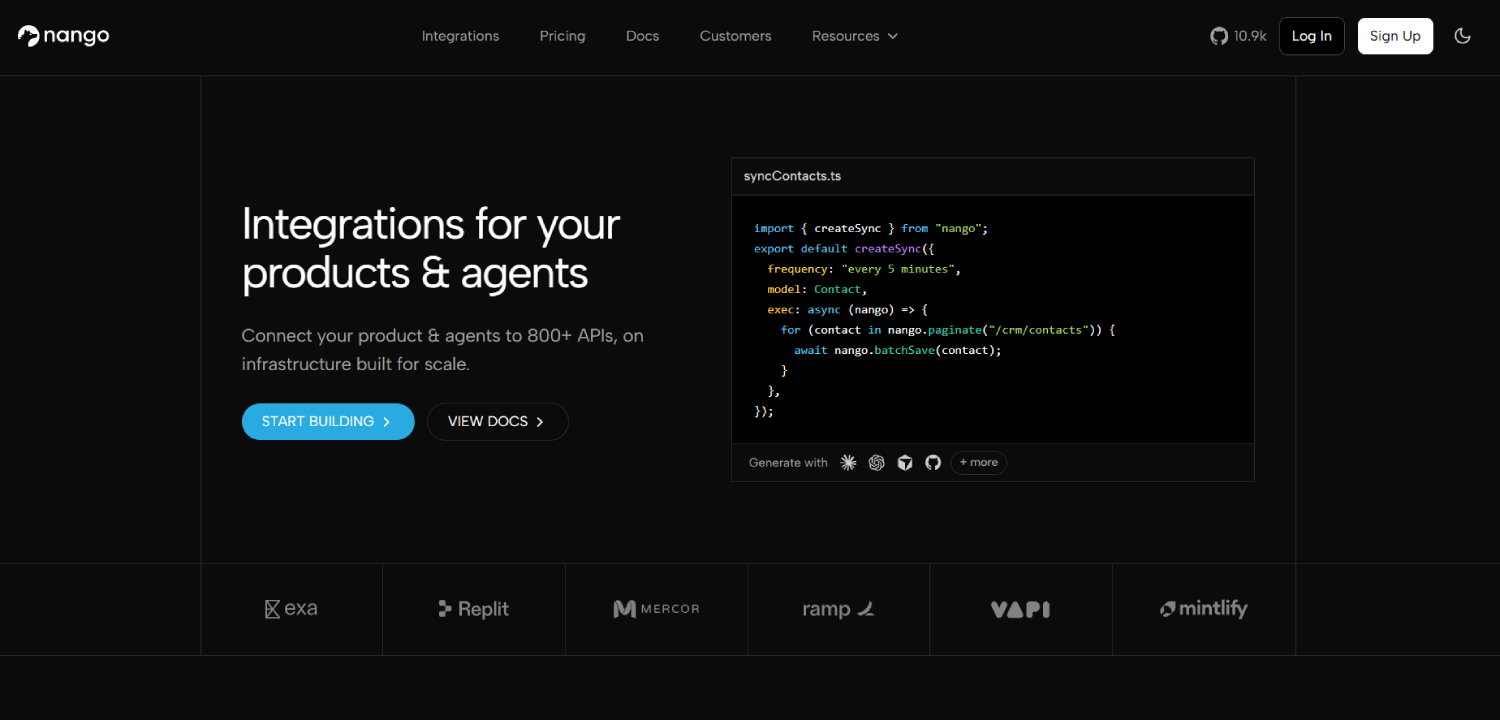
Nango is an open-source integration platform that handles OAuth, token management, and sync infrastructure, with pre-built connectors for QuickBooks, Xero, and other accounting platforms. The key differentiator is that Nango is self-hostable, which matters for teams with strict data residency requirements or compliance constraints that prevent customer financial data from passing through a third-party SaaS layer.
The trade-off is that Nango requires more engineering investment than a fully managed solution. You own the sync logic, the normalization schema, and the failure handling. The platform gives you the auth infrastructure and a library of connector templates, but it is not a drop-in unified API in the same way Codat or Merge are.
Nango’s cloud-hosted option reduces that burden, and pricing is available on its website with a free tier for development. For engineering teams comfortable with infrastructure ownership, Nango offers meaningful cost advantages at scale.
6. Chift: Best Accounting API for European SaaS Companies
Chift is a unified API provider based in Europe with coverage across accounting platforms popular in the EU and UK, including Exact, Teamleader, and Yuki, alongside QuickBooks and Xero. For North American SaaS companies, Chift is rarely the right choice. For European SaaS companies selling to SMBs on EU-specific accounting software, it fills a gap that Codat, Rutter, and Merge do not address well.
Chift’s data model is normalized across its supported platforms, and the API is designed for read and write operations on standard accounting objects. NetSuite support is limited. Pricing is not publicly detailed at the enterprise level.
7. SoftLedger: A Different Model Entirely , Embedded Accounting, Not a Connector
SoftLedger is worth naming because it appears in searches for accounting integration APIs, but it is solving a different problem. SoftLedger is a cloud accounting platform with its own API, designed for companies that want to embed accounting functionality or build on top of a general ledger rather than sync data to an existing customer ledger.
If your product needs to run accounting for your customers rather than read or write to the accounting system they already use, SoftLedger and similar embedded ledger tools are the relevant category. That is a fundamentally different architecture from a unified connector API. For a direct comparison of embedded ledger options, see double-entry ledger tools for fintech startups.
How to Pull Customer Accounting Data for Underwriting
Lenders and revenue-based financing platforms typically need three data sets from a borrower’s accounting system: a profit and loss statement for the trailing 12 months, a balance sheet as of the most recent period close, and a receivables aging report. Getting those through a unified accounting API requires the provider to support financial statement objects natively, not just transaction records.
Codat’s Lending API returns these as structured, normalized objects. Rutter returns financial statements as well, though the normalization depth varies by platform. Merge requires more assembly work on the client side for statement-level data.
One pattern that works well for underwriting teams is to combine accounting API data with bank transaction data for cross-validation. Accounting data tells you what the books say; bank data tells you what cash actually moved. The combination reduces fraud risk and improves model accuracy significantly. For the bank transaction layer, see the comparison of open banking APIs including Plaid, MX, and Finicity. Also relevant for teams building credit products: the top embedded credit APIs for B2B platforms.
Which Accounting API Supports NetSuite Read and Write?
Rutter has the strongest publicly documented NetSuite read and write support among the unified API providers. Codat also supports NetSuite bidirectionally, with coverage for invoices, bills, accounts, and journal entries. Merge’s NetSuite write support is more limited, particularly for journal entries and custom record types.
Apideck and Nango list NetSuite as a supported integration, but the depth of write operations is shallower than Rutter or Codat based on their public documentation. If NetSuite write is a hard requirement for your product, test it explicitly in the sandbox before signing a contract. NetSuite’s SuiteQL and REST API have quirks that surface differently across unified API implementations, and the gap between “we support NetSuite” and “we support the specific NetSuite objects you need with write parity” is significant.
Frequently Asked Questions
What is a unified accounting API?
A unified accounting API is a middleware layer that normalizes data from multiple accounting platforms, such as QuickBooks, Xero, and NetSuite, into a single consistent schema. Instead of building and maintaining separate native integrations for each platform, a product team integrates once with the unified API and gets access to all supported platforms through that single connection. The provider handles OAuth management, token refresh, schema translation, and sync reliability.
How does Codat compare to Rutter for accounting integrations?
Codat is stronger for financial services use cases, particularly lending and underwriting, where normalized financial statements and enhanced financial data are required. Rutter is stronger for ERP coverage, especially NetSuite write operations, and for platforms serving commerce companies. Both support QuickBooks and Xero with read and write. The choice depends on your customer base’s accounting platform distribution and whether you need financial statement objects or transactional data objects as the primary output.
Can I use a unified accounting API for fintech underwriting?
Yes, but only if the provider returns financial statement objects, not just transaction records. Codat’s Lending API is purpose-built for this and returns normalized profit and loss statements, balance sheets, and cash flow statements. Rutter also supports financial statement retrieval. For underwriting workflows, you typically want to pair accounting API data with bank transaction data for cross-validation, since the two data sources check each other for consistency and reduce fraud exposure.
Does QuickBooks Online have an open API?
Yes. Intuit’s QuickBooks Online Accounting API is publicly available through the Intuit Developer platform. It supports OAuth 2.0 authentication and exposes endpoints for customers, invoices, bills, accounts, payments, and other objects. Building directly against the Intuit API is viable for a QuickBooks-only integration, but managing token refresh, rate limits, and API version changes across a multi-tenant SaaS product adds significant ongoing maintenance.
What is the cheapest unified accounting API for a startup?
Apideck and Nango offer the most accessible pricing at early stages. Apideck publishes tiered pricing with a free development tier on its website. Nango has a free tier for self-hosted use and cloud pricing available on its website. Merge also offers a free tier limited to a small number of linked accounts. Codat and Rutter both require volume-based contracts with pricing discussed through sales, making them less practical for pre-revenue or seed-stage products.
Should I build or buy accounting integrations for my SaaS?
Buy if you need to support more than two accounting platforms, or if your customers include mid-market companies on NetSuite or Sage Intacct. Build if your integration surface is a single platform and your team has deep familiarity with that platform’s API. The hidden cost of building is not the initial engineering sprint; it is the ongoing maintenance across API version changes, OAuth edge cases, and new customer platforms. That maintenance typically consumes more engineering time than teams estimate before they start.
Which accounting API is best for reading journal entries from NetSuite?
Rutter has the strongest publicly documented support for reading journal entries from NetSuite, followed by Codat. Both normalize NetSuite’s journal entry object into a standard schema that matches what they return from QuickBooks and Xero. For write operations on NetSuite journal entries, Rutter is the more consistent option based on current documentation. Always validate in a sandbox environment, since NetSuite’s API surface is complex and coverage can vary by record type and account configuration.
The Real Decision: Coverage Depth Is the Moat, Not the Connection Count
Every unified accounting API vendor leads with the number of integrations they support. That number is largely a distraction. A provider that lists 30 accounting platforms but returns only invoices and contacts from half of them is less useful than a provider that supports eight platforms with full financial statement coverage and reliable write operations.
The right frame is this: identify the two or three accounting platforms your customers actually use, then verify in the sandbox that the API returns the specific objects your product needs with the read or write access pattern you require. Do not evaluate based on integration counts or marketing pages. Evaluate based on the object coverage table in the API documentation and the behavior of the sandbox when you try to write a journal entry or pull a balance sheet.
Teams that pick a unified accounting API based on name recognition or price alone tend to discover the coverage gaps six months into production, when a high-value customer on NetSuite cannot complete onboarding because the journal entry write endpoint is not implemented. That gap is recoverable, but it costs sprint time and customer trust simultaneously. The FintechSpecs Accounting API Stress Test exists precisely to surface those gaps before they become production incidents, run it on every vendor on your shortlist, not just the one you expect to win. Building a fintech product on solid API infrastructure is the same discipline as any other infrastructure decision, and the cost of a weak foundation compounds. For a broader view of how these decisions fit into a scaling fintech stack, the complete map of the fintech infrastructure stack is worth reviewing before you finalize your vendor shortlist.