
- Most early-stage fintech teams treat their ledger as a database table. That works until an auditor, a bank partner, or a reconciliation failure proves it does not.
- A proper double-entry ledger is not an accounting afterthought. It is the source of truth for every balance, every regulatory report, and every dispute resolution.
- Purpose-built fintech ledger tools like Formance, Modern Treasury, and Tigerbeetle enforce immutability and double-entry constraints at the infrastructure level, not the application layer.
- Building your own ledger is almost always more expensive than founders estimate, and migrating away from a homegrown system after Series A is one of the most disruptive engineering projects a fintech team can face.
- The right tool depends on whether you need a standalone ledger API, a full money-movement orchestration layer, or an open-source core you can self-host and extend.
The five strongest fintech ledger tools for startups right now are Formance Ledger, Modern Treasury, TigerBeetle, Ledger (by Stripe), and SoftLedger. Each targets a different use case: Formance for developer-first open-source flexibility, Modern Treasury for payment operations with reconciliation built in, TigerBeetle for raw transactional throughput, Stripe Ledger for teams already inside the Stripe stack, and SoftLedger for multi-entity accounting with an API layer. Which one fits depends on your transaction volume, your regulatory obligations, and how much ledger logic your engineering team wants to own.
Why Fintech Startups Get the Ledger Decision Wrong
The standard engineering instinct is to create a transactions table in Postgres, write balance queries against it, and call it a ledger. This works for demos. It breaks when your bank sponsor asks for an audit trail, when you need to reverse a transaction without deleting a row, or when your monthly close takes a full weekend because no one can explain why the sum of credits does not match the sum of debits.
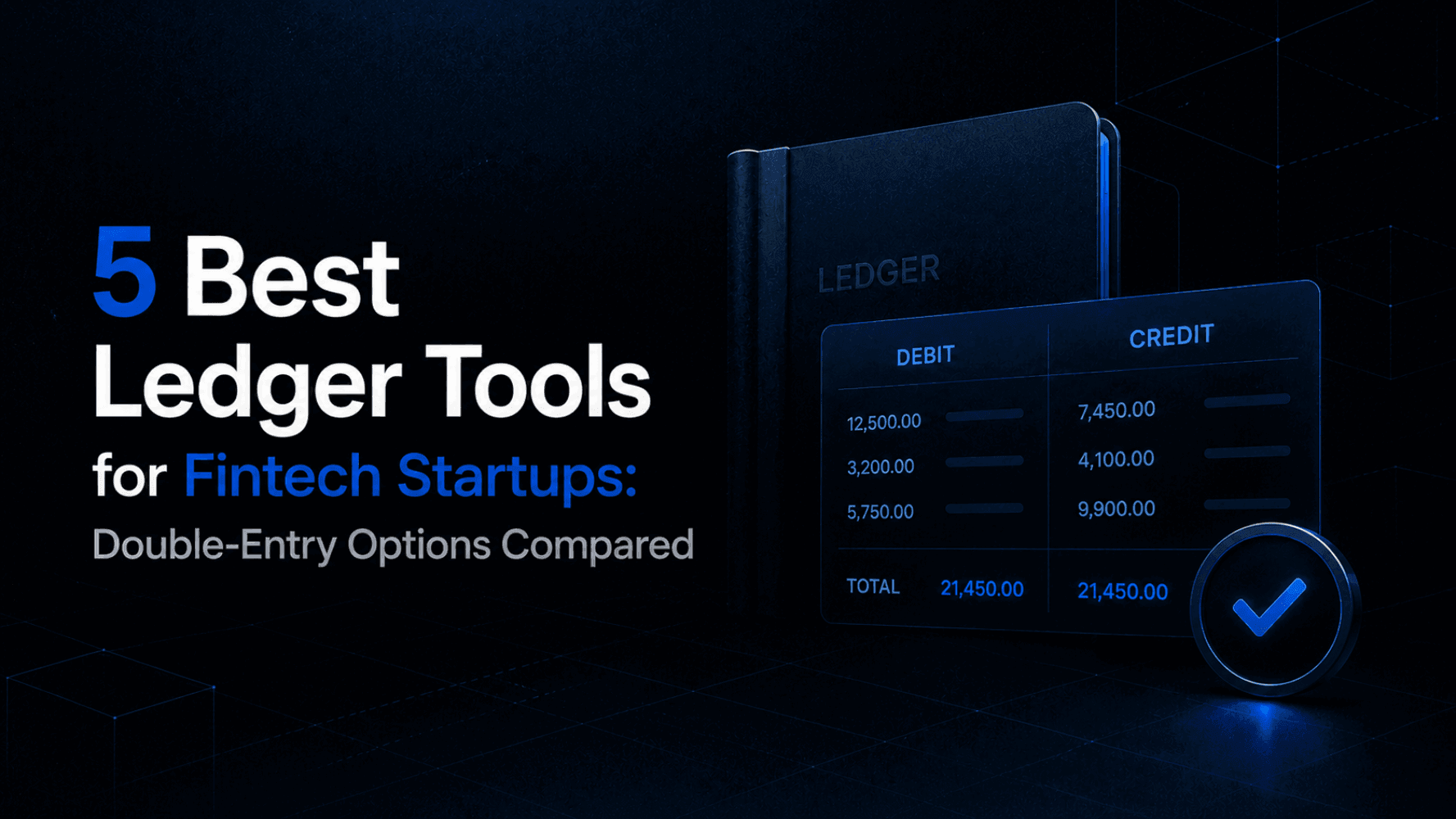
A proper double-entry ledger records every financial event as two equal and opposite entries: a debit to one account and a credit to another. The sum of all debits always equals the sum of all credits. This is not a bookkeeping convention from the 1400s that modern software has outgrown. It is the mechanical guarantee that money does not appear from nowhere or disappear into nothing, which is exactly what regulators and bank partners need to verify.
The deeper problem is timing. Most founders decide to fix their ledger after something breaks. By then, the data model is embedded across multiple services, the engineering team has built reconciliation logic on top of the original transactions table, and the migration requires either a full rewrite or a painful dual-write period. Common fintech infrastructure mistakes almost always include this one: treating the ledger as a detail rather than a foundation.
What Does a Double-Entry Ledger API Actually Do?
A double-entry ledger API exposes endpoints for posting transactions, querying account balances, and retrieving an immutable audit log, while enforcing the accounting constraint that debits equal credits on every write. The immutability part matters as much as the double-entry part. You cannot delete or update a posted transaction. Corrections happen through reversals, which themselves create new entries. Every state the system ever occupied remains queryable.
Beyond the math, a production ledger API typically handles three things your transactions table does not. First, it manages account hierarchies: user wallets roll up to pooled accounts, which roll up to a custodial balance at your sponsor bank. Second, it enforces idempotency, so a network retry never posts a transaction twice. Third, it provides multi-currency support with explicit exchange rate snapshots at the time of transaction, rather than recalculating at query time.
According to Modern Treasury’s developer documentation, a ledger API gives fintech companies a way to track internal balances that are separate from the movement of real money through bank rails. That separation is what makes reconciliation tractable: you know what your system believes, and you can compare it line by line against what your bank reports.
The FintechSpecs Ledger Infrastructure Stress Test
Before comparing specific tools, it helps to have a consistent framework for evaluating them. The criteria that matter most are not the ones in vendor marketing. Here is the framework FintechSpecs applies when assessing any ledger infrastructure choice for a startup context.
The Five Checks
- Immutability guarantee: Can a posted entry be modified or deleted at the database level, or does the system enforce append-only behavior architecturally? Soft enforcement through application logic is not sufficient.
- Double-entry enforcement: Does the system reject any transaction where debits do not equal credits, at the API level, before the write commits? Or is balance integrity maintained only by convention?
- Audit trail completeness: Is every state transition, including failed attempts and reversals, timestamped and queryable? Can you reconstruct the balance of any account at any point in time?
- Migration path: If you outgrow or need to replace this tool, what does data portability look like? Proprietary schemas with no export path are a future liability.
- Reconciliation surface: Does the tool provide a native way to match internal ledger entries against external bank statements or payment processor reports, or do you have to build that yourself?
Run any ledger tool through all five checks before signing a contract or merging a pull request. A tool that fails checks one or two is not a ledger. It is a transaction log with extra branding.
Build vs. Buy: What the Real Cost Looks Like
The build argument is always the same: “We have specific requirements, a Postgres table is free, and we can wire it up in a sprint.” The buy argument is less obvious until you price it out.
Consider a Series A fintech processing $2 million per month across 15,000 transactions. Building a compliant double-entry ledger from scratch requires at minimum: a schema design reviewed by an accountant familiar with fintech, idempotency keys wired through every payment path, a reversal mechanism that creates offsetting entries rather than deletes, balance lock logic to prevent race conditions on concurrent debits, and an audit export that satisfies a SOC 2 auditor. That is realistically four to six weeks of a senior engineer’s time, plus ongoing maintenance every time your payment rail or bank partner changes something.
Hosted ledger tools vary in pricing depending on transaction volume and feature tier, and most vendors in this category do not publish full pricing publicly. What is consistent across vendor conversations and publicly available information is that for most seed-to-Series B companies, the cost of a hosted solution is almost always lower than one week of a senior engineer’s time, before counting the opportunity cost of not shipping product features. The math shifts at very high transaction volumes or if you have unusual data residency requirements, but for the majority of early-stage teams, buy wins. This is one of the hidden costs that compress fintech SaaS margins in ways that do not show up on a pitch deck.
The migration risk is the part founders underestimate most. If your homegrown ledger has been running for 18 months, your balance calculations are scattered across application code, background jobs, and ad hoc queries. Migrating to a purpose-built system means reconciling your historical data into a new schema, running dual systems in parallel long enough to validate, and then cutting over without losing a transaction. That process routinely takes three to five months for teams that have never done it before. The financial and compliance consequences of getting it wrong mid-migration are significant enough that most teams wish they had made the right call earlier.
The 5 Best Fintech Ledger Tools Compared
| Tool | Type | Double-Entry Enforced | Immutable Audit Log | Self-Hosted Option | Best For |
|---|---|---|---|---|---|
| Formance Ledger | Open source / Cloud | Yes | Yes | Yes | Developer-first startups wanting full control |
| Modern Treasury | SaaS API | Yes | Yes | No | Teams needing payment ops plus reconciliation |
| TigerBeetle | Open source DB | Yes | Yes | Yes only | High-throughput transaction processing |
| Stripe Ledger | Native Stripe feature | Yes | Yes | No | Companies already using Stripe as primary rail |
| SoftLedger | SaaS + API | Yes | Yes | No | Multi-entity operators and fund managers |
1. Formance Ledger
Formance is an open-source programmable financial core ledger, described in its own GitHub repository as “a foundation for all kinds of money-moving applications.” The key architectural choice is that Formance uses a scripting language called Numscript to define transaction logic, which means your debit/credit rules are version-controlled and auditable code rather than buried application logic.
Formance enforces double-entry at the write level. Every Numscript transaction either commits with balanced entries or rejects entirely. The ledger is append-only by design. You can self-host on your own infrastructure, use Formance Cloud, or use the open-source version as the foundation for a proprietary build.
The trade-off is the learning curve. Numscript is not a standard language, and your team will spend time understanding it before they are productive. For a startup with a strong engineering team and specific compliance or data residency requirements, that investment pays off. For a team that wants to ship quickly and not own ledger infrastructure, the hosted SaaS options below are faster.
Formance Cloud pricing is not fully disclosed on their public site, but enterprise pricing is available on request. The self-hosted open-source version is free, with the usual infrastructure and maintenance costs that come with running your own systems.
2. Modern Treasury
Modern Treasury combines a payment operations API with a built-in double-entry ledger. The product is specifically designed for companies that move money through ACH, wire, and RTP rails and need to track internal balances alongside real bank movements. Their public documentation on ledger APIs is one of the clearest explanations of what ledger infrastructure actually does in practice.
The reconciliation layer is Modern Treasury’s strongest differentiator. Because the ledger knows about both your internal accounts and your external bank transactions, it can match them automatically and surface exceptions for manual review. For a company that processes payouts at scale, that capability alone can eliminate a significant amount of manual ops work.
Modern Treasury’s pricing is not fully public. The product is oriented toward mid-market and growth-stage fintechs, and pricing is available on request. If you are processing under $500,000 per month, the cost may not be justified yet. If you are approaching $5 million per month or managing complex multi-party payment flows, it is worth a serious evaluation. It fits naturally alongside other payment infrastructure tools for SaaS founders evaluating their full money-movement stack.
3. TigerBeetle
TigerBeetle is a purpose-built financial transactions database, not a SaaS product or an API service. It is an open-source database engine designed specifically for double-entry accounting at very high throughput, with safety properties built into the storage engine rather than enforced at the application layer.
TigerBeetle enforces that every transfer between two accounts is atomic and double-entry. It is written in Zig and built to sustain high transaction throughput on commodity hardware. According to TigerBeetle’s own published benchmarks, the exact numbers vary by hardware configuration and workload, so teams evaluating it for performance-critical use cases should run their own benchmarks against their expected transaction profile. The immutability guarantee is architectural: the storage format does not support in-place updates.
The constraint is that TigerBeetle is a database, not a full ledger service. You get the transactional core, and you build the API, the account management, the reporting layer, and the reconciliation tooling on top. This is the right choice for a team that genuinely needs the performance characteristics and wants to own the full stack. It is the wrong choice for a team that wants to ship a ledger in two weeks. TigerBeetle is self-hosted only, with no managed cloud option as of their current public roadmap.
4. Stripe Ledger
Stripe’s internal ledger system for tracking and validating money movement is documented publicly. Stripe has described their ledger as the source of truth for all balance and transaction state across their platform, providing immutable records of every event that affects money.
For companies building on Stripe, the practical question is how much of that infrastructure is exposed through the API for external use versus how much is internal to Stripe’s own systems. Stripe’s Connect platform exposes balance and transaction data through their API, and their Treasury product adds bank account and money movement features on top. Whether that constitutes a full double-entry ledger tool you can rely on as your core infrastructure depends heavily on how deeply embedded in the Stripe stack your product is.
If Stripe is your primary payment rail and you are not moving money outside their platform, using Stripe’s balance and transaction APIs as your ledger layer is reasonable for early-stage companies. If you move money across multiple rails, bank partners, or processors, you will quickly hit the limits of what Stripe’s platform can model for you.
5. SoftLedger
SoftLedger is a modern accounting platform built for complex financial operations, with a real-time API layer on top. It is designed for multi-entity structures: fund managers, crypto companies, holding companies, and fintech operators who need to consolidate financials across multiple legal entities in real time.
SoftLedger enforces double-entry accounting and provides a complete audit trail. Its API allows external systems to post transactions directly, which is what makes it relevant for fintech builders rather than just accountants. The product sits in an interesting middle space: more structured than a raw ledger API, less heavy than a full ERP like NetSuite, and genuinely API-first in a way that older accounting software is not.
SoftLedger is best suited for companies with real accounting complexity rather than pure transaction processing needs. If you are running a lending platform with multiple funding entities, a crypto fund with cross-entity intercompany transactions, or a neobank with multiple legal structures, SoftLedger’s consolidation layer has real value. For a single-entity payments startup, it may be more than you need.
What Does a Working Double-Entry Ledger Look Like in Practice?
Say a company operates a B2B payments platform. A buyer sends $10,000 to pay an invoice. The platform holds the funds for 48 hours before releasing to the supplier. In a proper double-entry ledger, this involves at minimum four account types: the buyer’s liability account on the platform, the platform’s pooled settlement account, the supplier’s receivable account, and the platform’s fee revenue account.
When the buyer pays, the system debits the buyer’s account and credits the pooled settlement account. When the platform takes its fee, it debits the pooled settlement account and credits fee revenue. When the supplier is paid out, it debits the pooled settlement account and credits the supplier’s account. At every step, debits equal credits. At every step, a full reversal is possible without touching existing entries.
Now run the same scenario through a transactions table with a balance column. The balance column gets updated on each event. If any step fails mid-sequence, you have a balance that reflects a partial state. If you need to audit the full history of that payment, you have rows with no causal relationship to each other. If a bank partner asks for a reconciliation report, you have to reconstruct it from application logs.
This is not a theoretical risk. It surfaces in due diligence, in SOC 2 audits, and in the conversations banks have before extending a sponsor bank relationship. The fintech compliance readiness checklist most auditors use includes questions about ledger immutability and audit trail completeness that a transactions table simply cannot answer.
How Do You Choose Between These Tools for Your Stage?
Stage and use case determine the right choice more than any feature comparison.
Pre-seed and seed companies moving under $500,000 per month with a single bank partner and no external audit requirement can start with Formance self-hosted or Stripe’s native infrastructure if they are Stripe-native. The priority at this stage is not having the perfect ledger. It is not building something you will have to rip out in 18 months.
Series A companies approaching $2 to $5 million per month, preparing for a SOC 2, or onboarding a bank sponsor should evaluate Modern Treasury or Formance Cloud. This is the stage where the build-vs-buy math most clearly favors buying. Engineering bandwidth is constrained, compliance requirements are becoming concrete, and the cost of a bad ledger is starting to show up in ops work.
High-throughput platforms processing tens of millions of transactions monthly, where performance is a genuine constraint, should look at TigerBeetle as the foundation for a custom ledger layer. This path requires significant engineering investment and is only appropriate if your transaction volume genuinely strains what a hosted SaaS solution can handle.
Multi-entity operators and companies with complex consolidation requirements should evaluate SoftLedger. The accounting API layer and real-time consolidation capabilities are hard to replicate with a pure transaction ledger tool.
| Company Stage | Monthly Volume | Recommended Starting Point | When to Revisit |
|---|---|---|---|
| Pre-seed / Seed | Under $500K | Formance (self-hosted) or Stripe native | At first bank partner onboarding |
| Series A | $500K to $5M | Modern Treasury or Formance Cloud | Before SOC 2 audit begins |
| Series B+ | $5M to $50M+ | Modern Treasury or TigerBeetle | If reconciliation ops exceeds 20 hours/month |
| Multi-entity operator | Any | SoftLedger | At first intercompany transaction |
What Are the Real Migration Risks If You Wait?
The migration problem is not just technical. It is operational and regulatory at the same time.
On the technical side, migrating from a homegrown transactions table to a proper double-entry ledger requires reconstructing the history of every account from your existing data. If your historical data was not stored with explicit debit/credit semantics, you may not be able to reconstruct it perfectly. Any gap in historical balance accuracy affects your ability to produce a clean audit trail for the periods before migration.
On the operational side, running two systems in parallel during the transition period means your ops team is reconciling against two sources of truth simultaneously. Every exception requires investigation in both systems. This is not a two-week project for most teams. It is a quarter-long effort that competes directly with product development.
On the regulatory side, if your bank sponsor or a regulator asks for historical transaction records during the migration window, you need to be able to produce them from either system. Gaps in the audit trail during a transition are exactly the kind of finding that delays licensing or causes a bank partner to increase oversight. The compliance mistakes that damage fintech startups most often involve exactly this kind of infrastructure debt surfacing at the worst possible moment.
Frequently Asked Questions About Fintech Ledger Tools
What is a ledger in fintech?
A ledger in fintech is the system of record for all financial balances and transactions within a platform. A proper financial ledger uses double-entry accounting, meaning every transaction is recorded as both a debit and a credit, so the sum of all entries always balances. It differs from a simple transaction log because it maintains account balances, enforces immutability, and provides a complete audit trail that regulators and bank partners can verify. In regulated money movement, the ledger is the foundation everything else is built on top of.
What is a double-entry ledger API?
A double-entry ledger API is an interface that allows software systems to post financial transactions, query account balances, and retrieve audit logs while enforcing that every posted transaction has equal debits and credits. The API-level enforcement is what distinguishes these tools from application-level conventions. If a transaction would violate the double-entry constraint, the API rejects it before the write commits. Tools like Formance, Modern Treasury, and TigerBeetle enforce this at the infrastructure layer. This guarantee is what makes ledger data reliable enough for regulatory reporting and third-party audits.
Is ledger infrastructure worth building internally?
For most fintech startups below Series B, building a production-grade double-entry ledger internally costs more than buying one. The engineering work required to get immutability, idempotency, reversal semantics, and audit completeness right is non-trivial, and the maintenance burden grows as your payment rails and bank partnerships change. The exception is a company with extremely high transaction volumes where the performance characteristics of purpose-built tools like TigerBeetle justify the investment, or where unusual data residency requirements make hosted options impractical.
What is the difference between a ledger and a payment processor?
A payment processor moves money between bank accounts through rails like ACH, wire, or card networks. A ledger tracks the state of balances and transactions within your own system. They serve different functions and most fintech companies need both. Your payment processor tells you that $10,000 moved from account A to account B. Your ledger tells you what that means for your internal accounts, how it changed every balance involved, and whether the books balance. Modern Treasury is one of the few tools that combines both layers, which is why it costs more than a standalone ledger API.
How does ledger infrastructure relate to SOC 2 compliance?
SOC 2 audits for fintech companies frequently include controls around data integrity, audit trails, and the accuracy of financial records. A proper double-entry ledger with an immutable log directly satisfies several of those controls. A homegrown transactions table with mutable balance columns and no reversal semantics creates audit findings. The specific controls vary by auditor and SOC 2 type, but companies preparing for their first SOC 2 should treat ledger infrastructure as a compliance dependency, not just an engineering concern. Audit prep is much smoother when your ledger can produce a complete, immutable history on demand.
Can Stripe replace a dedicated fintech ledger tool?
For companies that process all payments through Stripe and do not move money outside the Stripe platform, Stripe’s native balance and transaction data can serve as a basic ledger layer at early stages. The limitation appears when you add a second payment rail, a bank partner, or multi-currency operations. Stripe’s data model is designed around Stripe’s products, not around your internal account structure. Teams that grow beyond Stripe-native operations typically find they need a separate ledger to maintain a unified view of balances across all their money movement, regardless of which processor handled the transaction.
What should fintech founders look for in ledger API documentation?
The most important signals in ledger API documentation are explicit statements about immutability (can posted entries be modified or deleted), double-entry enforcement (does the API reject unbalanced transactions before writing), and idempotency key support (does the system prevent duplicate posts from network retries). Secondary signals include the richness of the audit query interface, whether the tool supports account hierarchies and rollups, and the clarity of the migration and data export documentation. Vendor documentation that avoids these specifics usually means the product does not enforce them at the infrastructure level.
The Infrastructure Decision That Compounds
Most fintech infrastructure decisions are reversible with enough engineering effort. The ledger is different. It is the data structure that every downstream system, every compliance report, and every reconciliation process reads from. Changing it after the fact requires touching everything at once, and doing that while the business is live and money is moving is among the most operationally complex things a fintech team can take on.
The tools covered here, Formance, Modern Treasury, TigerBeetle, Stripe Ledger, and SoftLedger, represent meaningfully different architectural choices. Formance gives you control and flexibility at the cost of learning Numscript and owning your own deployment. Modern Treasury gives you payment ops plus reconciliation in one product but at a price point that assumes real transaction volume. TigerBeetle gives you performance and correctness guarantees at the database layer but requires you to build everything on top. SoftLedger gives you accounting-grade completeness for multi-entity structures. Stripe Ledger gives you the simplest path if you are already Stripe-native.
The companies that get this right share one characteristic: they made the decision before they needed to. They picked a ledger tool when the stakes were low enough to migrate freely, validated it against their compliance requirements before the auditor showed up, and built their payment operations on top of a foundation that would not require re-engineering at the worst possible time. Whether you are comparing fintech APIs for your broader infrastructure stack or narrowing down on ledger tooling specifically, the right time to make this decision is before your next funding round, not after your first regulatory review.