
- Most fraud losses do not come from a single bad transaction. They come from patterns that went undetected for days or weeks while a team was focused on approvals.
- Fraud trend monitoring tools sit between your transaction engine and your risk team, surfacing anomalies, velocity changes, and cohort-level signals before they become chargebacks or regulatory flags.
- The tools in this list differ significantly in data sources, alert logic, and dashboard depth. Picking the wrong one means either drowning in noise or missing real exposure.
- For most Series A to Series C fintech teams, the highest-leverage tools combine real-time transaction scoring with historical trend views and configurable alert workflows.
- Point-in-time fraud checks at onboarding or approval are necessary but not sufficient. Ongoing monitoring is where most fintech risk programs have gaps.
The best fraud trend monitoring tools for fintech risk teams include Sardine, Unit21, Sift, Feedzai, SEON, Stripe Radar (with Sigma), DataVisor, Hawk AI, and LexisNexis ThreatMetrix. Each platform differs in how it ingests transaction data, structures alert workflows, and surfaces trend intelligence to risk analysts. The right choice depends on transaction volume, in-house data science capacity, and whether you need pre-built trend dashboards or a configurable rules engine.
Why Fraud Trend Monitoring Is a Different Problem Than Fraud Detection
Fraud detection answers a binary question at a single moment: approve or decline. Fraud trend monitoring answers a different question entirely: is something systematically wrong, and has it been getting worse?
A payment that scores clean at approval can still be part of a coordinated fraud ring testing card bins across your platform. A merchant processing legitimate transactions today may show velocity spikes tomorrow that signal account takeover. Neither of these shows up in a per-transaction approval model unless someone is watching the aggregate.
This is the gap that fraud detection and risk tools alone do not close. Trend monitoring requires a persistent view of behavioral baselines, cohort-level anomalies, and time-series data that most approval engines are not built to maintain.
What Should a Fraud Trend Monitoring Tool Actually Do?
Before comparing platforms, it helps to have a shared standard for what “trend monitoring” means in practice. The FintechSpecs Fraud Signal Stack is a four-layer evaluation framework for assessing whether a platform genuinely supports continuous monitoring or just wraps a detection engine in a dashboard skin.
Layer 1: Data Ingestion. What signals does the platform consume? Transaction data is table stakes. Real trend monitoring also pulls in device telemetry, IP reputation, behavioral biometrics, email/phone consortium signals, and bank-level account history. Platforms that only see your own transaction stream have a blind spot by definition.
Layer 2: Baseline Intelligence. Can the platform establish what “normal” looks like for a given user, merchant, or cohort? Without a behavioral baseline, there is no anomaly. Tools that skip this layer generate alert fatigue because they flag deviations without context.
Layer 3: Alert Workflow. How does a signal become an action? Strong platforms let risk teams define escalation paths: auto-block at one threshold, queue for review at another, notify a Slack channel at a third. The workflow layer is where most mid-market tools fall short. They surface the signal but leave the routing to manual processes.
Layer 4: Trend Dashboard. Can a risk analyst see a week-over-week decline in approval rates by payment method, a spike in BIN-level declines by geography, or a cohort of users with unusual session patterns? The dashboard layer is what separates monitoring tools from detection tools.
Which Fraud Trend Monitoring Tools Are Worth Evaluating?
The nine platforms below cover the full range from developer-first APIs to enterprise risk suites. Each entry covers data sources, dashboard capability, alert workflow design, and the team type it fits best.
1. Sardine
Sardine was built specifically for fintech and crypto platforms, which makes it one of the few tools whose data model is native to high-velocity, high-fraud-risk financial products. Its device and behavior intelligence layer captures over 4,000 features per session, including typing cadence, device orientation, and interaction timing, which feed into trend models that flag when cohort behavior shifts.
The dashboard surfaces trend data at the user, device, and flow level. Risk teams can see how fraud attempt rates are changing by acquisition channel or payment method over a configurable time window. Alert workflows are configurable via a rules editor and support case management natively, so an analyst does not need to jump between tools to investigate a flagged pattern.
Sardine is best suited to early-stage to Series C fintechs that want a consolidated stack rather than stitching together separate KYC, device, and monitoring vendors. Pricing is not publicly disclosed but is typically usage-based.
2. Unit21
Unit21 is primarily a transaction monitoring and case management platform, and its trend capabilities come from its rules engine and reporting layer rather than a native ML scoring model. Risk teams can build custom rules that define cohort-level alert conditions, then visualize how often those rules fire over time in the analytics dashboard.
What makes Unit21 strong for trend monitoring is the case management integration. When an alert fires, the investigation workflow is built in: analyst assignment, evidence collection, SAR filing support. The dashboard can show alert volume by rule type over time, which is a practical proxy for fraud trend visibility. According to Unit21’s public product documentation, the platform supports no-code rule creation, which means risk teams without data engineering support can build and iterate on monitoring logic independently.
Unit21 fits compliance-heavy teams at Series B and beyond who need audit trails and regulatory reporting alongside trend data. It is less suited to teams that want ML-driven anomaly detection without building rules manually.
3. Sift
Sift combines machine learning scoring with a network intelligence layer that draws on signals across its customer base. Its console includes a Workflows tool that lets risk teams define automated response logic based on score thresholds and entity attributes, and a Decisions dashboard that tracks how those workflows are performing over time.
The trend monitoring value in Sift comes from its Global Network score: a signal derived from how a given user, device, or payment method has behaved across other Sift customers. This cross-network visibility is meaningful for detecting coordinated attacks that target multiple platforms simultaneously. The console’s reporting layer lets teams track approval rates, chargeback rates, and false positive rates over rolling time windows.
Sift is a strong fit for e-commerce and marketplace fintechs with significant transaction volume. Pricing is not publicly listed and is negotiated based on volume.
4. Feedzai
Feedzai positions itself as an AI-native financial crime prevention platform and is one of the few vendors in this list that was built at enterprise scale from the start. Its RiskOps platform includes real-time transaction scoring, model management, and a case management layer. The trend monitoring capability comes from its anomaly detection engine, which monitors behavioral patterns at the account, merchant, and network level over time.
Feedzai’s dashboards are configurable and designed for risk operations teams rather than developers. Supervisors can track model performance, alert volumes, and investigation outcomes in a single view. The platform supports both supervised and unsupervised ML models, which means it can detect known fraud patterns and flag unknown behavioral shifts simultaneously. Feedzai is an enterprise-tier product; it is not the right choice for a seed-stage team that needs to be live in a week.
5. SEON
SEON takes a data enrichment-first approach to fraud monitoring. Given an email, phone number, or IP address, SEON queries dozens of open-source and consortium data sources to build a risk profile. Its dashboard shows how those enrichment signals are trending across your transaction population, including what percentage of new users have no social media footprint (a common synthetic identity signal) and how that share is changing week over week.
SEON’s alert workflow is rule-based and configurable via its admin console or API. The platform offers a free tier for low-volume use and a Pro tier with pricing starting at $599 per month according to its public pricing page, which makes it one of the few tools in this list with transparent entry-level pricing. SEON is a strong choice for teams that want enrichment-driven trend data without committing to an enterprise contract, though its ML depth is shallower than Feedzai or Sardine.
6. Stripe Radar with Sigma
Stripe Radar is the default fraud layer for Stripe users, and when combined with Stripe Sigma, it becomes a meaningful trend monitoring environment. Radar scores every transaction using ML models trained on Stripe’s network, and Sigma lets risk teams write SQL queries against their full transaction history to surface trend data.
The practical workflow: a risk analyst writes a Sigma query to pull approval rates, dispute rates, and fraud flag counts by payment method over the past 90 days, then schedules that query to run daily and output to a dashboard. It is not a purpose-built trend monitoring interface, but for teams already on Stripe, it removes the integration step entirely. Radar’s rules editor allows custom rules that can be monitored for firing frequency over time. Sigma pricing starts at $0.02 per query according to Stripe’s public pricing page.
This combination is best for Stripe-native teams at seed to Series A that want trend visibility without a separate vendor contract. It has real limitations: you only see your own data, and the dashboard layer requires manual query work.
7. DataVisor
DataVisor is built around unsupervised machine learning, which makes it particularly strong at detecting fraud rings and coordinated attacks that do not match any existing rule or labeled fraud pattern. Its trend monitoring capability comes from its intelligence graph, which tracks connections between accounts, devices, IPs, and behaviors over time and surfaces when clusters of entities start behaving similarly in ways that suggest coordination.
The dashboard includes a Fraud Intelligence Center that shows trend lines for new fraud clusters, attack types, and affected user cohorts. Risk teams can see when a new attack vector is emerging, not just when individual transactions score poorly. This is genuinely different from most platforms in this list, and it is the primary reason DataVisor belongs in a fraud trend monitoring evaluation even though it is less well-known than Sift or Feedzai.
8. Hawk AI
Hawk AI focuses on anti-money laundering and payment fraud monitoring for banks and fintech platforms. Its Explainable AI layer generates natural-language justifications for every alert, which matters for compliance teams that need to document why a case was opened. The trend dashboard shows alert volume, case outcomes, and false positive rates over configurable time windows.
For fintech teams subject to BSA/AML obligations, Hawk AI covers both fraud and financial crime monitoring in a single platform, which reduces the overhead of maintaining two separate monitoring environments. It is a better fit for regulated entities than for pre-license fintechs. Pricing is not publicly disclosed.
9. LexisNexis ThreatMetrix
LexisNexis ThreatMetrix is the largest consortium-based fraud intelligence network in this list, with device and identity intelligence drawn from billions of transactions globally. Its TrustScore model flags anomalies based on how a given device, email, or identity has behaved across the entire network, not just your platform.
The trend monitoring capability comes from its analytics layer, which shows how TrustScore distributions and attack type classifications are shifting over time across your user base. Risk teams can see if bot-driven account creation attempts are increasing as a share of new user flow, or if a specific device fingerprint cluster is appearing more frequently. LexisNexis ThreatMetrix is built for enterprise-scale deployments and is typically sold as part of a broader LexisNexis Risk Solutions contract. It is not the right entry point for a team under 50 employees.
How Do These Tools Compare Across Key Monitoring Dimensions?
| Tool | Primary Data Source | ML / Rules | Trend Dashboard | Alert Workflow | Best Fit Stage |
|---|---|---|---|---|---|
| Sardine | Device, behavior, consortium | ML + rules | Strong | Native case management | Series A to C fintech |
| Unit21 | Transaction, event streams | Rules-first | Alert trend views | Full case management | Series B+, compliance-heavy |
| Sift | Network + behavioral | ML + rules | Score and decision trends | Workflow builder | E-commerce, marketplace fintech |
| Feedzai | Transaction, behavioral | ML-first | Full RiskOps dashboard | Case management | Enterprise |
| SEON | Email, phone, IP enrichment | Rules + scoring | Enrichment trend views | Rule-based alerts | Seed to Series B |
| Stripe Radar + Sigma | Stripe network | ML + custom rules | SQL-driven, manual | Rules editor | Stripe-native, seed to Series A |
| DataVisor | Graph intelligence | Unsupervised ML | Fraud cluster trends | Investigation workflows | Mid-market, ring fraud use cases |
| Hawk AI | Transaction, AML signals | ML with XAI | Alert and case trends | Explainable alert routing | Regulated banks and fintechs |
| LexisNexis ThreatMetrix | Global device consortium | ML | Network-level trends | Enterprise integration | Enterprise, high-volume platforms |
What Does a Real Fraud Trend Monitoring Dashboard Show?
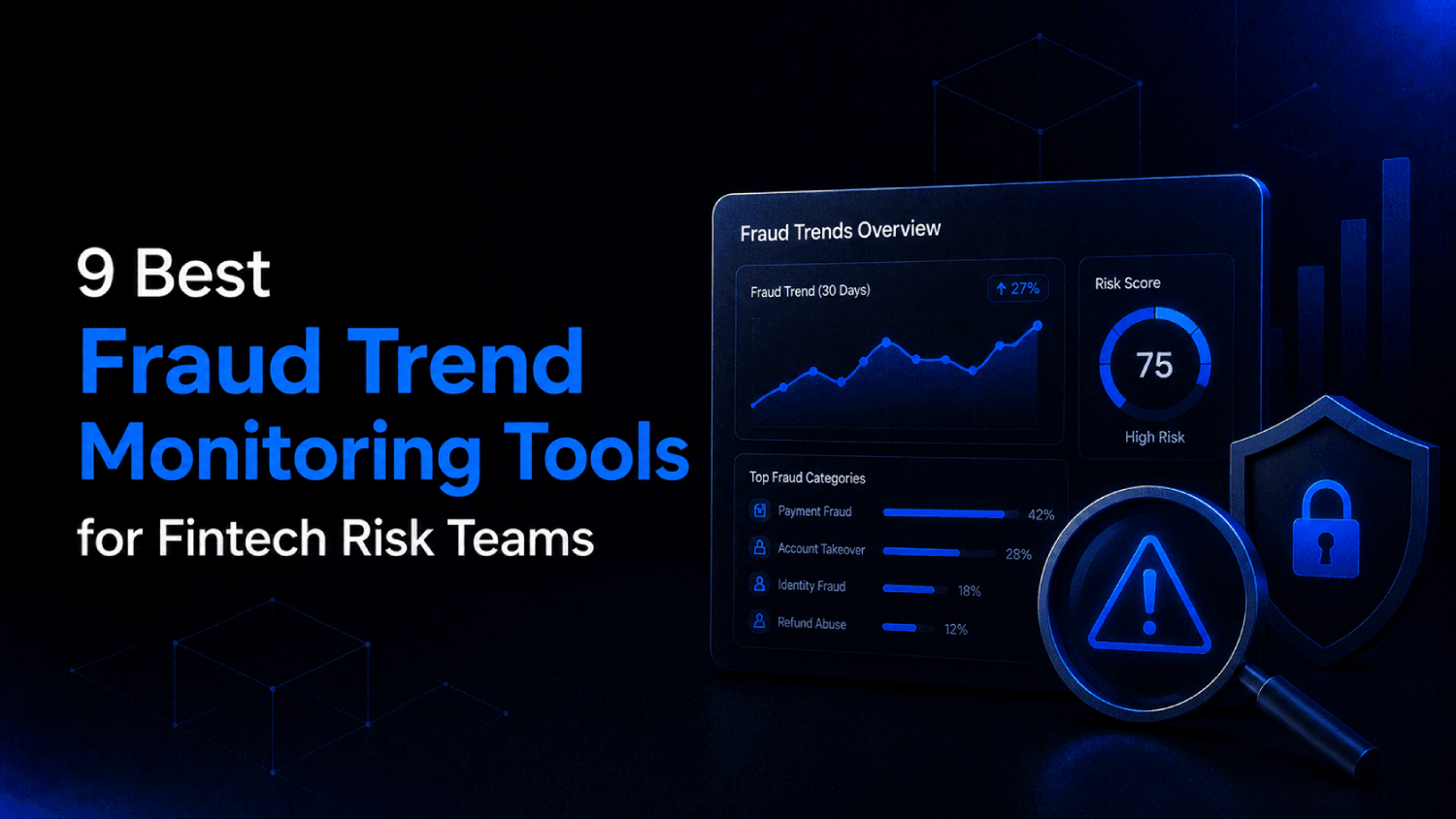
A well-configured fraud trend dashboard answers five questions on a single screen, without requiring a BI query. Say a fintech is processing consumer loan applications. The dashboard should show: new application volume by channel (day over day), ML risk score distribution across that volume, the percentage of applications triggering any rule or model flag, the share of flagged cases that converted to confirmed fraud after review, and how those rates compare to the prior 7 and 30 days.
That last point matters more than most teams realize. A fraud rate of 0.8% sounds acceptable until you see it was 0.3% three weeks ago and the slope is steep. Static snapshots miss that entirely.
Platforms like Sardine and Feedzai build this view natively. Unit21 approximates it through its rules-firing analytics. Stripe Sigma can produce it, but a risk analyst has to write and schedule the queries. The difference in time-to-insight between a native dashboard and a SQL-based workaround is usually the difference between catching a trend in 24 hours and catching it in a week.
How Should Alert Workflows Be Structured for Trend-Based Signals?
Transaction-level alerts and trend-level alerts require different routing logic. A single transaction that scores above a threshold can route to a review queue and get resolved in minutes. A trend signal, like a 40% week-over-week increase in failed authentication attempts from a specific device class, needs a different response: investigation of root cause, potential rule change, and possibly a communication to your card network or sponsor bank.
A practical alert workflow for trend monitoring has three tiers. Tier one covers real-time transaction flags that route to an auto-block or review queue immediately. Tier two covers daily trend summaries that are pushed to a risk team Slack channel or email digest, showing any metric that moved more than a defined threshold from its baseline. Tier three covers weekly trend reports that go to a VP or CFO, showing overall fraud rate trends, dispute rate trends, and the cost of confirmed fraud losses over the period.
Most teams build tier one. Few build tier two. Almost none build tier three consistently. That is where the biggest monitoring gaps live, and it is exactly what the most expensive risk mistakes in fintech trace back to.
What Data Sources Feed Fraud Trend Monitoring Tools?
The quality of a trend signal depends entirely on the breadth of data feeding it. Internal transaction data alone produces trend lines, but it cannot explain why a trend is moving. Cross-referencing with external signals is what turns a trend observation into an actionable insight.
The primary data sources used by the platforms in this list include: transaction metadata (amount, merchant category, payment method, geography), device fingerprinting and behavioral biometrics, IP reputation and proxy/VPN detection, email and phone number consortium data, bank account verification signals, and identity consortium data from shared fraud networks. LexisNexis ThreatMetrix draws on the broadest consortium by volume. Sardine combines device intelligence with behavioral biometrics more granularly than most. SEON excels at open-source enrichment from social and public data sources.
For teams building or evaluating their broader fintech infrastructure stack, the best fintech APIs for SaaS include several identity and risk data providers that can feed these monitoring platforms directly.
Which Tool Is Best for a Series A Fintech Without a Dedicated Fraud Team?
At Series A, most fintech companies have a single risk analyst, a compliance manager, and an engineer who handles fraud tooling as part of a broader infrastructure role. In that context, the priority is a tool that surfaces trend intelligence without requiring constant configuration work.
Sardine is the strongest recommendation at this stage because it combines device intelligence, behavioral monitoring, and case management in a single integration. SEON is the right choice if budget is the primary constraint, given its transparent entry-level pricing. Stripe Radar with Sigma works well if the company is Stripe-native and the analyst has SQL comfort.
Avoid starting with enterprise platforms like Feedzai or LexisNexis ThreatMetrix at this stage. The integration overhead and contract complexity will consume more engineering and legal time than the platform’s marginal capability advantage justifies at sub-$5M ARR.
How Do Fraud Trend Monitoring Tools Fit Into a Broader Risk Stack?
Fraud trend monitoring is one layer of a full risk program, not a standalone solution. It sits between your transaction decisioning layer (which handles real-time approval logic) and your compliance and reporting layer (which handles SAR filing, chargeback disputes, and regulatory reviews).
Teams that are earlier in their risk program build often combine fraud trend monitoring with KYC verification at onboarding, AML transaction screening, and chargeback management. If you are evaluating how those layers interact, the fintech product and compliance readiness checklist covers the full scope of what a regulated fintech needs to have in place by product stage.
The monitoring layer is what connects the dots between a clean onboarding check and a fraud loss that shows up three months later. Without it, your risk program is checking the doors when you walk in and never looking at the windows again. For fintech teams already thinking about the trade-off between friction and fraud protection, the fraud prevention versus user experience tension is worth reading alongside this evaluation.
Frequently Asked Questions
What is fraud trend monitoring, and how does it differ from fraud detection?
Fraud detection evaluates individual transactions or events in real time to approve or decline them. Fraud trend monitoring tracks patterns across many transactions over time to identify whether fraud rates, attack types, or behavioral baselines are shifting. Detection is a point-in-time decision. Monitoring is a continuous analytical process. Most platforms do both, but the quality of their trend monitoring capability varies significantly and is often the differentiating factor for mature risk teams.
What are the best fraud trend monitoring tools for fintech startups?
For early-stage fintechs, Sardine and SEON offer the most accessible entry points with strong trend visibility. Sardine excels in behavioral and device intelligence with native case management. SEON provides enrichment-driven trend data with transparent pricing starting at $599 per month on its Pro tier. Stripe Radar with Sigma works for Stripe-native teams that have SQL capability. Each of these scales without requiring enterprise-level procurement cycles.
What data sources do fraud trend monitoring platforms use?
Most platforms combine internal transaction data with external signals including device fingerprints, IP reputation, email and phone consortium scores, bank account verification data, and behavioral biometrics. Enterprise platforms like LexisNexis ThreatMetrix draw on global cross-network device data from billions of transactions. Sardine captures over 4,000 behavioral features per session. SEON queries open-source social and public data sources. The breadth of external data sources directly determines how early a platform can detect emerging attack patterns.
How should a risk team structure fraud monitoring alerts?
A practical structure uses three tiers: real-time transaction alerts that route to auto-block or human review queues, daily trend digests pushed to a risk team communication channel when any key metric deviates significantly from its baseline, and weekly summary reports for senior stakeholders showing fraud rate trends and confirmed loss figures. Most teams build only the first tier. The second and third tiers catch the slow-moving fraud patterns that single-transaction alerts miss entirely.
Can Stripe Radar be used for fraud trend monitoring?
Stripe Radar handles real-time transaction scoring and rules-based decisioning natively. When combined with Stripe Sigma, risk teams can run SQL queries against full transaction history to surface trend data including approval rate changes, dispute rate shifts, and fraud flag frequency over time. Sigma pricing starts at $0.02 per query according to Stripe’s public pricing page. The limitation is that this approach requires manual query work and only reflects your own platform’s data, with no cross-network signal.
What is a fraud intelligence platform?
A fraud intelligence platform is a system that aggregates fraud signals from multiple data sources, including transaction data, device intelligence, consortium networks, and behavioral analytics, to provide risk teams with both real-time scoring and longer-term trend analysis. Platforms like LexisNexis ThreatMetrix, Feedzai, and Sardine qualify as fraud intelligence platforms because they go beyond single-transaction scoring to build an ongoing intelligence picture of how fraud patterns are evolving across a product or network.
Which fraud monitoring tool is best for AML compliance?
Hawk AI is the strongest option for teams that need fraud monitoring and AML transaction monitoring in a single platform. Its Explainable AI layer generates natural-language alert justifications that support SAR filing and compliance documentation. Unit21 also covers AML use cases alongside fraud monitoring and includes built-in SAR filing support. For teams building out their AML stack more broadly, a dedicated review of AML screening APIs for US fintech companies covers the upstream identity and sanctions screening layer separately.
The Distinction That Actually Matters When Choosing
Every platform in this list will catch some fraud. The real question is whether your risk team will see a trend forming before it becomes a loss event. That depends less on the ML model and more on whether the platform’s dashboard and alert design actually surfaces time-series signals in a way that a risk analyst can act on without writing a custom query at midnight.
The FintechSpecs Fraud Signal Stack framework gives a practical lens for evaluation: start with data ingestion breadth, check whether the platform establishes behavioral baselines, test the alert workflow configuration in a sandbox before signing a contract, and spend thirty minutes with the trend dashboard before anything else. If the dashboard requires a data engineering request to answer “is our fraud rate up this week,” the platform is not doing its job.
For most Series A to Series B fintechs, Sardine covers the most ground without requiring enterprise overhead. For teams already deep into a Stripe stack, Radar plus Sigma gets farther than most teams use it. For regulated entities with AML exposure, Hawk AI or Unit21 reduces the overhead of running parallel compliance and fraud monitoring programs. None of these tools replace a risk analyst who understands your product. They give that analyst a fighting chance at staying ahead of the pattern instead of explaining it after the fact.