
- BaaS providers earn through interchange, platform fees, and interest spread, but each revenue line carries cost structures most operators underestimate before signing a contract.
- Sponsor bank constraints, compliance overhead, and fraud reserves compress margins in ways that do not appear in any pricing sheet.
- The cost-per-account economics only work at meaningful transaction volume, which means early-stage operators often subsidize their own BaaS provider’s unit economics.
- Regulatory pressure on sponsor banks has started flowing downstream to BaaS clients, adding compliance costs that were not in the original deal.
- Understanding where each revenue dollar goes in a BaaS stack is the prerequisite to building a financial product that does not slowly bleed margin.
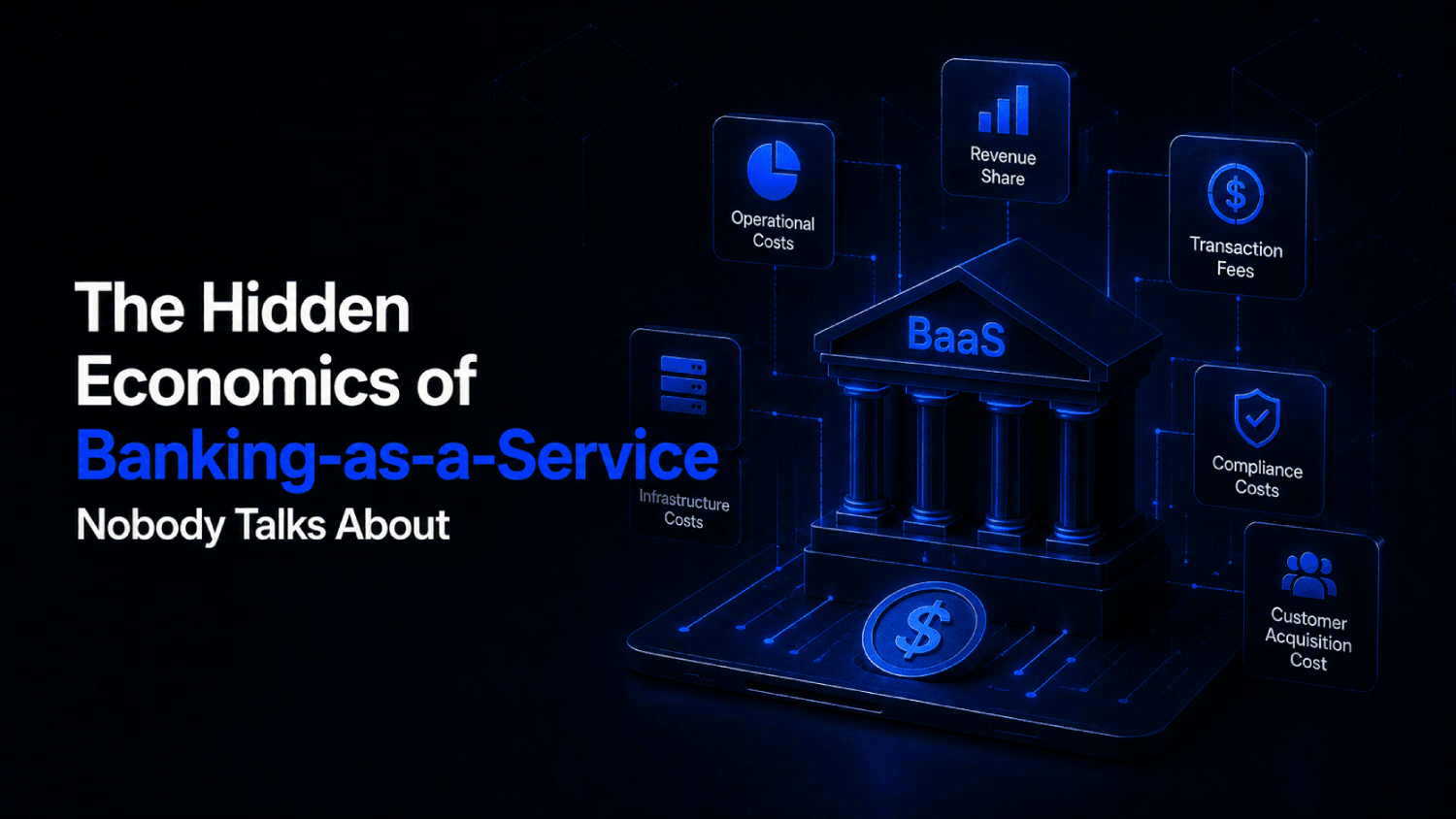
Banking-as-a-service economics sit at the intersection of revenue share, regulatory overhead, and operational cost , and the gap between what a pricing sheet shows and what a program actually costs is where most operators get caught. BaaS is a business model in which licensed banks expose their regulated infrastructure through APIs, letting non-bank companies offer financial products like accounts, cards, and payments without holding a banking charter. The provider earns through interchange revenue share, monthly platform fees, and in some cases interest spread on deposits. The client pays those fees plus the real costs of compliance, fraud, reserves, and support that do not appear on any pricing page.
Why the Simple Version of BaaS Economics Is Wrong
Most people who discover BaaS build a back-of-napkin model: charge end users a monthly fee, earn interchange on card spend, pay a platform fee to the provider, keep the spread. It reads cleanly. It almost never works out that way.
The model ignores the cost layer that sits between the revenue and the gross margin line. Compliance staffing, KYC vendors, fraud tooling, card disputes, customer support, and regulatory reserves all attach to a financial product in ways they do not attach to a SaaS product. A company that has built software before often treats these as one-time setup costs. They are not. They are per-account, per-transaction, and in some cases per-incident recurring costs.
The second problem is that BaaS pricing is structured to be easy to start and expensive to scale badly. Low monthly minimums and simple per-transaction fees obscure the real cost curve. Once you understand the full economics, the model changes considerably. That is what this piece works through.
How Does Banking-as-a-Service Actually Make Money?
BaaS providers sit between sponsor banks and the companies building financial products. Their revenue comes from four primary sources.
Interchange Revenue Share
Interchange is the fee a card network collects from a merchant’s bank when a transaction settles, then distributes back through the chain. When a BaaS client issues a debit or credit card, interchange flows from the card network to the sponsor bank, then to the BaaS provider, then partly to the client. The BaaS provider keeps a cut at each pass-through. For debit cards, interchange in the US is governed by the Durbin Amendment for large banks, making sponsor bank selection directly relevant to what rate a client ultimately earns.
Interchange is the most discussed revenue line in BaaS, but it is also the one most dependent on transaction volume to matter. A client with 500 active cardholders spending an average of $400 a month is generating a small fraction of what makes interchange financially interesting for either party.
Platform and API Fees
Most BaaS providers charge a monthly platform fee plus per-unit fees for account creation, ACH transfers, card issuance, and sometimes API calls. These fees cover the provider’s infrastructure, sponsor bank relationship costs, and compliance overhead. They are relatively predictable from the client side. What they do not reflect is the cost of all the adjacent tooling the client still has to buy separately.
Interest Spread on Deposits
When end users hold balances in BaaS-powered accounts, those deposits sit at the sponsor bank. The bank earns the federal funds rate or equivalent on those deposits. Some of that yield flows back to the BaaS provider, some to the client, and in many programs, very little to the end user. This spread became a meaningful revenue line when interest rates rose significantly. It also means BaaS economics are partially tied to macroeconomic conditions that no client controls.
Premium Features and Lending Products
Mature BaaS platforms have added credit products, earned wage access, and savings features that generate additional margin. These are typically higher-margin products for the provider but introduce credit risk and additional regulatory complexity for the client. Not every BaaS client has the operational capacity to manage them properly.
What Are the Real Costs Inside a BaaS Program?
Revenue tells one side of the story. The cost structure is where BaaS economics actually get hard, and where most operators get surprised.
Sponsor Bank Constraints and Costs
Every BaaS product runs on a sponsor bank’s charter. The sponsor bank is the actual regulated entity, and it sets rules on what the BaaS client can and cannot do, often without much negotiation at the early stages. Those rules include concentration limits (how many accounts can hold balances), transaction velocity caps, permitted use cases, and geographic restrictions.
When a sponsor bank faces regulatory scrutiny, it typically imposes new requirements on its BaaS partners downstream. Since 2023, several notable sponsor banks have received consent orders or formal regulatory guidance requiring them to tighten oversight of their BaaS programs. Clients found out about new compliance requirements through emails and contract amendments, not advance consultation. The cost of meeting those requirements fell on the client.
Compliance and KYC
Compliance is the most persistently underestimated cost in BaaS. A company needs identity verification at onboarding, ongoing transaction monitoring, suspicious activity reporting, OFAC screening, and in some cases enhanced due diligence for higher-risk users. These are not setup costs. They run every day, at every transaction, for every account.
KYC vendors like Persona, Jumio, and Stripe Identity charge per verification , pricing that scales with volume and varies by verification type, so the per-account cost compounds as a program grows. If you are comparing providers, the best KYC providers for fintech SaaS breaks down UX, cost, and approval rate differences that matter at scale. Transaction monitoring tools layer on top. If a program grows fast, compliance costs grow with it, and often faster if the user base attracts higher-risk segments. The real cost of compliance in fintech SaaS varies significantly by product type and user population, but it is rarely as cheap as early estimates suggest.
Fraud and Disputes
Fraud in financial products does not look like fraud in SaaS. It looks like an ACH return three days after a transfer, a chargeback filed thirty days after a card transaction, or a synthetic identity that passed KYC at onboarding. By the time the loss is visible, the money is gone.
BaaS clients absorb fraud losses in most program structures. The provider and sponsor bank have contractual protections. The client typically holds first-loss position on card disputes and ACH returns up to a defined threshold. Building a fraud detection and risk tooling stack is not optional , it is a cost of operating any payment or account product. Teams that skip it early pay for it in loss ratios later.
Reserves
Sponsor banks often require BaaS clients to maintain a cash reserve against potential losses. This is not an operating expense in the traditional sense, but it is capital that is tied up and unavailable for growth. For early-stage companies, a reserve requirement of several hundred thousand dollars or more is a real constraint on runway.
Reserve sizes are negotiated, and they typically reflect the sponsor bank’s assessment of the client’s fraud risk, user type, and transaction volume. Higher-risk programs carry larger reserve requirements. This is capital efficiency that never appears in a product pitch.
Customer Support for Financial Products
Support for financial products is categorically more expensive than support for SaaS. A user who cannot access their account has a compliance-adjacent problem. A disputed transaction has regulatory timelines. A frozen account triggers a user who may file a CFPB complaint. Financial services support requires more training, more documentation, and faster response times than most software companies have built for.
The cost per ticket for financial product support is significantly higher than for pure software. Companies that try to handle it with a general-purpose support team tend to create the exact friction that causes users to churn and regulators to notice.
Why Are BaaS Margins Hard to Protect?
BaaS margin compression comes from several directions simultaneously, which is what makes it difficult to model in advance.
Interchange rates are not fixed. Card networks adjust them, and regulatory changes can move them materially. The Durbin Amendment is cited as having created a two-tier interchange market in the US , large banks subject to the Federal Reserve’s debit interchange caps earn less per transaction than smaller exempt banks , and ongoing legislative discussions could affect this further. A BaaS program built around debit interchange from a large-bank sponsor earns less than one using a smaller bank exempt from Durbin caps.
Volume thresholds matter more than most clients realize. BaaS pricing is structured like SaaS in its early tiers, but the economics only become attractive at higher account volumes. Below certain thresholds, the fixed compliance and platform costs eat a disproportionate share of revenue. This is the unit economics trap that catches seed-stage companies the hardest.
A table of where margin pressure comes from, and whether it is a fixed or variable cost, helps clarify the picture:
| Cost Category | Fixed or Variable | Who Bears It | Timing of Impact |
|---|---|---|---|
| Platform / API fees | Mostly fixed + per-unit | BaaS client | From day one |
| KYC / identity verification | Variable (per verification) | BaaS client | At onboarding, ongoing |
| Transaction monitoring | Variable (per transaction) | BaaS client | Ongoing |
| Fraud losses / disputes | Variable (by incident) | BaaS client (first-loss) | 30-90 days post-transaction |
| Reserve capital | Fixed (tied up capital) | BaaS client | At program launch |
| Compliance staffing | Semi-fixed (scales with volume) | BaaS client | Grows over time |
| Interchange revenue share | Variable (per transaction) | Split: provider retains cut | Per settlement cycle |
| Interest spread on deposits | Variable (rate-dependent) | Split: sponsor bank retains majority | Ongoing, rate-sensitive |
| Support costs for financial products | Variable (per ticket) | BaaS client | Ongoing, scales with users |
The pattern is consistent: revenue is split, costs are borne primarily by the client. The BaaS provider has structurally better economics in the relationship, which is not inherently unfair, but it does mean the client needs to model this carefully before committing to a program structure.
What Does the BaaS Revenue Model Look Like at Different Stages?
The economics shift considerably as a program matures. At launch, costs dominate. At scale, revenue lines that seemed negligible become meaningful. Understanding which stage you are in changes what decisions are worth making.
Early Stage: High Cost Ratio, Low Revenue
A company launching a BaaS-powered product typically spends months with costs that outpace revenue. Platform minimums, KYC vendor setup, compliance counsel, and reserve requirements hit before the first active user. Interchange from a few hundred cardholders does not cover a compliance officer’s salary. This is expected, but it is often underfunded in seed-round budgets that treat the financial product as a feature rather than a separate cost center.
Growth Stage: Volume Starts to Cover Fixed Costs
Once a program reaches meaningful account volume, platform fees become a smaller percentage of total revenue, interchange adds up, and the fixed compliance infrastructure serves more users without a proportional cost increase. This is where the model starts to work. The challenge is that fraud exposure also scales with volume, and the cost of a compliance gap found by a regulator at this stage is higher than it would have been at launch.
Mature Stage: Margin Defense Becomes the Priority
At scale, the economics of a BaaS program look better on paper than they did early on, but new pressures appear. Sponsor bank concentration risk becomes a strategic issue. If the sponsor bank changes its program terms or exits the BaaS market (which has happened), migrating accounts is operationally expensive and potentially disruptive to users. Large BaaS clients have started diversifying across multiple sponsor bank relationships to hedge this risk. That diversification introduces its own costs.
The gross margin realities in fintech SaaS are relevant here because a BaaS-powered product will almost always carry lower gross margins than a pure software product. Building toward that ceiling requires deliberate decisions about which revenue lines to grow and which cost lines to contain.
How Does Regulatory Pressure Change BaaS Unit Economics?
Since 2022, federal banking regulators including the OCC and FDIC have increased scrutiny on sponsor banks running BaaS programs. The concern is that some banks were growing BaaS portfolios faster than their compliance infrastructure could monitor. Several banks received formal enforcement actions , Blue Ridge Bank, for example, entered into a formal agreement with the OCC in 2023 that required it to strengthen its fintech partnership oversight , and others had to slow down or restructure their programs.
The downstream effect on clients was real. Some BaaS operators received notice that their programs were being wound down or restructured on timelines not of their choosing. Others had new compliance requirements added mid-contract. The cost and operational disruption was significant.
This is not a reason to avoid BaaS, but it is a reason to evaluate the regulatory standing of the sponsor bank behind any BaaS provider you consider. Due diligence on a BaaS provider should include understanding which bank sponsors the program, whether that bank has received any regulatory guidance in the last 24 months, and what contract provisions govern changes to program terms. The fintech product and compliance readiness checklist covers what to assess before building on regulated infrastructure. The compliance mistakes that can destroy a fintech startup includes sponsor bank due diligence failures as a recurring theme.
What Are the Hidden Costs of BaaS That Do Not Appear in a Pricing Sheet?
Implementation costs are consistently underestimated. Integrating a BaaS API is not like integrating a SaaS API. There is a compliance review process, a sponsor bank application, a legal review of the program agreement, and usually a significant amount of back-and-forth before a program goes live. This process takes months at most providers. The engineering and legal cost of that period is real even if no monthly fees are being paid yet.
Ongoing program management is another cost that does not appear in pricing. BaaS programs require someone who understands the compliance requirements, manages the sponsor bank relationship, handles escalations, and monitors for regulatory changes. At smaller companies this falls on the founder or a generalist operator. At larger companies it requires a dedicated hire. Either way, it is a cost that a pure SaaS business would not carry.
Card program management adds another layer. Debit and credit card programs involve working with card networks, managing card artwork approvals, handling card fulfillment logistics, and managing lost or stolen card processes. These are operational realities that many first-time financial product builders have not encountered before. The hidden costs that compress fintech SaaS margins go well beyond the obvious line items.
Finally, the cost of switching is high. BaaS programs involve deep integration between the client’s product, the BaaS provider’s APIs, and the sponsor bank’s infrastructure. Migrating to a different provider means account migration, potential downtime, regulatory notifications in some states, and significant engineering work. Operators who sign BaaS agreements without understanding exit provisions often discover this cost at the worst possible time.
Which BaaS Revenue Lines Actually Scale?
Not all revenue in a BaaS program scales equally. Interchange scales with card spend, which scales with active users and spending behavior. Interest spread scales with deposit balances, which is harder to grow intentionally than transaction volume. Platform fees are largely fixed and do not scale as a revenue line for the client.
The operators who build the most durable BaaS economics are typically those who use the financial product as a distribution advantage rather than treating it as the primary margin driver. A company that offers banking features to its existing SaaS customers has a customer acquisition cost for those accounts that is effectively zero. The marginal cost to serve an account that belongs to someone already paying for software is lower than the marginal cost of acquiring a standalone financial account.
This is why embedded banking , where financial features sit inside a product with a non-banking primary value proposition , often has better economics than standalone neobanks. The customer already exists. The relationship is already established. The best embedded finance APIs for SaaS companies are built for exactly this pattern, providing financial functionality as a layer on top of an existing product rather than as the product itself.
Understanding which revenue line to prioritize also matters for choosing a BaaS provider. A company whose users spend heavily on cards should negotiate hard on interchange share. A company whose users will hold large balances should understand the deposit yield structure. A company whose users will primarily use ACH should understand transfer fees. The major BaaS platforms differ materially on these terms, and the right choice depends on which revenue line matters most for a given program.
Frequently Asked Questions
How does a BaaS provider make money?
BaaS providers earn primarily through four mechanisms: keeping a portion of interchange revenue from card transactions, charging monthly platform fees and per-unit API fees, earning a share of the interest spread on deposits held at the sponsor bank, and in some cases charging for premium features like credit products or earned wage access. Revenue is split between the provider, the sponsor bank, and the client, with the provider and bank typically holding the structural advantage in that split.
Why are BaaS margins difficult to protect for clients?
Margin compression in BaaS comes from multiple directions simultaneously. Revenue lines like interchange are split and capped. Cost lines like KYC, fraud losses, compliance staffing, reserves, and support fall primarily on the client. Below certain volume thresholds, fixed costs eat a disproportionate share of revenue. Regulatory changes at the sponsor bank level can add unexpected compliance costs mid-program. No single factor causes margin problems; the combination of all of them, arriving at different times, is what makes the banking-as-a-service economics hard to model accurately in advance.
What is a sponsor bank and why does it matter for BaaS economics?
A sponsor bank is the licensed financial institution whose charter underlies a BaaS product. Every BaaS program runs on one. The sponsor bank sets concentration limits, transaction caps, permitted use cases, and compliance requirements. When a sponsor bank faces regulatory scrutiny, it passes new requirements downstream to its BaaS clients. The financial health and regulatory standing of the sponsor bank directly affects the stability, cost structure, and long-term viability of any BaaS program built on top of it.
What are the hidden costs of building on BaaS infrastructure?
Beyond platform fees and interchange splits, BaaS clients absorb implementation costs during the lengthy onboarding process, ongoing compliance program management, KYC and transaction monitoring vendor fees, first-loss fraud exposure on card disputes and ACH returns, reserve capital requirements that tie up cash, and elevated customer support costs for financial product issues. The cost of switching providers is also high due to deep API integration and potential account migration complexity, which means the true cost of a BaaS relationship is best assessed over a multi-year horizon.
What is the difference between BaaS and embedded banking?
BaaS is the infrastructure model: a licensed bank exposing regulated services via API. Embedded banking is an application of BaaS where financial features are integrated into a non-banking product, like expense management inside accounting software or payments inside a marketplace. Embedded banking typically has better unit economics than standalone BaaS-powered products because the customer acquisition cost for the financial product is lower when the customer already uses the parent product for another purpose.
At what scale do BaaS unit economics start to work?
There is no universal number, because it depends on the revenue mix (interchange-heavy vs. deposit-heavy), the cost structure of the compliance program, and the fraud profile of the user base. The common pattern is that programs with fewer than a few thousand active accounts often run at a loss on the financial product itself. The economics improve as volume grows and fixed costs are spread across more accounts. Programs that achieve positive unit economics fastest are usually those attached to existing products with built-in distribution, rather than programs acquiring financial customers from scratch.
How does regulatory pressure on sponsor banks affect BaaS clients?
Regulatory actions against sponsor banks, including consent orders and formal guidance from the OCC or FDIC, typically require those banks to impose stricter oversight requirements on their BaaS programs. This translates to new compliance obligations, monitoring requirements, or in some cases program restrictions that flow directly to clients. Clients may receive limited notice and have limited ability to negotiate. This is why due diligence on the regulatory history of a sponsor bank is a necessary part of selecting any BaaS provider.
How should a BaaS client structure their model to protect margins?
The most defensible BaaS economics come from three practices. First, negotiating hard on the revenue line most relevant to actual user behavior, whether that is interchange share, deposit yield, or transfer fees. Second, treating compliance infrastructure as a capital investment rather than a variable cost to minimize, because underinvestment creates tail risk that destroys more margin than the spending would have. Third, building the financial product into an existing product relationship rather than acquiring financial customers independently, because the acquisition cost advantage compounds significantly over time.
The Mental Model That Actually Holds
BaaS economics are not complicated once you stop treating them as a single margin line and start treating them as a three-layer stack. The top layer is revenue: interchange, platform fees earned on the BaaS provider’s side, and interest spread. The middle layer is the cost of compliance and operations: KYC, monitoring, fraud, reserves, support, and program management. The bottom layer is the structural constraints: sponsor bank terms, regulatory environment, and contract provisions that determine what you can change and what you cannot.
Most operators spend time on the top layer in the planning phase. The middle layer is what determines whether the business works. The bottom layer is what determines whether it survives a regulatory cycle. A company that models all three before signing a BaaS agreement is building on a foundation that can hold. A company that models only the top layer is essentially funding a surprise for its future self.
The providers who make money in BaaS over the long term are the ones who understood early that the economics require either high volume, a captive customer base, or a compelling adjacent product that changes the acquisition math. None of those advantages come from the BaaS relationship itself. They come from what you bring to it.