
- BaaS is not dying. It is repricing around compliance infrastructure, and the providers who built compliance as an afterthought are the ones shutting down or getting acquired.
- Sponsor banks are the chokepoint. Regulators spent 2023 through 2025 issuing consent orders against banks like Blue Ridge Bank, Evolve Bank & Trust, and Sutton Bank, forcing a wave of fintech partner terminations that continues into 2026.
- The middleware BaaS layer, companies that sit between sponsor banks and fintechs without holding their own charter, faces the most structural pressure in the current environment.
- A durable BaaS provider in 2026 has either a direct bank charter, a sponsor bank relationship with a clean regulatory record, or such deep compliance infrastructure that the bank treats them as an asset rather than a liability.
- Builders who picked providers based on time-to-launch rather than regulatory stability are paying that bill now, in the form of rushed migrations and broken product timelines.
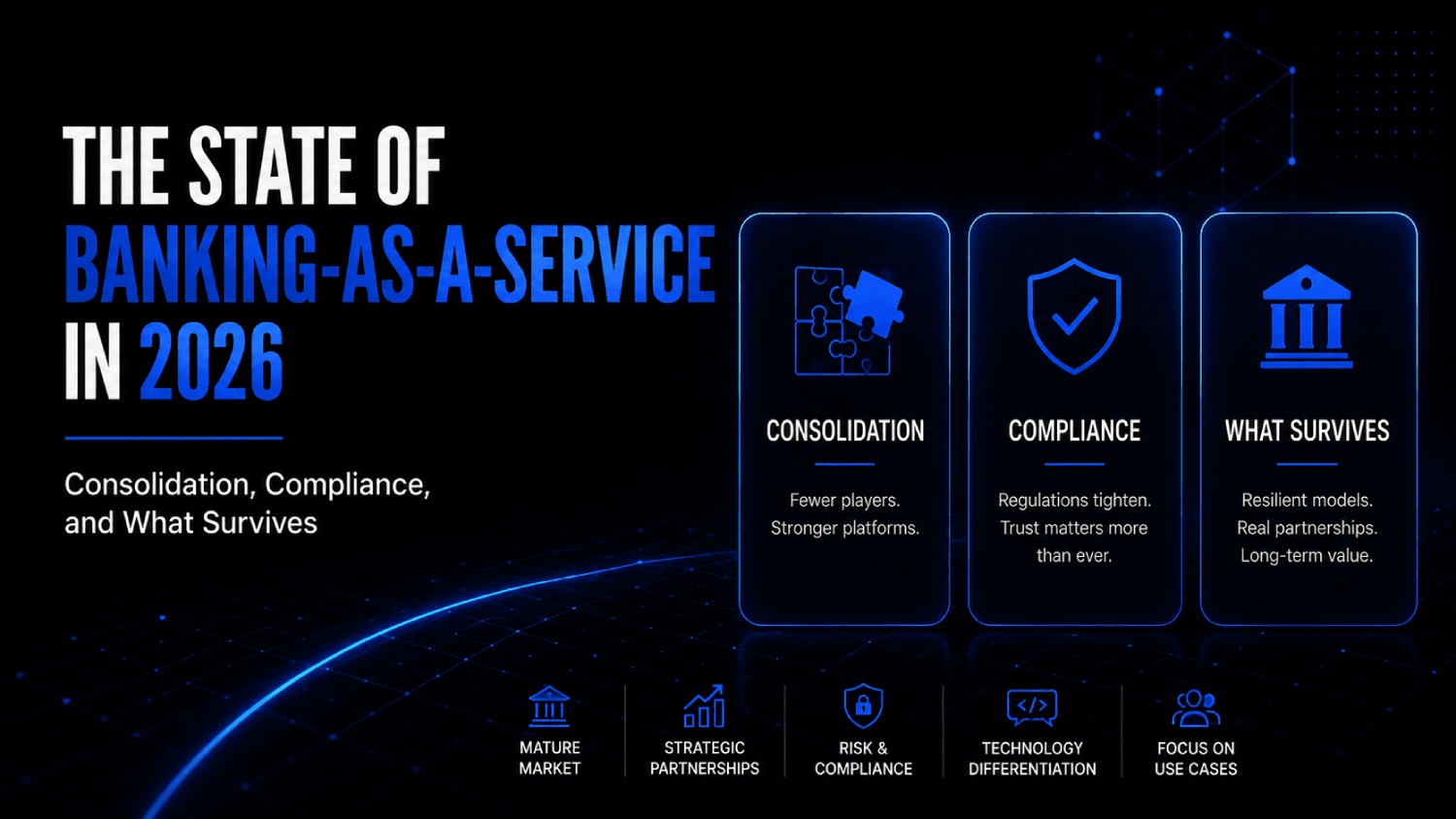
Banking-as-a-service is consolidating, not collapsing. The state of banking as a service in 2026 is a market shedding the providers that treated banking licenses as a commodity and compliance as a cost center, while the infrastructure that actually manages regulatory risk is attracting more volume. The embedded finance opportunity remains real, but the rules of access have changed materially. Builders who understand the new compliance architecture of BaaS can still move fast. Those who do not are exposed to sponsor bank exits they cannot predict.
What Is Actually Happening to the BaaS Market in 2026?
The phrase “BaaS is dead” gets recycled every time a high-profile provider shuts down or a sponsor bank pulls back. It was wrong in 2023 and it remains wrong in 2026. According to Wipfli’s state of the banking industry research, 88% of banking respondents are participating in or planning to participate in BaaS and embedded banking. Demand is not the problem.
Supply structure is the problem. The BaaS market spent roughly a decade growing by adding more sponsor bank relationships and more middleware providers, each layer adding abstraction and splitting the compliance responsibility between parties who each assumed the other was handling it. Regulators disagreed with that assumption, and the enforcement actions of the past three years have made that disagreement expensive.
What 2026 looks like on the ground: fewer active sponsor banks, higher compliance thresholds to maintain those partnerships, and a smaller set of BaaS platforms that have absorbed the volume shed by exits. The market did not shrink. It concentrated.
Why Are BaaS Middleware Companies Under So Much Pressure?
The classic BaaS middleware model looks clean on paper. A fintech startup contracts with a middleware platform, which manages the technical and compliance relationship with a sponsor bank, which holds the actual charter and deposit insurance. The fintech gets fast access to banking infrastructure. The middleware provider charges a spread or per-account fee. The sponsor bank earns interchange and float income.
The structural flaw is where the compliance accountability lands. The FDIC and the OCC view the sponsor bank as ultimately responsible for every fintech program running on its charter. When a middleware provider’s downstream clients have weak KYC, elevated fraud rates, or inadequate AML controls, the enforcement action goes to the bank, not the middleware layer. That asymmetry creates a conflict of interest: middleware platforms benefit from onboarding more clients quickly, while the bank absorbs the regulatory risk of that volume.
Regulators closed that gap aggressively starting in 2023. Evolve Bank & Trust, which powered a significant share of the middleware BaaS market, received a consent order from the Federal Reserve in 2024 requiring it to tighten fintech partner oversight. Evolve subsequently wound down or significantly reduced several fintech partnerships. Blue Ridge Bank, another major sponsor bank, exited its fintech partner business entirely under regulatory pressure. Sutton Bank implemented tighter program requirements.
Each of those exits forced the fintechs dependent on those banks to migrate, often on compressed timelines, to new sponsor banks or new BaaS platforms. The migration burden falls entirely on the fintech. That is the hidden risk in the middleware model that too few founders priced in when they signed their original BaaS agreements. For a fuller picture of what that risk actually costs, the breakdown of BaaS hidden economics is worth reading before you sign anything new.
The FintechSpecs BaaS Durability Test: Four Checks That Separate Stable From Fragile
Most frameworks for evaluating BaaS providers focus on developer experience and feature coverage. Those matter at launch. They become secondary when your sponsor bank gets a consent order eighteen months into production. The FintechSpecs BaaS Durability Test focuses on the structural indicators that predict whether a provider will still be operating your program in three years.
Check 1: Charter Independence
Does the provider hold its own bank charter, or does it depend on a third-party sponsor bank? Charter-holding platforms, including Column (which operates as a nationally chartered bank) and Cross River Bank (which is itself a federally chartered bank), remove one layer of regulatory intermediation. When a regulatory issue arises, there is one institution managing it rather than a bank and a middleware platform with different incentives. Charter independence does not guarantee clean regulatory outcomes, but it eliminates the most common failure mode: a sponsor bank exiting the fintech business under pressure and stranding its middleware clients.
Check 2: Sponsor Bank Regulatory Record
For middleware providers that rely on sponsor banks, the bank’s regulatory history is the most important due diligence input that fintechs routinely skip. FDIC enforcement orders, OCC supervisory agreements, and Federal Reserve consent orders are all public records. A sponsor bank that entered 2026 with an active consent order in place is a material operational risk, regardless of how good the middleware API feels to build on. Check the FDIC’s public enforcement database before any partnership conversation goes beyond initial scoping.
Check 3: Compliance Ownership Clarity
Ask any BaaS provider to define, in writing, which party is responsible for each compliance function: KYC decisioning, transaction monitoring, SAR filing, BSA officer coverage, and OFAC screening. The answer should be specific and contractual, not a reference to “shared responsibility.” Providers who have built genuine compliance infrastructure, rather than using the fintech’s own vendors loosely assembled, can answer this question precisely. Those who cannot are passing compliance risk to their clients without disclosing it.
Check 4: Program Concentration Risk
A BaaS platform running fifty fintech programs across three sponsor banks is structurally different from one running five programs across one bank. Concentration in sponsor bank relationships means a single bank exit wipes out the provider’s entire business. Concentration in fintech clients means one client’s fraud incident can trigger enhanced scrutiny across the whole program portfolio. Ask how many sponsor banks the provider works with and what percentage of their volume runs through each. Any answer above 70% concentration in a single bank is a risk flag.
Which BaaS Providers Are Positioned to Survive Consolidation?
The providers gaining ground in 2026 share one trait: they went into regulatory pressure with compliance built into their product, not bolted on after the fact. Below is a working map of the current field, with honest assessments of each positioning.
| Provider | Charter Model | Primary Strength | Key Risk Factor |
|---|---|---|---|
| Column | Own national bank charter | Direct regulatory relationship; no sponsor bank dependency | More selective about clients; not right for early-stage volume |
| Cross River Bank | Own federal charter | Deep fintech partner history; strong compliance infrastructure | Has faced regulatory scrutiny per public FDIC and Federal Reserve records; ongoing monitoring of program quality |
| Unit | Middleware (multiple sponsor banks) | Strong developer experience; diversified bank relationships | Dependent on sponsor bank stability; pricing has increased post-consolidation |
| Synctera | Middleware (bank marketplace model) | Bank matching model reduces single-bank concentration | Newer model; bank partners’ long-term commitment to fintech unclear |
| Lithic | Own bank charter (Pathward partnership history; charter pursued) | Card-specific depth; strong fraud tooling | Narrower product breadth than full-service BaaS |
| Treasury Prime | Middleware (multi-bank) | Multiple bank partnerships, portability pitch | Lost significant bank partnerships in 2023 tightening; recovery unclear |
The providers who absorbed the most volume from exits are those who entered the consolidation period with either charter independence or a demonstrably clean compliance record. That has given Column and Cross River meaningful pricing power. Builders comparing the current market to 2021-era BaaS pricing should expect materially higher per-account fees and more demanding onboarding requirements. For a current comparison of what is available on the platform side, the best banking-as-a-service platforms analysis covers the active field in detail.
What Does the Regulatory Crackdown Actually Mean for Builders?
The regulatory posture toward BaaS sponsor banks hardened after a series of high-profile consumer harm cases: Synapse Financial Technologies filed for bankruptcy in 2024, leaving end consumers unable to access funds held across its network of sponsor banks. The Synapse collapse was not primarily a technology failure. It was a recordkeeping and reconciliation failure, one where no single party had a complete and accurate ledger of which consumer owned which funds at which bank. Regulators treated it as a stress test the BaaS model failed publicly.
The FDIC responded by issuing clearer guidance on custodial account recordkeeping requirements for fintech-bank partnerships. The guidance effectively mandated that sponsor banks maintain their own reconciled records of end-user balances, rather than relying on middleware providers to supply that data. That requirement is operationally expensive. Banks that could not or would not absorb that cost exited the fintech partnership business. Those that remained raised their compliance requirements for new and existing programs.
For builders, this translates into three concrete changes. First, onboarding timelines for new BaaS programs have lengthened. What once took six to eight weeks now frequently takes four to six months as sponsor banks conduct more intensive program reviews. Second, compliance costs embedded in BaaS pricing have increased, often passed through as higher per-account or per-transaction fees. Third, fintechs are now asked to demonstrate their own compliance infrastructure rather than deferring to the platform layer. The era of treating compliance as “handled by the BaaS provider” is over.
Founders who want to understand compliance carrying costs at scale before finalizing any infrastructure decision should review the real cost of compliance in fintech SaaS by stage, it covers how those costs compound as programs grow.
Is It Still Safe to Build on a BaaS Provider?
Yes, but “safe” now requires active due diligence rather than the passive assumption that the provider has it covered. The consolidation period has actually improved average quality in the surviving provider pool. Platforms that were running loose compliance programs have exited or been forced to tighten. The providers still operating in 2026 generally passed a significant real-world stress test.
The specific risk that remains is sponsor bank concentration at the platform level. A BaaS middleware provider with one dominant sponsor bank relationship is still exposed to that bank’s regulatory trajectory. If you cannot get a clear answer from your provider about their bank diversification, treat that as a yellow flag. Consider a scenario: a Series A neobank processing 40,000 active accounts suddenly gets a 90-day notice that its BaaS provider is winding down its fintech programs due to a bank partner exit. The migration cost, counting engineering time, compliance re-review at the new bank, and customer communication, typically runs into the hundreds of thousands of dollars in direct costs before counting revenue disruption. That is not a hypothetical edge case. It happened repeatedly between 2023 and 2025.
The practical checklist for builders evaluating whether their current or prospective BaaS provider is structurally sound: confirm the sponsor bank’s current regulatory status publicly, ask for the provider’s bank diversification breakdown, request written compliance responsibility allocation, and review the contract’s termination and transition assistance provisions before you sign. For the full framework on evaluating any fintech vendor before you commit, the seven-point fintech vendor evaluation framework covers each of these dimensions in structured detail.
What Does the Future of Embedded Banking Actually Look Like?
The framing of “BaaS vs. direct banking” is giving way to something more layered. The market is splitting into three distinct delivery models, each serving a different type of builder and carrying different regulatory profiles.
Model 1: Charter-Holding Infrastructure Platforms
Providers like Column and Cross River function as actual banks that have built modern developer infrastructure on top of their charter. They handle regulatory relationship management internally, offer direct access to payment rails like ACH and wire, and carry the compliance burden without a middleware intermediary. The trade-off is access: these providers are increasingly selective, preferring established fintechs with demonstrable compliance programs over early-stage companies looking for fast market entry.
Model 2: Compliance-Led Middleware
The middleware layer is not disappearing, but it is bifurcating. Providers that invested in genuine compliance infrastructure, including their own BSA/AML programs, their own ledger reconciliation, and active monitoring of their fintech clients’ transaction patterns, are retaining and growing sponsor bank relationships. Those that did not are exiting. Unit represents the current benchmark for what compliance-led middleware looks like at scale: multiple sponsor bank relationships, compliance tooling embedded in the product, and a developer experience built around regulatory requirements rather than around them.
Model 3: Vertical-Specific Embedded Finance
A growing number of embedded finance deployments are not general-purpose banking at all. Property management platforms embedding tenant payment accounts, HR platforms embedding earned wage access, and healthcare platforms embedding HSA-adjacent products are all building narrower, more defensible use cases that tolerate less flexibility in exchange for cleaner regulatory positioning. These vertical deployments often use full-stack BaaS providers but configure only the specific features needed for their use case, which reduces the surface area for compliance issues and simplifies the sponsor bank relationship. For builders in this space, the best embedded finance APIs for SaaS companies covers the current API options across these verticals.
Why Are Sponsor Banks the Real Chokepoint in 2026?
Every BaaS product, regardless of which middleware platform delivers it, ultimately runs on a bank charter. That charter is the regulatory permission to accept deposits, issue FDIC-insured accounts, and participate in payment rails. According to the FDIC, there are roughly 4,500 FDIC-insured institutions in the United States, but the number willing to actively partner with fintech programs is substantially smaller and has contracted since 2023.
Sponsor banks that remain active in fintech partnerships in 2026 include Pathward Financial (formerly Meta Financial Group), The Bancorp Bank, Coastal Community Bank, and Lewis & Clark Bank, among others. Each has its own risk appetite, compliance requirements, and pricing. The variation in what each bank will and will not support, in terms of fintech use cases, customer risk profiles, and transaction volumes, is significant and not always transparent until you are deep in a partnership negotiation.
The sponsor bank relationship is also where interchange economics originate and where they are being renegotiated. As sponsor banks face higher compliance costs for running fintech programs, they are passing those costs through in the form of higher fees to BaaS middleware providers, who in turn pass them to fintechs. The interchange-funded BaaS model that made early neobanks economically attractive is under pressure from two directions: rising compliance costs compressing net interchange, and the Durbin Amendment’s ongoing impact on debit interchange rates for larger institutions. The sponsor bank programs evaluation guide breaks down what to assess before signing with any sponsor bank partner.
Frequently Asked Questions
Is the BaaS model in trouble after the regulatory crackdown?
The BaaS model is under structural pressure, not existential threat. Providers built on weak compliance infrastructure have exited or been forced to exit. The surviving providers, particularly those with charter independence or genuinely strong compliance programs, are absorbing more volume at higher prices. The underlying demand for embedded banking, confirmed by Wipfli’s 2026 research showing 88% of bank respondents participating or planning to participate in BaaS, remains intact. The business model is being repriced around compliance, not eliminated.
Which BaaS providers will survive consolidation?
Providers most likely to remain active through the current consolidation period are those with their own bank charter (Column, Cross River Bank), those with multiple diversified sponsor bank relationships and embedded compliance infrastructure (Unit, Synctera), and vertically specialized platforms whose narrow use cases reduce regulatory surface area. Providers dependent on a single sponsor bank with an active regulatory issue, or those who have not built genuine compliance ownership into their product, face meaningful exit risk over the next 12 to 24 months.
What caused the Synapse Financial collapse and why does it matter for BaaS?
Synapse Financial Technologies filed for bankruptcy in 2024 after a reconciliation breakdown left end-user funds in dispute across multiple sponsor banks. The core failure was that no single party, not Synapse, not any individual bank, maintained a complete reconciled ledger of which consumer owned which funds. The FDIC’s subsequent guidance on custodial account recordkeeping directly targeted this gap and forced sponsor banks to take direct responsibility for reconciliation rather than delegating it to middleware providers. It set the compliance floor for every BaaS program operating today.
How much has BaaS pricing increased after consolidation?
BaaS providers do not publish standardized public pricing, so direct comparisons are difficult to verify. Qualitatively, the market reports higher per-account setup costs, increased monthly minimum commitments, and more demanding compliance reviews that add significant internal cost even before platform fees. The pricing increase reflects two real inputs: higher compliance infrastructure costs at the sponsor bank and middleware layer, and reduced competition in the surviving provider pool. Builders should budget for compliance overhead as a line item separate from platform fees.
Can early-stage fintechs still access BaaS in 2026?
Yes, but with more friction than in 2020 through 2022. Charter-holding platforms like Column are increasingly selective and typically require fintechs to demonstrate an existing compliance program before onboarding. Middleware providers like Unit and Synctera remain more accessible at earlier stages but require documented KYC/AML policies as a baseline. Early-stage fintechs should expect a longer onboarding process, potentially four to six months, and should treat that timeline as a planning input rather than a negotiation outcome.
What is the difference between BaaS and embedded finance?
BaaS refers specifically to the infrastructure layer: the bank charter, payment rails, deposit accounts, and card issuing capabilities that a non-bank company accesses via API. Embedded finance is the broader category describing any financial product integrated into a non-financial product experience, whether that product is built on BaaS, a direct bank partnership, or a payment facilitator model. All BaaS deployments produce some form of embedded finance, but not all embedded finance uses BaaS. The distinction matters because the regulatory and operational requirements differ significantly depending on which model a builder chooses.
What does the Durbin Amendment mean for BaaS-powered neobanks?
The Durbin Amendment caps debit interchange rates for banks with assets over $10 billion at roughly 21 cents plus a small percentage per transaction. BaaS-powered neobanks typically partner with smaller community banks that are exempt from the cap, allowing them to earn higher interchange on debit transactions. As those sponsor banks grow or consolidate with larger institutions, they may cross the Durbin threshold and lose their interchange exemption. This is a slow-moving but real economic risk for neobank business models built primarily on interchange revenue.
Is BaaS regulation different from standard bank regulation?
The same federal frameworks apply: Bank Secrecy Act, OFAC sanctions compliance, FDIC recordkeeping requirements, and consumer protection laws like the Electronic Fund Transfer Act. What has changed is how regulators assign responsibility when those requirements are met through a three-party structure of bank, middleware, and fintech. Regulators now hold the sponsor bank accountable for the full compliance stack, which means banks have become more demanding about what compliance capabilities their fintech and middleware partners can demonstrate. The regulation is not new; the accountability structure is being clarified.
The Bottom Line on BaaS in 2026
BaaS is not a story about a market in decline. It is a story about a market that grew faster than its compliance infrastructure could support, absorbed a painful correction, and is now establishing a more durable operating floor. The providers that remain are, on balance, better equipped to manage regulatory risk than those who exited. That is not an accidental outcome. It is what enforcement pressure was designed to produce.
The builders who face the most risk in the current environment are not those who chose BaaS, but those who chose BaaS providers without applying the FintechSpecs BaaS Durability Test: charter independence, sponsor bank regulatory record, compliance ownership clarity, and program concentration risk. Every one of those variables is checkable before you sign. The builders who skip that diligence are not making a technology decision. They are making a bet on someone else’s regulatory relationship.
The future of embedded banking belongs to the providers and the fintechs that treat compliance as product infrastructure rather than a legal requirement to satisfy on paper. That shift is already visible in which providers are growing and which are winding down. The consolidation is not finished, but the direction is clear enough to build on.