
- Most platforms avoid embedded credit because they assume they need a lending license. The right API provider structure means the licensed lender sits behind the API, not you.
- The compliance model matters more than the feature set. Providers that own the regulated entity, manage underwriting, and handle adverse action notices remove the heaviest legal burden from the platform.
- Capital source structure determines product durability. Some providers fund loans from their own balance sheet; others connect to third-party capital networks. Each creates different risk exposure for your platform during a credit tightening cycle.
- The five providers covered here each suit a different platform archetype: B2B marketplace, vertical SaaS, spend platform, supplier network, and multi-product financial stack. Choosing the wrong category costs six to twelve months of integration rework.
- Embedded credit is not a feature addition. It changes your revenue model, your liability exposure, and your relationship with every business customer on your platform.
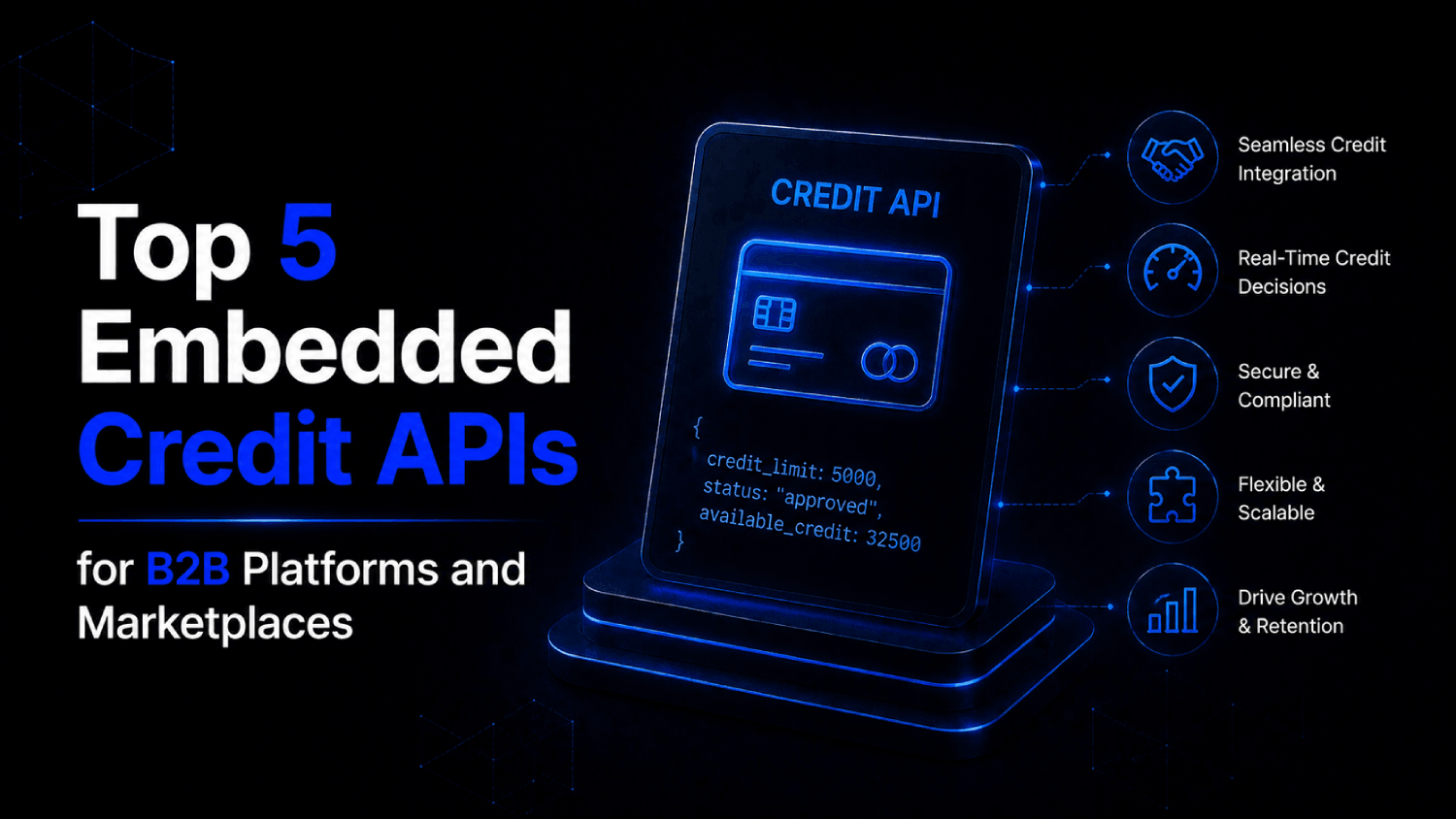
The top embedded credit API providers for B2B platforms are Stripe Capital, Parafin, Pipe, Resolve Pay, and Unit. Each uses a bank or licensed lender as the regulated entity behind the API, which means the platform operator does not need its own lending license. The right choice depends on whether your platform is a marketplace, vertical SaaS product, supplier network, or spend management tool, because each category requires a different underwriting data model and capital structure.
Why Do Platform Operators Fear Embedded Credit APIs?
The hesitation is understandable. Lending in the United States is regulated at both the federal and state level, with separate licensing requirements, truth-in-lending disclosures, fair lending rules, and state usury caps that vary by borrower location. A software platform that offers loans without the right structure can face enforcement from the CFPB, state banking regulators, and the FTC simultaneously.
What most platform operators miss is that well-structured embedded credit APIs externalize that regulatory surface. The API provider, or the bank partner behind it, holds the license, originates the loan, makes the credit decision, and issues the required disclosures. The platform passes data, receives a revenue share or referral fee, and shows the product in its UI. That is a materially different legal position than being the lender of record.
The compliance model is the product. Evaluating embedded credit APIs purely on developer experience or APR range without understanding who holds the paper, who handles adverse action notices, and how charge-offs flow back to the platform is how operators land in regulatory trouble eighteen months after launch. If you are still mapping out your broader compliance posture, the Fintech Product and Compliance Readiness Checklist covers the foundational layer this decision sits on.
How Should Platforms Evaluate Embedded Credit API Providers?
Before covering individual providers, it helps to apply a consistent evaluation structure. At FintechSpecs, we use what we call the Credit API Accountability Stack: five sequential questions that identify where regulated responsibility sits at each layer of the product.
- Who is the lender of record? Is it a chartered bank, a state-licensed lender, or the API provider itself? This determines which regulatory framework governs the product.
- Who owns the underwriting decision? Does the platform supply data and the provider makes the call, or does the platform configure its own underwriting logic? More configurability means more responsibility.
- Who manages compliance documents? Adverse action notices, TILA disclosures, and state-specific forms must be generated and delivered correctly. Providers that automate this remove the most operationally fragile piece.
- Where does the credit risk sit? On the provider’s balance sheet, on a third-party capital partner, or partially shared back to the platform? Balance sheet exposure shapes how the product behaves in a downturn.
- Can the API carry the product in production? Ask for the webhook list covering the full loan lifecycle, confirm that decline decisions return reasons and not just a status, and confirm who holds the servicing ledger once a loan is funded. A provider that cannot answer these three in writing will surface as an operational problem in month six, not month one. Our fintech API uptime and infrastructure reliability report covers how we measure this layer across providers.
Run every provider on this list through these five questions before signing a contract. The answers determine your actual liability surface, not the feature comparison table.
What Features Should an Embedded Lending API Actually Have?
Six capabilities separate an embedded lending API from a referral link with better styling. Confirm all six in the sandbox before the contract, not in the demo.
- Underwriting on platform-native data. The provider ingests the data you already hold and returns a decision without asking the borrower to upload documents. If your customer has to attach a bank statement, the product is not embedded.
- Offer surfacing you control. Pre-qualified offers should be available to your product as data, so you decide where the offer appears in the workflow. Providers that only ship a fixed widget decide that for you.
- White-label or provider-branded delivery, chosen deliberately. White-label keeps the borrower relationship with your platform and puts more disclosure responsibility on you. Provider-branded is faster to launch and cedes the relationship. Ask which one you are buying, because some providers offer only one.
- KYB and identity built in. The provider should verify the business, not hand you a verification task you then have to build against.
- Repayment structures that match your customers’ cash cycle. A share of transaction volume, a fixed instalment, and net-terms maturity behave differently in a bad quarter. Pick the one that matches how your customers earn.
- Lifecycle webhooks and reporting that reconciles. Offer made, application approved, funds disbursed, payment missed, loan closed. If you cannot subscribe to those events, your support team will learn about problems from your customers.
The order matters. Capability one determines whether the product can exist on your platform at all, and capability six determines whether you can operate it two years in.
Which Embedded Credit API Is Best for B2B Marketplaces?
1. Stripe Capital
Stripe Capital is the strongest default choice for platforms already processing payments through Stripe. The product offers merchant cash advances and business loans to businesses on a platform, with repayment tied to payment volume flowing through Stripe. Because Stripe already has transaction data from the platform, the underwriting decision runs without requiring borrowers to submit separate financial documents.
The embedded version of Stripe Capital, available through Stripe Connect and the Capital API, lets marketplace operators surface financing offers directly in their platform UI. Stripe handles the origination, the compliance documentation, and the capital. The platform operator receives a revenue share on funded loans.
This is the model people mean by merchant capital infrastructure: the capital, the underwriting, and the paper sit with the provider, and the platform supplies distribution and data.
Best for:
- B2B marketplaces already on Stripe Connect with meaningful GMV per merchant
- Platforms where transaction data is the primary underwriting signal
- Operators who want to add credit without a dedicated fintech integration team
- Situations where speed-to-market matters more than product customization
The constraint is that Stripe Capital only works within the Stripe payments stack. Platforms on other payment processors cannot use it, and customization of underwriting criteria or loan terms is limited compared to standalone embedded lending providers.
How Do You Integrate Lenders Into a Marketplace That Is Not on Stripe?
Marketplaces not running on Stripe have two structural choices, and they carry different amounts of work.
The first is a single embedded lender that underwrites on your marketplace data. Parafin and Pipe both work this way for non-Stripe platforms: one contract, one integration, one credit box, and the provider carries the capital and the compliance. This is the faster path and the right default for a marketplace under roughly $10M in annualized GMV, where a second lender would not meaningfully change approval rates.
The second is lender orchestration, where your application is routed across multiple lenders and each decides independently. This exists to raise approval coverage across a mixed seller base, because one lender’s credit box will always decline sellers another would fund. The cost is that you take on more of the experience: multiple offer formats, multiple decline reasons, and reconciliation across more than one servicing system. Orchestration earns its complexity when your sellers vary widely in size, industry, or trading history, and rarely before that.
The decision rule is coverage, not capability. If your declines cluster around one seller profile, a second lender fixes it. If your declines are spread evenly, the problem is your data quality and a second lender will decline the same businesses.
Which Embedded Credit API Is Best for Vertical SaaS Platforms?
2. Parafin
Parafin was built specifically for software platforms that want to offer working capital to their business customers without becoming a lender themselves. The company operates as the licensed lender and capital source, with the platform embedded as a distribution channel. Parafin underwrites based on the business data the platform already holds, whether that is sales data, invoices, payroll history, or other operational metrics specific to the vertical.
What distinguishes Parafin from Stripe Capital for vertical SaaS operators is the flexibility of the data model. A construction management SaaS platform can pipe in project completion rates and contract values. A restaurant software platform can use cover count data. Parafin’s underwriting engine is designed to ingest non-traditional signals that match the specific business type the platform serves, which tends to produce better approval rates for the platform’s customer base than generic credit scoring.
Best for:
- Vertical SaaS companies with 500 or more active business customers
- Platforms where industry-specific operational data outperforms generic credit signals
- Operators who want Parafin to own the compliance burden entirely
- SaaS products in home services, food and beverage, beauty, or retail where cash flow is lumpy
Parafin does not publicly disclose pricing or revenue share terms, so operators need to go through a Parafin does not publicly disclose pricing or revenue share terms, so operators need to go through a sales conversation. If working capital is the only product you plan to launch, our comparison of embedded working capital APIs for B2B platforms covers eight providers including Parafin, with a funding model table. For a broader map of embedded finance API options beyond credit specifically, the Best Embedded Finance APIs for SaaS Companies article covers the full stack.
Which Embedded Credit API Is Best for Spend Management Platforms?
3. Pipe
Pipe has repositioned from its original recurring revenue trading model to a broader embedded capital platform for software companies. The current product lets platforms offer working capital advances to their business customers, with Pipe functioning as the capital source and compliance layer. Pipe’s API is designed for platforms that want to offer credit as a distinct financial product rather than an ancillary feature of payments.
Pipe’s embedded credit product is particularly well-suited to spend management and financial operations platforms because it is designed around predictable business revenue rather than collateral or personal guarantees. A platform managing accounts payable or expense tracking for SMBs can offer Pipe-powered advances based on the revenue data already flowing through the platform.
In provider terminology this is revenue-based financing, priced off forward revenue rather than a fixed asset or a personal guarantee. The repayment structure uses a flat fee rather than an interest rate in many cases, which simplifies disclosure requirements.
Best for:
- Spend management platforms serving SMBs with $500K or more in annual revenue
- Platforms where business revenue data is the primary data asset
- Operators who want a standalone capital product rather than a payments-adjacent feature
- Companies looking for a provider willing to co-develop the product experience
Pipe does not publish API pricing publicly. The company has gone through significant strategic changes in recent years, so operators evaluating Pipe should ask pointed questions about capital source stability and what happens to existing loans if capital markets tighten.
Which Embedded Credit API Is Best for Supplier Networks?
4. Resolve Pay
Resolve Pay focuses on B2B net terms financing, which is a specific and underserved segment of embedded credit. Net terms is the trade credit that businesses extend to their customers: “pay in 30 days,” “pay in 60 days.” Resolve embeds into a platform or supplier network and handles the credit check, credit limit setting, and financing of the receivable so the seller gets paid upfront while the buyer pays on terms.
For supplier networks and B2B procurement platforms, this is the right product category. A marketplace connecting manufacturers to distributors does not need a cash flow advance. It needs a way to let buyers purchase on net terms without the seller carrying that receivable risk. Resolve’s API handles the underwriting of the buyer, the payment to the seller, and the collection from the buyer at maturity. Our comparison of B2B BNPL and trade credit platforms covers seven providers in this category, with buyer credit limits side by side.
Best for:
- B2B supplier networks and procurement platforms where net terms are a buyer expectation
- Platforms where sellers are small businesses that cannot afford to carry 60-day receivables
- Wholesale and distribution marketplaces with repeat buyer relationships
- Operators who need buy-now-pay-later functionality specifically designed for business buyers, not consumers
Resolve is not a general-purpose working capital API. Trying to use it for cash flow advances or equipment financing will not work. Its narrow focus is also its strength: the underwriting model, the compliance layer, and the product UX are all built around B2B trade credit specifically.
Which Embedded Credit API Covers Deposits, Cards, and Credit in One Integration?
5. Unit
Unit is a banking-as-a-service platform that includes lending as one component of a broader embedded finance stack. Where the other providers on this list are credit-first, Unit is infrastructure-first: its API lets platforms embed deposit accounts, cards, and credit products within a single integration. The lending component includes lines of credit and term loans, powered by Unit’s bank partner network.
Unit makes sense for platforms building a more complete financial product rather than adding a single credit feature. A vertical SaaS company that wants to offer its business customers a checking account, a debit card, and a working capital line can do all three through Unit rather than stitching together three separate providers. That integration simplicity has real operational value, even if Unit’s credit product is less specialized than Parafin’s or Resolve’s.
Best for:
- Platforms building a multi-product embedded finance suite rather than a standalone credit feature
- Series A or Series B companies with engineering capacity to handle a deeper integration
- Operators who want deposits, cards, and credit under one compliance umbrella
- Platforms where the long-term vision is becoming the primary financial account for their business customers
Unit does not publish pricing publicly. Given the breadth of the platform, the commercial terms vary significantly based on product scope. The 10 Best Banking-as-a-Service Platforms for Fintech Startups article covers Unit alongside its direct BaaS competitors in more detail.
At enterprise scale the calculation changes again: procurement, security review, and a signed data processing agreement usually take longer than the integration itself, so start provider conversations two quarters before you plan to ship.
Which Providers Offer Multiple Credit Products Through One Integration?
Multiple platform types and multiple credit products are different questions, and providers rarely solve both. Unit spans product categories, meaning deposits, cards, and credit through one integration. It does not give you several distinct credit products with separate credit boxes.
If what you need is term loans, revolving lines of credit, invoice financing, and B2B BNPL behind a single integration, the providers built for that requirement are not on this list of five, because they are lending infrastructure rather than platform-distributed capital. Kanmon positions itself as full-stack embedded lending for vertical SaaS with term loans, lines of credit, and invoice financing behind one API. Lendflow takes the orchestration route, routing a single application across a large panel of lenders to cover term loans, lines of credit, invoice factoring, merchant cash advances, and equipment finance.
The trade-off is consistent. A single-product provider gives you one credit box, one servicing system, and a launch measured in weeks. A multi-product provider gives you coverage across more of your customer base and hands you more product surface to operate: more offer states, more disclosure variants, and a servicing layer you will need to reconcile. Ask any multi-product provider which single system holds the loan ledger across all products, because if the answer is more than one system, you have bought several integrations wearing one brand. Our review of loan servicing software covers the layer that question is really about.
How Do These Five Providers Compare Side by Side?
Which Embedded Lending API Underwrites Best on B2B SaaS Data?
Choose the provider whose underwriting inputs match the data your platform already produces, because that alignment does more for approval rates than any other selection criterion.
Three data sets carry most embedded underwriting decisions. Payment volume flowing through your platform is the strongest single signal and the reason Stripe Capital converts well for Stripe-native platforms. Operational throughput, meaning the jobs, orders, covers, shipments, or projects your software measures, is what lets a vertical platform outperform generic credit scoring, and it is the input Parafin is built around. Recognized revenue, billed and collected, is the input behind revenue-based products such as Pipe’s.
Two questions decide whether any of it works on your platform. First, how many months of continuous history do you hold per customer, because a provider underwriting on trend cannot decision a customer you onboarded last month. Second, does the provider return decline reasons rather than a status, because reasons are what let you tell a customer why an offer disappeared and are what your compliance review will ask for.
If your platform holds none of these three data sets in depth, the honest answer is that embedded credit is premature. Fix the data layer first. Our guide to data enrichment APIs for fintech underwriting covers what to add when your own data is thin.
| Provider | Best Platform Type | Lender of Record | Underwriting Data Model | Credit Product Type | Compliance Handled By |
|---|---|---|---|---|---|
| Stripe Capital | B2B marketplace (Stripe-native) | Bank partner (verify current partner via Stripe’s public docs) | Payment transaction history | MCA and term loans | Stripe |
| Parafin | Vertical SaaS | Parafin (licensed lender) | Platform-specific operational data | Working capital advances | Parafin |
| Pipe | Spend and financial ops platforms | Pipe Capital (balance sheet) | Business revenue data | Revenue-based advances | Pipe |
| Resolve Pay | Supplier networks | Resolve (licensed lender) | Buyer credit profile | Net terms financing | Resolve |
| Unit | Multi-product embedded finance | Bank partners (Blue Ridge, etc.) | Configurable per platform | LOC, term loans, cards | Unit and bank partner |
What Compliance Questions Should Platforms Ask Before Signing With Any Provider?
Provider selection is not finished when you pick a name from the table above. Before signing, every platform operator should get written answers to six specific questions.
- Who is the lender of record on the loan agreement? The name on the note determines which regulator has jurisdiction.
- How are adverse action notices generated and delivered? Federal law requires these when credit is denied or reduced. If the provider automates them, confirm the format and timing are legally compliant in every state you operate in.
- What state licensing does the provider hold, and which states are excluded? Some providers cannot operate in certain states due to licensing gaps or usury conflicts.
- How does a charge-off affect the platform? Some providers claw back revenue share on defaulted loans. Others absorb all credit loss. This changes your unit economics model significantly.
- What happens to outstanding loans if the provider is acquired or shuts down? Borrowers on your platform borrowed through your product. If the provider fails, they still owe money to someone. Know who services the loans in that scenario.
- What data does the provider retain, and who owns the borrower relationship? Some providers will cross-sell to your customers directly. If they own the borrower relationship after origination, that is a competitive risk to evaluate.
These questions take on more weight for platforms at scale. The 10 Critical Mistakes When Choosing Fintech Infrastructure article covers the broader pattern of how these overlooked contract terms create operational problems later.
What Does Embedded Credit Actually Cost a Platform to Build?
None of the five providers on this list publish API pricing or revenue share rates publicly. The commercial model across all of them follows a similar structure: the platform receives a percentage of the loan amount as a referral or distribution fee. The actual rate is not publicly disclosed by any of these providers and is typically negotiated based on loan volume, average loan size, and the platform’s customer default rate. Operators should model multiple rate scenarios rather than anchoring to any single number before they have a term sheet in hand.
To illustrate the sensitivity, take deliberately round numbers. A vertical SaaS platform with 2,000 business customers, an average loan size of $25,000, and 400 customers drawing credit in a year generates $150,000 in referral revenue at a 1.5% revenue share, $100,000 at 1%, and $200,000 at 2%. The rate is the variable that matters most, and none of it is knowable before you have a term sheet in hand. Model all three scenarios against a realistic default assumption before you sign.
The engineering cost is the real variable. A shallow integration using a provider’s pre-built UI components takes two to four weeks for an experienced team. A deep integration with custom underwriting data feeds, white-labeled UX, and automated servicing workflows can take three to six months. The providers with the most opinionated integration (Stripe Capital, Parafin) tend to deploy faster. The providers offering more configurability (Unit) require more time.
How Do You Integrate an Embedded Credit API?
Integration runs in six stages, and the order is fixed because each stage produces the input the next one needs.
- Data audit before vendor selection. List, per customer, what you hold and for how long: payment volume, operational throughput, recognized revenue, business identity. This determines which providers can underwrite your base at all and should happen before demos, not after.
- Sandbox decisioning test with your real data shape. Push a representative sample through the provider’s sandbox, including your hardest cases: newly onboarded customers, seasonal businesses, customers with a bad quarter. What you are testing is whether decisions come back with reasons attached.
- Contract and compliance sign-off in parallel. The six questions in the section above go into the contract, not into an email thread. Adverse action handling and state coverage are the two that change your obligations if they are wrong, so route them through counsel. Our guide to FCRA compliance for loan underwriting covers what the adverse action requirement means in practice.
- Offer surfacing in the workflow. Decide where in your product a pre-qualified offer appears. The highest-converting placement is a moment where the customer is already thinking about money, such as an invoice, a payout, or a purchase order, not a banner on the dashboard.
- Webhook and reporting wiring. Subscribe to the full lifecycle, then reconcile the provider’s reporting against your own record for a full billing cycle before launch. Reconciliation gaps found after launch become support tickets.
- Support runbook before general availability. Your team will receive the questions, whatever the loan agreement says about who the lender is. Write the escalation path, the decline explanation script, and the hardship path before the first customer sees an offer.
Stages one to three run two to six weeks. Stages four to six are where timelines diverge: a pre-built provider UI ships in two to four weeks, a custom flow with white-labeled UX and automated servicing workflows takes three to six months.
Frequently Asked Questions
Does a platform need a lending license to offer embedded credit through an API?
In most cases, no. When the API provider or their bank partner is the lender of record, the platform operator functions as a distribution channel rather than a lender. The provider holds the license, originates the loan, and issues required disclosures. Platform operators should still consult legal counsel before launch, because the specific fee and compensation structure affects whether the platform triggers licensing requirements under certain state laws.
What is the difference between a working capital API and a net terms financing API?
A working capital API provides cash advances to a business based on its revenue or cash flow. The business uses the funds for any operational purpose and repays over time. A net terms financing API, like Resolve Pay, finances trade credit specifically. The lender pays the seller upfront and collects from the buyer at net 30, 60, or 90 days. These are different products for different buyer-seller dynamics, and conflating them leads to choosing the wrong provider.
What is the difference between a merchant capital API and an embedded credit API?
Merchant capital API usually describes a product that advances funds against payment volume the provider can already see, with repayment taken as a share of future transactions. Embedded credit API is the broader category, covering advances, term loans, lines of credit, and trade credit. The distinction matters when a provider is described as merchant capital infrastructure, because it usually means the provider needs to sit in the payment flow to underwrite. If your platform does not process payments for its customers, that provider is not a fit regardless of how good the API is.
How do embedded credit providers handle borrowers in states with strict usury laws?
Most providers that use bank partners benefit from federal preemption under the National Bank Act or Federal Deposit Insurance Act, which allows bank-originated loans to export the interest rate from the bank’s home state to the borrower’s state. Some providers have state licensing gaps and simply exclude certain states from their product. Operators should request a full list of supported states before integration, particularly if their customer base is concentrated in states like Colorado, Utah, or California, which have active lending regulation.
Can a platform use multiple embedded credit API providers at the same time?
Technically yes, but it creates operational complexity. Running Stripe Capital for payment-based advances alongside Resolve Pay for net terms is a legitimate dual-product strategy for a marketplace that serves both buyers and sellers with different needs. Running two providers offering the same product type, however, creates compliance documentation overlap, competing borrower relationships, and integration maintenance overhead that rarely justifies the redundancy.
What credit data signals do embedded lending providers use for underwriting?
The data model varies by provider. Stripe Capital uses payment processing volume and history flowing through Stripe. Parafin ingests platform-specific operational data, which can include sales velocity, customer retention, payroll, or industry metrics. Pipe emphasizes revenue data. Resolve Pay underwrites the buyer using trade credit history and business credit bureau data. Unit’s model depends on which credit product is configured and which bank partner is used. The right provider is often the one whose underwriting inputs match the data your platform already holds.
What is the typical revenue share structure for embedded credit distribution?
None of the major providers disclose standard revenue share rates publicly. The range varies based on loan volume, average loan size, default rates on the platform’s customer base, and the depth of the integration. Platforms with higher GMV or more creditworthy customer bases negotiate better terms. Operators should model at least three revenue share scenarios before signing, to understand the range of outcomes based on funded loan volume.
How to Make the Final Call Between These Providers
The platform type framework in this article is a starting point, not the finish line. The actual decision comes down to two questions that only the platform operator can answer: what data do you already have on your business customers, and how much of the compliance surface are you willing to own?
Platforms with strong payment data and no appetite for compliance ownership should start with Stripe Capital or Parafin. Platforms in supplier-heavy markets where net terms are a buyer expectation should evaluate Resolve Pay before anything else. Platforms building a multi-product financial stack over a two to three year horizon should talk to Unit early, even if they are not ready to launch credit yet, because the integration architecture decision made now determines what is possible later.
Credit is the product on your platform that most directly affects whether a business customer survives a slow quarter. That weight is worth slowing down for. The providers that get this right have compliance structures that protect borrowers as rigorously as they protect platform operators. That alignment, more than any API feature, is what makes embedded credit a durable part of a platform business rather than a liability waiting to surface. For a broader look at how fintech infrastructure decisions compound over time, the Fintech SaaS Scale Checklist covers the pattern across payments, compliance, and credit together.