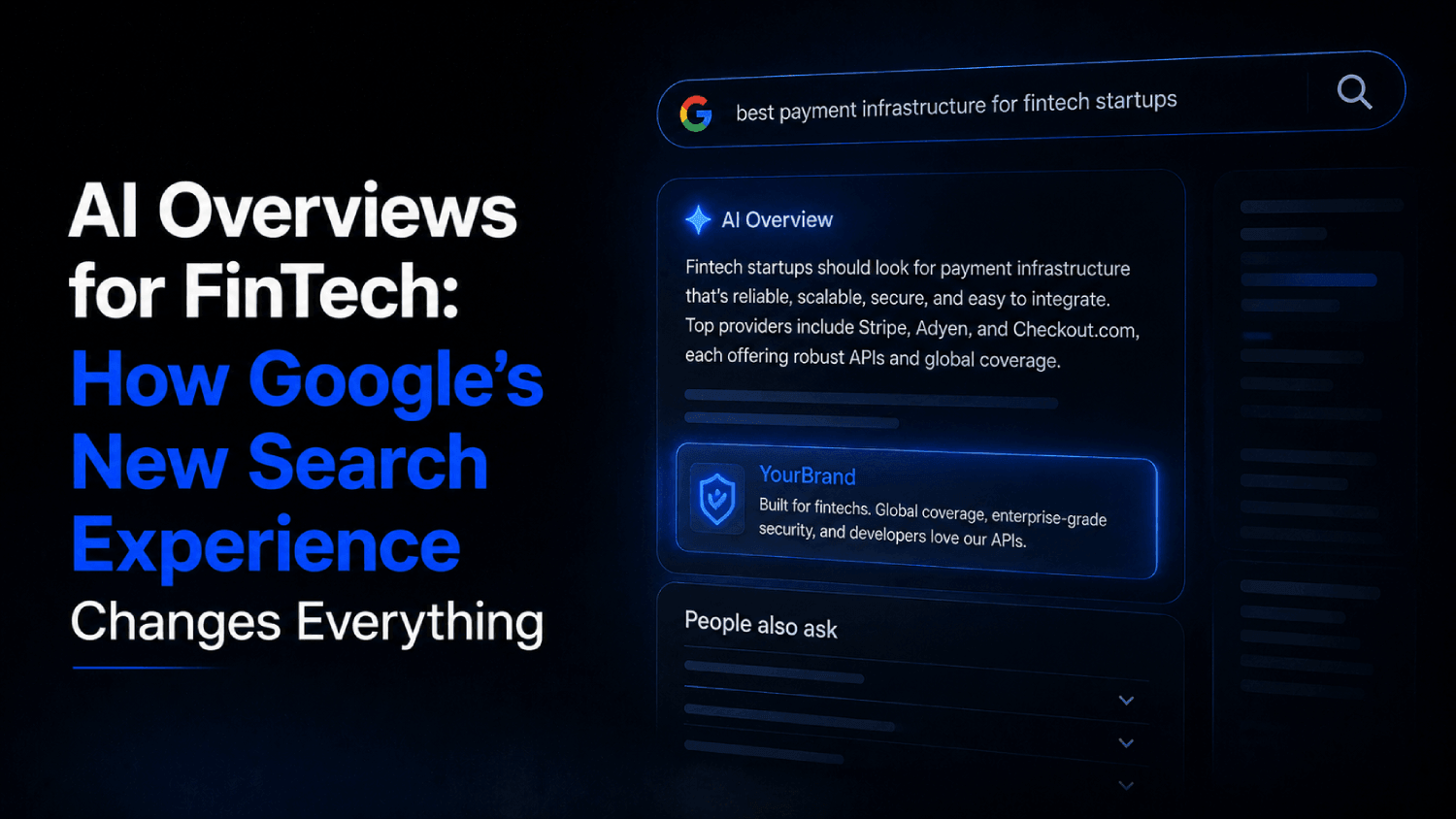

- Google AI Overviews synthesize answers from multiple sources into a single response, which means a fintech brand can rank on page one and still receive zero visibility if it is not selected as a source for the AI-generated summary.
- Selection into AI Overviews depends on structured authority, entity clarity, and content that directly answers specific queries, not just keyword density or domain rating alone.
- Fintech content faces a higher bar because Google’s systems treat financial topics as YMYL (Your Money or Your Life), requiring demonstrable expertise and sourcing that generic content sites cannot replicate.
- The optimization path for AI Overviews is distinct from traditional SEO and shares more in common with generative engine optimization (GEO), which rewards clear answers, named entities, and citable structure.
- Fintech brands that adapt their content architecture now will accumulate citation authority before competitors realize the rules changed.
Google AI Overviews generate a synthesized answer at the top of search results by pulling from a compressed set of selected sources. For fintech brands, this means traditional page-one rankings no longer guarantee impressions. Visibility depends on whether your content is structured so Google’s AI can extract, attribute, and surface it as part of that summary. The brands that understand this distinction will capture high-intent traffic. Those treating AI Overviews as rebranded featured snippets will lose it.
What Are Google AI Overviews and Why Do They Work Differently From Featured Snippets?
Featured snippets pulled a single block of text from a single page. Google AI Overviews pull from multiple sources simultaneously, synthesize a composite answer, and present it as Google’s own response, with small source citations below. The experience looks similar on the surface, but the underlying mechanics are fundamentally different.
A featured snippet rewarded the page with the cleanest answer to a specific query. AI Overviews reward content that contributes authoritative, citable facts to a broader synthesized response. Your page might supply one sentence out of a five-sentence AI Overview, or it might supply the primary claim, or it might not appear at all despite ranking in position three. Rank and inclusion are no longer the same thing.
Google has confirmed through its Search Central documentation that AI Overviews are generated using its Gemini-based systems and are designed to help users get quick answers on complex topics. The system is trained to prefer pages that demonstrate E-E-A-T (Experience, Expertise, Authoritativeness, and Trustworthiness), are well-structured, and provide direct, specific answers rather than broad topic coverage.
How AI Overviews Select Sources
Google has not published a precise algorithmic formula for source selection, but observable patterns point to several consistent factors. Pages that are cited tend to have clear heading structures that match query intent, answer the question in the first two to three sentences of a section, contain named entities (specific companies, tools, regulations, people), and sit on domains with established topical authority.
Pages that rank but are not cited tend to feature long introductions before reaching the answer, use vague language without specific claims, or rely on keyword density without genuine informational depth. Google’s AI treats your content as input material. If that material cannot be cleanly extracted, it will not be used.
How Do AI Overviews Affect Fintech SEO Specifically?
Fintech sits in one of the most consequential categories for AI Overview treatment: YMYL content. Google’s quality rater guidelines classify financial topics as high-stakes because bad information carries real-world harm. This means AI Overviews for fintech queries pull from a smaller, more vetted pool of sources than AI Overviews for, say, travel or cooking content.
That compression is the core issue. A query like “what is the best payment infrastructure for SaaS founders” might draw from fifty indexed pages in traditional search. The AI Overview might cite three. The funnel from “indexed” to “cited” is far narrower in fintech than in most verticals.
The YMYL Visibility Compression Problem
For a fintech brand, this means every piece of content either earns citation authority or produces no AI Overview presence at all. There is no middle tier. A page that ranks fifth and generates moderate click-through in traditional search might generate zero impressions in an AI Overview environment if it does not meet the structured authority threshold.
According to Semrush’s research on AI Overviews, the format appears most frequently for informational queries, complex multi-part questions, and comparison searches. All three of those query types are common in fintech: “how does ACH settlement work,” “what is the difference between a BaaS provider and a payment processor,” “which KYC solution is best for a Series A startup.” These are exactly the queries your target buyers are running.
What Changes for B2B Fintech Content Specifically
B2B fintech buyers run more complex, specific queries than consumer finance users. A CFO evaluating treasury management software is not searching “best bank account.” They are searching “multi-entity cash visibility tools for mid-market SaaS” or “FBO account structure for fintech platforms.” AI Overviews handle these queries differently from short-tail queries: they tend to synthesize comparison and definitional content rather than pulling from a single source.
This creates an opening for fintech brands that build content around specific, named comparisons and clearly explained concepts. The brands doing surface-level content (“What is embedded finance? Embedded finance is…”) will not be cited. The brands doing specific, authoritative content (“The difference between an FBO account and a custodial account for fintech platforms, and when each structure triggers different regulatory requirements”) will be.
If you want to understand how the broader AI search shift is changing the way B2B fintech buyers find and evaluate vendors, the analysis of how AI search is changing B2B fintech buyer behavior covers the demand-side dynamics in detail.
What Triggers Google AI Overviews for Financial Queries?
Google does not publish a trigger list, but data from search practitioners and Google’s own communications point to three consistent query characteristics that reliably produce AI Overviews.
First: queries with multiple valid answers or trade-offs. “How does interchange-plus pricing work” tends to trigger an AI Overview because the answer involves several components. Second: queries where the user is clearly in research mode, not navigational mode. Typing “Stripe pricing” takes you to Stripe’s site. Typing “how Stripe’s pricing compares to Adyen for SaaS billing” triggers an AI Overview because it requires synthesis. Third: queries where a direct answer is possible but requires some explanation, such as “what is a merchant of record” or “how does KYC verification work.”
Query Types That Consistently Trigger AI Overviews in Fintech
- Definitional queries with regulatory context (“what is AML compliance for fintech startups”)
- Comparison queries between named products or approaches (“BaaS vs payment facilitator model”)
- Process queries (“how does ACH origination work for SaaS platforms”)
- Evaluation queries (“what should I look for in a fraud detection tool”)
- Cost and pricing queries with complexity (“how much does KYC compliance cost for a Series A startup”)
Queries that do not reliably trigger AI Overviews include navigational searches (branded product names), transactional queries, and news queries where freshness overrides synthesis.
The FintechSpecs CANE Framework for AI Overview Optimization
Most AI Overview optimization advice defaults to generic SEO recommendations: improve E-E-A-T, add schema, write longer content. None of that is wrong, but it misses the structural specificity that fintech content requires. The FintechSpecs CANE framework organizes the four elements that consistently determine whether fintech content earns citation in AI Overviews.
Clarity: the page answers the target query within the first two to three sentences of the relevant section. Not in the introduction. Not in a conclusion paragraph. In the section that is structurally mapped to that query. Google’s AI extracts at the section level, not the page level. An H2 that says “How Does ACH Settlement Work?” followed immediately by a two-sentence direct answer, then an expansion, is extractable. An H2 that says “ACH Settlement” followed by a history paragraph is not.
Authority: the page cites named entities. Named companies, named regulations, named industry bodies, named standards. “Regulatory requirements vary” is not citable. “The ACH network is governed by Nacha, which requires same-day settlement for most debit transactions” is citable. The more specific and verifiable the claim, the more likely an AI system treats it as a source worth surfacing.
Nesting: the content uses a heading hierarchy that mirrors how a user thinks through a topic. H2 for the primary concept, H3 for the sub-questions a buyer naturally asks next. This structure tells the AI which section covers which sub-query. A flat wall of text with no heading structure offers no extraction points.
Evidence: the page references or links to authoritative external sources. This is not about stuffing citations. One well-placed link to a Nacha rule, an SEC filing, or a Federal Reserve publication does more for AI Overview citation probability than ten links to generic news articles. Google’s systems treat outbound links to authoritative sources as a trust signal, particularly for YMYL content.
How to Structure Fintech Content for AI Overview Inclusion
The practical implication of AI Overview mechanics is that content architecture matters more than word count. A 600-word article with clean CANE structure will outperform a 3,000-word article that buries the answer in narrative prose.
Heading Structure That AI Systems Can Parse
Write H2s as explicit queries, not topic labels. “Understanding Payment Processing” gives an AI system nothing to work with. “How Does Payment Processing Work for SaaS Platforms?” gives it a query-answer mapping it can use. Every H2 should read like something a buyer would type into a search bar or ask a chatbot.
H3s should cover the sub-questions that naturally follow. Under “How Does Payment Processing Work for SaaS Platforms?”, the natural H3s are: “What Is the Difference Between a Payment Processor and a Payment Gateway?”, “How Does Settlement Timing Affect SaaS Cash Flow?”, “What Fees Does a Payment Processor Charge?” Each H3 is a discrete extractable unit.
The Opening Sentence Test
Read the first sentence of each H2 section. If it does not answer the question posed in the H2 heading, rewrite it until it does. AI extraction systems do not read paragraphs, they read sections. The first sentence of a section carries disproportionate weight in determining whether that section contributes to an AI Overview response.
Consider a page covering the differences between various open banking APIs. An H2 that says “What Is the Difference Between Plaid, MX, and Finicity?” followed immediately by “Plaid focuses on consumer account connectivity, MX emphasizes financial data enrichment, and Finicity is built for credit decisioning workflows” is extractable. The same H2 followed by “Open banking has transformed how financial data moves across institutions” is not.
Schema and Structured Data for Fintech Content
FAQ schema, HowTo schema, and Article schema all contribute to AI Overview eligibility. FAQ schema in particular signals to Google that your page contains discrete question-answer pairs, which is exactly the format AI Overviews use. For fintech content, implementing FAQ schema on definitional and comparison pages is one of the highest-leverage technical changes a team can make.
Google’s Search Central documentation on FAQ structured data provides implementation specifications. The key requirement for fintech is that FAQ answers must be specific, accurate, and not promotional. An FAQ answer that reads like marketing copy will not be surfaced by AI systems treating it as factual content.
How AI Overviews Interact With Generative Engine Optimization (GEO)
AI Overviews are one surface in a broader shift toward AI-driven search. ChatGPT, Perplexity, and Google’s Gemini-based systems all draw on similar signals when deciding which sources to cite: entity clarity, structural authority, and verifiable claims. Optimizing for Google AI Overviews and optimizing for AI citation in general are largely the same discipline, which practitioners are calling generative engine optimization (GEO).
The overlap is not complete. Google AI Overviews draw from indexed web pages and apply Google’s own ranking signals on top of AI synthesis. ChatGPT and Perplexity apply different weighting systems and, in some cases, pull from real-time web results. But the content characteristics that earn citation across all of these surfaces are consistent: clear structure, named entities, verifiable claims, and demonstrable domain expertise.
For fintech brands, this means a single investment in content architecture improvement pays dividends across multiple AI surfaces, not just Google. A page built to the CANE framework will perform better in Perplexity results, better in ChatGPT with browsing enabled, and better in Google AI Overviews simultaneously.
The differences between traditional SEO and this newer discipline are covered in depth in the GEO vs SEO comparison for B2B SaaS, which is worth reading before making decisions about where to allocate content resources.
What Does the AI Overview Source Picture Look Like for Fintech Queries?
Run ten fintech queries in Google right now and observe which sources appear in AI Overviews. The pattern is consistent: established financial media (Forbes, Investopedia, NerdWallet for consumer queries), official regulatory or industry body pages (CFPB, Nacha, Federal Reserve), and specialist publications with dense named-entity content.
Generic SaaS blogs with fintech sections are rarely cited. Product pages from fintech vendors are rarely cited. Content that reads like an extended product description is never cited. The sources that appear share a characteristic: they answer the question directly, use specific names and numbers, and are structurally clean.
This is the opportunity for publications and specialist brands that produce genuine analysis. Investopedia has breadth but limited depth on B2B fintech infrastructure topics. A publication that goes deep on, say, the actual economics of BaaS provider relationships or the real cost structure of compliance at different company stages fills a gap that generic financial media does not cover. That depth is what earns citation on the queries your buyers run.
A Practical AI Overview Optimization Checklist for Fintech Content Teams
| Check | What to Do | Priority |
|---|---|---|
| H2 headings written as explicit queries | Rewrite any H2 that is a topic label rather than a question a buyer would ask | High |
| Direct answer in first sentence of each section | Audit each H2 section opening; rewrite if first sentence does not answer the H2 question | High |
| Named entities throughout | Replace vague references (“major banks,” “leading providers”) with specific company and product names | High |
| FAQ schema implemented | Add FAQ structured data to definitional, comparison, and how-it-works pages | High |
| Outbound links to authoritative sources | Link regulatory bodies, official documentation, and primary sources where claims require backing | Medium |
| Author credentials visible | Add bylines with verifiable expertise signals; YMYL content without clear authorship is deprioritized | Medium |
| Content freshness signals | Date-stamp articles and update them when regulatory or product facts change | Medium |
| Mobile and Core Web Vitals | Pages with poor performance metrics are less likely to be selected even with good content | Medium |
| Topical coverage completeness | Check that each page covers the sub-topics an AI system would expect to find under that heading | Medium |
| Avoid promotional language in informational content | AI systems do not cite marketing copy; confirm informational pages do not read like product descriptions | High |
A Typical Example: What This Looks Like in Practice
Consider a Series B fintech SaaS company offering expense management tools for mid-market finance teams. Their marketing team has published a 2,500-word article titled “Everything You Need to Know About Expense Management Software.” The article ranks on page two for several target queries. In traditional search, that means limited but real visibility. In an AI Overview environment, that article generates zero citations because it fails the CANE criteria: headings are topic labels, the opening paragraphs are scene-setting rather than direct answers, no regulatory context is named, and the content reads as product-adjacent.
The same team rewrites three targeted pages instead: “What Is the Difference Between a Corporate Card and an Expense Management Platform?”, “How Does Expense Reimbursement Compliance Work Under IRS Accountable Plan Rules?”, and “Which Expense Management Tools Integrate Directly With NetSuite and Sage Intacct?” Each page opens with a direct two-sentence answer, names specific products, cites specific IRS guidance or integration documentation, and uses FAQ schema. Within a content cycle, those pages begin appearing in AI Overviews for high-intent queries their buyers actually run.
The lesson is not that longer content is bad. It is that structured, query-specific content earns AI Overview inclusion while general awareness content does not, regardless of word count.
Frequently Asked Questions
How do AI Overviews affect fintech SEO differently from other industries?
Fintech content is classified as YMYL (Your Money or Your Life) by Google, which means the AI Overview source pool is more compressed and more vetted than in non-financial verticals. Fewer pages are considered eligible for citation, and the authority threshold is higher. A fintech brand competing for AI Overview inclusion is competing against established financial media and regulatory sources, not just other fintech blogs. The optimization bar is genuinely higher.
What triggers Google AI Overviews for search queries?
AI Overviews appear most consistently on informational queries with multiple valid components, comparison queries between named products or approaches, and process or definitional queries where a synthesized answer is more useful than a single link. Google’s AI systems assess whether the query benefits from a multi-source synthesized answer. Navigational queries, branded searches, and real-time news queries generally do not trigger AI Overviews.
How is appearing in an AI Overview different from a featured snippet?
A featured snippet pulled one block of content from one source and displayed it verbatim. An AI Overview synthesizes content from multiple sources into a composite answer, with source citations listed below. Your content might contribute one claim to a five-point AI Overview summary, or it might not appear at all despite ranking on page one. Inclusion depends on structural clarity and entity authority, not rank position alone.
How to optimize fintech content for AI Overviews?
Write H2 headings as explicit questions buyers would type into Google. Open every section with a direct answer in the first sentence. Name specific companies, tools, and regulations rather than using vague category language. Implement FAQ structured data on definitional and comparison pages. Link to authoritative primary sources like regulatory bodies and official documentation. Remove promotional language from informational content, as AI systems will not cite marketing copy regardless of ranking.
Is SEO dead or just evolving for fintech brands?
Traditional rank-and-click SEO is shrinking as AI Overviews intercept high-intent queries before users reach blue links. But the fundamentals that drive AI Overview inclusion, topical authority, structured content, and named entity density, are built on the same foundation as good SEO. The optimization discipline is evolving, not disappearing. Fintech brands that abandon SEO entirely will lose both traditional and AI-driven visibility. Those that adapt their content architecture will capture both channels.
Does ranking on page one guarantee inclusion in AI Overviews?
No. Google’s AI Overview source selection is independent of page rank. A page ranked third can be cited while a page ranked first is not, if the lower-ranked page has cleaner structure, more specific claims, and stronger entity clarity. According to Semrush’s analysis of AI Overview sources, many cited pages do not rank in the traditional top three positions. Rank and citation authority are related but distinct outcomes that require different optimization approaches.
What content types perform best in fintech AI Overviews?
Definitional pages that answer “what is X” with specific, named context. Comparison pages that contrast named products or approaches with clear criteria. Process pages that explain regulatory or operational workflows step by step. FAQ-structured pages where each question-answer pair is discrete and self-contained. Long-form opinion pieces and narrative brand content rarely generate AI Overview citations, even from authoritative domains.
Do AI Overviews reduce organic traffic for fintech sites?
For informational queries, AI Overviews can reduce click-through rates because some users find their answer in the Overview without clicking through. However, sites cited as sources within an AI Overview often see higher-quality traffic, as users who do click are already partially informed and further along in their research. For fintech brands, the goal shifts from ranking for traffic volume to earning citation for brand authority and qualified buyer engagement.
What This Means for Fintech Content Strategy Going Forward
The shift from blue-link ranking to AI Overview citation is not a future threat fintech brands can monitor and address later. AI Overviews are already present on a large share of informational and comparison queries, which are precisely the queries B2B fintech buyers run during vendor evaluation. A brand invisible in those Overviews is invisible during the most active research phase of the buying process.
The brands best positioned for this environment are not necessarily the largest or the oldest. They are the ones producing content that is structurally honest: query-matched headings, direct answers, named entities, verifiable claims, and no promotional padding masquerading as information. That is a content quality problem, not a budget problem. A single well-structured article on a specific fintech infrastructure topic can outcompete a corporate blog with hundreds of pages of shallow content.
The specific reasons fintech content is harder to produce than general SaaS content matter here too: regulatory specificity, the need for named sources, and the higher trust threshold your buyers carry all translate directly into AI Overview citation criteria. The difficulty of producing good fintech content is exactly why there is competitive white space for brands willing to do it correctly. The teams that understand this will build citation authority that compounds over time, while competitors are still publishing generic awareness content optimized for a search environment that no longer dominates how their buyers find information.