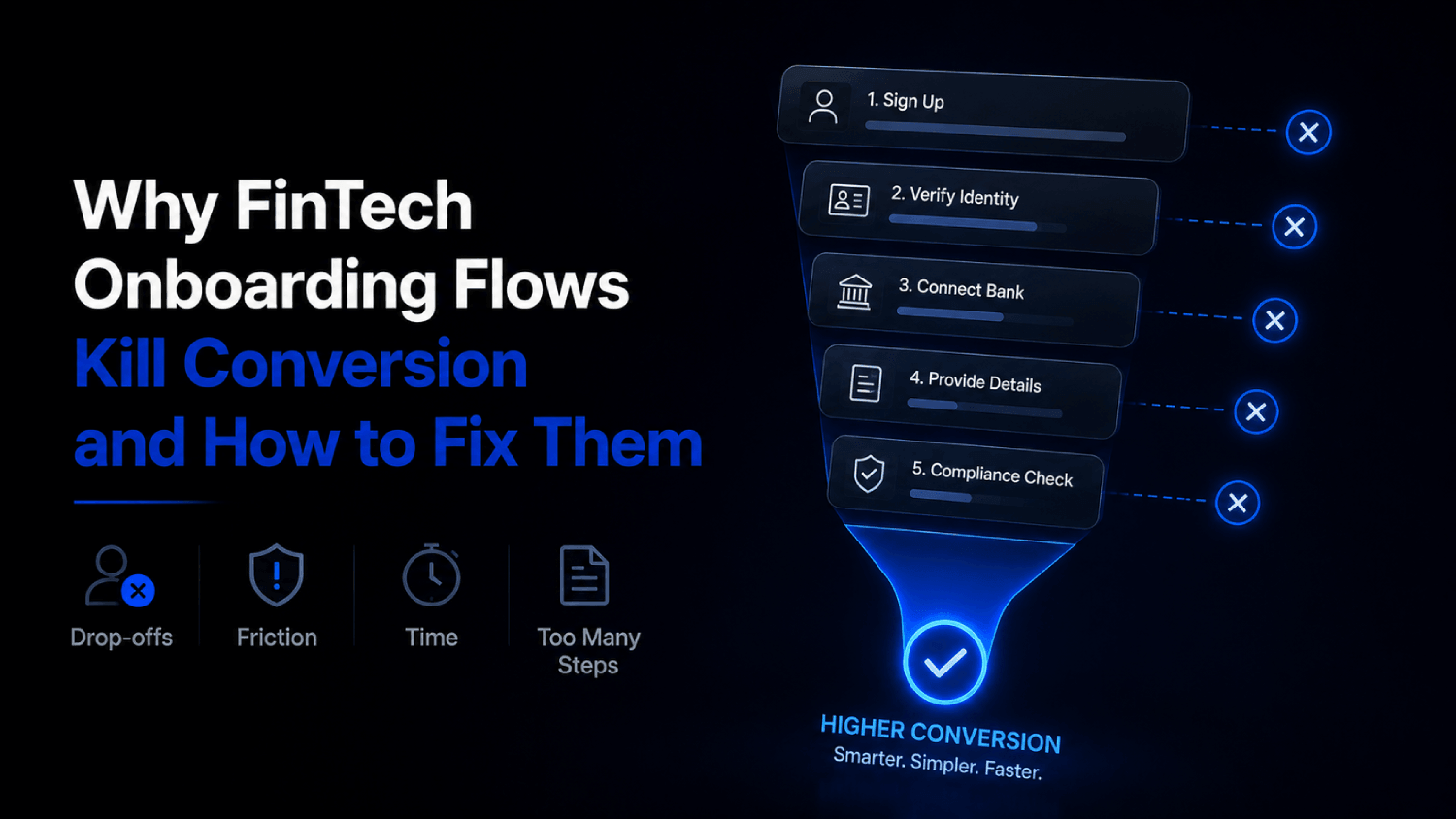

- Most fintech onboarding drop-off is not a compliance problem. It is a sequencing, trust, and communication problem that teams misattribute to KYC.
- Asking for sensitive information before demonstrating product value is the single most common structural mistake in fintech onboarding flows.
- Wait states, vague error messages, and missing support fallbacks cause abandonment at rates that dwarf the cost of an extra form field.
- The FintechSpecs Onboarding Teardown Framework breaks the activation funnel into seven checkpoints, each with a specific failure mode and a concrete fix.
- Progressive disclosure, risk-tiered KYC, and instant value proofs are not UX niceties. They are conversion levers with measurable impact on activation rates.
Fintech onboarding drop-off is largely a fixable product problem, not an unavoidable compliance tax. The core causes are poor sequencing (asking for identity before showing value), weak trust signals, absent wait-state communication, and unnecessary fields that serve internal assumptions rather than regulatory requirements. Teams that address these structural issues systematically, rather than patching individual screens, see material improvement in activation rates.
Why Fintech Onboarding Flows Kill Conversion at a Rate Most Teams Underestimate
Research on onboarding UX consistently finds that fintech products lose a significant share of prospects when onboarding runs longer than five minutes. That is not primarily because users are impatient. It is because five minutes of form-filling, document uploads, and identity checks, before a user has touched a single product feature, asks for enormous trust in exchange for nothing.
The assumption built into most fintech onboarding flows is that compliance gates must come first because regulators require it. That assumption is only partially true. Regulators require identity verification before a user transacts or holds funds. They rarely require it before a user sees a dashboard, calculates a savings rate, or runs a simulated transfer. The sequence is a product decision, not a legal one, and teams that conflate the two leave real conversion on the table.
A typical onboarding flow at a neobank, lending product, or investment platform asks for full legal name, date of birth, SSN, address, phone number, email verification, document upload, and sometimes bank linking, all before the user has seen their account balance or sent a single dollar. Each step is individually justifiable. Stacked together, they read as distrust. The user experience communicates that the product assumes the worst about them before proving it deserves their information.
What Does “Activation” Actually Mean in a Fintech Context?
Activation in fintech is the moment a user completes the minimum action that makes the product real to them: a first transfer sent, a card added to Apple Pay, a portfolio funded, an invoice paid. Everything before that moment is friction cost. The goal of onboarding is not completion of a compliance checklist. It is reaching activation in the fewest steps possible without violating the regulatory requirements that apply to that user at that risk tier.
Conflating “onboarded” with “KYC-complete” is the root error. A user can reach activation on many products with a soft identity check, then complete full KYC when they hit a transaction threshold. Products like Wise and Mercury have both iterated toward risk-tiered onboarding, where the depth of verification scales with the user’s intended activity. A user sending $200 domestically faces a lighter initial gate than one wiring $50,000 internationally. That is not regulatory slippage. It is good product design that happens to align with how most AML frameworks actually work.
The FintechSpecs Onboarding Teardown Framework: Seven Checkpoints
What follows is a structured audit framework, the FintechSpecs Onboarding Teardown Framework, built around the seven points where fintech onboarding consistently breaks down. Run your own flow through each checkpoint before drawing conclusions about what is hurting your conversion rate.
Checkpoint 1: Timing of the Value Proof
Where in the flow does the user first see or feel what the product does for them? If the answer is “after KYC approval,” the flow is built backwards. A value proof does not need to be a fully funded account. It can be a rate comparison, a projected return, a simulated dashboard, or a single completed action in a sandboxed state. Show the product before you ask for the identity.
Products that do this well include Robinhood, which lets users browse the investment interface and watchlist stocks before completing identity verification. The user develops a stake in the product before they hand over their SSN. Abandonment at the identity step drops because the user now has something to lose by leaving.
Checkpoint 2: Field Necessity Audit
Every field in your onboarding flow should answer one question: is this required by regulation, required by your fraud model, or required by your product’s core function? If it is none of these, cut it. Middle name, secondary phone number, referral source, employer name during initial signup for consumer products: these are examples of fields that feel reasonable in isolation but add friction without adding compliance or product value at that stage.
Run a field-by-field audit. Assign each field to one of three categories: regulatory requirement, fraud signal, or product necessity. Everything else is optional, and optional fields should default to off during initial onboarding. Collect them later, once the user has activated.
Checkpoint 3: KYC Sequencing and Drop-Off Signals
KYC is where most fintech onboarding audits start and stop. That is the wrong scope. KYC drop-off is real, but it is often a symptom of poor preparation rather than an inherently leaky step. Users abandon identity verification for three specific reasons: they were not warned about what documents they would need, the camera or upload interface failed them on mobile, or the wait state after submission gave them no signal about what would happen next.
The fix for each is concrete. Warn users about document requirements two screens before the upload step, not on the upload screen itself. Test your document capture interface on low-end Android devices, not just a MacBook camera. Set an explicit expectation for review time (“typically under 2 minutes,” or “we review within one business day”), and push a status update via email or SMS when the review completes. For a deeper look at how KYC providers differ on approval rates and UX quality, the KYC provider comparison on FintechSpecs breaks down the major vendors by those exact dimensions.
Checkpoint 4: Bank Linking Friction
Bank account linking through Plaid, MX, or Finicity is a high-drop step for a predictable reason: users who have never heard of these intermediaries see a third-party screen asking for their bank username and password, and they close the app. The trust gap is not irrational. It is a communication failure on the product’s part.
The fix requires two things. First, name the intermediary and explain what it does in plain language, one screen before the bank linking modal appears. Something like “We use Plaid, a secure connection service used by thousands of financial apps, to link your bank. We never store your login credentials.” Second, always offer microdeposit verification as a fallback, even if it delays activation by 1-2 days. Some users will never use credential-based linking regardless of how you explain it. Removing the fallback eliminates those users entirely.
Checkpoint 5: Document Upload UX
Document upload is where mobile-first fintech products frequently fail desktop-last. A user on an iPhone trying to photograph a state ID against a kitchen counter at night, using a form field designed for desktop file uploads, is not going to complete that step. File size limits, unsupported formats, blurry-image errors with no guidance, and timeout failures are the four most common causes of document upload abandonment.
Real-time image quality feedback, which flags blur or lighting problems before the user submits, reduces resubmission rates measurably. Onfido and Jumio both offer this capability at the SDK level. If you are building your own document capture, budget for it explicitly. The alternative is a silent failure that looks like user indifference in your funnel data.
Checkpoint 6: Wait State Communication
The period between submission and approval is the highest-risk window for permanent abandonment. A user who submits their identity documents and sees nothing for 24 hours has no idea whether the app is broken, their application is rejected, or review is in progress. They will often assume the worst and move on.
Three rules for wait states: give a specific time estimate rather than “under review,” send at least one proactive status update before the estimate expires, and give the user something to do while they wait. That last point is underused. During a 24-hour review window, a user can set notification preferences, explore product features in a preview mode, invite a contact, or set up their profile. Keeping the user active during the wait state reduces cold-start abandonment significantly and also gives you behavioral data about user intent before they have transacted.
Checkpoint 7: Support Fallback Visibility
Every broken step in onboarding needs a visible exit that does not end in app deletion. “Contact support” buried three menus deep is not a support fallback. It is friction that communicates the product does not expect things to go wrong, which makes the user feel worse when something does.
The support fallback should be visible at every high-friction step: KYC, bank linking, document upload, and any error state. A simple inline link to a live chat or a short-form help article is enough. Products that surface support proactively at error states see lower permanent abandonment than those that rely on users to find help on their own. This also connects directly to retention: a user who gets unstuck is more likely to activate than one who abandons and forgets.
The Onboarding Teardown Checklist
| Checkpoint | Common Failure Mode | Concrete Fix | Priority |
|---|---|---|---|
| Value Proof Timing | Product shown only after full KYC | Add sandboxed feature or rate preview before identity step | High |
| Field Necessity | Collecting fields that serve neither compliance nor product | Audit each field: regulatory / fraud / product only | High |
| KYC Sequencing | No document prep warning, poor mobile capture, silent post-submission | Pre-warn 2 screens early, test on low-end Android, set time expectation | High |
| Bank Linking | Third-party modal with no context, no fallback | Explain Plaid/MX/Finicity before modal, offer microdeposit fallback | Medium |
| Document Upload | Timeout errors, blurry image failures, no real-time feedback | Add real-time quality check, clear format/size guidance | Medium |
| Wait State Communication | Silent review window, no estimated timeline | Specific ETA, proactive status SMS/email, preview mode during wait | High |
| Support Fallback | Help buried deep, no escape from error states | Inline chat or help link at every high-friction and error screen | Medium |
How Risk-Tiered KYC Changes the Conversion Equation
Most fintech products apply maximum KYC requirements to all users at signup, regardless of their intended activity. That is a policy choice, not a regulatory mandate. FinCEN’s rules under the Bank Secrecy Act, and similar frameworks under CFPB guidance, allow for risk-based approaches to customer due diligence. A user creating a read-only account to view rates is not the same risk profile as one initiating a wire transfer above a reporting threshold.
Risk-tiered onboarding means collecting the minimum identity information required to let a user reach activation, then triggering enhanced verification when the user’s behavior crosses a defined threshold, whether by transaction volume, transfer type, or account age. This approach keeps the initial funnel shorter, which improves conversion at the top, while ensuring compliance at the point it actually matters. For teams concerned about the compliance cost of building tiered flows, the real cost of compliance at each stage of a fintech SaaS company gives a concrete breakdown of what that investment typically looks like.
The caveat is that tiered KYC requires a thoughtfully designed escalation moment. If a user hits an identity check for the first time after they are already engaged with the product, the communication around that moment needs to be clear: why it is happening now, what is required, and what happens if they cannot complete it. Teams that handle this escalation well retain more users through enhanced verification than teams that apply maximum friction at signup and hope users push through.
Why “Reduce Friction” Is the Wrong Frame for Fintech Onboarding
Telling a product team to reduce friction is too abstract to act on. Friction is not uniformly bad. Some friction signals security and builds trust. Asking a user to confirm their email address, for example, is friction that most users accept because they understand why it exists. The frame that actually produces results is friction justification: every piece of friction in your onboarding flow must be justified to the user in real time, in plain language, at the moment it appears.
A user who sees “We need your SSN to verify your identity as required by federal law” will comply at a higher rate than one who sees a blank SSN field with no explanation. The information requested is identical. The conversion difference comes entirely from whether the product bothered to explain itself. This is not a UX platitude. It is the difference between a user who trusts the product and one who suspects it.
Trust signals in fintech onboarding go beyond explanation copy. They include FDIC or SIPC insurance badges displayed at account creation, explicit statements about data handling adjacent to sensitive fields, and named security certifications like SOC 2 Type II displayed near document upload. None of these add meaningful time to the flow. All of them reduce the psychological cost of the steps they accompany. Teams building these flows from scratch, or rebuilding them, should read the FintechSpecs piece on trust-breaking mistakes fintech products make, which covers a wider set of the UX and operational choices that erode user confidence before activation.
What Product Analytics Actually Tells You About Onboarding Drop-Off
Most product teams look at aggregate funnel conversion: X% of signups complete KYC, Y% link a bank account. That data is useful but insufficient. The numbers that reveal fixable problems are step-level time-in-state and exit points within a single screen.
A user who spends four minutes on a document upload screen and then exits has a different problem than one who exits in under ten seconds. The first user tried and failed, probably because of a technical or UX issue. The second user saw the screen and made a deliberate decision not to proceed, probably a trust or value problem. Fixing the first requires improving the upload interface. Fixing the second requires adding a trust signal or explanation before the screen appears. If your analytics cannot distinguish these two exit types, you will spend engineering cycles on the wrong problem.
Session recording tools like Hotjar or FullStory reveal exactly where on a screen users abandon. Exit surveys with a single question, “What stopped you from completing this step?”, added to the abandonment confirmation email, generate qualitative data that funnel numbers alone cannot produce. These are low-cost inputs that most teams have access to and underuse. For teams tracking broader product and growth metrics, the fintech metrics that actually matter beyond vanity growth covers which onboarding and activation signals are worth tracking at each stage.
Where Fraud Detection Creates Invisible Onboarding Failures
One category of onboarding drop-off that product teams systematically miss is false positive rejections from fraud detection systems. A user whose identity verification silently fails because their name does not match their document exactly, or whose device fingerprint triggers a fraud flag, will receive either a generic “we could not verify your identity” error or, in worse implementations, no error at all, just a silent termination of the flow.
From the user’s perspective, the product broke. From the product analytics perspective, the user abandoned. Neither is true: the fraud system rejected them, often incorrectly. The rate at which this happens depends on the sensitivity of your fraud configuration and the quality of your KYC provider’s identity matching logic. Reviewing your fraud tool’s false positive rate, and building a manual review queue for borderline cases rather than auto-declining, recovers a population of good users that current funnels treat as losses. The fraud detection and risk tool comparison for fintech startups covers which vendors allow the most configurability on sensitivity thresholds, which matters directly for this problem.
Frequently Asked Questions About Fintech Onboarding Conversion
What is the KYC onboarding process in fintech?
KYC, or Know Your Customer, is the process by which a fintech product verifies a user’s identity before allowing them to access regulated financial services. It typically involves collecting legal name, date of birth, government-issued ID, and sometimes address and SSN, then running those details against identity databases or document verification services. The depth of verification required depends on the product type, transaction thresholds, and applicable regulation, such as FinCEN’s Customer Identification Program rules for US-regulated entities. Risk-based KYC frameworks allow lighter initial verification that escalates as user activity increases.
What is an activation funnel in fintech?
An activation funnel in fintech is the sequence of steps between a user signing up and completing their first meaningful product action, such as funding an account, sending a payment, or connecting a data source. Activation is a distinct metric from signup or KYC completion because it measures whether the user has actually experienced product value. Products with long, friction-heavy onboarding flows often show strong signup numbers but weak activation rates, which signals that users are creating accounts but not reaching the moment where the product becomes real and useful to them.
Why do users abandon fintech onboarding before completing KYC?
The most common reasons are: being asked for sensitive information before understanding why the product deserves it, encountering document upload failures on mobile, receiving no explanation for why specific fields are required, and seeing no indication of how long review will take after submission. Trust signals are also a factor, with users more likely to abandon when they see no security or compliance certification near the identity collection step. These are all product and communication problems, not inherent limitations of the compliance process.
How long should a fintech onboarding flow take?
Onboarding UX research consistently points to five minutes as the threshold beyond which fintech products see meaningful drop-off. The practical target depends on product type: a consumer HYSA should aim for a lighter initial flow than a business banking product, which has higher KYB requirements. The principle is to reach the user’s first activation moment in the fewest required steps, then collect additional information progressively as the user demonstrates engagement and their risk profile becomes clearer.
What is progressive disclosure in fintech onboarding?
Progressive disclosure means collecting only the information required for the user’s current action, and asking for more as they advance through the product. In practice, this means allowing a user to see a dashboard or run a calculation before requesting identity, and asking for bank linking only when the user initiates a transaction that requires it. It is the structural alternative to front-loading all compliance requirements at signup, and it works because it aligns the user’s commitment level with the product’s information requests at each stage.
Does faster KYC always improve conversion?
Speed helps but is not the primary driver. A KYC step that completes in 30 seconds but asks for information a user does not understand, or that fails silently, will still produce abandonment. The more important variables are preparation (was the user warned what they would need?), clarity (is the reason for each field explained?), feedback (does the user know their submission was received and when to expect a response?), and fallback (is there a visible way to get help if something goes wrong?). Speed matters more when it reduces perceived wait time during review than when it accelerates the collection form itself.
How does bank linking affect fintech onboarding drop-off?
Bank linking is one of the highest-drop steps in consumer fintech onboarding because it introduces a third-party interface, typically Plaid, MX, or Finicity, that many users have never encountered. When users see a screen asking for their bank username and password from an unfamiliar service, abandonment spikes. The fix is contextual explanation before the modal appears, not within it. Offering microdeposit verification as a fallback retains users who will not use credential-based linking under any circumstances. Comparing how these open banking APIs handle user experience is covered in the Plaid vs MX vs Finicity breakdown on FintechSpecs.
What is the average fintech onboarding conversion rate?
Fintech UX researchers and onboarding conversion analysts generally cite a healthy onboarding conversion rate in the range of 60% to 80%, though this varies considerably by product type, target user, and how conversion is defined. A lending product requiring credit underwriting will see lower completion rates than a HYSA with a lighter verification requirement. The more useful benchmark is comparing your own step-level drop-off against your historical baseline and against the completion rates of products targeting the same user segment, rather than chasing a universal number.
The Real Problem Is a Product Ownership Gap, Not a Compliance Gap
Most fintech onboarding failures persist not because they are hard to fix but because no single team owns the full flow. Compliance owns the KYC requirements. Engineering owns the document upload component. Growth owns the activation metric. Design owns the interface. When the onboarding flow drops users between steps, everyone points at a different owner and the problem stays broken longer than it should.
The teams that fix onboarding meaningfully assign one person, usually a product manager with authority across compliance, design, and engineering, to treat the full onboarding flow as a single product surface. That person runs the teardown framework above, assigns fixes to the right teams, and tracks step-level conversion as a product metric rather than a growth marketing metric. The seven-checkpoint audit described here is most useful when it generates a shared list of fixes that every stakeholder can see against the same funnel data.
The deeper insight is this: fintech onboarding is not broken because compliance is hard. It is broken because teams designed the flow to satisfy internal requirements and assumed users would complete it anyway. Users do not complete things that feel like bureaucracy. They complete things that feel like progress. Rebuilding onboarding around the user’s sense of progress, with compliance gates sequenced where they are actually required and explained when they appear, is the whole fix. Everything else is implementation.