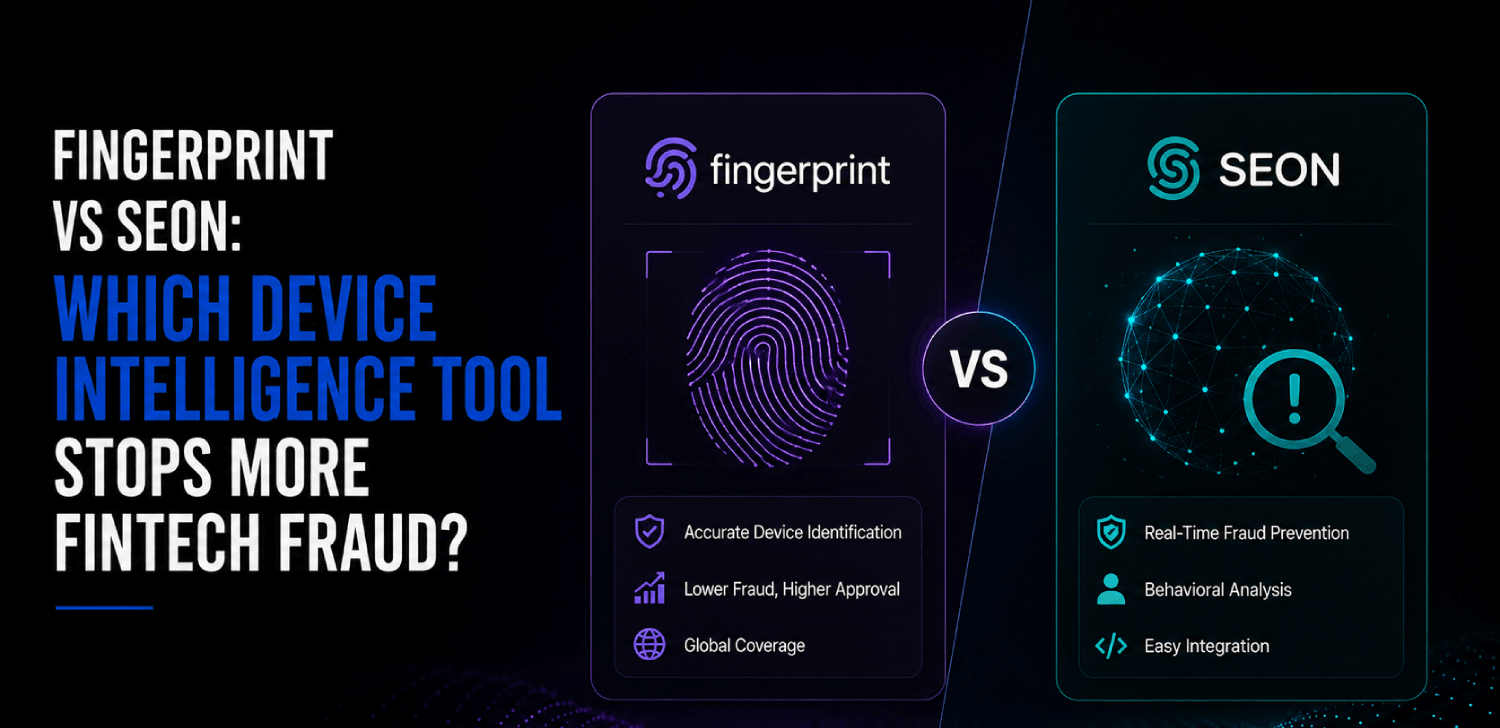

- Fingerprint specializes in device identification with a claimed 99.5% accuracy on its public site, making it the stronger choice when your primary threat is account takeover and credential stuffing.
- SEON combines device signals with email intelligence, phone intelligence, IP analysis, and social media lookups, giving fraud teams broader risk context at the cost of raw identification precision.
- Pricing models differ materially: Fingerprint charges per API call on a consumption basis, while SEON’s pricing is modular and tied to the signals you activate. Neither is obviously cheaper without knowing your traffic volume and fraud vector mix.
- For card cracking and payment fraud, SEON’s layered signal approach outperforms. For login-layer fraud and bot-driven ATO, Fingerprint’s identification depth wins.
- Treating these tools as interchangeable commodities is the mistake most fraud teams make before their first major incident.
Fingerprint vs SEON is not a question with a universal answer. Fingerprint is the better pick for teams whose primary fraud vector sits at the authentication layer, where device identification accuracy directly determines how many account takeover attempts you catch before they succeed. SEON is the better pick for teams who need a broader fraud signal stack covering payment fraud, synthetic identity, and social engineering, and who want to tune their own rules engine against those signals. Your traffic volume, fraud vector distribution, and engineering capacity determine which matters more.
Why Fraud Teams Get This Decision Wrong
Most fraud and risk leads evaluate device intelligence tools the same way they buy SaaS subscriptions: look at the feature list, compare the price, pick the cheaper one. That works for project management software. It does not work here, because the cost of the wrong choice is not a wasted seat license. It is fraud losses that compound for months before you realize your detection layer has a gap.
The deeper mistake is conflating device fingerprinting with device intelligence. They are related but not the same thing. Device fingerprinting is a technique: it collects browser and hardware signals to generate a stable identifier for a device across sessions. Device intelligence is a broader category: it interprets those signals in context, combines them with other data sources, and produces a risk verdict. Fingerprint sits closer to the fingerprinting end of that spectrum. SEON sits closer to the intelligence end. That distinction drives almost every trade-off in this comparison.
How Does Fingerprint’s Detection Approach Work?
Fingerprint’s core product is a visitor identifier. It generates a visitorID, a stable, probabilistic fingerprint derived from browser attributes, hardware signals, network characteristics, and behavioral patterns, and associates it with a persistent history of visits across sessions and even incognito mode. The company publicly claims 99.5% identification accuracy on its marketing pages, though they do not publish the methodology behind that figure.
The practical implication is high confidence at the device layer. When a fraudster attempts an account takeover using stolen credentials, Fingerprint can flag that the login device has never been seen before, or that the same device has been linked to multiple failed login attempts across accounts. That signal alone stops a large share of credential stuffing attacks, because most credential stuffing is automated and uses a narrow pool of infrastructure.
Fingerprint also offers Smart Signals, a layer of pre-built detections that sit on top of the raw identifier. These include incognito mode detection, virtual machine detection, browser tampering detection, and VPN/proxy identification. The SDK integrates via JavaScript snippet or mobile SDK, and the API returns results in under 500 milliseconds according to their documentation. For teams that need a clean, fast, developer-friendly identification layer without building their own rules engine, Fingerprint is well-designed for that job.
How Does SEON’s Detection Approach Work?
SEON approaches fraud detection from a different starting point. Rather than maximizing identification precision on a single signal type, it aggregates multiple independent signal sources and asks whether the combination is consistent with a legitimate user. Those sources include device fingerprinting, IP intelligence, email analysis, phone number analysis, and social media lookups against platforms like LinkedIn, Gravatar, and Twitter/X.
The email intelligence module checks whether an address is associated with real social accounts, whether it was recently created, and whether it appears on known breach lists. That is a signal set that no pure device fingerprinting tool produces. For fraud vectors like synthetic identity creation, where a fraudster uses a real device but a fabricated email history, this coverage difference is significant.
SEON also includes a configurable rules engine and a machine learning layer that teams can tune against their own labeled fraud data. This makes SEON less plug-and-play than Fingerprint, but more adaptable to specific fraud patterns that do not fit generic detection logic. For fraud teams with an analyst who can write rules and review model outputs, that flexibility has real value. For a two-person engineering team that needs fraud detection before launch, the configuration overhead is a genuine cost.
Signal Depth Comparison: What Each Tool Actually Detects
| Signal Category | Fingerprint | SEON |
|---|---|---|
| Device identifier (cross-session) | Yes, core product | Yes, one module among several |
| Browser attribute collection | Yes, deep collection | Yes |
| Incognito/private mode detection | Yes (Smart Signals) | Yes |
| VPN / proxy / Tor detection | Yes (Smart Signals) | Yes |
| Virtual machine / emulator detection | Yes (Smart Signals) | Yes |
| Bot / automation detection | Yes (Smart Signals) | Yes |
| IP intelligence and geolocation | Basic | Deep, including ISP and risk scoring |
| Email intelligence (social lookup) | No | Yes, core differentiator |
| Phone number intelligence | No | Yes |
| Social media presence scoring | No | Yes |
| Custom rules engine | Limited (via webhooks and integration) | Yes, built-in configurable rules engine |
| Machine learning model tuning | No self-serve tuning | Yes, trainable on own fraud data |
| AML / compliance layer | No | Yes (separate module) |
How Does Pricing Differ Between Fingerprint and SEON?
Fingerprint publishes tiered pricing on its public pricing page. The free tier covers 20,000 API calls per month, which is useful for development and low-traffic testing but not production fraud detection at meaningful scale. Paid plans start at a published monthly fee and scale by API call volume. Enterprise pricing is negotiated directly. The key pricing characteristic is that you pay per identification event, so cost scales directly with traffic, not with how many signals you activate.
SEON’s pricing page shows a modular structure. You activate the modules you need, email intelligence, phone intelligence, device fingerprinting, AML, and pay for the combination. This creates more pricing variables but also means a team that only needs device signals plus IP intelligence does not pay for social media lookups they will never use. For high-volume, low-breadth deployments, Fingerprint can be cheaper. For lower-volume deployments where you need multiple signal types, SEON’s modularity can be more cost-efficient.
Neither vendor publishes enterprise pricing publicly, and both encourage prospective buyers to request a demo before getting a firm quote. If you are comparing total cost at scale, model your expected monthly API call volume against Fingerprint’s per-call rates and compare it to SEON’s module fees at your expected transaction volume. The crossover point is not the same for every team.
Verdict by Fraud Vector: Which Tool Wins for Each Threat Type?
Credential Stuffing and Account Takeover: Fingerprint Wins
Credential stuffing relies on automated bots cycling through username/password combinations harvested from data breaches. The attacker’s goal is to find valid credentials before rate limiting or IP blocking stops them. Fingerprint’s high-confidence device identifier catches the reuse of the same device or device fingerprint across multiple login attempts, even when the attacker rotates IPs. Its bot detection Smart Signal adds another layer. For a neobank or lending platform where account takeover is the dominant fraud vector, Fingerprint’s identification precision at the login layer is the right primary tool.
Card Cracking and Payment Fraud: SEON Wins
Card cracking, where fraudsters test stolen card numbers against a payment form at low velocity to find valid cards, is a device-layer and behavioral problem, but it is also an identity-layer problem. The fraudster may use a clean device with a fresh email address and a residential IP. Fingerprint will not flag that session. SEON’s email intelligence and phone intelligence modules can identify that the email was created 12 hours ago, has no social presence, and is linked to a phone number registered in a different country. That combination of signals catches card cracking attempts that pure device fingerprinting misses entirely. For more on tools specifically designed for this threat, see FintechSpecs’ card cracking prevention tools comparison.
Synthetic Identity Fraud: SEON Wins
Synthetic identity fraud uses constructed identities built from real and fabricated data. The fraudster may operate from a legitimate consumer device, making device-layer signals largely useless. SEON’s multi-signal approach, correlating email age, social presence, phone carrier data, and behavioral patterns, is far better suited to detecting the identity inconsistencies that synthetic fraud leaves behind.
New Account Fraud at Scale: Fingerprint for Volume, SEON for Depth
At high registration volume, Fingerprint’s speed advantage matters. Sub-500ms API response on identification means you can run it synchronously in your onboarding flow without adding noticeable latency. SEON’s enrichment lookups across multiple external APIs take longer, which may push the risk check to an asynchronous review queue. If you need a real-time go/no-go at account creation for millions of monthly signups, Fingerprint handles the synchronous check and SEON handles the deeper async review. These tools are not mutually exclusive at this fraud vector.
Promotion Abuse and Multi-Accounting: SEON Wins
Bonus abuse and multi-accounting require detecting when the same individual is operating multiple accounts. Device fingerprinting helps here when the user is on the same device, but sophisticated abusers use multiple devices to avoid exactly that signal. SEON’s cross-entity linking through email and phone intelligence can connect accounts that share characteristics even across different devices. That makes it the stronger tool for neobanks and crypto platforms where promotion abuse is a meaningful loss driver.
The FintechSpecs Signal Stack Test
Before picking a vendor, fraud teams should work through what we call the FintechSpecs Signal Stack Test: map your actual fraud losses by vector over the last 90 days, then ask which signal layer would have caught each incident at the lowest false-positive cost. It is a four-question exercise designed to force specificity before a contract is signed.
First: what percentage of your losses came from login-layer attacks versus payment-layer attacks versus onboarding fraud? If login-layer losses exceed 60% of total, Fingerprint’s identification accuracy is your primary lever. Second: how much of your fraud involved clean devices used by bad actors rather than compromised devices? If the answer is significant, pure device fingerprinting has a ceiling. Third: do you have an analyst who can write and maintain rules, or do you need out-of-the-box detection? SEON requires more configuration investment. Fourth: what is your monthly API call volume and what is the cost crossover between the two vendors’ pricing models at that volume?
If you cannot answer the first question with real loss data, run a 30-day fraud tagging exercise before you sign anything. Buying a device intelligence tool without knowing your fraud vector distribution is how teams end up with a tool that does not fit. For a broader view of where fraud tooling fits within your full risk and compliance infrastructure, the FintechSpecs fintech product and compliance readiness checklist maps device intelligence against KYC, AML, and transaction monitoring obligations.
Implementation and Integration: What Does Each Tool Require?
Fingerprint’s implementation is a JavaScript snippet or mobile SDK, and the API returns a visitorID plus Smart Signal results. A developer can have the basic integration running in a few hours. The heavier lift is on the decision layer: you still need to decide what to do with the visitorID and signals, which means building or buying a rules engine separately.
SEON’s integration involves API calls per event type, and the setup of the rules engine requires meaningful configuration time. Their no-code rules interface is relatively accessible, but getting the model tuned to your specific fraud pattern requires labeled historical data and iteration. Plan for two to four weeks of integration and tuning before the system is performing well. For teams evaluating the full fraud detection stack, the fraud detection and risk tools overview on FintechSpecs covers how device intelligence fits alongside transaction monitoring, identity verification, and behavioral analytics.
Both vendors offer SDKs for Android and iOS in addition to web integrations. Fingerprint’s mobile SDK is notably well-documented; the mobile implementation is comparable in complexity to the web version. SEON’s mobile coverage exists but has historically received less attention in developer reviews than its web product.
Where Fingerprint Has Material Weaknesses
Fingerprint does not enrich identity signals. If a fraudster uses a real device they have never used for fraud before, Fingerprint has no historical anchor to flag them. The tool is retrospective in that sense: it builds a history of a device and alerts on anomalies, but it cannot tell you much about a device it has never seen. This cold-start problem is significant for businesses with high new-user volume where the fraud happens at first contact.
Fingerprint also does not offer a native AML or compliance layer. If your fraud team overlaps with your compliance function, as it does at most early-stage fintechs, you will need a separate vendor for AML transaction monitoring and sanctions screening. SEON includes AML as a module, though it is not a replacement for a dedicated AML platform at significant transaction volume. For a breakdown of dedicated AML tooling, see FintechSpecs’ AML screening API comparison.
Where SEON Has Material Weaknesses
SEON’s device fingerprinting is one component of a broader platform rather than its primary engineering focus. Reviewers on Gartner Peer Insights note that SEON is particularly strong when teams can invest in customizing its rules engine, which implies that teams who cannot do that customization get a less differentiated product. Its device identification accuracy is not independently published, and Fingerprint’s specific engineering investment in identification precision is reflected in the product.
The multi-API enrichment approach also introduces latency and third-party dependency. Social media lookups against external platforms can fail or return stale data. At high volume, this creates both performance and data freshness risks that a pure device fingerprinting approach does not have.
Frequently Asked Questions
Is Fingerprint better than SEON for preventing credential stuffing?
For credential stuffing specifically, Fingerprint is the stronger choice. Credential stuffing attacks rely on automating login attempts at scale, and Fingerprint’s high-confidence device identifier catches the reuse of infrastructure across attempts even when attackers rotate IPs. SEON can detect credential stuffing as well, but its broader signal set is more valuable for fraud vectors that happen away from the authentication layer, such as payment fraud and synthetic identity creation.
Does SEON do device fingerprinting?
Yes, SEON includes device fingerprinting as one of its signal modules. The distinction is that device fingerprinting is not SEON’s primary engineering focus. SEON’s differentiation comes from combining device signals with email intelligence, phone intelligence, IP analysis, and social media presence scoring into a unified risk score. Teams that need maximum device identification accuracy will find Fingerprint’s depth in that specific area more advanced than SEON’s device module.
How does Fingerprint’s real-time detection compare to SEON?
Fingerprint returns identification and Smart Signal results in under 500 milliseconds according to its documentation, making synchronous integration at login or payment submission practical. SEON’s multi-source enrichment involves external API lookups that add latency. For real-time, synchronous fraud checks at high volume, Fingerprint has a clear speed advantage. SEON’s deeper enrichment is better suited to asynchronous risk review workflows where a few seconds of delay is acceptable.
Can you use Fingerprint and SEON together?
Yes, and for some fraud stacks this combination makes sense. Fingerprint handles synchronous device identification at the login or payment layer, and SEON handles asynchronous enrichment and rule evaluation after the event is captured. The cost of running both is a real consideration, and most teams at seed to Series A will pick one. Series B and later fraud teams with dedicated analysts and meaningful fraud loss rates are the most likely candidates for a layered approach.
What kind of company is SEON?
SEON is a fraud prevention and AML compliance platform founded in Budapest in 2017. It serves financial services companies, neobanks, gaming platforms, and e-commerce operators. Its product covers device intelligence, email and phone enrichment, IP analysis, a configurable rules engine, machine learning-based fraud scoring, and an AML compliance module. It competes with Fingerprint on device intelligence but more broadly with fraud orchestration platforms like Sardine, Kount, and Sift.
How should a Series A fintech choose between Fingerprint and SEON?
Map your fraud losses by vector before making any vendor decision. If your losses are concentrated in account takeover and bot-driven attacks, Fingerprint’s identification precision justifies its focused scope. If your losses are spread across payment fraud, promotion abuse, and synthetic identity, SEON’s multi-signal approach covers more of that distribution. Also consider engineering capacity: Fingerprint is faster to implement, SEON requires more configuration but returns more signal types. The fraud prevention versus user experience trade-off analysis on FintechSpecs is worth reading before finalizing your stack design.
Does Fingerprint work for mobile fraud prevention?
Fingerprint offers iOS and Android SDKs in addition to its JavaScript web integration. The mobile SDK generates a stable device identifier that persists across app reinstalls in many cases, which is relevant for mobile-first fraud vectors. SEON also offers mobile SDKs. Both have web-first origins, but Fingerprint’s mobile documentation and developer reviews are generally stronger than SEON’s for native mobile implementations.
What fraud signals does SEON check that Fingerprint does not?
SEON checks email address age and social media presence across platforms including LinkedIn, Gravatar, and Twitter/X. It also checks phone number validity, carrier type, and country of registration, and runs IP analysis that includes ISP-level risk scoring. None of these signal types are available in Fingerprint’s product. These signals are most valuable for detecting synthetic identities, new account fraud, and promotion abuse, where the device is legitimate but the identity is not. For a broader view of where device intelligence fits in the fintech fraud stack, the device fingerprinting tools comparison covers additional vendors in the category.
The Decision That Actually Matters
Device fingerprinting accuracy and device intelligence breadth are in tension, not in alignment. Fingerprint built a product that is extremely good at one thing: knowing whether it has seen this device before and what it knows about it. SEON built a product that is reasonably good at many things: constructing a risk picture of both the device and the identity behind it. These are different products serving different primary use cases, despite appearing in the same vendor category.
The teams most likely to regret picking Fingerprint are those whose fraud shifts from ATO to payment fraud without a corresponding change in their detection stack. The teams most likely to regret picking SEON are those who needed a fast, developer-friendly identification layer and instead spent weeks configuring a rules engine. Both situations are common, and both are avoidable with a clear fraud vector audit before the contract is signed. Compliance-adjacent teams building their full risk infrastructure from scratch should also review the fintech product and compliance readiness checklist to understand where device intelligence sits relative to KYC, AML, and transaction monitoring obligations.
Fingerprint is not a better product than SEON in aggregate. SEON is not a better product than Fingerprint in aggregate. One is a precision instrument for a specific layer of fraud. The other is a broader signal aggregator that trades some precision for coverage. The right answer is the one that matches your actual fraud distribution, not the one that looks better in a feature matrix.