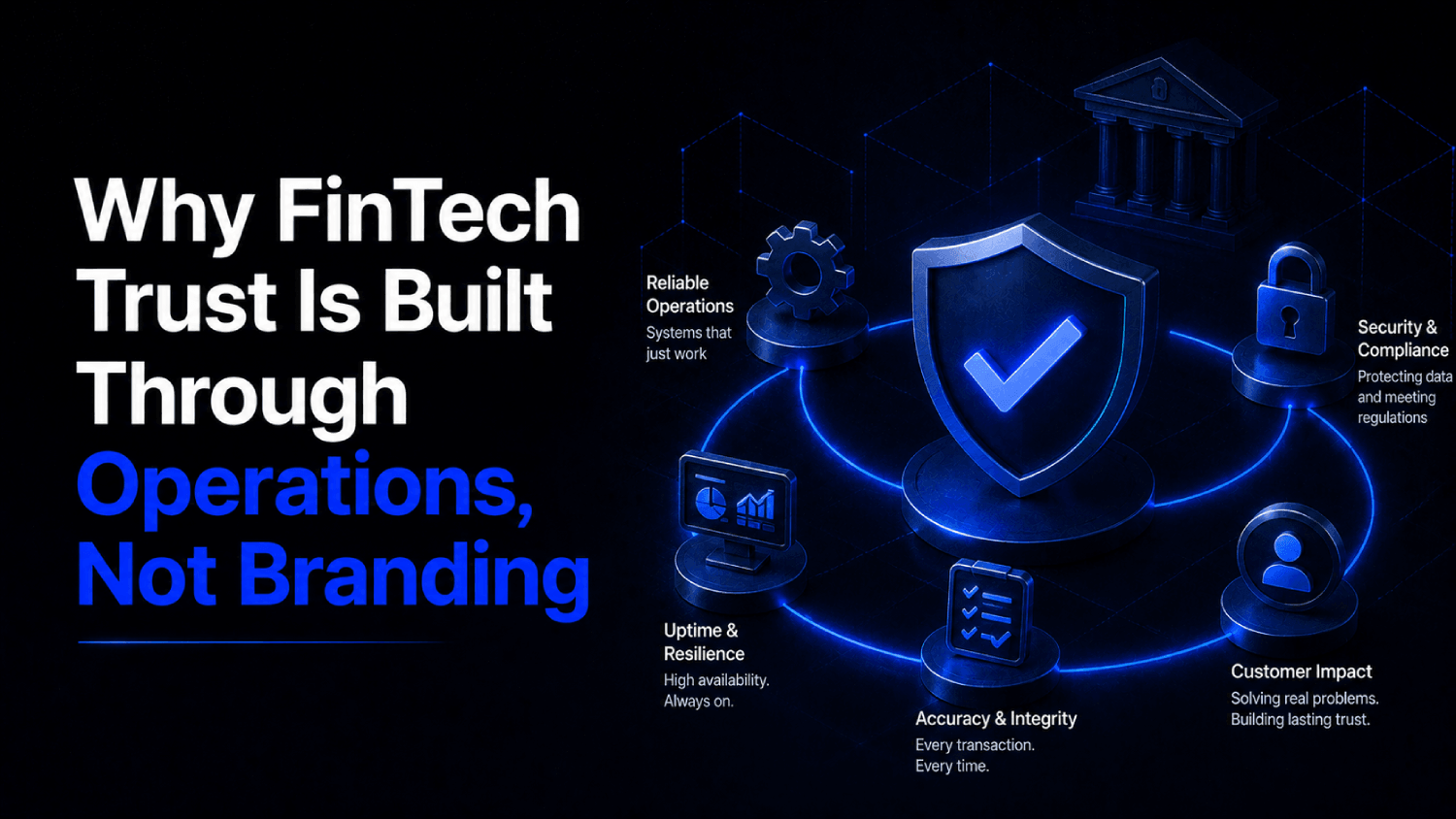

- A polished brand, a security badge, and five-star G2 reviews do not make a fintech company trustworthy. They make it look trustworthy, which is a different thing entirely.
- In fintech, trust is a product of operations: what happens when a payment fails, when a compliance question surfaces, when a user gets locked out at midnight, when your status page goes dark.
- The companies that retain customers through market turbulence are not the ones with the best logo. They are the ones whose systems behave predictably and whose teams communicate honestly under pressure.
- There is a repeatable structure to operational trust in fintech. It has six components, and most early-stage teams are missing at least three of them.
- Branding can compress the time it takes to get a prospect to a demo. It cannot keep them after something goes wrong.
Fintech companies build durable trust through operational consistency, not brand presentation. Fintech trust operations, not branding, determine whether customers stay. The real trust signals are uptime records, KYC approval rates, support response times, transparent compliance workflows, and clear incident communication. A company that handles one bad moment well earns more trust than a company that has never been tested. Branding sets expectations. Operations either meet them or do not.
Why Fintech Founders Misdiagnose the Trust Problem
Most early-stage fintech teams treat trust as a marketing problem. They invest in brand identity, add SOC 2 badges to their landing page, collect testimonials, and build a press page. None of that is wrong. All of it is insufficient.
The misdiagnosis happens because the feedback loop is slow. A user who loses confidence in your product during onboarding does not usually write a scathing review. They simply do not convert, or they churn quietly three months in. The brand team sees solid top-of-funnel numbers. The ops team sees a support queue full of the same three questions. Nobody connects the dots.
Fintech operates in a category where the cost of a mistake is not a bad meal or a delayed shipment. It is someone’s money, someone’s payroll, someone’s business. That asymmetry means users enter with a higher baseline of skepticism than they would bring to a SaaS productivity tool. Brand polish can lower the activation energy to try the product. It cannot absorb the credibility damage from a failed ACH transfer, an unexplained account freeze, or a compliance rejection with no explanation attached.
What Actually Signals Trust to a Fintech User
Trust signals in fintech are behavioral, not aesthetic. A user watching your onboarding flow is not evaluating your brand colors. They are watching whether your KYC process feels competent, whether error messages explain what went wrong, whether the next step is obvious, and whether your system behaves the way the product said it would.
Research on fintech adoption consistently points to perceived risk as the primary adoption barrier. When a user hesitates at a bank connection screen, the hesitation is not about logo design. It is about the mental model they have built from every prior interaction with your product. Did the app behave consistently? Did support respond when something broke? Did the terms of service match what actually happened to their money?
Three signals carry outsized weight with B2B buyers specifically. First, visible compliance infrastructure: not just a compliance page, but evidence that your workflows are built around it. Second, transparent reporting: dashboards that show what happened to a transaction, not just that it succeeded. Third, incident communication: the companies that send proactive outage emails before users notice a problem are consistently rated as more trustworthy than those that stay silent and fix it quietly. The silence is read as concealment.
The FintechSpecs Trust Stack: Six Layers That Actually Build Credibility
The framework below is what we call the FintechSpecs Trust Stack. It is not a branding checklist. It is an operational architecture. Each layer can be tested independently, and each layer either adds or erodes the trust accumulated by the layers beneath it.
Layer 1: Product Reliability
Uptime is the floor. A fintech product that goes down during market hours, payment windows, or payroll runs does not get a second chance with most B2B customers. Publishing a public status page, like those run through Atlassian Statuspage or Instatus, is table stakes. More important is what the page says when something breaks: a vague “investigating” message is worse than no message, because it signals that your team does not know what is happening either.
Reliability also means deterministic behavior. If a payment fails, the user should see a specific error code and a clear next step, not a generic “something went wrong.” Every ambiguous error message is a small trust withdrawal from an account that took months to build.
Layer 2: Compliance Infrastructure
For fintech SaaS, compliance is not a legal checkbox. It is a product feature that your enterprise customers and regulated partners evaluate before signing a contract. SOC 2 Type II, PCI DSS, BSA/AML programs, and GDPR or CCPA alignment are expected at Series A and effectively required by Series B. The standard is not whether you have them. It is whether they are embedded in your product workflows or bolted on as afterthoughts.
KYC and KYB processes are where compliance becomes immediately visible to end users. A KYC flow that requests the same document twice, times out without explanation, or rejects a valid ID with no appeal path destroys trust in under two minutes. Selecting the right KYC provider is directly connected to onboarding conversion, not just legal compliance. The fintech product and compliance readiness checklist is worth reviewing here if you are building those workflows from scratch.
Layer 3: Support Quality and Response Time
Support in fintech is a trust lever with immediate financial stakes. A user who cannot reach someone when a transfer is stuck is not mildly frustrated. They are actively calculating whether to move their money elsewhere. Response time targets need to match the urgency profile of the product, not the budget constraints of the team.
B2B fintech buyers specifically evaluate support during the sales process. They ask for SLAs, they ask for escalation paths, and they ask who picks up the phone at 2am when a payout batch fails. Companies that answer those questions with specifics close faster than companies that gesture at “dedicated support.” The companies that accidentally increase churn most often cite poor support responsiveness as the proximate cause in exit interviews.
Layer 4: Transparent Reporting and Reconciliation
If your users cannot independently verify what happened to their money, they will not trust that it arrived. This sounds obvious. Most fintech products still fail it. Reporting that shows only a success or failure status does not give finance teams what they need to close their books. Detailed transaction logs, exportable reconciliation files, and webhook payloads that include enough metadata for a CFO to audit without calling support are not advanced features. They are basic operational transparency.
This layer is particularly important for embedded finance and banking-as-a-service products, where the end user may never interact with your brand directly but is still forming a judgment about the platform they built on top of you. The economics of banking-as-a-service depend heavily on retention, and retention depends on whether the platform operator trusts that your reporting tells the truth.
Layer 5: Incident Communication
How a fintech company handles its worst moments determines its long-term reputation more than how it handles its best ones. The pattern that earns trust is consistent: detect the issue internally before users do, communicate immediately with what is known and what is not, update on a predictable schedule even if the update is “still investigating,” and send a post-incident report within 48 hours that explains root cause and what changed.
The pattern that destroys trust is equally consistent: silence until the support queue overflows, a vague status page update, no post-incident report, and a follow-up marketing email three days later that pretends nothing happened. Users remember the gap between what you said and what you did. That gap is your actual brand.
Layer 6: Proactive Compliance Communication
Regulatory changes, policy updates, and fee structure adjustments are inevitable in fintech. The companies that notify customers in advance, explain the reason, and give adequate lead time are consistently described as trustworthy partners. The companies that bury fee increases in a terms-of-service email sent on a Friday are not. This is not a customer success strategy. It is a basic information asymmetry problem. Your customers are running businesses. They need to plan. Treating them like they will not notice is a trust-breaking assumption.
Why Branding Cannot Substitute for Any of These Layers
Brand investment in fintech is not wasted. A clear value proposition, a professional identity, and consistent messaging all lower acquisition costs and help prospects self-qualify. But brand operates upstream of the product experience. Once a user is inside the product, brand cues recede and operational cues take over.
Consider a hypothetical Series A payments company, call it PayCore, processing a significant monthly volume. PayCore has excellent brand design, a compelling homepage, and strong social proof from beta customers. It also has a KYC rejection rate of roughly 15% with no automated explanation sent to rejected users, a status page that goes dark during incidents, and support tickets that average 26 hours to first response. The brand gets prospects to the signup page. Every one of those operational gaps is actively converting curious users into former users.
The gap between brand perception and operational reality is exactly where fintech companies lose enterprise deals late in the sales cycle. A buyer who has done a proof of concept will have encountered the real product. If their experience contradicts what the brand promised, the deal collapses not because of price but because of a credibility gap that no amount of polished collateral can close.
How Onboarding Functions as a Trust Audit
Onboarding is where users run their first real test of whether you are who you said you were. Every moment of confusion in onboarding is a data point that registers, often unconsciously, as a red flag. If the product promised instant account setup and the actual flow requires three documents, two email confirmations, and a 48-hour review period, users do not think “that’s reasonable given KYC requirements.” They think “this company misled me.”
The operational fix is not to remove the 48-hour review. It is to be explicit about it before the user starts the flow, explain why it exists, and communicate proactively throughout. That sequence, set expectation, deliver information, close the loop, is the microcosm of every trust-building interaction in fintech. The specific reasons fintech users drop off during onboarding almost always trace back to a gap between what was promised and what was experienced, not to the complexity of the requirements themselves.
What Operational Trust Looks Like at Scale
As fintech companies grow past early product-market fit, the trust stack becomes harder to maintain without deliberate investment. Support SLAs that held at 500 customers break at 5,000. Incident communication that was informal and fast when the founding team handled it degrades when it routes through multiple layers of customer success handoffs. Compliance documentation that passed a single enterprise audit becomes inadequate when the same buyer comes back for a renewal review and finds nothing updated.
Companies that scale past $10M ARR without breaking operational trust do not do it by adding brand spend. They build dedicated ops functions, invest in observability tooling, formalize incident response runbooks, and treat compliance as a continuous program rather than a point-in-time certification. The operational rigor compounds. Each year of clean incident history, each successful audit, each resolved support case is a deposit into a trust account that pays dividends in renewal rates and expansion revenue.
The most common trust-breaking mistakes at scale are not dramatic failures. They are slow degradations: response times creeping upward, reporting dashboards not updated to reflect new product features, compliance comms going out late. Users notice before the metrics do.
How Fintech Startups Earn Trust Without an Established Track Record
New fintech companies face an obvious problem: they cannot point to years of clean uptime or a long history of successful audits. The workaround is borrowed trust combined with demonstrated operational rigor from day one. Borrowed trust comes from infrastructure partnerships with names that carry credibility. Building on Stripe, Plaid, or an established banking partner signals something real to enterprise buyers, because those buyers know what it took to get approved to build on those platforms.
Demonstrated operational rigor means being transparent about what you have and what you do not yet have. A startup that publishes a public security page, links to its SOC 2 in progress audit, lists its banking partners by name, and provides a detailed incident response policy earns more trust from a sophisticated buyer than a startup that has a glossy “security” page with no specifics. Buyers who have been burned before by fintech vendors are looking for evidence that you have thought about failure modes. Give them that evidence explicitly.
Choosing the right infrastructure matters here more than most founders realize. The reliability and compliance posture of your payment processor, your BaaS provider, and your fraud detection stack all flow through to your customers’ experience of your product. Making poor infrastructure decisions early creates operational debt that eventually becomes a trust problem. The most expensive fintech infrastructure mistakes are rarely technical. They are selection errors that surface as reliability or compliance gaps six months after launch.
Frequently Asked Questions
How do fintech companies build trust with enterprise buyers?
Enterprise buyers evaluate fintech vendors on compliance documentation, support SLAs, uptime history, and reference customers in their industry. They conduct security reviews, legal reviews of data agreements, and often a proof-of-concept period. Trust is built by having specific, verifiable answers to each of these, not by brand materials. Companies that can produce a SOC 2 Type II report, a clear incident history, and a named support contact close enterprise deals faster than those that cannot.
What are the most important trust signals for a fintech product?
The highest-weight trust signals in fintech are: uptime records and a public status page, visible compliance certifications with current dates, transparent transaction reporting, fast and specific support responses, and proactive incident communication. For B2B products, the depth of your compliance documentation and the quality of your API documentation are also evaluated heavily. Brand elements matter for first impressions, but operational evidence is what closes deals and retains customers.
Why is fintech trust considered operational rather than a branding issue?
Brand shapes expectations before a user touches the product. Operations either fulfill or violate those expectations once they do. In fintech, the stakes of a broken expectation are high because the product handles money. A failed payment, an unexplained account restriction, or a compliance rejection with no recourse path creates a credibility gap that brand investment cannot repair. Trust is formed through repeated consistent behavior under real conditions, which is a product operations problem, not a marketing problem.
How should fintech startups communicate during an outage or incident?
The standard that earns trust is: communicate before users report the problem if possible, be specific about what is affected and what is not, update on a fixed schedule even when there is nothing new to report, and publish a post-incident review within 48 hours that includes root cause and remediation steps. Silence, vague status updates, and no follow-up are read by sophisticated users as evidence that the team did not have the incident under control and does not want accountability.
Does a SOC 2 certification actually build customer trust?
SOC 2 Type II certification is a trust signal primarily for B2B buyers and enterprise procurement teams. It confirms that an independent auditor reviewed your security controls over a period of time, typically six to twelve months, not just at a single point. Type I (point-in-time) carries less weight than Type II with buyers who have done this procurement before. SOC 2 alone does not substitute for operational trust signals like uptime history and support quality, but its absence is often a hard stop in enterprise sales cycles.
What are the regulatory red flags that destroy trust fastest in fintech?
BSA/AML failures top the list. A company that cannot demonstrate an active anti-money laundering program, with documented transaction monitoring, SAR filing procedures, and staff training records, will lose regulated partners and enterprise buyers immediately. Other red flags include expired or lapsed PCI DSS certification, CFPB enforcement actions in the public record, and KYC programs that lack an auditable adverse action process. Buyers doing serious due diligence check public regulatory databases. A disclosed gap with a remediation plan is recoverable. An undisclosed gap found during due diligence typically ends the conversation.
What is the relationship between onboarding UX and trust in fintech?
Onboarding is the first live test of whether a fintech product delivers what its brand promised. Every unexplained step, ambiguous error message, or surprise requirement in the onboarding flow registers as a credibility signal. Users do not consciously evaluate these moments, but they accumulate into a judgment. The fintech products with the highest onboarding completion rates are not the ones with the simplest requirements. They are the ones that set accurate expectations, explain each step, and close the loop when something goes wrong mid-flow.
How does fraud detection infrastructure affect user trust?
Fraud detection that triggers false positives, freezing legitimate accounts without explanation, is one of the fastest trust destroyers in fintech. Users who have their account restricted without notice or recourse rarely return. Conversely, a fraud detection system that catches a real threat and notifies the user clearly, with a transparent resolution path, can actually increase trust. The difference is communication. The right fraud detection tools give your team the ability to act quickly and explain the action, not just act. Silent account actions are read as arbitrary and opaque.
Can fintech companies recover trust after a major incident?
Yes, but recovery requires specific actions rather than general reassurance. Companies that recover trust after a major incident typically publish a detailed post-incident report, make affected customers whole through credits or fee waivers where applicable, update their status page policies, and demonstrate the remediation through subsequent behavior, not through announcements. Users are calibrated to marketing language in fintech. What they watch for after an incident is whether the next similar situation is handled better. A single well-handled incident response can improve retention among users who stayed through the failure.
Trust Is a System, Not a Posture
The companies that get this right do not treat trust as something to project. They treat it as something to build, layer by layer, in the same way they build product. The FintechSpecs Trust Stack is not a marketing framework. It is an operational architecture, and like any architecture, a weak layer undermines every layer above it. A company with excellent compliance infrastructure and terrible incident communication still fails the trust test, because the failure mode users remember is always the most recent one.
The practical implication is that trust-building requires ownership. Someone needs to own uptime and status page communications. Someone needs to own incident response runbooks. Someone needs to own compliance communication schedules. When these responsibilities are diffuse or informal, they degrade under pressure, which is exactly when they matter most.
Branding will always have a role in fintech. A clear identity and a coherent message lower friction at every stage of the funnel. But the companies that sustain customer relationships through regulatory changes, market volatility, and product failures are the ones that built the operational infrastructure to back their promises up. That infrastructure is the brand, experienced in real time, every time something goes wrong and gets handled well.