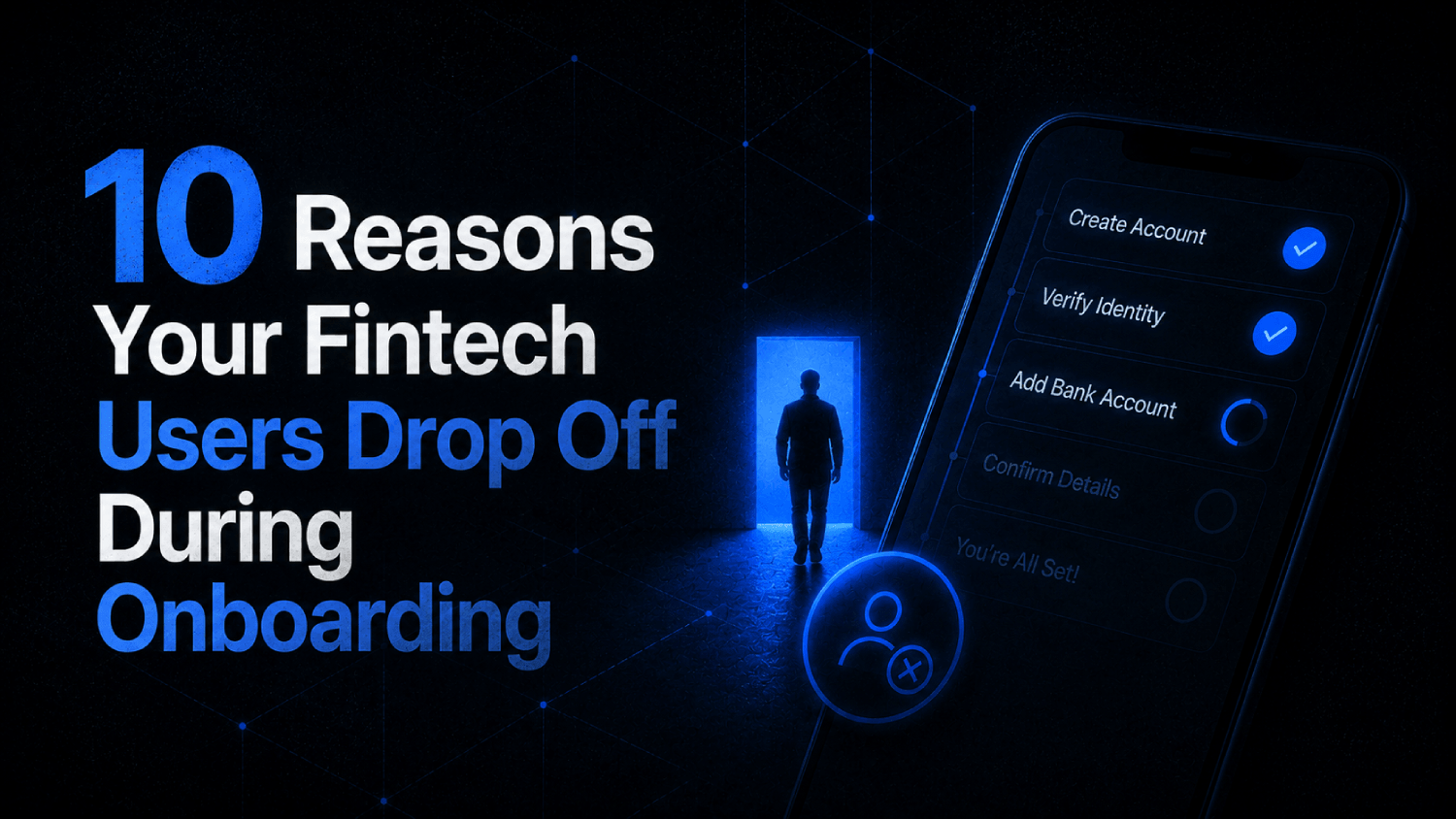

- Most fintech onboarding drop-off is not caused by KYC being hard. It is caused by poor timing, broken trust signals, and flows that ask for too much before delivering any value.
- Document upload, email verification, bank linking, and manual review wait states are the specific moments where users leave, and each one has a fixable cause.
- Sequencing matters as much as design. Asking for sensitive data before a user understands why they should trust you is a conversion problem, not a compliance problem.
- Operators who treat onboarding as a funnel, not a checkbox, consistently see higher activation rates without changing their KYC requirements at all.
Why Fintech Users Drop Off During Onboarding, And Why It’s a Product Problem, Not a Compliance Problem

Founders and product teams often accept onboarding drop-off as a cost of doing business in fintech. Compliance is hard, KYC is painful, and users are impatient. That framing lets a lot of preventable loss hide behind regulatory necessity.
The reality is that most drop-off happens at moments that are entirely within the product team’s control. Unclear error messages, premature data requests, invisible wait states, and missing trust signals are not compliance requirements. They are design failures. And they are costing companies a significant portion of the users they paid to acquire.
What follows is a breakdown of the ten most common reasons fintech users abandon onboarding, grounded in the specific moments where it actually happens.
1. The Flow Asks for Personal Data Before Establishing Any Value
Users arrive at onboarding with a hypothesis, not a commitment. They think this product might solve their problem, but they have not confirmed it yet. When the first screen asks for a Social Security number, a government ID, or bank credentials, the user has to decide whether they trust you enough to hand over sensitive data, before they have experienced anything that would justify that trust.
The fix is sequencing, not reduction of data collected. Show the user the dashboard they will have access to. Let them configure preferences. Give them one concrete moment of “this is what you get” before asking for anything sensitive. Plaid’s analysis of fintech onboarding identifies customer drop-off as one of the most significant challenges their customers face, and premature data requests are a consistent contributor across their network.
2. Document Upload Has No Guidance and No Recovery Path
Document upload is the single highest-friction moment in most fintech onboarding flows. Users are asked to photograph a government-issued ID under whatever lighting conditions they happen to be in, on whatever camera their phone has, without knowing what quality threshold the system requires.
When the upload fails, many flows return a generic error or simply drop the user back to the same screen with no explanation. According to reporting on KYC UX from Shufti Pro, the absence of clear error recovery paths is one of the primary structural reasons for KYC drop-off. A user who does not know whether their ID was rejected for poor image quality, an expired document, or a name mismatch has no path forward except to leave.
Specific guidance, retry counts, and human escalation options at this step are not nice-to-haves. They are retention mechanisms.
3. Email Verification Is Treated as Trivial When It Is Not
Email verification breaks momentum. The user is in your app, engaged, and you send them away to a different application to click a link. That context switch has a real abandonment cost, especially on mobile where switching between apps is more disruptive.
Two things make this worse. First, many products do not offer a resend option that is easy to find, so a user whose verification email went to spam simply cannot proceed. Second, some flows block all progress behind email verification before showing the user anything meaningful about the product. Reversing that order, letting users explore a limited state of the product while verification completes in the background, reduces the abandonment cost substantially without weakening the verification itself.
4. Bank Linking Triggers Distrust at the Wrong Moment
Connecting a bank account is a high-commitment action. Users have been trained by years of fraud news to be skeptical of anything that asks for banking credentials. When bank linking appears early in the onboarding flow, before the user has a clear picture of what they are signing up for, it reads as suspicious rather than functional.
Products that use Plaid or Finicity for bank linking have access to branded, recognizable connection flows that carry some trust by association. But even those flows convert better when the user already understands why linking is necessary. The explanation “we need your bank account to fund transfers” needs to appear before the bank linking screen, not on it.
5. KYC Is Presented as a Gate, Not as Part of a Process
KYC onboarding is frequently positioned as a rigid checkpoint rather than a progressive step in the flow, and that presentation transforms identity verification from “a thing you do to get access” into “a thing that might reject you.” The psychological effect on conversion is significant.
Progress indicators change this perception. A user who can see that document verification is step 3 of 5 has a mental model of progress. A user who hits a full-screen ID upload request with no context just sees a wall. Framing matters, and it costs nothing to add.
6. Wait States Are Invisible or Unexplained
Manual review happens. Automated checks take time. Some verifications cannot be instant. The problem is not the wait. The problem is that most products do not tell users what is happening during it.
A user who submits their documents and sees nothing but a spinner for twenty seconds does not know whether their submission worked, whether the system is slow, or whether something failed. Many of them close the app and never return. Products that show explicit confirmation, an estimated time range, and a notification commitment (“We’ll email you when verification is complete”) retain significantly more users through this stage. The wait becomes tolerable when it is explained.
7. The Mobile Experience Was Designed on Desktop
Document upload, form entry, and bank linking all behave differently on mobile than on desktop. Many fintech onboarding flows were designed on desktop-first tools and then adapted, which means the mobile experience has smaller tap targets, worse camera integrations, and form fields that do not trigger the right keyboard types.
A phone number field that brings up an alphabetic keyboard is a small failure. Multiplied across a twelve-step onboarding flow, small failures compound into abandonment. Mobile-first design is not just about screen size. It means camera APIs that work with the native document scanning experience, autofill compatibility with password managers, and step designs that account for one-handed use.
8. Error States Use Technical or Legal Language Users Do Not Understand
Compliance teams write error messages for legal accuracy. Product teams often do not revise them for user comprehension. The result is messages like “Identity verification could not be completed due to document inconsistency” that leave users with no understanding of what went wrong or what to do next.
Reporting from analysis of fintech onboarding UX at Eleken highlights this as a core UX failure that turns friction into confusion. Confusion in fintech does not produce help-seeking behavior. It produces abandonment, because users assume the rejection is final and personal rather than fixable.
Every error state should answer three questions: what happened, why it happened if legally permissible to say, and what the user should do next. Anything less is an exit ramp.
9. The Product Asks for Information It Does Not Visibly Use
Users notice when they fill out a field and it disappears into the void. If onboarding collects employment information, income range, or investment experience and then shows the user a generic product experience indistinguishable from someone who provided different answers, trust erodes. The user correctly perceives that the data collection was not for their benefit.
Personalization does not have to be sophisticated. Reflecting the user’s stated goal back to them on the confirmation screen (“Based on your goal of building an emergency fund, here’s where to start”) is enough to signal that the data was used. Products that cannot personalize at all should consider whether certain data collection steps are genuinely necessary at activation, or whether they belong later in the relationship.
10. The Onboarding Flow Has No Defined Owner
This is an organizational failure more than a UX failure, but it is one of the most common reasons fintech onboarding does not improve over time. When onboarding sits at the intersection of product, compliance, engineering, and marketing, it often belongs fully to none of them. Changes require cross-team alignment. Measurement is inconsistent. No one is accountable for the activation rate number.
The companies that improve onboarding conversion consistently are the ones that assign a single owner, set a clear activation metric, and run structured experiments against it. If you are looking at your broader fintech infrastructure with the same scrutiny, the fintech SaaS scale checklist for reaching $10M ARR covers how operational ownership gaps show up across the stack as companies grow.
The Specific Moments Where Users Leave
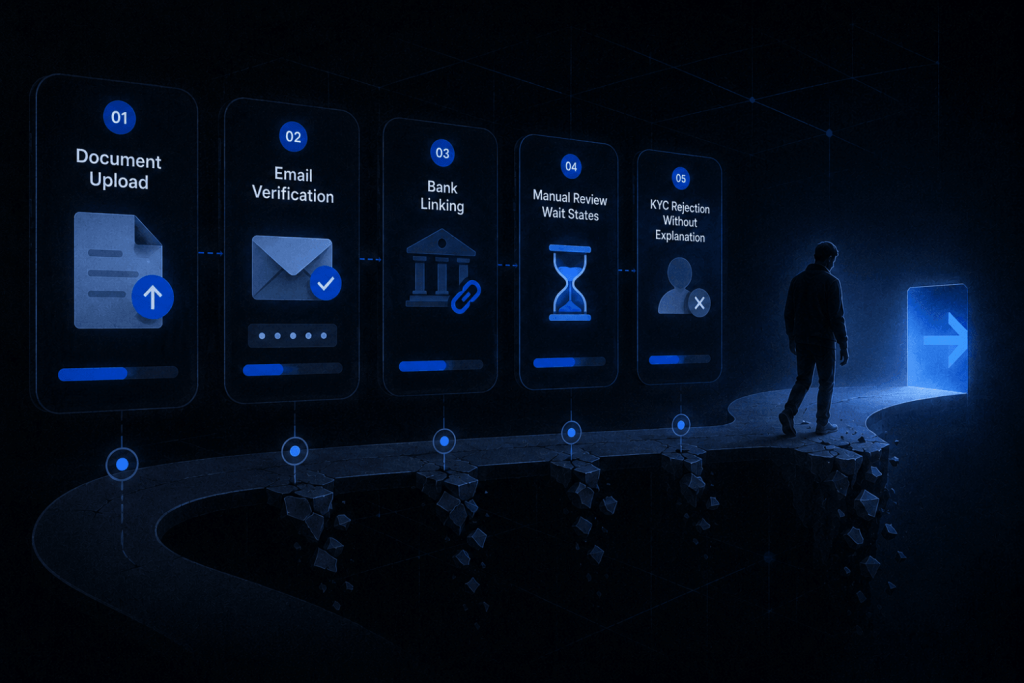
Document Upload
The highest drop-off moment in most flows. Fixable with better camera guidance, explicit file requirements, and clear error recovery paths that tell the user what specifically failed.
Email Verification
A context switch that punishes mobile users. Reducing its gating effect, offering prominent resend options, and letting users explore a limited product state while they verify reduces abandonment at this step.
Bank Linking
A high-trust request that needs to be preceded by a clear explanation of why it is necessary. Placement and framing matter more than the technical implementation. This is also where your choice of fintech API infrastructure affects the user experience directly, because different bank linking providers have meaningfully different success rates and UX quality.
Manual Review Wait States
A wait without communication is experienced as rejection. Explicit confirmation, time estimates, and a notification commitment convert users through this stage at a higher rate than a spinner alone.
KYC Rejection Without Explanation
The most damaging moment. A user who was rejected without understanding why cannot self-serve a solution. Human escalation paths, even via email, reduce permanent abandonment significantly. This connects to a broader question about how you have structured your fraud detection and risk tooling, since overly aggressive automated rejection is as costly as under-detection from a conversion standpoint.
What Risk-Based Onboarding Actually Means for Conversion
Risk-based KYC is not just a compliance strategy. It is a conversion strategy. If your product can onboard low-risk users with a lighter verification flow and reserve heavier checks for users whose activity or profile warrants it, you convert more users without taking on more regulatory risk. This requires investment in your risk scoring infrastructure, but the activation gain can be substantial.
Products that run every user through the same maximum-friction flow because it is easier to implement leave a significant portion of their legitimate user base on the table. The regulatory standard in the US does not require identical treatment of every user. It requires appropriate treatment based on assessed risk. Those are different things, and the gap between them is where activation rate improvement lives.
For teams thinking about this alongside their broader payments and banking infrastructure choices, the banking-as-a-service platform comparison for fintech startups covers how different BaaS providers handle KYC delegation and risk-based onboarding, which directly affects what flexibility your product team has.
Frequently Asked Questions
1. Why do fintech users drop off during onboarding more than in other app categories?
Fintech onboarding asks for a level of personal and financial information that no other app category routinely requests. Government IDs, bank credentials, Social Security numbers, and income data all appear in a single flow. Each request is a trust decision, and if the product has not established credibility before asking, users default to declining. The combination of high data sensitivity, regulatory complexity, and frequently poor UX design creates abandonment rates that are structurally higher than most consumer app categories.
2. What is the most common reason for KYC drop-off?
Document upload failure without clear recovery guidance is consistently reported as the primary KYC drop-off driver. When a user’s ID scan is rejected and the error message does not explain what failed or what to do next, the user has no viable path forward except to leave. A close second is the absence of any communication during manual review wait states, where users interpret silence as rejection and abandon the process before it completes.
3. How can fintech companies reduce onboarding friction without weakening KYC compliance?
The two are not in as much tension as they appear. Risk-based onboarding lets products apply lighter verification flows to lower-risk users while maintaining full checks where the risk profile warrants it. Progress indicators, clear error messages, explicit wait state communication, and better sequencing of data requests all reduce friction without touching the underlying compliance requirements. Most onboarding loss is a UX problem, not a compliance problem.
4. What does activation mean in fintech onboarding?
Activation is the moment a user completes enough of the onboarding flow to perform the core action the product is built around: their first transfer, their first investment, their first card transaction. Completing KYC alone is not activation. A user who verified their identity but never funded their account or executed a transaction has not been activated and is unlikely to become a retained user without intervention.
5. How does wait state communication affect fintech onboarding conversion?
Significantly. When manual review or automated checks require time, users who receive no communication overwhelmingly interpret the silence as failure and abandon. Products that send an explicit submission confirmation, provide an estimated review window, and commit to a notification when the decision is made retain a meaningfully higher share of users through this stage. The wait itself is less damaging than the uncertainty about whether anything is happening.
6. At what point in onboarding should bank linking be introduced?
After the user understands the product’s value and has seen at least one concrete reason to trust it. Bank linking introduced before that context exists reads as an aggressive or suspicious request. It should be preceded by a plain-language explanation of why the connection is needed, what access it grants, and what it does not. For most products, this means bank linking belongs at step three or four of the flow, not step one.
The Core Insight Most Teams Miss
Fintech onboarding drop-off is usually described as a KYC problem because KYC is where the data shows users leaving. But that is a measurement artifact, not a causal one. Users leave at document upload because the flow failed to establish trust before that point. They leave at bank linking because the value proposition was never made clear. They leave during manual review because nobody told them what was happening.
The upstream causes of drop-off are almost always sequencing, trust signals, and communication. Fix those, and the KYC steps become far less terminal, because the user arrives at them with enough context and confidence to push through. Teams that audit their funnel looking only at where users leave, rather than why those users had insufficient motivation to continue, will keep iterating on the wrong things.
Onboarding is not separate from your product. For most users, it is the product. How well you handle it shapes not just activation rates but long-term retention, because a user who fought through a bad onboarding experience already has reason to distrust you before they have made a single transaction. That perception is recoverable, but it costs more to fix after the fact than it does to prevent.