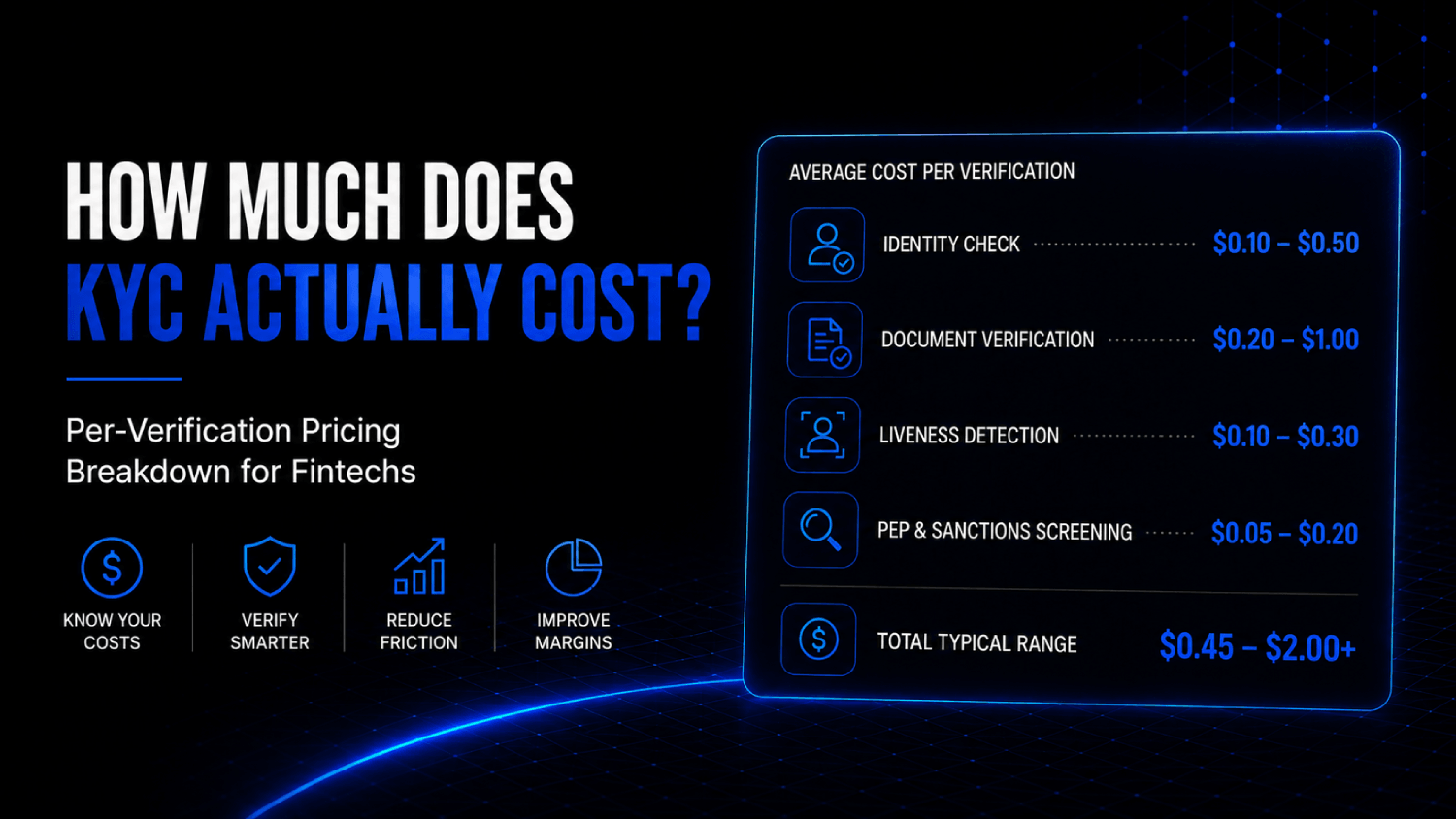

- KYC cost per verification ranges from roughly $0.50 to $7.00 depending on check type, volume, and pricing model , database lookups sit at the low end, liveness detection and document verification at the high end.
- Most vendors sell one of three pricing structures: per-check transactional, approved-only (you pay only for passed verifications), or tiered volume contracts. Each has a different break-even profile.
- Approved-only pricing sounds cheaper but often carries overages at 12k, 50k, and 100k verification thresholds that quietly inflate your unit cost at scale.
- This article covers per-verification unit economics only. For program-level compliance costs , staff, legal, audits , see the real cost of compliance in FinTech SaaS, broken down by stage.
- Use the FintechSpecs KYC Cost Benchmark Stack (defined below) to stress-test any vendor quote before you sign.
KYC cost per verification falls into three check types with predictable price bands: database identity checks run $0.50 to $1.50 per verification, document verification runs $0.80 to $3.00, and liveness or biometric checks add $1.00 to $4.00 on top. Approved-only pricing models typically price these bundles at a premium per passed user, with overages kicking in above contracted volume tiers. A fintech running 50,000 verifications per month should budget between $1.50 and $4.00 per approved user depending on check stack, before negotiated volume discounts.
Why KYC Pricing Feels Opaque (and Why It Is Not)
Vendors rarely publish a single number because there is no single number to publish. KYC is a stack of discrete checks, and you pay for each layer you activate. The opacity is real but not mysterious once you understand the underlying components.
Every KYC check traces back to one of three data sources: a government database (cheap to query, fast), a document image parsed by OCR and fraud detection (more compute, more cost), or a biometric comparison against that document (most compute, highest cost). Vendors bundle these layers, label the bundle a “standard” or “enhanced” package, and price accordingly. The price variation you see across quotes is almost always a reflection of which layers are inside the bundle, not arbitrary markup.
Where pricing genuinely gets murky is in the model itself. Some vendors charge per API call regardless of outcome. Others charge only for verifications that return a result above a confidence threshold. A few charge only for users who clear all checks and get approved. Those structures have completely different economics at scale, and comparing them on sticker price alone is a mistake.
What Does Each KYC Check Type Actually Cost?
The table below reflects publicly available pricing data and figures from vendor documentation as of mid-2025. Where vendors do not publish pricing, ranges reflect figures cited in industry surveys and vendor-provided documentation.
| Check Type | What It Does | Typical Cost Range (per check) | Notes |
|---|---|---|---|
| Database identity check | Name, DOB, SSN/address match against credit bureaus or government databases | $0.50 to $1.50 | Fastest, cheapest; no document required |
| Document verification | Passport, driver’s license, or ID card parsed via OCR, checked for tampering | $0.80 to $3.00 | According to ComplyCube’s published pricing documentation (as of mid-2025), lower-volume rates run $0.80 to $1.35 per check |
| Liveness / biometric check | Selfie comparison against document photo, deepfake detection | $1.00 to $4.00 | Often sold as add-on; required for high-risk or regulated flows |
| AML / watchlist screening | Sanctions, PEP, adverse media against OFAC and global lists | $0.10 to $0.50 | Cheapest layer; often bundled at no marginal cost above a threshold |
| Full identity bundle (database + doc + liveness) | Complete onboarding check stack | $1.50 to $7.00 | Upper end reflects low-volume or high-risk use cases |
The $0.50 to $7.00 range cited across the current search results is accurate, but it is the range across all check types, not the range for any single check. A vendor quoting you $3.50 per verification for a doc plus liveness bundle is not gouging you. A vendor quoting $3.50 for a database-only check is.
What Are the Three KYC Pricing Models and Which One Fits Your Volume?
Getting the model right matters more than negotiating the per-check rate, because the wrong model can cost you 2x to 3x more than the sticker price implies.
Per-Check Transactional Pricing
You pay for every API call that returns a result, regardless of whether the user passes. A declined verification costs the same as an approved one. This model is straightforward to forecast: multiply your expected monthly verification volume by the per-check rate, add a buffer for retries and abandonment.
This model works well for fintechs with high approval rates and predictable volume. If your pass rate drops , say, a fraud spike or a new user cohort with more document variation , your cost per approved user rises while your vendor revenue stays flat. That asymmetry is worth stress-testing before you sign.
Approved-Only Pricing
You pay only for verifications where the user is approved. Declined, abandoned, and flagged verifications do not generate a charge. This sounds obviously better, but vendors price this model at a meaningful premium over transactional rates , because they are absorbing the cost of the checks that do not convert.
The model becomes relevant when your approval rate is below roughly 70%. If 30% or more of your users fail verification, per-check pricing means you are spending real money on non-customers. Approved-only pricing caps that exposure.
Volume-Tiered Contracts
Common at scale (typically above 10,000 verifications per month), tiered contracts commit you to a volume band in exchange for a lower per-check rate. The tiers that come up most often in fintech onboarding quotes are 12,000, 50,000, and 100,000 verifications per month. Exceeding your contracted tier triggers overage pricing, which is almost always higher than your contract rate and sometimes higher than what you would have paid on a transactional plan.
The overage structure is where buyers get caught. A contract at 50,000 verifications per month at $1.80 per check might carry overages at $2.40 per check above the tier. If you run 60,000 verifications in a spike month, your blended rate for that month jumps. Model your 90th-percentile volume, not your average, before committing to a tier.
| Pricing Model | Best For | Risk | Typical Premium vs. Transactional |
|---|---|---|---|
| Per-check transactional | High approval rates, predictable volume | Cost rises if pass rate falls | Baseline |
| Approved-only | Sub-70% approval rate, fraud-prone segments | Higher base rate; vendor may limit retries | 20% to 40% premium per approved user |
| Volume-tiered contract | Stable volume above 10k/month | Overage exposure above tier | Discount vs. transactional, but lockup risk |
How Does Approved-Only Pricing Work at 12k, 50k, and 100k Volume Tiers?
Approved-only contracts at specific volume thresholds are one of the least-documented structures in vendor quotes, and also one of the most consequential. Here is how they typically work in practice.
Say a vendor quotes you approved-only pricing at $2.20 per approved user up to 12,000 approved verifications per month. Your committed monthly spend is $26,400. Overages above 12,000 approved users bill at $2.60. If you have a strong onboarding month and approve 15,000 users, the incremental 3,000 users cost $7,800 instead of $6,600 , an 18% spike in unit cost on the overage volume alone.
At the 50,000-tier, vendors typically offer a lower per-approved-user rate (often in the $1.60 to $2.00 range for a doc plus liveness stack) but require a minimum monthly commitment regardless of actual volume. Miss your tier by 20% for three consecutive months and you have paid for verifications you did not run. That is the inverse overage problem: underutilization of a committed tier.
The 100,000-tier is almost always a custom negotiated contract. Public pricing disappears at that volume, and vendors price based on your approval rate, check stack, and competitive pressure from other vendors you are talking to. Getting two competing quotes at this volume is not optional , it is the only lever you have.
What Is the FintechSpecs KYC Cost Benchmark Stack?
When a vendor sends you a quote, the number on the page is the output of decisions you did not make together. The FintechSpecs KYC Cost Benchmark Stack is a four-step framework for reconstructing what a quote actually costs and whether it is competitive.
Layer 1: Decompose the check stack. Ask the vendor to list every check included in the quoted price. Database lookup, document parse, liveness, AML screening, and ongoing monitoring are separate cost centers. If they cannot itemize, they are bundling to obscure. Compare only like-for-like check stacks across vendors.
Layer 2: Normalize to cost per approved user. Convert every quote to cost per approved user, not cost per attempt. Divide the total monthly contract cost by your expected approved-user count at your historical approval rate. A $1.20 per-check quote with a 65% approval rate equals $1.85 per approved user. A $1.80 approved-only quote is more expensive in absolute terms but eliminates the 35% waste.
Layer 3: Model overage exposure. Take your 90th-percentile monthly volume (not your average) and run it through the quoted overage rate. If that number exceeds your base contract cost by more than 15%, you are undertiered and should negotiate a higher tier with a volume ratchet.
Layer 4: Price the retry loop. Failed verifications often trigger user retries. If a vendor’s per-check model counts each retry attempt as a billable check, your effective per-user cost rises with your retry rate. Ask directly: does a user who submits two documents get billed once or twice? The answer changes your cost model meaningfully.
How Much Should KYC Cost Per User for a Fintech Startup?
The honest answer depends on your regulatory environment, your user risk profile, and what checks your sponsor bank or compliance program requires. That said, some benchmarks hold across most US consumer fintech onboarding scenarios.
A seed-stage fintech running database-only identity checks for low-risk users should pay between $0.50 and $1.00 per verification at volumes under 5,000 per month. A Series A company running document verification plus AML screening should budget $1.50 to $3.00 per user at 10,000 to 50,000 monthly verifications. A Series B or later lender or neobank running the full stack , database, document, liveness, AML, and ongoing monitoring , should expect $3.00 to $6.00 per approved user before volume negotiation brings that down.
One data point worth anchoring to: Didit has cited industry data indicating that companies spend between $1,500 and $3,000 to complete the KYC review of a single client in manual or high-touch processes , though the underlying survey source is not publicly disclosed, so treat it as directional rather than a precise benchmark. Automated API-based verification exists precisely to collapse that number. If your automated per-user cost is approaching $7.00 or above, either your check stack is overspecified for your risk tier or your approval rate is low enough that you should renegotiate to an approved-only model. For context on how KYC cost fits into your broader compliance budget, hidden costs that compress fintech SaaS margins covers how verification spend stacks against other infrastructure line items.
Which Vendor Pricing Models Are Worth Benchmarking?
We are not ranking vendors here , that analysis lives in our KYC provider comparison ranked by UX, cost, and approval rates. What we can do is describe the pricing models in market so you know what category each vendor falls into before you request a demo.
ComplyCube publishes tiered pricing on their site, which makes it one of the more transparent options for benchmarking. Their document verification starts at $0.80 to $1.35 per check at lower volumes according to their published documentation. Sumsub operates primarily on volume-tiered contracts with approved-only options available at higher tiers , pricing is not public and requires a demo. Jumio and Onfido (now part of Entrust) both use negotiated enterprise contracts above a volume threshold, with entry-level API access available via self-serve at published rates.
Persona uses a modular pricing model where you pay per check type rather than per bundle, which makes it easier to run the FintechSpecs Benchmark Stack against. Stripe Identity publishes per-verification pricing publicly, which makes it a useful floor benchmark even if you end up choosing a more specialized provider. Socure and Mitek focus on enterprise accounts and do not publish pricing.
For fintechs evaluating identity infrastructure alongside broader compliance tooling, the KYB provider comparison for B2B fintech onboarding covers the business verification side of the same workflow , worth reading if you are onboarding both individuals and business entities.
What Hidden Costs Are Not in the Per-Check Price?
The per-check rate is the most visible cost, not the total cost. Four additional cost centers consistently appear in fintech KYC budgets that do not show up in a vendor quote.
Ongoing monitoring fees. Many regulated fintechs are required to re-screen customers against sanctions and PEP lists on a recurring basis, not just at onboarding. Vendors price this as a monthly per-active-user fee, typically $0.05 to $0.15 per user per month. At 100,000 active users, that is $5,000 to $15,000 per month on top of onboarding costs.
Integration and maintenance engineering time. Building and maintaining a KYC integration is not free. A first-time integration with a new vendor typically takes one to three weeks of engineering time. Ongoing maintenance , handling API version changes, edge case handling, retry logic , adds a few hours per month. At a $150 to $200 loaded engineering hourly rate, first-year integration cost runs $15,000 to $40,000 before you have processed a single user.
Manual review overhead. No automated system achieves 100% straight-through processing. Users who fail automated checks typically enter a manual review queue. If your vendor does not offer managed manual review, you are staffing that queue. If they do, the per-case manual review fee is usually $5.00 to $25.00 per case depending on complexity , an order of magnitude above your automated rate.
Failed verification cost to the business. Every user who abandons or fails verification is an acquisition cost with no revenue attached. If your customer acquisition cost is $40 and your automated KYC pass rate is 80%, you are spending $50 of acquisition cost per successfully onboarded user, not $40. KYC friction that lowers pass rates is a revenue problem, not just a cost problem. Our analysis of why fintech users drop off during onboarding covers how verification friction maps to conversion loss at each step.
Frequently Asked Questions
What is the average KYC cost per verification in the US?
For automated API-based checks, the average falls between $1.50 and $3.50 per user for a standard identity plus document verification stack. Database-only checks run $0.50 to $1.50. Adding liveness detection pushes the total to $3.00 to $7.00 per user at low volumes. Volume discounts typically begin at 10,000 to 12,000 verifications per month and can bring rates down 20% to 40% at the 50,000-plus tier. Manual review processes cost significantly more, with industry data pointing to $1,500 to $3,000 per client in high-touch KYC programs.
What is approved-only KYC pricing and how does it compare to per-check pricing?
Approved-only pricing means you pay only when a user passes all verification checks and is approved. Declined, abandoned, and flagged users generate no charge. Vendors price this model at a 20% to 40% premium over standard per-check rates because they absorb the cost of checks that do not convert. It makes financial sense when your approval rate is below roughly 70%. Above that threshold, per-check transactional pricing typically results in a lower cost per approved user, because you are not paying the approved-only premium to avoid waste that barely exists.
How much do overage fees cost at the 12k, 50k, and 100k volume tiers?
Overage pricing at volume tier contracts is almost always higher than your contracted per-check rate, often 20% to 35% above the base rate. At a 12,000-verification-per-month tier, exceeding your commitment by 3,000 checks could add 15% to 18% to your monthly bill at typical overage rates. At the 50,000 tier, underutilization risk runs the other direction: missing your committed volume means you pay for verifications you did not run. The 100,000-tier is custom-negotiated, and no public pricing applies. Always model your 90th-percentile volume, not your average, before committing to a tier.
What is the cheapest KYC provider for a startup?
Cheapest depends entirely on your check stack and volume. For database-only identity verification at low volume, Stripe Identity and ComplyCube both publish competitive entry-level rates. For startups that need document verification plus liveness at under 5,000 verifications per month, transparent self-serve pricing from providers like Persona or Stripe Identity is often more cost-effective than negotiating an enterprise contract. The cheapest provider for your specific use case is the one that matches your check stack to your approval rate , not the one with the lowest headline per-check number.
Is there a KYC cost calculator I can use to estimate my budget?
No vendor-neutral public KYC cost calculator exists as of this writing, but you can build a usable estimate in a spreadsheet. Take your expected monthly verifications, multiply by your blended per-check rate for your check stack, divide by your expected approval rate to get cost per approved user, then add 10% to 15% for retries and edge cases. Add ongoing monitoring fees per active user per month. That gives you a monthly KYC infrastructure budget you can compare against any vendor quote using the FintechSpecs KYC Cost Benchmark Stack framework described above.
How does KYC cost fit into total compliance spend?
Per-verification KYC cost is one line item in a much larger compliance budget. Program-level costs , compliance officers, legal counsel, audits, BSA/AML program maintenance, and regulatory reporting , dwarf per-check costs at scale. A fintech at 100,000 monthly verifications might spend $150,000 to $350,000 per year on KYC infrastructure but several times that on the people and processes required to operate the program. For a full breakdown of program-level compliance costs by company stage, see the real cost of compliance in FinTech SaaS.
What is the standard KYC check package for a US fintech?
For consumer-facing fintechs operating under BSA/AML obligations, the minimum standard package typically includes a database identity check (name, DOB, SSN match), OFAC sanctions screening, and document verification for higher-risk users or those who fail the database check. Liveness detection is increasingly required by sponsor banks and BaaS providers as a fraud control. The “enhanced” package , database plus document plus liveness plus PEP screening , is standard for neobanks, lending platforms, and any product touching account funding or money movement.
Does KYC pricing change depending on the document country of origin?
For most US-focused fintechs, domestic document verification rates apply to US-issued IDs and passports. International documents typically carry a surcharge, either as a higher per-check rate for non-domestic documents or as an add-on for international coverage. If your user base includes a significant percentage of non-US residents or recent immigrants presenting foreign-issued documents, ask vendors explicitly for their international document rate and coverage list. Some providers cover 190-plus countries; others have meaningful gaps that create manual review backlogs and hidden cost.
How to Use Price Bands to Benchmark Any Vendor Quote
When a vendor gives you a quote, run it through three filters before responding. First, confirm the check stack matches what you actually need , not what the vendor defaults to. A quote that includes liveness when your compliance program does not require it is not competitive pricing, it is an overspecified product. Second, convert the quote to cost per approved user using your actual approval rate. Third, model your spike month, not your average month, against the overage rate.
The buyers who get the best KYC pricing are not the ones who negotiate hardest. They are the ones who walk into negotiation with two competing quotes, a clear check stack specification, and a volume model built on their 90th-percentile traffic. Vendors discount to close. They discount faster when they know you have done the math. For more on applying this kind of discipline across your broader vendor selection process, the fintech vendor evaluation framework covers how to structure due diligence before you sign any infrastructure contract.
KYC pricing follows a logic once you see the layers beneath it. Database checks are cheap because they are a query against an existing database. Document checks cost more because they require compute and fraud detection. Liveness costs the most because it adds a biometric comparison and deepfake risk assessment. Every quote you receive is some combination of those layers plus a pricing model on top. Know which layers you need, know which model fits your approval rate, and the number on the page becomes a negotiating position rather than a final answer.