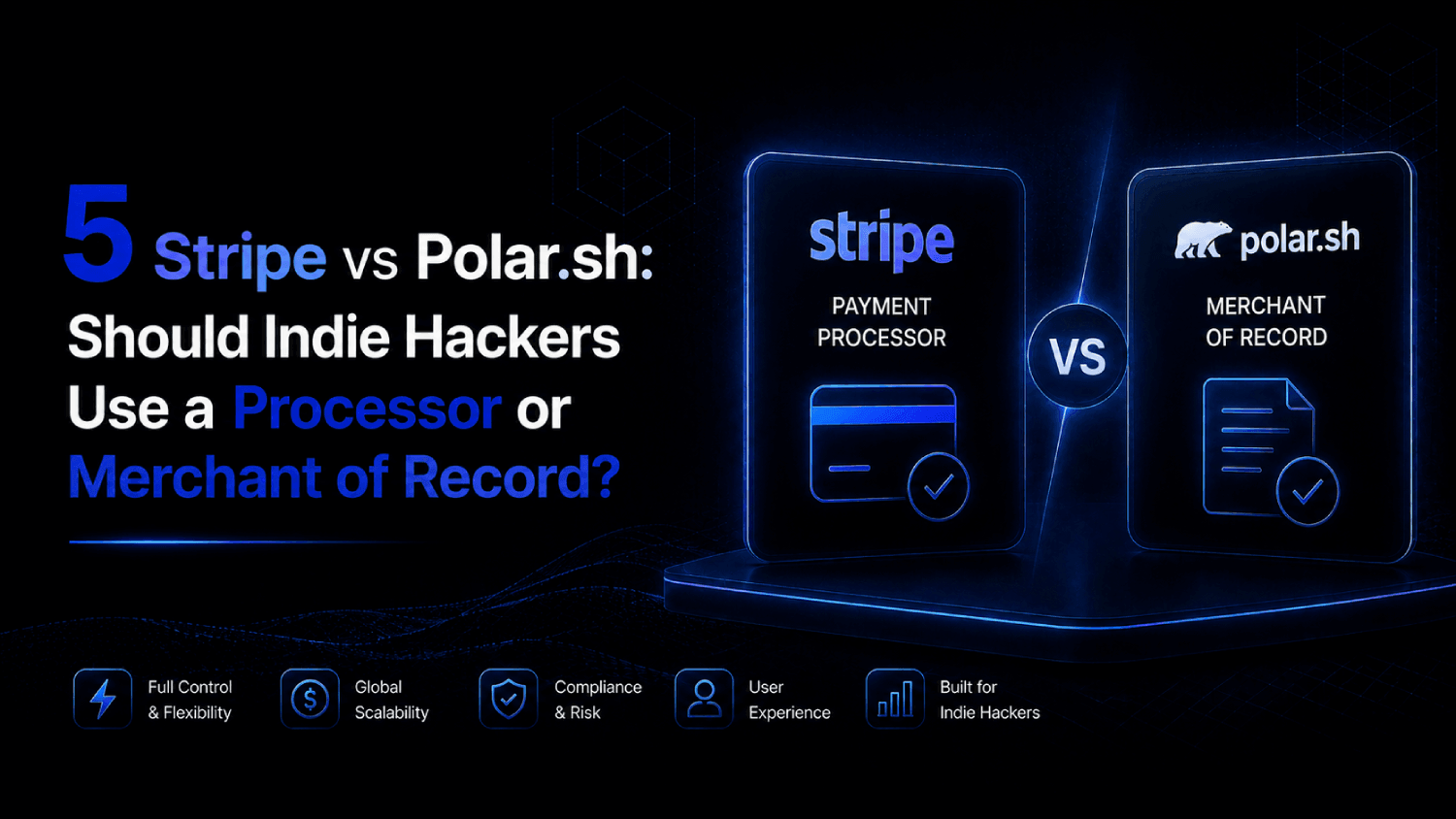

- Stripe is a payment processor. You are the merchant of record, which means you own every tax obligation, VAT registration, and compliance headache in every country you sell into.
- Polar.sh is a merchant of record. It becomes the seller on every transaction, collecting and remitting taxes on your behalf across jurisdictions automatically.
- The fee gap is real but smaller than founders assume. Polar.sh charges 5% plus 40 cents per transaction on its free tier, while Stripe sits at 2.9% plus 30 cents for standard card transactions in the US.
- Stripe wins for complex billing logic, enterprise contracts, and teams with in-house tax infrastructure. Polar.sh wins for solo founders and small teams selling globally who want zero tax exposure from day one.
- The decision is not about which platform looks nicer. It is about which legal entity you want standing between your product and the tax authorities of 40-plus countries.
Most Stripe vs Polar comparisons frame this as a feature race. They miss the structural question underneath it. Stripe is a payment processor that moves money and gives you tools to build around it. Polar.sh is a merchant of record that sells your product on your behalf, handling global tax collection and remittance automatically. If you sell only in the US and have tax software already set up, Stripe is probably cheaper and more flexible. If you are a solo founder selling internationally without a dedicated tax stack, Polar.sh removes a legal liability that can blindside early-stage companies when they start getting traction in Europe or Canada. The right way to think about this choice is not features versus features, it is which legal structure fits your current situation and what the cost of switching looks like in 18 months.
What Is the Actual Difference Between a Payment Processor and a Merchant of Record?
When you use Stripe, your company is the seller. That means every transaction your customer sees on their credit card statement shows your business name. You collected the money. You owe the sales tax, VAT, or GST in whatever jurisdiction your customer lives in. Stripe processes the payment and gives you the infrastructure to handle the rest, but the legal and tax obligations sit entirely with you.
When you use a merchant of record versus a payment processor, the MoR’s name appears on the transaction. Polar.sh buys the product from you and resells it to your customer. That legal shift transfers the tax collection and remittance obligation to Polar.sh. You get paid the net amount. Polar.sh handles the rest.
For an indie hacker selling a $29 SaaS tool to users in Germany, France, the UK, and Australia, this difference is enormous. EU digital services require VAT collection and remittance per country. Getting this wrong is not a slap on the wrist. It is back taxes, potential fines, and possible deregistration from payment processors who flag non-compliant merchants.
How Do Stripe and Polar.sh Actually Price Their Services?
According to Stripe’s public pricing page, the standard rate in the US is 2.9% plus 30 cents per successful card transaction. International cards add 1.5%. Currency conversion adds another 1%. If you are selling a $10/month subscription to a customer in France using a European card, your effective Stripe rate could clear 5% before you have touched tax tools.
According to Polar.sh’s public pricing page, the free plan charges 5% plus 40 cents per transaction, and Polar.sh takes care of all tax handling globally within that fee. There is no separate cost for a Stripe Tax integration, no Avalara subscription, no accountant hours spent filing quarterly VAT returns in the EU.
The math shifts depending on your customer geography and your existing infrastructure. A US-only SaaS founder with Stripe and Stripe Tax already running pays 2.9% plus 30 cents plus 0.5% for Stripe Tax on eligible transactions. That is still cheaper than Polar.sh’s 5% plus 40 cents in most scenarios. But a founder selling globally without any tax tooling in place would need to add third-party tax software, which narrows the gap considerably. For a wider view of how these cost structures play out across billing models and revenue stages, the comparison of payment infrastructure tools for SaaS founders is worth reviewing alongside this one.
What Does Polar.sh Actually Cover That Stripe Does Not?
Polar.sh handles VAT in the EU, GST in Australia and Canada, and sales tax in applicable US states as the merchant of record. It files the returns. It handles the registration requirements. You do not appear in any of these calculations as the liable party.
Stripe, by contrast, offers Stripe Tax as an add-on that calculates and collects the correct tax at checkout. But Stripe Tax does not remit anything on your behalf. You still owe the filings. You still need to register in each applicable jurisdiction or use a separate service that handles that. Stripe gives you the number. You still write the check to the tax authority.
This is the distinction most indie founders miss. Automatic tax calculation is not the same as automatic tax liability removal. Polar.sh does the latter. Stripe does the former, at most.
Where Stripe’s Flexibility Creates a Real Advantage
Polar.sh is well-suited for straightforward subscription or one-time digital product sales. If you need per-seat pricing that changes mid-cycle, usage-based billing tied to API call volume, metered charges that settle at the end of a billing period, or custom enterprise contracts with net payment terms, Polar.sh’s billing infrastructure is not built for that. Stripe’s billing engine handles all of it.
Stripe also integrates with nearly every downstream tool a growing SaaS team uses: Chargebee, Recurly, ProfitWell, Baremetrics, and dozens of RevOps tools that were built to talk to Stripe natively. If your billing model will get more complicated as you grow, Stripe’s network of integrations is difficult to replace. For a deeper look at how the broader merchant of record field compares for B2B SaaS teams with more complex requirements, the Stripe vs Paddle vs Lemon Squeezy vs Polar comparison covers that decision in detail.
There is also developer tooling to consider. Stripe’s API documentation, SDKs, webhook infrastructure, and testing environment are among the most mature in payments. Polar.sh is newer and its developer API, while functional, does not yet match that depth. If your product requires custom checkout flows, embedded billing portals, or direct API integration, Stripe gives you more to work with today.
The FintechSpecs Seller-of-Record Decision Matrix
Most comparisons frame this as a features race. That misses the point. The Stripe vs Polar decision is a legal structure question first and a cost question second. It breaks down across four axes that most feature comparisons skip entirely.
Tax exposure: How many countries are you selling into? Do you have existing tax compliance infrastructure, or are you starting from zero? If you are in three or more non-US jurisdictions and have no accountant or tax tool handling cross-border filings, the MoR model removes the liability entirely. If you are US-only with Stripe Tax already running, you are probably fine.
Billing complexity: Can your pricing be expressed as a flat recurring amount or a one-time charge? If yes, Polar.sh covers it. If your pricing has usage components, mid-cycle upgrades, volume tiers, or contract-level customization, you will hit the edges of Polar.sh’s billing engine quickly. This is the axis where Stripe vs Polar diverges most sharply for growing SaaS products.
Revenue stage: Early-stage founders with low transaction volume can absorb Polar.sh’s higher per-transaction rate without much pain. At $10,000 monthly recurring revenue, the 2-percentage-point fee difference between Polar.sh and Stripe is roughly $200 per month. That number grows linearly. The crossover point where Stripe-plus-tax-tools becomes cheaper than Polar.sh depends on your specific geography mix and tax overhead, but for many founders it appears somewhere between $5,000 and $10,000 MRR. These are illustrative benchmarks based on the published rates above, not a universal rule, your card mix, currency split, and tax tool costs will move the number.
Chargeback and dispute tolerance: As the merchant of record, Polar.sh also handles chargebacks on your behalf. With Stripe, chargebacks are your problem. If you sell a product category with elevated dispute rates, offloading that risk has real value.
Where Polar.sh Beats Stripe for Indie Hackers Specifically
Polar.sh was built with the solo creator and indie hacker use case explicitly in mind. It supports GitHub-native monetization, sponsorships, and digital product sales out of the box. For a developer selling a CLI tool, a VS Code extension, or a small SaaS with a GitHub-heavy user base, the distribution fit is genuinely better than Stripe.
Setup time is also dramatically shorter. There is no need to configure Stripe Tax, register a legal entity in additional jurisdictions, or set up webhooks to a billing provider. You add Polar.sh to your product, and international tax compliance is handled from the first transaction.
The open-source orientation of Polar.sh also matters for trust. Its codebase is publicly available, which is unusual for a payments company and meaningful for developer-focused founders who want transparency into how their billing works. Stripe is not open source.
Choose Stripe If
- You sell primarily to US customers and already have Stripe Tax or a tool like Avalara handling state sales tax.
- Your billing model includes usage-based charges, per-seat pricing, or mid-cycle plan changes that require a mature billing engine.
- You need deep integrations with downstream RevOps, finance, or analytics tools built for Stripe natively.
- You are building toward enterprise contracts where Stripe’s payment infrastructure gives you more flexibility on payment terms and invoice workflows.
- Your team has a developer who will build and maintain custom checkout or billing portal experiences.
Choose Polar.sh If
- You are a solo founder or a two-person team selling digital products or simple subscriptions globally and you have no existing tax compliance infrastructure.
- You want zero personal exposure to VAT, GST, or digital services tax obligations in the EU, UK, Canada, or Australia from day one.
- Your pricing is simple: flat monthly, flat annual, or one-time.
- You sell to developers or open-source communities where Polar.sh’s GitHub integration and transparent pricing are a better cultural fit than Stripe’s checkout flow.
- You are pre-revenue or very early and the higher per-transaction fee is an acceptable trade for eliminating legal and administrative overhead.
A Worked Scenario: Global SaaS at $3,000 MRR
Say a solo founder is running a developer tool with 200 paying customers at $15 per month. Half are in the US, and the other half are spread across the EU, UK, and Australia. Monthly revenue is $3,000.
On Stripe, the base processing cost is roughly $87 at 2.9% plus 30 cents per transaction. The non-US customers using international cards add roughly 1.5% to those 100 transactions, adding another $22. Stripe Tax adds 0.5% on applicable transactions. Total processing and tax tool cost comes to roughly $120 to $130 per month. That figure excludes the time or accountant cost of actually filing VAT returns in the EU, which Stripe Tax does not do for you.
On Polar.sh, the same $3,000 in revenue at 5% plus 40 cents per transaction costs roughly $230. That number includes global tax handling, filing, and no exposure to EU VAT registration requirements. The gap is roughly $100 per month at this revenue level. If your time filing EU VAT quarterly is worth more than $100, or if you would otherwise pay an accountant to do it, Polar.sh is competitive. Above $10,000 MRR, the math typically tips toward Stripe-plus-tax-tooling, assuming you invest in the infrastructure.
These figures are built directly from the published rates cited earlier in this piece. Your actual numbers will vary based on card types, currencies, dispute rates, and the tax tools you choose, but the structure of the tradeoff holds. The hidden costs that compress SaaS margins at exactly this stage are worth mapping before you pick a payment stack.
What Happens When You Outgrow Polar.sh?
Migrating off a merchant of record is messier than migrating off a payment processor. When Polar.sh is the seller of record, your customers’ payment relationships are technically with Polar.sh, not you. Moving those subscriptions to Stripe means contacting customers, re-collecting payment methods, and potentially losing some subscribers in the transition.
This is not specific to Polar.sh. Every MoR has the same migration friction, including Paddle and Lemon Squeezy. It is a structural property of the merchant of record model. Founders who anticipate rapid growth, enterprise deals, or complex billing evolution within 18 months should factor this switching cost into the decision now rather than after they have 2,000 subscribers on file with an MoR.
Founders who build financial infrastructure with growth in mind often run into this specific friction. The most common fintech infrastructure mistakes include choosing a vendor for launch-day convenience without modeling what migration looks like 18 months later.
Is Polar.sh Cheaper Than Stripe in Practice?
Not at face value. Polar.sh’s published rate of 5% plus 40 cents is higher than Stripe’s 2.9% plus 30 cents for US transactions. But the comparison only holds if you account for what Stripe does not include. Stripe Tax, third-party filing services, accountant costs, and the time overhead of managing multi-jurisdiction compliance all add to Stripe’s real cost of ownership for a globally-selling founder. The total cost comparison is context-specific and depends heavily on where your customers are and what tax infrastructure you would otherwise need to build.
How Polar.sh Handles Payouts and Currency
Polar.sh pays out in USD by default, with support for additional currencies depending on your account setup. Payouts go through Stripe Connect under the hood, which means Polar.sh’s payout infrastructure is built on top of Stripe’s rails. This is worth knowing because it means you are not escaping Stripe entirely when you use Polar.sh. You are simply adding a legal and tax layer on top of it.
Stripe’s own payout timing is typically two business days for US accounts. Polar.sh’s payout timing follows a similar cadence, though the exact schedule depends on your account configuration. Check Polar.sh’s documentation directly for the most current payout schedule, as this has changed as the platform has matured.
Frequently Asked Questions
Why use Polar.sh instead of Stripe for international sales?
Polar.sh acts as the merchant of record, which means it collects and remits VAT, GST, and digital services tax in the jurisdictions where your customers live. You have no direct tax obligation to foreign tax authorities. Stripe processes your payments but leaves all tax registration, collection, and remittance obligations with you. For founders selling into the EU or other VAT-required markets without a tax compliance stack, Polar.sh removes a significant legal liability that Stripe does not touch.
Is Polar.sh cheaper than Stripe?
At the transaction level, Polar.sh charges 5% plus 40 cents versus Stripe’s 2.9% plus 30 cents for US card transactions, so Stripe is cheaper per transaction. The total cost comparison shifts when you add Stripe Tax at 0.5% per transaction, international card surcharges of 1.5%, and the cost of a third-party service or accountant to handle VAT filings. For founders selling globally without existing tax infrastructure, the all-in cost difference narrows significantly or reverses, depending on volume and geography.
Can you use both Stripe and Polar.sh together?
You can run them in parallel for different product lines or markets, but it adds complexity to your revenue reconciliation and billing reporting. Some founders use Polar.sh for international sales and Stripe for US billing to get the best cost structure in each market while offloading international tax compliance. This is a reasonable approach at early stages but introduces two separate billing systems that do not natively share data, which creates operational overhead as you scale.
What billing models does Polar.sh support?
Polar.sh supports flat-rate subscriptions, one-time digital product sales, pay-what-you-want pricing, and GitHub-native sponsorships. It does not support usage-based billing, metered subscriptions, per-seat pricing with mid-cycle changes, or complex enterprise invoice workflows. If your pricing model requires any of those features, Stripe’s billing infrastructure, or a dedicated billing layer like Chargebee or Recurly on top of Stripe, is the more appropriate path. The range of Stripe billing alternatives for usage-based pricing is also worth reviewing if your model is metered or hybrid.
Does Polar.sh handle chargebacks?
Yes. As the merchant of record, Polar.sh is the entity that processes disputes with the card networks. You are not the disputing party. This offloads chargeback management, dispute evidence submission, and the associated administrative work from your team. With Stripe, chargebacks are your responsibility. You receive the dispute notification, submit evidence, and bear the $15 dispute fee per chargeback that Stripe charges regardless of outcome.
How hard is it to migrate from Polar.sh to Stripe later?
Harder than most founders expect. Because Polar.sh is the merchant of record, existing subscribers have a payment relationship with Polar.sh’s entity, not yours. Migrating active subscriptions requires customers to re-enter payment information under your new billing system, which introduces churn risk in the transition. This migration friction is a structural feature of all merchant of record platforms. Founders who anticipate significant billing complexity or enterprise sales within 12 to 18 months should weigh this switching cost before committing their subscriber base to an MoR.
Is Polar.sh suitable for B2B SaaS or only consumer products?
Polar.sh works for B2B SaaS products with simple, flat-rate pricing models. It handles business customers the same as consumer customers from a billing standpoint. Where it falls short for B2B specifically is in enterprise sales infrastructure: there is no support for custom contracts, net-30 payment terms, invoice-based billing, or multi-seat enterprise deals. For B2B SaaS teams with moderate to high deal complexity, the tradeoffs between MoR platforms designed for enterprise are worth reviewing in the context of a broader merchant of record comparison for B2B SaaS.
What happens to my tax compliance if Polar.sh shuts down or changes its terms?
If you are mid-subscription cycle and Polar.sh changes terms or ceases operations, you revert to being the merchant of record by default. That means immediate exposure to all the tax obligations you were previously offloaded from. It is a low-probability scenario but a real business risk. Founders treating Polar.sh as core billing infrastructure should keep documentation of all transactions and understand the jurisdictions their customers are in, so that if a forced migration occurs, they can reconstruct their tax obligations accurately.
The Stripe vs Polar decision comes down to one question: who do you want to be legally responsible for your customers’ taxes? If you are a solo founder with customers in multiple countries and no tax infrastructure in place, Polar.sh removes a compliance burden that would otherwise require meaningful time and money to handle correctly. If you have a billing model that will grow in complexity, or if you are building toward enterprise contracts, Stripe gives you the infrastructure to support that growth without the migration pain of switching off an MoR later.
What most indie hackers underestimate is that payment compliance is not a one-time setup task. Tax registration requirements change. Jurisdictions add new digital services taxes. Filing deadlines vary by country. The MoR model essentially turns that ongoing work into a fixed percentage fee. Whether that trade is worth it depends entirely on the size of your tax exposure and the value of your time spent managing it.
If you are pre-revenue or in the first six months of charging customers, start with Polar.sh and de-risk the tax question entirely. When you hit the revenue point where Stripe’s lower transaction fees clearly outweigh the cost of tax tooling and compliance overhead, you will have the runway to make that migration deliberately rather than urgently. That sequencing matters more than which platform wins on a feature checklist. Founders thinking through the broader sequencing of payment infrastructure choices as they scale should also review the fintech SaaS scale checklist before committing to any billing stack long-term.