
- Metronome vs Orb vs Lago is the core usage-based billing decision for companies that have outgrown Stripe’s metered billing or Chargebee’s subscription-first model.
- Orb handles the most complex pricing structures out of the box, including hybrid, matrix, and tiered-with-minimum models, making it the strongest choice for AI infrastructure and developer tool companies with multi-dimensional pricing.
- Metronome is purpose-built for sales-led enterprise motions, with contract management and commit tracking that neither Orb nor Lago matches natively.
- Lago is the only open-source option in this group, which makes total cost of ownership and data residency negotiable in ways that SaaS-only vendors cannot match.
- Metering accuracy and revenue recognition are the real differentiators in this Metronome vs Orb vs Lago comparison, not the invoice UI or the dashboard.
For usage-based billing, Orb is the best fit for companies with complex, multi-dimensional pricing who need a full billing stack. Metronome fits sales-led teams managing enterprise contracts and usage commits. Lago fits engineering-heavy teams who want open-source control, self-hosted data residency, or a lower-cost path to a custom billing engine. None of the three is a generic billing tool. Each makes specific architectural trade-offs that matter at scale.
Why Generic Billing Tools Break on Usage-Based Products
Most billing platforms were designed for subscriptions. A fixed price, a billing date, a charge. Usage-based billing breaks that model because revenue is a function of consumption, and consumption is a continuous stream of events that must be ingested, deduplicated, aggregated, and stored before a dollar amount can even be calculated.
Stripe’s subscription billing, Chargebee, and Recurly handle simple metered billing, but they push the aggregation logic back to the product team. You write the code that counts API calls or compute minutes, then send a quantity to the billing platform. That works until your pricing gets complicated: tiered rates with volume discounts, prepaid credits that roll over, matrix pricing across two dimensions, or mid-cycle plan changes that require proration across a commit. At that point, billing logic ends up scattered across your product, your data warehouse, and your billing vendor, and reconciliation becomes a monthly archaeology project.
Metronome, Orb, and Lago all pull that aggregation logic into the billing layer itself. That is the shared premise. Where they diverge is in how deeply they handle it, and which buyer problems they prioritized when making product trade-offs. If you are evaluating alternatives to Stripe for usage-based pricing, this comparison of Stripe billing alternatives covers the broader field.
How Metronome, Orb, and Lago Actually Work Under the Hood
Metronome: Contract-First Billing for Enterprise Sales Motions
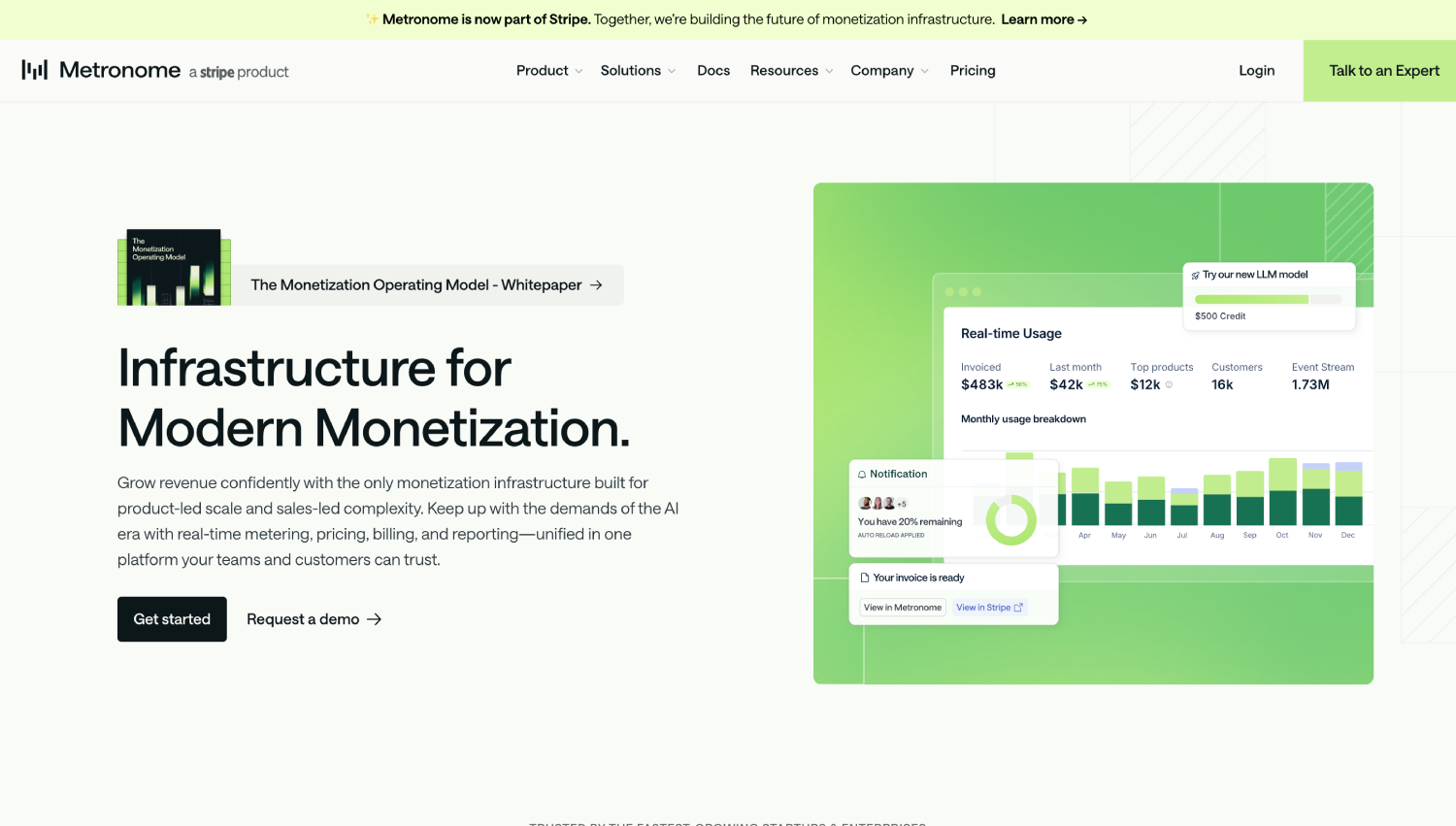
Metronome was built around the idea that enterprise software companies sell on contracts, not on self-serve checkouts. Its core primitives are credits, commits, and contracts. A commit is a minimum spend a customer agrees to, and Metronome tracks real-time usage against that commit so both the vendor and the customer can see where they stand at any moment. That sounds like a feature. In practice, it changes how a sales team operates: AEs can show a prospect their current burn rate against contract mid-quarter, which affects renewal conversations.
On the metering architecture side, Metronome ingests raw events via API and applies billable metrics on top of them, so you can change what you charge for without re-instrumenting your product. According to Metronome’s public documentation, their event ingestion is designed to handle high-volume, out-of-order events with idempotency keys to prevent double-counting. The revenue recognition tooling integrates with accounting workflows, which matters for finance teams closing books under ASC 606.
Where Metronome is thinner: self-serve checkout flows, invoicing customization, and pricing model flexibility at the low end. It is built for deals that go through a sales team, not for a product-led growth motion where a developer signs up and starts billing in an afternoon.
Orb: The Billing Engine Built for Pricing Complexity
Orb takes a different starting point. Its metering architecture is centered on a concept the company calls the Plan, which defines all pricing logic declaratively, including tiered rates, matrix dimensions, minimum charges, and credits. When a customer’s usage comes in, Orb evaluates the plan and produces a deterministic invoice. You can preview an invoice at any point in the billing period, see exactly what a customer will owe, and change pricing structures without migrating data.
Orb explicitly supports pricing models that would require custom code elsewhere: bulk pricing, package pricing, percentage of total cost, tiered BPS (basis points), and matrix pricing where the rate depends on two variables simultaneously (say, region and model tier for an AI API). For companies in the AI infrastructure space, that matrix pricing support is not a nice-to-have. It is load-bearing.
Orb also ships invoicing, a customer portal, and reporting as part of the platform. According to Orb’s product pages, it includes support for pricing experimentation, meaning you can define multiple price configurations and test them before rolling out broadly. That is useful for companies actively iterating on their monetization model, which is most companies in the first two years after launching a usage-based product.
Lago: Open-Source Billing Infrastructure with Full Data Control
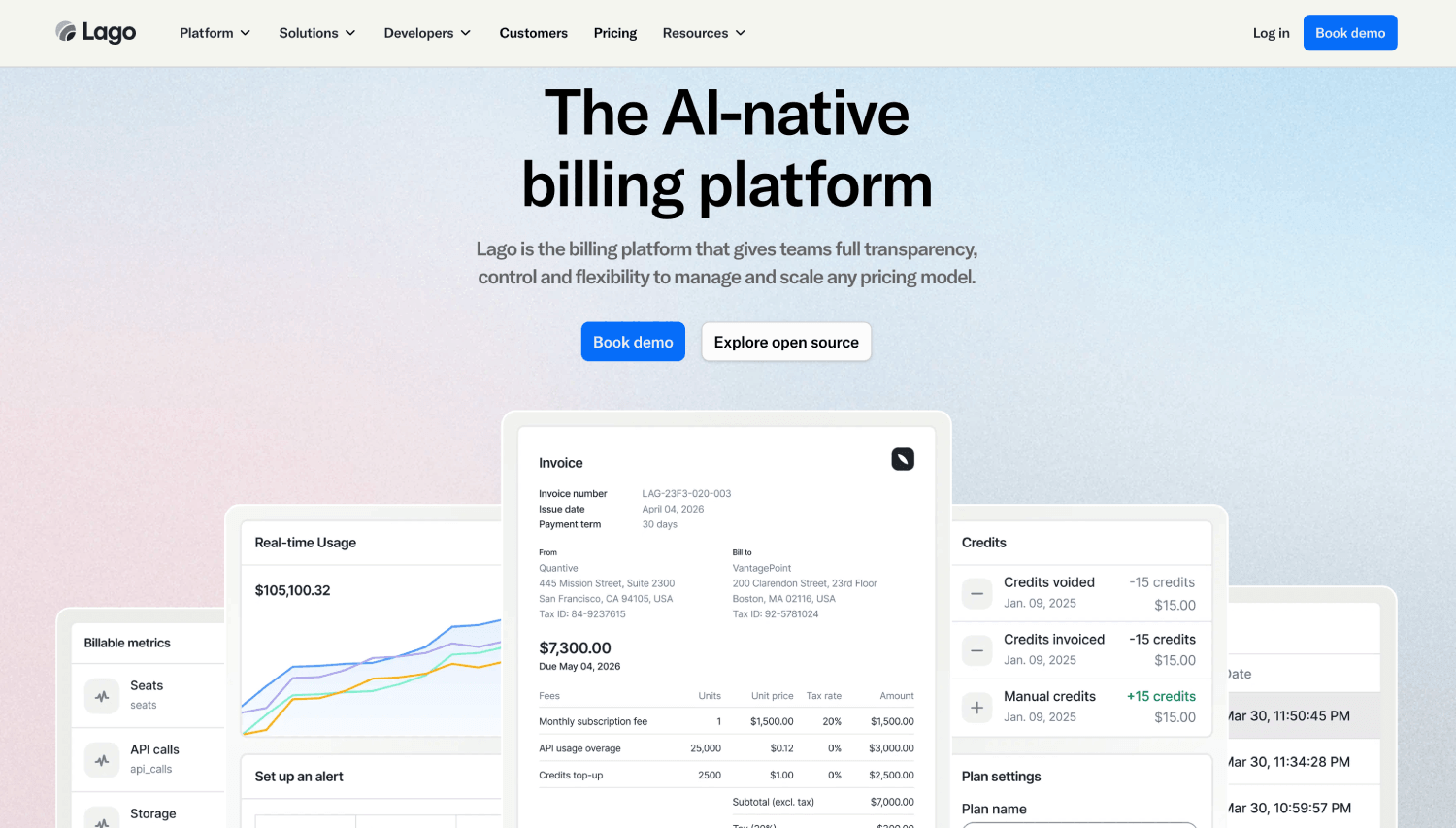
Lago is the most architecturally distinct of the three. It is open-source (available on GitHub), which means you can self-host the entire billing stack on your own infrastructure. The cloud version, Lago Cloud, is a managed SaaS offering, but the open-source path is a real option used by teams who cannot send billing data to a third-party SaaS for compliance or data residency reasons.
Lago handles metering, invoicing, wallets (prepaid credits), coupons, and webhooks for billing events. The pricing model primitives include graduated charges, package charges, percentage charges, and volume-based charges. It is a capable set for most usage-based products, though it does not reach the matrix pricing depth that Orb handles out of the box.
The practical appeal of Lago for a Series A or B company is cost structure. Self-hosting Lago means you pay infrastructure costs rather than a percentage of revenue or a high per-event fee. For companies at lower ARR with high event volumes, that math can favor Lago significantly. The trade-off is engineering time spent on deployment, upgrades, and support.
Side-by-Side Metering Architecture and Feature Comparison
| Feature | Metronome | Orb | Lago |
|---|---|---|---|
| Deployment model | SaaS only | SaaS only | Open-source + Cloud SaaS |
| Event ingestion API | Yes, with idempotency | Yes, with idempotency | Yes, with idempotency |
| Real-time usage preview | Yes | Yes | Yes |
| Tiered pricing | Yes | Yes | Yes (graduated + volume) |
| Matrix pricing (2D rate card) | Limited | Yes, native | Not native |
| Prepaid credits / wallets | Yes (commits) | Yes | Yes |
| Contract and commit tracking | Yes, core feature | Yes | Limited |
| Revenue recognition (ASC 606) | Yes, native tooling | Partial (integrations) | Limited |
| Pricing experimentation | Limited | Yes | No |
| Self-hosted option | No | No | Yes |
| Open-source | No | No | Yes (Apache 2.0) |
| Customer portal | Yes | Yes | Yes (basic) |
| Invoicing and tax | Yes | Yes | Yes (tax via integrations) |
| Primary buyer fit | Enterprise, sales-led | PLG + enterprise, complex pricing | Engineering-led, cost-sensitive, compliance-constrained |
What Does Each Platform Actually Cost?
None of the three publishes a standard price list for their core platform. All three use custom pricing based on event volume, contract size, and product tier. Metronome and Orb both position above the SMB market, and public conversations among buyers on forums like Reddit suggest both run into five figures annually at meaningful scale. Lago Cloud pricing is also custom, but the self-hosted open-source version shifts cost entirely to infrastructure and engineering overhead.
For teams evaluating cost, the relevant calculation is not just the vendor fee. It is vendor fee plus engineering time lost to billing logic that the vendor does not handle. A team spending 15 hours a month debugging metering edge cases is spending money whether or not it shows up in a SaaS invoice. That hidden cost is one of the arguments Metronome, Orb, and Lago all make against building in-house, and it is covered in more detail in this breakdown of hidden costs eating fintech SaaS margins.
Lago’s open-source path does lower the cash cost, but it requires a team capable of running and maintaining the infrastructure. For a two-person engineering team already stretched thin, the tradeoff is unfavorable. For a team with dedicated platform engineering and a compliance reason to keep data on-premises, it can be the best economics in the market.
The FintechSpecs Metering Stress Test: Four Questions That Separate These Platforms
Most buyers compare features. The more useful exercise is to stress-test the metering architecture specifically, because metering errors compound. An undercounting bug that runs for 30 days before detection does not just lose that month’s revenue. It creates a retroactive billing dispute, a customer trust problem, and an audit trail issue if you are closing books under accrual accounting. Here are the four questions to ask every vendor before you sign.
1. How does the platform handle late-arriving events? Usage events from distributed systems often arrive out of order or delayed by minutes or hours. A billing engine that only accepts events in real time and cuts invoices before late events land will undercount. Ask specifically: what is the event ingestion window, and what happens to events that arrive after an invoice is finalized? Orb and Metronome both address this in their architecture documentation. Lago’s behavior here depends on your configuration if self-hosted.
2. What is the deduplication strategy? If your product emits events and your network retries a delivery, a naive billing engine charges twice. All three platforms claim idempotency support, but the implementation matters. Ask for the idempotency key schema and whether it is enforced at the database level or at the application layer. Application-layer deduplication can fail under high load.
3. Can you backfill historical events? When you change a billable metric definition, do you recalculate historical usage, or does the new definition only apply forward? This affects your ability to correct errors and to model pricing changes. Metronome’s event store approach is designed to support retroactive metric changes. Orb similarly stores raw events and applies metric definitions on read. This is one of the clearest architectural advantages these platforms have over passing aggregated quantities to a billing tool downstream.
4. How does the platform handle mid-cycle plan changes? A customer upgrades or downgrades mid-billing-period. Who handles proration, what happens to committed spend, and how does this appear on the invoice? For companies with enterprise contracts, this edge case is not rare. It happens at every renewal negotiation. Metronome’s commit tracking handles this natively. Orb handles it through plan versioning. Lago supports it but with more manual configuration at the self-hosted tier.
How Metronome’s Commit Tracking Changes a Real Renewal Conversation
To make the Metronome vs Orb vs Lago comparison concrete, consider a hypothetical that comes up constantly in enterprise SaaS: a $240,000 annual commit deal, paid quarterly, where the customer is 70% through Q3 and has consumed 58% of their annual allotment.
Without commit-aware billing infrastructure, the AE going into that renewal conversation is working from a CRM note, a spreadsheet the CS team maintains manually, and whatever the customer’s own finance team pulled from their usage dashboard. The numbers rarely agree. The renewal discussion starts with a 20-minute reconciliation before anything commercial gets discussed.
With Metronome’s commit tracking, that same AE can pull a real-time burn report showing: $139,200 consumed against $240,000 committed, $100,800 remaining, with current run rate implying $168,000 in usage by year-end , meaning the customer will land $72,000 short of their commit. That single data point reframes the conversation. Instead of defending overage charges, the AE is now discussing whether to right-size the commit down (and reprice), add new product lines to drive utilization, or restructure the Q4 payment schedule to reflect actual trajectory.
Orb tracks commits as well, but the native commit-visibility tooling in Metronome , including the ability to surface this data to customers through a portal so they are never surprised , is designed around exactly this enterprise sales workflow. Lago, at the self-hosted tier, would require custom reporting to produce the equivalent view. The numbers here are illustrative, but the workflow is real, and the platform that owns that data natively has structural leverage in every renewal conversation.
Which Platform Wins for Different Buyer Profiles
AI Infrastructure and Developer Tool Companies
If you are building an API product that charges per token, per image, per request, or across model tiers by region, Orb is the clearest match. The matrix pricing support means you can charge different rates for GPT-4-class calls versus smaller models, per region, without writing custom billing logic. Metronome can approximate this but requires more configuration. Lago does not support it natively at all.
Enterprise SaaS with Sales-Led GTM and Committed Contracts
Metronome is built for this. The commit and credit tracking, the contract management layer, and the ASC 606 revenue recognition tooling are purpose-built for companies with AEs closing multi-year deals with annual minimums. If your CFO needs to see deferred revenue schedules and your sales team needs to see customer burn against commit in real time, Metronome handles that workflow better than the other two. You can read more about how pricing model complexity affects billing decisions in the FintechSpecs pricing models guide for fintech SaaS.
Compliance-Constrained or Cost-Sensitive Engineering Teams
Lago is the answer when the data cannot leave your infrastructure, when your engineering team is strong enough to run it, or when you need to keep vendor costs low while building toward a pricing model that is not yet fully defined. The open-source path also means you can fork and extend the billing logic for cases none of the three vendors have productized. That flexibility has real value, but it comes with real maintenance cost.
Product-Led Growth Companies Iterating on Usage-Based Pricing
Orb’s pricing experimentation feature makes it the better fit for PLG companies that are still learning what to charge for and want to test rate structures without an engineering sprint every time. Metronome is heavier for this use case. Lago’s self-hosted version requires infrastructure changes to test pricing configurations. If you are at seed or early Series A and still figuring out your monetization model, Orb gives you the most runway to experiment without re-architecting. The billing decisions you make early compound in ways that are hard to undo, which is one of the arguments covered in common fintech pricing mistakes founders keep repeating.
How These Three Compare to Building Your Own Billing Engine
The standard argument for building billing in-house is control. The standard counter-argument is that billing is harder than it looks. A system that ingests events, deduplicates, aggregates, applies tiered pricing, handles proration, generates invoices, manages retries, and produces clean rev-rec data takes most teams six to twelve months to build at a level they trust in production. Metronome, Orb, and Lago all exist because companies learned that the hard way.
The more honest frame is that building in-house makes sense if your pricing model is static, simple, and unlikely to change. If you expect to iterate on pricing, add new products, or move upmarket to enterprise deals, the cost of maintaining a custom billing system grows with that complexity. For fintech teams evaluating their full infrastructure stack, the considerations here overlap with the trade-offs covered in the ten critical mistakes when choosing fintech infrastructure.
Frequently Asked Questions
What is the difference between Metronome vs Orb vs Lago for usage-based billing?
In the Metronome vs Orb vs Lago comparison, Orb focuses on pricing model depth and works well for companies with complex, multi-dimensional rate structures and PLG motions. Metronome focuses on enterprise contract management, including commit tracking and real-time burn visibility, making it a stronger fit for sales-led teams with annual minimum deals. Lago is open-source and self-hostable, making it the primary option for teams with data residency requirements or cost constraints. Orb ships more complete billing infrastructure out of the box; Metronome ships deeper contract and revenue recognition tooling; Lago ships control over the entire stack.
What does Lago do, and who is it for?
Lago is an open-source metering and billing platform. It handles event ingestion, usage aggregation, pricing configuration, invoicing, and prepaid wallets. The open-source version can be self-hosted on your own infrastructure, which makes it the primary choice for teams with data residency requirements or teams looking to avoid percentage-of-revenue SaaS fees. Lago Cloud is a managed version for teams that want the open-source foundation without the ops overhead.
Is Stripe a viable alternative to Metronome, Orb, or Lago for usage-based billing?
Stripe’s metered billing handles simple usage pricing, but the aggregation logic stays on your side. You count the usage, send a quantity to Stripe, and Stripe applies a rate. That works for basic cases. For tiered pricing with volume discounts, matrix rate cards, mid-cycle commit tracking, or ASC 606 revenue recognition, Stripe requires significant custom engineering. Metronome, Orb, and Lago pull that logic into the billing layer itself, which is the core architectural difference. A broader comparison of Stripe billing alternatives for usage-based pricing is available here.
Which usage-based billing platform handles the most complex pricing models?
Orb handles the widest range of pricing model complexity natively, including matrix pricing (rate determined by two variables simultaneously), tiered with minimum charges, percentage-of-cost pricing, bulk pricing, and package pricing. Metronome supports complex enterprise pricing but is more tightly scoped to credit and commit structures. Lago handles graduated, volume, percentage, and package pricing, but does not offer matrix pricing as a native construct.
How does open-source Lago compare to Lago Cloud?
The open-source version of Lago gives you the full codebase to self-host and modify. You control deployment, upgrades, data storage, and any custom extensions to the billing logic. Lago Cloud is a managed version with less operational overhead. The open-source path has meaningful infrastructure and engineering maintenance costs, but it eliminates data-sharing with a SaaS vendor and shifts pricing from a recurring fee to infrastructure costs. For teams with specific data residency requirements, the self-hosted path is often the deciding factor.
What is a metered billing platform, and how is it different from subscription billing?
A metered billing platform ingests raw usage events from your product, aggregates them according to your pricing rules, and calculates charges based on actual consumption rather than a fixed fee. Subscription billing charges a set amount on a recurring schedule regardless of usage. The technical difference is where aggregation happens: metered billing platforms own the event store and the aggregation logic, while subscription billing platforms expect you to send pre-calculated quantities. That distinction determines whether you can change pricing models without re-engineering your product.
How should a Series B SaaS company choose between Metronome, Orb, and Lago?
A Series B company should start with its GTM motion and pricing trajectory. If the company is moving upmarket with annual contracts and usage commits, Metronome’s contract management layer justifies the trade-off. If pricing is still evolving and the company needs to run experiments without engineering sprints, Orb gives more flexibility. If there is a compliance requirement to keep billing data on-premises, or if engineering capacity can absorb the ops overhead, Lago self-hosted is worth the evaluation. The decision is less about features and more about which platform’s architectural bets match where the business is headed.
The Revenue Recognition Problem Nobody Talks About Until Close
There is a moment in every fast-growing SaaS company’s life when the auditor asks for a schedule of recognized versus deferred revenue by customer, by period, broken down by committed minimums and actual usage. Most billing tools cannot produce that report. The data exists somewhere, but it is distributed across the billing platform, the CRM, and the data warehouse, and reconciling it takes the finance team a week every quarter close.
This is where the Metronome versus Orb choice becomes a finance team conversation, not just a product conversation. Metronome’s native ASC 606 revenue recognition support and commit tracking mean the revenue recognition data is already structured in the billing layer. For a company approaching a Series C or heading toward an audit, that is not a small thing. It can shorten a week-long close to a day, as described in how financial close automation tools cut month-end time.
Orb integrates with accounting systems and produces clean invoice data, but the rev-rec logic itself sits outside the platform. Lago, particularly the self-hosted version, gives you the raw data to build whatever you need, but building ASC 606 reporting on top of an open-source billing engine is a project in itself. The platform that looks cheapest at the procurement stage can be the most expensive one when the first audit comes around. Teams tracking the fintech metrics that matter at this stage will find additional context in the FintechSpecs guide to fintech metrics beyond vanity growth.