
- Revenue-based financing lets SaaS and ecommerce companies borrow against future revenue without giving up equity or board seats.
- Repayment is tied to a percentage of monthly revenue, so payments shrink automatically in slower months.
- Fee structures vary significantly across providers: some charge a flat factor rate, others charge percentage-of-revenue fees, and a few charge interest like traditional debt.
- The right provider depends on your business model, revenue type (subscription vs. transactional), and how much flexibility you need in repayment timing.
- Capchase, Pipe, Founderpath, Wayflyer, and Uncapped each serve meaningfully different buyer profiles despite competing for the same search terms.
Revenue-based financing (RBF) is a form of non-dilutive capital where a company receives an upfront sum and repays it as a fixed percentage of monthly revenue until a predetermined total is paid back. It suits SaaS companies with predictable subscription revenue and ecommerce brands with consistent sales volume. Cost is expressed as a flat fee or factor rate rather than an annualized interest rate, which makes direct cost comparisons across providers harder than they first appear.
What Is Revenue-Based Financing and How Does It Actually Work?
A company takes $200,000 from an RBF provider and agrees to repay $220,000 total, a 1.1x factor rate. Each month, a fixed percentage of revenue (say 5%) is deducted until the $220,000 is recovered. In a strong revenue month that deduction might be $15,000. In a weak month it might be $6,000. The lender gets paid back faster or slower depending on the company’s performance, but the total repayment amount does not change.
That flexibility is the core structural difference from venture debt, which typically requires fixed monthly payments regardless of revenue performance. It is also what separates RBF from equity: no dilution, no warrants, no preferred liquidation preferences.
The total cost of capital in revenue-based financing is expressed as the factor rate, not an APR. A 1.1x factor on $200,000 means you pay $20,000 to access that capital. If repayment takes 6 months, the implied annualized cost is higher than if it takes 18 months. Most providers do not surface this calculation prominently, which matters when comparing offers. If you are weighing RBF against a traditional term loan or venture debt, understanding the full unit economics of your funding structure before signing is worth the extra day of analysis.
Who Qualifies for Revenue-Based Financing?
Typical qualification thresholds vary by provider, but most require at least $10,000 to $50,000 in monthly recurring revenue and several months of operating history. SaaS companies with predictable MRR are considered lower risk because the revenue pattern is easier to model. Ecommerce brands are evaluated differently: providers look at trailing 90-day Shopify or Amazon revenue, gross margin, and ad spend efficiency rather than MRR.
Credit scores matter less here than in traditional lending. Most RBF providers connect directly to your payment processor, bank account, or accounting software to underwrite from actual revenue data. That means a founder with a thin personal credit file can still qualify if the business numbers are strong.
The profile that gets rejected most often: pre-revenue companies, businesses with declining revenue trends, and companies where revenue is highly lumpy (large, infrequent contracts rather than recurring smaller ones). Revenue-based financing is designed for businesses with consistent, verifiable cash inflows, not for pre-product startups.
The RBF Provider Evaluation Framework: Four Dimensions That Actually Differ Across Providers
Most comparison articles list features. This one uses four dimensions where providers genuinely diverge in ways that competitors in this space do not consistently separate out , and where the wrong choice costs real money. These are not generic procurement criteria; they reflect the specific failure modes FintechSpecs has observed across RBF buyer decisions.
1. Fee structure transparency: Is the total cost expressed as a flat factor rate, an origination fee plus percentage, or a hybrid? Hidden origination fees of 1-3% are common and can meaningfully change the effective cost of capital. The key test: can you derive the all-in repayment amount before signing, or does the provider require a term sheet to get to that number?
2. Repayment flexibility: Can you pause repayments, renegotiate the revenue share percentage, or refinance mid-term? Some providers offer true revenue-linked flexibility; others have minimum monthly payment floors that negate the flexibility benefit. The presence or absence of a floor is the single most consequential feature for companies with seasonal or uneven revenue.
3. Revenue type compatibility: Does the provider’s underwriting model fit subscription MRR, transactional ecommerce GMV, or both? A provider optimized for SaaS metrics will undervalue an ecommerce brand and vice versa. This dimension is where most RBF missteps happen , founders apply to a structurally mismatched provider and interpret a low offer as a reflection of their business quality rather than the underwriting model.
4. Speed and automation: How long from application to funded? Some providers fund in 24-48 hours via automated decisioning; others require a week-plus of manual review. For time-sensitive inventory purchases or marketing campaigns, this is not a minor operational detail. The difference between same-day and two-week funding can determine whether you capture a seasonal window or miss it entirely.
Which 8 Providers Lead the Revenue-Based Financing Market?
1. Capchase
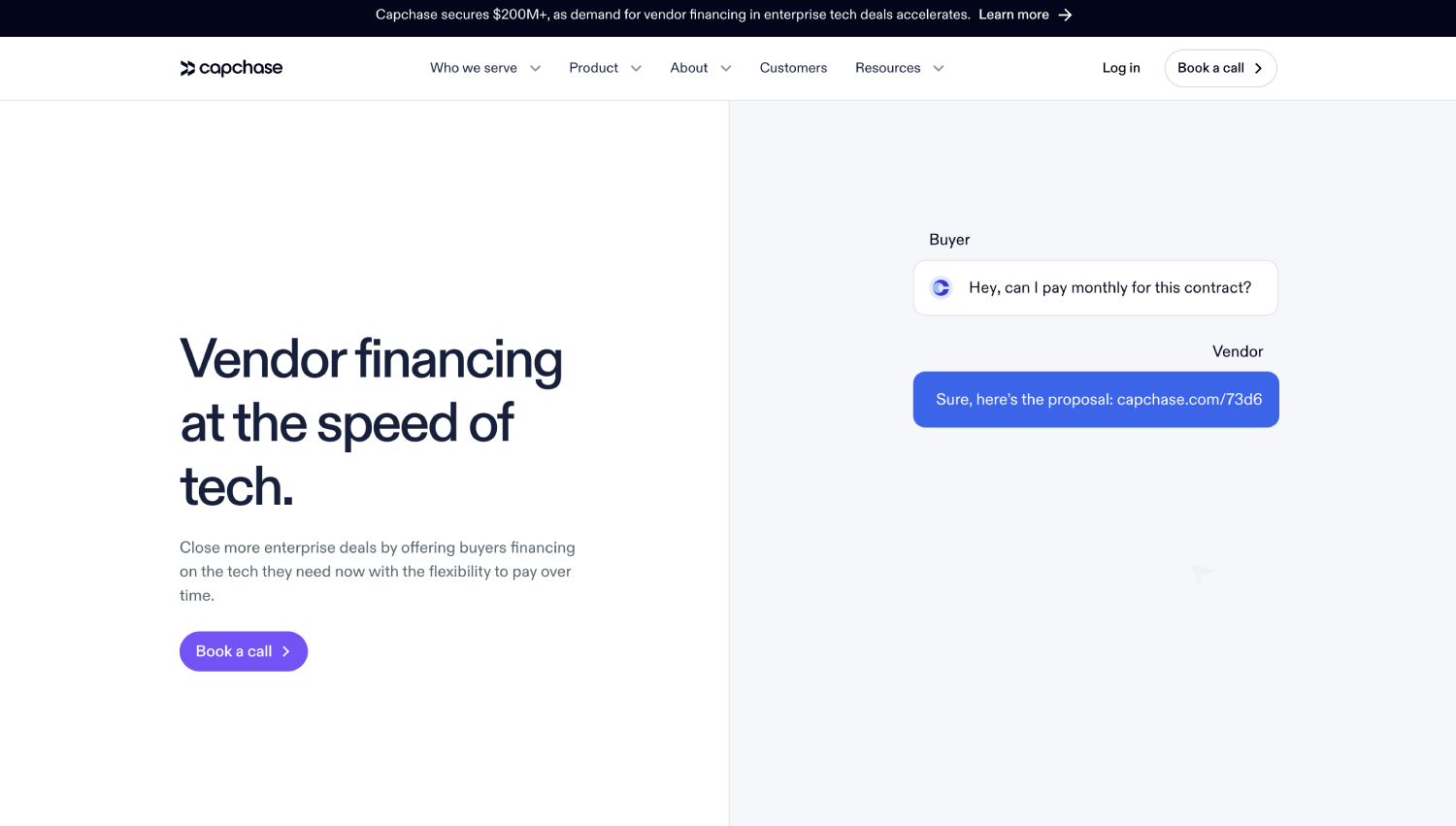
Capchase focuses almost entirely on SaaS companies. Their core product, Capchase Grow, advances capital against contracted or recurring ARR. They connect to your billing system (Stripe, Chargebee, Recurly) and model forward revenue from subscription data rather than bank statements alone.
The underwriting edge Capchase has over generalist providers is that they weight net revenue retention and churn cohorts, not just current MRR. A company with 110% NRR gets better terms than a company with the same MRR but 90% NRR. That is a meaningful structural advantage for SaaS founders with strong retention metrics. Capchase does not publicly disclose a single fee rate; pricing is offer-specific, so you need to run the application to get numbers. They also offer a pay-later product for vendor invoices, which is worth noting if you carry large annual software bills.
2. Pipe

Pipe originally built a marketplace model where investors bid on SaaS revenue contracts, but has since repositioned as a more direct working capital provider. They now serve both SaaS and non-SaaS businesses including ecommerce and services companies.
Pipe’s strength is speed: their automated underwriting can generate a term offer within hours of connecting your financial accounts. Their pricing is not publicly listed in a flat rate; offers are individualized. One structural note: Pipe charges a trading fee rather than a traditional interest rate, which is worth clarifying in their term sheet. They also have a capital marketplace component where qualified businesses can access capital from multiple funding sources through a single application.
3. Founderpath
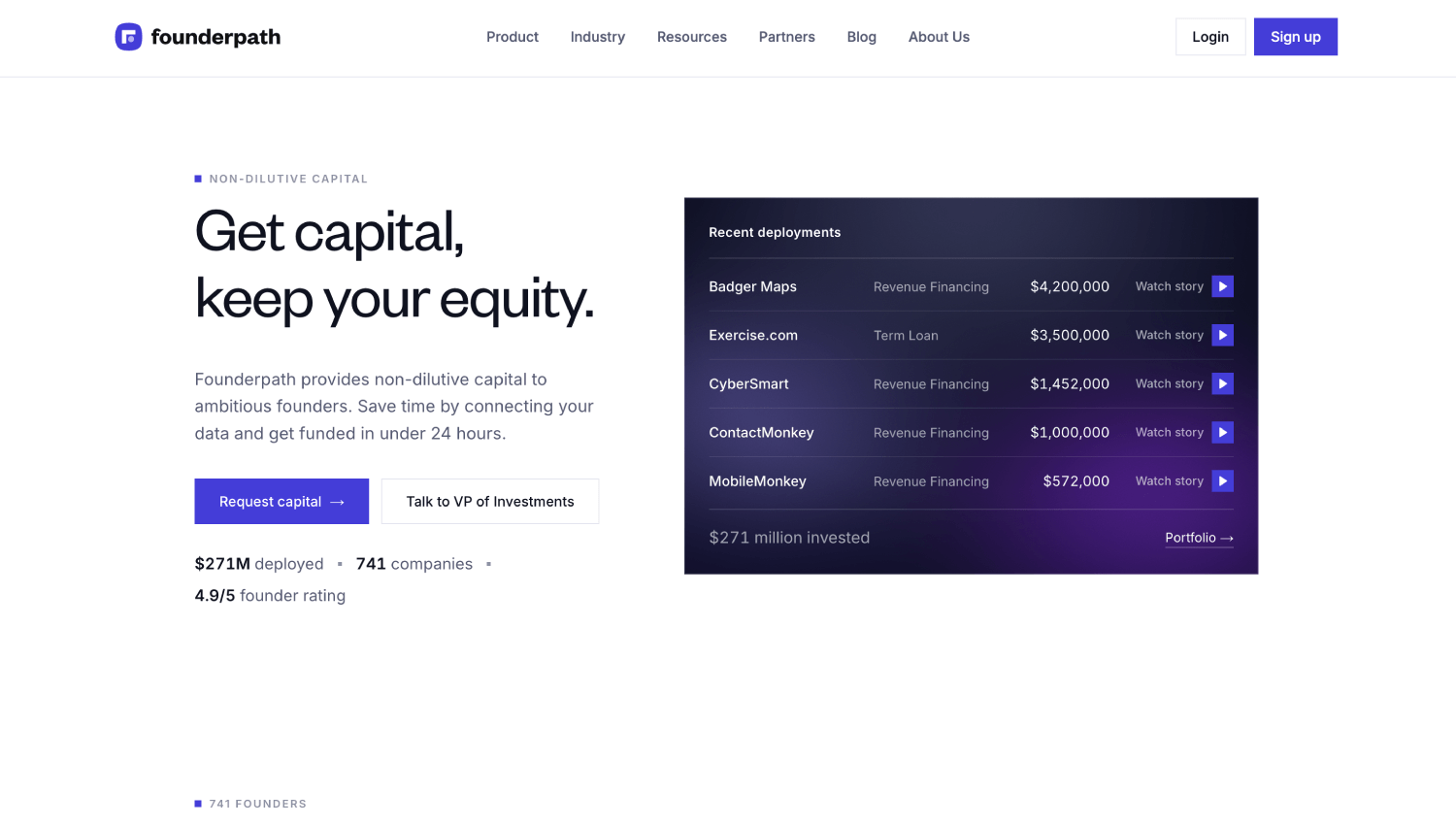
Founderpath explicitly targets bootstrapped and lightly funded SaaS founders who want non-dilutive capital without the enterprise sales process that larger RBF providers often require. Their minimum threshold is lower than most: they have publicly stated they work with companies doing as little as $3,000 MRR, which makes them one of the most accessible options at the early stage.
What separates Founderpath operationally is their onboarding experience. You connect your Stripe or Baremetrics account, and they return a capital offer almost immediately, often the same day. There is no lengthy manual review for smaller advance amounts. Their fee structure is a flat factor rate disclosed at application. For a bootstrapped SaaS founder at $5,000-$30,000 MRR who needs $25,000-$150,000 quickly, Founderpath is the most direct path to capital in this category.
4. Wayflyer
Wayflyer is the clearest ecommerce specialist in this list. They underwrite against marketing efficiency (ROAS, CAC, LTV) and inventory cycles rather than subscription MRR. Their system ingests Shopify, Google Ads, and Facebook Ads data to build a forward revenue model based on your ad spend trajectory.
The practical implication: an ecommerce brand that gets a low offer from a SaaS-focused RBF provider will often get a substantially better offer from Wayflyer because the underwriting model actually fits the business. Wayflyer primarily serves DTC ecommerce companies, and their capital is frequently used for inventory financing and paid media campaigns ahead of seasonal peaks. They operate in the US, UK, and several other markets. Pricing is not flat-listed; offers are generated post-application.
5. Uncapped
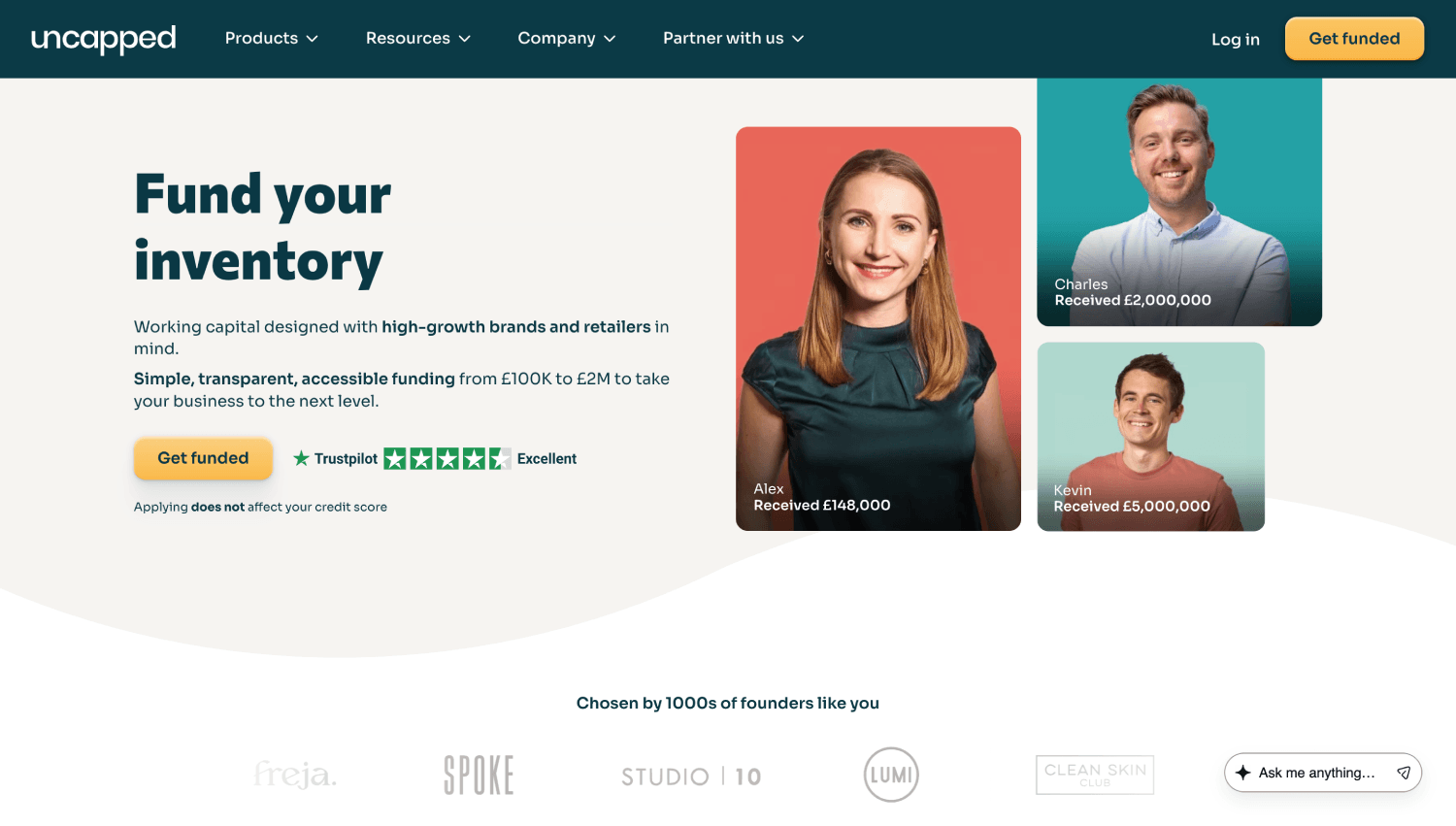
Uncapped serves both ecommerce and SaaS companies and markets itself on the absence of a minimum repayment floor. Revenue share payments flex fully with revenue, with no monthly minimum. For companies with seasonal revenue (holiday ecommerce, annual contract SaaS), that feature is more than a marketing claim; it means the repayment structure actually matches cash flow patterns.
Uncapped originated in Europe but operates in the US market. Their factor rates are not publicly posted but are disclosed at the term sheet stage. One practical distinction: they offer a specific product for marketing capital that is priced separately from general working capital, which allows ecommerce brands to isolate the cost of funding a specific ad campaign rather than blending it into broader operational borrowing.
6. Clearco
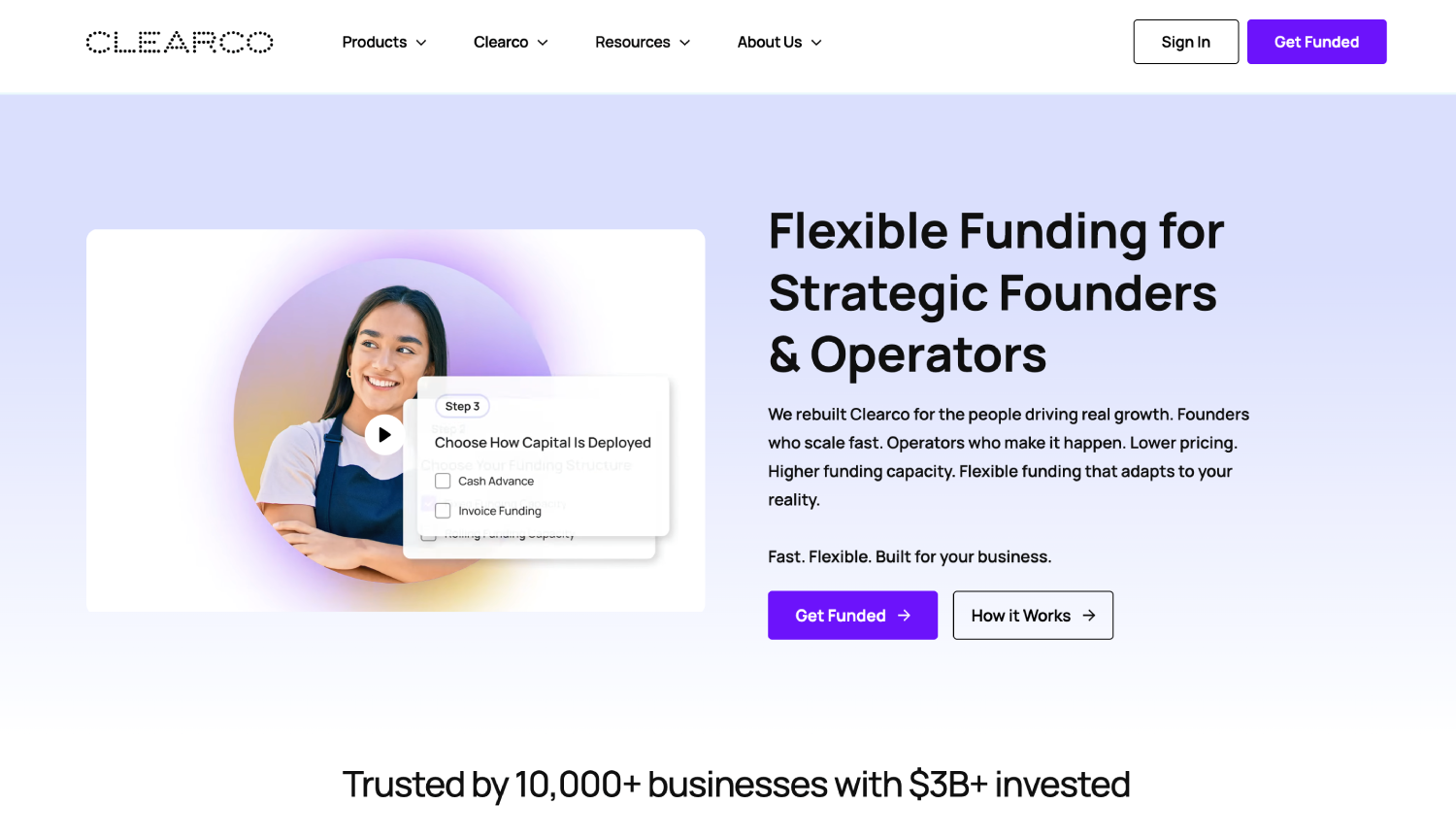
Clearco (formerly Clearbanc) is one of the original RBF providers for ecommerce and SaaS. They pioneered the 20-minute term sheet for ecommerce brands by connecting directly to Shopify and ad platform data. Their Capital product funds marketing, inventory, and general growth expenses.
Clearco went through a period of significant restructuring and layoffs in 2022-2023, which raised questions about reliability that a buyer evaluating them today should factor in. They remain operational and have published that they have deployed over $2 billion to founders since founding. Their fee structure uses a flat percentage of funded amount as a fee, with no compounding interest. The public-facing fee range is not currently listed on their pricing page; prospective borrowers receive individualized offers.
7. Arc
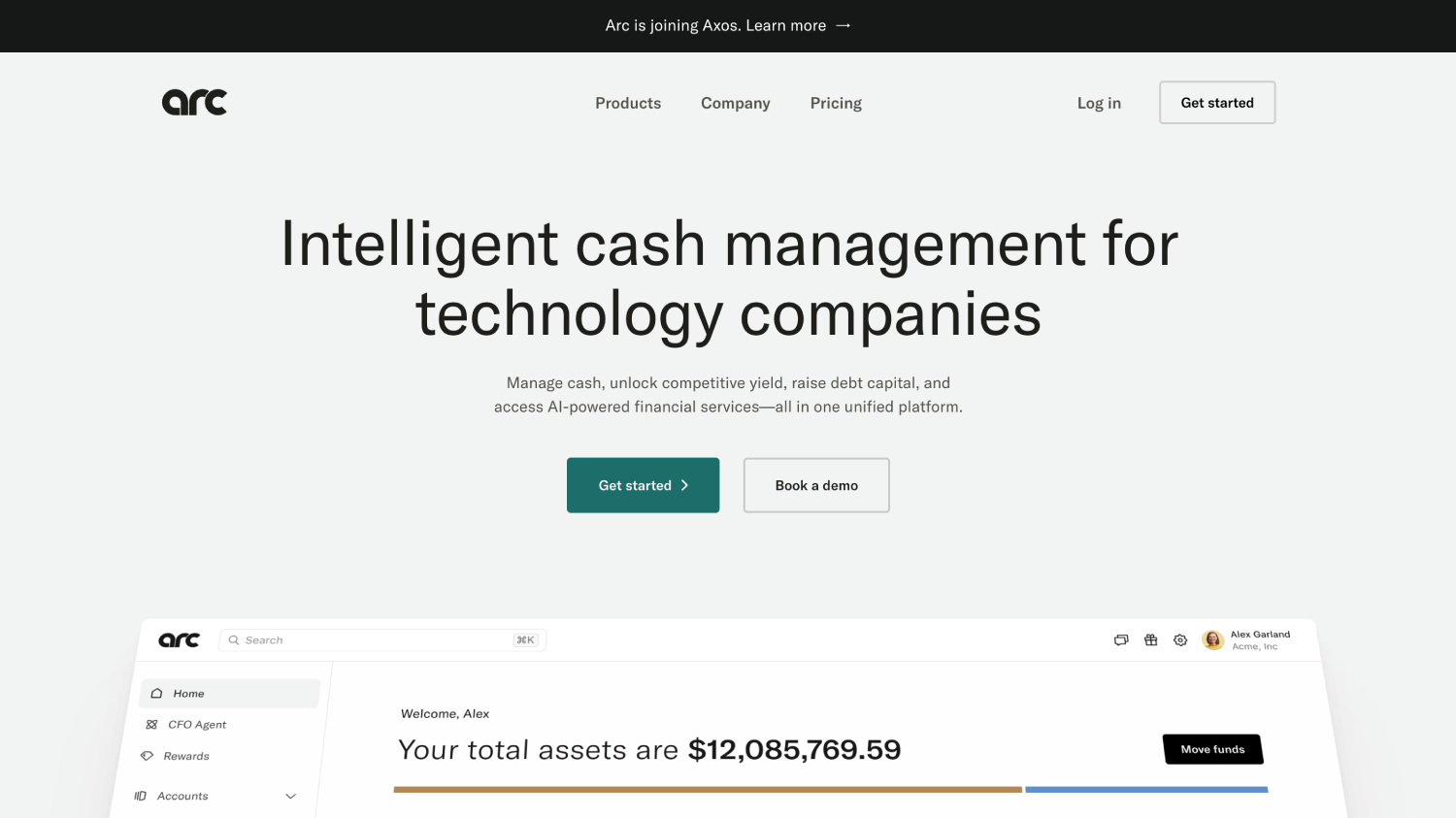
Arc positions itself as a financial platform for startups that includes RBF as one component. Beyond revenue-based financing, they offer a startup banking account, treasury management, and venture debt. For a SaaS founder who wants non-dilutive capital and wants to consolidate financial operations in one place, Arc’s bundled model is worth evaluating.
Their RBF product, Arc Advance, underwrites against SaaS metrics with a focus on ARR and net revenue retention. What distinguishes Arc from pure-play RBF providers is their treasury product: they pay meaningfully higher yield on idle cash than a standard business checking account, which offsets some financing costs for capital-efficient companies. Pricing on the Advance product is offer-specific and not publicly posted.
8. Lighter Capital
Lighter Capital is one of the longer-tenured players in RBF for SaaS, having been active since 2010. They focus exclusively on technology companies and have financed hundreds of software businesses over that span. Their product functions more like a term loan with revenue-linked repayments rather than a pure revenue share, and they offer multi-tranche structures that let companies draw additional capital as revenue grows.
Lighter Capital’s minimum threshold sits higher than Founderpath’s; they publicly state they work with companies typically generating $200,000 or more in annual recurring revenue. Their process is more involved than automated platforms: there is a real underwriting review with a human team, and timelines run longer as a result. For a later-stage SaaS company that wants structured capital and is comfortable with a more traditional process, Lighter Capital’s track record and multi-tranche flexibility are genuine differentiators. Their fee and term information is disclosed after initial application review.
How Do These Providers Compare on Fee Structure and Repayment Terms?
| Provider | Primary Segment | Typical Advance Range | Fee Structure | Repayment Flexibility | Speed to Fund |
|---|---|---|---|---|---|
| Capchase | SaaS | Not publicly disclosed | Flat factor, offer-specific | Moderate | Days |
| Pipe | SaaS + Multi-segment | Not publicly disclosed | Trading fee, offer-specific | High (automated) | Hours to days |
| Founderpath | Early-stage SaaS | $10K-$1M+ | Flat factor rate, disclosed at offer | Moderate | Same day possible |
| Wayflyer | Ecommerce DTC | Not publicly disclosed | Flat fee, offer-specific | High (seasonal flex) | Days |
| Uncapped | Ecommerce + SaaS | Not publicly disclosed | Factor rate, offer-specific | High (no minimum floor) | Days |
| Clearco | Ecommerce + SaaS | Not publicly disclosed | Flat fee percentage | Moderate | Days |
| Arc | SaaS | Not publicly disclosed | Offer-specific | Moderate | Days |
| Lighter Capital | SaaS / Tech | $50K-$3M+ | Revenue share, multi-tranche | High (multi-draw) | Weeks |
Note: Fee rates are not publicly disclosed by most providers and must be evaluated at the offer stage. “Advance range” figures reflect publicly available information where it exists; otherwise the figure is omitted rather than estimated.
RBF vs Venture Debt: What Is the Actual Difference?
Venture debt is a term loan structure. It has fixed monthly payments, a defined maturity date, and often includes warrants that give the lender the right to buy equity at a set price. The warrant coverage is small (typically 1-2% of the loan amount as a percentage of equity), but it is technically dilutive. Venture debt is almost always offered by lenders like Western Technology Investment, Hercules Capital, or Silicon Valley Bank to companies that have already raised a priced equity round, because the lender uses the equity raise as a proxy for validated enterprise value.
Revenue-based financing has no warrant requirement, no fixed monthly minimum (in true revenue-linked structures), and does not require a prior equity raise. The trade-off is that RBF typically has a higher effective cost of capital on a per-year basis for companies that repay quickly, and smaller advance sizes relative to venture debt. A Series A company that raised $5M in equity and needs $2M in additional growth capital would likely qualify for venture debt at lower all-in cost than RBF. A $500K ARR bootstrapped company that has not raised a priced round would not qualify for venture debt at all but could qualify for revenue-based financing.
For founders at the seed-to-Series A stage who want to extend runway without another dilutive round, RBF is often the more accessible path. If you are already post-Series A and have institutional investors, venture debt deserves a side-by-side comparison. The metrics that matter most in that comparison are your effective cost of capital over the expected repayment period and the total dilution impact of any warrants.
An Illustrative Scenario: What Revenue-Based Financing Actually Costs a SaaS Company
Consider a SaaS company doing $80,000 MRR ($960,000 ARR) with 95% gross retention and 105% net revenue retention. They want to fund $150,000 in sales hiring without raising a priced round.
A provider offers $150,000 at a 1.12x factor rate, meaning total repayment is $168,000, an $18,000 fee. Repayment is set at 6% of monthly revenue. In month one at $80,000 revenue, the repayment is $4,800. If revenue grows at 5% per month, repayment rises proportionally.
The numbers below are illustrative approximations based on this specific scenario , not guaranteed outcomes , intended to show how repayment duration changes effective cost:
- At 5% monthly revenue growth, full repayment takes roughly 27 months. The implied annualized cost on the $18,000 fee over that period is approximately 10-11% (rough estimate).
- If the company grows faster and clears the $168,000 in roughly 15 months, the same $18,000 fee implies an annualized cost closer to 18-20% (rough estimate).
The actual annualized cost in your situation will depend on your specific revenue trajectory and monthly repayment amounts. These figures are meant to illustrate direction, not precision. The underlying dynamic holds regardless of the exact numbers: the faster you repay, the higher the annualized cost on the fixed fee, because the fee does not change but the time period shortens.
For a high-growth company confident in their trajectory, equity dilution at a high valuation may actually be cheaper than RBF on a fully loaded cost basis. For a stable, moderately growing company, revenue-based financing is often the better financial trade.
What Are the Real Downsides of Revenue-Based Financing?
The most common downside founders underweight is the cash flow drag during high-growth periods. Because repayments scale with revenue, a month where you close a large expansion deal or run a successful campaign results in a larger repayment, pulling cash out precisely when you might want to reinvest it aggressively.
A second practical risk: stacking RBF facilities. Some founders take advances from multiple providers simultaneously, each claiming a percentage of revenue. If you have three facilities each claiming 5% of revenue, you are sending 15% of gross revenue to lenders before paying any operating expenses. That can create a genuine cash crunch even at strong revenue levels. Most providers include covenants against stacking, but not all enforce them rigorously at origination.
The fee structure opacity is also worth naming directly. Because providers present costs as factor rates rather than APRs, comparing revenue-based financing to a traditional line of credit or venture debt requires manual conversion. A 1.1x factor repaid in 8 months translates to a very different annualized cost than the same factor repaid in 20 months, and most term sheets do not surface this calculation. Understanding your own growth trajectory before signing is not optional; it is the primary financial lever you control. If you are building a SaaS business where gross margins are already under pressure, layering in a high-cost capital structure compounds the problem quickly.
Which Provider Should You Choose?
Early-stage bootstrapped SaaS (under $500K ARR): Founderpath. Lowest friction, fastest funding, lowest minimum revenue threshold. The automated Stripe integration means you get a real offer in hours, not a week.
SaaS company with $1M-$10M ARR and strong NRR: Capchase or Arc. Both weight retention metrics in underwriting, meaning a company with 110% NRR gets better terms than one with 95% NRR at the same MRR. Arc’s bundled banking and treasury product is worth evaluating if you are also looking to improve yield on operating cash.
Ecommerce DTC brand with seasonal revenue: Wayflyer or Uncapped. Wayflyer’s marketing data integration and Uncapped’s no-minimum-floor repayment structure both address the cash flow seasonality that ecommerce brands face. A DTC brand heading into Q4 inventory build genuinely benefits from a provider that understands ad spend-to-revenue lag.
Later-stage SaaS ($5M+ ARR) that wants multi-tranche structured capital: Lighter Capital. The longer process and higher minimum ARR requirement reflect a more deliberate underwriting approach, but the multi-tranche structure lets you draw capital in stages as your business hits milestones rather than taking one large advance and paying interest on unused funds.
Companies that have already built out their payments and billing infrastructure should note that the depth of your financial data integrations , your Stripe history, your Chargebee MRR data, your bank connectivity , directly affects the offer quality you receive. Providers with richer data make better-priced offers. If your financial stack is fragmented, consolidating it before applying is a practical step that can improve your terms. The way your payment infrastructure is architected affects more than operations; it affects your creditworthiness with data-driven lenders. Similarly, founders still mapping out which fintech niche to build in should factor in whether their chosen segment has the revenue predictability that RBF providers reward.
Frequently Asked Questions About Revenue-Based Financing
What is a revenue-based financing agreement?
A revenue-based financing agreement is a contract where a company receives a lump-sum advance and agrees to repay a fixed total amount (the advance times a factor rate) by remitting a set percentage of monthly revenue to the lender. Repayment continues until the total is recovered. The agreement specifies the advance amount, the factor rate, the revenue share percentage, and any caps or floors on monthly repayment amounts. Unlike a loan, there is no fixed maturity date; repayment duration depends on the company’s revenue performance.
What are the downsides of using revenue-based financing?
The main downsides are: higher implied annualized cost during fast-growth periods, cash flow drag that scales with revenue during repayment, limited advance sizes compared to venture debt, and factor rate structures that obscure true cost of capital comparisons. Stacking multiple RBF facilities is also a real risk. Founders who grow faster than expected often find that revenue-based financing was more expensive than a simple equity round would have been at the valuation they achieved, though that comparison requires hindsight that was not available at signing.
Is revenue-based financing non-dilutive?
Yes. Revenue-based financing does not involve issuing equity, warrants, or options. The lender has no ownership stake, no board representation, and no right to purchase shares. The company’s cap table is unaffected. This is the primary structural difference from a priced equity round and the key distinction from venture debt, which sometimes includes warrant coverage. Non-dilutive means that all future upside in company value belongs entirely to existing shareholders.
What does RBF stand for in business?
RBF stands for revenue-based financing. In practice, the term is used interchangeably with revenue-based investing, revenue share financing, and royalty-based financing, though these structures have subtle legal differences. In the startup and SaaS context, RBF almost always refers to the advance-plus-factor-rate model where repayment is a fixed percentage of monthly revenue. The term should not be confused with RBF in networking contexts, where it refers to a different protocol entirely.
How is revenue-based financing different from a merchant cash advance?
A merchant cash advance (MCA) is structurally similar to RBF but serves a different borrower profile and typically carries higher costs. MCAs are designed for businesses with daily card transactions (restaurants, retail), and repayment is often daily rather than monthly. MCA providers frequently access your merchant account directly to collect repayments rather than invoicing. Revenue-based financing is generally targeted at SaaS and ecommerce companies with higher monthly revenues, longer repayment periods, and more formal agreement structures. The effective cost of capital on MCAs is frequently higher than RBF when converted to an annualized rate.
Do RBF providers check personal credit?
Most revenue-based financing providers perform a soft credit check on founders or guarantors as part of underwriting but weight business revenue data far more heavily than personal credit scores. A founder with a 650 personal credit score running a business with $100,000 MRR and low churn will generally qualify with most providers. Personal credit becomes more relevant for very early-stage companies with limited revenue history, where it serves as a secondary signal. Providers like Founderpath and Pipe emphasize their revenue-first underwriting model explicitly, making them more accessible to founders with thin personal credit files.
Can ecommerce companies use RBF the same way SaaS companies do?
Ecommerce companies can access revenue-based financing, but the underwriting model differs. SaaS providers underwrite against MRR, NRR, and churn. Ecommerce-focused providers like Wayflyer underwrite against trailing sales volume, gross margin, return rates, and marketing efficiency metrics like ROAS. An ecommerce brand applying to a SaaS-optimized provider may receive a lower offer or a rejection not because their business is weak, but because the underwriting model does not fit their revenue pattern. Matching provider to business model is the single most important variable in getting a competitive offer.
The Bottom Line on Revenue-Based Financing Providers
The RBF market has fragmented in a useful direction: providers have specialized by segment rather than competing identically. That means the best provider for a $3,000 MRR bootstrapped SaaS founder (Founderpath) is not the same as the best provider for a $5M ARR SaaS company with 110% NRR (Capchase or Arc) or a DTC brand heading into a seasonal inventory build (Wayflyer). Applying to the wrong provider does not just risk rejection; it risks getting a lower offer than your actual business deserves because the underwriting model does not match your revenue structure.
The cost transparency problem is real and uniform across the category. No major revenue-based financing provider publicly posts a rate card with enough specificity to compare offers without applying. The practical fix is to apply to two or three providers simultaneously, collect term sheets, and convert factor rates to implied annualized costs using your own revenue growth assumptions. That calculation takes 20 minutes and consistently reveals material differences between offers that look similar on the surface. Understanding where your business sits on the growth trajectory question , because faster repayment means higher annualized cost , should inform which factor rate you are actually willing to accept.
RBF is not categorically cheaper or better than equity or venture debt. It is a different tool with specific conditions under which it outperforms. For a capital-efficient SaaS company that wants to accelerate growth without a dilutive round, or an ecommerce brand that needs inventory capital before a seasonal window, it is often the most financially rational choice available. The mistake is treating revenue-based financing as default non-dilutive funding without running the actual cost comparison against the alternatives on your cap table. If the underlying go-to-market engine is working and you need fuel not a structural fix, RBF is a well-matched instrument. Founders who want to pressure-test whether their margins can absorb repayment before signing should read why most FinTech SaaS margins are worse than founders think first.