
- A clean homepage and polished marketing site tell you nothing about what it feels like to integrate a banking API at 11pm before a launch deadline.
- The platforms that win on developer experience share four qualities: sandbox environments that mirror production behavior, documentation with real code examples, webhooks that fire reliably, and escalation paths that reach humans before a ticket ages 48 hours.
- Column, Unit, Synctera, Treasury Prime, Green Dot, and Stripe Treasury each make different trade-offs across docs depth, SDK coverage, and support responsiveness.
- For most seed-to-Series B teams, the sandbox-to-production fidelity gap is the single most expensive hidden cost in a BaaS integration, not the per-account fee.
- Choosing a BaaS partner based on who has the best-looking developer portal is how teams end up rebuilding integrations six months post-launch.
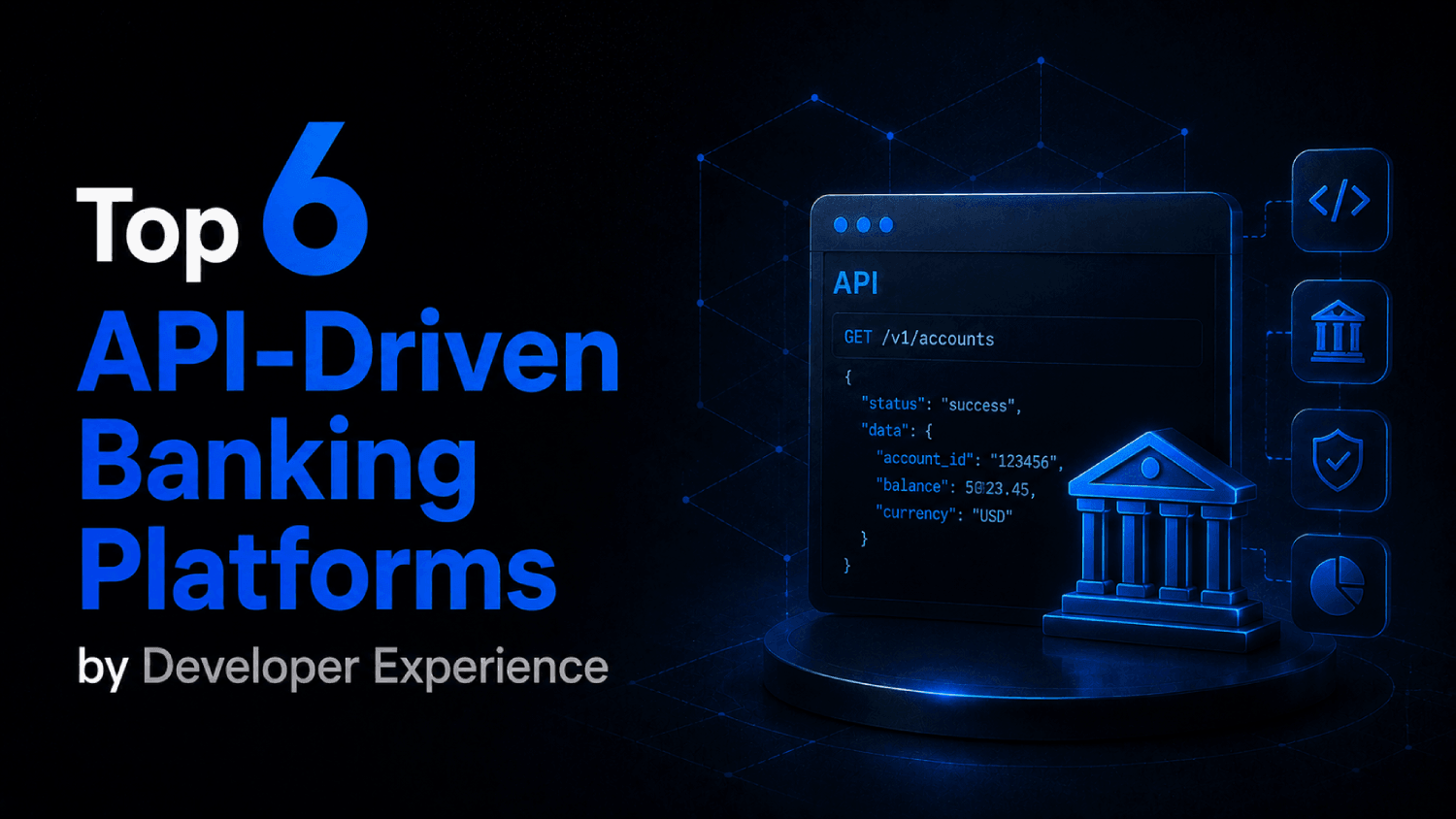
The API-driven banking platforms with the strongest developer experience are Column, Unit, Synctera, Treasury Prime, Green Dot, and Stripe Treasury. Column and Unit lead on sandbox realism and documentation depth. Synctera and Treasury Prime offer more hands-on integration support. Green Dot suits high-volume consumer programs. Stripe Treasury is the fastest path to production for teams already inside the Stripe stack.
Why Most Teams Pick the Wrong BaaS Platform During Evaluation
Most technical evaluators spend their first 30 minutes on a BaaS vendor’s website looking at the wrong things. They check the UI of the developer portal, scan the API reference page for familiar endpoint patterns, and assume that a well-organized docs site means a smooth integration. That assumption breaks badly in production.
What actually predicts integration pain is whether the sandbox handles edge cases the same way production does: declined transactions for insufficient funds, KYC holds mid-flow, webhook retry logic under failure conditions, and rate limiting behavior at scale. A sandbox that returns generic 200s for everything trains developers on a fiction. When production returns a 422 with a bank-specific error code they have never seen, the debugging starts from zero.
This article ranks six platforms using what we call the FintechSpecs BaaS Developer Stress Test: a five-point evaluation framework that covers documentation completeness, sandbox realism, SDK and tooling support, webhook reliability and configurability, and escalation path quality. The goal is not to find the platform with the most features. It is to find the one that costs the least engineering time from first API call to production.
The FintechSpecs BaaS Developer Stress Test: What We Measured
Before the rankings, here is how to read them. Each platform was assessed across five dimensions that predict real integration effort, not marketing claims.
- Documentation completeness: Does the API reference include error codes, edge case behavior, and worked examples beyond the happy path? Are changelog entries timestamped and searchable?
- Sandbox realism: Does the sandbox replicate production failure modes, including KYC rejections, ACH returns, card declines, and balance edge cases? Can you generate synthetic test data without writing your own scripts?
- SDK and tooling coverage: Are there official SDKs in the languages your team actually uses? Is there a Postman collection or OpenAPI spec available from day one?
- Webhook reliability and configurability: Can you configure webhook events at the entity level, not just at the account level? Is there a retry policy, a delivery log, and a way to replay failed events?
- Escalation path quality: When a bug is bank-side, how quickly does a real engineer respond? Is there a Slack channel, a dedicated integration engineer, or a tiered ticket system with SLAs?
This framework matters because banking API errors are not the same as typical SaaS API errors. A failed webhook on a payment event is not a bug you can log and move on. It may mean a transaction was processed but your system never updated. That is a compliance and reconciliation problem, not just a developer experience problem. Teams evaluating banking-as-a-service platforms for the first time often underweight this category entirely.
How Do These Six Platforms Compare Across the Five Dimensions?
| Platform | Docs Depth | Sandbox Realism | SDK Coverage | Webhook Quality | Escalation Path | Best For |
|---|---|---|---|---|---|---|
| Column | Excellent | High | Moderate | Strong | Dedicated engineer | Engineering-led fintech startups |
| Unit | Excellent | High | Strong | Strong | Slack + tickets | Embedded finance in vertical SaaS |
| Synctera | Good | Moderate | Moderate | Moderate | High-touch integration team | Teams that want bank-matching support |
| Treasury Prime | Good | Moderate | Moderate | Moderate | Account manager + engineers | Multi-bank program flexibility |
| Green Dot | Adequate | Limited | Limited | Adequate | Partner portal + support tickets | High-volume consumer card programs |
| Stripe Treasury | Excellent | High | Excellent | Excellent | Stripe standard support tiers | Teams already on Stripe Connect |
Column: Which Platform Has the Best API Documentation for Banking?
Column is a nationally chartered bank that also functions as a BaaS infrastructure provider, which changes how its API documentation reads compared to every other platform on this list. Because Column owns its own bank charter, its docs explain the actual banking primitives underneath, not just the API wrapper. You learn why a wire transfer has a cutoff time, not just that it does.
Documentation and Error Handling
Column’s API reference documents error responses at the field level, including specific bank reason codes for ACH returns. Most BaaS platforms pass through generic error messages from their sponsor bank; Column surfaces the underlying codes directly. That difference cuts debugging time when a batch of ACH debits returns a mix of R01, R02, and R10 codes that mean entirely different things operationally.
Sandbox Behavior
Column’s sandbox supports synthetic ACH return scenarios and simulated wire failures, which means teams can test their error-handling logic before touching production funds. The sandbox does not cover every edge case, but it handles more failure states than most competitors. Teams building credit or lending products on top of Column have noted the ability to simulate account hold scenarios is particularly useful for testing compliance-adjacent workflows.
Support and Escalation
Column assigns a dedicated integration engineer during onboarding. For engineering-led teams building from scratch, this matters more than a Slack community with 2,000 members. A single human who knows your implementation can cut through a bank-side issue in hours instead of days. Column does not publicly list pricing on its website; contracts are negotiated directly.
Best fit: Seed-to-Series B fintech companies with strong engineering teams who want direct access to banking primitives and are willing to invest in a longer but more stable integration.
Unit: Which BaaS Platform Has the Strongest SDK and Developer Tooling?
Unit is the platform most commonly recommended by developers who have actually shipped a product on it, which is a meaningful signal in a space where vendor marketing is indistinguishable from vendor reality. Unit’s developer experience is deliberately opinionated: it makes specific choices about how to model accounts, customers, and transactions, and it documents those choices thoroughly.
SDK Coverage and OpenAPI Spec
Unit publishes an OpenAPI specification and maintains official SDKs for TypeScript, Python, and Ruby. For a vertical SaaS company with a TypeScript backend, this means generated types, autocomplete in the IDE, and a Postman collection available from day one. Teams that have previously integrated a BaaS platform without an official SDK know exactly what this saves: typically several days of building and maintaining an internal API client before writing a single line of product logic.
Sandbox Realism
Unit’s sandbox includes a test environment that replicates production event sequences for card transactions, including authorization, clearing, and settlement as separate events. This matters because many teams build against a sandbox that collapses these into a single event, then discover in production that their balance update logic needs to handle partial settlements, authorization holds, and clearings on different timestamps. Unit also provides a dashboard for the sandbox environment that mirrors the production dashboard, so operations teams can learn the tooling before going live.
Webhook Configuration
Unit supports event filtering at the resource level, which means you can subscribe to card authorization events separately from ACH events without routing everything through a single endpoint and filtering in your code. Webhook delivery logs are accessible in the dashboard with per-event retry history. This level of observability is not universal across BaaS providers, and it significantly reduces the time to diagnose a missed event in production.
Best fit: Vertical SaaS platforms embedding financial accounts, cards, or payments for their end customers. Unit’s model works particularly well for companies in property management, trucking, healthcare, or any vertical where the platform controls the customer relationship. If you are building the kind of embedded finance product described in this overview of embedded finance APIs, Unit is one of the first platforms worth evaluating.
Synctera: Which BaaS Provider Offers the Best Bank-Matching and Integration Support?
Synctera takes a different approach than Column or Unit. Its primary value proposition is not the cleanest API or the most complete SDK; it is the managed relationship with multiple sponsor banks and the integration team that helps you work through that relationship. For teams where the compliance and bank partnership questions are more complex than the technical ones, that trade-off can be worth it.
Documentation and Developer Portal
Synctera’s API documentation is functional and covers the core endpoints for accounts, cards, payments, and KYC. It lacks the depth of Column’s error-code documentation and does not include the kind of edge case guidance that Unit provides. For a team with strong BaaS experience, this is a real gap. For a team that is leaning on Synctera’s integration support rather than building independently, it matters less.
The Compliance-First Integration Model
Where Synctera differentiates is in its bank-matching service. Rather than integrating directly with a single sponsor bank, Synctera manages the relationship with multiple partner banks and routes programs to the appropriate institution based on product type, volume, and geography. From a developer perspective, this means the API stays consistent even if the underlying bank changes. The compliance overhead of managing multiple bank relationships is handled at the Synctera layer. Teams who have read about the hidden economics of banking-as-a-service will recognize this as a meaningful structural difference.
Support Model
Synctera’s integration support is higher-touch than most competitors. During onboarding, teams work with both a technical integration manager and a compliance specialist. For companies launching their first card program or deposit product, this reduces the risk of building something that fails a bank audit six months later. The trade-off is that Synctera’s development velocity during integration tends to be slower than Unit or Column because more decisions go through a review process.
Best fit: Companies launching regulated financial products for the first time, particularly those where the compliance infrastructure is as important as the technical one.
Treasury Prime: Which BaaS Platform Offers the Best Multi-Bank Flexibility?
Treasury Prime connects fintech companies to a network of community and regional banks through a unified API layer. The developer experience reflects that architecture: consistent API endpoints regardless of which bank is underneath, with the trade-off that some bank-specific capabilities are abstracted away or unavailable.
API Design and Documentation
Treasury Prime’s API follows REST conventions and includes reasonable documentation for accounts, ACH, wires, and card programs. The docs include example requests and responses, though error documentation is less granular than Column’s. One practical advantage is that the API surface does not change when Treasury Prime switches or adds a bank partner, which reduces re-integration work as your program scales or your banking relationship changes.
Multi-Bank Architecture for Risk Diversification
For companies that have thought carefully about the risks of concentrating their entire program on a single sponsor bank, Treasury Prime’s multi-bank model is structurally valuable. A single sponsor bank failure does not strand your program; Treasury Prime can route to an alternate bank. For the developer team, this means the integration is written once against Treasury Prime’s API rather than maintained separately per bank. The operational complexity of managing multiple bank relationships moves to the Treasury Prime layer.
Webhook and Event Model
Treasury Prime supports webhooks for the major transaction event types. The webhook system is functional, though the event granularity and delivery observability are not as detailed as Unit’s. Teams building event-driven reconciliation flows will want to test the sandbox thoroughly before committing to the webhook model for critical financial state updates. This is relevant context when thinking through the costs that can compress fintech SaaS margins in ways founders do not anticipate.
Best fit: Companies that want multi-bank redundancy in their infrastructure and are comfortable with a slightly higher abstraction layer over the raw banking primitives.
Green Dot: Which BaaS Platform Is Best for High-Volume Consumer Card Programs?
Green Dot is a licensed bank with decades of experience running prepaid card programs at consumer scale. Its BaaS developer portal reflects a platform that was built for volume and reliability at the consumer tier, not for developer-first flexibility. That is a fair description, not a criticism, because for specific program types, it is exactly the right fit.
Developer Portal and Documentation
Green Dot’s developer documentation covers the core APIs for card issuance, account management, and transactions. The documentation is adequate for building a standard program but does not reach the depth of Column or Unit on error handling or edge case behavior. Green Dot’s history with large-scale consumer programs means its infrastructure has been tested at volumes that few other BaaS providers can match from their own operations.
Sandbox Limitations
Green Dot’s sandbox environment is more limited than the top-tier options on this list. Generating synthetic edge cases requires more manual configuration, and the range of simulatable failure modes is narrower. For a team building a standard prepaid card program with predictable flows, this may not matter. For a team building complex financial logic around declined transactions or KYC hold scenarios, it creates a gap between sandbox testing and production behavior.
Support Structure
Green Dot uses a partner portal model where most support requests flow through a ticketing system rather than a direct engineering channel. For high-volume programs with established runbooks, this is manageable. For teams in early integration who are hitting unusual behavior, the ticket queue can slow down debugging relative to competitors who offer direct Slack access or dedicated integration engineers.
Best fit: Companies running high-volume consumer prepaid card or debit programs where reliability at scale matters more than developer tooling flexibility. Not the right choice for early-stage teams that need intensive sandbox experimentation.
Stripe Treasury: Which BaaS Platform Has the Fastest Path to Production?
Stripe Treasury is Stripe’s embedded banking product, built on top of Stripe Connect. For teams already using Stripe as their payment processor or marketplace platform, Treasury is almost certainly the fastest path from zero to a working financial account product. For teams not already on Stripe, the calculus is different.
Documentation and Developer Tooling
Stripe’s documentation is widely regarded as the industry benchmark for API documentation quality. Treasury inherits that quality: the docs include detailed guides, code samples in multiple languages, interactive API explorers, and a changelog with specific dates and versioning. Stripe publishes its OpenAPI specification, and official libraries exist for Node.js, Python, Ruby, PHP, Go, Java, and .NET. The tooling advantage over competitors is substantial and measurable in integration time.
Sandbox and Test Data
Stripe’s test environment allows developers to trigger specific financial scenarios using test card numbers, test ACH routing numbers, and event simulation endpoints. Treasury-specific scenarios, including financial account creation, outbound transfers, and balance updates, are all testable in the sandbox without contacting support. The sandbox also supports Stripe’s webhook testing toolchain, which lets teams trigger test events and inspect delivery logs from the dashboard or the CLI.
Webhook Infrastructure
Stripe’s webhook system is one of the strongest in payments and banking infrastructure. It includes automatic retries, configurable retry schedules, event delivery logs with per-attempt status, and the ability to replay any event from the dashboard. The Stripe CLI adds local webhook forwarding during development, so developers can receive production-format webhook events on localhost without exposing a public endpoint. This eliminates an entire category of integration friction that other platforms require workarounds for.
The Platform Dependency Trade-Off
The constraint with Stripe Treasury is architectural. It is designed to work within Stripe Connect, which means your customer accounts need to be Stripe Connect accounts, your payment flows need to run through Stripe, and your pricing is subject to Stripe’s terms. For teams already committed to that stack, this is not a limitation. For teams evaluating a broader infrastructure choice, it creates lock-in that deserves explicit consideration. The most common fintech infrastructure mistakes include choosing a platform for its developer experience without accounting for the structural constraints that come with it.
Best fit: Platforms built on Stripe Connect that want to add financial accounts, cards, or cash management to their product without switching payment infrastructure. Also a strong choice for any team that wants Stripe-quality documentation and tooling on a banking product.
What Do the Best Banking API Documentation Sites Have in Common?
Across all six platforms, the ones that score highest on developer experience share three structural qualities that are worth internalizing as evaluation criteria.
First, they document the sad path as thoroughly as the happy path. The best API docs include a full error code reference with human-readable descriptions, common causes, and suggested remediations. Platforms that only document success responses are implicitly telling you that you will figure out the failures in production. That is expensive.
Second, they treat the changelog as a first-class developer resource. Timestamped, searchable changelogs that describe what changed at the field level, not just at the feature level, are a signal of organizational maturity. Teams who have lived through an undocumented breaking change in a banking API do not forget it.
Third, they make the sandbox self-service. The best sandboxes let developers generate and resolve synthetic edge cases without filing a ticket or waiting for a support response. Every minute a developer spends waiting for a test environment to be configured is a minute they are not writing product code. Teams evaluating fintech APIs for SaaS should treat sandbox self-sufficiency as a hard requirement, not a nice-to-have.
Consider This Scenario: What Integration Looks Like in Practice
Say a Series A company is building a spend management tool for healthcare staffing agencies. They need to issue debit cards to contractors, fund those cards from agency accounts, and capture transaction data at the merchant category code level for compliance reporting. Their engineering team is five people. They have 90 days to get to a beta program.
On Unit, they can have a sandbox environment running with test card issuances and simulated transactions on day one. The TypeScript SDK means their backend engineers are not hand-writing HTTP clients. Webhook subscriptions for card authorization events are configured in the dashboard in minutes. The compliance documentation for their specific program type is available in Unit’s developer portal. At 90 days, they are in production with their first cohort of agency customers.
On Green Dot, the same team would spend the first two to three weeks working through a partner onboarding process before getting sandbox access. The sandbox would require more manual setup to generate the edge cases they need to test. Support responses would come through a ticketing system rather than a direct channel. At 90 days, they might be in late integration testing rather than production. That delta is not a technical failure; it is a developer experience gap with real business consequences.
Frequently Asked Questions About BaaS Developer Experience
What makes a great API developer experience for banking products?
The highest-signal indicators are sandbox realism, error documentation depth, and escalation path quality. A sandbox that handles failure modes like ACH returns, KYC holds, and card declines the same way production does saves significant debugging time. Error documentation that includes bank-specific reason codes and suggested remediations reduces the distance between a failed API call and a fix. Escalation paths that reach a real engineer within hours, not days, matter most when a bank-side issue is blocking a launch.
What is the difference between a developer portal and actual developer experience?
A developer portal is the website. Developer experience is the sum of every interaction from the first API call to a stable production integration. Platforms with polished portals sometimes have shallow documentation, limited sandboxes, and slow support. Platforms with plainer portals sometimes have better error coverage, faster escalation, and more realistic test environments. Evaluate the substance behind the portal, not the portal itself.
Which BaaS platforms have the best webhook implementations?
Stripe Treasury leads on webhook infrastructure, with delivery logs, per-attempt retry history, event replay, and CLI-based local forwarding. Unit is a close second, with event-level filtering and sandbox dashboard visibility. Column and Treasury Prime offer functional webhook systems. Green Dot’s webhook implementation is adequate for standard programs but lacks the observability tools that teams building event-driven financial logic need during debugging.
How important is sandbox realism when evaluating a BaaS provider?
It is the most underweighted evaluation criterion. A sandbox that returns success responses for every test call trains your team on behavior that does not exist in production. When production returns error codes, return scenarios, or partial settlement events that the sandbox never generated, you are debugging against a gap in your test coverage rather than a gap in your code. Require a sandbox demo that includes simulated failure modes before signing any contract.
What escalation paths should a fintech team require before signing with a BaaS provider?
At minimum: a named integration contact during onboarding, a defined SLA for critical production issues, and a direct channel that is faster than a general support ticket queue. For bank-side issues specifically, the ability to escalate to someone who has a relationship with the sponsor bank is worth more than any amount of documentation. Ask vendors explicitly how a production outage is handled and who your team calls at 2am.
Does choosing Stripe Treasury create vendor lock-in?
Yes, structurally. Stripe Treasury is built on Stripe Connect, which means your customer accounts, payment flows, and pricing are all within the Stripe platform. For teams already using Stripe Connect as their core infrastructure, this is a natural extension with minimal marginal cost. For teams evaluating a fresh infrastructure stack, the lock-in should be weighed explicitly against the tooling advantages. Switching away from Stripe Treasury later requires migrating both the banking product and the payment infrastructure simultaneously.
How do I evaluate a BaaS platform’s API documentation before committing?
Look for four things: a complete error code reference with descriptions and causes; a changelog with field-level detail and dates; code examples in multiple languages beyond the getting-started guide; and documentation of asynchronous event sequences, not just synchronous request-response pairs. Most banking API operations involve multiple async events across authorization, clearing, and settlement. Platforms that only document the initial API call are hiding half the integration surface.
The Most Important Insight Before You Build Your Shortlist
The platforms that generate the most developer complaints are not the ones with bad APIs. They are the ones where the sandbox was too optimistic and production was the first real test of the integration. Banking infrastructure has failure modes that SaaS infrastructure does not: regulatory holds, bank-side timeouts, ACH return windows, and card network rules that have no equivalent in a standard REST API. The platform that respects those failure modes in its testing environment will save you more engineering time than any feature comparison chart.
For teams at the evaluation stage, the practical move is to run every shortlisted vendor through a sandbox stress test before signing. Pick three failure scenarios specific to your product, configure them in each sandbox, and see which platform’s documentation and support help you resolve them fastest. That exercise will tell you more about real developer experience than any demo call.
Your BaaS provider is not just an API vendor. It is infrastructure that sits between your product and a regulated financial system. The teams that pick well choose based on what happens when something goes wrong, not on what happens when everything goes right. That mental model should drive every evaluation conversation you have from here.