
- Fintech SaaS sales cycles are slow not because buyers are cautious by nature, but because each deal runs a gauntlet of security review, compliance vetting, legal, finance, and procurement before anyone signs.
- The average B2B fintech deal involves four to eight stakeholders across departments that have no shared incentive to move fast.
- Most GTM teams diagnose the wrong bottleneck. They blame the champion when the real delay sits in infosec or legal.
- Building your GTM motion around the review stages rather than around your product features compresses cycle time without lowering deal quality.
- The teams that close fastest treat compliance documentation and security questionnaires as sales assets, not administrative chores.
Fintech SaaS sales cycles are slow because every deal touches risk, money, and regulated data simultaneously. That combination triggers security reviews, compliance audits, legal redlines, and finance sign-offs that run in parallel and rarely stay in sync. Conservative buyers are a symptom, not the cause. The real driver is structural friction built into how enterprises evaluate anything that touches their financial infrastructure. Teams that redesign their GTM process around these review stages close deals measurably faster than those that optimize pitch decks instead.
Why Is the Fintech Sales Cycle Structurally Different from Regular SaaS?
A standard SaaS sale might involve a champion, a budget owner, and a legal review. A fintech SaaS sale adds infosec, compliance, risk, and sometimes a regulatory affairs team to that list. Each function applies its own veto power independently. The deal does not close when everyone agrees it is good. It closes when no one is still blocking it.
That distinction matters because it changes where time disappears. In most SaaS deals, velocity comes from keeping the champion engaged. In fintech deals, the champion is often onside within weeks. The deal then spends months in queues the champion cannot control. Founders who have not sold into financial services before often mistake this silence for disinterest. It is usually a compliance queue.
There is also a switching cost asymmetry that slows buyers down deliberately. A company replacing its payment infrastructure, banking partner, or fraud detection stack is not just changing software. It is changing how money moves. That is a category of risk that procurement and legal treat with appropriate gravity, regardless of how good your demo was. If you want to understand how that risk calculus plays out across the full product and compliance review process, the fintech product and compliance readiness checklist maps the exact surface area buyers are evaluating.
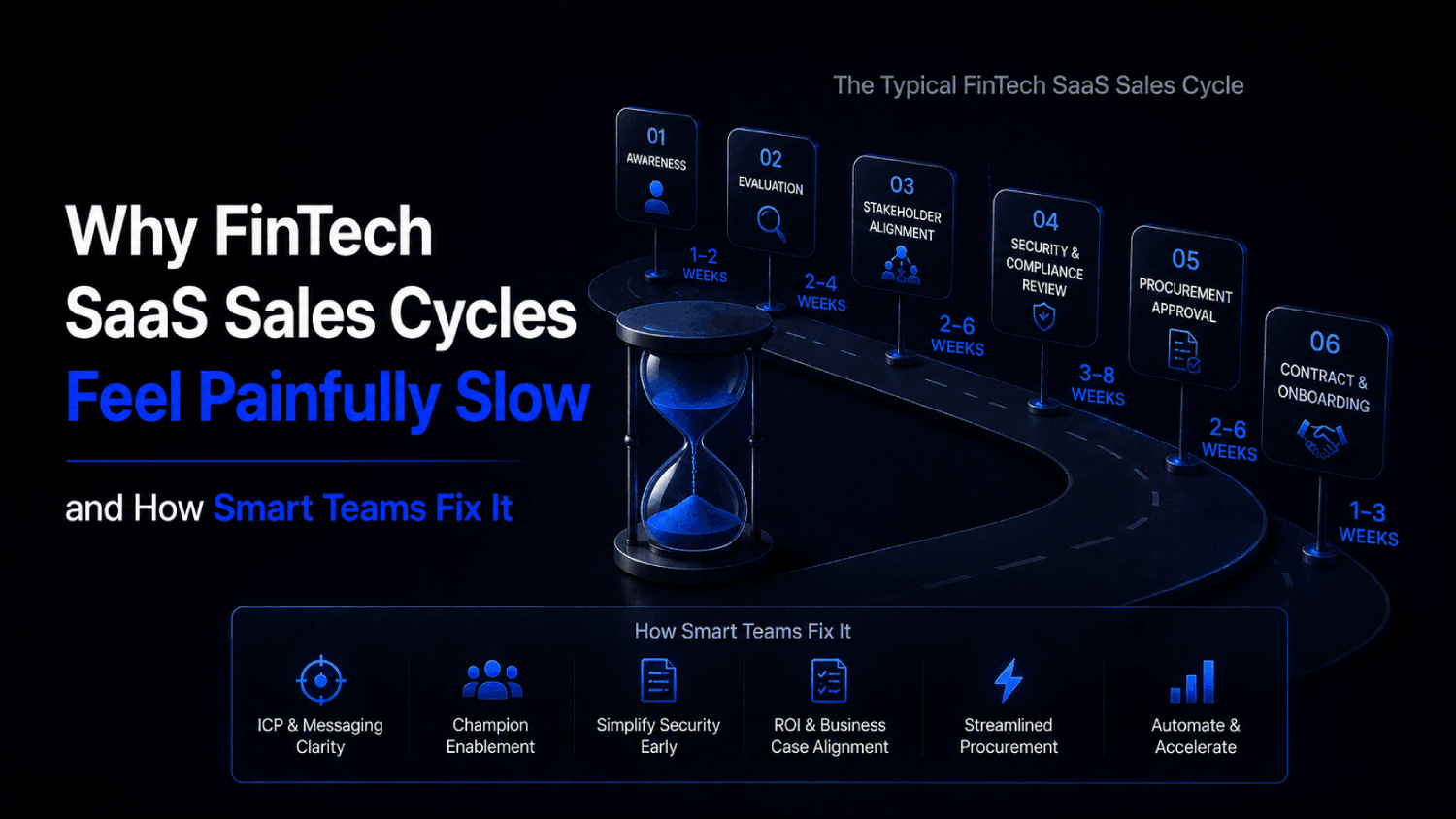
What Does a Typical Fintech SaaS Sales Cycle Actually Look Like, Stage by Stage?
Most fintech GTM teams think about their pipeline in deal stages. The buyer thinks in review stages. Those two maps rarely align, which is where deals get lost. Below is the FintechSpecs Deal Friction Map: a stage-by-stage breakdown of where time actually goes in an enterprise fintech sale, and what is happening on the buyer’s side at each point.
| Stage | Who Owns It on Buyer Side | Typical Duration | What Stalls It | What Moves It |
|---|---|---|---|---|
| Discovery | Champion / VP | 1-3 weeks | No clear business case, wrong ICP | Sharp problem framing, credible reference customers |
| Security Review | CISO / Infosec Team | 3-8 weeks | Missing SOC 2, incomplete questionnaires | Pre-built security pack, proactive CAIQ response |
| Compliance Review | Compliance / Risk Officer | 4-10 weeks | No regulatory documentation, unclear data residency | Pre-drafted compliance FAQ, mapped regulatory coverage |
| Finance Review | CFO / VP Finance | 2-4 weeks | No ROI model, opaque pricing | Vendor-provided ROI template, clear total cost of ownership |
| Legal Review | General Counsel / Legal Team | 4-8 weeks | Non-standard MSA, DPA gaps, liability language | Pre-negotiated MSA template, pre-signed DPA |
| Procurement | Procurement / Vendor Management | 2-5 weeks | Not on approved vendor list, missing insurance certs | Pre-registration on common procurement portals |
| Implementation Review | Engineering / Platform Team | 2-6 weeks | Unclear integration specs, no sandbox environment | Full API documentation, live sandbox before contracting |
These stages often run concurrently in theory. In practice they queue sequentially because the champion does not have bandwidth to manage all of them at once. A deal where legal does not start until infosec finishes has added six to ten weeks before anyone signs anything.
Discovery: Where the Business Case Gets Built or Does Not
Discovery in fintech is not about uncovering pain. It is about building an internal business case that survives five layers of review. The champion needs language that maps your product’s value to compliance posture, risk reduction, and operational cost, not just to the feature problem they originally called about.
If your discovery calls end with a champion who is excited but cannot articulate why their CISO, CFO, and legal team should approve the deal, you have not finished discovery. You have just made a friend.
Security Review: The Longest Queue Nobody Warned You About
Infosec reviews in financial services are not rubber stamps. Enterprise banks, insurers, and fintech platforms run vendor security assessments that can involve hundreds of questions across the Cloud Security Alliance’s CAIQ framework, plus evidence requests for penetration test reports, SOC 2 Type II certification, encryption standards, and data retention policies.
Teams that show up to these reviews without a prepared security evidence pack wait three to eight weeks for their first substantive response. Teams that pre-build a vendor trust portal with SOC 2 reports, pen test summaries, and pre-filled CAIQ responses cut that queue substantially. Vanta and Drata both offer trust center products that let vendors publish security documentation publicly, which eliminates the back-and-forth request cycle entirely.
Compliance Review: The Stage That Has No Deadline
Security reviews at least have a checklist. Compliance reviews in fintech often do not. A compliance officer evaluating a new payment infrastructure vendor is asking questions that do not appear on any standard form: How does this vendor interact with our existing licenses? What happens to data residency if we expand internationally? Does this create any new reporting obligations under BSA or GLBA?
These questions are not rhetorical. They are genuine, and they take time to answer correctly. The teams that move fastest through compliance review are the ones who have anticipated those questions and written the answers before being asked. A pre-drafted compliance FAQ specific to your product, covering data handling, regulatory touchpoints, and applicable frameworks, is worth more than another sales call. The real cost of compliance in fintech SaaS breaks down exactly what that documentation burden looks like by company stage.
Where Do Most Fintech GTM Teams Actually Lose Time?
The single most common error is treating the enterprise fintech sale as a linear process when it is a parallel coordination problem. Most GTM teams focus their energy on the champion and wait for the champion to pull other stakeholders in. That works in software sales. In fintech, it produces deals where infosec and legal have not even been introduced to the vendor six months into the sales process.
The fix is what experienced enterprise fintech sellers call multi-threading: deliberate, early outreach to every review function, not to sell them, but to understand their specific requirements before the formal review starts. If your champion can introduce you to their CISO for an informal 20-minute security call in month one, you can pre-build your security response to their specific questionnaire instead of a generic one. That collapses the formal review from eight weeks to three.
Weak Proof Is a Bigger Problem Than Slow Buyers
Enterprise fintech buyers are not slow. They are thorough. There is a difference. A CFO who takes eight weeks to approve a payment infrastructure contract is not being conservative for sport. They are waiting for evidence that the risk is quantified and bounded.
Generic case studies do not provide that evidence. A case study that says “we helped Company X improve their payment operations” tells the CFO nothing. A case study that says “we reduced failed payment rate from 4.2% to 0.9% for a Series C lending platform processing $40M per month over 90 days” is specific enough to be credible and specific enough to be referenced in an internal approval memo. Buyers do not just want to believe you work. They need artifacts they can hand upward.
This is also why reference customer calls are disproportionately powerful in fintech. A 30-minute call between your existing customer’s Head of Compliance and your prospect’s Head of Compliance does more for deal velocity than any number of vendor-produced materials. The peer trust transfer is immediate and carries institutional credibility that no sales deck can replicate.
How Does Pricing Structure Affect Fintech Sales Cycle Length?
Pricing opacity adds weeks to enterprise fintech deals. When a buyer cannot model the total cost of ownership from publicly available information, they request a custom proposal. That proposal goes to finance for review. Finance asks follow-up questions. The vendor revises. The cycle extends by four to six weeks on average before any other review stage has even started.
Teams that publish clear pricing architecture, even if the exact number is “contact us,” reduce this friction by letting finance start their modeling earlier. Better still, vendors who provide a self-service ROI calculator or a finance-ready cost model template get their deals through finance review faster because the buyer’s team does not need to build the analysis from scratch.
Pricing structure also affects which review stages get triggered. Usage-based pricing tied to transaction volume can trigger a risk review that flat-rate licensing does not, because variable cost models create budget exposure that finance wants to stress-test. That is not a reason to avoid usage-based pricing. It is a reason to document your pricing volatility in advance with scenario modeling. The range of pricing models in fintech SaaS each carry different procurement implications that most founders do not consider until a deal stalls.
What GTM Moves Actually Shorten Fintech Sales Cycles?
The FintechSpecs Sales Friction Reduction Stack is a set of four GTM assets that, when built before the first enterprise deal, address the four review stages that account for the majority of cycle time. None of them are sales materials in the traditional sense.
1. The Vendor Trust Pack
A vendor trust pack is a self-service documentation bundle that covers every question a security and compliance reviewer will ask. At minimum it includes your SOC 2 Type II report (or the timeline to achieve it), a completed CAIQ questionnaire, your pen test executive summary, your DPA template, and a data flow diagram. Host it on a platform like Vanta or build a simple gated page. Give the link to your champion at the end of discovery so the review process can start before legal has even been introduced.
2. The Pre-Negotiated MSA Template
Legal review delays in fintech are almost always caused by one of two things: non-standard liability language or missing data processing terms. A vendor who shows up with a clean, enterprise-ready MSA that includes a pre-signed DPA, standard limitation of liability clauses, and pre-drafted SLA terms removes the most common sources of legal redlines before they appear.
Many early-stage fintech teams do not have an MSA template at all. They draft agreements reactively, one deal at a time. That turns every legal review into a negotiation from scratch. A single upfront investment in a solid MSA with an embedded DPA compresses legal review from eight weeks to four on a consistent basis.
3. The Finance-Ready ROI Model
Build the spreadsheet your buyer’s CFO would build if they had full information. Include a base case, a conservative case, and a break-even analysis. Use your reference customer metrics as inputs with clear labels showing they are external benchmarks. Deliver this during discovery so finance has it before the formal review begins.
This also helps avoid the single biggest finance review delay: waiting for the champion to translate technical product benefits into financial language. Most champions cannot do this accurately or quickly. The vendor who does it for them controls the narrative and removes a bottleneck.
4. The Sandbox-First Integration Approach
Engineering reviews in fintech are slow because engineers do not want to evaluate a vendor based on documentation alone. They want to touch the API. Every week a prospect’s engineering team spends waiting for sandbox access is a week the deal is stalled on a technicality.
Fintech vendors who offer fully self-service sandbox environments with complete API documentation eliminate this queue entirely. The engineering review can happen in parallel with legal and compliance rather than after them. Teams evaluating fintech APIs for SaaS integration increasingly treat sandbox availability as a baseline requirement, not a differentiator.
What Role Does GTM Sequencing Play in Fintech Sales Velocity?
Most enterprise fintech teams run outbound to senior buyers, get an interested champion, and then wait for the champion to coordinate internal reviews. That model works when the champion has organizational authority and bandwidth. In financial services, champions are often mid-level operators who are interested but lack the political capital to pull legal, infosec, and compliance into a vendor review simultaneously.
High-velocity fintech GTM teams flip this. They identify champions, yes, but they also map the full stakeholder architecture before the first formal meeting. They request informal introductions to the CISO and head of compliance as part of discovery, framing it as due diligence prep rather than a sales expansion. They treat every stakeholder’s requirements as a product spec to be met, not an objection to be overcome.
This approach is explored in depth across the go-to-market strategies built specifically for fintech SaaS, where the distinction between founder-led and enterprise-led motion makes a measurable difference in how these review cycles get managed.
Does Company Size Change the Fintech Sales Cycle Dynamic?
Yes, materially. Selling to a 50-person fintech startup is structurally different from selling to a regional bank or a public insurance company. The startup may have a CISO who is also the head of engineering. The bank has a dedicated vendor management team, an infosec committee, and a compliance officer who reports to the board.
For early-stage founders targeting mid-market fintech buyers, the cycle time is shorter but the champion’s internal credibility matters more. A champion at a 200-person fintech who cannot defend the vendor choice to their COO will stall the deal at finance just as reliably as any enterprise review committee. The mechanism is different. The effect is the same.
Teams that have identified the right customer profile and segment their outbound accordingly see significantly better pipeline velocity. Moving upmarket without the corresponding GTM infrastructure, documentation, and reference proof points is one of the more common GTM mistakes that slow fintech SaaS growth in practice.
Frequently Asked Questions
How long is a typical fintech SaaS sales cycle?
A fintech SaaS deal sold into mid-market or enterprise financial services typically runs 90 to 180 days from first meeting to signed contract. Deals involving core banking infrastructure, payment rails, or regulated data can extend past 12 months for large enterprise targets. SMB and startup-focused fintech products can close in 30 to 60 days when the buyer does not trigger formal security or compliance reviews. Cycle length correlates most strongly with how many internal review functions the vendor touches, not with deal size alone.
What is the biggest bottleneck in enterprise fintech sales?
Security and compliance review, in that order, account for the majority of cycle time in most enterprise fintech deals. Infosec teams at financial institutions run thorough vendor assessments that can take six to eight weeks even when the vendor is fully cooperative. Compliance review follows and has no fixed timeline. Legal review is a close third. GTM teams that treat these three functions as primary stakeholders from the beginning of a deal, rather than at the end, consistently close faster than those that engage them reactively.
Why do fintech enterprise deals take so long compared to regular SaaS?
Fintech SaaS products touch regulated data, financial transactions, or banking infrastructure. That triggers review processes that standard productivity software does not face. A legal team can approve a project management tool in days. The same legal team reviewing a payment infrastructure vendor must assess liability exposure, data processing obligations under GLBA or CCPA, and contractual risk that could affect the company’s regulatory standing. The review is proportionate to the risk, not to the sales team’s urgency.
How do fintech teams shorten sales cycles without discounting?
Pre-building documentation that satisfies each review stage before it formally begins. This means a published vendor trust pack for security review, a pre-signed DPA and clean MSA for legal, a buyer-ready ROI model for finance, and mapped compliance documentation for risk and compliance teams. These assets do not accelerate buyer decision-making. They eliminate queue time by allowing parallel rather than sequential reviews. Discounting compresses a different variable, contract value, without reducing cycle time at all.
Does a SOC 2 certification actually speed up fintech sales cycles?
Yes, for deals that require infosec review. A SOC 2 Type II report with a clean opinion eliminates the bulk of the security questionnaire process at many financial institutions, which have standing policies to accept it as evidence of control maturity. Without SOC 2, vendors face individual questionnaires that can run 200 to 400 questions and require weeks of back-and-forth. The ROI on SOC 2 for fintech vendors targeting enterprise buyers is primarily measured in cycle time reduction, not just credibility signaling.
What is multi-threading in enterprise fintech sales?
Multi-threading means building direct relationships with multiple stakeholders at a target account simultaneously, rather than relying on a single champion to carry internal coordination. In fintech sales, this typically means separate introductions to the CISO, head of compliance, general counsel, and CFO, each receiving information relevant to their specific review criteria. Multi-threaded deals are more resilient to champion turnover and progress faster through review stages because each function has already been engaged before the formal review begins.
How does pricing structure affect fintech sales cycle length?
Usage-based and variable pricing models typically extend finance review because they require buyers to model cost scenarios under different transaction volumes. Flat-rate or seat-based pricing is faster to approve because the budget exposure is fixed and bounded. If you sell usage-based pricing into enterprise fintech, providing a detailed cost modeling tool and historical variance data from existing customers reduces the finance review from weeks to days. Opaque pricing that requires a custom quote adds two to four weeks before any formal review begins.
What is the FintechSpecs Deal Friction Map?
The FintechSpecs Deal Friction Map is a stage-by-stage breakdown of where time disappears in enterprise fintech sales cycles, mapped to the specific buyer-side function responsible at each stage. It covers discovery, security review, compliance review, finance review, legal review, procurement, and implementation review. For each stage it identifies the buyer-side owner, typical duration, what causes delays, and what resolves them. It is distinct from a standard sales pipeline because it maps the buyer’s internal process rather than the vendor’s commercial stages.
The Uncomfortable Reality About Fintech Sales Velocity
Most fintech founders who want to close faster are optimizing the wrong end of the sale. They invest in better demos, tighter pitches, and more senior AEs when the cycle is being extended by a compliance queue the champion has no control over. That is like hiring a faster driver for a car stuck in traffic.
The teams that genuinely compress cycle time have made a prior investment in documentation, legal infrastructure, and security credentialing that most early-stage companies defer until a deal is already stalled. Building a vendor trust pack before your first enterprise conversation, getting SOC 2 on the roadmap before you need it, and negotiating a clean MSA template with your counsel before your first legal review, these are GTM decisions, not compliance overhead. They pay off in months, not years.
There is also a selection effect worth naming. Buyers who put your deal through a six-month review and still sign are fundamentally different from buyers who sign fast because they skipped the review. The first group is more likely to renew, expand, and refer other buyers. The second group is more likely to churn when their compliance team eventually audits their vendor stack. Designing your GTM to serve buyers who take due diligence seriously is not just faster. It is a more durable growth strategy. Teams working through the fintech SaaS scale checklist consistently find that the GTM and compliance infrastructure decisions interact more than they expected.