
- Every US state has an unclaimed property law. Dormant balances do not just sit idle , they transfer to the state on a legally defined clock, with penalties for missed filings.
- Dormancy periods vary by state and account type, ranging from one to seven years, which makes spreadsheet-based tracking a genuine audit liability.
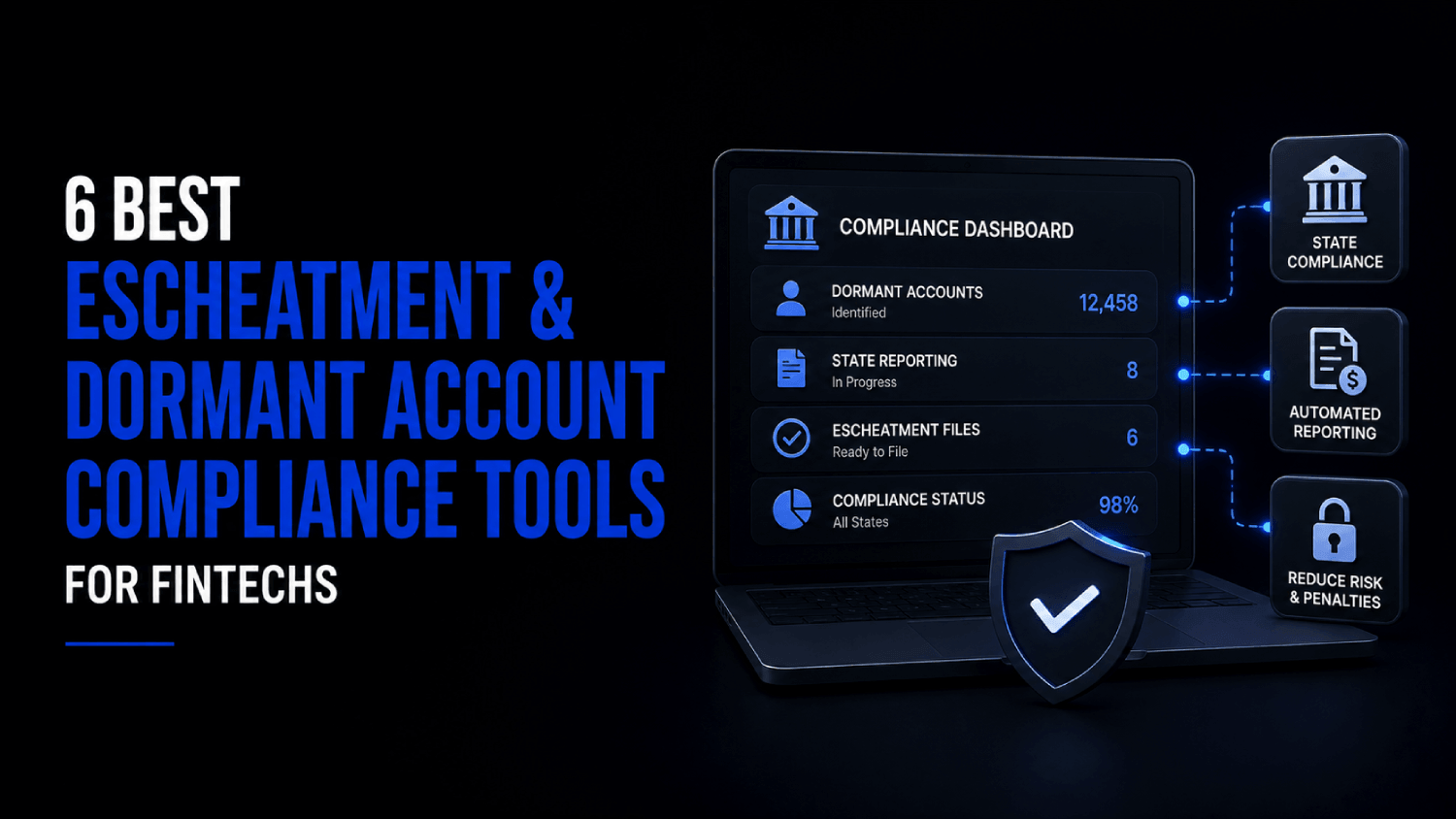
- Purpose-built escheatment software automates dormancy detection, owner outreach (due diligence), state-specific report generation in NAUPA II format, and remittance tracking.
- The six tools below cover the full spectrum from enterprise tax consulting platforms to API-native dormant account detection built for fintech infrastructure teams.
- For fintechs holding customer funds , neobanks, embedded wallets, prepaid programs, lending platforms , this is not optional compliance. It is a recurring annual obligation.
The six best escheatment and dormant account compliance tools for fintechs are Sovos Unclaimed Property, Ryan LLC Unclaimed Property, MarketSphere Consulting, Tata Consultancy Services (TCS) Financial Crimes and Compliance, Abandoned Property Solutions (APS), and Rynoh Escheatment. Each handles dormancy detection, owner due diligence, and NAUPA II state filings differently. Sovos and Ryan suit large, multi-state reporting programs. Rynoh is purpose-built for check-based escheatment. APS targets mid-market fintechs. TCS fits financial institutions with existing compliance infrastructure.
Why Dormant Account Compliance Is Not Optional for US Fintechs
Every US state enforces unclaimed property laws under what is collectively called escheatment. When a customer stops interacting with their account for a defined dormancy period, the account balance is legally presumed abandoned. At that point, the holder , your fintech , owes the funds to the state, not to some abstract future. Missing the filing deadline creates audit exposure, interest, and penalties that compound annually.
This catches fintech operators off-guard because dormant accounts look like a bookkeeping footnote. They are not generating chargebacks or support tickets. They do not appear on any fraud dashboard. But regulators treat them as customer funds held in trust, and auditors will ask for your dormancy tracking methodology going back three to ten years depending on the state.
Fintechs are especially exposed because they tend to accumulate orphan accounts at scale , users who completed KYC, funded a wallet or deposit account, and then churned without formal closure. If you are building on a banking-as-a-service platform, your sponsor bank agreement likely requires you to handle unclaimed property compliance as the program manager. That obligation lands on your ops team.
What Is the Dormancy Clock? State Requirements Primer
Dormancy periods start from the last date of customer-initiated activity on an account, which states define differently. A single balance transfer counts as activity in most states. Receiving a statement you never opened does not. The period between last activity and required state remittance varies by property type and jurisdiction.
The table below captures common dormancy periods by account type across major US jurisdictions. These figures reflect general statutory frameworks. Always verify current rules directly with each state’s unclaimed property administrator, as legislatures update them periodically.
| Account / Property Type | Typical Dormancy Period | High-Volume States |
|---|---|---|
| Checking and savings accounts | 3 years (most states) | CA, NY, TX, FL, IL |
| Prepaid cards and stored value | 3-5 years | Varies widely; some states exempt dormancy fees |
| Uncashed checks (payroll, vendor) | 1-3 years | DE is 1 year for dividends |
| Gift certificates and credits | 3-5 years (state-specific) | Some states exempt; verify per state |
| Securities / brokerage accounts | 3-5 years | NASAA model law followed by most states |
| IRA and retirement accounts | 3 years after required distribution | Federal SECURE Act intersects state law |
| Insurance proceeds | 3-5 years from maturity or death | TX and CA have active enforcement history |
Delaware deserves special mention. Because most US companies incorporate in Delaware, the state has aggressive audit programs and one of the narrowest dormancy windows in the country for certain property types. A fintech that remits to the state of the customer’s last known address , the standard priority rule , still needs Delaware coverage for customers with no address on file.
Before filing, most states require a due diligence period: a written notice to the apparent owner (usually by first-class mail) between 60 and 180 days before the remittance deadline. The timing, content, and delivery method of that notice varies by state and balance threshold. This is where manual processes fail first.
The FintechSpecs Escheatment Readiness Test: Four Checks Before You Buy Software
Before evaluating any vendor, run these four checks against your current setup. This framework, which we call the Escheatment Readiness Test, tells you what class of tool you actually need.
Check 1: Data completeness. Do you have last-activity dates and last-known-address data for every account at the ledger level? Dormancy detection requires clean timestamped activity records. If your ledger infrastructure does not expose this cleanly, even the best compliance software cannot generate accurate reports.
Check 2: State exposure map. How many states are you filing in, and do you hold property types with different dormancy periods? A neobank with customers in all 50 states plus DC runs 51 separate filing calendars. A B2B SaaS with corporate card balances may only face 8-12 relevant jurisdictions. The answer changes which tool tier you need.
Check 3: Filing history. Have you ever filed? If not, and you have been operating for three or more years, you may need a voluntary disclosure agreement (VDA) before filing normally. Several vendors on this list support VDAs, which can significantly reduce penalty exposure versus a cold filing.
Check 4: Internal capacity. Does your team have a compliance or legal resource who can own this process, or do you need a managed service? Software-only tools require someone who understands NAUPA II format, state-specific waivers, and negative reporting requirements. Managed service models cost more but remove the knowledge gap.
What Does Escheatment Software Actually Do?
The core workflow has five stages. Dormancy detection flags accounts that have crossed their state-specific inactivity threshold. Due diligence management generates and tracks required owner outreach notices. Report generation produces NAUPA II formatted files accepted by state administrators. Remittance tracking confirms that funds and reports reach the correct state offices. Audit defense maintains records of every step in case of an examination.
NAUPA II is the data standard most states use for unclaimed property reports. It defines file structure, property type codes, and required fields for each holder report. Software that does not output valid NAUPA II files is not production-ready for multi-state filings. Verify this explicitly before signing any contract.
Some tools add owner reunification features, which attempt to match claimants to their property after remittance. This matters more for states like California, which actively markets its unclaimed property database to consumers, than for states with lower public visibility.
6 Best Escheatment Software Tools for Fintechs
1. Sovos Unclaimed Property
Sovos is the largest dedicated tax and compliance software company focused on this category in the US. Their unclaimed property product handles all 54 US jurisdictions (50 states, DC, Puerto Rico, US Virgin Islands, and Guam), generates NAUPA II output, and includes automated due diligence letter workflows. The platform is designed for mid-to-large enterprises and financial institutions with high account volumes across many states.
Sovos also offers voluntary disclosure agreement support, which is important for fintechs that have never filed and want to clear prior-year exposure without triggering a full audit. Their compliance calendar tracks filing deadlines by jurisdiction, which helps ops teams avoid the most common failure mode: missing a state’s October or November cutoff because the date was buried in a spreadsheet.
Pricing is not publicly disclosed. Enterprise contracts are the norm. Sovos fits a Series B or later fintech with a dedicated compliance function and filing obligations in 20 or more states.
2. Ryan LLC Unclaimed Property Services

Ryan operates as a tax consulting firm with a specialized unclaimed property practice. Unlike pure-software vendors, Ryan embeds consultants into your process. Their teams handle multi-state holder audits, VDA negotiations, and remediation projects where historical records are incomplete or inconsistent.
For a fintech that just discovered a three-year gap in its filing history, Ryan’s managed service model is more appropriate than a software subscription. Their consultants know the procedural nuances of state audit bureaus, which matters when you are negotiating penalty abatement on a large balance. Ryan does not publish pricing; engagements are scoped individually.
The trade-off is that Ryan is consulting-led, not software-led. If you want a self-service dashboard your ops analyst can run monthly, Ryan is not that. If you need expert representation and project management for a remediation or first-time filing program, it is a strong option.
3. MarketSphere Consulting
MarketSphere occupies a similar position to Ryan: a specialized unclaimed property consulting and managed service firm rather than a pure-play software product. MarketSphere is known for holder audit defense, VDA program management, and multi-state due diligence program design. They work with financial services companies, including banks and their fintech subsidiaries.
Where MarketSphere differs from Ryan is in its focus on building internal process documentation for clients. If your goal is to develop in-house expertise that reduces dependence on external consultants over time, MarketSphere structures engagements toward that outcome. For a growth-stage fintech preparing for its first full filing cycle, this knowledge transfer approach has practical value. Pricing is engagement-based and not published publicly.
4. Rynoh Escheatment
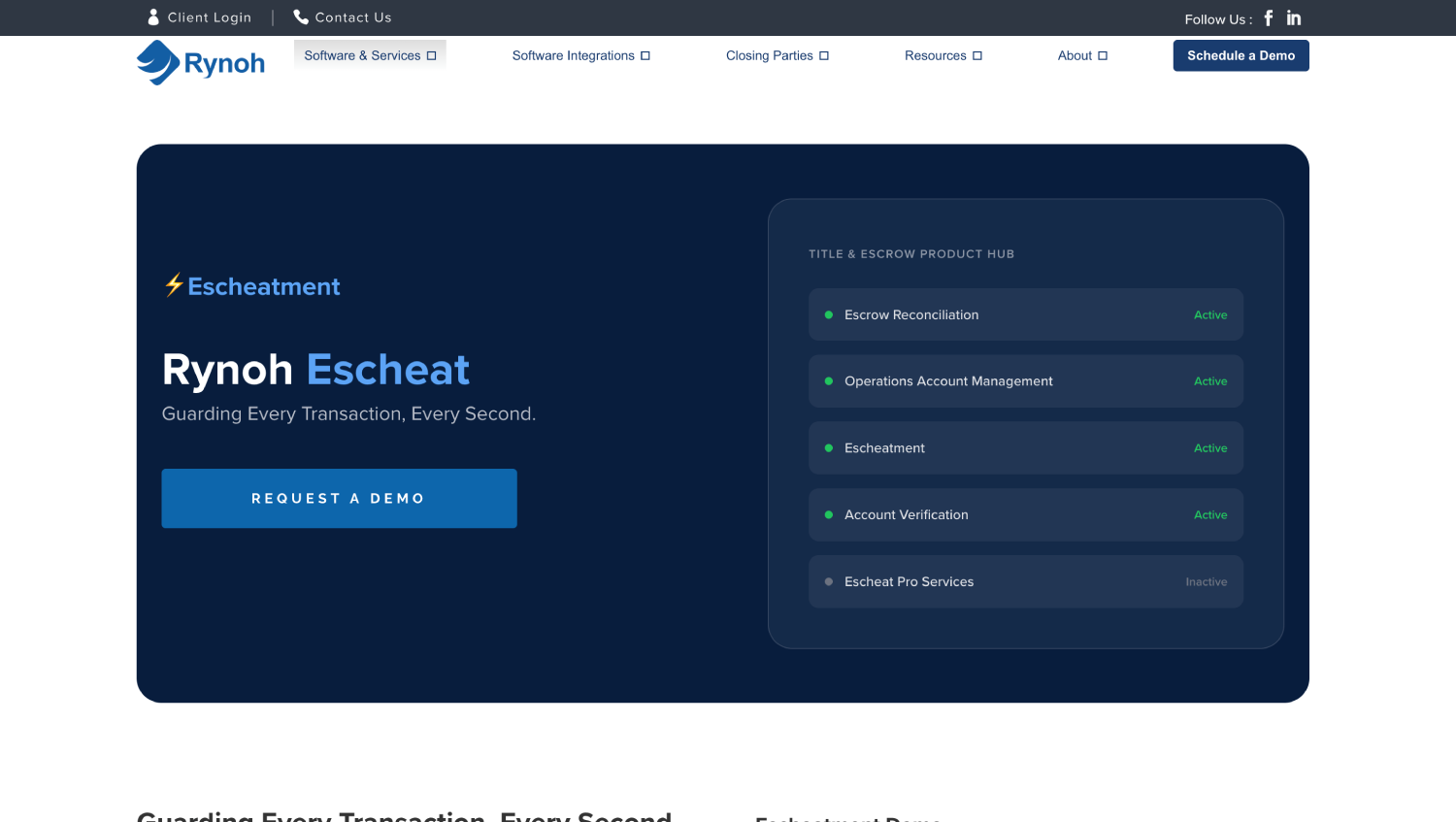
Rynoh is purpose-built for check-based escheatment, with particular depth in stale-dated check management, reconciliation, and NAUPA II state filings. The platform automates reporting, reconciliation, and state filings with built-in compliance checks and real-time monitoring.
Rynoh is the most operationally specific tool in this group. If your fintech issues physical or ACH disbursements that go uncashed , think insurance payouts, loan disbursements, or vendor payments , and the reconciliation burden is your primary problem, Rynoh addresses that directly. It is less suited for wallet or deposit account dormancy across a large consumer customer base.
Rynoh’s focus makes it one of the few tools in this category that a controller or treasury analyst at a mid-market fintech could implement without dedicated compliance personnel. Pricing is not publicly listed; contact them directly for a quote.
5. Abandoned Property Solutions (APS)
APS targets mid-market companies that need software-led compliance without the full overhead of an enterprise consulting engagement. The platform handles dormancy flagging, automated due diligence notice generation, NAUPA II report creation, and filing calendars across all 50 states plus DC.
APS is one of the few vendors in this space that markets to companies doing their first-ever filing, with onboarding workflows designed for teams that do not already have an unclaimed property process in place. That makes it a credible first tool for a Series A or Series B fintech that has crossed the threshold where spreadsheets are no longer defensible but cannot justify enterprise consulting fees.
Pricing is not publicly disclosed, but APS is generally positioned below Sovos in cost. They are worth requesting a demo from if your state exposure map from the Readiness Test above returned fewer than 25 jurisdictions.
6. HRS Pro by Neumo
Neumo’s HRS Pro is an off-the-shelf unclaimed property reporting platform that outputs jurisdiction-accepted NAUPA II reports using a standardized data model. It is designed for compliance teams that need software rather than consulting, with multi-state report generation driven by imported account data.
HRS Pro suits companies with clean, exportable account data and a compliance analyst who can run the tool. It is not a managed service. The platform handles the report generation layer well, but due diligence letter workflows and audit defense documentation require your team to manage separately or supplement with outside counsel.
Neumo does not publicly disclose per-seat or per-filing pricing. Contact them directly for a quote; costs are generally structured around the volume of property reported. For comparison shopping, request quotes from both HRS Pro and APS at the same time to benchmark.
Tool Comparison: Escheatment Software for Fintechs
| Tool | Best For | Delivery Model | NAUPA II Output | VDA Support | Public Pricing |
|---|---|---|---|---|---|
| Sovos Unclaimed Property | Large multi-state programs, 20+ jurisdictions | Software + compliance support | Yes | Yes | No (enterprise contract) |
| Ryan LLC | Audits, remediation, VDA negotiations | Managed consulting | Via consultants | Yes | No (scoped per project) |
| MarketSphere | Process-building, audit defense | Managed consulting | Via consultants | Yes | No (scoped per project) |
| Rynoh Escheatment | Check-based and stale-dated payment escheatment | Software | Yes | Not specified | No (contact required) |
| Abandoned Property Solutions (APS) | Mid-market, first-time filers, under 25 states | Software | Yes | Varies by engagement | No (contact required) |
| HRS Pro by Neumo | Compliance analysts with clean data exports | Software | Yes | No | No (contact required) |
How Do Fintechs Handle Unclaimed Property in Practice?
The most common approach at early-stage fintechs is to ignore the problem until a state auditor or sponsor bank raises it. That is not a compliance strategy. State auditors have authority to audit third-party records going back three to ten years, and the priority rules that govern which state gets remittance can create double-exposure if you remit to the wrong state and then get audited by another.
Consider a hypothetical scenario, for example: a neobank launched in 2021 holds 40,000 accounts, with roughly 2,400 accounts showing no customer-initiated activity for more than three years. Assume an average balance of $47 on those dormant accounts. That is approximately $113,000 in dormant funds that may be reportable across multiple states depending on where those customers last resided. Missing the filing in California alone , which has a proactive reunification program and active audit posture , creates interest exposure at rates set by the state controller’s office, compounding annually from the due date.
The realistic operational path for a fintech at this scale: use a software tool like APS or HRS Pro to run the dormancy analysis and generate filings, and bring in a firm like Ryan or MarketSphere for any prior-year remediation before making your first filing. The fintech compliance readiness checklist we publish includes unclaimed property as one of the recurring annual obligations that growth-stage teams routinely underestimate.
What Is Orphan Account Detection and How Does It Differ from Dormancy Tracking?
Orphan accounts and dormant accounts are related but not identical. In an IT or IAM context, an orphan account is one with no active user or owner , typically from a departed employee or a terminated customer who left no record. In banking and fintech, the term is often used interchangeably with dormant accounts, but the compliance trigger is always dormancy (time since last activity) rather than account status in your CRM.
For unclaimed property purposes, what matters is the last date of customer-initiated activity, the property type, and the customer’s last known address. An account that is flagged as “churned” in your product analytics tool may or may not be legally dormant, depending on whether the customer initiated any transaction after their last login. This distinction matters because premature flagging creates unnecessary due diligence burden, while delayed flagging creates audit exposure.
Dormant account detection at the fintech infrastructure level typically requires a query against your core ledger or banking-as-a-service provider’s data, filtered by property type and last-activity timestamp. If you are evaluating the compliance obligations that come with your infrastructure stack, the most common fintech infrastructure mistakes include failing to capture last-activity timestamps at the transaction level, which makes retroactive dormancy analysis significantly harder.
Frequently Asked Questions
What is escheatment software?
Escheatment software is a compliance platform that helps organizations identify dormant accounts, track state-specific dormancy periods, generate owner due diligence notices, produce NAUPA II formatted reports, and remit unclaimed property to state administrators. It replaces manual spreadsheet tracking with automated dormancy detection and state-by-state filing calendars. Purpose-built tools also maintain audit trails that protect holders during state examinations. The term is used interchangeably with unclaimed property compliance software.
How do I identify a dormant account for unclaimed property purposes?
A dormant account is one where no customer-initiated activity has occurred for the period defined by the relevant state’s unclaimed property statute , typically three years for deposit accounts. Customer-initiated activity generally means a transaction, withdrawal, deposit, or written customer contact. Receiving a statement, auto-debit fees, or bank-initiated credits typically do not reset the dormancy clock in most states. Your ledger must capture timestamped transaction records at the account level to run accurate dormancy detection.
Which states have the most aggressive unclaimed property enforcement?
California, Delaware, and New York are consistently cited by compliance practitioners as the states with the most active audit programs for unclaimed property holders. California’s controller’s office has a public-facing property search and proactive reunification program. Delaware’s short dormancy windows for certain property types and its incorporation base make it a frequent audit jurisdiction for corporations. Texas and Illinois also have active programs. Any fintech with customers in these states should prioritize those filings first.
What is a voluntary disclosure agreement (VDA) and should a fintech use one?
A VDA is an agreement between a state and a holder who has not previously filed unclaimed property reports. In exchange for coming forward voluntarily, most states reduce or eliminate interest and penalties on past-due amounts. For fintechs that have been operating for two or more years without filing, a VDA is almost always preferable to a cold audit. Most states have formal VDA programs. The process requires working with a consultant or legal counsel familiar with each state’s program rules, since terms vary significantly.
Do fintechs using banking-as-a-service platforms need to file unclaimed property separately?
Generally yes. The holder of record for unclaimed property purposes is the entity that holds the customer relationship and the funds obligation , usually the program manager (the fintech) rather than the sponsor bank. Your BaaS agreement should specify this, but do not assume the bank handles it by default. Review your program agreement and confirm the obligation with legal counsel. Some sponsor banks provide data exports specifically for unclaimed property analysis, while others require you to pull this data separately.
What is NAUPA II and why does it matter?
NAUPA II is the data standard defined by the National Association of Unclaimed Property Administrators. Most US states require holders to submit unclaimed property reports in NAUPA II format. The standard defines file structure, property type codes, and required data fields including owner name, last known address, account number, and property amount. Escheatment software that does not output valid NAUPA II files cannot be used for multi-state filing without additional manual work. Verify NAUPA II output capability before purchasing any tool.
What is FSITrack?
FSITrack is a compliance tracking tool used in some state unclaimed property administrator offices on the government side. It is not a holder-facing software product and not a tool fintechs use directly for their own filings.
How much does escheatment software cost?
None of the major vendors in this category publish list pricing publicly. Sovos, Ryan, MarketSphere, APS, Rynoh, and HRS Pro by Neumo all require a direct inquiry for pricing. Costs generally scale with the number of states you file in, the volume of property reported, and whether you need managed services or software only. A software-only tool for a mid-market fintech filing in under 25 states will cost less than an enterprise managed service for a large financial institution. Budget conversations typically start in the low five figures annually for software, with consulting engagements priced per project.
What records do fintechs need to maintain for unclaimed property audits?
State auditors typically request records going back seven to ten years, including account opening dates, last-activity dates by transaction type, address history, due diligence notice records (proof of mailing), and prior filing records. Fintechs that lack clean historical data often discover this gap only after an audit notice arrives. This is one of the strongest arguments for implementing dormancy tracking infrastructure early, not after you reach a certain account volume. Clean data now reduces remediation costs significantly later.
The Compliance Pattern That Shows Up Every Time
Every fintech that runs into unclaimed property problems shares the same origin story: the team treated dormant accounts as a data quality issue rather than a legal obligation. By the time a state auditor or a Series C due diligence process surfaces the gap, the remediation cost has compounded. The right moment to implement escheatment software was your second year of operation. The second-best moment is now.
The tool selection is less complicated than it looks. Software-only tools like APS or HRS Pro work for teams with clean ledger data and an analyst who can own the process. Enterprise platforms like Sovos fit large, multi-state programs where filing volume and risk exposure justify the contract. Consulting firms like Ryan and MarketSphere are the right first call when you have unfiled prior years and need a professional to negotiate your position with state administrators. Rynoh is the most direct answer for check-based disbursement programs.
The compliance cost here is low relative to the audit exposure it prevents. A fintech that holds customer funds in any form , wallets, deposit accounts, prepaid balances, uncashed checks , is a holder under every US state’s unclaimed property statute. That obligation does not require a trigger event. It runs on a calendar, and purpose-built software is the only practical way to keep pace with 51 different ones simultaneously. Teams that track this with a spreadsheet are not saving money. They are deferring the audit invoice. The companies that treat this seriously early are the ones that pass the compliance checks that matter most when a bank partnership or acquisition conversation begins.