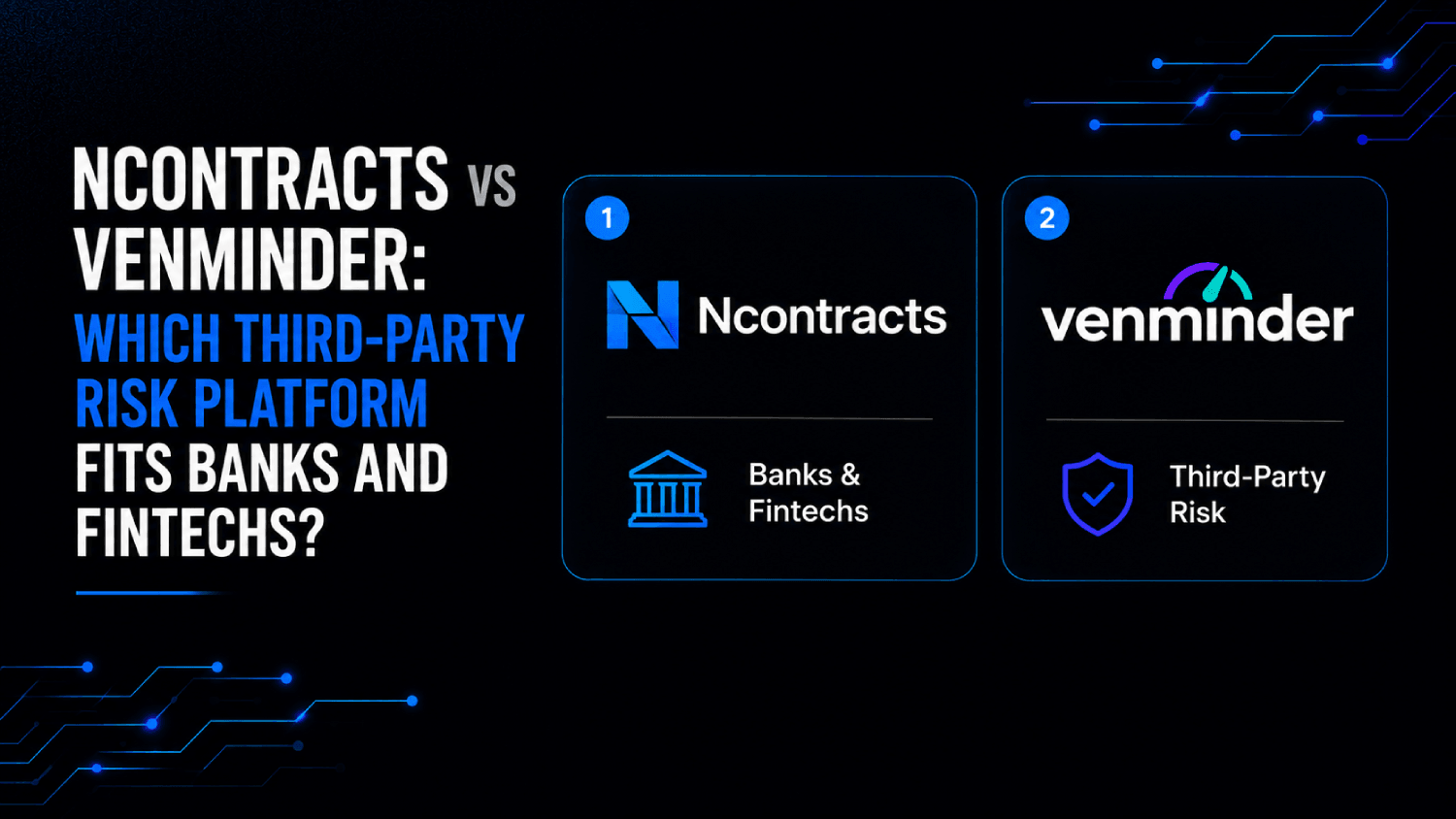

- Venminder is described on its official website as “Venminder by Ncontracts” and is “trusted by over 1,200 companies worldwide,” indicating a close corporate relationship with Ncontracts. The exact terms and timing of any acquisition or investment are not confirmed on either company’s official website.
- Despite operating under shared branding, the two platforms still run with distinct interfaces, data sets, and pricing structures, making the choice a real product decision, not just a branding one.
- Venminder leads on managed due diligence services and pre-built vendor assessments; Ncontracts leads on integrated bank compliance workflows, audit management, and regulatory change tracking.
- Community banks and credit unions with 10 to 50 vendors and limited internal risk staff get more immediate value from Venminder’s managed service layer. Banks with complex multi-department compliance programs benefit more from the broader Ncontracts suite.
- Neither vendor publicly discloses per-seat or per-vendor pricing; both require a sales conversation, which means your negotiating position depends on how clearly you define your vendor count and contract requirements upfront.
Ncontracts and Venminder now operate under shared corporate branding , Venminder’s official website describes the platform as “Venminder by Ncontracts.” But they sell different products to overlapping buyers, and the platform you sign will determine how your risk team actually works day to day. Venminder is the stronger choice for institutions that need outsourced due diligence and a managed vendor assessment library. Ncontracts fits better when your compliance program spans exam prep, policy management, and multi-department risk workflows beyond just vendor oversight.
What Happened: Ncontracts and Venminder Now Operate as One Brand
Ncontracts and Venminder now share a corporate identity. Venminder’s official website describes the platform as “Venminder by Ncontracts” and states it is “trusted by over 1,200 companies worldwide.” Ncontracts’ homepage cites “15+ Years of Experience” and “5000+ Financial Industry Clients.” The specific terms, structure, and timeline of any formal transaction between the two companies are not detailed on either official website, and FintechSpecs has not independently verified those details through filings or press releases.
For buyers, this creates an unusual evaluation dynamic. You are not choosing between two fully independent competitors. You are choosing between two product lines inside a shared corporate structure, each with its own sales team, contract structure, and implementation path. That distinction matters because it changes how you negotiate, what support looks like post-signature, and where the integration roadmap is heading.
The platforms have not merged into a single product. As of their respective public marketing pages, Venminder continues to operate as a unified third-party risk platform with its own login environment, vendor library, and managed assessment services. Ncontracts’ core platform continues to carry its own suite covering risk management, compliance, audit, and findings management. Buyers should expect some roadmap convergence over time, but that convergence is not yet reflected in what either platform delivers today.
Who Are These Platforms Actually Built For?
Ncontracts’ primary market is community banks, credit unions, and mid-size financial institutions that need to satisfy federal and state regulatory examination requirements across multiple compliance domains. The platform covers vendor management as one module inside a broader GRC environment that also includes compliance management, audit management, risk assessments, findings tracking, and regulatory change management. A bank using Ncontracts is typically managing simultaneous obligations across BSA, CRA, HMDA, and vendor oversight, all feeding into a single risk program.
Venminder’s target user is the vendor risk manager or third-party risk officer who spends most of their day on due diligence workflows: sending questionnaires, reviewing SOC 2 reports, grading vendor responses, and building evidence files for examiners. Venminder’s differentiation is its managed service layer, where the company’s own analysts review vendor documents on behalf of clients and deliver graded assessments. This is not a feature most GRC platforms offer at all.
The overlap exists at community banks and credit unions where the VP of Compliance or Chief Risk Officer is also the de facto vendor risk manager. That person often evaluates both platforms. The deciding factor is whether they need one tool that handles all compliance domains or a dedicated tool that handles third-party risk exceptionally well with human analyst support behind it.
Head-to-Head: Where Each Platform Wins and Loses
| Evaluation Dimension | Ncontracts | Venminder |
|---|---|---|
| Primary buyer | Compliance teams at community banks and credit unions needing multi-domain GRC | Vendor risk managers at banks, credit unions, and fintechs focused on TPRM |
| Third-party risk depth | Solid module within broader GRC; adequate for most bank exam needs | Dedicated TPRM platform with the deepest pre-built vendor library and managed assessments |
| Managed due diligence services | Not a core offering | Core differentiator; analysts review vendor documents and deliver graded results |
| Compliance suite breadth | Covers audit, risk assessment, findings, regulatory change, policy management | Focused on vendor lifecycle; limited native compliance management outside TPRM |
| Vendor assessment library | Available but smaller | Large pre-built library of standardized vendor assessments |
| US regulatory alignment | Built around OCC, FDIC, NCUA, CFPB examination frameworks | Built around FFIEC guidance on third-party risk and TPRM examination requirements |
| Fintech buyer fit | Moderate; better for licensed institutions than early-stage fintechs | Better; lighter lift for Series B/C fintechs building a vendor risk program |
| Integration effort | Moderate; API availability varies by module | Moderate; core workflows are workflow-driven rather than API-first |
| Pricing transparency | Not publicly disclosed; requires sales engagement | Not publicly disclosed; requires sales engagement |
| UI complexity | More complex; reflects multi-module scope | Simpler single-login environment; purpose-built for TPRM workflows |
| Support model | Account-based support with implementation services | Analyst-backed support as part of managed service tiers |
| Switching cost | High; data lives across multiple compliance modules | Moderate to high; vendor records and assessment history are sticky |
How Does Venminder’s Managed Due Diligence Actually Work?
Venminder’s managed assessment service is the feature that separates it from most software-only TPRM platforms. When a bank needs to review a vendor’s SOC 2, financial statements, business continuity plan, or information security documentation, Venminder’s analysts do the reading and deliver a scored, graded assessment back to the client. The bank gets an analyst opinion, not just a place to upload files.
This matters operationally. A compliance officer at a $500 million community bank is unlikely to have a dedicated TPRM analyst on staff. Reviewing 40 vendor documents per year is a significant time burden when you are also managing exam prep, BSA training, and policy updates. Venminder’s managed layer converts a manual internal process into an outsourced deliverable , concrete headcount avoidance with a receipt attached.
Ncontracts does not offer an equivalent managed service at the same scale. Its platform is software-driven: it gives your team a structured workflow to manage vendor due diligence, but your team still does the document review. For institutions that have the internal capacity, that trade-off is fine. For institutions that do not, Venminder’s model is a meaningfully different value proposition.
What Does Ncontracts Cover That Venminder Does Not?
Ncontracts is a GRC platform that includes vendor management as one of several interconnected modules. The full product set covers risk assessment, compliance management, audit management, findings and remediation tracking, and regulatory change management. A bank examiner expects to see evidence of a functioning risk program across all these areas. Ncontracts is built to produce that evidence systematically.
Regulatory change management is a specific capability worth calling out. Banks face a continuous stream of guidance updates from the OCC, FDIC, NCUA, and CFPB. Tracking which changes affect which policies, assigning remediation tasks, and documenting completion is a full-time workflow in larger compliance departments. Venminder does not cover this. Ncontracts does.
Audit management is similarly outside Venminder’s scope. Banks using Ncontracts can run internal audit workflows, track audit findings, assign corrective actions, and report on program status, all inside the same platform that manages their vendor risk program. For a Chief Risk Officer trying to present a unified risk picture to the board, that integration has real value. It is not a feature you can replicate by bolting Venminder onto a separate audit tool without losing data coherence.
The FintechSpecs Name-Swap Test: Does Your Shortlisted Platform Actually Fit?
Before running the detailed four-question filter below, apply what FintechSpecs calls the Name-Swap Test to any vendor pitch deck you receive: replace the vendor’s name with a generic placeholder and read the pitch again. If the claims still describe your institution’s actual workflow gaps, the platform is worth evaluating. If the claims dissolve into vague promises about “centralized risk visibility,” you are looking at category marketing, not product differentiation.
Both Ncontracts and Venminder use broadly similar language in their marketing. The Name-Swap Test forces you past the surface. Here is what survives it for each platform:
For Venminder: “Our analysts review your vendor’s SOC 2 and deliver a graded assessment within X business days.” That claim is specific, verifiable, and either matters to your team or it does not. It survives the swap.
For Ncontracts: “Regulatory change alerts map automatically to your policy library and assign remediation tasks across departments.” Again, specific and testable. It survives the swap.
Claims that do not survive: “Our platform gives you a 360-degree view of vendor risk.” Every platform in this category says that. It tells you nothing about fit.
The FintechSpecs TPRM Fit Test: Four Questions Before You Choose
Run through these four questions and the answer becomes clear. They are designed to expose the specific capability gaps that marketing language obscures.
1. Do you have internal capacity to review vendor documents? If you have a dedicated analyst or a compliance team that can evaluate SOC 2 reports, financials, and BCP documentation internally, Ncontracts’ software-driven workflow is sufficient. If that work would fall to someone already managing multiple compliance domains, Venminder’s managed service layer saves real hours every month.
2. Is your compliance program vendor-risk-only, or does it span multiple domains? Vendor management is one piece of bank compliance. If you also need to track regulatory changes, manage audit findings, and document policy attestations in the same system, Ncontracts gives you that. Venminder does not.
3. How many critical vendors do you have? Banks with 20 or fewer critical vendors may find Venminder’s managed assessment service covers most of their heavy lift cost-effectively. Banks with 80 or more critical vendors face higher assessment volumes and need to compare per-assessment pricing carefully against doing it in-house on either platform.
4. Are you preparing for a specific regulatory exam? OCC and FDIC examiners reviewing third-party risk programs will look for evidence of due diligence documentation, risk tiering, and ongoing monitoring. Both platforms produce examiner-ready output. But if your exam also covers BSA, CRA, or internal audit, Ncontracts produces a more comprehensive evidence set from a single system.
A hypothetical that illustrates the stakes: a $600 million community bank with one compliance officer, 45 active vendors, and an OCC exam scheduled in eight months. Running that scenario through all four questions points unambiguously to Venminder , the managed service absorbs the document review burden, the pre-built assessment library covers most of the 45 vendors, and the exam output aligns directly to FFIEC guidance. Switch the scenario to a $1.4 billion bank with a three-person compliance team, active BSA and CRA obligations, and an internal audit program that reports to the board , the same four questions point to Ncontracts, because the audit and regulatory change modules are doing work that no bolt-on TPRM tool can replicate.
Ncontracts vs Venminder Pricing: What Buyers Actually Face
Neither Ncontracts nor Venminder publishes pricing on their public websites. Both require a sales conversation before you see a number. Based on publicly available review data and community bank technology discussions, both platforms are sold on annual contract terms. Contract minimums and structure vary by institution size and module selection.
Venminder’s pricing is generally understood to vary by tier, with managed assessment volume being the primary cost driver. Buying more analyst-reviewed assessments per year increases your cost. The software platform access and the managed service layer appear to be sold together in tiered bundles, though the company does not publish those tiers publicly.
Ncontracts’ pricing reflects its modular structure. You can buy vendor management alone or the full GRC suite, and price scales with the scope. Adding audit management or regulatory change tracking to a base vendor management contract increases the total cost meaningfully. Buyers who go in expecting a simple per-vendor or per-user price will find the conversation more complex than that.
The practical implication: go into both sales conversations with a clear count of your vendors, your expected assessment volume per year, and the specific modules you need. Without those numbers, you cannot compare quotes meaningfully. If you are evaluating both platforms simultaneously, ask each for pricing on identical scope and push for multi-year discount terms upfront. Both platforms compete for the same buyers and have room to negotiate.
For broader context on how compliance tooling costs scale with company stage, the real cost of compliance in fintech SaaS broken down by stage is a useful reference before you enter either negotiation.
Integration and Implementation: What the Setup Actually Requires
Venminder is not an API-first platform. Its core workflow is questionnaire-based: you invite vendors into the platform, they respond to standardized assessments, and the results flow into your risk register. Implementation is primarily configuration rather than engineering. Most community bank deployments involve setting up your vendor list, customizing risk tiers, and configuring workflows. Venminder markets this as something a small team can do without heavy IT involvement.
Ncontracts has a broader surface area to configure. Getting vendor management, compliance tracking, audit management, and findings workflows all set up and connected requires more structured implementation. Ncontracts offers implementation services, but the timeline and complexity vary by how many modules you activate. Banks that go live on all modules simultaneously report a longer time-to-value than those that phase the rollout.
Neither platform advertises deep native integrations with core banking systems like Fiserv, Jack Henry, or Finastra. Vendor risk management data generally does not need to flow bidirectionally with a core banking system, so this gap is less significant than it would be in a payments or ledgering context. The more common integration need is with your document storage environment (SharePoint, Google Drive) and your contract management tooling, where both platforms offer varying levels of compatibility.
Fintech companies evaluating either platform should note that neither is designed for developer-led integration. If your vendor risk program needs to ingest data programmatically from other systems or push risk signals into an internal dashboard, you will need to assess API availability directly with each vendor’s sales team, since documentation is not publicly available.
How Should Fintechs Evaluate These Platforms Differently Than Banks?
A Series B fintech building a vendor risk program for the first time is in a structurally different position than a $2 billion community bank with a decade of TPRM history. The bank has existing vendor records, historical due diligence files, and an established risk tier structure to migrate. The fintech is starting from scratch and needs to get to a defensible program before its next regulatory review or banking partner audit.
Venminder’s lighter lift for initial setup makes it more appropriate for early-program fintechs. The pre-built questionnaire library and vendor assessment templates mean you can stand up a functioning TPRM workflow quickly without building your own assessment framework from scratch. The managed service tier also means a two-person compliance team can handle more vendors than they could on a software-only platform.
Ncontracts is worth considering for fintechs that have already received a bank charter or are operating under a sponsor bank program with explicit contractual requirements around their own vendor oversight. In those cases, the multi-module GRC structure helps align with what your sponsor bank’s risk team expects to see. If you are building toward a BaaS program or managing relationships with multiple banking infrastructure partners, a broader risk management footprint has real value. The fintech product and compliance readiness checklist is a useful framework for assessing where vendor risk fits in your overall compliance architecture.
US Coverage and Regulatory Alignment: What Each Platform Supports
Both platforms are built primarily for the US financial services market. Ncontracts explicitly targets the regulatory examination frameworks used by federal bank regulators. Its compliance management module references OCC, FDIC, NCUA, and CFPB guidance, and the platform is designed to produce documentation that maps directly to what examiners request during safety-and-soundness exams.
Venminder’s regulatory alignment is concentrated around FFIEC guidance on third-party risk management, specifically the 2021 interagency guidance update that raised expectations for vendor oversight at banks. Its assessments and risk frameworks reflect that guidance directly. For any institution whose third-party risk program is anchored to FFIEC standards, Venminder’s alignment is tight.
Neither platform covers non-US regulatory frameworks in depth. If your institution operates across jurisdictions and needs vendor risk workflows that account for GDPR, PRA, or APRA requirements, both platforms would require significant customization. For North American community banks and credit unions, this limitation is irrelevant. For fintechs with international operations, it is worth flagging before you sign.
What Does Switching From One to the Other Actually Cost?
Switching costs in TPRM platforms are driven by three things: data portability, workflow re-learning, and contract exit terms. Both platforms store years of vendor assessments, due diligence documents, risk scores, and audit trails. That history is difficult to export cleanly into a new platform, and even harder to make useful once it arrives.
Venminder’s managed assessment history is particularly sticky. If your examiners have seen three years of Venminder-formatted assessment reports, switching to a different platform format mid-exam cycle creates a documentation discontinuity that requires explanation. That is not a fatal problem, but it is an avoidable friction.
Ncontracts’ multi-module structure means switching costs grow with each module you activate. A bank that has built its audit management, compliance tracking, and vendor risk workflows inside Ncontracts is not moving three things when it switches. It is moving everything at once, or accepting a long parallel-run period.
Annual contract terms are standard for both platforms. Ask about data export capabilities before you sign. Specifically, confirm that you can export vendor records, assessment history, and risk scores in a machine-readable format. That single negotiating point can dramatically reduce switching cost if you ever need to move. The broader principles in this fintech vendor evaluation framework apply directly here, particularly around data ownership and exit clauses.
Frequently Asked Questions
Is Ncontracts the same as Venminder?
They now operate under shared corporate branding. Venminder’s official website describes the platform as “Venminder by Ncontracts,” and Ncontracts’ website cites over 5,000 financial industry clients across its combined business. Both platforms continue to operate with separate interfaces, product teams, and sales processes. They are not the same product. Ncontracts is a broader GRC platform; Venminder is a dedicated TPRM platform with a managed due diligence service layer. Buyers should evaluate them as distinct products within a shared corporate structure, at least for now.
What is Venminder used for?
Venminder is used for third-party risk management at banks, credit unions, and fintechs. Its core functions include vendor onboarding and risk tiering, due diligence questionnaire management, document collection and review, ongoing monitoring of critical vendors, and exam-ready reporting. Its distinguishing feature is a managed assessment service where Venminder’s own analysts review vendor documents and deliver graded risk assessments back to the client, reducing the internal burden on small compliance teams.
How does Venminder pricing work?
Venminder does not publicly disclose pricing. The company sells through a direct sales process, and pricing varies by institution size, vendor count, and the volume of managed assessments included in the contract. Managed assessments, where Venminder’s analysts review vendor documents on your behalf, appear to be the primary cost driver above a base platform fee. Buyers should request pricing on a defined scope that includes their total vendor count and expected annual assessment volume to enable a meaningful comparison.
Which platform is better for a community bank under $1 billion in assets?
Venminder is generally the better fit for community banks under $1 billion in assets that have limited internal risk staff. The managed assessment service fills the capacity gap that small compliance teams face when covering 30 to 60 vendors annually. Banks in this tier rarely need Ncontracts’ full GRC suite. If the bank already uses a separate audit or compliance tracking tool and only needs purpose-built TPRM, Venminder’s narrower focus is an advantage, not a limitation.
Which platform fits a Series B or Series C fintech better?
Venminder fits most growth-stage fintechs better than Ncontracts, primarily because setup is faster and the managed service tier reduces the staff time required to maintain a functional program. Fintechs operating under a sponsor bank relationship or pursuing a bank charter should evaluate Ncontracts if their sponsor’s risk requirements extend beyond third-party oversight into broader GRC documentation. In most other cases, Venminder gets a fintech to a defensible vendor risk program faster and with less internal overhead.
What is the difference between TPRM and ERM?
Third-party risk management (TPRM) covers the risks introduced by vendors, partners, and service providers, including operational, cyber, financial, and compliance risks from outside the organization. Enterprise risk management (ERM) is a broader framework that covers all material risks to the institution, including strategic, credit, market, and operational risks, regardless of their source. TPRM is a subset of ERM. Venminder is a TPRM platform. Ncontracts positions itself closer to an integrated GRC suite that supports a broader ERM program.
How do these platforms handle AI-powered risk features?
Venminder’s public marketing describes the platform as AI-powered, with AI capabilities applied to due diligence workflows and vendor monitoring. Ncontracts has similarly added AI-referenced features to its product descriptions. Neither company publicly documents specific model architectures, accuracy benchmarks, or false-positive rates for AI-driven risk alerts. Buyers evaluating AI features in either platform should request a live demonstration using their own vendor data rather than relying on marketing descriptions.
Can these platforms replace a dedicated vendor management team?
No software-only TPRM platform fully replaces a vendor management team. Venminder’s managed assessment service comes closest by handling document review and scoring, but someone inside your organization still needs to own vendor relationships, make risk acceptance decisions, and respond to exam findings. Ncontracts’ software requires even more internal capacity. Both platforms increase the efficiency and documentation quality of an existing team. They do not substitute for the risk judgment that regulators ultimately hold your institution responsible for.
The Decision That Will Outlast the Marketing
The shared-branding news created a wave of “are these the same thing now?” evaluations in risk and compliance departments across the US. They are not the same thing yet, and the product gap between them is real enough to drive a different outcome for your institution. A community bank that needs managed vendor assessments and a pre-built due diligence library should not buy Ncontracts because the name recognition is stronger. A bank that needs to manage audit findings, track regulatory changes, and document its full risk program in one place should not default to Venminder because the UI feels simpler.
The post-merger question that actually matters for buyers is this: what is the combined entity’s product roadmap? If Ncontracts plans to absorb Venminder’s managed service capability into the core GRC platform over the next 18 to 24 months, buyers who sign Ncontracts today may get Venminder’s best feature without paying for two products. If the platforms remain parallel indefinitely, the differentiation persists and the choice stays meaningful. That roadmap question belongs in your first sales conversation with either team, and the specificity of the answer will tell you a great deal about how seriously the combined company has thought through integration.
Apply the Name-Swap Test one final time before you sign: pull out the contract scope and ask whether the modules listed there map to work your team will actually do in the first 90 days. If the answer is yes on every line, you have found your platform. If half the modules describe work you hope to do someday, you are paying for aspiration rather than operations.
For fintech teams building vendor risk programs from scratch, the vendor management tooling decision is often buried under more urgent infrastructure choices. But regulators and banking partners scrutinize vendor oversight programs carefully, and a poorly documented program creates exam findings that cost more to remediate than the platform would have cost upfront. The calculus here is not about software features. It is about which platform produces examiner-ready evidence with the least internal friction, given the team size and compliance scope you actually have. Start there and the comparison becomes straightforward. Those building out broader risk operations will find the vendor risk management tools overview for fintech startups a useful adjacent reference, and teams assessing compliance infrastructure more broadly can cross-reference the compliance automation tools overview for US fintechs before finalizing their stack.