
- Mambu suits fintechs and challenger banks that want to launch quickly on a pre-built, composable core with a lower initial engineering lift and a broader partner network.
- Thought Machine suits institutions that need radical product configurability at the ledger level, particularly established banks modernizing from a legacy core.
- Pricing is not publicly disclosed by either vendor; both require enterprise negotiation, but Thought Machine’s implementation costs trend significantly higher due to the engineering depth required.
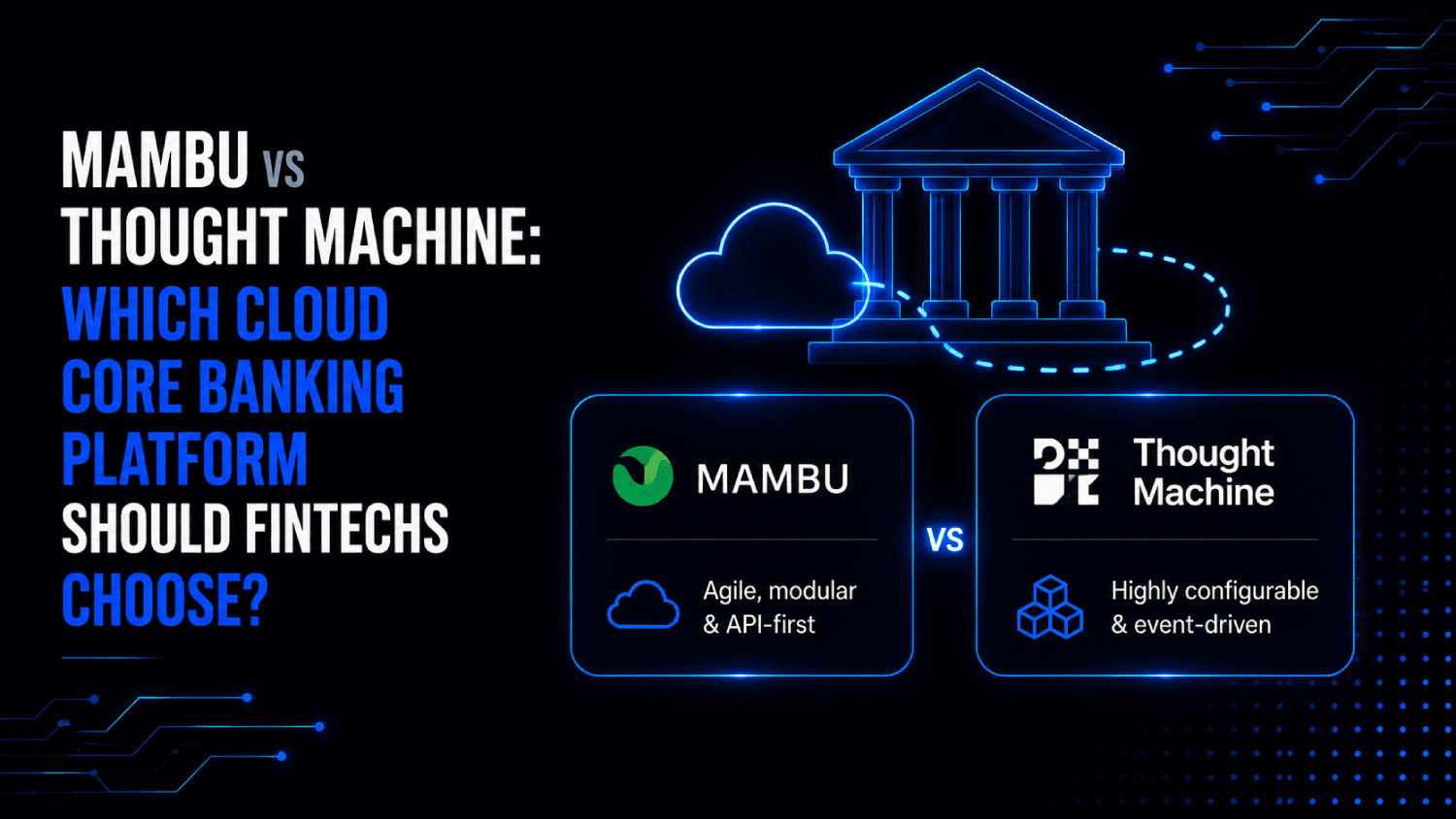
- The two platforms are architecturally different at their foundation: Mambu uses a cloud-native SaaS model with product-level APIs, while Thought Machine’s Vault Core runs on Smart Contracts that define every financial product in code.
- Switching cost is high on both platforms once deep integrations are built, but Thought Machine’s Smart Contract model creates more internal IP and a harder exit path.
Mambu is the better default for seed-to-Series C fintechs and digital banks that need a proven cloud core with a large integration library and faster time-to-market. Thought Machine’s Vault Core is the stronger fit for larger institutions, particularly Tier 1 or Tier 2 banks, that want total programmable control over financial product logic and have the engineering capacity to build on a lower-level, Smart Contract-based infrastructure. The two platforms are not interchangeable, and the architecture difference between them changes your build plan, team requirements, and long-term TCO fundamentally.
Choose Mambu or Thought Machine: Quick Verdict Table
| Criterion | Choose Mambu | Choose Thought Machine |
|---|---|---|
| Company stage | Seed to Series C, or growth-stage neobank | Tier 1 or Tier 2 bank, or well-funded challenger with large eng team |
| Architecture preference | Composable SaaS core with pre-built product APIs | Programmable ledger via Smart Contracts (code defines products) |
| Time to first product | Faster; extensive partner network and pre-built connectors | Slower; requires significant Smart Contract development before launch |
| Product configurability | High within Mambu’s product framework | Near-total; any product logic can be written from scratch |
| US market coverage | Deployed in US; growing US client base | US presence; clients include US-based institutions |
| Pricing model | Subscription plus volume tiers (not publicly disclosed) | Enterprise contract (not publicly disclosed) |
| Implementation complexity | Moderate; SI partners widely available | High; requires certified implementation partners and engineering depth |
| Compliance ownership | Platform handles core infrastructure compliance; product compliance is yours | Same split; Vault Core is infrastructure, product compliance is yours |
| Switching cost | High once integrated | Very high; Smart Contracts create proprietary product IP on the platform |
| Integration ecosystem | Larger; 450+ listed partners in Mambu’s marketplace | Growing; fewer pre-built connectors, more custom integration expected |
What Is the Actual Architecture Difference Between Mambu and Thought Machine?
This is the question most vendor comparison pages avoid, and it is the one that matters most. Mambu operates as a cloud-native, API-first core banking platform where financial products, accounts, and transactions are managed through a pre-built but configurable product framework. You configure loans, deposits, and current accounts using Mambu’s product engine. The platform does the heavy lifting; your engineers connect it to your front end and third-party services.
Thought Machine’s Vault Core works differently at a foundational level. Every financial product on Vault Core is defined by a Smart Contract, which is Python code that specifies exactly how that product behaves at the ledger level. There are no pre-built product templates in the traditional sense. A savings account, a mortgage, a credit card: each is a Smart Contract that your engineers (or Thought Machine’s implementation partners) write and maintain. This gives institutions total control over product logic. It also means you need a team capable of writing and testing financial product code before you can launch anything.
The downstream consequences of this difference are significant. Mambu clients typically reach their first production environment faster because the product framework already exists. Thought Machine clients spend more pre-launch time in engineering but end up with proprietary Smart Contracts they own and control. That ownership is valuable for large institutions building differentiated products, and it is a burden for smaller teams that just want a working current account on day one.
How Do Mambu and Thought Machine Compare on US Market Coverage?
Both platforms operate in the US market, but their footprints reflect their customer profiles. Mambu has built a broader global client base, including US-based fintechs and digital banks. Mambu’s website describes the platform as powering financial services that millions of people rely on every day and references hundreds of innovators in its client base, though the company does not publish a specific client count. Thought Machine similarly does not disclose a precise number of clients on its public site. Any specific figures circulating in market comparisons are not verifiable from either company’s published materials and should be treated with caution.
What is clear from each vendor’s public client references is that Mambu’s disclosed roster skews toward mid-market fintechs, challenger banks, and growth-stage digital lenders, reflecting a longer track record in that segment and an earlier push into Latin America, Europe, and the US challenger bank space. Thought Machine’s US clients include larger institutional names. JPMorgan Chase has publicly discussed its work with Thought Machine as part of its retail banking technology modernization efforts, a reference that says something meaningful about where Vault Core performs best, even if the precise scope of that engagement is not fully detailed in public disclosures. Thought Machine also counts Lloyds Banking Group and Standard Chartered among its clients, which further anchors its institutional positioning.
For US fintechs navigating state licensing, BaaS partnerships, and sponsor bank relationships, Mambu’s larger partner network is practically relevant. If you are evaluating which platform has more pre-built connectors to US-relevant infrastructure providers, Mambu wins by a material margin today. That gap may close, but it matters when you are trying to move fast. The complete fintech infrastructure stack map covers how a core banking platform sits relative to payments, KYC, fraud, and data layers, useful context for understanding which integrations you will actually need before committing to either vendor.
What Does Mambu vs Thought Machine Pricing Actually Look Like?
Neither vendor publishes pricing. Both require a direct sales conversation and an enterprise contract negotiation. This is standard for core banking platforms, but it creates a real due diligence challenge. Based on publicly available information and market-reported ranges, here is what buyers report experiencing.
Mambu operates on a subscription model that typically scales with the number of accounts or customers on the platform, plus module-level pricing for products like loans or deposits. For a deeper breakdown of what Mambu’s total cost of ownership looks like across platform fees, implementation, and ongoing costs, see the Mambu pricing and TCO analysis on FintechSpecs. Contract minimums are not publicly disclosed, but implementation costs through a system integrator typically add six figures to the initial engagement before you write a single line of your own code. The hidden costs that erode fintech SaaS margins are worth reviewing alongside any vendor pricing conversation, since platform fees are rarely the largest line item once integration, ongoing maintenance, and compliance infrastructure are factored in.
Thought Machine’s pricing is similarly opaque, but the implementation burden is higher by reputation and by client report. Writing and testing Smart Contracts for a full product suite before launch is an engineering project measured in months and headcount, not weeks. For a fintech at the seed or Series A stage, that engineering cost alone can exceed the platform licensing cost in year one. The platform is priced for and by institutions that have the budget to absorb that complexity.
| Pricing Dimension | Mambu | Thought Machine |
|---|---|---|
| Pricing model | Subscription, typically account-based volume tiers | Enterprise contract, terms not public |
| Public pricing page | Not available; requires sales contact | Not available; requires sales contact |
| Implementation cost | Moderate; SI partner fees typically six figures | High; Smart Contract development adds significant pre-launch cost |
| Typical buyer profile by budget | Growth-stage fintechs to mid-size banks | Tier 1 and Tier 2 banks, well-capitalized challengers |
| Contract length | Multi-year typical | Multi-year typical |
How Much Integration Effort Does Each Platform Require?
Mambu’s integration story is built around its partner marketplace. According to Mambu’s public website, the platform has 450+ partners covering payments, KYC, fraud, card issuing, and data. Many of these are pre-built connectors maintained by the partner, which means your engineers are configuring rather than building from scratch. For a fintech assembling a modern stack, that is the difference between a two-week integration and a two-month one. If your stack includes a KYC provider, a payment processor, or a fraud detection tool, there is a meaningful chance Mambu already has a production-tested connector for it.
Thought Machine takes a different position. Vault Core’s API layer is extensive and well-documented, but the expectation is that your team or your implementation partner will build the integrations your product requires. Thought Machine has expanded its partner network, including integrations with cloud infrastructure providers, but the network is smaller and the connectors are less mature than Mambu’s. If your stack already includes a KYC provider, a payment processor, and a card issuer, expect more custom work on Thought Machine to wire them together.
This difference compounds at scale. Early in a build, both platforms feel like heavy lifts. Two years in, Mambu clients typically have a broader base of off-the-shelf integrations running; Thought Machine clients have deeper, more custom integrations that they own. Which outcome you prefer depends entirely on your product strategy and team composition. Fintechs that compete on speed and distribution tend to prefer Mambu’s approach. Institutions competing on product differentiation tend to prefer Thought Machine’s.
The integration question is also where the most common fintech infrastructure mistakes show up. Underestimating integration complexity is consistently the reason core banking implementations run over time and over budget, regardless of which vendor you choose.
Which Platform Has Better Product Depth for Specific Use Cases?
Lending and Credit Products
Mambu has strong lending capabilities built into its product engine, including consumer loans, SMB lending, revolving credit, and mortgage products. Configuration is done through the platform’s product designer rather than through code, which makes it accessible to product managers and not just engineers. Most lending fintechs targeting a standard US consumer or SMB product can get to market faster on Mambu.
Thought Machine’s Smart Contract approach is particularly powerful for complex or non-standard lending structures. If you are building a product with unusual interest calculation logic, dynamic fee structures, or multi-party ownership models, Vault Core’s flexibility is genuinely superior. You can define exactly what happens at every event in the product lifecycle. For a standard personal loan product, that flexibility is overkill. For a structured credit product at a Tier 1 bank, it is the point of the platform.
Deposit Products and Current Accounts
Both platforms handle demand deposits and current accounts. Mambu’s account management layer is mature and widely deployed in neobanks across multiple markets. Thought Machine’s deposit Smart Contracts are equally capable and have been deployed at scale inside major institutions. The difference again comes down to configuration approach: Mambu gives you a product builder, Thought Machine gives you a code editor.
Embedded Finance and BaaS Use Cases
Mambu is more commonly chosen by Banking-as-a-Service providers and embedded finance platforms. Its API-first design and partner network make it practical to use as the ledger layer behind a BaaS product. If you are building a BaaS platform for fintech clients and need a core that your downstream fintechs can interact with programmatically, Mambu has more proven implementations in that model.
How Do Mambu and Thought Machine Handle Compliance Ownership?
Both platforms are clear that the core infrastructure is their responsibility and the product-level compliance is yours. This is the standard split in cloud core banking: the vendor manages infrastructure security, data residency, uptime SLAs, and the compliance of the platform itself. You manage BSA/AML program design, KYC flows, product disclosures, and regulatory reporting.
Where this matters practically is in the audit and examination process. Both platforms produce audit logs and support regulatory reporting exports, but your compliance team still needs to own the program. Neither Mambu nor Thought Machine serves as your compliance officer or your sponsor bank. If you are an early-stage fintech unclear on where your regulatory responsibility begins, the Fintech Product and Compliance Readiness Checklist is worth reviewing before you enter a platform negotiation. The checklist specifically addresses which compliance obligations transfer to your team at contract signature and which remain with the vendor, a distinction that matters during regulatory examination.
Thought Machine’s Smart Contract model does create one compliance-specific consideration. Because product logic lives in code rather than in a configuration UI, your compliance and legal team need to be comfortable reviewing Python contracts during product launches or changes. That is a workflow that most traditional compliance functions are not set up for, and it is worth surfacing early in an evaluation.
What Do Mambu and Thought Machine’s Support Models Look Like?
Mambu offers tiered support, with higher service levels available in enterprise contracts. The platform has a documented developer portal, active community, and a network of certified implementation partners globally. For a fintech scaling in the US, finding a Mambu-certified system integrator is straightforward. Several large consulting firms and specialist fintech SIs maintain Mambu practices.
Thought Machine provides implementation support through a combination of its own professional services team and certified partners. Given the Smart Contract development requirement, Thought Machine clients are typically more dependent on the vendor’s professional services or on highly specialized SI partners during the initial build phase. That dependency has cost implications, and it is worth mapping out before you sign a contract.
Neither vendor has a self-serve onboarding path in the way that a developer-first infrastructure company might. These are enterprise relationships that begin with a sales process and involve ongoing account management. The question for your evaluation is not whether support exists but whether the support model matches your internal team’s capabilities and the speed at which you need to move.
The FintechSpecs Core Platform Selection Framework
When evaluating core banking platforms at the shortlist stage, most teams compare feature lists that are deliberately written to look similar. A more reliable evaluation method examines five dimensions that expose real differences between vendors. This is what we call the FintechSpecs Core Platform Selection Framework.
Velocity ceiling: What is the fastest you can reach production with this platform given your current engineering headcount? This is not a marketing question; it requires a technical discovery call where you walk through a specific product build end to end. Mambu’s ceiling is higher for small teams. Thought Machine’s ceiling is higher for large engineering organizations with financial product experience.
Product ownership model: When you write a product on this platform, who owns and maintains the product logic long term? On Mambu, product logic lives in the platform’s configuration layer and evolves with platform updates. On Thought Machine, it lives in Smart Contracts your team owns. Both models have merit; the right choice depends on whether you want to own that IP or whether you want the vendor to manage product evolution.
Exit cost: What does it cost in time and money to migrate away from this platform in three years? For Mambu, the exit path involves migrating account data and rebuilding integrations, which is painful but well-understood. For Thought Machine, exiting also means rewriting Smart Contracts on the new platform, which adds a layer of complexity specific to the architecture. Both are high-switching-cost decisions. Neither should be made without a serious look at what a future core banking migration would require, including data migration scope, integration rebuild costs, and parallel-run timelines that the migration guide addresses in detail.
Partner depth at your specific use case: A large partner marketplace is only valuable if the partners you need have production-tested connectors. Ask each vendor for three reference clients in your exact product category and geography. Generic references are not useful.
Regulatory surface area: Which regulatory requirements in your specific market does the platform support natively, and which require custom development? US-specific requirements around Regulation E, TILA, and state-level disclosures are not the same as EU requirements. Verify the specifics, not the general claim that the platform is “compliant.”
What Are the Real Switching Costs for Each Platform?
Switching core banking platforms is one of the most expensive decisions a fintech can make, and the industry has enough cautionary tales to fill a book. Both Mambu and Thought Machine create meaningful switching costs once you are in production. The question is what form those costs take.
For Mambu clients, switching costs are driven primarily by integration complexity and data migration. If you have 15 integrations running through Mambu’s API layer and two years of account history in the platform, replicating that on a new core is a major engineering project. The data model is Mambu’s, and while they provide data export capabilities, the translation work is yours.
Thought Machine’s switching costs include everything Mambu clients face, plus the Smart Contract layer. Every financial product you have written and tested as a Smart Contract exists only inside Vault Core’s runtime environment. Migrating means rewriting those product definitions in whatever format your new platform uses. For institutions that have invested heavily in proprietary Smart Contracts, that is a significant loss of embedded engineering investment. It is also, from a different angle, an argument for choosing Thought Machine if you are serious about building product IP that is hard to replicate: the moat cuts both ways.
Which Core Banking Platform Is Better for US Fintechs Specifically?
For a US fintech at the seed-to-Series B stage, Mambu is the more practical choice in most scenarios. The implementation timeline is shorter, the partner network includes more US-relevant integrations, and the operational model requires less specialized engineering. If you are building a neobank, an SMB lender, or an embedded banking product and you need to reach production within 12 months, Mambu gives you a higher probability of hitting that timeline.
Thought Machine is the stronger choice for a US institution modernizing a legacy core or a well-capitalized challenger bank with a specific product differentiation thesis that requires total control over financial product logic. If you are building something that no existing product template covers, and you have the engineering team and the budget to build it properly, Vault Core’s flexibility is genuinely differentiated. That is a specific situation, not the default.
Both platforms are legitimate infrastructure choices. The mistake most teams make is evaluating them as if they are competing on the same axis. They are not. Mambu competes on speed, partner network reach, and accessibility. Thought Machine competes on depth, flexibility, and institutional-grade programmability. Pick the axis that matches where you are and where you are trying to go.
If your team is still assembling the broader fintech stack beyond the core, the complete fintech infrastructure stack map covers how a core banking platform sits relative to payments, KYC, fraud, and data layers, which is useful context before you sign an enterprise contract with either vendor.
Frequently Asked Questions: Mambu vs Thought Machine
Which banks use Thought Machine?
Thought Machine’s publicly disclosed clients include JPMorgan Chase, Lloyds Banking Group, Standard Chartered, and Atom Bank, among others. The client list skews toward large established banks and well-funded challengers. Thought Machine does not publish a full client list, and client details are typically subject to NDA terms in enterprise contracts. The institutional profile of their reference clients is the clearest indicator of the platform’s positioning.
What is Mambu and who uses it?
Mambu is a cloud-native core banking platform used by digital banks, fintechs, and traditional financial institutions to run lending and deposit products without legacy mainframe infrastructure. Clients include N26, OakNorth, and BancoEstado, among others. Mambu’s website describes the platform as powering financial services that millions of people rely on every day, though the company does not publicly disclose a specific client count. The platform is particularly common among challenger banks in Europe and growth-stage fintechs in Latin America and the US.
How does Mambu pricing compare to Thought Machine pricing?
Neither vendor publicly discloses pricing. Mambu typically operates on a subscription model scaled to account or customer volumes, with additional module-based fees. Thought Machine uses enterprise contract pricing. Both require a direct sales engagement before any numbers are discussed. In practice, Thought Machine implementations tend to carry higher total first-year costs because of the Smart Contract development work required before launch, independent of any licensing fee differences.
Can a seed-stage fintech use Thought Machine?
Technically yes, but it is rarely the right fit. Thought Machine’s Smart Contract-based architecture requires significant engineering investment before a single product goes live. A seed-stage fintech typically lacks the engineering headcount, the budget for specialist SI partners, and the runway to absorb a multi-month build cycle. Mambu, or a BaaS platform sitting on top of a core, is a more appropriate starting point for early-stage teams. Thought Machine becomes more relevant when the company scales and product differentiation requires platform-level control.
What is Mambu’s Vault Core comparison, and how does it differ from Thought Machine’s Vault Core?
Mambu does not have a product called Vault Core. Vault Core is the name of Thought Machine’s primary core banking product. The naming overlap causes confusion in search results. Mambu’s core product is simply called the Mambu Platform or Mambu Core. When buyers search “Mambu Vault Core comparison,” they are typically looking for a direct head-to-head between Mambu’s platform and Thought Machine’s Vault Core, which is exactly what this article covers.
How long does implementation take for Mambu vs Thought Machine?
Implementation timelines vary by product complexity, team size, and SI partner capability. Mambu implementations for a standard product set are generally reported to take three to nine months from contract signature to production. Thought Machine implementations for comparable scope tend to take longer, often nine to eighteen months or more, because of the Smart Contract development phase. Both timelines extend significantly for complex, multi-product builds or large data migrations from a legacy core.
What are the downsides of cloud core banking platforms like Mambu and Thought Machine?
Both platforms create deep vendor dependency once you are in production. Data portability is limited by the vendor’s export capabilities and by the complexity of your integration layer. Neither platform is cheap at scale, and pricing grows with volume. Thought Machine adds the specific downside of requiring specialized Smart Contract engineering talent that is not widely available in the hiring market. Both platforms place product compliance responsibility on the client, which means your team owns BSA/AML, KYC program design, and regulatory reporting regardless of which core you choose.
Should I run an RFP for Mambu and Thought Machine simultaneously?
Running both in parallel is reasonable if you are genuinely uncertain about which architecture fits your needs. However, a useful filter to apply first is your engineering team size and the complexity of the financial product you are building. If your product can be configured in Mambu’s product engine without custom code, Thought Machine’s Smart Contract flexibility is adding cost without adding value. An RFP process for Thought Machine without a product-specific reason to need programmable contracts is likely to end with a decision for Mambu anyway, after months of evaluation time. Start by answering the architecture question before running a full vendor process.
The Decision Is Architectural Before It Is Commercial
Most vendor evaluation processes spend too much time on pricing and not enough on architecture fit. With Mambu and Thought Machine, the commercial terms matter less than the fundamental question of whether your team is prepared to build financial products as code. That is the real differentiator, and it does not show up in a feature comparison matrix.
Mambu is the default choice for most fintechs because it is the platform built for teams that want to compose a banking product quickly using a proven, configurable foundation. Thought Machine is the deliberate choice for institutions that have a specific reason to need total control over product logic at the ledger level, and who have the engineering and budget to exercise that control well.
Before you request demos from either vendor, answer two internal questions: How many engineers do you have who can write and maintain financial product code? And what specific product logic requires customization that a pre-built product engine cannot handle? If you cannot answer the second question concretely, Mambu is almost certainly the right starting point. If you can answer it with three specific product behaviors that Mambu’s engine cannot support, Thought Machine is worth the evaluation investment.