
- Mambu does not publish list pricing. Every contract is negotiated, and the gap between a starter deal and a mid-market deal can be six figures annually.
- The platform fee is only one part of the bill. Implementation, data migration, system integrator margins, support tiers, and per-API-call overages routinely double the first-year cost.
- Buyer-reported annual contract values range from roughly $150,000 to well over $1 million depending on transaction volume, number of products, and geography.
- Three cost categories catch most buyers off guard: sandbox and non-production environment fees, data egress charges, and the cost of Mambu-certified implementation partners.
- Getting a realistic budget requires at least two competing quotes from alternative cloud core banking platforms, not just Mambu’s sales cycle.
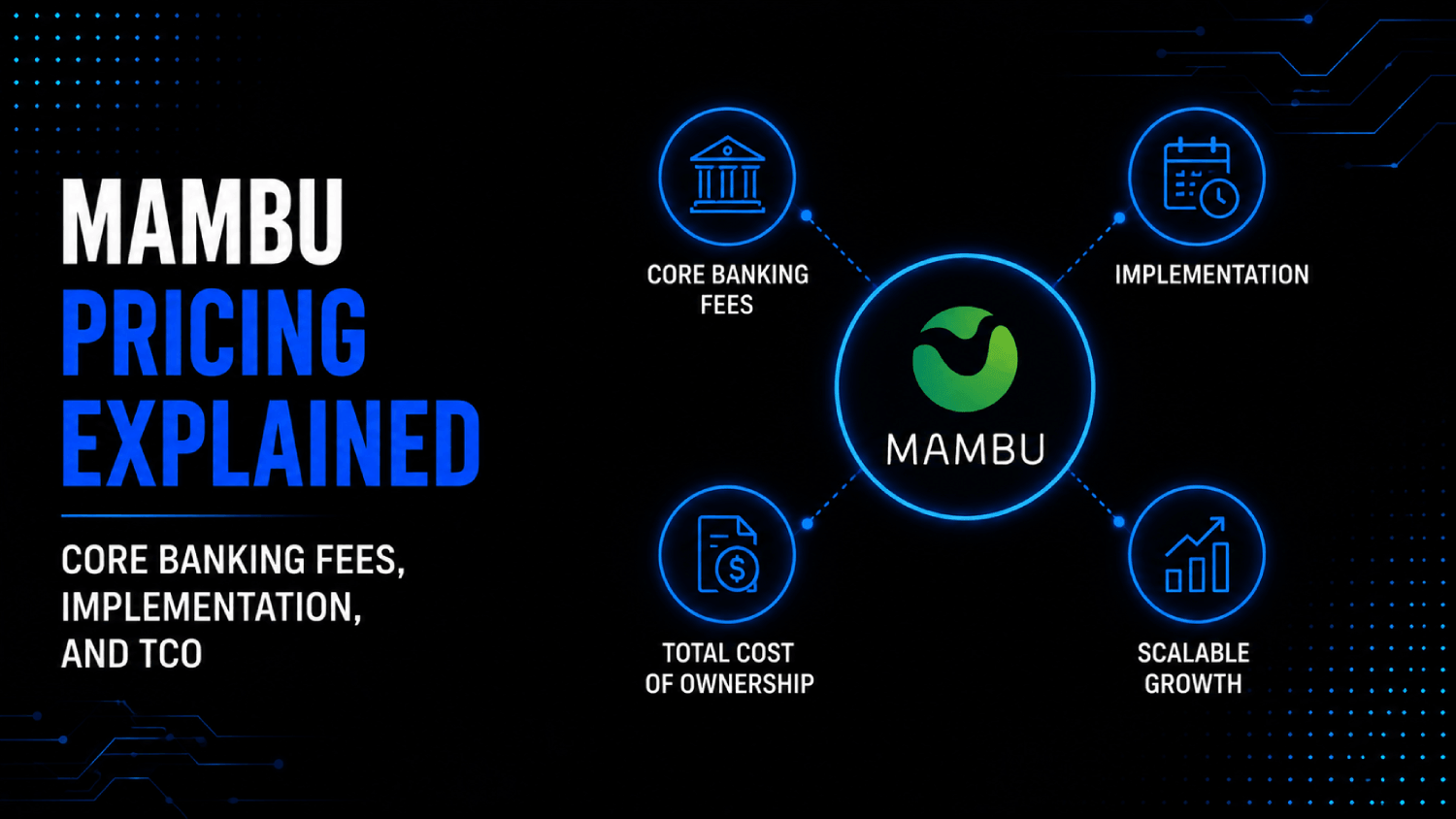
Mambu does not publish pricing publicly. The platform operates on a subscription model where fees vary based on the number of active accounts, transaction volume, product modules, and geographic scope. Buyer-reported annual contracts typically start around $150,000 for smaller deployments and exceed $1 million for mid-market or multi-region programs. First-year total cost of ownership, including implementation and integration work, often runs two to three times the platform license alone.
Why Most Mambu Budget Estimates Start Wrong
Most finance leaders approaching a Mambu evaluation assume the platform fee is the number to nail down. It is not. The platform fee is the floor, and sometimes not even the biggest line item in year one.
Mambu positions itself as a cloud-native, composable core banking platform. It runs on a SaaS subscription model and is available through the AWS Marketplace, where the listed base cost shows $0.00 for the banking platform entry point with additional usage costs layered on top. That listing reflects the mechanics of the pricing model well: the base license is almost meaningless without understanding how usage tiers, modules, and consumption charges stack.
The common mistake is treating the contact-sales form as a proxy for budget. It is a starting point for a negotiation that will take weeks and involve legal, procurement, and often a system integrator before any number is real.
How Mambu’s Pricing Model Actually Works
According to Mambu’s documentation hub, the platform uses a consumption-based subscription model. Pricing is calculated based on a combination of active accounts, the number of loan or deposit products configured, API call volumes, and in some cases transaction throughput.
There is no per-seat model the way you would see in typical SaaS tools. The billing unit is the financial product and the account that holds it. A lender with 10,000 active loan accounts pays differently from one with 100,000, and the step-up between tiers is not linear.
The Core Fee Components
Platform license fees are the annual or multi-year subscription cost for access to the Mambu engine. This covers the core ledger, account management, and workflow capabilities. Pricing here is not disclosed publicly and is negotiated based on account volume projections.
Module fees apply when you activate specific product types beyond the base configuration. Savings, lending, current accounts, and more complex structured products often carry separate activation or incremental fees. Running multiple product lines on one instance increases this figure materially.
API consumption charges come from the number of calls made to Mambu’s APIs within a billing period. High-frequency use cases like real-time balance checks, instant loan decisioning, or automated account updates can generate significant overage if the contracted call volume is underestimated.
Support tier fees are separate from the license. Mambu offers multiple support levels, and the lower tiers deliver significantly less responsiveness than most production financial services operations require. Upgrading to a tier with defined SLAs and named technical account management adds to annual spend.
What Does Mambu Implementation Actually Cost?
Mambu is not a plug-and-play deployment. Every production implementation involves a certified system integrator or Mambu’s own professional services team, and that work is billed separately from the platform license.
The scope of implementation varies enormously. A greenfield neobank building one loan product from scratch moves faster than a bank migrating a portfolio of legacy products with complex business logic. For a realistic sense of the full process, the core banking migration guide covers what that transition actually involves at each stage.
Implementation Cost Ranges by Complexity
For a simple single-product deployment with clean data and no legacy migration, system integrator fees typically start around $150,000 to $300,000. This assumes a relatively standard lending or deposit product and a team that has done it before.
Mid-complexity deployments involving two or three product lines, API integrations with third-party KYC, payment rails, and reporting systems, and some data migration work tend to run $400,000 to $800,000 in professional services alone.
Full-scale implementations for established lenders or banks moving a live portfolio with regulatory reporting requirements, multiple product types, and multi-region configurations have buyer-reported professional services costs above $1 million. Some exceed $2 million when a large SI is involved and the timeline extends past 12 months.
These are buyer-reported ranges compiled from procurement discussions and public analyst commentary. Mambu does not publish implementation pricing.
The FintechSpecs Three-Band Cost Model for Mambu
Because Mambu’s pricing is opaque, the most useful exercise is modeling three realistic deployment scenarios. Each band below represents a distinct buyer profile, not a Mambu-published tier. These are illustrative scenarios built from buyer-reported ranges and public AWS Marketplace data.
| Cost Category | Band 1: Startup / Single Product | Band 2: Growth / Multi-Product | Band 3: Mid-Market / Multi-Region |
|---|---|---|---|
| Annual Platform License | $150,000, $250,000 | $300,000, $600,000 | $700,000, $1,200,000+ |
| Implementation (Year 1) | $150,000, $300,000 | $400,000, $800,000 | $1,000,000, $2,000,000+ |
| Support Tier Upgrade | $20,000, $40,000 | $50,000, $100,000 | $100,000, $200,000 |
| API Overages / Data Fees | $10,000, $30,000 | $30,000, $80,000 | $80,000, $200,000+ |
| Estimated Year-1 TCO | $330,000, $620,000 | $780,000, $1,580,000 | $1,880,000, $3,600,000+ |
| Estimated Year-2 TCO | $170,000, $290,000 | $350,000, $700,000 | $800,000, $1,400,000 |
Year-two costs drop because implementation is largely a one-time expense, but the platform license typically escalates with account growth. Contracts commonly include volume escalators that trigger automatically when account thresholds are crossed.
Which Hidden Fees Do Mambu Buyers Most Often Miss?
The line items below do not appear prominently in early sales conversations. They appear in the contract.
Non-Production Environment Fees
Running a staging or UAT environment separate from production is standard practice for any regulated financial product. Mambu charges for non-production environments. Buyers who assume free sandboxes discover this during contract review. Budget $20,000 to $60,000 annually depending on the number of environments needed.
Data Egress and Export Fees
Pulling data out of Mambu for reporting, data warehouse ingestion, or regulatory submissions can trigger egress costs depending on volume and method. Teams building real-time analytics pipelines or feeding data to external BI tools should scope this carefully before signing.
System Integrator Lock-In
Mambu works with a certified partner network. Not every SI has Mambu-certified engineers, and the pool of experienced practitioners is smaller than it appears. This creates a de facto rate premium. Hourly rates for senior Mambu-certified engineers from established SIs can exceed $250 to $350 per hour. A 12-month build with a team of four runs fast.
Contractual Minimums and Volume Escalators
Mambu contracts include annual minimums regardless of actual account volumes during early growth stages. If a neobank projects 50,000 accounts in year one and only reaches 20,000, it still pays for 50,000. Volume escalators work in the other direction: crossing a threshold mid-year can trigger a step-up in the next contract period.
Renewal Negotiating Position
After 18 to 24 months of production data, workflows, and integrations built around Mambu’s APIs, switching cost is high. This reduces negotiating power at renewal. Buyers who treat the initial contract as a temporary arrangement often find the renewal conversation less flexible than expected. Understanding the full economics of core banking vendor lock-in is part of the hidden cost categories that erode fintech SaaS margins over time.
What Are the Real Negotiation Levers With Mambu?
Going into a Mambu sales process without a prepared list of negotiation questions is expensive. These are the areas where contracts have historically moved.
Questions to Ask Before Signing
- What is the exact account threshold at which pricing steps up, and what is the new rate at each step?
- Are non-production environments included, and if not, what is the per-environment annual cost?
- What API call volume is included in the base tier, and what is the overage rate per 1,000 calls?
- Is data egress priced separately, and at what volume does that fee apply?
- What are the terms for renewal pricing, specifically whether the vendor can raise the license fee and by how much?
- Can we lock in current pricing for years two and three, or is renewal price subject to negotiation?
- What is the minimum annual commitment, and does it scale with our actual account ramp?
- Which support tier is included, and what are the defined SLAs for critical production issues?
- Is Mambu professional services priced separately from the SI network, and can we use a non-certified partner?
- What are the data portability and exit provisions if we decide to migrate to a different platform?
Getting written answers to these questions before the contract stage is worth more than almost anything else you can do in the procurement process. Procurement teams at fintech companies often underestimate how much vendor pricing strategy affects long-run unit economics. The broader pattern of critical mistakes in fintech infrastructure selection almost always includes inadequate contract diligence.
Lower-Cost Alternatives to Mambu Worth Benchmarking
Getting a Mambu quote without at least two alternative quotes is a negotiating mistake. The alternatives below are genuine competitors for the same use cases, not workarounds for smaller budgets.
| Platform | Best For | Pricing Model | Key Difference vs Mambu |
|---|---|---|---|
| Temenos | Established banks, complex product sets | License + implementation, not publicly disclosed | Deeper out-of-box regulatory coverage; higher implementation cost |
| Thought Machine | Greenfield bank builds and challenger banks | Consumption-based SaaS, not publicly disclosed | Smart Contract-native configuration; steeper engineering curve |
| 10x Banking | Tier-2 and Tier-3 banks modernizing core | Contract-negotiated SaaS | Strong multi-tenancy; smaller partner network than Mambu |
| Finxact | US credit unions and community banks | Contract-negotiated; US-market focused | Regulatory depth for US charters; less global footprint |
| Finastra SaaS | Mid-size banks wanting broad product coverage | SaaS subscription, not publicly disclosed | Larger product library; heavier legacy heritage in parts of the stack |
A full comparison of how these platforms differ in architecture, developer experience, and total cost profile is covered in the Mambu alternatives comparison for core banking platforms. For buyers evaluating BaaS-adjacent infrastructure alongside a core banking decision, the best banking-as-a-service platforms for fintech startups covers the lighter-weight options that do not require a full core banking procurement cycle.
Applying the FintechSpecs True-Cost Stack Test to Mambu
Most vendor evaluations focus on the platform fee because that is what the vendor presents first. The FintechSpecs True-Cost Stack Test reorders the analysis around five layers that must all be costed before any number is real. This framework applies to any opaque enterprise fintech contract, but it is particularly relevant for core banking platforms where the gap between quoted and actual costs is widest.
Layer 1: The License Floor. What is the minimum annual contract value, and what does it actually include? Strip out implementation and support to isolate the platform cost.
Layer 2: The Consumption Ceiling. Model your realistic P90 usage scenario, not the median. API calls, account volumes, and data exports all have upside exposure. What does the bill look like if you grow 40% faster than projected?
Layer 3: The Partner Tax. What is the all-in cost of certified partners, required integrations, and mandatory third-party tooling? For Mambu, this is where system integrator fees live.
Layer 4: The Compliance Carry. What ongoing work does the platform create or eliminate for your compliance and risk team? A platform that automates regulatory reporting saves real headcount. One that requires manual reconciliation adds cost. This layer is frequently ignored and almost always material.
Layer 5: The Exit Cost. What does it cost to leave? Data portability terms, migration complexity, and contractual exit clauses are pricing in disguise. A vendor with poor exit terms is effectively charging a higher price than their license fee suggests.
Running a procurement process through all five layers changes the outcome of the decision more often than any single feature comparison.
Frequently Asked Questions About Mambu Pricing
What is Mambu’s minimum contract value?
Mambu does not publish a minimum contract value. Based on buyer-reported ranges and third-party analyst commentary, the practical floor for a production deployment is around $150,000 per year for the platform license alone. Smaller engagements have been reported at lower figures in early pilots, but full production contracts with support and modules included rarely come in below this range. Always request a formal quote based on your specific account volume and product scope.
Is Mambu pricing based on per-transaction fees?
Mambu’s primary billing unit is the active account, not individual transactions. However, API call volumes and data consumption can function as de facto transaction-adjacent costs if your architecture generates high call frequencies per account. Teams running real-time balance updates or frequent automated account operations should model their API call volume carefully before signing, as overages beyond the contracted call limit are billed separately.
Does Mambu charge separately for implementation?
Yes. Implementation is not included in the platform license. Mambu’s own professional services team and its certified system integrator network both bill separately for implementation work. For a straightforward single-product deployment, implementation fees start around $150,000 to $300,000. Complex legacy migration projects have reached $2 million or more in professional services costs. These figures are buyer-reported and not published by Mambu.
How does Mambu pricing compare to Thought Machine or Temenos?
All three platforms use negotiated, non-public pricing. Mambu is generally positioned as more accessible for greenfield and fintech-native deployments, with faster time-to-launch for straightforward product types. Temenos carries broader out-of-box regulatory coverage but higher implementation costs. Thought Machine’s Smart Contract model offers more configuration flexibility but requires stronger engineering capability. Getting quotes from at least two of the three simultaneously is the only way to benchmark what the market will actually bear for your use case.
What banks and fintechs use Mambu?
Mambu counts N26, Raiffeisen Bank, ABN AMRO (for specific products), BancoEstado, and a range of emerging market digital lenders among its publicly referenced customers. The client base spans neobanks, digital lenders, and established banks running specific product lines on the platform alongside legacy cores. Customer references are worth requesting during procurement, specifically for organizations at a similar scale and product complexity to your own.
Can you use Mambu through AWS Marketplace to simplify procurement?
Mambu is listed on the AWS Marketplace, which can simplify procurement for organizations with existing AWS committed spend. The AWS listing shows a base platform cost of $0.00 with additional usage costs layered on top. Routing the contract through AWS Marketplace does not change the underlying pricing negotiation, but it can consolidate billing and count toward AWS Enterprise Discount Program commitments, which has real budget value for teams already deeply on AWS infrastructure.
What are the main reasons companies leave Mambu for a competitor?
The most frequently cited reasons in migration discussions include pricing escalation at renewal after achieving scale, API call volume costs becoming prohibitive for high-frequency use cases, and implementation complexity exceeding initial projections. Some organizations also cite limited flexibility in customizing business logic without engaging paid professional services. Exit is technically possible but operationally demanding, particularly when multiple years of transaction history and reporting infrastructure are tied to the platform.
How do you evaluate whether Mambu’s TCO is competitive for your use case?
Run the FintechSpecs True-Cost Stack Test across License Floor, Consumption Ceiling, Partner Tax, Compliance Carry, and Exit Cost. Then benchmark across at least two competing platforms with the same account volume and product scope. Year-one TCO comparisons are misleading because implementation is front-loaded. A fair comparison uses a three-year blended cost including license escalators, support upgrades, and realistic consumption growth. Any vendor who resists providing a three-year projection during procurement is worth approaching with caution.
How to Build a Realistic Mambu Budget Before Talking to Sales
Start with your account volume projection at 12, 24, and 36 months. This is the primary lever Mambu uses to price. Then document how many distinct product types you need, since each additional product type typically expands the contract scope. Estimate your API call frequency per account per day, multiply by projected account volumes, and you have a rough consumption model to pressure-test against whatever call volume is included in a proposed contract.
Add a line for implementation at the low end of the band for your complexity level, then add 30% as a contingency. Core banking implementations rarely come in under budget. Factor in one support tier upgrade from whatever the base contract includes, because production financial services operations almost always require better SLAs than the entry tier provides.
This pre-sales model will not be accurate, but it will give you enough grounding to recognize when a vendor quote is aggressive, reasonable, or padded. It also gives your legal and finance teams something concrete to negotiate against rather than starting from a blank page. Fintech procurement teams who skip this step tend to sign contracts that look reasonable in year one and become painful by year three, which is a pattern that shows up across infrastructure categories, not just core banking.
Getting to a real number requires multiple competing quotes. A Mambu proposal reviewed only against Mambu’s own tier structure has no competitive anchor. Bring in at least one alternative from the platforms in the table above, use both quotes to negotiate, and plan for the process to take longer than your CFO expects.