
TLDR
- Business off-ramps are not exchange withdrawals. They settle converted stablecoin balances directly to corporate bank accounts, with KYB, FX pricing, and local payment rails built in.
- Settlement speed and corridor coverage are the two variables that actually differentiate providers. Fee structure matters less than you think until volume exceeds $500K per month.
- The right provider depends on three things: where your bank account sits, which stablecoins you hold, and whether you need a white-label API or a hosted dashboard.
- Bridge, BVNK, and Zero Hash lead on US corridors and compliance depth. Mural and Conduit win for Latin America. Transak and Ramp Network cover the broadest global retail reach.
- Most providers do not publish fee schedules publicly. Expect FX spread plus a transaction fee, and negotiate both when your monthly volume clears $250K.
The nine providers below handle USDC-to-bank and USDT-to-bank settlement for businesses. They differ meaningfully on settlement time (same-day versus T+1 versus T+2), corridor coverage (US-only versus 180+ countries), stablecoin support (USDC and USDT only versus multi-chain), compliance posture (MTL holder versus bank-direct versus both), and API maturity. Pick the one that matches your bank’s geography, your treasury’s stablecoin preference, and your engineering team’s integration timeline.
What Separates a Business Off-Ramp from Selling Crypto on an Exchange?
Selling USDC on Coinbase and receiving a dollar in your business bank account sounds identical to using a business off-ramp. It is not. A consumer exchange converts crypto to a custodial balance first, then requires a manual ACH or wire withdrawal, which adds one to three business days and a separate transaction step your finance team has to reconcile.
A business off-ramp API converts and settles in a single programmatic flow. You call the API, specify the stablecoin amount and destination bank account, and receive a reference number. The settlement hits the account directly via ACH, wire, SEPA, or local rails. No custodial intermediate balance. No manual withdrawal. Your accounting system sees one debit entry and one bank credit.
The compliance architecture is also different. Business off-ramps run KYB on your company during onboarding, apply transaction monitoring to outbound flows, and produce audit-ready reporting for your finance and legal teams. Exchanges run KYC on individuals. That gap matters the moment a regulator asks you to explain a $300,000 USDC liquidation in your general ledger. Understanding this distinction sits at the core of the Fintech Product and Compliance Readiness Checklist, which covers what audit documentation you should be generating at each transaction layer.
How to Compare Crypto Off-Ramp Providers: The FintechSpecs Settlement Stack Test
Most comparison frameworks for off-ramp providers list features. This one tests the thing that breaks in production. We call it the FintechSpecs Settlement Stack Test, a four-layer check you run before shortlisting any provider.
Layer 1: Corridor viability. Does the provider actually settle to a bank account in the country where your entity is incorporated? “Supported” on a marketing page often means a third-party partner with T+3 settlement and a call to activate. Ask for the exact rails used and the average settlement time in your specific corridor before signing.
Layer 2: Stablecoin-chain match. USDC on Ethereum, USDC on Solana, and USDC on Base are three different assets from an infrastructure standpoint. Confirm the provider accepts your specific chain, not just the token. Several providers listed below only support ERC-20 USDC, which matters if your inbound flows are on Solana or Tron.
Layer 3: Compliance handoff. Who owns the money transmission compliance for the converted fiat leg? If the provider holds a money transmitter license (MTL) in the states or countries where you operate, they own that leg. If they use a bank partner, understand what triggers that bank’s review queue and how it affects settlement SLAs.
Layer 4: API reliability and retry logic. Settlement APIs fail. What happens to a USDC transfer when the fiat rail goes down? Does the provider hold the converted balance in a custodial account, queue the wire, and notify you? Or does the USDC sit unprocessed? The answer determines your treasury risk on any given day. This is the layer most teams miss until they have a failed payroll run.
Which Corridors and Settlement Times Should You Expect?
| Provider | Key Corridors | Settlement Speed (Fiat) | Stablecoins Supported | API-First? | Best For |
|---|---|---|---|---|---|
| Bridge | US, EU, UK, LATAM (expanding) | Same-day to T+1 (USD via ACH/wire) | USDC, USDT (ERC-20, Solana, Base) | Yes | US-first fintechs and platforms |
| BVNK | US, EU, UK, Africa, APAC | T+0 to T+1 (SEPA instant, Faster Payments) | USDC, USDT, EURC, multi-chain | Yes | Global enterprise and corridor diversity |
| Mural | US, LATAM (MXN, COP, BRL, ARS) | Same-day to T+1 in LATAM | USDC, USDT | Yes | Cross-border payouts to Latin America |
| Transak | 170+ countries | T+1 to T+3 (varies by corridor) | USDC, USDT, DAI, multi-chain | Yes (widget + API) | Broad global coverage, mid-market |
| Ramp Network | 150+ countries | T+1 to T+2 | USDC, USDT, multi-chain | Yes (widget + API) | Consumer-embedded off-ramp flows |
| Coinbase (Prime + Cloud) | US, EU, UK, select APAC | Same-day to T+1 (USD via wire) | USDC, USDT, ETH, BTC, multi-chain | Yes | Institutional volume with brand trust |
| Zero Hash | US, EU, Canada, Australia | Same-day to T+1 (USD/EUR) | USDC, USDT, ETH, BTC, multi-asset | Yes | Embedded crypto infra for fintechs |
| Conduit | US, LATAM (MXN, BRL, COP) | Same-day to T+1 | USDC, USDT | Yes | LATAM payouts for remote teams and gig platforms |
| Coinbase Commerce | US-primary | T+1 to T+2 | USDC, ETH, BTC | Yes (payments focus) | E-commerce and SaaS accepting crypto payments |
Settlement times quoted above reflect standard ACH or wire settlement after the stablecoin conversion is confirmed. Same-day settlement almost always requires the transaction to clear before a provider’s daily cutoff, typically 2:00 PM to 3:00 PM Eastern for US domestic wires. Verify cutoff times directly with each provider before building treasury logic around them.
Bridge: Best Stablecoin Off-Ramp for US-First Platforms
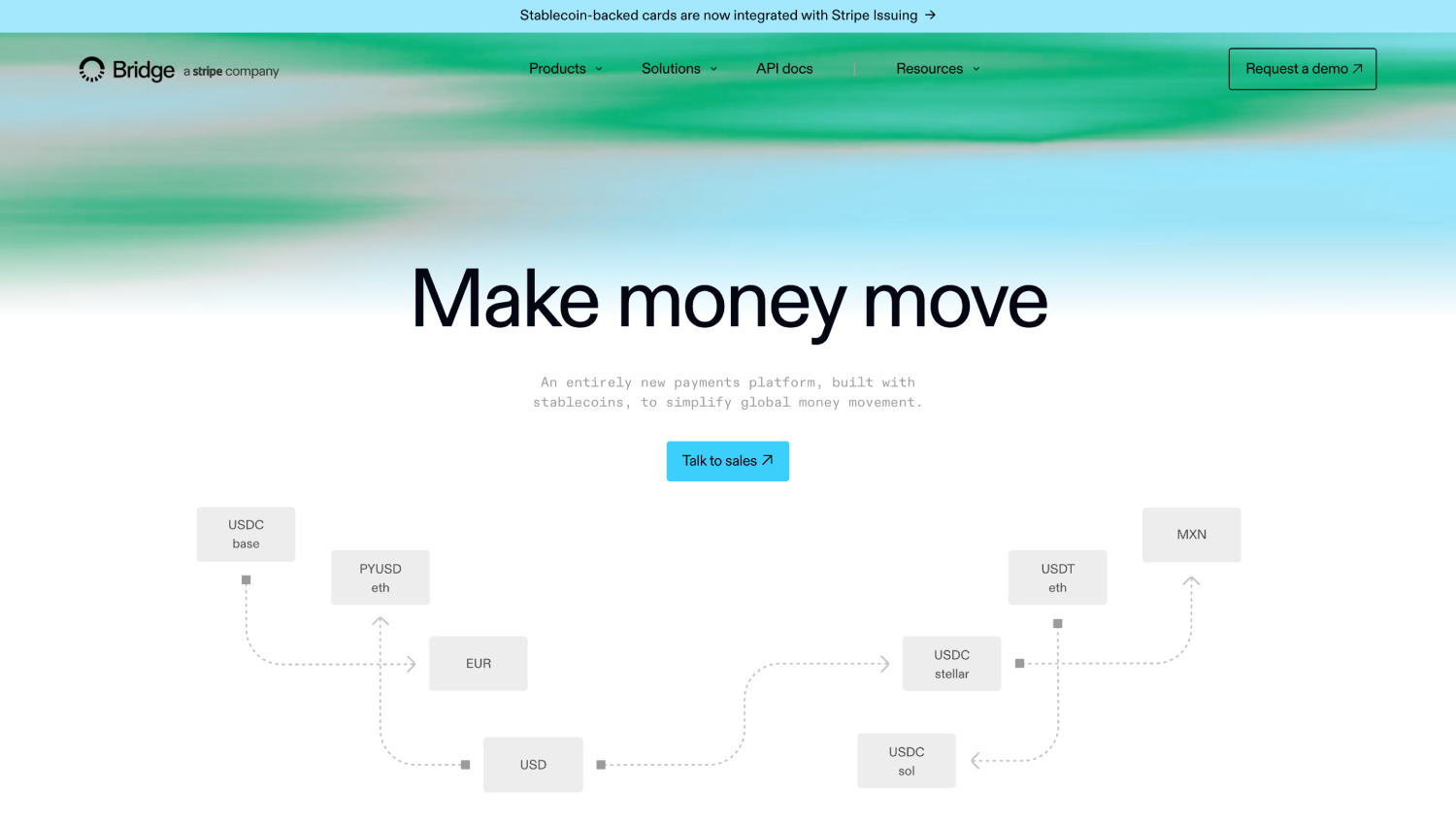
Bridge (acquired by Stripe in 2024) operates as a stablecoin financial infrastructure layer. Its off-ramp product accepts USDC and USDT across Ethereum, Solana, and Base, and settles to US bank accounts via ACH or wire, with same-day settlement available for wires when transactions clear before the daily cutoff.
Bridge’s compliance posture is aggressive. The company holds money transmitter licenses across US states and has built KYB and transaction monitoring directly into its API flow, meaning your platform does not need to layer a separate compliance vendor on top for the fiat settlement leg. That matters for early-stage fintechs that want to move fast without owning the MTL complexity themselves.
Pricing is not public as of November 2026. Bridge operates on a negotiated-fee model, with a reported FX spread plus a per-transaction fee structure. For teams evaluating the full Bridge infrastructure picture against alternatives, the BVNK vs Bridge vs Conduit stablecoin infrastructure comparison covers API depth, compliance posture, and corridor differences in detail. Bridge’s LATAM and African corridor support remains more limited than BVNK or Mural, making it the cleaner choice for US-centric treasury flows than for global payouts.
BVNK: Best Off-Ramp for Global Corridors and Enterprise Compliance
BVNK is a London-based crypto payment infrastructure company with FCA registration in the UK, EMI licensing in the EU, and a footprint that covers the US, Africa, and APAC. Its off-ramp API converts USDC, USDT, and EURC to fiat and settles via SEPA Instant (for EUR), Faster Payments (for GBP), and ACH or wire (for USD).
SEPA Instant settlement is where BVNK differentiates most clearly from US-native competitors. EUR settlement within seconds during banking hours gives European treasury teams something Bridge and Zero Hash cannot match on the EUR leg today. For a company running payroll or vendor payments in euros, that distinction is worth pricing the spread difference carefully.
BVNK’s onboarding requires KYB documentation and a compliance review. The process takes longer than Bridge’s, particularly for companies in higher-risk jurisdictions, but the resulting setup gives you access to the broadest corridor set in this comparison. Pricing is not publicly listed as of November 2026. BVNK operates on a volume-based fee model with negotiated spreads.
Mural: Best Stablecoin Off-Ramp for Latin America Payouts
Mural is built specifically for cross-border payouts, with native support for converting USDC to MXN (Mexican peso), COP (Colombian peso), BRL (Brazilian real), and ARS (Argentine peso). That combination is rare. Most enterprise off-ramp providers treat LATAM as a secondary market and route through correspondent banks with T+2 or T+3 settlement. Mural claims same-day to T+1 settlement in the major LATAM corridors using local payment rails.
The API is straightforward for treasury teams: specify the stablecoin amount, the destination currency, and the recipient bank account, and Mural handles the conversion and local rail settlement. It is designed for recurring payout flows, contractor payments, and cross-border treasury management rather than spot conversions.
Mural does not publish pricing as of November 2026. The fee structure is an FX spread plus a transaction fee, with volume tiers available. If Latin America is your primary corridor need and you want an API-first provider that treats LATAM as a first-class market rather than a fallback, Mural warrants a direct evaluation call.
Transak: Best Off-Ramp for Broad Global Coverage at Mid-Market Volume
Transak covers more than 170 countries and supports a wide range of stablecoins across multiple chains, including USDC, USDT, and DAI. It offers both a hosted widget (for products that want to embed off-ramping without building a full integration) and a direct API for platforms that need programmatic control.
The tradeoff for breadth is settlement speed. Transak’s T+1 to T+3 settlement range reflects the use of local bank partners in each corridor rather than direct rail access. In markets where Transak is not a direct license holder, the settlement chain is longer. For a US company with straightforward ACH needs, that is a reason to look elsewhere. For a company serving users in 40 countries who need to receive local currency, the coverage is hard to replicate with a single alternative provider.
Transak publishes a fee calculator on its website. Off-ramp fees vary by corridor and payment method, so check the public calculator against your specific corridors before comparing total cost to BVNK or Bridge.
Ramp Network: Best Off-Ramp for Consumer-Embedded Flows
Ramp Network covers over 150 countries and supports both on-ramp and off-ramp flows through a widget-first architecture. It is optimized for products where the end user is an individual (a wallet user, a DeFi participant, a gaming platform user) who needs to convert crypto to local fiat in their personal bank account.
For pure B2B treasury use cases, Ramp Network is less purpose-built than Bridge or BVNK. Its compliance model is KYC-centric (individual identity verification) rather than KYB-centric (business entity verification), which means the compliance flow fits consumer apps better than it fits corporate treasury settlement. For fintechs or platforms that need to off-ramp on behalf of end users as part of a consumer product, Ramp Network’s coverage and embedded widget make a strong case. For converting your own company’s USDC treasury to USD, Bridge or Zero Hash are more direct fits.
Coinbase (Prime and Cloud): Best Off-Ramp for Institutional Volume with Brand Credibility
Coinbase Prime is the institutional arm of Coinbase, designed for companies moving significant volume. The off-ramp flow connects to Coinbase’s custodial infrastructure and settles to US bank accounts via same-day wire when volume and timing conditions are met. Coinbase holds money transmitter licenses across all required US states and is a publicly traded company, which matters to in-house legal teams that need to defend third-party infrastructure choices to a board or auditor.
Coinbase Cloud (formerly known as Coinbase Commerce and Coinbase Developer Platform) provides the API layer for embedding off-ramp functionality directly into a product. The two products serve different use cases and have separate onboarding paths.
The practical limit of Coinbase as an off-ramp provider is geography. The corridor coverage is strong for the US, EU, and UK, but thin compared to BVNK or Transak for Africa, Southeast Asia, or LATAM. If your settlement needs are US-first and your volume is high enough to access Prime pricing, Coinbase is the most defensible choice from a compliance and counterparty risk standpoint.
Zero Hash: Best Off-Ramp for Embedded Crypto Infrastructure at Scale
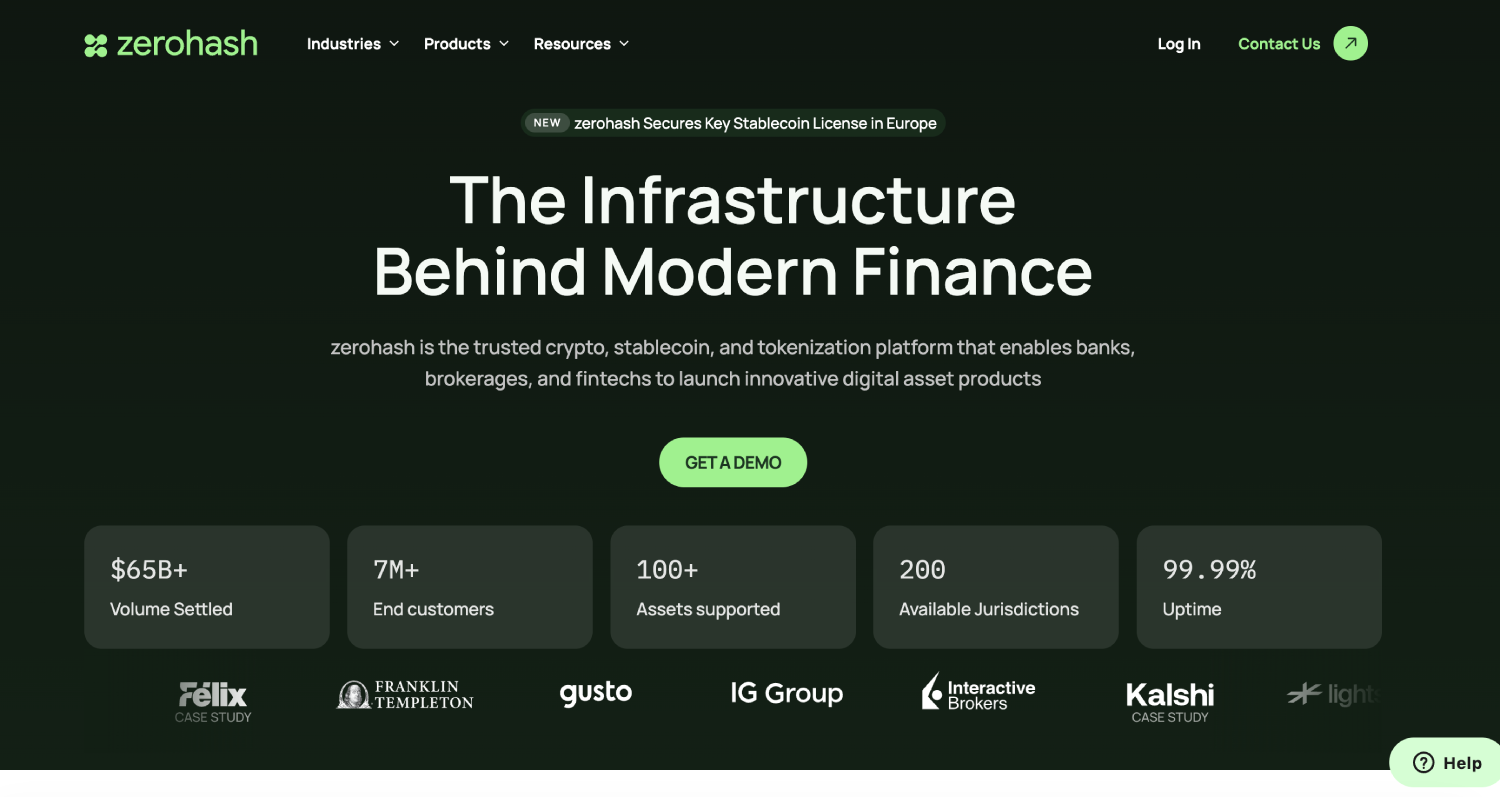
Zero Hash is a B2B-only crypto infrastructure provider with no consumer-facing product. It holds BitLicenses and money transmitter licenses across the US, is registered with FinCEN, and operates in Canada and Australia in addition to its US and EU coverage. The off-ramp product settles USDC and USDT (plus non-stablecoin assets) to bank accounts via ACH, wire, or SEPA.
Zero Hash’s primary differentiator is the compliance infrastructure it provides to clients. When you integrate Zero Hash, you are embedding a licensed money services business into your product, which means the fiat settlement compliance is Zero Hash’s regulatory obligation, not yours. For a fintech building a product that touches crypto-to-fiat flows, that structure can be significantly cheaper than acquiring your own MTLs. The 11 Best Stablecoin Infrastructure Providers roundup covers Zero Hash’s positioning alongside BVNK and Bridge for teams evaluating the full infrastructure layer, not just off-ramp settlement.
Zero Hash does not publish pricing as of November 2026. The fee model is a spread on conversion plus a per-transaction fee, negotiated based on volume. Clients have included major fintech companies and neobanks, and the company is known for its compliance-first onboarding process, which is thorough but takes longer than some alternatives. Plan four to eight weeks for a full integration go-live.
Conduit: Best Stablecoin Off-Ramp for LATAM Gig and Remote-Team Payouts
Conduit focuses on USDC-to-local-currency settlement in Latin America, with support for MXN, BRL, and COP as of November 2026. It is built for platforms paying contractors, remote workers, and gig workers in LATAM who want to receive funds in local currency rather than holding stablecoins.
The product targets a slightly different use case than Mural. Where Mural positions toward treasury and B2B payout flows, Conduit’s design leans toward per-recipient disbursement at scale, where a single platform might be paying thousands of individuals in different LATAM countries in a single batch run. Settlement is same-day to T+1 on major corridors using local rails.
Conduit does not publish pricing publicly as of November 2026. For teams building payroll or gig-economy disbursement products in LATAM, it belongs on the evaluation list alongside Mural. The deciding factor between the two is typically API maturity and the specific currencies your recipients need, not fee structure.
A Worked Scenario: What Off-Ramp Costs Look Like at $300K Monthly Volume
Consider a Series B B2B SaaS company headquartered in the US, paying 200 contractors monthly across Mexico, Colombia, and Brazil, and holding a $300,000 USDC treasury balance that needs to convert to local currencies each month. Here is how the cost math plays out across provider types, using publicly available or commonly disclosed fee ranges. These are illustrative figures, not guaranteed provider quotes.
A provider charging a 0.5% FX spread plus a $5 flat fee per transaction on 200 payments equals roughly $1,500 in spread costs plus $1,000 in transaction fees, or $2,500 total per month. A provider charging a 1.0% FX spread with no transaction fees equals $3,000 per month on the same volume. The flat-fee model wins at high transaction counts with smaller individual payment sizes. The spread-only model wins when you have fewer, larger transactions.
At $300K monthly, most of the providers in this list will negotiate. The published or default fee structure is rarely what a company paying at this scale actually pays. Get quotes from at least three providers and structure the negotiation around your average transaction size and your monthly volume, not just the per-transaction fee. Settlement speed is also a negotiating lever. Providers may charge more for same-day wire settlement than for T+1 ACH. If your treasury can absorb T+1, say so explicitly.
How Does Stablecoin Selection Affect Off-Ramp Settlement?
USDC settles most cleanly across the broadest set of providers because Circle, its issuer, has direct banking relationships that support fast conversion to USD. USDC on Base tends to settle with the lowest gas costs for the on-chain leg. USDC on Solana is accepted by fewer off-ramp providers than USDC on Ethereum but is growing as providers add Solana support.
USDT on Tron (TRC-20) is commonly used in emerging market corridors because of low transaction costs, but fewer institutional off-ramp providers accept TRC-20 USDT for business settlement. BVNK and Transak are among the more accommodating. If your inbound stablecoin flows include TRC-20 USDT, verify chain support explicitly before onboarding.
EURC (Circle’s euro-pegged stablecoin) is worth evaluating for EUR-denominated settlement flows because it eliminates a FX conversion step entirely. BVNK explicitly supports EURC, and several other providers are adding it. If you hold EURC and need to settle in EUR, the stablecoin-to-bank path is more direct than converting USDC to EUR. For a broader view of stablecoin infrastructure options beyond off-ramp settlement, the 10 Leading Stablecoin Payment APIs covers the full payment stack from issuance to settlement.
What Compliance Documentation Do Business Off-Ramps Require?
Every provider in this list requires KYB onboarding before you can initiate fiat settlements. The exact documentation varies, but the standard set includes articles of incorporation, a government-issued ID for beneficial owners above a 25% ownership threshold, proof of business address, and a description of your use case and expected transaction volume.
Higher-volume accounts and accounts in higher-risk jurisdictions (defined by each provider’s internal risk framework) will face additional requests. These can include audited financials, AML program documentation, and evidence of your own KYB or KYC processes if your platform is passing customer funds through the off-ramp. Allow two to six weeks for onboarding depending on provider and jurisdiction complexity.
Transaction monitoring is ongoing after onboarding. Most providers apply automated rules and will pause settlement on transactions that trigger their risk models. Build a compliance escalation contact into your vendor relationship from day one. A paused $200,000 wire with no direct escalation path costs you more than any negotiated fee savings. This is one of the 10 Compliance Mistakes That Can Destroy Your Fintech Startup, specifically the failure to own the vendor relationship at the compliance level, not just the engineering level.
Which Provider Should You Choose Based on Your Situation?
| Your Situation | Best Fit | Runner-Up |
|---|---|---|
| US-only treasury, USDC, want compliance embedded | Bridge | Zero Hash |
| EU settlement, SEPA Instant needed | BVNK | Zero Hash |
| LATAM payouts, MXN/BRL/COP/ARS needed | Mural | Conduit |
| LATAM gig/contractor disbursements at scale | Conduit | Mural |
| 170+ country global coverage, mid-market volume | Transak | Ramp Network |
| Consumer-embedded off-ramp in your product | Ramp Network | Transak |
| High institutional volume, US compliance defensibility | Coinbase Prime | Zero Hash |
| Building embedded crypto product, need licensed infra | Zero Hash | Bridge |
| Multi-chain, multi-asset, global enterprise needs | BVNK | Coinbase Prime |
Frequently Asked Questions
What is the difference between a stablecoin off-ramp API and a crypto exchange withdrawal?
A crypto exchange withdrawal requires a custodial balance on the exchange, then a separate ACH or wire request to move fiat to your bank account. A stablecoin off-ramp API converts and settles in a single programmatic step, with the fiat depositing directly into your designated business bank account. Off-ramp APIs also include KYB compliance, transaction monitoring, and audit reporting, which exchange withdrawals do not provide for business accounts. The distinction matters for reconciliation, compliance, and settlement speed.
How long does it take to convert USDC to USD for a business bank account?
Settlement time depends on the provider and the rail used. Same-day wire settlement is available from Bridge, BVNK, Coinbase Prime, and Zero Hash for US-dollar accounts, provided the transaction clears before the provider’s daily wire cutoff (typically 2:00 PM to 3:00 PM Eastern). ACH settlement takes one to two business days. SEPA Instant from BVNK can settle EUR in seconds during banking hours. LATAM corridors through Mural and Conduit typically settle same-day to T+1 using local rails.
Do crypto off-ramp providers require a money transmitter license from my company?
Not necessarily. Providers like Bridge, Zero Hash, and BVNK hold their own money transmitter licenses or equivalent registrations and operate as the licensed party in the settlement flow. When you use their infrastructure, you are embedding a licensed MSB into your product. This does not eliminate your compliance obligations entirely, but it does mean you are not required to hold an MTL yourself for the fiat conversion and settlement leg. Consult legal counsel for your specific jurisdiction and use case.
Which off-ramp providers support USDT on Tron (TRC-20)?
TRC-20 USDT support varies significantly. BVNK and Transak are among the providers with documented support for TRC-20 USDT settlement flows, particularly for emerging market corridors where TRC-20 is widely used due to low transaction costs. Bridge, Zero Hash, and Coinbase Prime focus primarily on ERC-20 and Solana-based assets for institutional flows. Verify chain support directly with each provider before assuming your USDT will be accepted, since chain support can change as providers update their infrastructure.
What fees should I expect when off-ramping USDC to a business bank account?
Most business off-ramp providers charge a combination of an FX spread (typically 0.3% to 1.0% on the converted amount, though this varies) and a per-transaction fee (ranging from flat fees to a percentage). None of the providers in this list publish full fee schedules publicly as of November 2026. At volumes above $100K per month, expect to negotiate both the spread and the per-transaction fee. Same-day wire settlement typically costs more than T+1 ACH from the same provider. Get itemized fee quotes from at least three providers before committing.
Can I off-ramp USDC to a non-US bank account using these providers?
Yes, but the provider choice matters substantially by corridor. BVNK covers the broadest set of non-US corridors including EU, UK, Africa, and APAC. Mural and Conduit are purpose-built for LATAM bank account settlement. Transak covers 170-plus countries but with longer settlement times on less common corridors. Bridge and Zero Hash are strongest for USD settlement to US accounts, with limited non-US coverage outside of EU. Match your primary settlement corridor to the provider’s direct-rail footprint, not just its “supported countries” marketing list.
How do I handle the tax and accounting treatment of stablecoin-to-bank conversions?
The accounting treatment depends on whether your jurisdiction treats stablecoin conversion as a taxable disposal event. In the US, converting USDC to USD is technically a disposal of a digital asset, but since USDC is designed to be dollar-pegged, the gain or loss is typically negligible. Work with a crypto-aware accountant to establish your accounting policy before your first large off-ramp transaction. Off-ramp providers generate transaction records and sometimes 1099 or equivalent reporting depending on volume and jurisdiction. Confirm the reporting obligations your provider will fulfill versus what your finance team must handle independently.
The Decision Framework
Most teams spend too long on fee negotiation and not enough time on corridor verification and API reliability. The fee spread between providers at a given volume tier is often less than 0.3%, which on $300K per month is $900. A single failed same-day wire that lands a day late, or a compliance hold that pauses a payroll run, costs more than that in staff time and counterparty trust. Test settlement reliability before you test pricing.
Build your shortlist around two variables: the specific country where your bank account receives funds, and the specific chain and stablecoin you are converting. If those two match cleanly with a provider’s direct-rail infrastructure and compliance posture, everything else is negotiable. For teams building the broader payment infrastructure around this settlement layer, the 9 Best Cross-Border Payout APIs covers the fiat-native alternatives that complement stablecoin off-ramp settlement in a multi-rail treasury setup.
The providers in this list are not interchangeable. Bridge and Zero Hash are compliance infrastructure plays for US-first fintechs. BVNK is the global enterprise play. Mural and Conduit own LATAM. Transak and Ramp Network cover global breadth at the cost of settlement speed. Coinbase Prime is the institutional choice when brand defensibility matters to your board. Pick based on where your money lands, not based on who has the best-looking developer documentation.