
TLDR
- Invoiced, Versapay, and Billtrust solve different AR problems: Invoiced suits self-serve mid-market teams that need clean ERP integrations and flexible payment terms; Versapay wins when your customers need to dispute, comment, and collaborate on invoices before paying; Billtrust fits larger companies running high-volume invoicing across multiple delivery channels.
- The customer portal experience separates these three more than any other feature. Versapay’s portal is built for two-way conversation. Invoiced and Billtrust treat the portal primarily as a payment destination.
- ERP integration depth matters most at evaluation time. Billtrust has the broadest native connection list for enterprise ERPs. Invoiced has the cleanest API for custom builds. Versapay sits in the middle.
- None of these vendors publish standard pricing publicly. All three require a discovery call. Budget planning should start at five figures annually for a mid-market team.
- The right pick is not the one with the most features. It is the one whose workflow matches how your customers actually pay and communicate.
For mid-market B2B companies comparing AR automation platforms , specifically the Invoiced vs Versapay decision and how Billtrust fits into the picture , the clearest split is this: choose Versapay if your customers dispute invoices frequently and need a shared workspace to resolve them before payment; choose Billtrust if you run complex, high-volume invoicing across EDI, email, and portal delivery at enterprise scale; choose Invoiced if your team is smaller, values developer-friendly APIs, and wants a faster path to live without heavy implementation services. Each platform automates AR, but they are built around different assumptions about where AR friction actually lives.
Why “They All Do the Same AR Automation” Is the Wrong Frame
Most AR automation platforms claim the same feature list: automated invoice delivery, payment portals, cash application, collections workflows, and ERP sync. Reading the marketing pages for Invoiced, Versapay, and Billtrust in sequence, you will notice the language is almost interchangeable. That is the problem.
The actual differentiation lives in three places that marketing copy obscures: the architecture of the customer-facing portal, the philosophy behind collections workflows, and the integration model. A team that evaluates these platforms on feature checkboxes will pick the wrong one. The fit depends on where your AR breakdown currently happens, not on which vendor has the longer features list.
Consider a common mid-market scenario. A distribution company invoices 400 customers monthly. Roughly 15% of invoices generate a dispute or a “where’s my PO?” question before the customer will pay. That 15% consumes 60% of the AR team’s time. In this situation, Versapay’s collaborative portal directly attacks the problem. Invoiced or Billtrust will still require your team to handle those disputes through email or phone, outside the platform.
What Is Versapay and Who Should Use It?
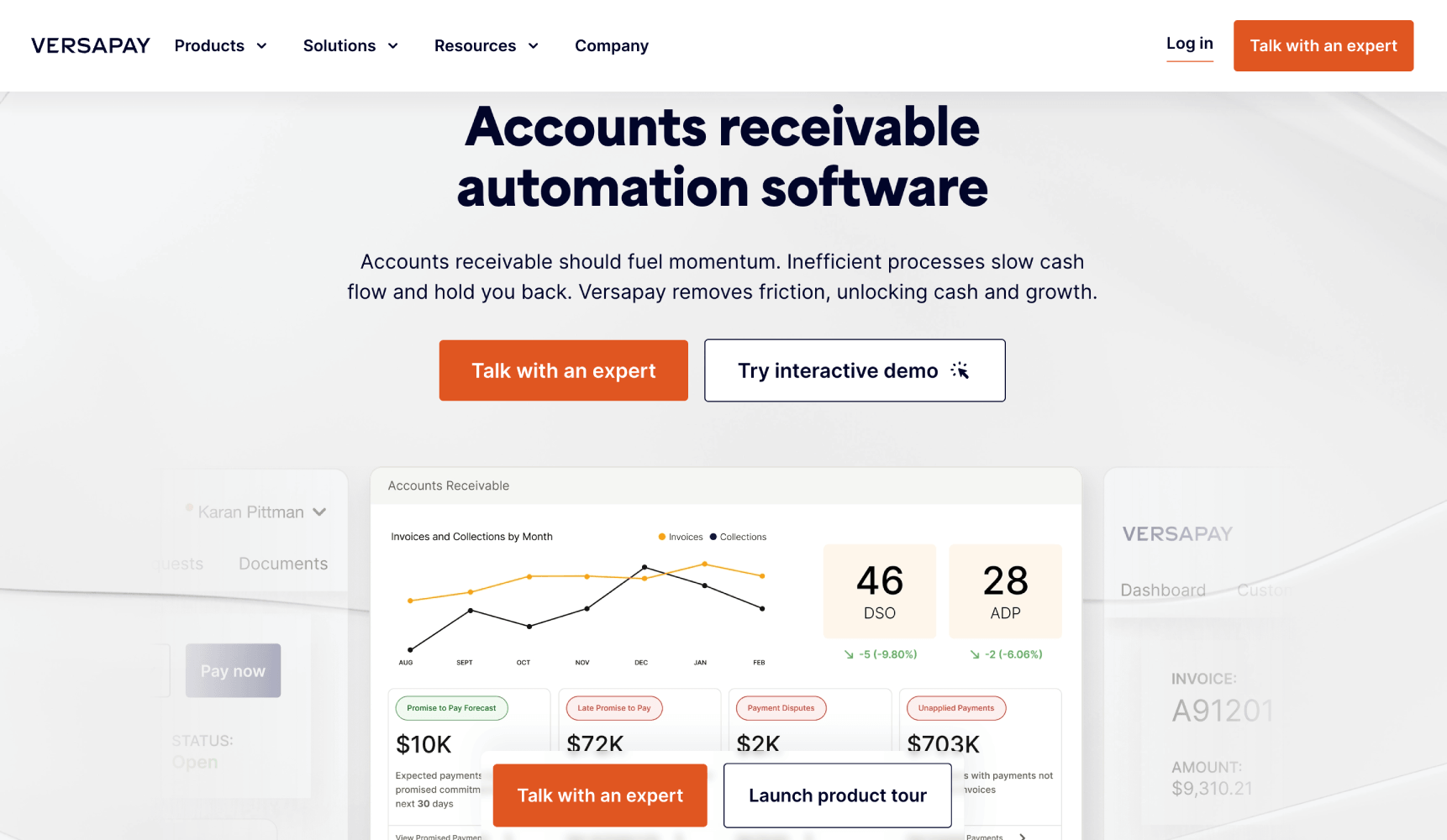
Versapay’s core product is built around what the company calls collaborative AR. The customer portal is not just a payment page. Buyers and sellers can exchange messages, attach documents, and resolve disputes within the invoice itself, before payment clears. For companies whose DSO drag comes from invoice disputes rather than customer cash flow problems, this workflow difference is significant.
Versapay targets mid-market to enterprise companies with complex buyer relationships and high dispute rates. It connects to major ERPs including NetSuite, SAP, Oracle, and Microsoft Dynamics. The cash application module uses AI-assisted matching, which reduces manual remittance processing for teams handling ACH, check, and virtual card payments from diverse payer bases.
The platform also supports network-based payments, where enrolled buyers can pay across the Versapay network with reduced friction. This is useful for companies selling to large enterprise buyers who prefer to pay through a centralized AP portal rather than logging into a supplier’s payment page. The tradeoff is that the network effect is most valuable when your buyers are also on Versapay or connected to it, which is not guaranteed.
What Is Invoiced and Who Should Use It?
Invoiced positions itself as a full AR automation suite with strong API flexibility and a faster time-to-value for mid-market teams. The platform covers invoice delivery, a self-service payment portal, automated collections sequences, and cash application. It integrates natively with NetSuite, QuickBooks, Sage, and others, and offers a REST API for teams that need to build custom workflows on top of the platform.
The product is best suited for companies where the AR team is lean, where implementation budget is limited, and where the priority is reducing manual email follow-up on overdue invoices rather than managing complex disputes. Invoiced’s collections automation lets teams define rule-based dunning sequences by customer segment, invoice age, and payment history, which cuts repetitive outreach without requiring a large configuration project.
The portal experience in Invoiced is straightforward: customers receive a branded payment page, can view invoice history, and pay via ACH or card. It lacks the in-portal dispute and commenting layer that Versapay offers. For companies where disputes are rare and the main friction is simply getting customers to pay on time, that is not a meaningful gap.
What Is Billtrust and Who Should Use It?
Billtrust built its product around high-volume invoice delivery across every possible delivery channel: email, postal mail, EDI, customer portals, and its own Business Payments Network (BPN). It was acquired by Flywire in 2023, which expanded its reach into education, healthcare, and global B2B payment flows. The acquisition is worth noting during vendor evaluation because it affects roadmap, support structure, and contract negotiations.
Billtrust is the strongest choice for companies with enterprise-level invoicing complexity: multiple legal entities, international customers, EDI mandates from large retail buyers, and strict SLA requirements around invoice delivery confirmation. Its cash application product uses machine learning to match payments against open invoices and handles complex remittance formats including 820 EDI transactions.
The gap Billtrust shows in mid-market evaluations is complexity cost. The platform is powerful but implementation is heavier than Invoiced or even Versapay. For a 50-person company with a two-person AR team, the configuration overhead can outweigh the automation benefit in the first 12 months. Billtrust fits best when you already have dedicated AR staff and an implementation budget to match the platform’s scope.
Portal and Integration Comparison: The Deciding Table
Portal architecture and ERP integration depth are the two criteria that most directly predict whether a platform reduces DSO for a given company. The table below maps each vendor across the dimensions that matter most for a mid-market shortlist.
| Criteria | Invoiced | Versapay | Billtrust |
|---|---|---|---|
| Customer portal type | Payment destination, self-service | Collaborative workspace with in-portal messaging and dispute resolution | Payment destination, multi-channel delivery |
| In-portal buyer-seller communication | No | Yes, native | No |
| ERP integrations (native) | NetSuite, QuickBooks, Sage, Xero, others | NetSuite, SAP, Oracle, Microsoft Dynamics, others | SAP, Oracle, NetSuite, Microsoft Dynamics, JD Edwards, others |
| API access | REST API, developer-documented | Available, less emphasized for custom builds | Available, enterprise-oriented |
| Cash application AI matching | Yes | Yes | Yes |
| EDI support | Limited | Limited | Strong, including 820 EDI |
| Payment network | No proprietary network | Versapay network (buyer enrollment) | Business Payments Network (BPN) |
| Best fit company size | SMB to mid-market | Mid-market to enterprise | Mid-market to large enterprise |
| Implementation complexity | Low to moderate | Moderate | Moderate to high |
| Pricing transparency | Not public | Not public | Not public |
How Does Versapay Compare to Billtrust on Collaborative AR?
Versapay and Billtrust both describe themselves as enterprise-grade AR platforms, but their models diverge at the point where a buyer has a question about an invoice. In Versapay, that question lives in the portal. Both the buyer’s AP team and the seller’s AR team see the same thread, attached to the same invoice, with a full audit trail. The invoice does not move to “paid” until the dispute is resolved. This is not a minor UX difference. It changes how AR teams structure their day.
In Billtrust, the invoice delivery and cash application are polished, but buyer-seller communication defaults to outside the platform. An AR analyst still receives an email from a buyer’s AP contact, still has to look up the invoice in a separate system, and still has to manually update notes. The automation stops at delivery and payment matching. Billtrust’s strength is in the breadth of delivery formats and the reliability of getting invoices to the right place in the right format, including EDI. That is a different problem than dispute velocity.
For companies where the DSO problem is “our invoices are arriving but buyers are not paying because of a dispute backlog,” Versapay’s architecture addresses the root cause. For companies where the problem is “our invoices are arriving in the wrong format and buyers are rejecting them upstream,” Billtrust’s delivery infrastructure is the better answer.
The FintechSpecs AR Fit Signal Framework
Because all three platforms compete for the same shortlist, mid-market finance teams need a structured way to identify which one fits before spending time in demos. The following framework, which we call the AR Fit Signal Framework, maps four internal signals to platform selection.
Signal 1: Dispute rate. Calculate the percentage of your monthly invoices that generate at least one buyer question, dispute, or short payment before being paid. If that rate is above 10%, Versapay’s collaborative model is worth prioritizing. Below 5%, dispute-workflow depth is not a differentiator.
Signal 2: Channel complexity. Count the distinct delivery methods your customers require: email PDF, EDI 810, buyer portal upload, postal mail, self-service payment link. If you have three or more required delivery channels, Billtrust’s multi-channel delivery engine becomes relevant. Invoiced and Versapay are weaker here.
Signal 3: Integration build appetite. If your finance team wants a platform they can configure and extend without a systems integrator, Invoiced’s REST API and documented developer resources give them the most control. If your team prefers a fully managed implementation with professional services, Billtrust’s enterprise services model fits better.
Signal 4: Team size and bandwidth. A two-person AR team running on spreadsheets and email will get more value from Invoiced’s self-serve onboarding than from Billtrust’s implementation-heavy model. A seven-person AR team at a $100M revenue company has the bandwidth to absorb a longer implementation in exchange for the structural improvements Versapay or Billtrust deliver.
How Do These Platforms Handle Cash Application?
Cash application is the back half of the AR cycle: matching incoming payments to open invoices automatically, without manual line-item reconciliation. All three platforms offer AI-assisted cash application, but the inputs they handle well differ.
Billtrust handles the widest range of remittance formats, including 820 EDI, complex lockbox data, and multi-entity payments. This is where its enterprise positioning shows. For a company receiving thousands of payments monthly from a diverse buyer base that includes large retailers sending EDI remittance data, Billtrust’s cash application accuracy holds up under that variety.
Versapay’s cash application benefits from the collaborative portal: because disputes are resolved in-platform before payment, the match rate on incoming payments is higher. When a payment arrives, the associated invoice already has a clean status. The dispute that would have created a short payment or deduction exception was resolved upstream.
Invoiced’s cash application handles the common cases well, ACH payments, credit card transactions, and standard remittance, but it is not built for complex EDI remittance or high-volume lockbox processing. For a mid-market company receiving under a few hundred payments a month from buyers who pay via ACH or card, the difference is not meaningful in practice.
Finance teams evaluating payment reconciliation more broadly can find additional context in our comparison of payment reconciliation software for fintech finance teams.
What About Quadient AR, and How Does It Compare?
Quadient AR (formerly YayPay) is a fourth name that appears frequently on mid-market shortlists, particularly in searches comparing Billtrust versus Quadient. The platform sits closest to Versapay in market positioning: it emphasizes AI-driven collections, customer-facing portals, and ERP integration for mid-market teams. Quadient AR includes predictive payment scoring, which estimates when a specific customer is likely to pay based on historical behavior. That feature has practical value for AR teams building collections prioritization queues.
Compared to Versapay, Quadient AR lacks the in-portal collaborative dispute layer. Compared to Invoiced, it is positioned at a slightly higher price point with a more managed implementation model. Compared to Billtrust, it is weaker on EDI and multi-channel invoice delivery. Quadient AR earns a place on shortlists for mid-market companies that want predictive analytics layered on top of standard collections automation, but want to avoid Billtrust’s implementation weight.
For the specific comparison between Versapay and Quadient: if buyer-side communication and dispute resolution matter, Versapay wins. If predictive collections scoring is the priority and dispute rate is low, Quadient AR is worth a demo. The two platforms are not clearly superior across all criteria, which is why both appear on the same shortlists.
Pricing: What Mid-Market Teams Should Actually Budget
None of the three vendors , Invoiced, Versapay, or Billtrust , publish standard pricing publicly as of the time of publication. All three require a discovery call and scope conversation before quoting. This is standard for B2B SaaS AR platforms because pricing typically depends on invoice volume, number of ERP connections, payment processing volume, and the specific modules included.
Mid-market teams should budget starting in the low five figures annually for Invoiced at smaller scale, with costs rising as invoice volume and user count grow. Versapay and Billtrust are generally priced higher for comparable configurations, with enterprise contracts often in the mid-to-high five figures or beyond, depending on scope. These ranges are directional estimates based on contract structures common to this category; confirm figures directly with each vendor during the sales process, as none of the three disclose pricing on their public pages.
Implementation costs are a separate budget line. Invoiced’s implementation is lighter and can often be handled internally. Versapay and Billtrust typically involve professional services engagements, which can add meaningful cost in the first year. For a finance team evaluating total cost of ownership, the implementation cost and time-to-value are as important as the annual subscription fee.
The pattern of hidden costs in fintech software is worth reviewing before signing any contract. Our coverage of hidden costs that affect fintech SaaS margins covers the structural reasons these costs tend to compound after signing.
ERP and Tech Stack Integrations: What to Verify Before Signing
All three platforms advertise integrations with major ERPs, but the depth of those integrations varies. A native integration that syncs invoice status bidirectionally is categorically different from a one-way export or a middleware-dependent connection. Before signing any contract, finance teams should ask the vendor to demonstrate the specific integration with their ERP version in a sandbox environment, not just confirm that the integration exists on paper.
Billtrust has the deepest integration history with large enterprise ERPs, particularly SAP and Oracle. Its connections to these systems have been built over years of enterprise deployments. If your company runs SAP S/4HANA and needs a vendor with a documented track record at that scale, Billtrust’s reference list is stronger than the alternatives.
Invoiced’s REST API gives technical teams the most flexibility to build custom sync logic. For companies running less common ERPs, or those with heavily customized NetSuite or Sage instances, Invoiced’s API-first approach lets the engineering team build a precise integration rather than working around a rigid connector. This matters most for B2B SaaS companies whose billing logic is complex enough that a standard connector will not cover all the edge cases.
Teams evaluating the broader range of accounting and ERP integration options can review the analysis of accounting integration APIs for B2B SaaS for context on how these connectivity layers typically work.
A Worked Scenario: Where Each Platform Wins
Consider three hypothetical mid-market companies, each a reasonable proxy for common buyer profiles.
Company A is a $40M revenue B2B distributor with 300 active customers. About 18% of its invoices generate a dispute or a question before payment. The AR team of three spends most of its time in email threads trying to track down PO numbers and reconcile short payments. This company’s DSO problem is dispute velocity, not delivery. Versapay’s collaborative portal eliminates the email back-and-forth by moving the conversation into the invoice itself. Implementation will take longer than Invoiced, but the structural improvement addresses the actual bottleneck.
Company B is a $20M revenue SaaS company with a leaner finance team of two. Customers pay via ACH or credit card within standard net-30 terms, and disputes are rare. The main pain point is manual follow-up emails on 60-plus-day invoices. Invoiced’s automated collections sequences handle this directly, and the API lets the team sync with their existing NetSuite instance without a systems integrator. This company does not need Versapay’s collaborative layer or Billtrust’s EDI depth.
Company C is a $150M revenue manufacturer that sells to large retail chains. Those retail buyers require EDI 810 invoicing, have strict format requirements, and run payments through centralized AP portals. Billtrust’s multi-channel delivery infrastructure and EDI support handle these requirements natively. Neither Invoiced nor Versapay would meet the EDI mandate from day one.
Frequently Asked Questions
Is Versapay or Invoiced better for a B2B company trying to reduce DSO?
The answer depends on where DSO drag originates. If a high percentage of invoices generate buyer disputes or questions before payment, Versapay’s collaborative portal reduces that friction because buyers and AR teams can resolve issues inside the invoice, before it ages. If the DSO problem is simply slow payment on undisputed invoices, Invoiced’s automated dunning sequences handle that more efficiently and with a faster implementation timeline. Identify your dispute rate first, then choose.
Does Billtrust still make sense after its acquisition by Flywire?
Billtrust’s core product continues to operate under the Flywire umbrella, and its EDI and multi-channel invoicing capabilities remain its primary strength. The acquisition expanded Flywire’s reach into education and healthcare, which broadens Billtrust’s addressable market but also means the company’s strategic roadmap is shaped by priorities beyond pure B2B AR automation. Companies evaluating Billtrust should ask specifically about the product roadmap and support structure under Flywire’s ownership before signing a multi-year contract.
Can Invoiced handle complex ERP integrations, or is it only for simpler setups?
Invoiced supports native integrations with NetSuite, QuickBooks, Sage, and Xero, and offers a documented REST API for custom builds. For companies running heavily customized ERP environments or less common systems, the API is the practical path. The limitation is that custom API work requires internal or contractor technical resources. Invoiced is not the right choice if your team has no engineering bandwidth and needs a fully managed integration with a complex SAP or Oracle environment.
How does Quadient AR compare to Versapay for mid-market AR automation?
Quadient AR (formerly YayPay) and Versapay both target mid-market companies with ERP integrations and customer-facing portals. Versapay’s primary differentiator is the in-portal dispute and messaging workflow, which lets buyers and sellers communicate within the invoice before payment. Quadient AR offers predictive payment scoring, which helps teams prioritize which customers to contact first. If dispute resolution is the main bottleneck, Versapay wins. If collections prioritization is the main need and dispute rate is low, Quadient AR is worth evaluating alongside Versapay.
Do any of these AR platforms support international invoicing?
All three platforms handle multi-currency invoicing to varying degrees, but international support varies significantly by region and payment method. Billtrust’s acquisition by Flywire expanded its international payment handling, particularly for education and healthcare receivables. Versapay and Invoiced support multi-currency invoicing for common international scenarios but are primarily optimized for North American B2B billing workflows. Companies with significant international AR volume should verify specific country and currency support directly with each vendor.
What is a realistic implementation timeline for each platform?
Invoiced typically goes live in four to eight weeks for mid-market teams with a standard ERP configuration, per the vendor’s published product documentation. Versapay implementations generally run eight to sixteen weeks depending on ERP complexity and the number of customers needing portal enrollment, per Versapay’s implementation guidance. Billtrust implementations for mid-market to enterprise configurations often extend to three to six months, particularly when EDI delivery channels and multi-entity setups are involved, as noted in Billtrust’s enterprise onboarding documentation. These are directional ranges; actual timelines depend heavily on internal resource availability and the complexity of existing billing logic. Verify current timelines directly with each vendor before planning a go-live date.
Is accounts receivable automation worth the investment for a company under $10M in revenue?
At sub-$10M revenue with a small customer base and a single AR staff member, the ROI calculation for a platform like Versapay or Billtrust is difficult to justify on automation savings alone. Invoiced’s lower entry cost and lighter implementation make it the most realistic option at that stage. For most companies under $10M, a combination of basic invoicing software and disciplined dunning processes delivers most of the benefit without the contract complexity of a full AR automation platform. The investment becomes clearer as invoice volume, customer count, and AR staff time compound past a certain threshold.
How do these platforms handle payment acceptance fees?
AR automation platforms typically pass through payment processing fees from underlying payment rails , ACH, credit card, and virtual card , at rates that vary by contract. Versapay processes payments through its own network and third-party processors. Invoiced works with payment processors including Stripe and others. Billtrust’s Business Payments Network handles payments across multiple rail types. None of the three publish payment processing rates publicly as of the time of this writing, and the blended rate you pay will depend on your payment mix and negotiated contract terms. For context on how billing and payment fee structures work in practice, see the analysis of how fintech companies monetize payments without degrading the payer experience.
What the Right Choice Actually Comes Down To
The frame that matters is not which platform has the longest feature list. It is which platform’s architecture matches the specific point in your AR cycle where time and money are lost. Versapay’s collaborative portal is a structural answer to dispute-driven DSO. Billtrust’s multi-channel delivery and EDI infrastructure are structural answers to invoice delivery and remittance complexity. Invoiced’s API flexibility and lighter implementation are structural advantages for teams that need to move fast without a large services engagement.
Finance teams that skip the AR Fit Signal Framework and go straight to demos will spend weeks comparing features that all three platforms share, while missing the single architectural difference that will define whether the platform reduces DSO by 8 days or by 2. Run the four signals first: dispute rate, channel complexity, integration build appetite, and team bandwidth. The right shortlist becomes obvious before a call is ever needed.
One final observation worth holding onto: the vendor that wins your demo is not necessarily the vendor that fits your workflow. Demo environments are controlled, disputes are pre-resolved, and ERP sync is pre-configured. Ask each vendor to walk you through what happens when a buyer disputes an invoice and your AR team is unavailable. The difference in that answer tells you more about fit than anything on their feature comparison sheet. For companies building out their broader financial operations stack alongside AR automation, the accounts payable automation comparison covers the AP-side tooling that typically pairs with AR platforms in a mid-market finance function.