
- A credit-as-a-service API lets non-lending platforms embed credit products without holding a lending license or managing capital risk.
- The right CaaS provider handles underwriting, compliance, and capital deployment. Your platform handles the user experience and earns a revenue share.
- The five providers covered here serve distinct use cases: consumer-facing apps, B2B marketplaces, vertical SaaS, and payroll platforms.
- The biggest hidden cost is not the API fee. It is the compliance infrastructure you still need to build around it if you pick the wrong provider.
- Use the FintechSpecs CaaS Fit Test at the end of this article to match your platform type to the right lending rail.
A credit-as-a-service API lets non-lending platforms offer loans, lines of credit, BNPL, or working capital to their users by connecting to a provider that owns the lending license, funds the loans, and manages regulatory compliance. The platform integrates an API, presents credit offers inside its product, and earns a revenue share or fee per funded loan. Providers in this category include Kanmon, Parafin, Pipe, Bond, and Scratch Financial, among others. No lending license is required from the platform side.
Why Non-Lenders Keep Getting Credit Wrong
Most founders who want to add credit to their platform assume they need a lending license, a credit risk team, and a warehouse line before they can launch anything. That assumption kills the feature before scoping ever starts. The reality is that the licensing burden, balance sheet exposure, and compliance overhead are all transferable to a CaaS provider through a program agreement.
What you are actually buying when you sign a CaaS API contract is access to someone else’s bank charter or state lending licenses, their underwriting model, and their capital. Your obligation is to integrate the API, present the offer accurately to your users, and comply with any marketing restrictions the provider gives you. That is a product and engineering problem, not a lending business problem.
The category is genuinely different from embedded lending APIs aimed at platforms that want more underwriting control. If you want to tune credit policy, set your own loss tolerance, or use proprietary data to drive decisions, you are shopping in a different category. CaaS APIs are for platforms that want the revenue line and the user experience without the infrastructure. For a deeper look at the full embedded lending spectrum, the best embedded lending APIs for vertical SaaS platforms covers where the two categories split.
What Does a Credit-as-a-Service API Actually Include?
At minimum, a credit-as-a-service API gives you a set of endpoints to check eligibility, return a credit offer, and initiate a loan draw. The provider handles the loan agreement, the funds disbursement, repayment collection, and delinquency management. You render the offer in your UI.
Better providers add co-branded loan agreements, white-label servicing portals, and real-time webhooks for repayment events so you can reflect loan status inside your platform. The best ones have pre-built UI components or SDKs that cut integration time from weeks to days and handle the required disclosures automatically. That last part matters more than most teams expect. TILA disclosures, state-specific APR caps, and required adverse action notices are all your problem if the provider does not handle them.
The compliance wrapper a CaaS provider builds around an API is worth as much as the API itself. A provider operating under a bank partnership model passes FDIC-supervised compliance through to you under a program agreement. A provider operating under its own state licenses gives you narrower geographic coverage and more variability in the terms you can offer. Ask every shortlisted provider: which states are covered, under what charter or license, and what changes if a state updates its rate cap law.
Which Credit-as-a-Service API Providers Should You Actually Consider?
The list below covers providers with public-facing developer documentation, active platform partnerships, and verifiable US market coverage. Pricing for all providers was not publicly disclosed at time of writing. Contact sales for current commercial terms.
Kanmon
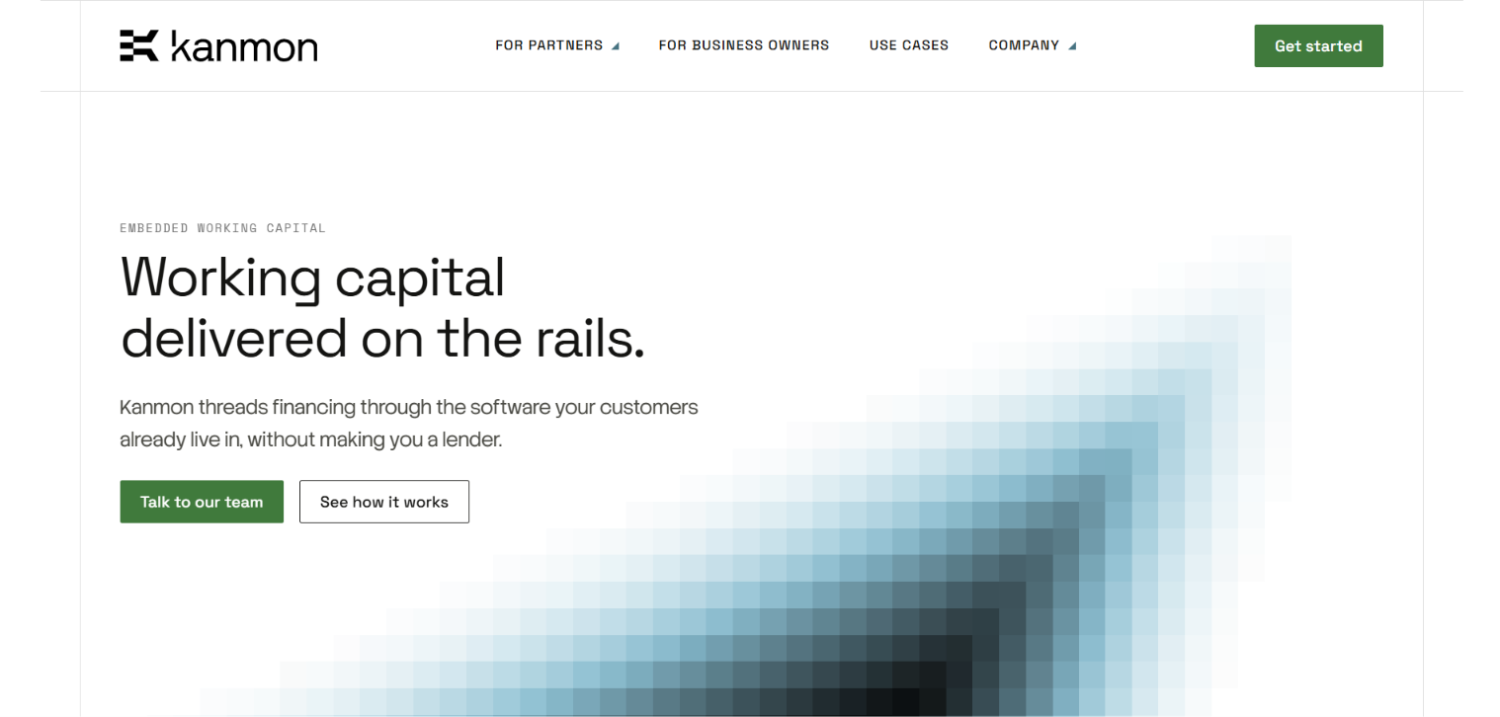
Kanmon focuses on small business lending embedded in B2B SaaS platforms. It offers term loans and lines of credit with an API that returns pre-qualified offers based on business financial data you pass at the time of the eligibility check. The integration model is designed for vertical SaaS products that already have financial data on their merchants, such as invoicing tools, accounting platforms, or payments-led commerce tools.
Kanmon’s key differentiator is that it can ingest platform-native data, including invoices, GMV, and payment history, rather than relying solely on bureau pulls to underwrite. That matters if your users are thin-file businesses that would not qualify through a traditional credit check. The company operates under a bank partnership model, which provides consistent coverage across states without the fragmented licensing picture you get from a non-bank lender. Kanmon is one of the providers compared in the best embedded working capital APIs for B2B platforms roundup.
Parafin
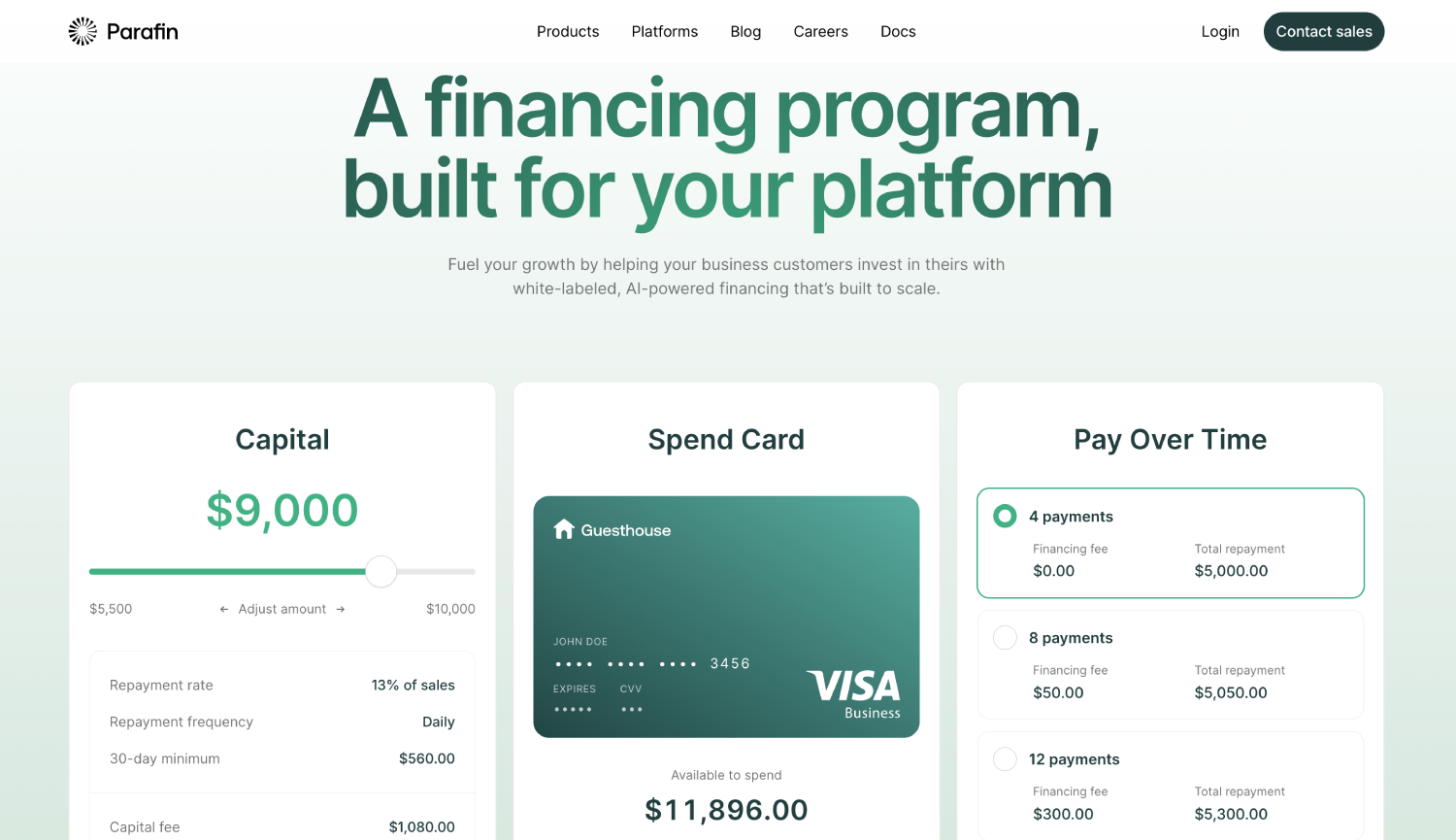
Parafin offers embedded working capital for platforms with transaction volume data, most commonly commerce platforms, marketplaces, and payments-led software. Its model is merchant cash advance structured as capital advances, with repayment tied to future revenue as a fixed percentage of daily sales. That repayment structure is important: it means no fixed monthly payment, which reduces delinquency risk for your users and simplifies the offer narrative.
Parafin’s integration is designed to work with existing payment data rather than requiring a separate bank connection. If your platform already processes or sees the revenue data of your merchants, you can pass that through Parafin’s API without asking users to re-authenticate their bank accounts. The company has disclosed partnerships with platforms including DoorDash, Amazon, and Mindbody, which gives some signal about the tier of platforms they work with. Pricing is not publicly listed.
Pipe

Pipe initially focused on SaaS recurring revenue financing before pivoting to a broader capital marketplace for platforms. Today it operates as an embedded capital product for businesses that want non-dilutive financing, with a platform API that lets SaaS or fintech companies offer capital access as a feature. Pipe’s underwriting leans on ARR and revenue predictability, making it a reasonable fit for platforms serving subscription-first businesses.
The Pipe model differs from Kanmon and Parafin in that it operates more as a marketplace connecting businesses to multiple capital providers rather than a single-funder model. That creates more flexibility in offer terms for well-qualified businesses but adds complexity to the integration and the disclosure workflow. If your user base is diverse in creditworthiness, the single-funder model from Kanmon or Parafin gives you a more predictable offer rate.
Bond Financial Technologies
Bond (now part of Fortune Brands after a 2024 acquisition) is a broader banking-as-a-service platform that includes a credit API as part of its suite. Its credit module supports consumer credit cards and charge cards, making it one of the few CaaS-adjacent providers in this category that operates in the consumer revolving credit space rather than B2B lending. That distinction matters for platform fit: Bond is most relevant for consumer apps building a co-branded credit card experience, whether that is a rewards card tied to a loyalty program, a charge card paired with a spending or budgeting product, or a store card embedded in a consumer marketplace. It is not designed for installment loans or working capital.
Bond’s credit product is tightly coupled to its card issuing infrastructure, which means it works best for platforms that want to issue a branded credit card to consumers rather than offer a standalone loan or line. If your platform is a consumer app looking to add a co-branded credit card experience, Bond is worth evaluating alongside the providers in the best card issuing APIs for consumer lending and credit card programs roundup. If you need installment loans or working capital for business users, Bond is not the right fit here.
Scratch Financial
Scratch Financial operates in a narrower vertical: patient financing and service-based consumer credit at the point of service. Its API allows healthcare practices, veterinary clinics, and similar service platforms to offer installment financing at checkout. The company acts as the lender and manages the full servicing stack, while the platform integrates a white-label apply-and-fund flow.
Scratch competes with CareCredit and Sunbit in the healthcare financing vertical. Its API-first approach makes it a better fit for digital-native platforms building their own intake and scheduling workflows than for traditional practices running legacy software. Coverage is US-only. Pricing is not publicly disclosed.
How Do These Providers Compare on the Dimensions That Actually Matter?
| Provider | Best Platform Type | Credit Product | Underwriting Model | Business or Consumer | Pricing Disclosed? |
|---|---|---|---|---|---|
| Kanmon | B2B vertical SaaS (invoicing, payments, commerce) | Term loans, lines of credit | Platform-native data + bureau | Business | No |
| Parafin | Commerce and marketplace platforms | Revenue-based capital advance | Transaction/revenue data | Business | No |
| Pipe | Platforms serving subscription businesses | Capital marketplace, term financing | ARR and revenue predictability | Business | No |
| Bond | Consumer apps wanting branded credit cards | Consumer credit card / charge card | Traditional bureau-based | Consumer | No |
| Scratch Financial | Healthcare and service-at-point-of-care platforms | Consumer installment loans | Service context + bureau | Consumer | No |
Every provider in this category operates on a revenue-share or fee-per-loan model negotiated through a sales process. None publish standard rate cards. That is common in this space because the economics depend heavily on your platform’s GMV, user creditworthiness, and the product structure you agree to. Plan for a commercial negotiation, not just a technical proof of concept. If you want a framework for that conversation, the 7-point fintech vendor evaluation framework is worth reading before you sign anything.
What Is the FintechSpecs CaaS Fit Test?
Before starting vendor conversations, run your platform through four filters. This is the FintechSpecs CaaS Fit Test, and it will save you two to three wasted sales calls.
Filter 1: Data proximity. Do you already see financial data on your users, such as transaction history, invoice volume, or recurring revenue? If yes, you can pass platform-native signals to an underwriter and likely get better approval rates and lower cost of capital. Kanmon and Parafin are built for this. If you have no financial data on users, you are dependent on bureau pulls, and your offer rates will be higher.
Filter 2: Business or consumer. Consumer credit products are governed by TILA, FCRA, Regulation Z, and state usury laws. Business credit products are subject to a lighter disclosure regime in most states, though California’s SB-1235 commercial financing disclosure law is an exception. If your users are businesses, you have more flexibility on product design. If they are consumers, your CaaS provider needs a solid compliance wrapper, and you need to audit theirs carefully.
Filter 3: Repayment structure match. Revenue-based repayment works for users with variable cash flow. Fixed installment loans work for users who want payment predictability. Revolving credit works for users with recurring small purchases. If your users are merchants with daily revenue, Parafin’s advance model reduces delinquency friction. If your users are healthcare patients, fixed installments from Scratch are more appropriate. Mismatching the repayment structure to user cash flow patterns drives charge-offs and destroys the product’s reputation inside your platform.
Filter 4: Compliance handoff clarity. Ask every provider to walk you through, in writing, which compliance obligations remain with your platform and which they own. The dividing line is almost always at marketing: you are responsible for how you present the offer, and they own the loan agreement and servicing disclosures. But that line is blurry in practice, especially around pre-qualification copy, APR display, and adverse action notices. If a provider cannot give you a clear written answer on compliance ownership, treat that as a red flag, not a minor gap.
What Does Integration Actually Take for a Credit API?
The technical lift for a CaaS integration is smaller than most engineers expect and bigger than most product managers estimate. The API calls themselves, an eligibility check, an offer return, a loan initiation, and a webhook receiver for repayment events, are straightforward. Most providers offer a sandbox environment with test credentials and mock data. Engineers who have worked with Stripe or Plaid will find the API patterns familiar.
Where integration stalls is not in the API. It is in the legal review of the program agreement, the compliance review of your marketing copy and offer presentation UI, and the integration of the provider’s required disclosures into your checkout or application flow. Budget four to eight weeks for a first integration when you include legal review cycles. Budget two weeks if your legal team is fast and the provider has pre-approved UI templates you can use without modification.
For platforms still evaluating their broader infrastructure picture, the fintech infrastructure stack map shows where credit APIs sit relative to payments, banking, and identity layers, which helps teams plan the sequencing of infrastructure buildouts.
What Should Non-Lenders Know About Compliance Before They Start?
The most common mistake is assuming the CaaS provider handles all compliance. They handle the lending compliance: origination, disclosures, FCRA obligations, servicing, and collections. You handle the marketing compliance: how you describe the product, what terms you display before a user applies, and whether your UI creates any implication of a guaranteed approval.
State rate caps are a live issue. Several states cap consumer loan APRs, and some have extended those caps to commercial financing above certain thresholds. Your CaaS provider’s coverage map tells you which states they can originate in. If your platform has significant user density in states where the provider cannot operate, that is a material product gap to understand before launch. Do not assume a provider’s coverage map is static. It changes as they obtain new licenses or as state laws change.
If you are building a consumer-facing credit product, FCRA compliance touches your platform even if you do not make credit decisions. How you present pre-qualification offers, whether you run a soft or hard pull at each step, and what happens when a user is declined all have regulatory implications. The FCRA compliance services for lending and credit data startups guide covers the specific obligations worth understanding before you finalize your offer flow.
Frequently Asked Questions
Do I need a lending license to use a credit-as-a-service API?
No. The CaaS provider holds the lending license or operates under a bank partnership that covers origination. Your platform integrates the API and presents offers to users, but the loan is made by the provider or their bank partner. You are acting as a referral or distribution channel, not a lender. That said, depending on how your state defines “credit services organizations” or “loan brokers,” there may be a registration or disclosure obligation at the platform level. Check with legal counsel before launch.
How does revenue share work in a CaaS program?
The provider funds the loans, takes the credit risk, and collects repayments. Your platform earns a percentage of the interest income or a flat fee per funded loan, depending on the commercial structure you negotiate. Revenue shares vary widely based on your platform’s GMV, user creditworthiness, and loan volume. No providers in this category publish standard revenue share rates. Expect to negotiate this as part of the program agreement.
What is the difference between a CaaS API and an embedded lending API?
A CaaS API is a fully managed credit program where the provider owns the underwriting, capital, and compliance. Your platform distributes the product and earns revenue without setting credit policy. An embedded lending API gives your platform more control, including the ability to configure underwriting rules, set pricing, or use proprietary data models, but typically requires you to hold a lending license or partner with a licensed lender directly. CaaS is appropriate when you want low operational overhead. Embedded lending is appropriate when competitive differentiation depends on your credit model.
How long does it take to launch a credit product on a CaaS API?
Technical integration typically takes two to four weeks. The longer variable is legal review of the program agreement and compliance review of your UI and marketing copy. Total time from contract signature to go-live is commonly six to twelve weeks, depending on your legal team’s speed and whether your CaaS provider offers pre-approved UI templates. Providers with strong white-label UI kits reduce this timeline meaningfully.
Can a CaaS API serve thin-file or credit-invisible business users?
This varies significantly by provider. Kanmon and Parafin are both built to ingest platform-native financial data , transaction history, invoice volume, GMV , to underwrite users who would not qualify through a bureau pull alone. If your platform holds rich transactional data on users, ask each provider specifically how they ingest that data and what weight it carries relative to traditional bureau signals in their underwriting model. Providers that rely solely on bureau data will produce lower approval rates for thin-file users regardless of how well your platform knows them.
What happens to my users if a CaaS provider shuts down or exits the program?
This is a risk most platforms underestimate. If the provider exits, your users’ existing loans move to a successor servicer, but new originations stop. Your credit feature disappears. Evaluate your provider’s financial stability, bank partnership stability, and what the program agreement says about wind-down notice periods and data portability. A provider operating under a direct bank partnership has more institutional stability than a venture-funded non-bank lender with a warehouse line. Ask about the wind-down clause before you sign.
The Underlying Decision: CaaS vs Building Nothing
For most platforms, the real comparison is not between CaaS providers. It is between integrating a CaaS API and not offering credit at all. Credit products drive meaningful monetization and retention when they are well-matched to user needs. A merchant who takes a working capital advance inside your platform is significantly more engaged with your product than one who goes to an external lender. That stickiness is the business case, not the revenue share alone.
The providers that work best are the ones whose underwriting model is closest to the data your platform already holds. Parafin for transaction-heavy commerce platforms, Kanmon for B2B SaaS with invoice or payment data, Scratch for service-vertical platforms with healthcare or wellness users. The fit test matters more than the feature list because a mismatched underwriting model produces low approval rates, and low approval rates produce user frustration, not revenue.
Run the CaaS Fit Test before you start vendor conversations. Know your data proximity, your user type, the repayment structure that matches their cash flow, and exactly which compliance obligations land on your team. That preparation shortens your evaluation from three months to three weeks and surfaces the right provider faster than any feature matrix will.