
- Equipment and asset financing can be embedded via API, just like cash advances or credit lines. The infrastructure exists now.
- Most embedded lending platforms default to revenue-based or unsecured credit. Only a handful of providers handle collateralized asset or equipment financing specifically.
- The key technical difference: equipment financing APIs must handle asset identification, collateral valuation, and UCC filing, not just credit decisioning and disbursement.
- The right provider depends on whether you need white-label origination, a lender network, or full loan lifecycle management built into your platform.
- Pricing across this category is almost entirely custom and negotiated. No provider in this space publishes per-loan fees publicly.
Equipment financing can be embedded into B2B platforms via API, and several providers have built infrastructure specifically for this. Taycor Financial, Lendio Embedded, Kanmon, Pipe, TimePayment, and Finix each represent a different integration model , from simple application routing to full white-label asset lending with UCC filing, collateral tracking, and lender network access. Most require a direct sales conversation to get pricing, but the infrastructure for embedding equipment and asset financing into vertical SaaS or marketplace products is production-ready. This article covers what each provider actually does, where each falls short, and how to run an evaluation before you build.
Why Most Embedded Lending APIs Skip Equipment Financing Entirely
Embedded lending infrastructure has grown fast, but almost all of it was built around unsecured products: revenue-based advances, working capital lines, BNPL. That is not an accident. Those products are simpler to underwrite, faster to close, and do not require a security interest in a physical asset.
Equipment financing introduces mechanics that generic embedded credit APIs were not designed to handle. You need asset identification (make, model, serial number, age), collateral valuation, a process for UCC-1 financing statement filings, and in many cases, the ability to handle both loans and true leases under different accounting treatments. A platform that can originate a $15,000 revenue advance in two API calls cannot originate a $180,000 CNC machine lease without significant additional infrastructure.
This matters for platform builders because the market they are leaving on the table is large. Construction, healthcare, agriculture, transportation, and manufacturing are all vertical SaaS categories where equipment is the primary capital purchase. If your platform serves these industries and only offers working capital, you are referring your best customers elsewhere for their largest financing decisions. For a deeper look at how embedded credit infrastructure fits into a broader stack, the overview of embedded credit API providers for B2B platforms covers the unsecured side of this market well.
What Should an Equipment Financing API Actually Do?
Before evaluating providers, it helps to define what you actually need the API to do. Breaking requirements into four distinct capability layers eliminates most vendors from consideration immediately.
Layer 1: Application and Credit Routing
The API accepts a financing application from your platform user, collects the relevant business and asset data, and routes it to one or more lenders for a credit decision. This is the minimum viable integration and the most common starting point. Providers operating here are essentially technology-enabled brokers.
Layer 2: Lender Network and Offer Aggregation
Instead of routing to a single lender, the API surfaces multiple offers from a lender network, allowing your user to compare rates, terms, and structures before accepting. This adds meaningful value for borrowers in the $25,000 to $500,000 range, where multiple funders compete actively.
Layer 3: Collateral and Asset Management
The API handles asset-specific data fields, collateral tracking, and in some implementations, coordinates UCC-1 filings. This is where most platforms underestimate complexity. Equipment serial numbers, depreciation schedules, and end-of-term options (buyout, renewal, return) all require data structures that do not exist in generic credit APIs.
Layer 4: Full Loan Lifecycle and Servicing
Origination, disbursement, payment collection, delinquency management, and end-of-lease handling are all managed through the API. Very few providers offer this level of integration. Those that do are typically purpose-built equipment finance platforms rather than embedded finance generalists.
Which Equipment Financing API Providers Are Worth Evaluating?
| Provider | Integration Model | Asset Classes Covered | Lender Network | API-First | Best For |
|---|---|---|---|---|---|
| Taycor Financial | White-label origination | Equipment, vehicles, software | Proprietary + network | Partial | Platform builders wanting a direct lender relationship |
| Lendio Embedded | Lender marketplace API | Equipment, working capital, SBA | Multi-lender marketplace | Yes | Platforms wanting multi-lender offer comparison |
| Kanmon | Embedded lending infrastructure | Equipment, invoice, working capital | Curated network | Yes | B2B SaaS wanting full white-label experience |
| Pipe | Capital-as-a-service API | Equipment, recurring revenue | Proprietary | Yes | Platforms with subscription or recurring revenue data |
| TimePayment | Equipment leasing API | Equipment, technology, medical | Proprietary | Partial | Vertical SaaS in healthcare, technology, or general equipment |
| Finix | Payments and embedded finance | Equipment financing (via partners) | Partner-dependent | Yes | Platforms already using Finix for payments wanting to add financing |
Taycor Financial: Best for White-Label Equipment Lending with a Direct Lender
Taycor Financial is one of the few equipment finance companies that explicitly supports platform and referral partner integrations with a co-branded or white-label option. They lend directly across equipment, vehicles, and software, and they maintain a referral network for deals they cannot hold on their own balance sheet. Ticket size range and specific program eligibility should be confirmed directly with Taycor, as the company does not publish this detail publicly.
The trade-off is that Taycor is not a pure-API play. Integration is closer to a white-label web experience or application feed than a fully headless API with webhooks and real-time decisioning. Platforms that want a clean JSON-based integration with async decisioning callbacks will find this friction. For platforms that can work within an iframe or redirect flow and prioritize direct lender relationships over API architecture, Taycor is worth a serious conversation.
Pricing is not publicly disclosed. All terms are negotiated based on deal volume and platform profile.
Lendio Embedded: Best for Multi-Lender Equipment Financing Offers
Lendio’s partner program gives platforms access to a multi-lender marketplace through a single integration. Equipment financing is one of several loan types surfaced through the platform, alongside SBA loans, lines of credit, and business term loans. When a borrower applies, their application routes to multiple lenders simultaneously and returns competing offers. For current details on lender network size and composition, Lendio’s partner documentation is the authoritative source.
This model works well for platforms where the financing decision is important but not the core product. The borrower sees real offers from real lenders, which increases conversion relative to a single-lender experience. The downside is that the platform has less control over the user experience and lender mix. Lendio’s revenue model is referral-fee based, so the economics look different from a white-label origination arrangement.
Lendio does not publish its partner API pricing publicly. The integration is developer-accessible, and their partner documentation covers standard REST API patterns.
Kanmon: Best for B2B SaaS Wanting a Fully Embedded Asset Lending Layer
Kanmon positions itself as embedded business lending infrastructure for platforms, covering equipment, invoice financing, and working capital in a single API. The pitch is that a SaaS company can offer multiple lending products to its customers without managing separate lender relationships for each product type.
What makes Kanmon worth serious evaluation for equipment financing is the API architecture. It is designed for headless integration, meaning the platform controls the full UI while Kanmon handles underwriting, lender routing, compliance, and servicing in the background. For platforms that have already built a lending surface or are planning to, this reduces the operational overhead significantly. The comparison with working capital APIs is covered in the embedded working capital API breakdown, which is useful context if you are evaluating both product types simultaneously.
Kanmon does not publish per-loan fees or revenue share arrangements publicly. Pricing is custom.
Pipe: Best for Platforms with Recurring Revenue or Subscription Data

Pipe expanded from its original revenue-based financing model into a broader capital-as-a-service API for platforms. Equipment financing is part of their product suite, and the underwriting model leans on platform-native data , revenue history, payment behavior, and subscription metrics , rather than relying solely on traditional credit pulls.
This is genuinely differentiated for platforms that aggregate financial data about their customers. A fleet management SaaS that knows how much revenue each operator is generating has underwriting signal that a traditional equipment lender does not. Pipe’s API can surface that signal and use it to extend financing offers that would not be available through a conventional application process.
The caveat is that Pipe’s equipment financing product is better suited to smaller ticket sizes and shorter terms than a traditional equipment lender. Platforms should confirm current eligible ticket ranges and asset types directly with Pipe, as product scope has evolved since the company’s original launch. For large industrial assets or complex collateral structures, a more conventional equipment finance path is likely required.
TimePayment: Best Equipment Leasing API for Technology and Medical Verticals
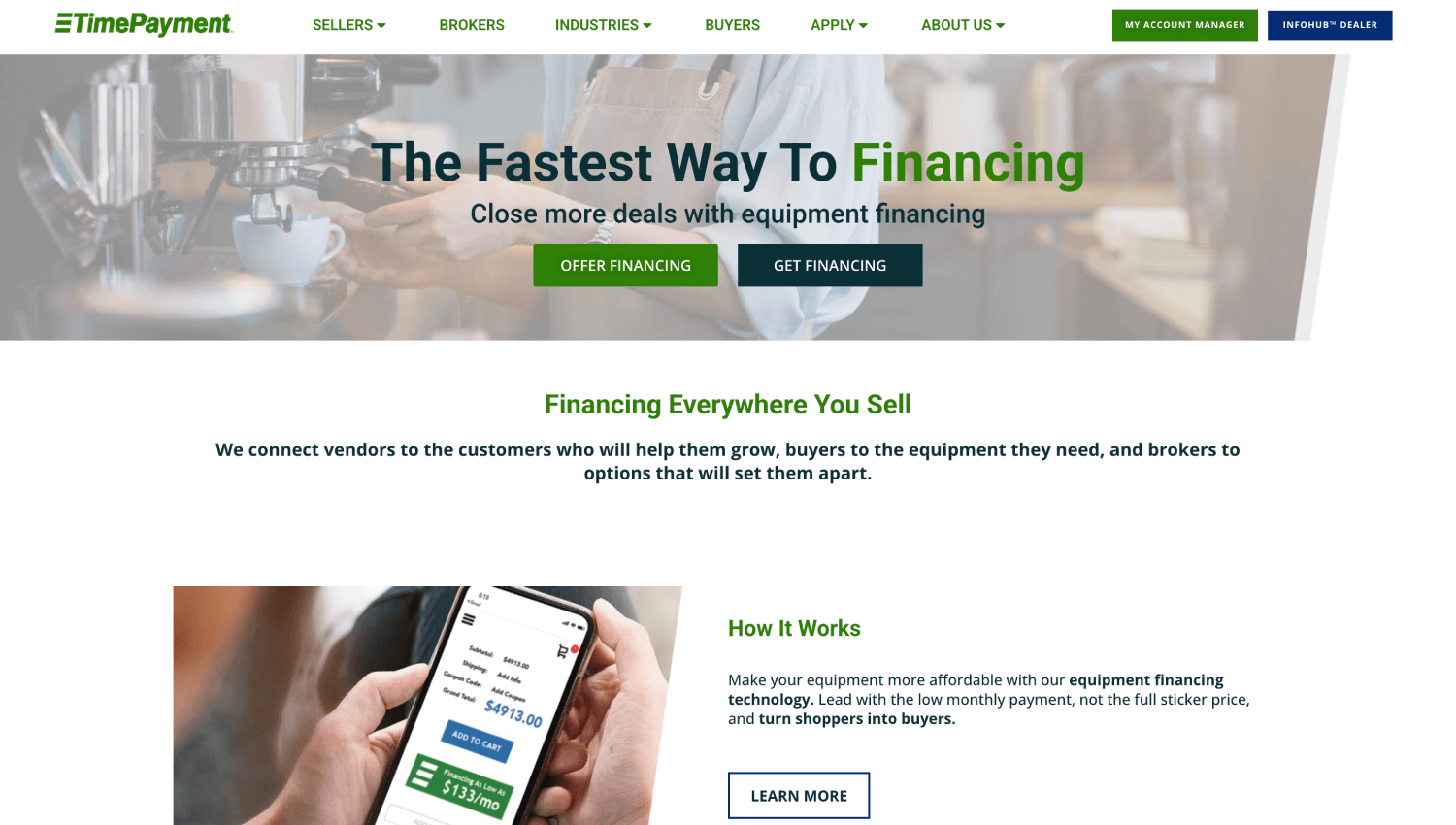
TimePayment is a specialized equipment leasing company with API and program integration capabilities for vendors and platforms. Their core focus is technology equipment, medical equipment, and general commercial equipment, with a particular strength in smaller ticket transactions. Per their public website, TimePayment covers transactions from $500 to $500,000.
TimePayment offers a vendor program that lets equipment sellers embed lease-to-own options at the point of sale. For SaaS platforms that sit adjacent to equipment purchasing , whether a marketplace, ERP, or industry-specific workflow tool , this maps well. The integration model includes both API endpoints and pre-built application flows depending on what level of customization the platform needs.
Their decisioning speed is a practical advantage: they advertise fast credit decisions for smaller tickets, which reduces friction at the point of sale. For larger or more complex transactions, turnaround time increases as with any lender. TimePayment does not publish partner API pricing publicly.
Finix: Best for Platforms Already Embedded in Payments Wanting to Add Financing
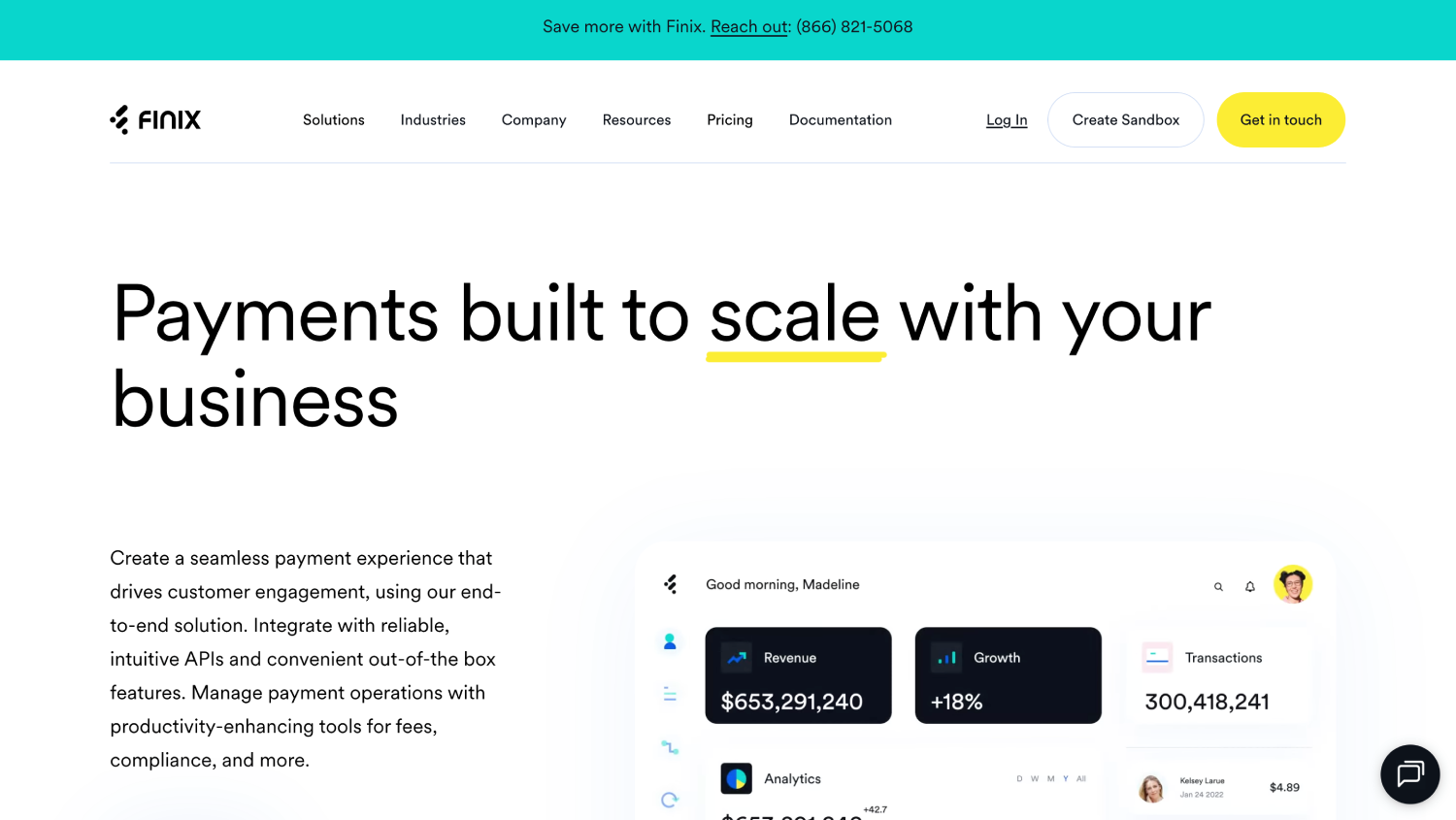
Finix is primarily a payments infrastructure company, but it has extended into embedded lending through partner integrations. For platforms already using Finix as their payment processing layer, adding equipment financing through the same infrastructure relationship is operationally simpler than standing up a second vendor relationship.
The financing products available through Finix are partner-dependent, not natively built. That is worth flagging. You are adding a lending layer to a payments stack, not working with a purpose-built equipment finance API. If your platform’s primary need is payments with financing as an add-on, Finix is worth exploring. If equipment financing is the primary feature, a more specialized provider will give you better control over the loan product design and lender economics. Platforms evaluating broader payments infrastructure alongside financing might find the Top 10 Embedded Payments Providers for B2B SaaS Platforms useful for understanding how these layers interact.
What Does It Actually Cost to Embed Equipment Financing?
None of the providers in this category publish per-loan fees or revenue share percentages publicly. That is standard for embedded finance infrastructure, not a red flag specific to this category. Pricing typically involves some combination of a platform fee or monthly minimum, a per-application or per-funded-loan fee, a revenue share on interest or origination fees, or some blend of all three.
The economics depend heavily on deal volume, average ticket size, and which party holds credit risk. A platform that refers deals and takes no credit risk receives a smaller slice than a platform that participates in the loan economics or guarantees some portion of performance. Before any integration conversation, it is worth building a model around expected deal volume and average loan size to understand whether the revenue share math makes sense for your unit economics. The analysis of fintech SaaS gross margins covers how embedded finance economics affect overall platform margins, which is directly relevant here.
How to Evaluate an Equipment Financing API Before You Sign
Four checks tend to surface the problems most platforms only discover after go-live. Run these before committing to any provider.
Check 1: Asset coverage specificity. Ask for a list of eligible asset classes and any exclusions. “Equipment” is not a single category. Aged assets, specialized machinery, and software-defined assets are commonly excluded by lenders who market themselves as equipment finance providers. Individual providers set their own age thresholds and exclusion criteria , request the specific eligible asset schedule for any provider you are evaluating. If they cannot produce one, expect unexpected declines in production.
Check 2: UCC filing ownership. Ask explicitly who files and maintains the UCC-1 financing statement and who is responsible for UCC terminations at payoff. If the answer is vague, that is an operational risk that falls on your platform when a borrower’s lien is not released correctly.
Check 3: Decision speed by ticket size. Equipment financing decisions vary dramatically by loan size. Confirm the decisioning SLA for deals in your typical range and ask what percentage of applications in that range receive instant versus manual decisions. Manual underwriting introduces days of latency that will frustrate your users and kill conversion.
Check 4: End-of-term handling. For lease products specifically, ask how end-of-term options (purchase, return, renewal) are communicated and executed. If this process requires the borrower to call a phone number, your embedded experience breaks at exactly the moment the customer relationship is most important.
For a broader framework on evaluating fintech vendors before signing, the 7-point fintech vendor evaluation framework covers due diligence questions that apply across all infrastructure categories.
What Compliance Requirements Apply to Embedded Equipment Financing?
Equipment financing through a B2B platform touches several regulatory layers that are distinct from consumer lending but not without complexity. UCC Article 9 governs secured transactions in personal property, which covers most equipment loans. True leases are governed differently from security agreements, and the line between a lease and a disguised sale matters for both accounting and regulatory treatment.
State lending licenses are required in many jurisdictions if your platform is in the chain of origination rather than purely referring deals. The specific license requirement depends on the state, the product type, and how much influence the platform has over credit decisions and terms. If you are building a white-label experience where your platform controls the application and the offer presentation, consult with a fintech attorney on whether you need a commercial finance license or a broker license in your target states. This is not optional, and the cost of getting it wrong is significant.
FCRA considerations apply if credit reports are pulled during underwriting, even if your platform is not the entity pulling them. Understanding how data flows between your platform, the API provider, and any lenders in the chain matters before you go live. The FCRA compliance services overview for lending startups is a useful starting point for understanding your obligations.
Frequently Asked Questions About Equipment Financing APIs
What is the difference between an equipment financing API and an embedded credit API?
An embedded credit API typically handles unsecured or revenue-based products where the primary underwriting signal is cash flow or business revenue. An equipment financing API must also handle collateralized lending: asset identification, collateral valuation, and security interest filing. The data model, lender requirements, and compliance obligations are meaningfully different. Most embedded credit APIs cannot originate a collateralized equipment loan without significant custom work or a specialized partner layer on top.
Can a vertical SaaS platform legally offer equipment financing without a lending license?
In most states, referring customers to a lender without influencing credit terms or holding any credit risk does not require a lending license. If your platform controls the application flow, presents offers as your own, or participates in the credit economics, licensing requirements may apply. The exact threshold varies by state and product type. B2B commercial lending has more permissive rules than consumer lending in most jurisdictions, but the analysis is fact-specific and requires legal review before launch.
What asset classes do equipment financing APIs typically support?
The most common eligible asset classes across API providers include commercial vehicles, construction equipment, medical and dental equipment, restaurant and food service equipment, technology hardware, and manufacturing machinery. Assets commonly excluded include real estate, assets beyond a provider’s maximum age threshold, assets with no clear secondary market, and in some programs, software without a hardware component. Each provider sets its own exclusion criteria , always request an eligible asset schedule before building against any provider.
How does underwriting work for equipment financing embedded in a platform?
Underwriting typically combines a business credit check on the borrower, a review of business financial data (bank statements, revenue, time in business), and an assessment of the asset itself including age, type, and estimated market value. Some API providers use the platform’s own data, such as transaction history or subscription revenue, as additional underwriting signal. The credit decision is usually made by the lender in the network, not the platform, even in white-label integrations.
What is a UCC-1 financing statement and why does it matter for equipment loans?
A UCC-1 financing statement is a public filing under the Uniform Commercial Code that notifies other creditors that a lender has a security interest in a specific asset. It is required for secured equipment loans and leases treated as security agreements. From an integration standpoint, the filing must be created at origination and terminated at payoff. Platforms should confirm which party in their integration is responsible for these filings, because unfiled or unterminated UCC statements create legal and operational problems for both borrowers and lenders.
What ticket sizes do equipment financing APIs typically handle?
This varies significantly by provider. Programs oriented toward technology and smaller commercial equipment often focus on transactions from $5,000 to $250,000. Providers with broader lender networks or balance sheet capacity can handle larger transactions in the $500,000 to $5 million range. Most API-integrated programs are optimized for smaller and mid-market tickets where decisioning can be faster and more automated. Very large or complex transactions typically require manual underwriting regardless of the platform integration.
The Decision Most Platforms Get Wrong
Platforms evaluating equipment financing APIs tend to anchor on the API architecture first and the loan product second. That is backwards. The loan product , specifically which assets are eligible, what terms lenders will offer, and how the end-of-term experience works , determines whether your users will actually convert. A technically elegant API that routes applications to lenders with poor approval rates for your specific customer segment is worse than a less polished integration with better lender fit for your vertical.
The smarter evaluation sequence starts with your customer profile. What assets are your users financing? What is the typical ticket size? What is the average time in business and revenue profile of your customers? Take those inputs to potential API providers and ask for a realistic approval rate estimate before signing anything. Any provider that cannot give you directional approval rate data for a defined customer segment is not yet a serious partner for this use case.
Equipment and asset financing is one of the last major lending categories still waiting for its embedded finance moment. The infrastructure is ready. The question is whether platform builders will treat it as a product decision first and a technology integration second.