
- Embedded invoice financing is a distinct vendor category from generic working-capital APIs. Providers are specialized for AR-collateralized advances, not revenue-share or MCA structures.
- The five providers that matter for B2B platforms are Kanmon, Resolve, Stenn, CapChase, and Tribal Credit, each targeting different platform types and invoice profiles.
- The core integration decision is whether you want a white-label, co-branded, or referral model. That choice drives how much of the economics you keep and how much compliance you own.
- Factoring-as-a-service differs from invoice financing APIs in one critical way: factoring transfers the receivable; financing does not. The legal and UCC implications matter for your borrowers’ balance sheets.
- Rate transparency and advance rate consistency are the two metrics most platforms underestimate before signing a term sheet with a factoring provider.
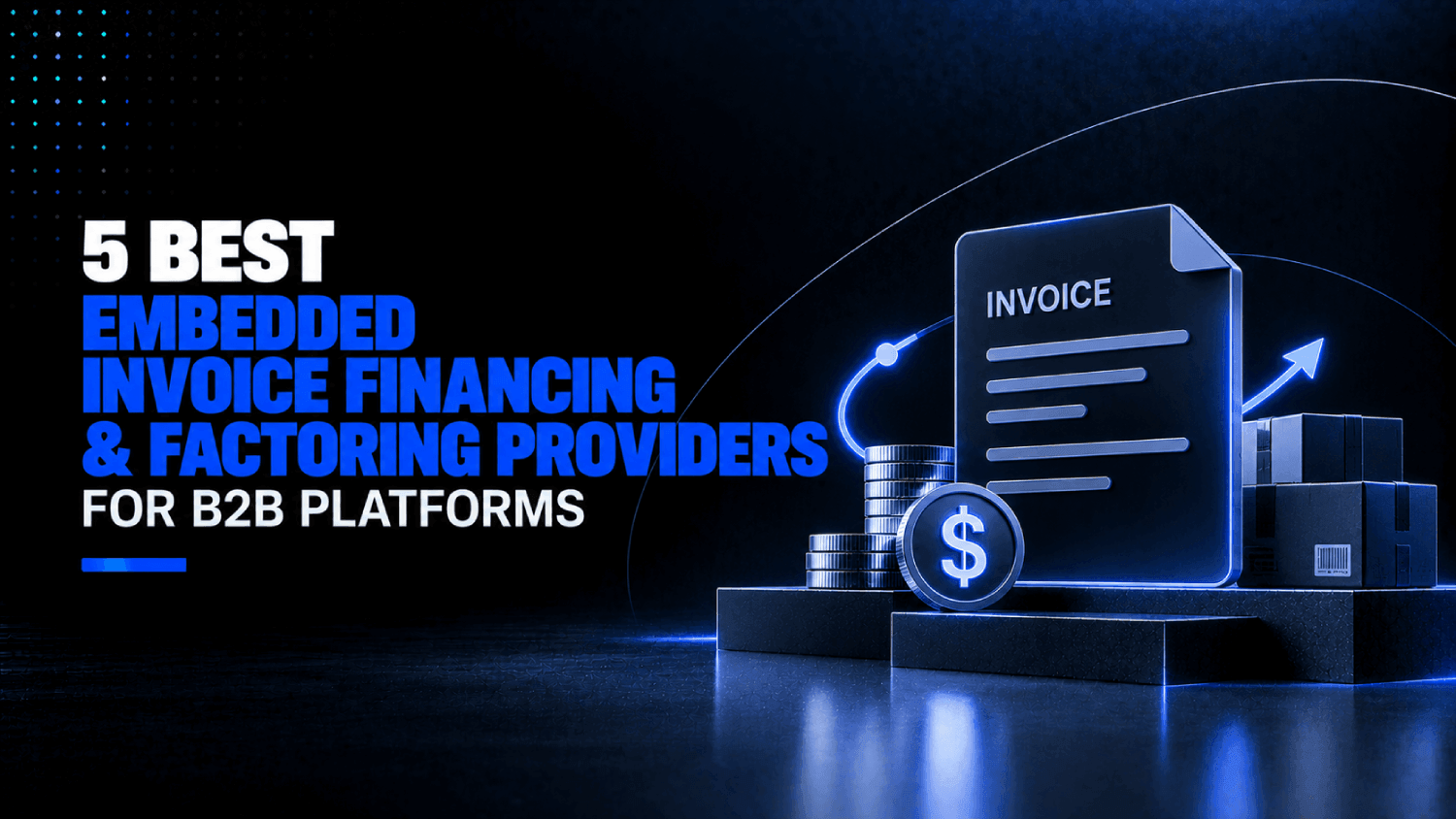
The best embedded invoice financing providers for B2B platforms are Kanmon, Resolve, Stenn, Crowdz, and CapChase. Each exposes an API or white-label product that lets a marketplace, vertical SaaS, or B2B platform offer invoice financing or factoring directly in their product. Kanmon fits platforms serving SMB suppliers; Resolve suits B2B merchants with net terms buyers; Stenn targets cross-border trade receivables; Crowdz offers a multi-funder marketplace model; CapChase specializes in SaaS and recurring-revenue AR.
Why Embedded Invoice Financing Is Not Just Another Working-Capital API
Most platforms evaluating fintech infrastructure treat factoring and invoice financing as a subcategory of working-capital APIs. They are not. The underlying asset is different, the credit model is different, and the legal structure is different.
Working-capital APIs like Parafin or Pipe advance against future revenue, typically using a revenue-share repayment structure tied to card processing volume or subscription MRR. Invoice financing and factoring advance against an already-earned receivable, a confirmed invoice with a known debtor. The collateral is an existing obligation, not a forecast.
That distinction changes the risk model entirely. The funder underwrites the debtor’s creditworthiness, not the supplier’s. A two-year-old supplier with a Fortune 500 customer can get funded where a mature supplier with weak-credit debtors cannot. For platform operators evaluating which product fits their merchant base, this is the first question to answer: are your users owed money by creditworthy buyers? If yes, embedded factoring likely delivers better approval rates and lower rates than revenue-based alternatives. If your users have mixed or unknown debtor quality, a working-capital API is a faster path. Our breakdown of embedded working-capital API providers for B2B platforms covers the revenue-advance side of this decision.
Factoring vs. Invoice Financing: What the Legal Difference Means for Your Platform
These two terms are often used interchangeably in vendor marketing. They are not the same product.
Invoice factoring is a sale of the receivable. The supplier assigns the invoice to the funder, who then owns the right to collect from the buyer. A UCC-1 financing statement is typically filed. The supplier’s balance sheet shrinks by the receivable amount and gains cash. Recourse vs. non-recourse factoring determines whether the supplier is on the hook if the buyer defaults.
Invoice financing (also called accounts receivable financing or AR financing) is a loan secured by the receivable. The supplier retains ownership of the invoice and collects from the buyer. The advance is repaid when the buyer pays. The receivable stays on the supplier’s balance sheet as collateral, not as proceeds.
For platform operators, the distinction affects two things. First, your borrowers’ accountants and CFOs will ask. A SaaS company using your embedded product to accelerate collection on net-60 invoices may prefer financing over factoring to avoid off-balance-sheet treatment. Second, compliance and licensing requirements differ by state. Factoring, as a purchase of receivables, generally does not trigger lending license requirements. AR financing, as a loan, may. Any platform embedding either product should work through this with counsel before launch. The Fintech Product and Compliance Readiness Checklist covers the licensing questions worth asking early.
How to Evaluate an Embedded Invoice Financing Provider: The FintechSpecs Receivables Stack Test
Generic vendor-evaluation checklists ask about uptime and support. For factoring-as-a-service, those questions come last. The four dimensions that actually determine whether a provider fits your platform are funding depth, debtor coverage, integration model, and economics pass-through.
Funding Depth
How much capital can the provider deploy per invoice, per merchant, and in aggregate across your platform? A provider backed by a single credit facility may tighten advance rates or pause funding during market stress. Ask specifically whether the facility is revolving, the size of the committed facility, and whether concentration limits cap any single debtor or platform partner.
Debtor Coverage
Factoring rates and approval depend heavily on whether merchants’ buyers are in the provider’s approved debtor list, or on how quickly the provider will underwrite new debtors. Some providers maintain pre-approved debtor networks (common in cross-border factoring). Others underwrite each debtor manually, which can add days to first funding. For marketplaces with diverse buyer bases, underwriting speed matters more than the headline advance rate.
Integration Model
Providers offer three distinct integration structures. A referral model sends your merchants to the provider’s own portal. A co-branded model embeds the provider’s UX under your domain. A white-label API model gives your engineering team full control over the user experience, with the provider running credit and compliance in the background. White-label gives the best user experience and the most economics, but it also requires the most integration work and may trigger licensing questions depending on how the product is presented.
Economics Pass-Through
Platforms make money on embedded financing through revenue share, margin on rates, or a platform fee charged to merchants. The structure matters. A provider offering 100 basis points of revenue share on a 2% factor rate is very different from one that lets you set your own rate above a floor and keep the spread. Know which model you are signing before you compare providers.
Which Providers Actually Offer an Invoice Factoring API or White-Label Product?
| Provider | Product Type | Best Fit | Integration Model | Geographic Focus | Public Pricing |
|---|---|---|---|---|---|
| Kanmon | Embedded lending platform (invoice financing + LOC) | B2B SaaS and marketplace platforms, SMB suppliers | White-label API | US | Not publicly disclosed |
| Resolve | Embedded net terms and AR financing | B2B merchants offering net terms to buyers | API + white-label | US | Not publicly disclosed |
| Stenn | Cross-border invoice financing and factoring | Platforms with international trade receivables | API + direct | Global, US focus | Not publicly disclosed |
| Crowdz | Receivables marketplace (multi-funder auction) | Platforms wanting competitive funder access | API + marketplace | US, UK, EU | Not publicly disclosed |
| CapChase | Revenue and AR financing for SaaS | SaaS platforms with recurring-revenue AR | API + direct | US, EU | Not publicly disclosed |
As of this writing, none of the five providers above publish standard pricing on their public homepages. All require a demo or partnership conversation before terms are discussed, which is standard for B2B embedded finance infrastructure where pricing depends heavily on portfolio characteristics.
Kanmon: The Embedded Lending Layer Built for Platform Operators
Kanmon is the provider most commonly referenced when B2B platform teams search for a white-label invoice financing API. The product is built specifically for platforms that want to offer financing under their own brand, not as a referral to a third-party lender.
Kanmon’s model covers multiple credit products through a single integration, including invoice financing, lines of credit, and term loans. For platform operators, this matters because merchants rarely need just one product. A supplier might use invoice financing for seasonal cash flow and a line of credit for equipment. Kanmon lets you offer both without integrating a second provider.
The underwriting model focuses on the supplier and the debtor in combination. A strong debtor can pull through a thinner supplier profile. The platform receives revenue share on originations, and Kanmon handles compliance, servicing, and collections. The trade-off is that you do not control the credit policy. If Kanmon tightens underwriting, your merchants see it as your product rejecting them.
Resolve: Net Terms Financing Embedded at the Checkout or Invoice Level
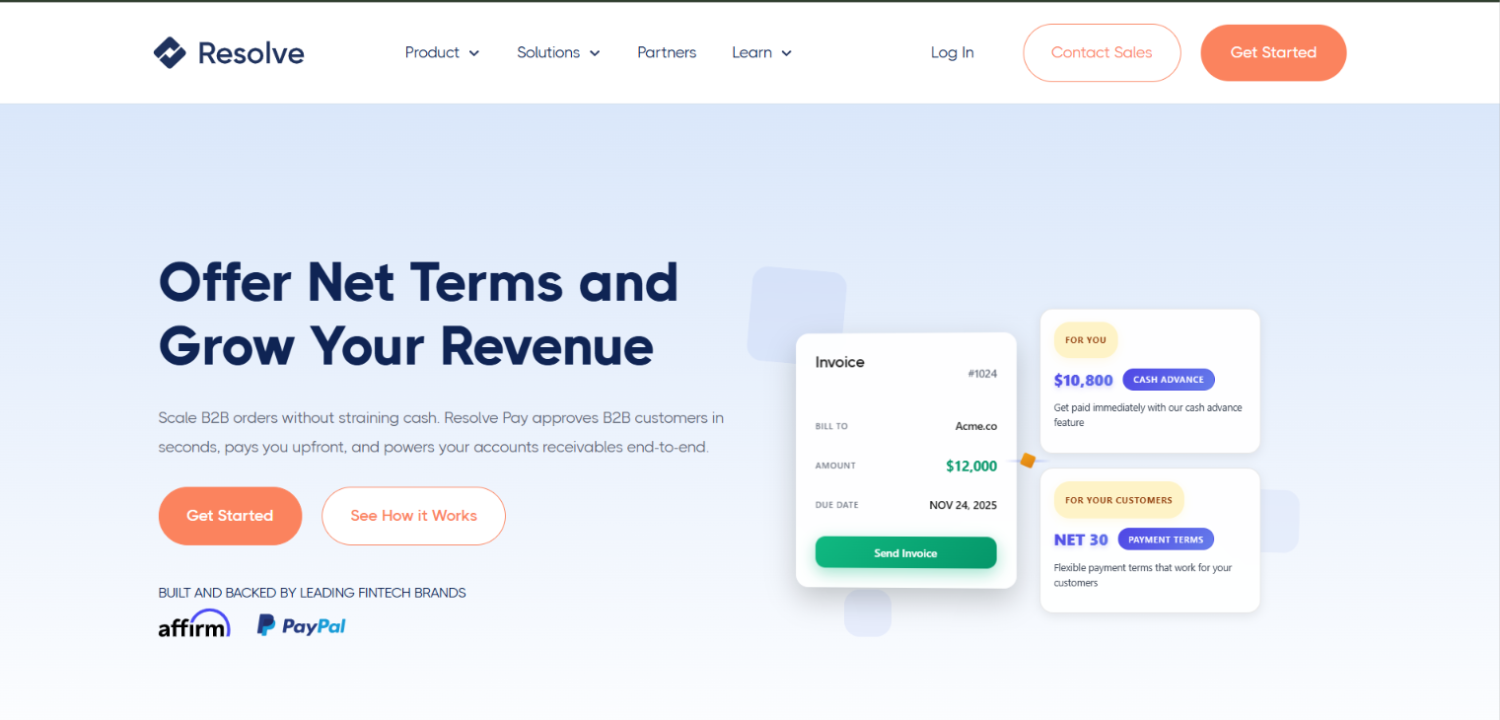
Resolve takes a different angle. Instead of positioning as a pure factoring provider, Resolve embeds net terms at the point of sale or invoice. A B2B merchant using Resolve can offer net-30, net-60, or net-90 payment terms to their buyers while getting paid immediately. Resolve takes the credit risk on the buyer.
For platforms running B2B marketplaces or procurement tools, this is closer to B2B buy-now-pay-later than traditional factoring, but the economic mechanism is the same: the supplier gets cash, and the receivable is effectively purchased by Resolve. The distinction for buyers is that they see extended payment terms, not a financing product.
The integration model supports both API and white-label deployments. Resolve’s buyer credit decisioning is automated, which means approval speed is measured in seconds for known buyers and hours for new ones. The coverage limitation is that Resolve focuses on US buyers. Platforms with significant international buyer bases will find coverage gaps.
Stenn: Cross-Border Trade Receivables at Platform Scale
Stenn is the clearest choice when your platform connects suppliers to international buyers. Most domestic factoring providers will not advance against invoices owed by foreign debtors. Stenn’s model is built specifically for cross-border trade finance, with experience in markets across North America, Europe, and Asia.
The product covers invoice financing against confirmed purchase orders or invoices. Stenn underwrites the importer (buyer), not the exporter (supplier), which means a small US supplier selling to a large European retailer can access financing that no domestic bank would offer them. For platforms in manufacturing, wholesale distribution, or import-export coordination, this fills a gap that generic working-capital APIs cannot.
Stenn does have an API, though the integration depth for embedded deployments is less developed than Kanmon’s platform-first model. Platforms considering Stenn for embedded use should ask specifically about white-label availability and whether co-branded flows are supported, as the primary product has historically been direct-to-supplier.
Crowdz: Multi-Funder Receivables Marketplace for Competitive Pricing
Crowdz runs a receivables marketplace where suppliers upload invoices and multiple institutional funders bid on them. The supplier receives competitive offers and selects the best rate. For platform operators, the model has one obvious benefit: merchants get better rates through competition, which means better product-market fit.
The trade-off is complexity. A marketplace model means your merchants are interacting with multiple funders, approval is not guaranteed, and the experience is less predictable than a single-funder model. If a merchant submits an invoice and receives no bids, they get nothing. For platforms where consistency of outcome matters more than optimizing rate, Crowdz is a harder sell.
Crowdz has operated in the US, UK, and EU, making it one of the few options for platforms with multi-geography merchant bases seeking a single AR financing integration. The API allows programmatic invoice submission, which makes embedded integration technically feasible, though the UX complexity of presenting auction outcomes inside your product requires meaningful design work.
CapChase: Invoice Financing for SaaS and Recurring-Revenue AR
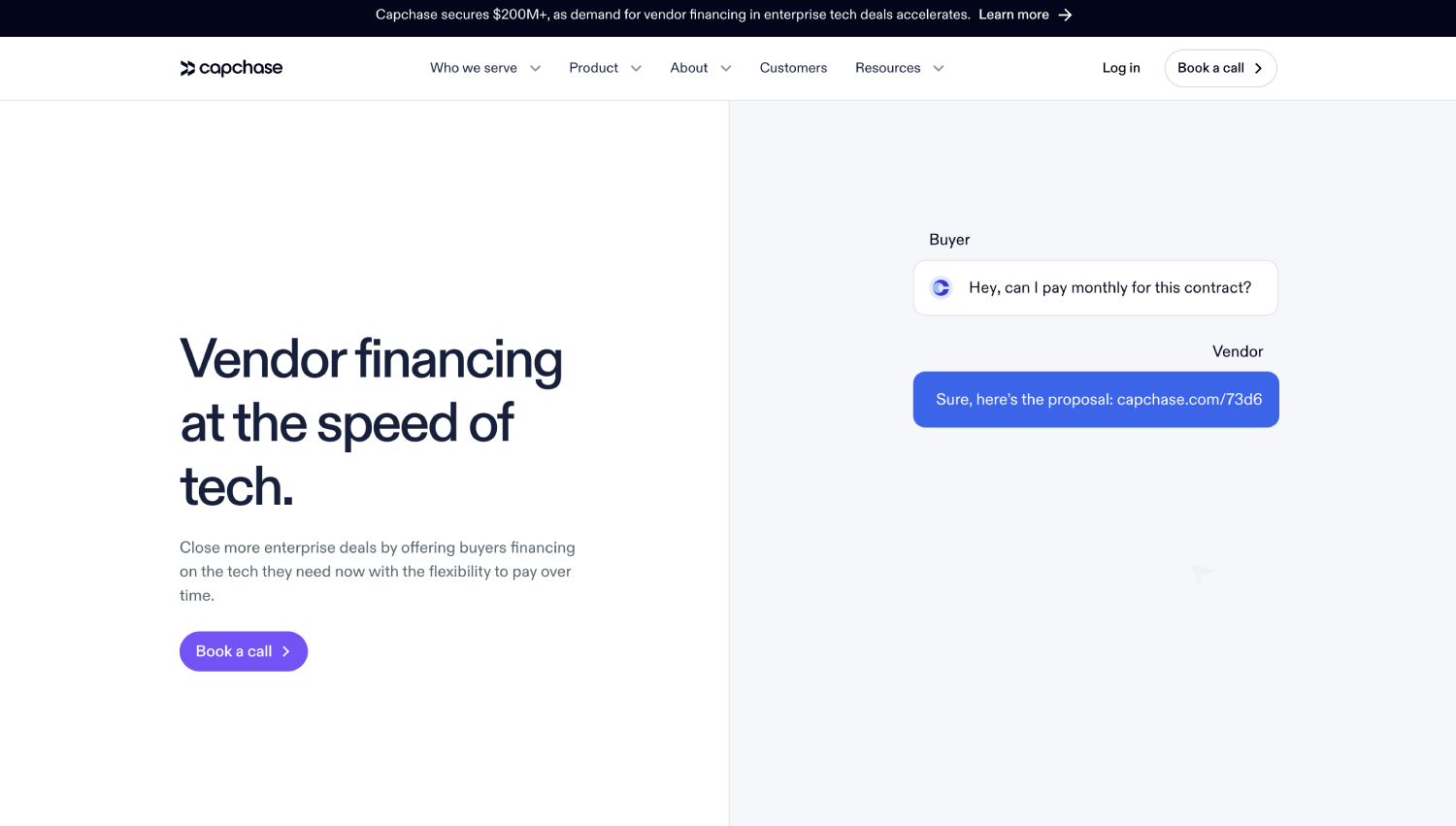
CapChase built its original product around advancing against SaaS ARR, but the product has expanded into invoice financing for B2B companies with recurring revenue profiles. The fit is narrow but deep. If your platform serves SaaS companies or subscription businesses that issue annual invoices to corporate buyers, CapChase’s underwriting is calibrated for that exact AR profile.
A SaaS company with a $500K annual contract paid in net-60 installments is a strong CapChase candidate. The funder understands contracted revenue, logo retention, and churn risk in ways that traditional factoring underwriters do not. For platforms in the vertical SaaS infrastructure space, this specialization translates to higher approval rates and better advance rates on the specific AR your merchants generate.
CapChase is less suited for platforms with transaction-heavy or project-based invoicing. One-time services, construction draws, or manufacturing invoices with variable payment behavior are outside the core model.
What Does an Embedded Invoice Financing Integration Actually Look Like?
Consider a B2B procurement marketplace. Suppliers list inventory, buyers place purchase orders, and invoices are generated inside the platform after fulfillment. The platform embeds an invoice financing product so that a supplier can click “get paid now” on any open invoice and receive 85% to 90% of the invoice value within 24 hours, with the remaining amount (minus fees) delivered when the buyer pays.
In this model, the platform handles the UX entirely. The factoring provider runs credit checks on the buyer in the background, funds the advance to the supplier’s connected bank account, and monitors the buyer’s payment. The platform earns a revenue share on the fee charged to the supplier. From the supplier’s perspective, the platform is the lender.
The engineering footprint for this integration typically involves four API calls: invoice submission, buyer credit check, advance confirmation, and payment status webhook. Most providers add a webhook for repayment events and a reporting endpoint for the platform’s finance team. The invoicing API layer that generates the invoice in the first place is a separate integration, but most embedded factoring providers accept invoice data via JSON, so the connection is straightforward.
What Pricing Looks Like Without Published Rates
None of the five providers above publish standard pricing on their public homepages. This is intentional. Factor rates, advance rates, and platform revenue share all vary based on portfolio quality, average invoice size, buyer concentration, and volume commitments.
What platforms can expect in a negotiation: factor rates (the fee charged to the supplier) typically run from 1% to 5% of invoice value depending on buyer credit quality, invoice tenor, and industry, based on ranges discussed in provider conversations, as none of these figures are published publicly. Advance rates typically run from 80% to 95% of invoice face value, again reflecting provider-reported ranges rather than publicly listed terms. Platform revenue share is typically a portion of the factor rate, often expressed as a basis-point spread or percentage of the fee collected.
The economics only work if your platform has sufficient volume to justify the integration cost. A platform advancing $500K per month in invoices will have different negotiating position than one advancing $5M per month. The conversation with providers starts differently at those two numbers. For a deeper look at how fintech infrastructure pricing actually works in practice, the hidden costs that affect fintech SaaS margins are worth reviewing before you model the embedded financing revenue line.
Frequently Asked Questions
What is the difference between embedded invoice financing and invoice factoring as a service?
Embedded invoice financing refers to the delivery model: financing built into a platform’s product rather than offered as a standalone service. Invoice factoring as a service (sometimes called factoring-as-a-service) refers to the underlying product structure, where receivables are purchased by a funder. A platform can embed factoring-as-a-service, making them the same thing in practice. The distinction matters when comparing providers: some offer financing (a loan against AR) while others offer true factoring (a purchase of AR). The legal, accounting, and licensing implications differ for your merchants.
Do you need a lending license to offer embedded invoice factoring on your platform?
Generally, no, if the product is structured as a true factoring arrangement, where the receivable is purchased rather than used as collateral for a loan. Factoring is a commercial transaction, not a loan, and typically falls outside state lending license requirements. That said, if your platform earns fees in a way that resembles interest, or if the product is structured as AR financing rather than factoring, licensing requirements may apply. This is a jurisdiction-specific legal question, not a blanket rule, and every platform should get legal review before launch. The compliance blind spots common at early-stage fintech companies include exactly this kind of product-structure licensing gap.
What advance rate should platforms expect from embedded invoice financing providers?
Advance rates for B2B invoice financing typically run between 80% and 95% of invoice face value. The rate depends primarily on debtor credit quality and invoice tenor. A 45-day invoice owed by a creditworthy Fortune 1000 buyer will attract a higher advance rate than a 90-day invoice from a smaller private buyer. Platforms should ask providers for their typical advance rate range by debtor tier, not just the headline number, since the average rate across a mixed portfolio will be lower than the best-case scenario in a sales deck.
How does embedded factoring affect a merchant’s relationship with their buyer?
In a recourse factoring arrangement, the supplier retains responsibility if the buyer does not pay. In a non-recourse arrangement, the funder absorbs the default risk. For the buyer relationship, the key variable is notification. Some factoring arrangements require the buyer to be notified that payment should be remitted to the funder (known as notification factoring). Others do not (non-notification). Notification factoring can create awkward dynamics between your merchant and their buyer. Platforms should confirm whether the provider’s default structure is notification or non-notification, and allow merchants to choose if the provider supports both.
Can a B2B marketplace embed invoice financing for both domestic and international invoices?
Domestic-only coverage is the default for most providers. Kanmon, Resolve, and CapChase focus on US-domiciled buyers. Crowdz covers the US, UK, and EU. Stenn is the strongest option for cross-border trade receivables, particularly involving buyers in Europe and Asia. If your platform has significant international buyer concentration, cross-border coverage needs to be a first-order evaluation criterion, not an afterthought. Platforms with mixed domestic and international volume often end up running two integrations: one domestic factoring provider and one cross-border provider like Stenn.
What is the typical time from invoice submission to funding in an embedded factoring product?
For pre-approved or previously funded debtors, same-day or next-day funding is common. For new debtors requiring underwriting, the process can take two to five business days. The fastest funding scenarios occur on platforms that pre-integrate buyer credit data, allowing the funder to decision invoices in near-real time. Platforms should ask each provider what percentage of their current portfolio funds in under 24 hours, which gives a more honest picture than the headline “same-day funding” claim in marketing materials.
How does embedded invoice financing compare to B2B BNPL for platform operators?
The buyer pays later in both models, but the flow of money differs. In embedded invoice financing, the supplier gets cash early, and the funder waits for the buyer to pay on their normal terms. In B2B BNPL, the buyer explicitly opts into extended terms at checkout, often with a fee or interest charged to the buyer. For platforms where the friction point is on the supplier side (waiting 60 days to get paid), invoice financing is the right product. For platforms where the friction point is on the buyer side (inability to pay on delivery), B2B BNPL is the right product. Some platforms need both.
Embedded Factoring Is a Product Category Decision, Not an API Decision
Platforms that treat embedded invoice financing as an API selection problem get stuck. The real decision is whether this product fits your merchant’s actual cash flow pain, and whether your platform’s buyer network has the credit quality to make the economics work. A procurement marketplace with Fortune 500 buyers and SMB suppliers is an ideal fit. A services marketplace with small business buyers on both sides will see low approval rates and thin economics regardless of which provider they integrate.
Once the fit is established, the provider choice comes down to two things: geography and integration depth. For US-only platforms serving SMB suppliers, Kanmon is the most platform-native option. For cross-border trade, Stenn covers ground that domestic providers cannot. For platforms where merchant rate optimization matters more than consistency, Crowdz’s marketplace model is worth the UX complexity. For SaaS-adjacent platforms, CapChase’s underwriting logic is built for recurring-revenue AR in a way that generic factoring providers are not.
The embedded finance category rewards specificity. A platform that goes to market with “instant pay on any invoice” for a well-defined merchant segment with creditworthy buyers will outperform one that embeds a generic working-capital product and calls it invoice financing. The provider you pick is less important than the merchant segment you pick first.