
- Embedded finance APIs and embedded lending APIs are not the same category. Most embedded finance platforms cover payments, banking, and cards but treat lending as an afterthought or exclude it entirely.
- Vertical SaaS platforms need lending APIs that handle origination logic, underwriting data connections, compliance infrastructure, and capital sourcing, not just a generic credit widget.
- The vendors that matter for B2B vertical SaaS are Kanmon, Parafin, Pipe, Capchase, Liberis, Lendflow, and a few others with genuine API-first architectures and pre-built underwriting rails.
- Choosing the wrong provider locks you into either a capital partner’s credit box or a compliance structure your business cannot sustain. Evaluate those two dimensions before anything else.
- The FintechSpecs Lending API Fitness Test, defined below, gives you a four-part framework for shortlisting providers without wasting six weeks on the wrong sales cycles.
Vertical SaaS platforms looking to add lending should shortlist API providers built specifically for embedded lending, including Kanmon, Parafin, Pipe, Liberis, Lendflow, and Capchase. Each connects your platform to capital partners, underwriting data sources, and compliance infrastructure through a developer API. The right choice depends on whether your borrowers are businesses or consumers, whether you want to take balance-sheet risk or act as a distributor, and how much compliance overhead your team can absorb.
Why General Embedded Finance APIs Do Not Cover Lending
A vertical SaaS founder building on an embedded finance platform reasonably assumes they can bolt on lending the same way they bolt on a bank account or a debit card. That assumption is wrong, and it costs teams months.
Embedded banking APIs give you ledger accounts, ACH rails, and card issuing. None of those touch the core mechanics of a loan: origination decisioning, credit bureau pulls, state lending license compliance, capital sourcing, and loan servicing. Stripe, Unit, and Synctera all do embedded banking well. None of them give you a working embedded lending product out of the box.
The regulatory gap alone separates these categories. Issuing a debit card ties you to card network rules. Originating a loan ties you to state lending licenses, the Truth in Lending Act, Regulation Z, fair lending rules, and, for small business borrowers, a separate set of commercial lending frameworks. You either need a licensed lending partner to sit between you and the borrower, or you need to obtain licenses yourself. That is why dedicated embedded lending APIs exist as a distinct category. For a fuller map of the infrastructure layers these APIs sit within, see The Fintech Infrastructure Stack in 2026.
What Is the FintechSpecs Lending API Fitness Test?
Before shortlisting any vendor, run every candidate through four checks. This framework, which FintechSpecs calls the Lending API Fitness Test, filters out providers that look suitable in a demo but break down during implementation.
Check 1: Capital Structure Match
Does the provider bring its own capital, connect you to a capital partner, or let you plug in your own lender? Some providers (Parafin, Liberis) act as the lender and take the credit risk themselves. Others (Lendflow, Kanmon) operate as infrastructure that connects your platform to a lender network. Your answer changes everything: a provider that is also the capital source sets the credit box, controls approval rates, and captures the yield. Infrastructure-only providers give you more control but require you to source or negotiate capital separately.
Check 2: Compliance Ownership
Who holds the lending license? If the API provider owns or partners with a licensed lender, your compliance surface shrinks considerably. If you are expected to obtain state licenses or manage your own bank partner, your legal costs and timeline jump. Ask every vendor directly: who is the licensed lender in this arrangement, and in which states?
Check 3: Underwriting Data Connectivity
A lending API that cannot connect to bank transaction data, accounting software, or credit bureaus forces you to build that plumbing yourself. The better providers give you pre-built connections to Plaid, Codat, business credit bureaus, or their own cash-flow analysis layer. That connectivity is the actual underwriting engine. An API without it is a checkout form.
Check 4: Platform Economics Transparency
How does the provider make money, and does that conflict with your borrowers’ interests? Revenue-share models where you earn a portion of the loan yield align incentives differently than flat API fees. Know the model before you sign, because it will shape how aggressively the provider approves or declines your customers.
Which APIs Add Lending to a Vertical SaaS Platform?
The following providers each have genuine API-first embedded lending products designed for software platforms. Pricing is not publicly disclosed by most of these vendors at a per-loan level. Where figures are not published, this article notes that directly.
| Provider | Capital Model | Borrower Type | Best For | Public Pricing |
|---|---|---|---|---|
| Kanmon | Lender network | SMB | Vertical SaaS wanting multi-lender optionality | Not publicly listed |
| Parafin | Balance sheet (Parafin lends) | SMB | Platforms with high GMV and dense transaction data | Not publicly listed |
| Pipe | Balance sheet / capital markets | SMB / SaaS companies | Platforms where users have recurring revenue | Not publicly listed |
| Liberis | Balance sheet (Liberis lends) | SMB | Payments platforms and marketplaces in US and UK | Not publicly listed |
| Lendflow | Infrastructure / lender marketplace | SMB | Platforms wanting a credit API with decisioning orchestration | Not publicly listed |
| Capchase | Balance sheet (Capchase lends) | SaaS companies (B2B) | SaaS platforms offering financing to their own SaaS customers | Not publicly listed |
| Stripe Capital | Balance sheet (Stripe lends) | SMB using Stripe | Platforms already processing payments on Stripe | Factor rate disclosed per offer |
Kanmon: Best Embedded Lending API for B2B SaaS Underwriting Flexibility
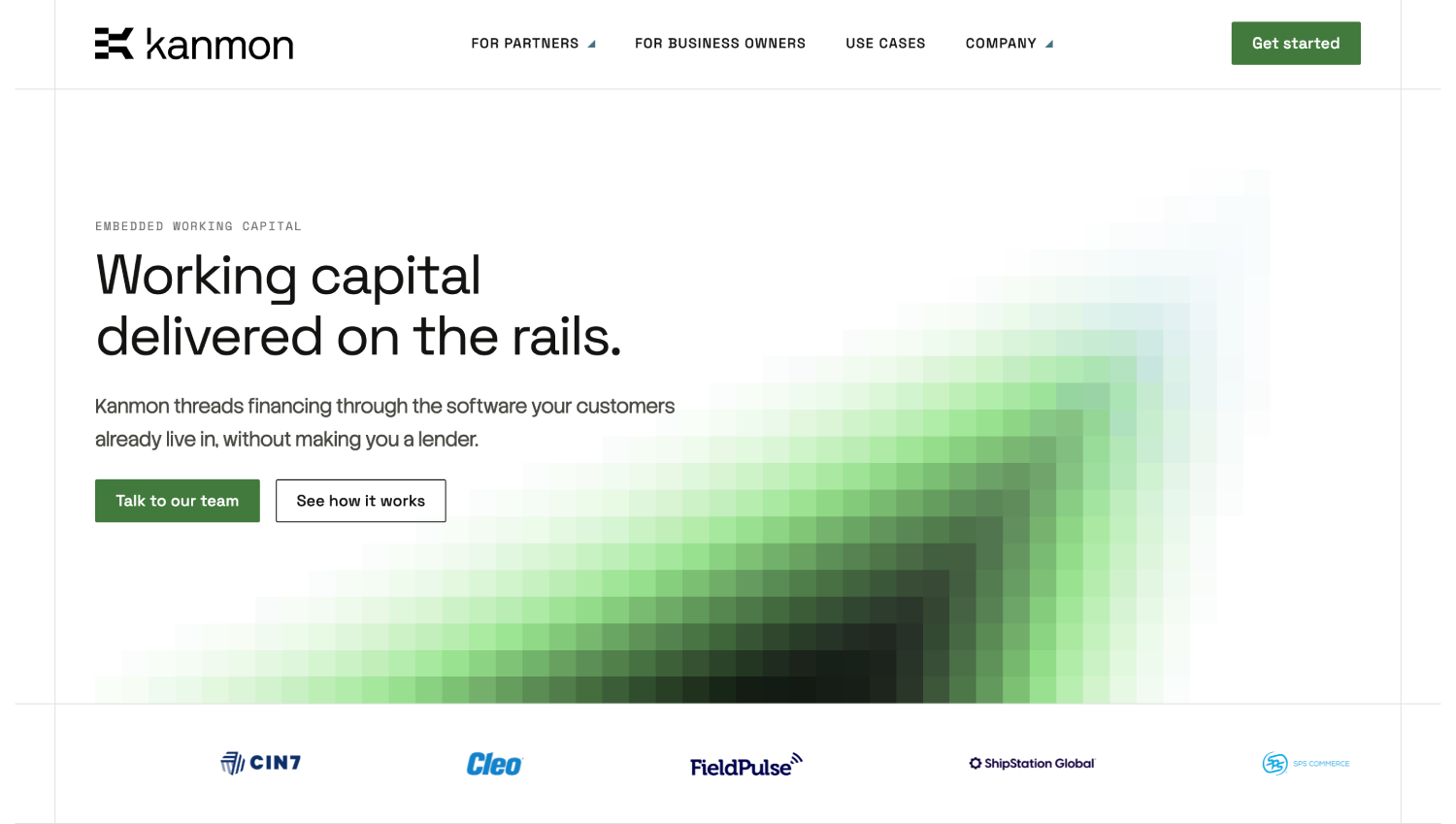
Kanmon is purpose-built for vertical SaaS platforms that want to offer business loans without becoming a lender themselves. The platform connects your SaaS product to a network of licensed lenders and handles the origination workflow, application UI, underwriting data aggregation, and lender matching through a single API integration.
The key differentiator is multi-lender routing. Rather than locking your borrowers into one capital source’s credit box, Kanmon routes applications across multiple lenders and surfaces the best offer. That matters for approval rates, especially for thin-file SMB borrowers. Kanmon covers term loans, lines of credit, and revenue-based financing products.
Kanmon does not publicly disclose its pricing or revenue-share model. Pricing is negotiated based on platform volume. For teams evaluating Kanmon alongside other embedded credit options, the Top 5 Embedded Credit APIs for B2B Platforms and Marketplaces comparison covers Kanmon’s positioning in more detail.
Parafin: Best for High-GMV Payments Platforms
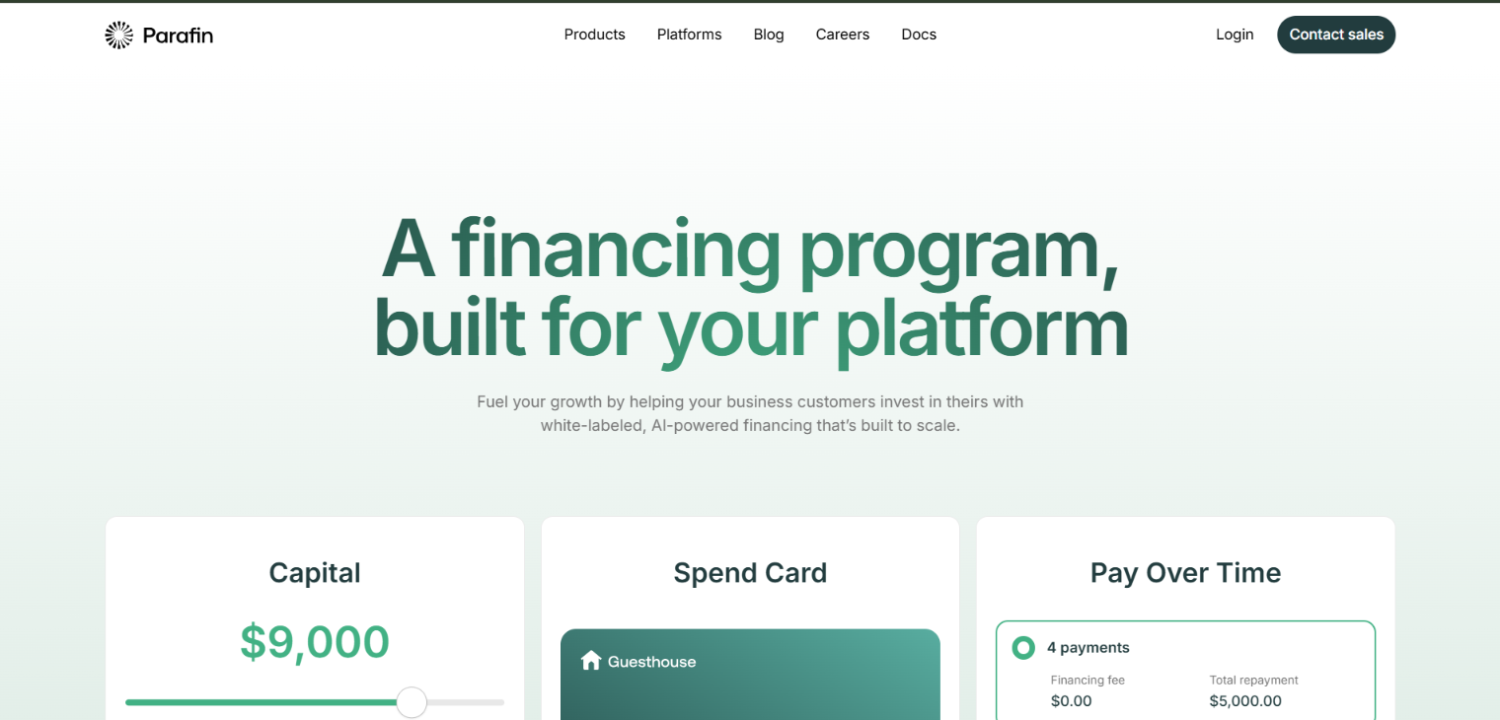
Parafin takes a fundamentally different approach. Parafin is the lender, not the infrastructure. When your platform integrates Parafin, Parafin uses the transaction data flowing through your platform to underwrite your merchants or users directly, then lends its own capital. Your platform earns a revenue share on funded loans.
This model is powerful for platforms with dense payment transaction data because Parafin’s underwriting is built around cash-flow signals, not traditional credit bureau pulls. A restaurant management SaaS, a field service platform, or a marketplace with years of GMV data gives Parafin exactly the signals it needs to approve borrowers that a bank would decline.
The downside is control. Because Parafin is the lender and owns the credit decision, you cannot adjust the credit box, negotiate rates with alternative lenders, or surface competing offers. Parafin pricing is not publicly disclosed. The embedded working capital comparison at Best Embedded Working Capital APIs for B2B Platforms covers Parafin alongside Pipe and Kanmon with additional context on how each capital model affects platform economics.
Pipe: Best for Platforms Serving SaaS or Subscription Businesses

Pipe started as a revenue-based financing platform for SaaS companies and has since built an embedded product that lets platforms offer capital advances to their own customers. If your vertical SaaS serves businesses with recurring revenue, subscription contracts, or predictable ARR, Pipe’s underwriting model fits that borrower profile better than most.
Pipe underwrites against contracted future revenue rather than historical cash flow or credit scores. That opens up financing for early-stage companies with strong contracts but thin credit histories. For a vertical SaaS serving software companies, professional services firms with retainer contracts, or subscription-based businesses, that underwriting logic translates directly into higher approval rates for your customers.
Pipe’s embedded product requires a platform partnership agreement. Pricing and revenue-share terms are not publicly posted. Pipe has historically been US-focused but has expanded its geographic footprint.
Liberis: Best Embedded Lending API for Payments Platforms with International Reach

Liberis operates a revenue-based financing product embedded inside payments platforms and marketplaces. Like Parafin, Liberis is the lender and uses transaction data from your platform as the primary underwriting input. Unlike Parafin, Liberis has a significant footprint in the UK and Europe in addition to the US, which matters for platforms serving merchants across multiple geographies.
Liberis structures its products as revenue-based finance, meaning repayment is tied to a percentage of future card sales rather than fixed monthly payments. That structure reduces borrower default risk for volatile businesses like retailers and restaurants. From a platform integration standpoint, Liberis provides white-labeled application flows and a revenue-share model for the embedding platform.
Liberis does not publish its per-advance pricing publicly. Gross yields on revenue-based finance products are typically embedded in a factor rate disclosed at the time of the offer to the borrower.
Lendflow: Best API-Driven B2B Lending Infrastructure for Custom Credit Products
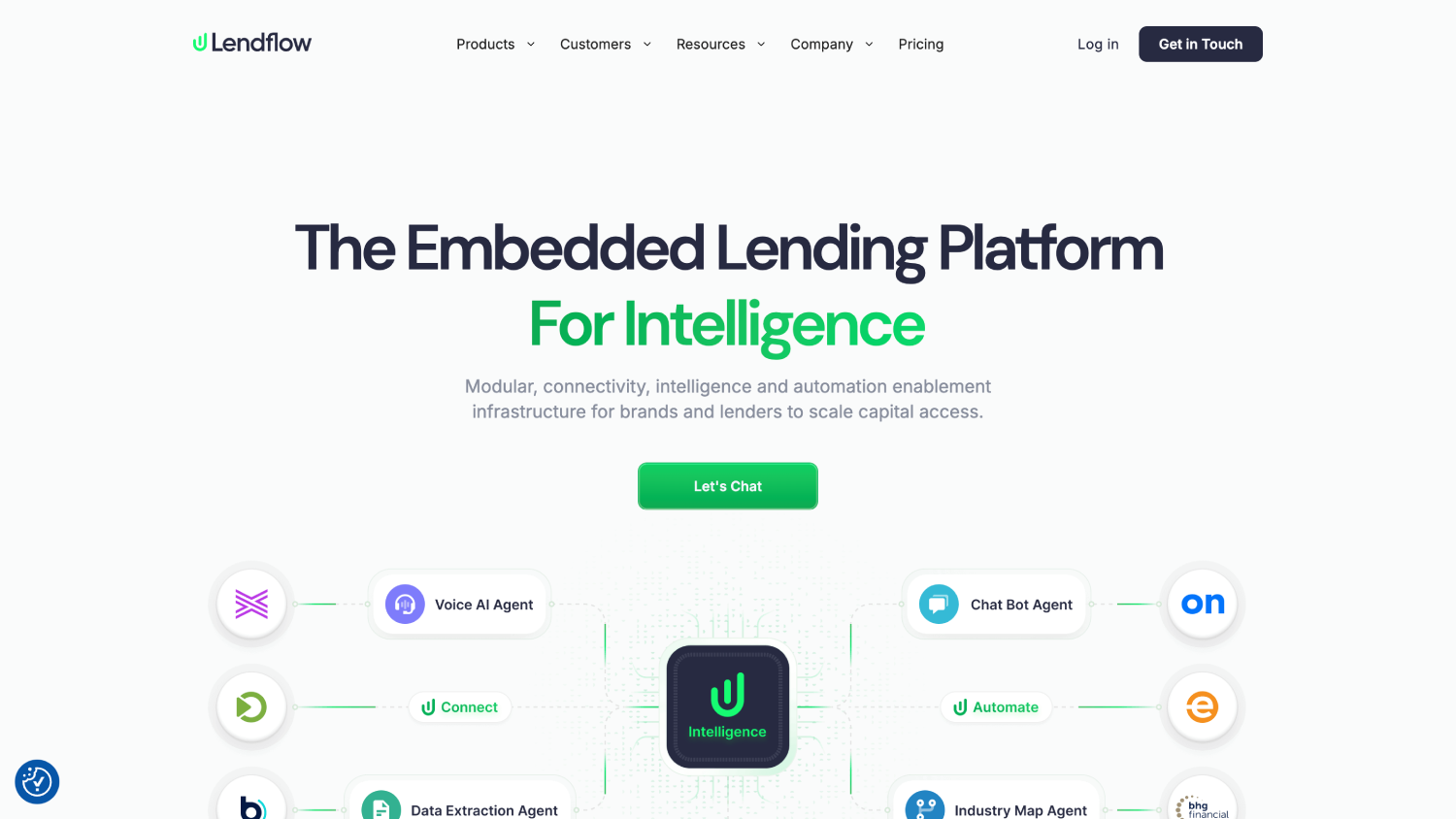
Lendflow is the most infrastructure-oriented provider on this list. Rather than acting as a lender, Lendflow gives platforms a credit orchestration API: pre-built connections to credit bureaus, bank data aggregators, fraud tools, and a network of lenders, with a rules engine on top that lets platforms configure their own decisioning logic.
That flexibility is genuinely useful for vertical SaaS teams that have domain-specific underwriting signals their platform already collects. A legal practice management SaaS knows that a law firm billing $40,000 per month through the platform is creditworthy even if the firm’s Experian score is thin. Lendflow lets you feed those platform-native signals into the credit decision alongside bureau data.
Lendflow’s pricing is not publicly listed and varies by integration depth and volume. The tradeoff for flexibility is complexity. Lendflow requires more engineering investment than plug-and-play providers like Parafin. Teams evaluating Lendflow should also look at their data enrichment requirements, since the quality of underwriting outputs depends heavily on data inputs. The Best Data Enrichment APIs for Fintech Underwriting and Risk Teams covers the data layer that sits underneath platforms like Lendflow.
Capchase: Best for SaaS Platforms Offering Financing to Software Customers
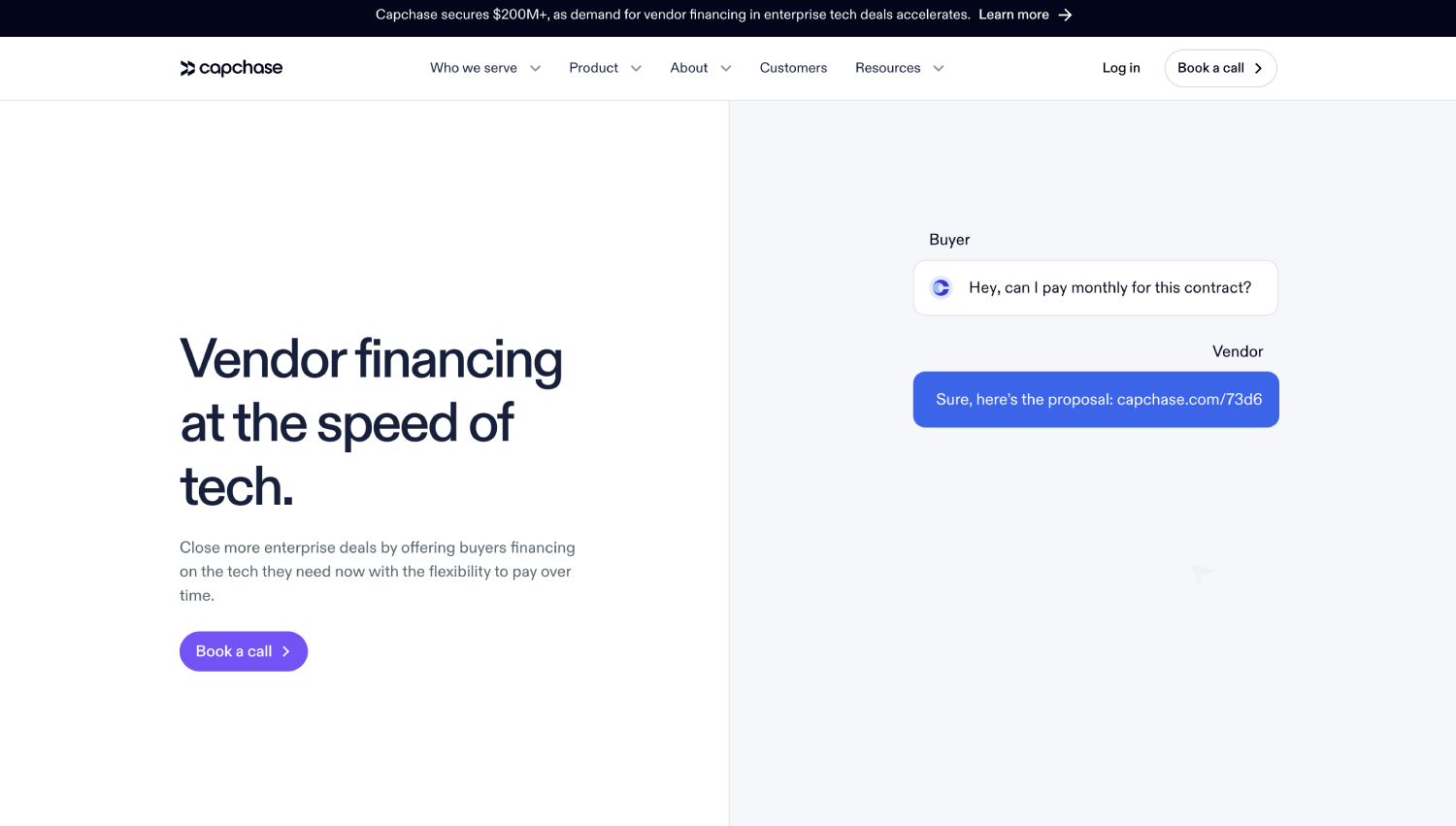
Capchase occupies a narrow but important niche. It finances SaaS companies directly and offers an embedded product that lets SaaS platforms extend that financing to their own customers. If you sell software to other software businesses and want to offer those customers a way to pay annually upfront (while you collect a lump sum immediately), Capchase’s embedded product handles both the financing and the annual-vs-monthly pricing arbitrage.
Capchase Pay, the embedded product, lets a SaaS vendor offer annual pricing with monthly payment terms to the buyer, while Capchase advances the full annual contract value to the vendor immediately. The underwriting is built around SaaS-specific metrics: ARR, churn, and subscription tenure. That specificity is the product’s strength and its limit. It does not generalize well to non-SaaS borrower profiles.
Capchase does not publish per-transaction pricing publicly. Rates are disclosed at the time of financing based on the borrower’s profile.
Stripe Capital: Best for Platforms Already Running on Stripe Payments
Stripe Capital is the most constrained option on this list and also the fastest to integrate for platforms already on Stripe. Stripe underwrites merchant cash advances using payment processing data from your Stripe account, surfaces pre-approved offers to eligible merchants, and repays via an automatic percentage of daily Stripe processing volume.
The integration path is the shortest of any provider here, often just a few API calls if your platform is already using Stripe Connect. The tradeoff is that Stripe’s credit decisions are entirely Stripe’s, the product is a merchant cash advance rather than a term loan or line of credit, and the model only works for borrowers with meaningful Stripe processing history.
Stripe discloses the factor rate on each capital offer rather than publishing a fixed rate. For platforms not running on Stripe, this option is not relevant. For platforms processing significant GMV through Stripe Connect, it is often the lowest-friction way to get a lending product in front of users quickly.
What Does It Actually Cost to Add Embedded Lending to a SaaS Platform?
None of the primary embedded lending API providers publish tiered pricing pages in the way that Stripe or Plaid do. The economics are negotiated based on platform volume, borrower profile, and desired product structure. That is not unusual for the category since lending involves capital deployment, not just software access fees.
The cost structure typically has three layers. First, there is the platform integration fee or setup cost, which may be zero for providers like Parafin and Stripe Capital that make money on loan yield rather than API access. Second, there is the revenue-share model: providers that act as lenders typically pay the platform a percentage of loan revenue as a referral or distribution fee. Third, there are compliance costs, which fall on the platform to the extent the provider does not fully own the licensed-lender relationship.
Consider a hypothetical: a vertical SaaS platform serving 500 home services businesses, each processing $20,000 per month through the platform. If 15 percent of those businesses take a working capital advance averaging $30,000, and the platform earns a 2 percent revenue share on loans originated, that is roughly $45,000 in lending revenue per cohort. The actual numbers will vary by provider, borrower approval rate, and negotiated share, but the model illustrates why lending is one of the highest-margin financial products a vertical SaaS can add. The embedded finance economics are explained further in The Hidden Economics of Banking-as-a-Service, which covers how the capital-versus-infrastructure distinction plays out in platform revenue models.
What Compliance Infrastructure Do These APIs Provide?
The compliance picture differs substantially by provider type. Providers that act as the lender (Parafin, Liberis, Capchase, Stripe Capital) handle state lending licenses, Truth in Lending Act disclosures, and loan servicing compliance themselves. The platform’s compliance obligation is primarily limited to marketing the product accurately and not engaging in discriminatory referral practices.
Infrastructure providers like Lendflow and Kanmon connect your platform to licensed lenders in their network, which similarly keeps the license off your books. The platform’s exposure increases when a lender in the network exits or when the product structure changes, since you may need to re-paper agreements.
Platforms that want full control over the loan product, including rate setting and credit policy, typically need to work with a sponsor bank directly and either obtain lending licenses or rely on the bank’s charter. That path is significantly more complex and is covered in detail in the Best Sponsor Bank Programs for Fintech Startups analysis. For most vertical SaaS teams, staying with a provider that owns the compliance infrastructure is the right call until lending volume justifies the overhead of a direct bank relationship.
Frequently Asked Questions
What is embedded lending for vertical SaaS?
Embedded lending for vertical SaaS is the practice of integrating a loan or credit product directly into a software platform’s user experience through an API. Rather than sending users to a bank or third-party lender, the platform surfaces pre-qualified financing offers, collects applications, and processes repayments inside its own product. The platform typically partners with a licensed lender or lending infrastructure provider rather than holding a lending license itself.
Which embedded lending API providers work with B2B SaaS platforms?
Kanmon, Parafin, Pipe, Liberis, Lendflow, Capchase, and Stripe Capital each offer API-based embedded lending products designed for software platforms. Kanmon and Lendflow are infrastructure-first, connecting platforms to lender networks. Parafin, Liberis, Capchase, and Stripe Capital act as the lender directly. The right choice depends on your borrower profile, the transaction data your platform collects, and how much control you want over the credit product.
Does a SaaS platform need a lending license to embed loans?
Generally no, if you are using a provider that acts as the licensed lender or that connects you to licensed lenders in its network. The licensed lender sits between the platform and the borrower and assumes the regulatory obligation. Platforms that want to set their own credit policies, rates, or loan structures directly may need their own licenses or a sponsor bank relationship, which is a significantly more involved path.
How do embedded lending API providers make money?
Providers that act as the lender earn interest income and fee income on the loans they originate. Platforms typically receive a revenue share on funded loan volume, ranging from a small percentage of the loan amount to a share of interest income, depending on the provider and the negotiated terms. Infrastructure-only providers like Lendflow charge platform fees or per-decisioning fees for API access to their credit orchestration and lender network.
What data do embedded lending APIs use to underwrite borrowers?
Most embedded lending APIs built for vertical SaaS rely on a combination of bank transaction data (via Plaid or similar), payment processing data from the platform itself, business credit bureau data, and accounting system data. Providers like Parafin and Liberis weight platform transaction data most heavily because they have direct access to it through the integration. Lendflow and Kanmon offer configurable data connections that let the platform incorporate its own domain-specific signals into the underwriting decision.
How long does it take to integrate an embedded lending API?
Integration timelines vary significantly. Stripe Capital is the fastest for platforms already on Stripe Connect, with some integrations completed in days. Providers like Parafin and Liberis that own the full lending flow typically have integration timelines of four to twelve weeks, including compliance review and UI implementation. Lendflow’s infrastructure model, which requires more configuration of decisioning logic and data connections, can take longer depending on how customized the credit product needs to be.
Can embedded lending APIs handle both consumer and business borrowers?
Most of the API providers listed here are designed for small business borrowers, not consumers. Consumer lending carries a different regulatory framework under TILA, state usury laws, and the CFPB’s jurisdiction. Platforms looking to offer personal loans or consumer credit products to individuals need providers specifically licensed and built for consumer lending. The providers listed in this article are best suited for B2B embedded lending use cases.
Conclusion
Embedded lending is not a feature you add to a vertical SaaS platform. It is a financial product with a capital source, a compliance structure, and an underwriting model, each of which you are inheriting from the API provider you choose. The shortlist for any serious evaluation should start with two questions: who is the licensed lender, and who controls the credit box? Providers that answer both questions clearly are the ones worth spending time on.
For most vertical SaaS teams at seed to Series B, starting with a balance-sheet lender like Parafin or Liberis (if you have GMV data) or Kanmon (if you want lender optionality) gets you to market faster than building a more custom stack. The Lending API Fitness Test, run before any demo, will save you from the most common trap in this category: choosing an API that demos beautifully but cannot actually approve your customers because the credit box does not fit your borrower profile.
The vendors in this space are evolving their products quickly, and the lines between infrastructure provider and capital source are blurring. Platforms that understand the economics and compliance ownership of their lending product, rather than treating it as a black-box API, will find it far easier to negotiate terms, adapt when a lender relationship changes, and eventually graduate to a direct bank program if volume justifies it. That progression is the real strategy. The API is just the starting point.