
TLDR
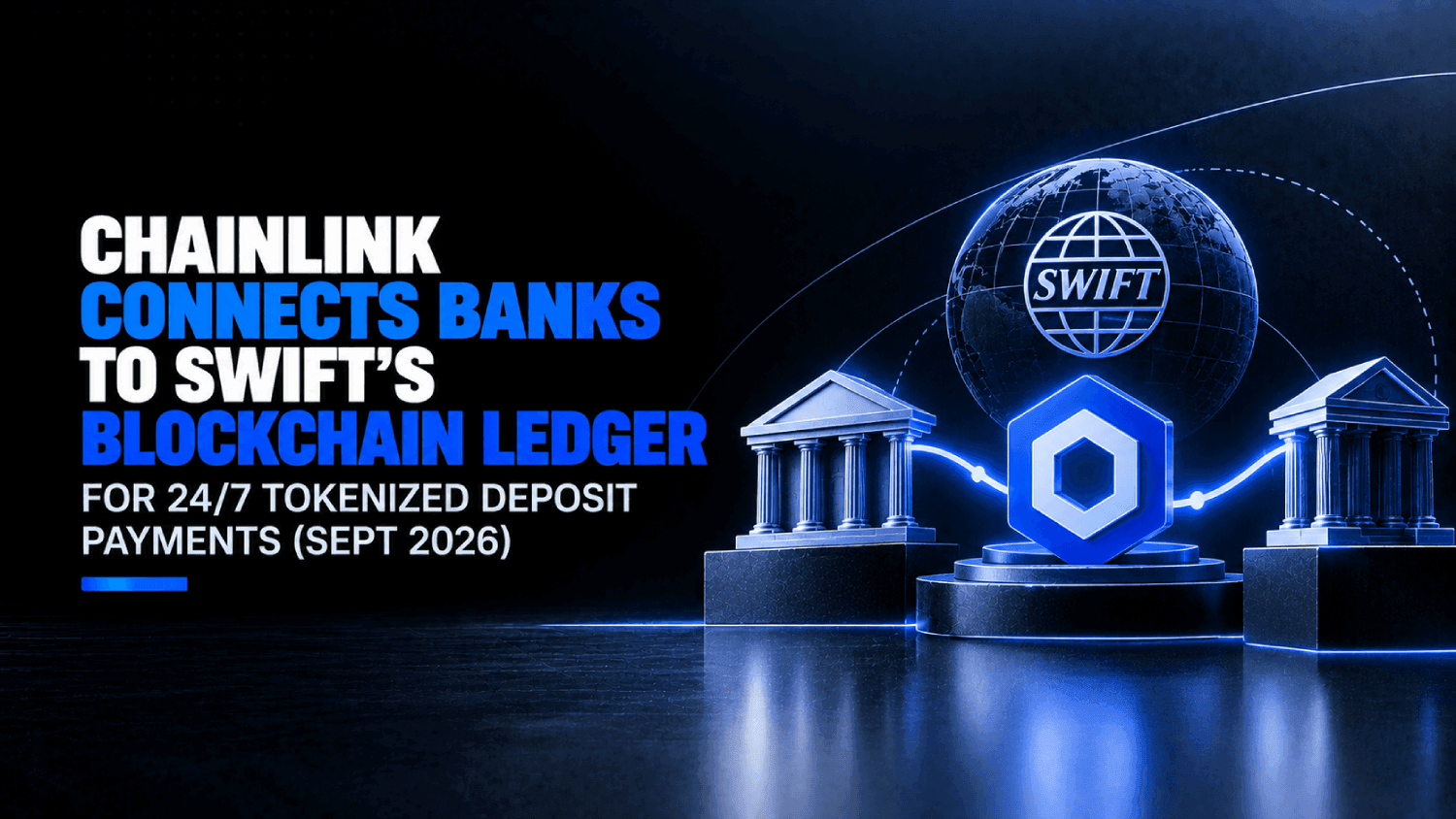
- On Sept. 28, 2026, Chainlink announced it is enabling financial institutions to connect their systems and key-signing infrastructure to Swift’s blockchain ledger through the Chainlink Runtime Environment (CRE).
- The job is connectivity and orchestration, not replacing Swift messaging or final settlement. Banks keep control of transaction keys via a self-signing model. CRE orchestrates workflows that link bank systems to Swift’s ledger for 24/7 tokenized-deposit payment flows, including overnight and weekends.
- Swift’s ledger is already in an initial-use phase with 17 banks across six continents preparing to pilot live tokenized-deposit transactions (ANZ, BNP Paribas, BNY, Citi, DBS, FAB, FirstRand, HSBC, Itaú, Lloyds, Mashreq, MUFG, OCBC, Standard Chartered, UBS, UOB, Wells Fargo). Tokenized deposits stay on bank-owned ledgers; Swift’s ledger coordinates movement before final settlement through existing mechanisms such as RTGS.
- This is a news explainer on bank tokenized-deposit rails and FI connectivity. Distinct from SoFi × Mastercard SoFiUSD card settlement, Visa × Reap stablecoin cards, Fed GENIUS stablecoin rulemaking, Citi × Coinbase merchant/BaaS stablecoin checkout, and agentic commerce principle releases.
Sept. 28, 2026 adds a concrete integration path for banks that want onto Swift’s shared ledger without ripping out security governance. Chainlink said it is working so institutions can access Swift’s ledger and manage smart-contract usage on both their own tokenized-deposit ledgers and the Swift ledger, with CRE at the center.
For FintechSpecs operators, the buyer question is cross-border always-on commercial bank money, not stablecoin card settlement or merchant checkout conversion. Ask who holds the deposit liability, who signs the transaction, who orchestrates the ledger hop, and what still settles in RTGS at the end.
What Chainlink announced on Sept. 28
Per the Chainlink press release:
- Financial institutions can connect systems and key-signing infrastructure to Swift’s blockchain ledger through the Chainlink platform.
- Banks can manage smart contracts on their own ledgers for tokenized deposits and on the Swift ledger.
- A self-signing model via CRE lets institutions retain control of the keys that authorize transactions, while CRE orchestrates workflows to Swift’s ledger.
- The stated outcome is adopting 24/7 tokenized payment workflows while preserving existing security governance, approval processes, and operating models.
Sergey Nazarov, CEO of Chainlink Labs, said the firm is “thrilled to be supporting the Swift ledger as more banks seek to join it and need a technology partner that can help them launch tokenized deposit capabilities and properly connect to the Swift ledger to gain the full benefit of its large network of users.”
Chainlink also notes Swift connects more than 11,500 financial institutions and corporates across more than 200 markets, and that Swift moved from concept (announced at Sibos 2025, designed with feedback from more than 40 institutions) to activation in about nine months.
What Swift’s ledger actually does (and does not do)
Swift’s ledger orchestrates 24/7 movement of bank-issued tokenized deposits. It does not replace Swift messaging, does not hold customer funds, and does not change final settlement rails.
From Swift’s ledger announcement:
- The ledger is a secure orchestration layer for bank-issued tokenized deposits that live on banks’ own ledgers.
- Participating banks can move funds for customers overnight and on weekends, then complete final settlement through existing systems.
- Swift frames this as extending trusted infrastructure into digital money without compromising compliance, credit, risk, and control standards already embedded in payment processing.
- Thierry Chilosi, Chief Business Officer at Swift, positioned the ledger as allowing tokenised value to move across borders “with the velocity and flexibility modern commerce expects, while maintaining the same high levels of resiliency, security, and compliance global finance requires,” and as a foundation for future areas such as programmable money and agentic commerce.
Chainlink’s Sept. 28 release restates the same architecture: deposits remain on bank balance sheets as commercial bank money; orchestration happens before final settlement; final settlement continues through agreed mechanisms such as real-time gross settlement systems.
Operator map: layers in the Chainlink × Swift stack
| Dimension | What moves in this news | What operators still own |
|---|---|---|
| Deposit liability | Bank-issued tokenized deposits on bank-owned ledgers | Balance-sheet, capital, and deposit-product policy |
| Orchestration ledger | Swift shared ledger coordinates interbank movement 24/7 | Participation criteria, use-case scope, and pilot ops |
| Connectivity / workflow | Chainlink CRE connects FI systems and key signing to Swift | Key custody, approval workflows, and change management |
| Final settlement | Still via existing mechanisms (e.g. RTGS), per both PRs | Nostro/vostro, liquidity desks, cutover runbooks |
| Client experience | Faster, always-on cross-border availability for treasury clients | Fee disclosure, status messaging, exception handling |
How this differs from SoFi×Mastercard, Citi×Coinbase, Visa×Reap, and GENIUS rulemaking
Recent FintechSpecs coverage is heavy on stablecoin settlement, checkout, cards, and policy. Keep tokenized bank deposits on Swift as a separate URL.
| Dimension | Chainlink × Swift ledger (Sept. 28 connectivity) | SoFi × Mastercard SoFiUSD | Citi × Coinbase Virtual Accounts / Spring | Visa × Reap / Fed GENIUS track |
|---|---|---|---|---|
| Primary asset | Bank-issued tokenized deposits (commercial bank money on bank ledgers) | Bank-issued stablecoin for card-program settlement | Stablecoins with fiat auto-conversion and bank-of-record settlement | Stablecoin-linked cards / federal payment-stablecoin perimeter |
| Primary job | FI connectivity to a shared bank ledger for 24/7 cross-border orchestration | Live card settlement in SoFiUSD | BaaS virtual accounts • merchant stablecoin checkout | Issuing programs / regulatory NPRs |
| Who is speaking | Chainlink (CRE) + Swift (ledger) + pilot banks | SoFi Bank + Mastercard | Citi Services + Coinbase Payments | Visa/Reap partners or federal agencies |
| Operator question | Can my bank or FI connect tokenized-deposit workflows to Swift without rewriting key governance? | Is my card program settling in a bank-issued stablecoin today? | Can merchants take stablecoins and still receive fiat from a bank? | Can I issue/settle stablecoin cards, or what rules constrain issuers? |
Also keep J.P. Morgan × Thunes Xpedite Remit as corridor payout contrast, not the same shared-ledger product. Keep best FedNow API providers (RTP included) for domestic instant-rail vendor shortlists; this Swift story is cross-border tokenized-deposit orchestration.
Adjacent US signal: TCH On-Chain Money Initiative × Quant
Operators mapping tokenized-deposit networks should also track the domestic US path. On Sept. 24, 2026, The Clearing House selected Quant to power its On-Chain Money Initiative, an interoperable network for clearing and settling tokenized deposit transactions with connectivity to RTP and CHIPS, expected availability to participating institutions in 1H 2027.
That is a separate product and timeline from Swift’s global ledger + Chainlink CRE connectivity. Do not merge them into one URL. Use TCH × Quant when the buyer question is US interbank tokenized deposits onto RTP/CHIPS; use this post when the question is connecting FIs to Swift’s shared ledger for cross-border tokenized-deposit orchestration.
Pilot bank roster and what “ready for use” means
Swift lists these institutions preparing to pilot initial live transactions:
- ANZ, BNP Paribas, BNY, Citi, DBS
- First Abu Dhabi Bank (FAB), FirstRand Bank Limited, HSBC, Itaú Unibanco, Lloyds Bank
- Mashreq, MUFG Bank, OCBC, Standard Chartered, UBS, UOB, Wells Fargo
Bank quotes in the Swift release emphasize liquidity efficiency, always-on client experience, and interoperability with existing rails, not a greenfield replacement of correspondent banking overnight. HSBC, for example, frames connecting its Tokenised Deposit Service to Swift’s ledger as progress toward payments that work the way clients’ businesses operate: real time, across time zones, without artificial cut-offs.
Treat “ready for use” and “preparing to pilot” as controlled go-live language. Diligence which corridors, which deposit products, and which client segments each bank actually opens first.
Risk, controls, and diligence questions
Tokenized-deposit programs fail on liability clarity, key governance, and settlement fallback, not on whether a connectivity vendor is named in a press release.
What Chainlink and Swift put on the table
- CRE-based connection from FI systems and key signing to Swift’s ledger
- Self-signing so institutions retain authorization keys
- Orchestration of 24/7 tokenized-deposit flows before final settlement
- Explicit preservation of existing security governance and operating models
- A multi-bank pilot roster already attached to the Swift ledger
What operators should still design for
- Deposit vs stablecoin perimeter. Tokenized deposits are commercial bank money on bank ledgers. Do not reuse stablecoin custody, issuer, or GENIUS Act checklists without a legal remap.
- Key custody and dual control. Self-signing preserves institutional keys. Diligence HSM/custody topology, maker-checker, and CRE workflow change control.
- What “before final settlement” means operationally. Map liquidity, failed orchestration, and how RTGS or other final settlement is triggered when the ledger hop succeeds or fails.
- Sanctions, AML, and travel-rule ownership. Shared orchestration does not automatically answer who screens the originator, beneficiary, and intermediate banks on each hop.
- Client disclosure and cutoffs. Always-on marketing must match published fee, FX, and status messaging for weekend and overnight legs.
- Vendor concentration. CRE connectivity to Swift is powerful. Map exit options if CRE, bank ledger tech, or Swift participation terms change.
- Geographic and product scope. Seventeen pilot banks does not mean every corridor or every corporate product is live. Ask for the first production use cases per bank.
- Agentic commerce is future framing, not this release. Swift mentions programmable money and agentic commerce as a longer-term foundation. Do not treat this announcement as a live agent-payments product. Keep ACP vs AP2 vs x402 as a separate protocol comparison URL.
Who should care, and what to ask
Prioritize a deep read if you:
- Run transaction banking, treasury, or cross-border product at a bank or large FI evaluating tokenized deposits
- Own payments infrastructure, interoperability, or digital-asset connectivity at a fintech building with bank partners
- Advise corporate treasurers who need weekend/overnight cross-border liquidity without holding public stablecoins
- Compare bank-ledger tokenized deposits against card-network stablecoin settlement and merchant stablecoin checkout stacks
Concrete questions for Swift participants, Chainlink, counsel, and treasury
- Which deposit products and client segments are in the first pilot, and which corridors go live first?
- How does CRE self-signing map to existing payment authorization matrices and audit evidence?
- What are orchestration SLAs, failure queues, and the handoff to RTGS or other final settlement?
- Who is the BSA/AML and sanctions program owner for each leg of a tokenized-deposit payment?
- How do ledger balances, nostro positions, and weekend liquidity buffers change under always-on availability?
- What commercial model applies (messaging, orchestration, connectivity platform fees) at production volumes?
- How does this interact with domestic US paths such as TCH’s On-Chain Money Initiative (RTP/CHIPS), if at all?
- What is the non-pilot onboarding path for mid-tier banks and for fintechs that only access the network via a sponsor bank?
The take: connectivity is the product, not another stablecoin logo
The Sept. 28 Chainlink announcement matters because it turns Swift’s shared ledger from a bank-club architecture story into a procurement-shaped connectivity path: keep your keys, keep final settlement, and use CRE to orchestrate 24/7 tokenized-deposit workflows onto infrastructure already trusted across 200+ markets.
The operator lesson is sharper: bank tokenized deposits become interesting when orchestration, key governance, and RTGS fallback are explicit, not when a headline only says “blockchain payments.”
Treat this as FI connectivity news for Swift’s tokenized-deposit ledger, with a 17-bank pilot roster already named. Diligence corridor scope, deposit-product perimeter, AML ownership, and settlement runbooks before you rewrite a cross-border roadmap around the release.
For corridor payout contrast, keep J.P. Morgan × Thunes Xpedite Remit separate. For domestic instant rails, keep best FedNow API providers separate. For stablecoin settlement and checkout news, keep SoFi × Mastercard SoFiUSD and Visa × Reap as separate URLs. For BaaS category depth (a different buyer question), start with best Banking-as-a-Service platforms.
FAQ
When did Chainlink announce connectivity to Swift’s blockchain ledger?
Sept. 28, 2026, in a Chainlink press release.
What does CRE do in this design?
The Chainlink Runtime Environment orchestrates workflows that connect financial institutions to Swift’s ledger while institutions retain control of the keys used to authorize transactions (self-signing model).
Are tokenized deposits the same as stablecoins?
No. In the Swift and Chainlink framing here, tokenized deposits are digital representations of bank deposits that remain on banks’ ledgers and balance sheets as commercial bank money. Stablecoin card settlement and merchant checkout are different products covered elsewhere on FintechSpecs.
Does Swift’s ledger replace final settlement?
No. Both Chainlink and Swift state that orchestration happens before final settlement, and final settlement continues through agreed mechanisms such as RTGS systems.
Which banks are in the initial Swift ledger pilot set?
Seventeen institutions across six continents, including ANZ, BNP Paribas, BNY, Citi, DBS, FAB, FirstRand, HSBC, Itaú, Lloyds, Mashreq, MUFG, OCBC, Standard Chartered, UBS, UOB, and Wells Fargo, per Swift.
How is this different from SoFi × Mastercard SoFiUSD?
SoFi × Mastercard is live card-program settlement in a bank-issued stablecoin. This story is FI connectivity to Swift’s shared ledger for tokenized-deposit cross-border orchestration.
How should operators treat The Clearing House × Quant news?
As an adjacent US tokenized-deposit network signal (RTP/CHIPS connectivity, targeted 1H 2027 availability), not as a substitute for this Swift × Chainlink explainer. Keep separate URLs.
Does this announce a live agentic payments product?
No. Swift mentions programmable money and agentic commerce as future foundation language. This release is about tokenized-deposit connectivity and 24/7 orchestration.