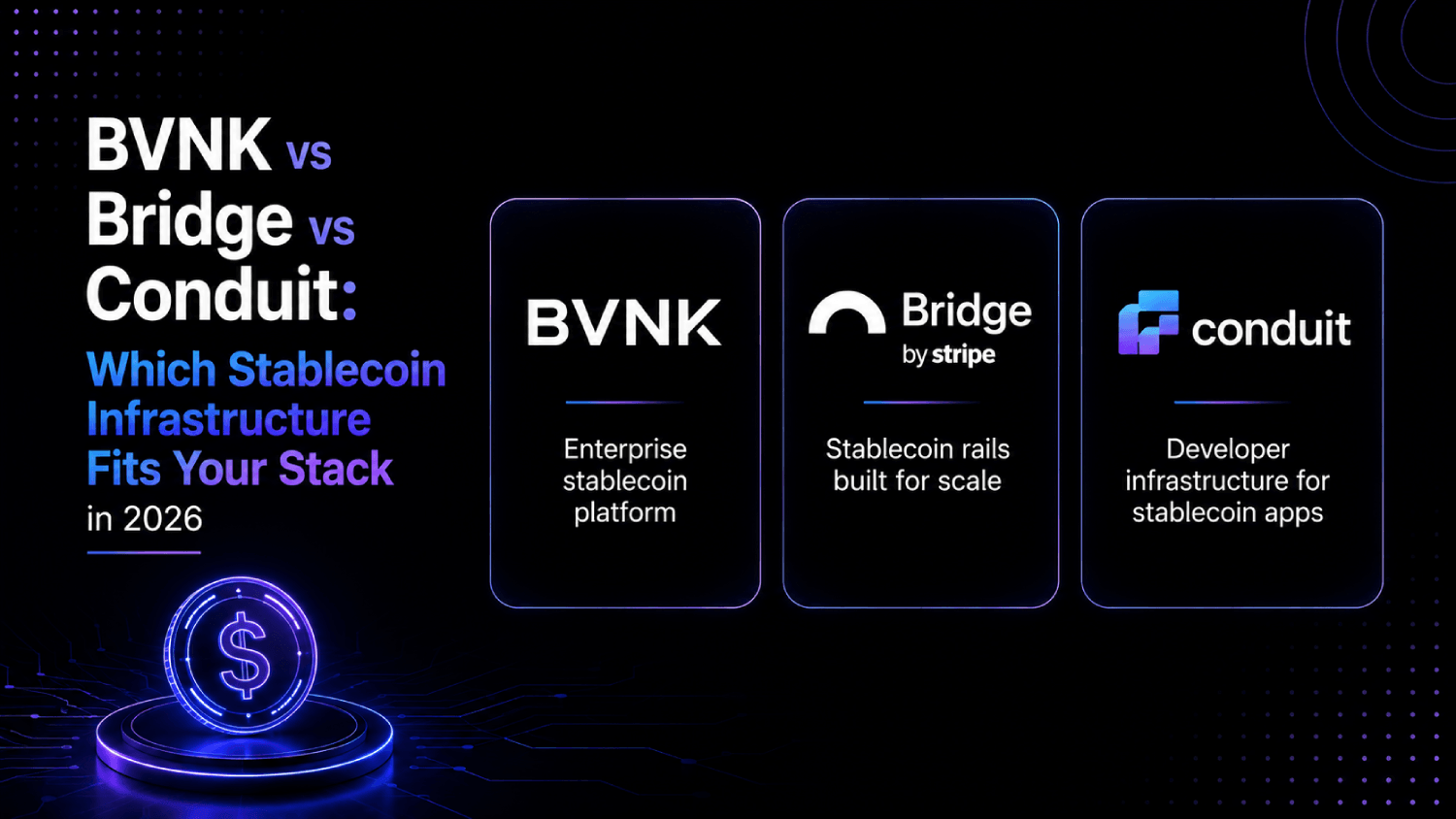

- BVNK, Bridge, and Conduit are not interchangeable. Each serves a distinct buyer: enterprise treasury teams needing multi-currency accounts, developer-first startups moving quickly on USDC rails, and cross-border operators focused on emerging market corridors respectively.
- Bridge onboards fastest for US-based teams building on Stripe’s infrastructure. BVNK takes longer but offers the broadest enterprise feature set. Conduit is purpose-built for Latin America and Africa corridors where the other two have limited reach.
- Compliance review timelines differ significantly: Bridge benefits from Stripe’s KYB infrastructure, while BVNK’s onboarding is more thorough and better suited to companies already operating in regulated environments.
- API ergonomics favor Bridge for developers who want minimal abstraction and direct wallet provisioning. BVNK’s API surface is wider but requires more integration work. Conduit’s API is narrower and corridor-specific.
- The wrong choice costs more than the fee difference. Picking an enterprise provider at pre-Series A wastes 2-4 months. Picking a corridor-light provider when 60% of your volume is LatAm forces a painful migration.
BVNK is the better fit for enterprise treasury teams that need multi-currency stablecoin accounts, conversion, and bank-grade compliance tooling. Bridge suits developer teams at seed to Series B who want fast API access to USDC rails without managing keys or reserves, especially within Stripe’s infrastructure. Conduit is the clearest choice when your primary corridors are Latin America or Sub-Saharan Africa and you need local settlement depth those other two providers cannot match.
Why This Decision Is Not a Coin Flip
Most founders comparing stablecoin infrastructure treat it as a commodity layer. They run a quick feature checklist, see that all three providers offer stablecoin APIs, and either defer the decision or pick whoever answered the sales email first. That approach works fine until it doesn’t, and when it fails, it usually fails at compliance review or corridor coverage, two problems that are expensive and slow to fix mid-integration.
Comparing BVNK vs Bridge is the most common starting point for this decision, but Conduit belongs in the conversation whenever emerging market corridors are central to the product. All three share a surface-level pitch: connect traditional finance to stablecoins via API. Below that surface they diverge sharply on who they are designed to serve. Understanding that divergence is the actual decision.
What Does Each Provider Actually Do?
BVNK: Enterprise Stablecoin Banking
BVNK positions itself as a stablecoin payment infrastructure provider for enterprise clients. The core product is a multi-currency account that lets businesses hold, convert, send, and receive stablecoins and fiat currencies through a single API. BVNK holds regulatory licenses in multiple jurisdictions and targets companies moving significant cross-border payment volumes where treasury management and compliance reporting matter as much as transaction speed.
Mastercard has a disclosed involvement with BVNK through its Mastercard Accelerate program, which signals its trajectory toward institutional rather than startup-first adoption. Its product depth shows this orientation: BVNK supports multiple stablecoins (USDC, USDT, and others), offers fiat-to-stablecoin conversion, and provides detailed transaction reporting suitable for enterprise finance teams. The onboarding process reflects this too. It is thorough, slower than Bridge, and designed for companies that arrive with compliance documentation already in order.
Bridge: Developer-First Stablecoin Primitives
Bridge was acquired by Stripe, which is the single most important context for evaluating it. As Stripe’s stablecoin infrastructure layer, Bridge lets developers provision blockchain wallets per end-user without managing private keys, gas fees, or reserve mechanics. The abstraction is aggressive by design. A developer can issue a stablecoin wallet to an end-user, accept USDC, and convert it to fiat with relatively few API calls.
Bridge’s compliance and regulatory infrastructure benefits from Stripe’s existing KYB and KYC systems. For US-based teams already in the Stripe infrastructure, that integration path is materially faster than starting from scratch with a standalone stablecoin provider. Bridge also handles the regulatory, compliance, and technical complexity that would otherwise require dedicated legal and engineering resources at an early-stage company. The trade-off is that its corridor coverage skews US and Western Europe, and its product roadmap is now tightly coupled to Stripe’s priorities.
Conduit: Corridor-Specific Cross-Border Settlement
Conduit takes a narrower and more honest approach than either of its larger competitors. It does not try to be a full treasury platform or a universal stablecoin primitive. It focuses on cross-border settlement in corridors where legacy correspondent banking is most broken: Latin America, Sub-Saharan Africa, and Southeast Asia. Its API is designed for remittance companies, B2B payment operators, and neobanks that need to move money between the US dollar and local currencies in markets where SWIFT is slow and expensive.
Conduit’s differentiation is local settlement depth. Where BVNK and Bridge treat LatAm or Africa as reachable but secondary, Conduit treats them as the primary use case. That specificity means faster local settlement, better FX rates on those corridors, and onboarding support oriented toward companies whose entire product depends on getting this right. The limitation is the inverse: if your primary markets are Western Europe or developed Asia, Conduit’s advantage shrinks considerably.
How Do They Compare on the Features That Actually Matter?
| Dimension | BVNK | Bridge (Stripe) | Conduit |
|---|---|---|---|
| Primary buyer profile | Enterprise treasury, Series C+ | Developer-first, seed to Series B | Cross-border operators, LatAm/Africa focus |
| Stablecoins supported | USDC, USDT, and others | USDC-primary, expanding | USDC-primary, corridor-dependent |
| Fiat-to-stablecoin conversion | Yes, multi-currency | Yes, within Stripe infrastructure | Yes, focused on local currency pairs |
| Wallet provisioning per end-user | Yes | Yes, core product feature | Limited |
| Regulatory/compliance infrastructure | Own licenses, multi-jurisdiction | Stripe’s KYB/KYC backbone | US-regulated, corridor-specific licensing |
| Onboarding speed (estimated) | Weeks to months | Days to weeks (Stripe integration) | Days to weeks |
| Emerging market corridor depth | Moderate | Limited | Deep (LatAm, Africa primary) |
| API complexity | Wide surface, more integration work | Narrow, high abstraction | Narrow, corridor-specific |
| Public pricing | Not publicly disclosed | Not publicly disclosed | Not publicly disclosed |
| Ideal use case | Multi-currency enterprise treasury | Embedding stablecoin into a product | Cross-border LatAm/Africa settlement |
None of the three publish pricing publicly. Budget conversations happen in sales. That is worth flagging because pricing opacity at this layer of the stack is common, but it makes side-by-side cost comparison impossible without actually going through each onboarding funnel. If pricing is your primary decision variable, you need quotes from all three before making a call.
Which Provider Onboards a Sub-$10M ARR Company Fastest?
Bridge wins on raw onboarding speed for early-stage US companies. Stripe’s KYB infrastructure means Bridge can move through business verification faster than a standalone provider, and its developer documentation is built for teams that want to start building before the sales contract is signed. For a seed-stage fintech that needs stablecoin rails live in 30 days, Bridge is the realistic choice.
Conduit is the second-fastest option, particularly for companies whose business model is self-evidently cross-border remittance or B2B payments into specific corridors. The narrower scope means Conduit’s compliance review is more focused. A company sending money from the US to Mexico or Nigeria fits a pattern Conduit has reviewed hundreds of times, which compresses the back-and-forth.
BVNK’s onboarding is the most thorough. That is not a flaw for the right company, but a sub-$10M ARR startup without a dedicated compliance team will find the process slow. BVNK is built for companies that arrive with AML policies, transaction monitoring in place, and a clear institutional use case. Forcing that process at the wrong stage is where founders lose 6-10 weeks they cannot afford. For a deeper look at what compliance readiness actually requires before signing with any of these providers, the Fintech Product and Compliance Readiness Checklist is a useful pre-flight check.
How Do They Compare on Emerging Market Corridors?
Conduit was designed for this question. Its core product is built around the thesis that stablecoins solve a real problem in corridors where correspondent banking relationships are thin, FX spreads are wide, and settlement times are measured in days rather than hours. If your company’s revenue depends on USD-to-BRL, USD-to-NGN, or USD-to-KES settlements, Conduit has local banking relationships and settlement infrastructure that BVNK and Bridge currently cannot match.
BVNK covers more currencies than Bridge and has made moves toward broader emerging market access, but its strength is in institutional clients in markets where regulatory clarity already exists. Its cross-border product is more capable on established corridors (US-EU, UK-EU) than on frontier corridors.
Bridge, as a Stripe product, reflects Stripe’s geographic footprint. Stripe has improved its global coverage considerably, but LatAm and Sub-Saharan Africa remain secondary markets relative to North America and Europe. A remittance company building a US-to-Mexico B2B payment product would be working against Bridge’s grain, not with it.
The FintechSpecs Corridor-Stage Matrix: Matching Provider to Company Profile
After working through each provider’s actual positioning, a simple framework emerges for making this decision. We call it the Corridor-Stage Matrix: two axes (company stage and corridor priority) that narrow the field from three options to one.
| Company Stage | Primary Corridors: US/EU/UK | Primary Corridors: LatAm/Africa/SEA |
|---|---|---|
| Seed to Series A (sub-$5M ARR) | Bridge , fastest path to live rails | Conduit , corridor depth outweighs everything |
| Series A to Series B ($5M-$20M ARR) | Bridge (if Stripe-native) or BVNK (if multi-stablecoin treasury matters) | Conduit or BVNK (if institutional compliance required) |
| Series B to Series C ($20M+ ARR) | BVNK , enterprise treasury features justify onboarding overhead | BVNK + Conduit as dual-stack is viable |
The dual-stack option at Series B+ is worth naming explicitly. Cross-border payment operators at higher volume often run BVNK for enterprise treasury and a corridor specialist like Conduit for local last-mile settlement , a pattern that reflects the reality that no single provider has solved every corridor at institutional depth simultaneously. This is not complexity for its own sake. It is a recognition that the two products are solving genuinely different problems within the same payment flow. For a wider view of how stablecoin infrastructure fits into the broader fintech stack, the 11 Best Stablecoin Infrastructure Providers for Fintechs and B2B SaaS covers the fuller competitive field.
What Are the API Ergonomics Like for Each Provider?
Bridge API
Bridge’s developer documentation reflects Stripe’s culture: well-structured, example-heavy, and designed to get a developer to a working integration quickly. The key abstraction is wallet provisioning. Developers issue wallets per end-user, fund them, and trigger transfers without touching key management or gas mechanics. For a team building a consumer app or B2B SaaS tool that wants to add stablecoin functionality without becoming a crypto company internally, this is the right level of abstraction.
BVNK API
BVNK’s API is wider. It covers more transaction types, more currencies, and more reporting endpoints. That breadth is genuinely useful at enterprise scale, where finance teams need granular data for reconciliation, FX reporting, and audit trails. The trade-off is integration time. A broader API surface means more decisions during implementation and more surface area to maintain. Teams that have shipped similar integrations before will handle this. Teams without a dedicated fintech engineer will feel it. The 10 Best Fintech APIs for SaaS provides useful context on what good API design looks like at each stage of complexity.
Conduit API
Conduit’s API is deliberately narrow. It does fewer things than BVNK and is less abstracted than Bridge, but what it does, it does for a specific context. The endpoints are designed around the cross-border settlement workflow: initiate transfer, specify corridor, receive settlement confirmation. For a company that knows exactly what it needs and has built similar integrations, Conduit’s API is fast to implement. For a company still figuring out its payment architecture, the narrowness can feel limiting.
Is Conduit Better Than Bridge for Cross-Border Stablecoin Settlement?
For US-to-LatAm or US-to-Africa corridors, yes. Conduit’s local settlement infrastructure on those corridors is deeper than Bridge’s current offering, and that depth translates to faster settlement and better FX rates on those specific pairs. Bridge’s strength is product simplicity and Stripe integration, not emerging market corridor depth.
The honest answer changes if your corridors are US-to-EU or US-to-UK. On those routes, Bridge’s Stripe-backed infrastructure is fully competitive, and the onboarding speed advantage tips the balance back toward Bridge. Conduit’s edge is specific, not universal.
What Does BVNK Do That Bridge and Conduit Don’t?
BVNK’s distinct capability is multi-currency treasury management at enterprise scale. Where Bridge abstracts away complexity and Conduit focuses on specific corridors, BVNK provides the full stack: hold balances in multiple stablecoins and fiat currencies, convert between them, manage accounts for multiple entities, and produce reporting that an enterprise finance team can actually use for month-end close and audit purposes.
A payments company processing $50M a month across seven currencies needs more than a wallet API. It needs a treasury product. BVNK builds for that buyer. Bridge and Conduit do not, at least not yet. For companies at that scale asking whether their current infrastructure can handle the load, the Fintech SaaS Scale Checklist is a useful framework for stress-testing the decision.
A Worked Scenario: Where Each Provider Wins in Practice
Consider three hypothetical companies, each at a different stage with different corridor needs.
Company A is a seed-stage B2B SaaS tool helping US freelancers get paid in USDC. Volume is low, the team has one engineer, and speed to market is the only thing that matters. Bridge is the clear answer. It abstracts away key management, benefits from Stripe’s compliance infrastructure, and can be live in weeks. Choosing BVNK at this stage means spending two months in onboarding for features the company won’t use for another year.
Company B is a Series A remittance startup sending money from the US to Nigeria and Ghana. Their product’s margin depends on local settlement speed and FX rates. Bridge’s Africa coverage is thin. BVNK covers more than Bridge but is not optimized for these corridors at this level of depth. Conduit is built for exactly this. The integration is narrower but the corridor performance is meaningfully better, and that performance difference shows up in the P&L.
Company C is a Series C B2B payments platform managing treasury across USD, EUR, GBP, and USDC for corporate clients. It needs multi-entity accounts, FX conversion, compliance reporting, and an audit trail that satisfies enterprise finance teams. Bridge is not built for this complexity. Conduit is too narrow. BVNK is the only one of the three that addresses all of these requirements in a single product. The onboarding overhead is justified because the alternative is stitching together three separate tools.
Frequently Asked Questions
Is BVNK legitimate and safe to use?
BVNK holds regulatory licenses across multiple jurisdictions and has received institutional backing including participation in Mastercard’s partner programs, which signals institutional-grade vetting. Its client base includes enterprise-scale B2B payment companies. BVNK is not a retail consumer product, and its onboarding process reflects that. Companies that complete onboarding are operating under BVNK’s regulatory umbrella, which includes AML and compliance obligations on both sides of the relationship. It is a legitimate infrastructure provider for the enterprise market it targets.
Who bought Bridge crypto and what does that mean for users?
Stripe acquired Bridge. For existing and prospective Bridge customers, the acquisition means two things: Bridge’s compliance and KYB infrastructure is backed by Stripe’s systems, and Bridge’s product roadmap is now aligned with Stripe’s broader payments strategy. Teams already using Stripe for payment processing will find the integration path shorter. Teams on other payment stacks will need to evaluate whether the Stripe dependency creates friction in their architecture.
What is the difference between Conduit and legacy cross-border payment providers?
Legacy cross-border providers route payments through correspondent banking networks, which adds settlement time and markup at each hop. Conduit uses stablecoins as the settlement layer, moving value on-chain between sender and receiver and converting to local currency at the destination. On corridors where correspondent banking is thin, this translates to faster settlement and tighter FX spreads. The difference is most pronounced in Sub-Saharan Africa and Latin America, where legacy rails are slowest and most expensive.
Can a company use both BVNK and Conduit at the same time?
Yes, and some operators at Series B and above do exactly this. The typical pattern is using BVNK for enterprise treasury management and multi-currency balance holding, while using Conduit for last-mile settlement on specific emerging market corridors where Conduit has deeper local infrastructure. The dual-stack approach adds operational complexity and requires engineering resources to maintain two integrations, but for companies where corridor performance directly affects margin, it is a defensible architecture choice.
How do stablecoins reduce costs in cross-border B2B payments?
Traditional cross-border B2B payments travel through correspondent banking networks, with each intermediary bank adding a fee and a delay. Stablecoin rails replace those intermediaries with on-chain settlement, reducing the number of fee-bearing hops. The savings are most significant on corridors with few direct banking relationships between sending and receiving countries. Beyond fee reduction, stablecoin settlement can compress T+3 or T+5 correspondent banking timelines to near-instant, which has real working capital implications for the businesses involved. For a broader look at how stablecoin payment APIs fit into this picture, the 10 Leading Stablecoin Payment APIs for Fintech Platforms covers the wider field.
What should I check before signing with any stablecoin infrastructure provider?
Before signing, verify three things: first, which jurisdictions the provider holds licenses in and whether those jurisdictions cover your end markets. Second, who holds regulatory liability when a transaction is flagged, because some providers act as principal and others act as agent, and that distinction changes your compliance exposure significantly. Third, what the provider’s uptime SLA is and whether they publish incident history publicly. Providers that obscure their infrastructure reliability or compliance structure are a risk signal. The 7-Point Fintech Vendor Evaluation Framework covers this diligence process in full.
Does Bridge work for non-US companies?
Bridge’s strongest support is for US-incorporated companies, which aligns with Stripe’s core market. Non-US companies can access Bridge in certain geographies, but the onboarding path is less direct and the compliance infrastructure may not cover all jurisdictions. Non-US teams in Europe or the UK may find BVNK’s multi-jurisdictional licensing structure a better fit, since BVNK holds licenses in the UK and EU as well as the US. Teams in LatAm or Africa should evaluate Conduit’s local coverage before assuming Bridge or BVNK can match it.
Which stablecoin infrastructure provider is best for B2B payments specifically?
For US-to-US or US-to-EU B2B payments where speed of integration matters most, Bridge. For B2B payments into emerging markets where local settlement is the core product requirement, Conduit. For B2B payments at enterprise scale involving multi-currency treasury management, multiple entities, or institutional compliance requirements, BVNK. The answer depends entirely on volume, corridor, and company maturity. Any provider that tells you they are the best choice for all three scenarios simultaneously is oversimplifying.
The Choice Is About Fit, Not Features
Each of these three providers has a clear natural buyer. Bridge is the right default for developer-first teams that want to move fast, are inside Stripe’s infrastructure, and do not need deep emerging market coverage. Conduit is the obvious choice the moment your primary corridors shift to Latin America or Africa. BVNK makes sense when treasury complexity, multi-currency management, and enterprise compliance requirements all converge in the same product.
The companies that pick the wrong provider usually do so by evaluating features in isolation rather than matching provider design philosophy to company stage. An early-stage team that picks BVNK because it has the widest feature set will spend months in onboarding that they did not plan for. A Series C platform that picks Bridge because it was fast to set up at seed stage will eventually hit ceiling on treasury management and reporting capabilities.
The stablecoin infrastructure market is still maturing. New corridors open, regulatory frameworks shift, and all three of these providers are expanding their coverage. That means today’s comparison has a shelf life. Revisit it when your volume, corridors, or compliance requirements change. The Corridor-Stage Matrix is a tool for making the current decision clearly, not a permanent answer to a moving question.