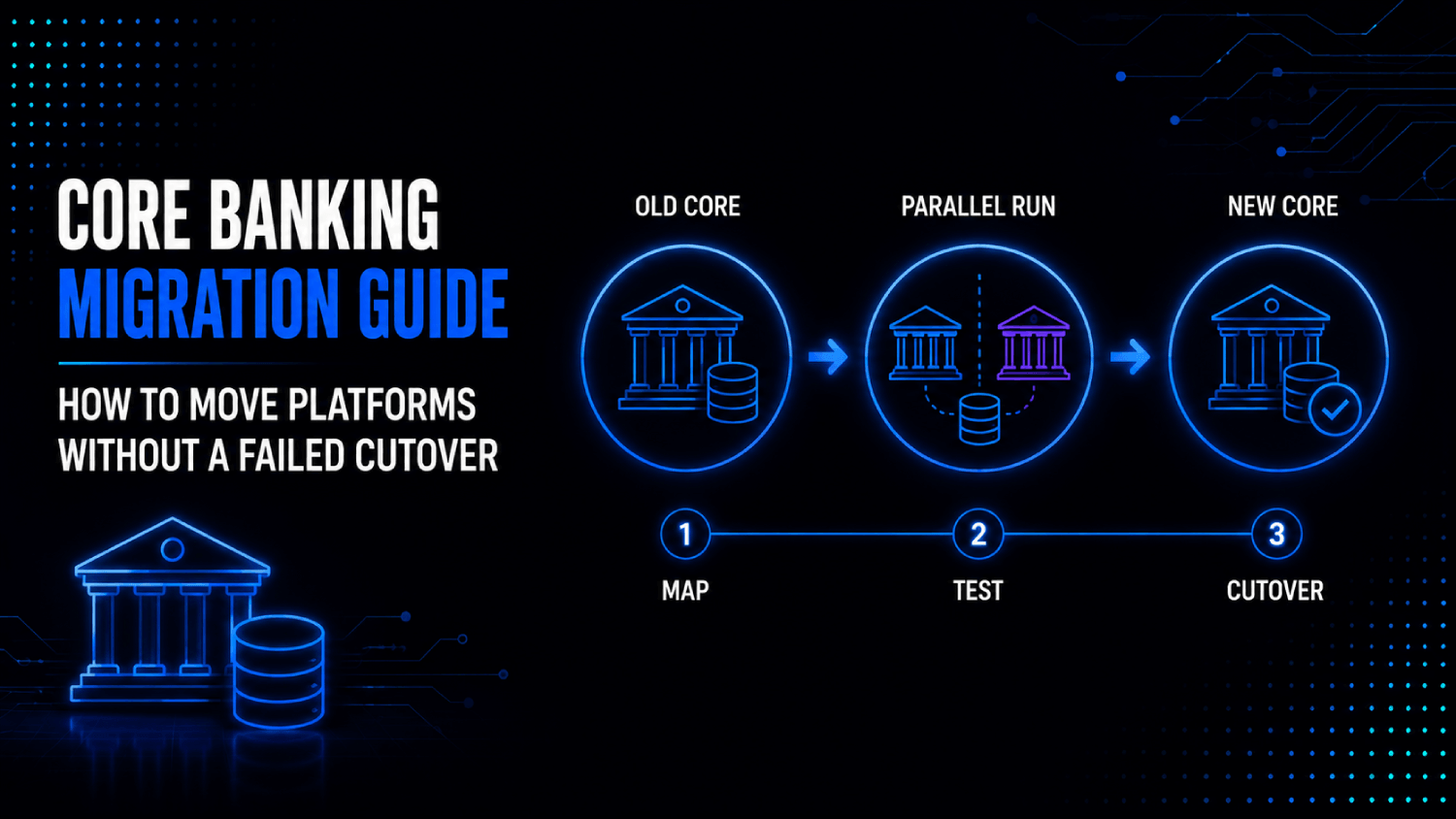

- Most core banking migrations fail at data mapping and cutover, not at vendor selection. The platform decision is the easy part.
- A phased rollout with hard gates between phases cuts failure risk more than any single testing protocol. If a gate condition is not met, the timeline moves, not the standard.
- Every migration needs an explicit owner matrix. Without named DRIs for data, controls, integration, and rollback, accountability diffuses into a project plan nobody reads.
- The 48 hours after go-live are the highest-risk window. Post-launch monitoring metrics need to be defined before cutover, not during the incident.
- Cloud-native cores like Mambu, Thought Machine, and Temenos each have different migration support models. That difference matters more than feature parity when your production data is in transit.
A core banking migration is the operational transfer of all customer accounts, transaction history, product configurations, control rules, and integration dependencies from a legacy system to a target platform, executed through a structured cutover process with defined rollback conditions. This core banking migration guide covers that full process end-to-end: strategy selection, data controls, the owner matrix, phase gates, failure scenarios, test case requirements, and post-launch stabilization. Done well, a migration takes 12 to 24 months for a mid-size institution. Done poorly, it triggers regulatory escalation, customer data loss, and failed transactions that can surface weeks after go-live.
Why Core Banking Migrations Fail Before Cutover Day Even Arrives
The assumption that a signed vendor contract means the hard work is done causes more project failures than any technical deficiency. Analysis of failed core banking programs consistently identifies three root causes: people and culture, process breakdowns, and technology misconfiguration. Vendor capability is rarely the primary variable.
What actually kills migrations early is the gap between what data exists in the legacy system and what the target platform expects. Legacy cores often hold 15 to 20 years of accumulated account structures, fee configurations, and product exceptions that were never formally documented. When the data extraction phase begins, that undocumented complexity surfaces all at once.
The second failure pattern is treating cutover as a single event rather than the final gate in a staged process. Teams rush toward a calendar deadline, compress testing, and carry unresolved data quality issues into production. The result is not a clean go-live but a live debugging session with real customer money.
What Is the Right Core Banking Migration Strategy for Your Situation?
There are four primary migration strategies, and choosing the wrong one for your organizational risk tolerance is a compounding mistake. Each involves a different tradeoff between speed, reversibility, and operational complexity during the transition period.
Big Bang Cutover
All accounts migrate in a single weekend window. Legacy system turns off, new system turns on. This minimizes the period of dual-running cost but concentrates all risk into one 48 to 72 hour window. It is appropriate only for institutions with simple product sets, clean data, and a target platform the team has already tested extensively in a production-equivalent environment.
Phased Migration by Product or Segment
New accounts or a specific product tier migrate first, while existing accounts stay on the legacy system. Teams run both platforms in parallel and migrate cohorts progressively. This extends the timeline and costs more operationally, but it contains failure to a subset of accounts and gives the team real production experience before the full migration. Most mid-size fintech lenders and neobanks use this approach.
Strangler Fig Migration
The target platform takes over individual services incrementally, while the legacy core continues handling everything else. A routing layer directs traffic. This approach comes from software architecture and works well when the target platform is API-first and the legacy system can expose data via middleware. Thought Machine’s Vault and Mambu both support this model through their integration layers.
Parallel Run with Hard Cutover Date
Both systems run simultaneously, processing the same transactions, and outputs are reconciled daily to identify discrepancies. The cutover date is fixed, but the team has a reconciled view of both systems before committing. This is the highest-cost approach but gives regulators and internal audit the most evidence of readiness.
| Strategy | Risk Level | Cost | Best For | Rollback Complexity |
|---|---|---|---|---|
| Big Bang Cutover | High | Low | Simple product sets, clean data | Very high |
| Phased by Segment | Medium | Medium | Neobanks, fintech lenders | Medium |
| Strangler Fig | Low-Medium | High | API-first targets, legacy can expose APIs | Low |
| Parallel Run | Low | Very High | Regulated banks, M&A scenarios | Low |
The FintechSpecs Migration Owner Matrix: Who Owns What and When
Every failed migration has the same post-mortem finding: nobody owned the specific thing that broke. The FintechSpecs Migration Owner Matrix assigns a named DRI (directly responsible individual) to each workstream, not a team or a vendor. Teams make decisions in meetings. DRIs make decisions at 2am when the data load fails.
The matrix below is not a RACI chart. RACI charts distribute ownership so broadly that accountability disappears. Each row has one owner and one escalation path. The column structure is deliberate: Key Deliverables are output-defined, not activity-defined. An owner is not accountable for running a process; they are accountable for a specific artifact existing and being correct by a specific date.
| Workstream | Primary Owner Role | Escalation Path | Key Deliverables |
|---|---|---|---|
| Data extraction and mapping | Data Engineering Lead | CTO / VP Engineering | Field mapping spec, null handling rules, transformation scripts |
| Product configuration | Product Manager (Core) | CPO | Fee schedules, rate tables, product rules in target system |
| Compliance and controls | Head of Compliance | CEO / Board | AML rule parity checklist, SAR continuity plan, regulator notification |
| Integration testing | Platform Engineering Lead | CTO | API contract tests, end-to-end transaction flows, error handling |
| Cutover execution | Program Manager | CEO | Cutover runbook, rollback criteria, communication plan |
| Regulatory and audit | Chief Risk Officer | Board Audit Committee | Examiner-ready documentation, control mapping evidence |
| Customer communications | Head of Operations | CMO | Pre-cutover notice, incident response scripts, support escalation |
| Post-launch monitoring | SRE / FinOps Lead | CTO | Dashboard live before cutover, alert thresholds set, on-call schedule |
The compliance workstream deserves specific attention. Many teams treat AML rule parity as a technical configuration task, but it has regulatory implications. If your current core runs transaction monitoring rules that generate SARs, those rules must be replicated, tested, and documented in the target system before cutover. A gap in SAR generation during or after migration is a BSA examination finding, not just a bug ticket. For teams building out this layer, the AML transaction monitoring tools comparison on FintechSpecs covers which platforms support rule portability natively.
Core Banking Data Migration: The Checklist That Actually Matters
Data migration in banking is not a bulk export. It is a field-by-field translation between two data models that were almost certainly built by different teams, in different eras, with different assumptions about how accounts, balances, and transactions should be structured.
Pre-Migration Data Audit
- Run a full account count reconciliation between the legacy system and your migration target after each extraction batch.
- Identify all null, blank, or default-value fields in the legacy data and define explicit handling rules for each. Leaving this to the ETL script author creates silent errors.
- Document every custom product code, fee exception, and manual override in the legacy system. These are the records most likely to fail validation in the target platform.
- Map every external system that reads from or writes to the legacy core: payment rails, card processors, reporting systems, fraud tools, and GL feeds. Each is a migration dependency.
- Run a data vintage analysis. Accounts opened before a certain year may have been migrated from an older system and carry structural anomalies from that earlier migration.
Data Transformation Controls
- Every transformation rule must be written in a testable specification, not informal documentation.
- Run transformation scripts against a full copy of production data in a staging environment before any cutover rehearsal.
- Reconcile balances at the account level and the aggregate level after each transformation run.
- Preserve the original legacy record identifiers as reference fields in the target system. Post-migration support queries will reference legacy account numbers for months.
- Define the authoritative source of record for each data class during the transition window. For parallel-run migrations, this is not obvious and must be explicit.
Compliance and Control Parity Checklist
- AML transaction monitoring rules: exported, imported, and tested in target environment.
- Sanctions screening: vendor connection tested against live feeds in staging.
- Velocity and fraud rules: all thresholds documented and replicated.
- Regulatory reporting fields: every field required for CTR, SAR, and 1099 generation mapped and validated.
- Dormant account logic: state-by-state escheatment rules configured in target system.
- Interest calculation method: daily vs. monthly accrual logic verified with sample accounts.
- Fee assessment triggers: overdraft, maintenance, and transaction fees tested against known account histories.
For teams that need to pressure-test their compliance configuration before cutover, the Fintech Product and Compliance Readiness Checklist provides a parallel framework for the regulatory side of this process. Teams running compliance checks in parallel with infrastructure decisions may also find the 10 Critical Mistakes When Choosing Fintech Infrastructure useful for identifying configuration gaps that typically surface during migration scoping.
What Does a Realistic Core Banking Migration Timeline Look Like?
The range published by vendors in sales materials (6 to 9 months) is achievable only for greenfield implementations with no legacy data. For any institution migrating an existing customer base, 12 to 24 months is the realistic range, depending on data complexity, product count, and regulatory environment.
Phase 1: Discovery and Architecture (Months 1-3)
This phase produces the decisions, not the code. The outputs are a signed data mapping specification, a confirmed migration strategy, an integration dependency map, and a preliminary cutover runbook. Any team that skips this phase and moves directly to configuration will rebuild it under pressure later.
Key milestones: legacy data audit complete, target platform provisioned in staging, owner matrix signed off, regulatory pre-notification filed if required by charter or program agreement.
Phase 2: Configuration and Integration Build (Months 3-8)
Product rules, fee schedules, and interest logic are configured in the target system. API integrations to payment rails (ACH, RTP, wire), card processors, and downstream reporting systems are built and unit-tested. The data transformation scripts are written and tested against anonymized production data subsets.
Key milestones: all product configurations validated against a known set of legacy account scenarios, integration tests passing for all critical payment flows, data transformation scripts producing balance-reconciled output on a 10% sample of production accounts.
Phase 3: Parallel Testing and Dress Rehearsal (Months 8-14)
Full migration rehearsals run against complete production data copies in a staging environment. Output is reconciled against the live legacy system. Discrepancies are root-caused and resolved before the next rehearsal. Most teams need two to three full rehearsals before cutover conditions are met.
Key milestones: three consecutive rehearsals with balance reconciliation variance below the defined threshold, cutover runbook executed successfully in staging, rollback procedure tested and timed, all integration partners notified and confirmed ready.
Phase 4: Staged Rollout and Cutover (Months 14-18)
For phased migrations, new accounts begin onboarding to the target platform. Existing accounts migrate in cohorts. For big bang migrations, this phase is the cutover weekend itself, preceded by a freeze period on the legacy system.
Key milestones: first cohort migrated and monitored for 30 days, no critical issues from cohort 1 before cohort 2 begins, cutover communication sent to all affected customers, support team briefed and staffed.
Phase 5: Post-Launch Stabilization (Months 18-24)
Legacy system maintained in read-only mode for a defined period, typically 90 days minimum. All post-migration support queries resolved. Regulatory reporting validated through at least one full reporting cycle on the new platform.
| Phase | Duration | Go/No-Go Gate Condition |
|---|---|---|
| Discovery and Architecture | Months 1-3 | Data mapping spec signed, owner matrix approved |
| Configuration and Build | Months 3-8 | All integrations tested, 10% data sample reconciled |
| Parallel Testing | Months 8-14 | 3 consecutive clean rehearsals, rollback tested |
| Staged Rollout | Months 14-18 | Cohort 1 stable for 30 days, no blocking issues |
| Stabilization | Months 18-24 | Full reporting cycle completed, legacy decommission approved |
The phase gate structure above is not a project management preference. Each gate condition is written as a binary pass/fail because the failure mode in banking migrations is almost always a gate that was treated as advisory. A 30-day cohort stability requirement that gets waived at day 22 because the board wants to announce a platform launch is how post-migration incidents happen.
What Are the Rollout Gates and How Do You Enforce Them?
A rollout gate is a binary condition: either the criterion is met and the project advances, or it is not met and the timeline extends. Gates are not negotiable checkpoints that get signed off in a steering committee with outstanding items logged in Jira. They are hard stops with pre-defined consequences.
The gate criteria that matter most are balance reconciliation variance, transaction success rate in staging, integration error rate, and rollback procedure timing. Here is what each should look like in a production-ready migration plan:
- Balance reconciliation variance: total migrated account balances must match legacy system output to within a defined threshold, typically zero variance for demand deposits and a documented tolerance for accrued interest rounding. Any variance above threshold is a gate failure.
- Transaction success rate: all critical payment flows (ACH origination, wire initiation, card authorization, internal transfers) must achieve a 99.9% success rate across 72 hours of parallel processing in staging before cutover is authorized.
- Integration error rate: downstream system integrations (fraud tools, GL feeds, reporting APIs) must show an error rate below 0.1% over a 48-hour test window.
- Rollback timing: the full rollback procedure, restoring all accounts to the legacy system from a known-good snapshot, must execute within the defined rollback window (typically 4 hours for a big bang migration). If the rehearsal takes 6 hours, the window must be renegotiated or the procedure simplified before cutover.
The rollback plan is the most under-specified document in most migration projects. Teams produce a rollback section in the cutover runbook that says “revert to legacy system.” That is not a plan. The rollback plan needs to specify the snapshot point, the data that will be lost for transactions processed after the snapshot, how customers will be notified, how regulators will be notified, and who has authority to trigger it. Pre-defining rollback authority prevents the political negotiation that delays rollback decisions during a live incident.
What Failure Scenarios Should Your Migration Plan Explicitly Address?
Most teams plan for technical failures. Fewer plan for the specific failure modes that are statistically most likely in a banking migration.
Silent Data Corruption
Transformation logic produces output that passes record-count reconciliation but contains incorrect values in specific fields. Interest rate rounding errors, fee calculation differences, and incorrect accrual dates are the most common forms. These do not appear in balance totals until a customer disputes a statement or a regulatory report is generated.
The mitigation is transaction-level testing, not just aggregate reconciliation. Select a stratified sample of accounts (high-balance, recently opened, accounts with exception products, accounts with negative history) and manually verify every field against the legacy record.
Integration Timeout Cascades
During high-volume periods after cutover, a downstream system that was stable in staging begins returning timeouts. The new core retries, the downstream system queues, and the cascade grows. This scenario is especially common when the target platform has different retry logic than the legacy system the downstream provider was calibrated to.
The mitigation is explicit timeout and retry configuration testing during integration testing, including failure injection tests that simulate downstream latency. For teams building on top of payment rails directly, the FedNow and RTP instant payment API comparison covers which providers handle retry logic transparently at the rails layer.
Compliance Rule Gaps Post-Cutover
A transaction type that triggered a monitoring alert on the legacy system does not trigger on the new platform because the rule was not fully ported. The gap may not surface until an examiner reviews transaction monitoring outputs or a SAR that should have been filed is not.
The mitigation is running both monitoring systems in parallel for at least 30 days post-cutover and reconciling alert output. Any transaction that triggers on one system but not the other is investigated before the legacy monitoring is turned off.
Legacy System Dependency Discovered Post-Cutover
An internal tool, report, or workflow was reading directly from the legacy database and was never documented as a migration dependency. It breaks 72 hours after cutover when the team has already moved on to stabilization mode.
The mitigation is a dependency discovery phase early in the project, including a 30-day period where every team in the organization is asked to document any system, report, or process that touches the legacy core. This produces a longer list than anyone expects and is always worth the time.
Vendor Support Degradation at Go-Live
The target platform vendor assigned a strong implementation team during the sales and pre-launch phase, but post-cutover support moves to a standard support queue. Response times increase at exactly the moment when rapid response is most needed.
Contract for post-launch support SLAs separately from the implementation agreement, with defined response times for P0 and P1 incidents during the first 90 days. Get escalation contacts in writing before signing. When evaluating vendors on migration risk, the next-generation core banking platform comparison covers which providers publish implementation support commitments. The 7-point fintech vendor evaluation framework is also worth running against any platform shortlist before a migration contract is signed.
What Test Cases Does a Core Banking Migration Require?
The test case library for a core banking migration is not a QA checklist. It is a structured proof that the new system behaves identically to the legacy system for every financially material transaction type.
Required Test Case Categories
- Balance integrity tests: open a test account on the legacy system, execute a defined transaction sequence, migrate the account, verify that all balances, accrued interest, and fee assessments match exactly.
- Payment rail tests: ACH origination and receipt, wire initiation, RTP send and receive, card authorization, card settlement, and any proprietary payment rails your institution uses.
- Interest accrual tests: verify daily accrual, rate change events, compounding logic, and statement cycle cutoffs across a 30-day test window.
- Fee assessment tests: overdraft, NSF, maintenance, wire fee, and any tiered fee structures. Test edge cases: accounts at exactly the fee threshold, fee waivers, and accounts with fee exceptions.
- Regulatory reporting tests: generate CTR and 1099 test outputs on the new platform and verify field-by-field against the legacy system for the same transaction set.
- Negative path tests: insufficient funds, closed account transactions, expired cards, failed ACH returns. Verify that error codes and customer-facing messages are accurate.
- High-volume stress tests: simulate peak transaction volume (at least 2x normal daily volume) and verify that response times, error rates, and queue depths remain within acceptable ranges.
- Rollback tests: execute a partial migration, trigger rollback, and verify that account states return exactly to the pre-migration snapshot.
Every test case needs a defined expected result documented before the test runs. Test cases that are evaluated subjectively after the fact produce disputes, not evidence.
How Do Vendor Implementation Models Differ Across Core Banking Platforms?
Vendor selection is covered extensively elsewhere, including in the core banking platform comparison on FintechSpecs. What matters for implementation planning is how each vendor structures the migration support engagement, because that determines your actual resource requirements and risk exposure during the project.
Mambu uses a partner-led implementation model, meaning a certified system integrator typically runs the migration project. The quality of the implementation varies by partner. Teams evaluating Mambu should ask for partner references specifically from migration projects, not just greenfield builds. For teams considering alternatives, the Mambu alternatives comparison covers how competing platforms handle the migration process.
Thought Machine with its Vault platform takes a more direct implementation approach for larger clients. The platform’s use of a smart contract configuration language (Vault Contracts) means that product configuration during migration requires engineers who can write or review contract code, not just configure settings in a UI.
Temenos has the longest installed base and the most migration case studies, but also the most complex implementation process. A Temenos migration typically involves more configuration layers and more integration touchpoints than a cloud-native alternative.
Regardless of vendor, the implementation team’s experience with data migration from your specific legacy platform is more predictive of success than their general platform expertise. Ask how many migrations they have executed from your current core provider specifically.
What Post-Launch Metrics Should You Monitor After Core Banking Cutover?
Post-launch monitoring should be configured and running before the cutover window opens. Waiting until after go-live to set up dashboards adds hours of diagnostic time to the most critical period of the project.
Technical Metrics (Monitor in Real-Time)
- Transaction success rate by payment type (ACH, wire, card, internal transfer)
- API response time by endpoint, with alerts at 2x baseline latency
- Queue depth for any asynchronous processing jobs
- Error rate by error code, segmented by transaction type
- Database connection pool utilization
- Integration health for each downstream system (fraud, GL, reporting, card processor)
Financial Accuracy Metrics (Monitor Daily for 90 Days)
- End-of-day balance reconciliation: total balances on target platform vs. expected based on migration snapshot plus post-migration transactions
- Interest accrual amounts vs. expected for a sample of test accounts
- Fee assessment count and total vs. expected based on transaction volume
- Regulatory report output: any CTR or SAR generation gaps vs. expected trigger events
Customer Impact Metrics (Monitor Daily for 30 Days)
- Support ticket volume segmented by issue type, with a specific category for migration-related issues
- Transaction decline rate vs. pre-migration baseline
- Account access failure rate (login, authentication, balance display errors)
- Direct dispute volume related to balance or transaction discrepancies
Set explicit thresholds for each metric at which the incident response protocol is triggered. A 0.5% increase in transaction decline rate over a 2-hour window should trigger an immediate investigation, not a next-morning review. The 48 hours after go-live are when silent failures are most likely to compound. Teams that have also invested in metrics frameworks beyond standard reporting tend to catch post-migration anomalies faster because they have baseline data to compare against.
Frequently Asked Questions
What is the difference between a core banking migration and a core banking implementation?
A core banking implementation builds a new system from scratch, typically for a new institution or product. A migration transfers existing customers, accounts, transaction history, and configurations from a legacy system to a target platform. Migration is substantially more complex because it requires data extraction, transformation, validation, and cutover planning alongside all the configuration work of a greenfield implementation. The presence of live customer data under regulatory obligations makes migration a higher-stakes project.
How long does a core banking migration take for a mid-size fintech?
For a fintech with an existing customer base, 100,000 or more accounts, and multiple product types, 12 to 18 months is a realistic timeline from project kickoff to full legacy decommission. Institutions with simpler product sets and clean data sometimes complete migrations in 9 to 12 months. Estimates under 9 months from vendors during the sales process should be treated as greenfield timelines applied to a migration scenario, which is a different problem entirely.
What is a cutover plan in banking system migration?
A cutover plan is the operational document governing the transition from the legacy system to the target platform during the go-live window. It specifies the exact sequence of steps, timing, and decision points, including when data extraction freezes, when the transformation runs, when validation checks must pass, when each integration switches to the new platform, and when the legacy system is taken offline. It also defines rollback triggers: the specific conditions under which the team reverses course and restores the legacy system.
What are the biggest risks in core banking data migration?
Silent data corruption is the highest-consequence risk because it can pass record-count reconciliation while containing field-level errors that affect customer balances or regulatory reporting. Other high-risk areas include undocumented product exceptions in the legacy system, missing integration dependencies discovered post-cutover, compliance rule gaps that create SAR filing lapses, and vendor support degradation after go-live. Each of these has a specific mitigation, which is why a migration plan that addresses only technical testing is incomplete.
Is cutover the same as go-live in a banking migration?
Cutover refers specifically to the execution window when control transfers from the legacy system to the target platform, including the data load, validation, and integration switch sequence. Go-live is the moment the new platform begins processing live customer transactions. In a well-run migration, go-live follows successful completion of the cutover sequence and confirmation that rollback conditions have not been triggered. They are related but not identical: a failed cutover means go-live does not happen, and the team executes rollback instead.
What compliance obligations arise during a core banking migration?
Regulated institutions typically must notify their primary federal regulator before a material system migration, with timelines that vary by charter type and regulator. BSA and AML obligations continue uninterrupted through the migration window, meaning monitoring, alert review, and SAR filing must remain operational on either the legacy or target system at all times. FDIC insurance records, account ownership data, and beneficiary designations must be accurately preserved and verifiable throughout. State-chartered banks may also have state regulator notification requirements. Teams should confirm specific obligations with legal counsel for their charter type before finalizing the migration timeline.
How do you test a core banking migration before cutover?
Effective pre-cutover testing has three layers. The first is unit testing of transformation scripts against sample data to verify that individual field mappings produce correct output. The second is full rehearsal migrations against a complete copy of production data in a staging environment, with balance reconciliation at the account and aggregate level. The third is end-to-end integration testing, where each connected system (payment rails, card processors, fraud tools, GL, reporting) is exercised against the staging environment and its output validated. All three layers must pass before cutover conditions are considered met.
What should a post-migration stabilization period include?
The stabilization period, typically 60 to 90 days post-cutover, involves running the legacy system in read-only mode so historical records remain accessible for dispute resolution. Daily balance reconciliation continues until variance is consistently at zero. Regulatory reports are generated and reviewed for at least one full reporting cycle. Support ticket volumes are tracked and migration-related issues resolved systematically. Legacy decommission approval requires sign-off from compliance and operations leads, not just engineering, confirming that no active process still depends on legacy system data.