
- Most fintech infrastructure companies earn from multiple revenue streams simultaneously, not just one.
- The six core monetization models are: transaction fees, SaaS subscriptions, interchange, take rates, compliance and licensing services, and enterprise contracts.
- Transaction-based and interchange models scale with volume; SaaS and enterprise contracts provide predictable baseline revenue regardless of usage.
- Understanding which model a vendor uses tells you how their incentives align with yours, which matters more than the headline price.
- Infrastructure companies that look free often monetize through interchange or data, not through direct fees.
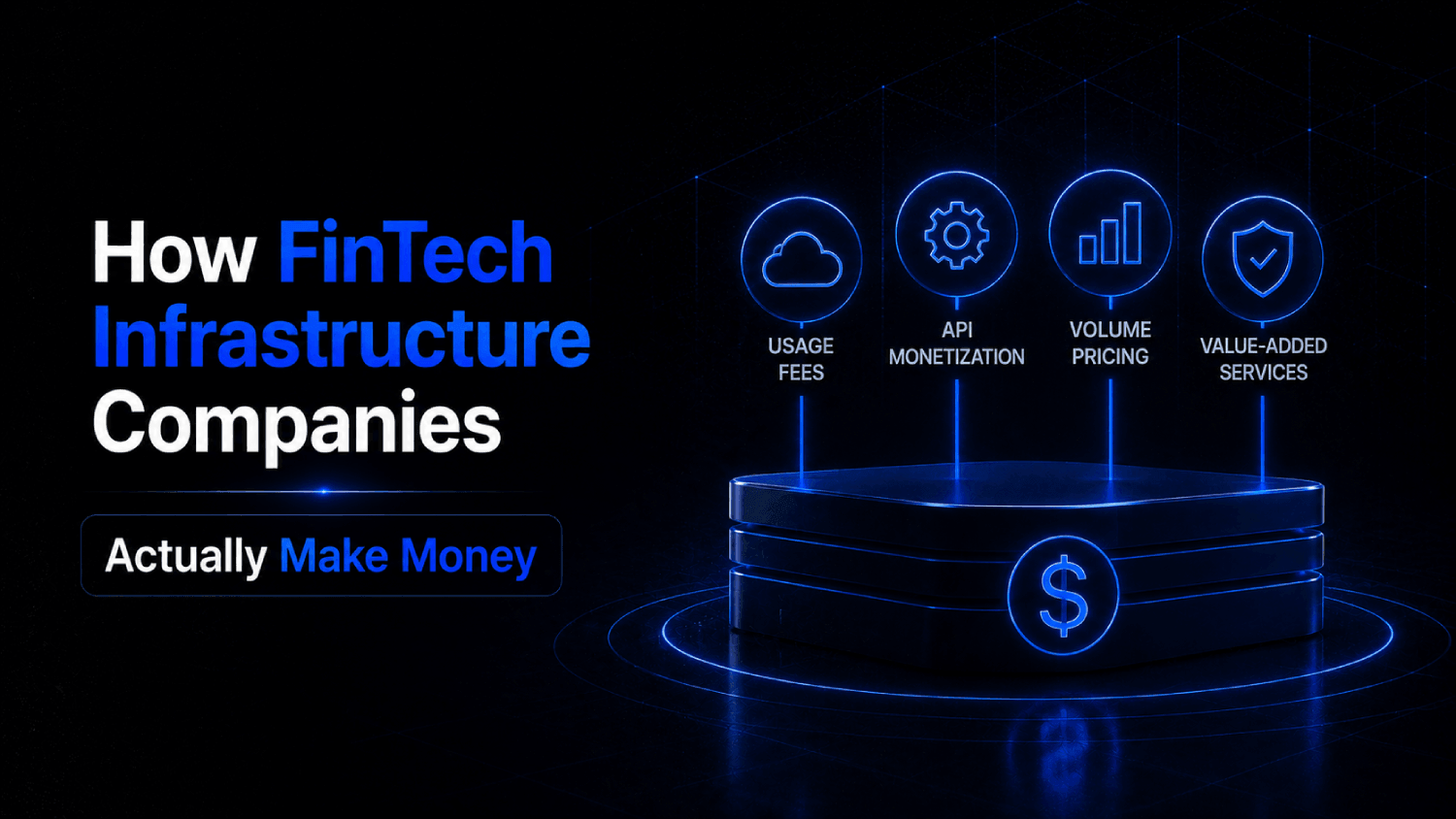
How fintech infrastructure companies make money is more layered than most buyers realize. These companies generate revenue through a combination of transaction fees, monthly or annual SaaS subscriptions, interchange revenue, take rates on payments or lending, compliance and licensing services, and long-term enterprise contracts. Most mature infrastructure providers run two or three of these models at once, layering predictable subscription revenue on top of variable usage-based income to smooth out cash flow and increase lifetime value per customer.
Why the “API fees” assumption misses most of the picture
Most people who build on fintech infrastructure assume the vendor makes money when they make an API call. That is partly true, and partly a significant oversimplification. The API call might be free, subsidized, or bundled into a subscription. The actual revenue might come from somewhere else entirely.
Take Plaid. Its core product connects bank accounts to applications. But Plaid also earns revenue from identity verification services, income verification, and signal products layered on top of that core connectivity. The API access is the door. The monetization lives deeper inside.
Payment infrastructure companies like Stripe operate similarly. Stripe’s headline model is a per-transaction percentage fee, but the company also earns from Stripe Capital (lending), Stripe Radar (fraud scoring), Stripe Tax, and Treasury (banking services). A startup paying Stripe for payment processing may not realize it is also contributing to multiple separate revenue lines. For a closer look at how payment infrastructure costs stack up in practice, the best payment infrastructure tools for SaaS founders breaks down the real pricing across competing platforms.
What are the six main ways fintech infrastructure companies generate revenue?
Each model below represents a distinct monetization mechanism. Most infrastructure companies combine two or more.
1. Transaction fees
A percentage of each payment processed, sometimes with a fixed per-transaction component added on top. Stripe’s public pricing page lists 2.9% plus $0.30 per successful card charge for standard online payments. Adyen uses an interchange-plus model, charging a processing fee on top of the underlying interchange cost. Transaction fees reward infrastructure companies for volume growth, which aligns their incentives with the customer’s.
2. SaaS subscriptions
A fixed monthly or annual fee for platform access, regardless of transaction volume. This model is common among compliance infrastructure providers, data infrastructure vendors, and banking-as-a-service platforms. Unit and similar Banking-as-a-Service providers typically charge a platform fee plus per-account fees on top. Subscriptions create predictable revenue for the vendor and predictable costs for the buyer, though they can become expensive at low usage levels.
3. Interchange revenue
When a company issues cards through a bank program manager or BaaS provider, a portion of the interchange fee generated every time that card is swiped flows back to the infrastructure company or its partner bank. This is how many “free” fintech products are funded. The end user sees no fee; the merchant’s bank absorbs the interchange cost. Infrastructure companies like Marqeta earn a share of interchange on every transaction processed on cards they issue. For a deeper look at the BaaS platforms that use this model, see the best Banking-as-a-Service platforms for fintech startups.
4. Take rates on payments or lending
A take rate is the percentage of gross payment volume or loan principal that the infrastructure company retains as revenue. It is most visible in embedded lending and buy-now-pay-later infrastructure. A company providing lending-as-a-service might retain 1% to 3% of the loan principal as a fee, passing the rest to the capital provider. Take rates are usage-based like transaction fees but apply to a broader set of financial products beyond card payments.
5. Compliance and licensing services
Know-your-customer (KYC), anti-money-laundering (AML) monitoring, sanctions screening, and state money transmitter license coverage are all services that fintech infrastructure companies charge for separately. Alloy, Persona, and Sardine are examples of compliance infrastructure vendors that monetize directly through per-verification fees or subscription tiers. Some BaaS providers bundle compliance services into their platform fee. Others charge for them à la carte. The cost of compliance at each stage of growth is worth understanding separately, which the real cost of compliance in fintech SaaS covers in detail.
6. Enterprise contracts and revenue share
Large infrastructure companies also sign multi-year contracts with banks, insurance companies, and enterprise software platforms. These contracts often include a base fee for access and a revenue share component tied to volume. Stripe, Adyen, and FIS all operate at this tier. The contract size can run from hundreds of thousands to tens of millions of dollars annually. Revenue share arrangements mean the infrastructure company earns more when the client grows, creating a long-term alignment that pure subscription models do not provide.
Revenue model comparison: how the six models differ by structure
| Revenue Model | How It Works | Scales With Volume? | Predictable Revenue? | Common Among |
|---|---|---|---|---|
| Transaction fees | % of each payment processed, often plus a fixed per-transaction fee | Yes | No | Payment processors, money transfer platforms |
| SaaS subscriptions | Fixed monthly or annual platform fee, sometimes tiered by usage | Partially (tiered plans) | Yes | Compliance tools, data infrastructure, BaaS platforms |
| Interchange revenue | Share of the interchange fee earned on card transactions | Yes | No | Card issuers, BaaS providers, neobanks |
| Take rates | % of loan principal or gross payment volume retained | Yes | No | Embedded lending, BNPL infrastructure |
| Compliance and licensing services | Per-verification fees or subscription for KYC, AML, sanctions screening | Partially | Partially | Identity verification, risk infrastructure vendors |
| Enterprise contracts and revenue share | Multi-year base fee plus volume-tied revenue share | Yes (revenue share component) | Yes (base fee component) | Large processors, core banking vendors, API aggregators |
How do payment infrastructure companies specifically generate revenue?
Payment infrastructure is the most visible segment of fintech infrastructure, and it illustrates the layering principle well. A payment infrastructure company earns from the transaction itself, from add-on products sold alongside the transaction, and increasingly from financial products that sit downstream of the payment.
Stripe’s revenue comes from transaction processing fees, plus fees for Radar (fraud detection), Atlas (business formation), Capital (merchant cash advances), Billing, Tax, and Treasury products. No single product dominates. The payment processing fee brings the customer in; the add-ons expand the revenue per customer over time. This expansion revenue model is why infrastructure companies invest heavily in reducing onboarding friction. The easier you are to start with, the faster they get to upsell the second and third product.
Adyen takes a different angle. It charges interchange-plus pricing rather than a flat percentage, which means the fee reflects the actual network cost plus Adyen’s margin. This model tends to favor high-volume merchants who want cost transparency, while Stripe’s flat-rate model favors early-stage companies that want pricing simplicity. The comparison between these two approaches is worth understanding before committing to either, and the Stripe vs Adyen comparison for B2B SaaS breaks down exactly where the cost differences emerge.
How do API pricing models work in fintech specifically?
API monetization in fintech does not follow a single standard. Four distinct structures appear across the market.
Pay-per-call pricing
The customer pays for each API call made, typically priced in tiers that reduce the per-call cost at higher volumes. Plaid charges per API call for account connection, transaction retrieval, and identity verification, though exact pricing is available by contacting sales for enterprise tiers. This model works well when usage is predictable but becomes expensive at scale if the product architecture generates high call volumes per user.
Flat-rate subscription with usage caps
A monthly fee covers a defined number of API calls or verifications. Usage above the cap triggers overage fees. Many identity verification vendors like Onfido and Persona use this structure. It is easier to budget for than pure pay-per-call, but overage fees can create surprise costs during growth spikes.
Revenue share on financial outcomes
The API is priced at zero or near-zero, and the vendor takes a share of the financial outcome instead. Embedded lending APIs often work this way. The infrastructure company earns when a loan is originated or when a card transaction occurs. This aligns the vendor’s incentive directly with the customer’s revenue, but it means the vendor has more interest in your transaction volume than in your technical success per se.
Freemium with commercial tiers
A free tier handles low-volume or sandbox usage. Commercial tiers grant production access, higher rate limits, SLAs, and support. This structure is common across developer-facing API businesses, and fintech API companies have widely adopted it. Plaid, Marqeta, and many identity verification vendors all use free or sandbox tiers as the top of their sales funnel, converting developers to paid plans once a product moves toward production. The conversion rate from free to paid is the key metric vendors optimize for. For a broader look at how fintech APIs are structured across categories, the best fintech APIs for SaaS covers the leading platforms across verticals.
What does banking infrastructure monetization actually look like in practice?
Banking infrastructure refers to the core systems that allow companies to offer account, payment, and lending products without a bank charter. This includes core banking software, BaaS middleware, ledger infrastructure, and KYC orchestration layers.
A company like Solaris in Europe or Synapse, which entered bankruptcy proceedings in 2024, disrupting a number of fintech programs that relied on its BaaS infrastructure, operated by charging a monthly platform fee, a per-account-opened fee, a per-transaction fee, and interchange on card usage. Each component is modest in isolation. Stacked together across thousands of end-user accounts, the revenue becomes significant. This is why BaaS providers push their clients toward high-engagement, high-transaction products rather than passive savings accounts. Passive accounts generate no interchange and minimal transaction fees.
Core banking vendors like Temenos, Finastra, and NCR Atleos monetize through large multi-year software license or SaaS contracts with banks, often including implementation fees, support contracts, and module-based pricing for add-on capabilities. These contracts can run for a decade or longer. The switching cost is so high that once a bank selects a core banking vendor, the vendor has significant pricing power at renewal.
How do fintech infrastructure companies balance free products against paid monetization?
Several fintech infrastructure companies offer genuinely free products, at least at low usage levels. The business logic is straightforward: a free product reduces friction to adoption, builds usage data, and creates the customer relationship that eventually monetizes through a commercial product sitting adjacent to the free one.
Twilio used this strategy in communications infrastructure. Free credits to start, pay-as-you-go pricing as you scale, enterprise contracts once volume justifies the conversation. Fintech infrastructure vendors have replicated this playbook. The risk for buyers is underestimating how quickly free tiers hit their caps and what the commercial pricing looks like afterward. This is one of the more common hidden costs buyers encounter, and hidden costs that affect fintech SaaS margins covers the full range of where unexpected charges appear.
How do fintech infrastructure revenue models affect the buyer’s own margin?
The vendor’s monetization model directly affects the buyer’s gross margin. A transaction-fee model means your infrastructure cost rises proportionally with revenue. A SaaS model means your infrastructure cost is fixed, so margin improves as revenue grows. The implications for a fintech SaaS company scaling from $1M to $10M ARR are substantial.
At $1M ARR, a 2.9% transaction fee on $1M in gross payment volume costs $29,000 per year in infrastructure fees. At $10M in GPV, that same rate costs $290,000. If a flat-rate SaaS alternative covers the same volume for $50,000 per year, the cost difference at scale is $240,000. That is not a pricing preference. It is a margin architecture decision. The real reasons fintech SaaS margins are worse than founders expect explains how these infrastructure cost structures compound over time.
The practical implication is that the right monetization model for your vendor is the one that stays in proportion to your cost of delivering the product, not just the one with the lowest number on page one of the pricing sheet.
Frequently asked questions about fintech infrastructure monetization
1. How do fintech companies make profit if many products are free or low-cost?
Free or low-cost products are typically loss leaders funded by higher-margin products sold to the same customer. A company offering free account connectivity earns from identity verification, lending, or compliance services layered on top. Infrastructure vendors also earn from interchange when cards are used, which generates revenue without any visible fee to the end user. Profitability comes from the combination of products in the stack, not from any single product priced in isolation.
2. What is the difference between a take rate and a transaction fee in fintech?
A transaction fee is a fixed charge per payment event, often expressed as a percentage plus a flat amount (e.g., 2.9% plus $0.30). A take rate is the percentage of total financial volume retained by the platform across a broader category of activity, such as the percentage of a loan originated or the percentage of gross merchandise value processed through a marketplace. Take rates are more common in lending and marketplace infrastructure. Transaction fees are more common in payment processing.
3. Do fintech infrastructure companies earn money from data?
Some do, with significant variation in how. Data aggregators like Plaid sell access to financial data APIs, which means data connectivity is the product. Other infrastructure companies use transaction data to inform credit decisions, fraud models, or marketing products that generate separate revenue. Regulations like the California Consumer Privacy Act and GDPR constrain how customer financial data can be used or sold. Infrastructure companies in regulated segments typically cannot sell raw customer transaction data to third parties without explicit consent.
4. Why do some fintech infrastructure vendors push revenue share models instead of subscription fees?
Revenue share aligns the vendor’s incentive with the client’s growth. When the client processes more volume, the vendor earns more. This is appealing during early commercial conversations because it requires no upfront fee and no guaranteed payment. For the vendor, it is also a bet that the client will grow fast enough to make the revenue share more valuable than a subscription would have been. The trade-off for buyers is that revenue share models become expensive at scale, often more expensive than a flat SaaS fee would have been.
5. How does interchange revenue work for fintech infrastructure companies?
Interchange is the fee a merchant’s bank pays to the cardholder’s bank every time a card is swiped. In the US, card network rules govern how much interchange is collected. When a fintech infrastructure company issues cards through a bank partner, that bank collects interchange and shares a portion back to the program manager or BaaS provider. The split depends on the contract. The infrastructure company may then share part of its portion with the fintech company running the program. This is why corporate card programs and expense management platforms can offer rewards without charging a subscription fee.
6. What is infrastructure monetization in banking specifically?
In the context of traditional banking, infrastructure monetization refers to banks generating revenue by offering their technology infrastructure to third parties. A bank with a well-developed payments core, ledger, or compliance system can license that capability to fintechs, corporate clients, or other banks as a service. This is the origin of many BaaS programs. The bank monetizes its regulatory charter and technical infrastructure rather than only monetizing the deposits and loans on its own balance sheet.
7. How do enterprise fintech infrastructure contracts differ from standard API pricing?
Enterprise contracts replace per-call or per-transaction pricing with a negotiated annual fee covering a defined volume, often with a revenue share component above a threshold. They include SLAs, dedicated support, customization rights, and sometimes exclusivity provisions. The pricing is not published publicly. Enterprise contracts favor buyers who have predictable, high volume and want cost certainty. Standard API pricing favors early-stage buyers who want to start without a sales process and are willing to pay a higher unit rate in exchange for flexibility.
8. Can a fintech infrastructure company run all six revenue models at once?
Large infrastructure companies do exactly this. Stripe charges transaction fees, sells SaaS products, earns interchange through its Issuing product, runs a revenue share through Capital, charges for compliance tools like Radar, and signs enterprise contracts with large clients. Each model serves a different customer segment and stage. Early-stage customers land on transaction pricing. As they grow, they add SaaS products. Large enough customers negotiate enterprise contracts. The six models are not competing strategies. They are stages in the same customer lifecycle.
The model behind the model
Fintech infrastructure companies are not primarily in the API business. They are in the financial services business, using APIs as the distribution mechanism. Every model described here, whether interchange, take rates, or enterprise contracts, ultimately traces back to a financial activity: a payment moving, a loan being made, an account being opened, a card being swiped.
This distinction matters when evaluating vendors. A company monetizing through interchange wants you to issue cards to active spenders. A company monetizing through transaction fees wants you to process high volumes of payments. A company monetizing through compliance services wants you to onboard users at scale. Their product roadmap, their pricing evolution, and their support priorities will all reflect where their revenue actually comes from.
The buyers who negotiate the best terms and avoid margin surprises are the ones who map the vendor’s revenue model before signing anything. When you know how your infrastructure partner makes money, you know what behavior they will reward, what they will price aggressively to acquire, and what they will charge more for once you are locked in.