
- ACH weekly payouts are becoming a churn driver for gig and creator platforms. Workers who can access earnings same-day are measurably less likely to switch platforms.
- Push-to-card (Visa Direct, Mastercard Send) delivers funds to a debit card in under 30 minutes. RTP and FedNow move bank-to-bank in seconds. ACH next-day is the slowest option still widely defaulted to.
- Providers differ most on rail support, per-transaction fees, API maturity, and whether they handle compliance or push it back to you.
- Stripe Instant Payouts suits teams already on Stripe. Branch is purpose-built for gig worker payouts at scale. Trolley wins for creator platforms paying internationally. Dwolla and Astra fill specific gaps in between.
- The fee structure matters more than the headline speed. A $0.25 per-payout fee at 100,000 monthly payouts is $25,000 monthly before you’ve moved a dollar elsewhere.
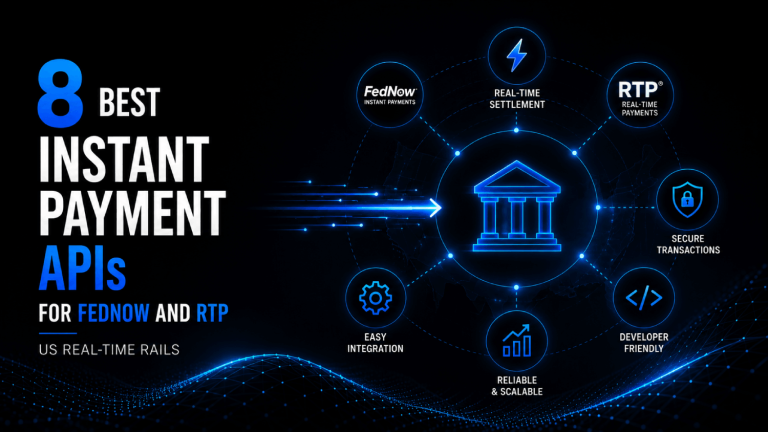
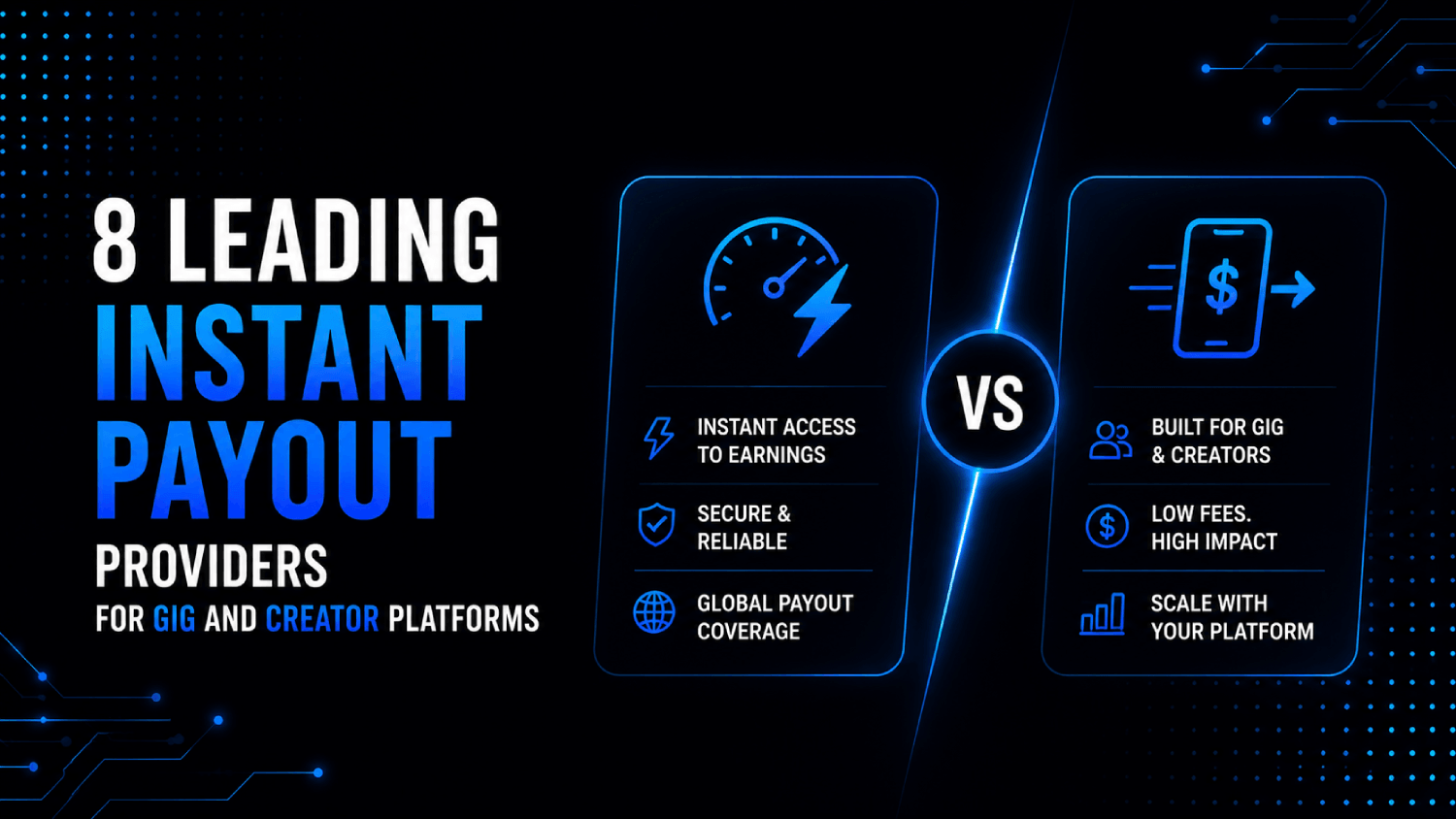
The best instant payout providers for gig and creator platforms in the US are Stripe Instant Payouts, Branch, Trolley, Dwolla, Astra, Hyperwallet, Gusto (for hybrid embedded payroll), and Checkbook. Each uses different rails, charges differently per transaction, and makes different compliance trade-offs. Push-to-card via Visa Direct or Mastercard Send reaches most US debit cards in under 30 minutes. RTP and FedNow clear bank accounts in seconds. Your choice depends on rail mix, volume, whether your workers have bank accounts, and how much compliance you want the vendor to own.
Why Instant Payouts Became a Retention Problem, Not a Nice-to-Have
Weekly ACH was the default because it was cheap and simple. It still works fine for salaried employees who budget around pay cycles. For gig workers and independent creators, it creates a specific friction: they completed the work, they can see the balance, and they cannot touch it for days.
That gap is where churn starts. Competing platforms offering same-day or next-hour access win workers at the margin, especially when earnings are the primary income source and a worker has a bill due Tuesday. The cost of losing that worker to a competitor platform far exceeds the $0.25 to $1.50 per-payout fee for instant rails.
For platform operators, the operational calculus is also changing. FedNow launched in July 2023 and has been expanding its bank participation since. The Clearing House’s RTP network has been live longer and already reaches the vast majority of US demand deposit accounts. Visa Direct and Mastercard Send cover hundreds of millions of debit cards. The infrastructure is mature. The question is now which provider wraps it into an API you can actually build on.
If you’re evaluating the broader payments infrastructure context, the FintechSpecs comparison of FedNow and RTP API providers covers the rails themselves in more depth. This article focuses specifically on the provider layer for gig and creator disbursement use cases.
How to Compare Instant Payout Providers: The FintechSpecs Payout Stack Test
Most provider comparisons list features. This one starts with a four-point evaluation framework designed specifically for disbursement-heavy platforms, which we call the FintechSpecs Payout Stack Test. Run every provider through these four checks before shortlisting.
Rail breadth: Does the provider support push-to-card (Visa Direct and/or Mastercard Send), RTP, FedNow, and same-day ACH as distinct options? A provider that only does push-to-card cannot reach workers at banks not enrolled in card networks for debit access. One that only does RTP cannot pay workers whose banks aren’t RTP-enabled yet.
Compliance ownership: Does the provider hold money transmitter licenses or operate through a sponsor bank model, or does your platform need to own that licensing? This is the most commonly overlooked variable in early vendor decisions. If the provider pushes compliance back to you, your legal costs go up significantly before you process dollar one. The FintechSpecs fintech compliance checklist walks through what that liability surface looks like in practice.
Fee structure at volume: Per-transaction fees that look reasonable at 1,000 payouts per month compound quickly. Consider what the unit economics look like at 10x your current volume before you’re locked into a contract.
API maturity: Can your team go live in days with well-documented webhooks, idempotency, sandbox testing, and clear error handling? Or will you spend weeks on edge-case behavior that isn’t in the docs?
Speed-to-Recipient by Rail: What Actually Happens After You Call the API
| Rail | Typical Speed to Recipient | Recipient Requirement | Availability |
|---|---|---|---|
| Visa Direct (push-to-card) | Under 30 minutes, often under 2 minutes | Eligible Visa debit card | 24/7/365 |
| Mastercard Send (push-to-card) | Under 30 minutes | Eligible Mastercard debit card | 24/7/365 |
| RTP (The Clearing House) | Seconds | Bank enrolled in RTP network | 24/7/365 |
| FedNow | Seconds | Bank enrolled in FedNow | 24/7/365 |
| Same-Day ACH | Same business day (batch cutoffs apply) | US bank account | Business days only |
| Standard ACH (next-day) | 1 business day | US bank account | Business days only |
Push-to-card is the most broadly accessible instant rail for US-based workers right now, because debit card penetration is higher than RTP-enrolled bank account penetration. RTP and FedNow are faster and cheaper per transaction where they work, but bank enrollment is still not universal. A production-grade payout system for a large worker base typically needs both rails with automatic fallback logic.
Which Instant Payout Provider Should You Actually Use?
1. Stripe Instant Payouts
Stripe Instant Payouts is the most common starting point for platforms already using Stripe Connect. It supports push-to-debit-card delivery, typically settling within 30 minutes, and is accessible via the same API surface your team already uses for everything else in the Stripe stack.
The fee structure, according to Stripe’s public pricing page, is 1% of the payout amount with a $0.50 minimum per payout. That makes it cost-effective for larger payouts but expensive at small amounts. A $10 creator payout costs $0.50 in instant payout fees alone, which is a 5% take on the disbursement before any other costs.
Stripe Instant Payouts works best for platforms that have mid-to-large payout amounts per worker and want zero net-new infrastructure. It does not shine for platforms doing high-frequency micro-payouts. RTP and FedNow support are not exposed directly through Stripe Instant Payouts at this writing, which is a real gap if your workers’ banks aren’t on card networks for debit push.
2. Branch
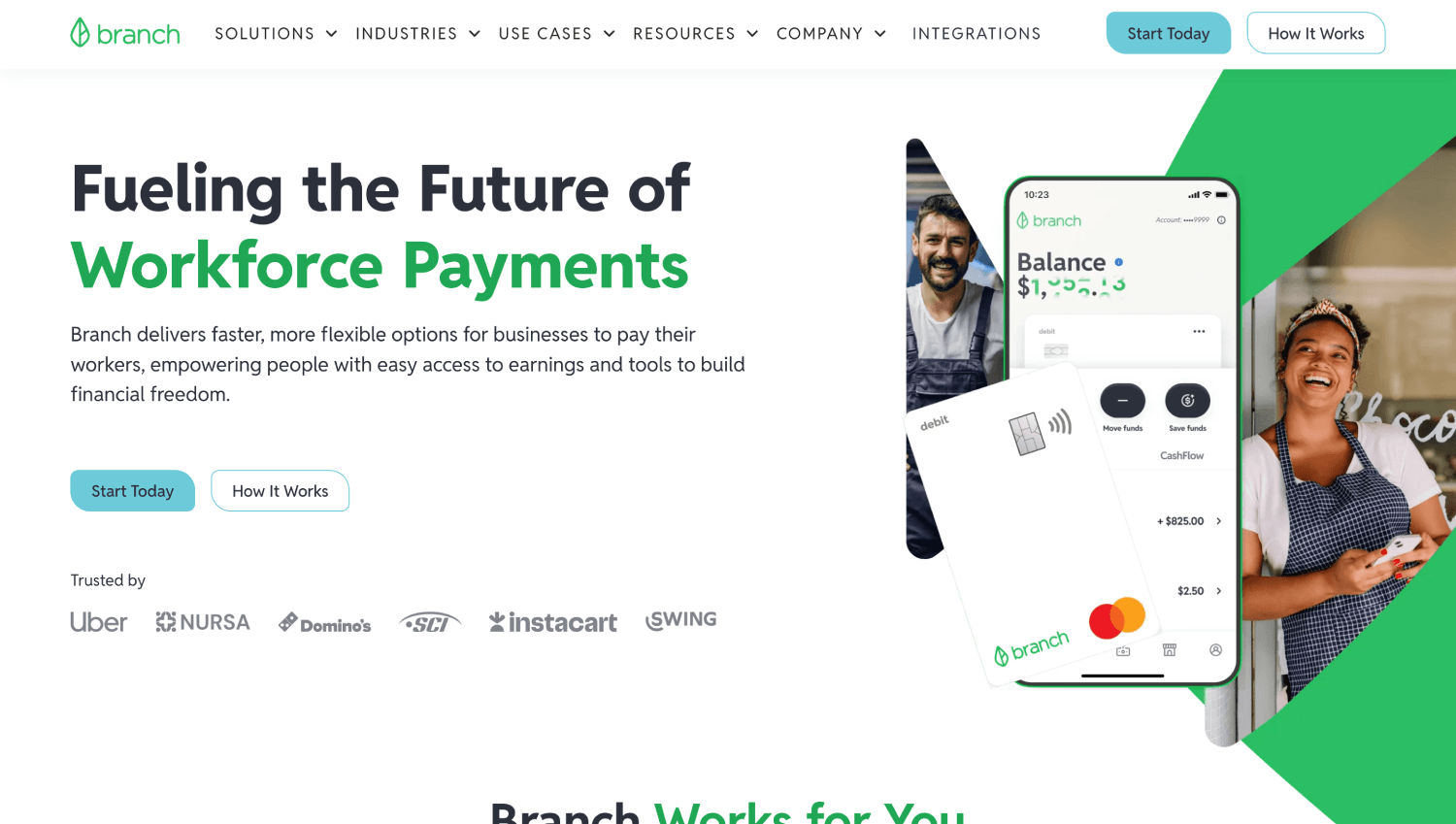
Branch is purpose-built for gig worker and hourly worker disbursements. It offers instant pay via push-to-card and operates a worker-facing app and debit card, which means workers without traditional bank accounts can still receive instant payouts without needing an existing bank relationship.
This is the key differentiator. Most other providers on this list assume the recipient has a bank account or debit card. Branch owns the full recipient-side experience, which matters enormously for platforms with unbanked or underbanked worker populations. The platform also handles earned wage access, tip payouts, and mileage reimbursements as distinct disbursement types.
Branch is sold as a B2B solution to platform operators. Pricing is not publicly disclosed per transaction. For high-volume gig platforms, Branch negotiates enterprise contracts. It is not a self-serve API-first tool in the way Stripe is, which means longer sales cycles but also more support during implementation.
3. Trolley
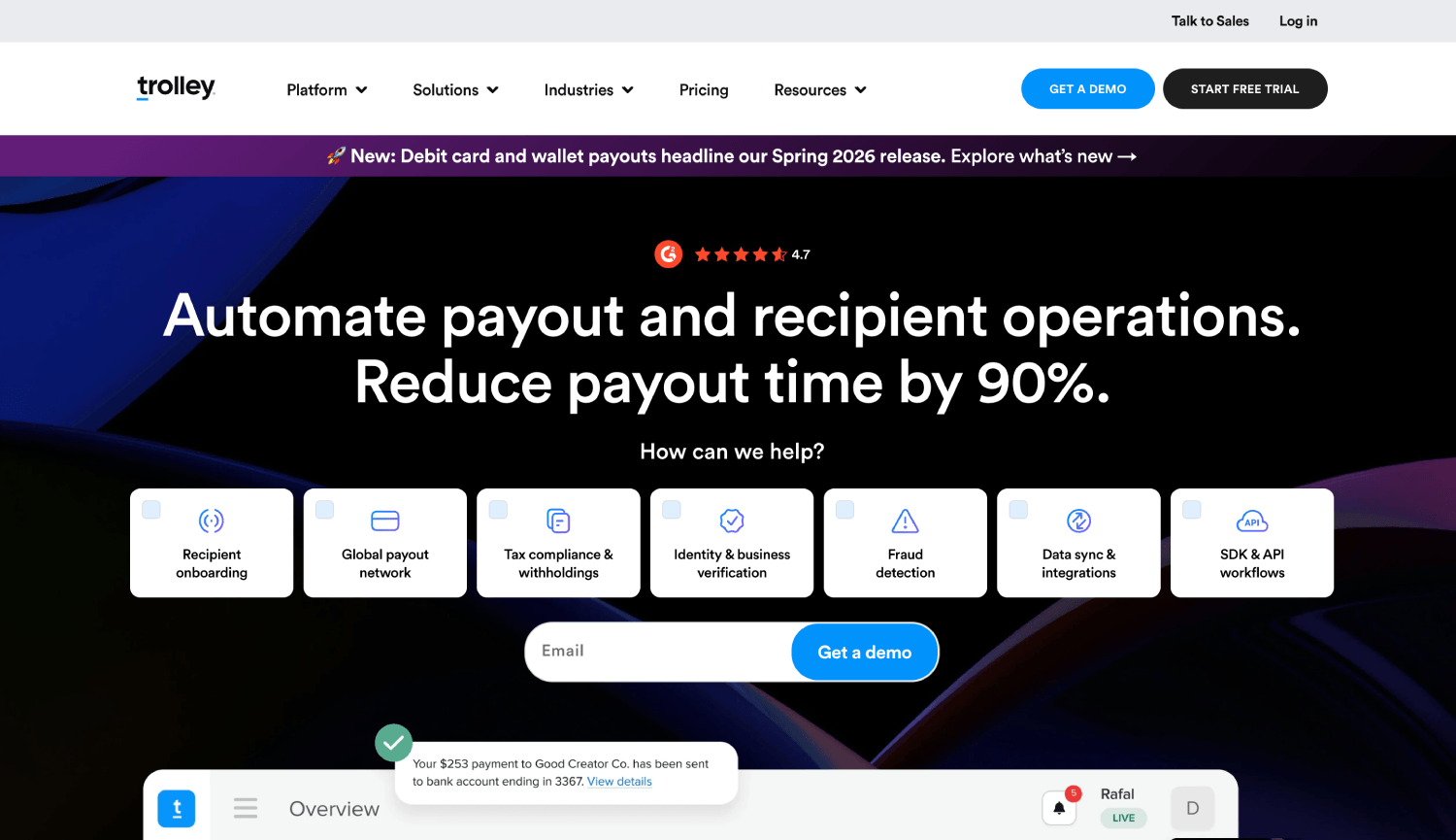
Trolley is the strongest option for creator platforms with international payees. It supports payouts to 210+ countries and territories, handles tax form collection (W-9, W-8BEN) natively in the platform, and offers batch payout management with automated reconciliation.
For US domestic instant payouts specifically, Trolley supports ACH and can connect to faster rails. Where it genuinely stands apart is the combination of tax compliance and global reach in one platform. Creator platforms paying YouTube contributors, writers, or course instructors across the US and internationally will find Trolley handles the full workflow that other providers split across multiple tools.
Trolley’s pricing is not publicly listed per transaction and requires a demo call. It positions as a mid-market to enterprise tool, and the sales process reflects that.
4. Dwolla
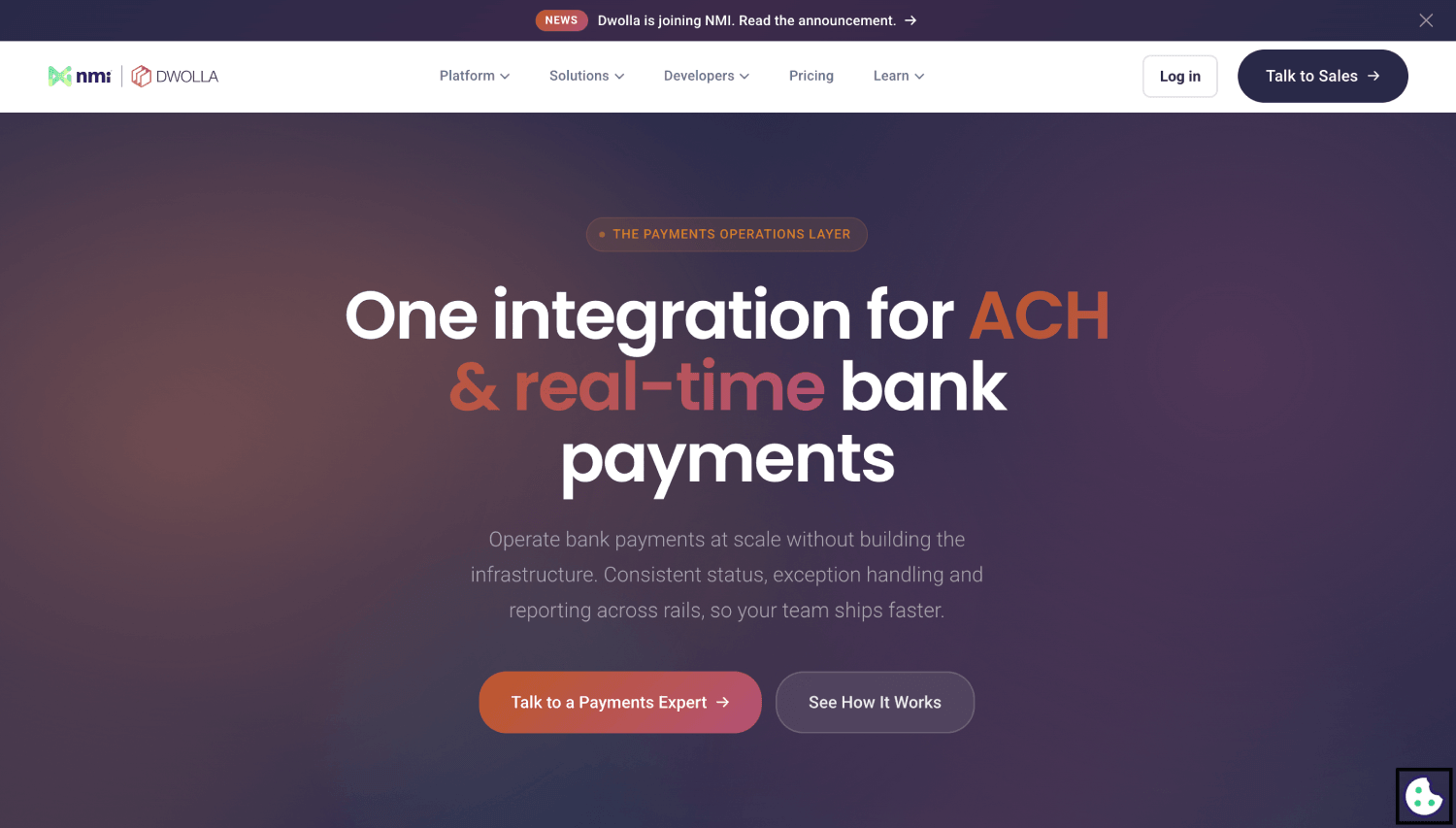
Dwolla is an API-first payment operations platform with strong support for ACH, same-day ACH, and RTP. Its developer documentation is among the most detailed in this category, and it has a clear bank partner model that means Dwolla holds the regulatory infrastructure rather than requiring your platform to carry MTL exposure.
Dwolla’s pricing starts at a free Sandbox tier, with paid plans from $250 per month (as listed on their public pricing page) for production access. Transaction fees vary by plan and volume. For platforms that primarily need bank-to-bank transfers at speed, Dwolla’s RTP support and API quality make it a strong candidate. Push-to-card is not a native Dwolla feature, which is the primary limitation for platforms with workers who lack bank accounts.
Dwolla is a good fit for marketplace and gig platforms where workers are vetted and have verified bank accounts, and where the platform team wants to build a more custom payout experience rather than adopt a white-labeled worker-facing product.
5. Astra
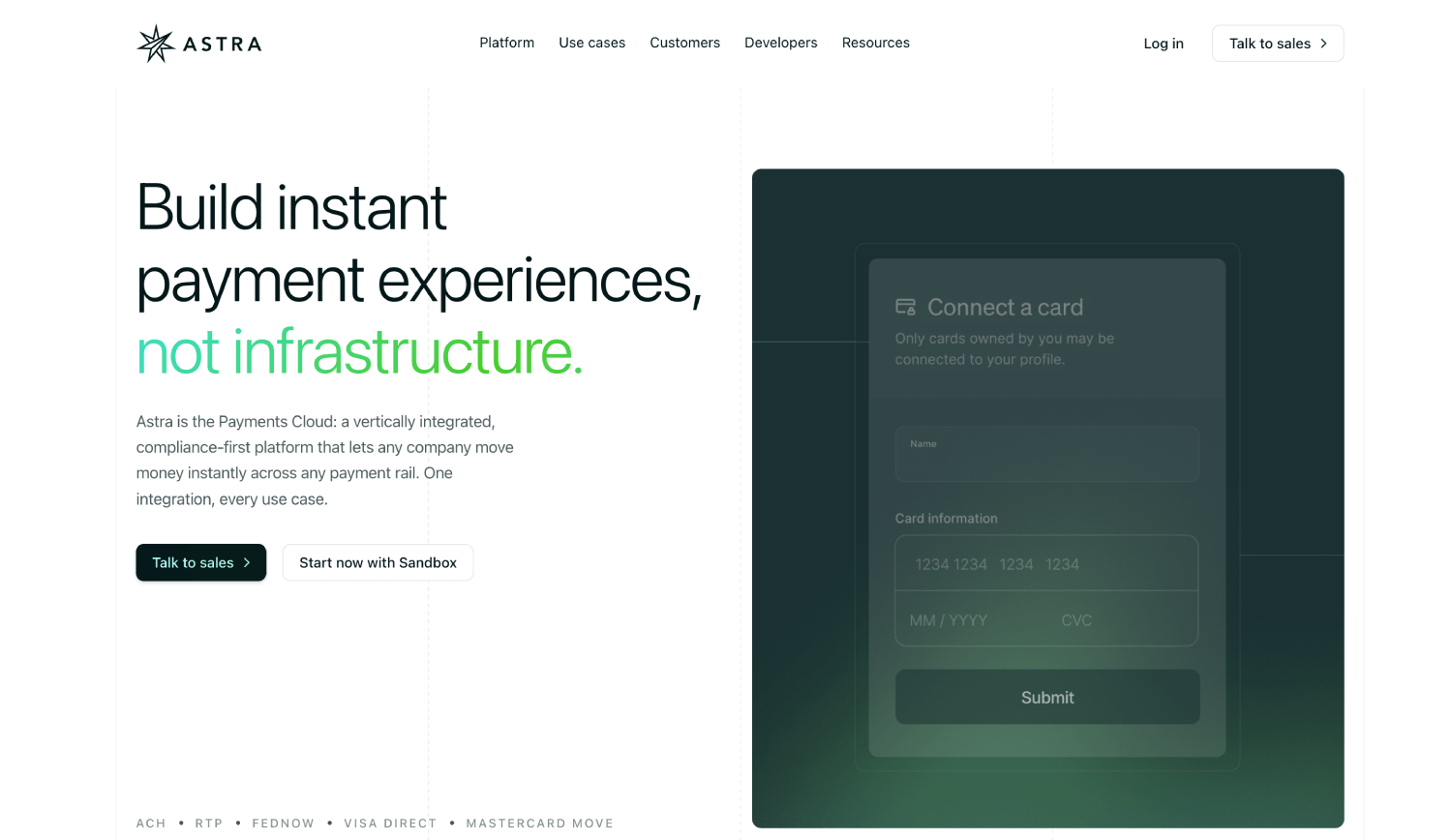
Astra specializes in push-to-card and card-to-card transfer orchestration. It sits as a middleware layer, connecting to Visa Direct and Mastercard Send and handling the routing logic, tokenization, and retry behavior that makes push-to-card production-grade rather than brittle.
Where Astra earns its place on this list is the push-to-card API experience specifically. For platforms that know push-to-card is the primary rail and want a provider focused entirely on making that work reliably, Astra offers a cleaner build path than using a general payments platform that also happens to support Visa Direct as one feature among dozens.
Pricing is not publicly disclosed and is negotiated by volume. Astra targets fintech builders directly, so the API documentation is developer-oriented and the integration is designed for teams who want control over the UX rather than a branded worker portal.
6. Hyperwallet (PayPal)
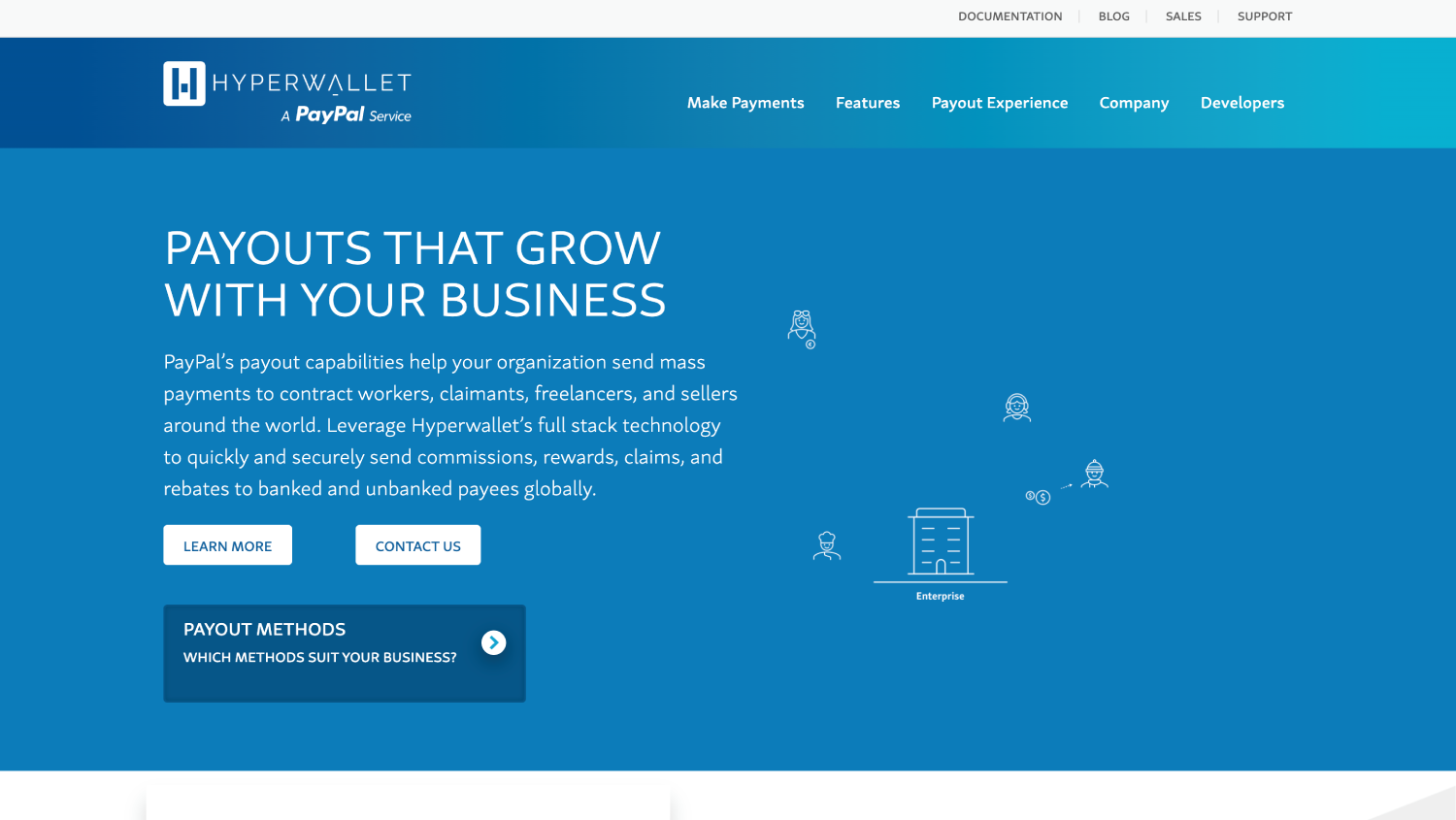
Hyperwallet, now part of PayPal, handles mass payouts at scale. It supports push-to-debit-card, ACH, PayPal wallet, Venmo, prepaid card, paper check, and bank wire as payout methods, giving recipients more choice than almost any other provider on this list.
The recipient flexibility is the main reason to consider Hyperwallet. For platforms with diverse worker populations where some want debit card push, some want PayPal, and some prefer ACH, Hyperwallet’s multi-method support reduces friction without requiring you to integrate multiple providers. The compliance infrastructure is PayPal’s, which is a meaningful advantage for platforms not prepared to build their own.
The trade-off is API modernity. Hyperwallet’s API layer shows its age relative to newer entrants. Teams building a highly custom experience may find the integration more work than the documentation suggests. For platforms that want reliability and recipient optionality over bleeding-edge developer ergonomics, it holds up.
7. Checkbook
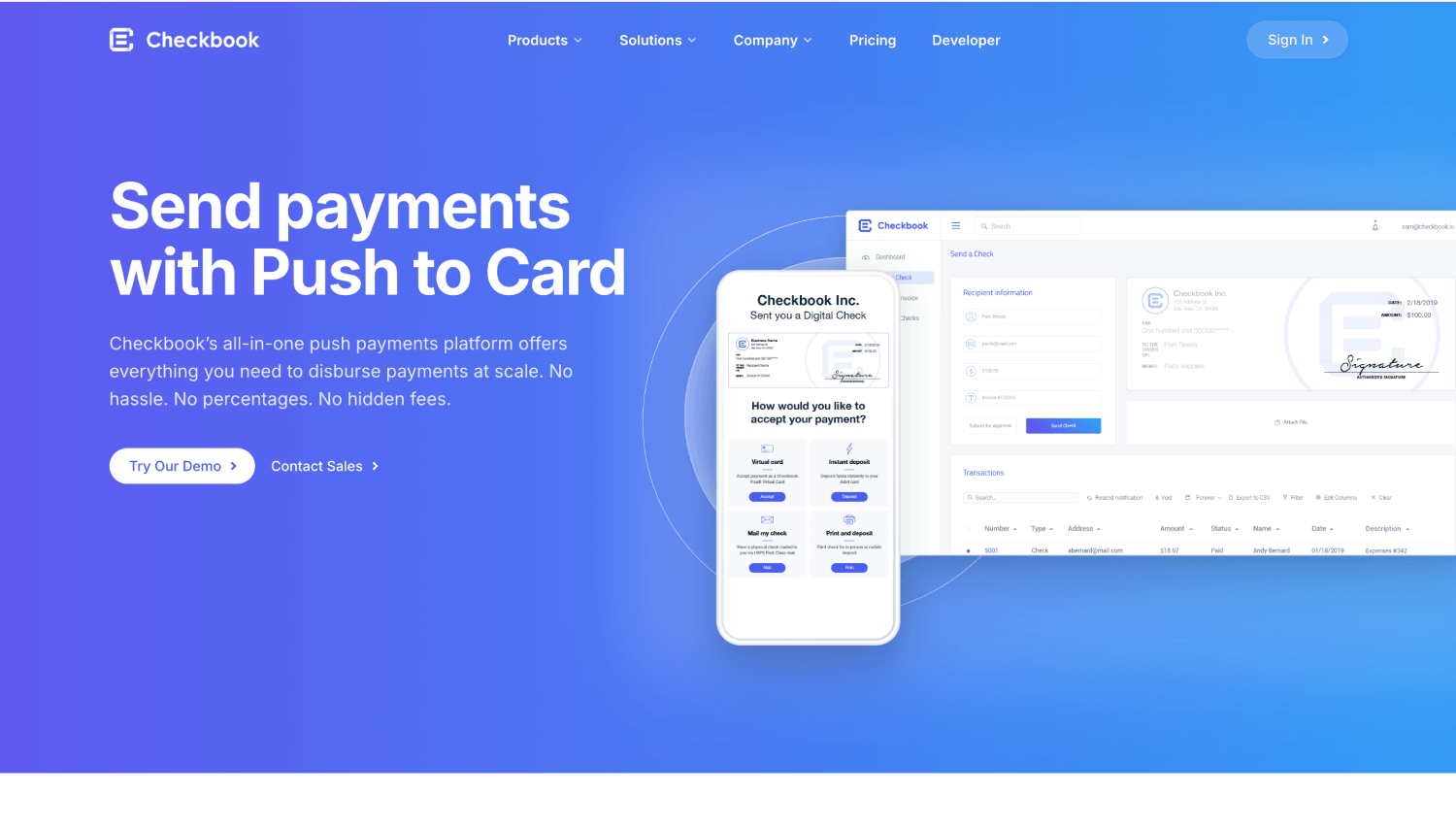
Checkbook takes a different angle. It focuses on digital check payouts, ACH, and direct-to-debit via its own card network connections. The platform is best known for replacing paper check workflows with instant digital equivalents, which is more relevant for creator platforms that inherited legacy payout setups than for platforms building from scratch.
Where Checkbook fits specifically is platforms with a segment of payees who explicitly prefer check payment, combined with workers who want digital instant delivery. Checkbook handles both in one integration, which is a workflow advantage for payout ops teams managing mixed recipient preferences.
Pricing starts at a per-check fee model and scales. The instant delivery options (ACH, push-to-card) are available but are not the headline feature the way they are for Branch or Astra.
8. Gusto Embedded Payroll
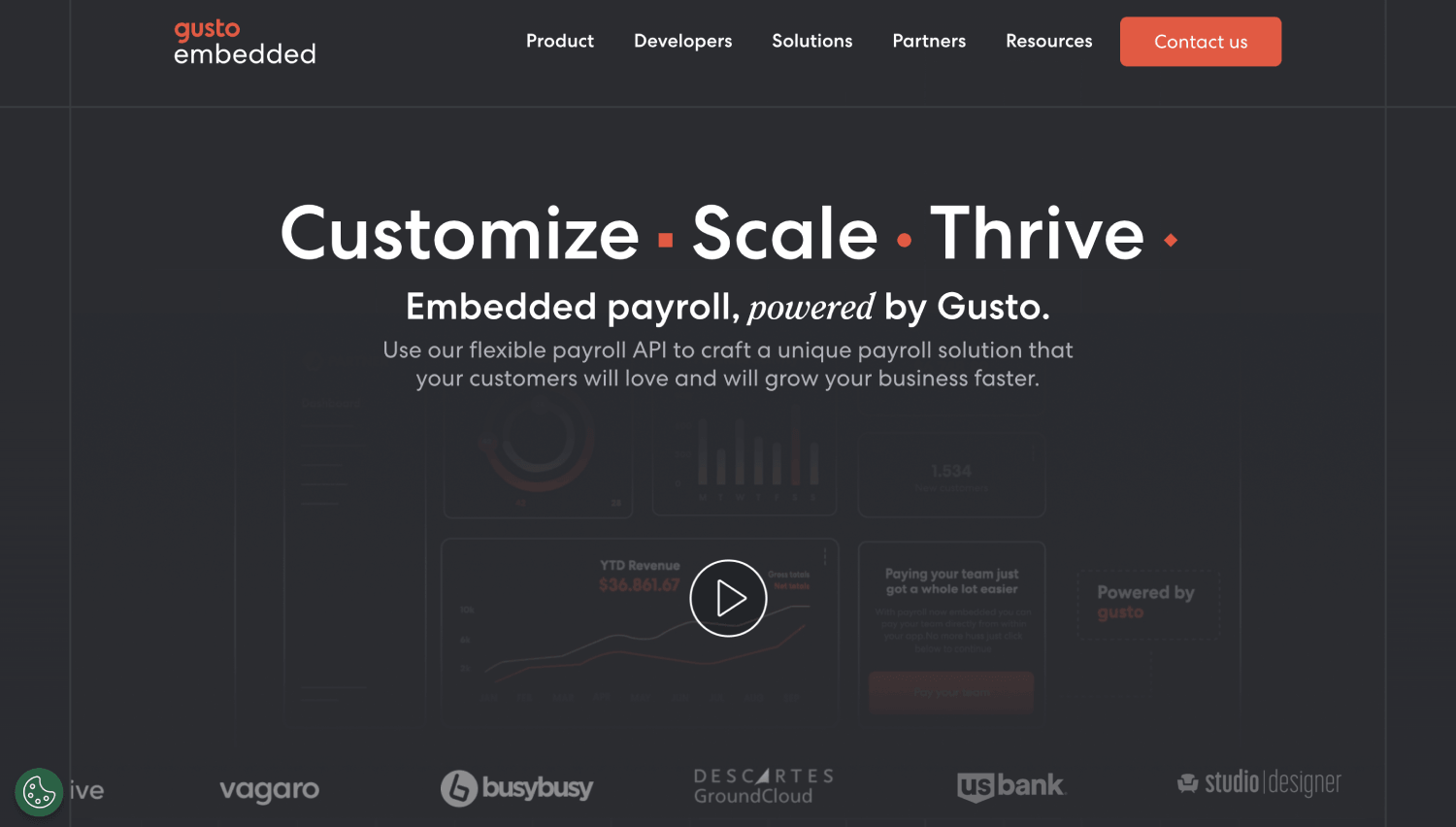
Gusto Embedded Payroll is the right choice when your platform needs to handle payroll tax withholding, W-2 and 1099 generation, and payroll compliance alongside fast disbursement. It is not an instant payout API in the pure sense, but for platforms that have blended worker populations (some W-2 employees, some 1099 contractors) or want to offer payroll as a feature, Gusto’s embedded product handles the compliance surface that pure payout APIs leave exposed.
Gusto Embedded offers same-day direct deposit as an option. It is more relevant for platforms that have graduated beyond pure contractor payout needs into full employer-of-record or payroll-as-a-feature territory. If you are building a vertical SaaS product for home services, healthcare staffing, or similar categories where worker classification matters as much as speed, Gusto Embedded deserves evaluation alongside the faster pure-payout options.
For a deeper look at how embedded payroll APIs compare in the vertical SaaS context, the FintechSpecs embedded payroll API comparison covers Check, Gusto Embedded, and Zeal side by side.
Full Provider Comparison: Rail Support, Speed, and Fit
| Provider | Push-to-Card | RTP / FedNow | Same-Day ACH | Best Fit | Pricing Model |
|---|---|---|---|---|---|
| Stripe Instant Payouts | Yes (Visa Direct) | No | Yes | Stripe-native platforms, larger payouts | 1% per payout, $0.50 min (public pricing) |
| Branch | Yes | Varies by partner | Yes | Gig / hourly workers, unbanked populations | Enterprise contract, not public |
| Trolley | Partial | No (US focus via ACH) | Yes | Creator platforms, international payout + tax | Not public, demo required |
| Dwolla | No | Yes (RTP) | Yes | API-first platforms, banked workers | From $250/mo (public pricing) + per-transaction |
| Astra | Yes (Visa Direct + MC Send) | No | No | Push-to-card-first builds | Volume-negotiated, not public |
| Hyperwallet | Yes | No | Yes | High recipient optionality, multi-method delivery | Not public, varies by volume |
| Checkbook | Yes (limited) | No | Yes | Mixed digital/check payout workflows | Per-transaction, public on site |
| Gusto Embedded | No | No | Yes (same-day DD) | Payroll compliance + embedded disbursement | Per-employee fee model |
What Does the Fee Math Look Like at Real Volumes?
Consider a hypothetical gig platform processing 50,000 payouts per month with an average payout of $40. Using Stripe Instant Payouts at 1% with a $0.50 minimum, every payout in this scenario hits the $0.50 floor , meaning the per-payout fee exceeds the 1% rate for any payout under $50.* That works out to $25,000 per month in instant payout fees alone, or $300,000 annually, before any other platform costs.
At the same volume with a flat $0.25 per-payout provider (common at enterprise volume tiers with RTP-enabled tools), the same throughput costs $12,500 per month, $150,000 annually. The spread is $150,000 per year on identical transaction volume. Rail selection and fee structure are not operational details. They are margin decisions.
* This example assumes 100% of payouts are at or below $50, so every transaction hits the $0.50 minimum rather than the 1% rate. At higher average payout amounts, the percentage fee would exceed the floor and the total cost would differ accordingly.
This is why the FintechSpecs Payout Stack Test prioritizes fee structure at volume as a distinct evaluation criterion rather than treating cost as a secondary filter. The right provider at 1,000 payouts per month can become the wrong provider at 50,000. For a full treatment of how hidden cost structures compound across fintech infrastructure, the FintechSpecs breakdown of hidden fintech SaaS margin killers is worth reviewing before signing any infrastructure contract.
How Do Compliance Responsibilities Differ Across Providers?
This is where platforms most often get caught off guard. Not all instant payout providers are equal from a regulatory standpoint.
Stripe, Dwolla, Branch, and Hyperwallet all operate with their own licensing infrastructure, meaning your platform uses their regulatory coverage. You are responsible for your own KYC and fraud controls for your user base, but you are not separately obtaining money transmitter licenses in every state. This is the right structure for most platforms at seed through Series B scale.
Astra and some smaller API providers operate as pass-through technology layers that connect to sponsor banks or card networks. In some configurations, your platform may need to hold specific licenses or work through a sponsor bank arrangement of your own. Clarify this before integration, not during a legal review six months later.
Trolley handles tax withholding and 1099/W-8 reporting as part of its product, which reduces compliance burden for creator platforms specifically. No other provider on this list combines instant payout rails with native tax compliance in one platform at the same depth.
For teams building their first embedded financial product, the FintechSpecs outbound payment API comparison covers the B2B payout infrastructure layer more broadly, including how compliance responsibility typically divides between platform and provider.
Frequently Asked Questions
What is an instant payout?
An instant payout is a disbursement that reaches the recipient in minutes or seconds rather than the 1-3 business days typical of standard ACH. The mechanism is either push-to-card (Visa Direct or Mastercard Send, delivering to a debit card), RTP (The Clearing House’s real-time bank transfer network), or FedNow (the Federal Reserve’s instant payment rail). All three operate 24/7, including weekends and holidays. The provider you use determines which rails are available and what the per-transaction cost is.
What is a push-to-card payout and how long does it take?
Push-to-card is a payment method that sends funds directly to a debit card using Visa Direct or Mastercard Send. Funds typically appear in under 30 minutes and in many cases in under two minutes. It works without the recipient needing to initiate a pull or share full bank account details. The recipient just provides their debit card number. This is the fastest broadly accessible instant rail for US workers because it reaches any eligible Visa or Mastercard debit card, regardless of whether the underlying bank is enrolled in RTP or FedNow.
Which instant payout provider is best for gig platforms with unbanked workers?
Branch is the strongest choice when a meaningful portion of your worker base lacks a traditional bank account. Branch operates a worker-facing debit card and app, which means workers receive funds to a Branch-issued card without needing a pre-existing bank relationship. Hyperwallet is a secondary option, supporting PayPal and Venmo as payout destinations in addition to debit card and ACH, which provides flexibility without requiring a bank account for every payee.
Does Dwolla support FedNow and RTP for instant payouts?
Dwolla supports RTP via The Clearing House network. FedNow support varies by Dwolla’s sponsor bank arrangements and should be confirmed directly with their team for production use cases. Dwolla does not natively support push-to-card (Visa Direct or Mastercard Send), which means it is better suited for platforms whose workers have verified bank accounts at RTP-enabled institutions than for platforms needing a card-based instant option as a fallback.
What is the difference between RTP, FedNow, and same-day ACH?
RTP (The Clearing House) and FedNow (Federal Reserve) are true instant payment rails that settle in seconds, 24/7. Same-day ACH settles on the same business day but only during business hours and depends on batch cutoff windows, meaning a payout initiated at 4:45 PM may not reach the recipient until the next morning. RTP and FedNow both carry per-transaction limits; according to The Clearing House’s public documentation, RTP has a $1 million per-transaction limit. FedNow’s per-transaction limit is set by each participating financial institution and can vary , confirm the applicable limit with your bank or provider. Same-day ACH has a $1 million per-transaction cap as well.
How should I choose between Stripe Instant Payouts and a dedicated payout provider?
Stay with Stripe Instant Payouts if your platform already processes payments through Stripe Connect, your average payout is large enough that the 1% fee does not create a cost problem, and you have no need for RTP/FedNow or unbanked worker support. Switch to a dedicated provider (Branch, Dwolla, Astra) if your average payout is small, volume is high, you need multiple rail options, or you have compliance complexity that requires a vendor with deeper payout-specific infrastructure. The decision point is typically somewhere between 20,000 and 50,000 payouts per month, where the fee delta against a flat-rate provider becomes material.
Do instant payout providers handle 1099 tax reporting for gig workers?
Most do not. Stripe, Dwolla, Astra, and Branch are disbursement infrastructure providers, not tax compliance platforms. Trolley is the primary exception on this list, offering native W-9 collection, W-8BEN handling, and 1099 generation within its platform. Platforms using other providers typically pair them with a dedicated tax compliance tool or handle 1099 filing through their own accounting stack. The FintechSpecs fintech compliance checklist covers the 1099 and tax ID collection requirements in more detail.
The Counterintuitive Truth About Instant Payout Infrastructure
Most platforms treat instant payouts as a feature to add. The smarter framing is to treat payout speed as a worker retention mechanism that competes directly with platform switching. When a worker on Platform A can see $87 in earned pay and access it in 30 minutes, while the same worker on Platform B waits until Friday, the payout infrastructure becomes the product experience.
The providers that get this right are the ones that have built around the recipient experience, not just the sender API. Branch’s worker app, Trolley’s tax workflow, Hyperwallet’s multi-method delivery , these are not extra features. They are the thing that removes friction for the worker on the other end of your payout call.
The final variable most operators underestimate is rail resilience. Push-to-card has high recipient coverage but depends on card network uptime and debit card eligibility. RTP has near-instant settlement but requires bank enrollment. A production payout system for any platform expecting to grow past a few thousand active workers should have at least two rails with automatic fallback logic, not a single path that fails silently on a Saturday night. The choice of instant payout provider determines whether you can build that resilience in without going back to re-architect your payout stack 18 months later.