
- Plaid’s per-call pricing model creates unpredictable costs at scale , several aggregators offer flat-rate or volume-tiered pricing that pencils out better above 10,000 monthly active users.
- Coverage is not Plaid’s moat: MX, Finicity, and Yodlee each match or exceed Plaid on US institution count for specific use cases like lending, payroll, and wealth management.
- Quiltt is the only aggregator on this list built explicitly as a multi-rail abstraction layer, letting you run Plaid and MX simultaneously without rewriting your integration.
- The right alternative depends on your use case first, price second: a personal finance app has different data needs than an ACH origination platform.
- Running a single aggregator is an operational risk most founders do not price in , aggregator outages have taken down entire product features overnight.
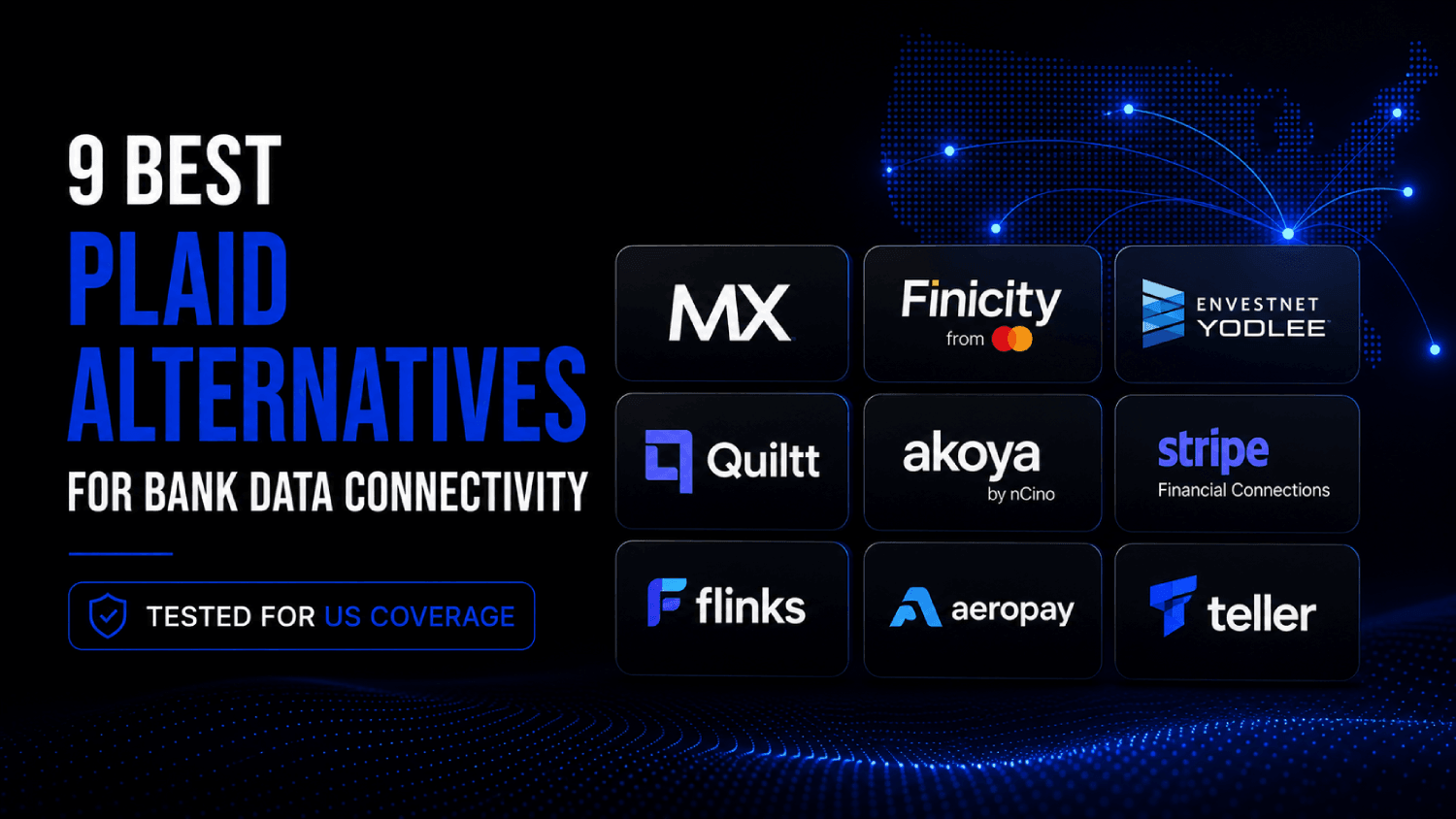
The strongest Plaid alternatives for US bank data connectivity are MX, Finicity (Mastercard), Envestnet Yodlee, Quiltt, Akoya, Stripe Financial Connections, Flinks, Aeropay, and Teller. Each covers 10,000 or more US institutions in some form, but they differ sharply on pricing model, data quality, sandbox access, and the specific financial workflows they serve best. Plaid is not the default choice for every stack.
Why Developers and Founders Are Actually Leaving Plaid
Plaid’s brand dominance in open banking is real but it obscures a specific problem: the pricing model is consumption-based, and at any meaningful scale, the monthly bill becomes a line item that finance teams start questioning. A company processing 50,000 account connections per month is paying in a range that most early-stage companies did not model when they chose Plaid in year one.
Coverage gaps are the second forcing function. Plaid’s network is wide but uneven , smaller credit unions, regional banks, and certain payroll providers have spotty or unreliable connections. For lending products that need verified income data or real-time balance checks, a failed connection is not a UX annoyance. It is a dropped application.
The third reason is aggregator concentration risk. Building an entire bank data stack on a single aggregator means a Plaid outage takes your product down. That risk calculus changes once you have real users. The alternatives below solve for one or more of these problems specifically.
If you want a direct head-to-head breakdown of Plaid, MX, and Finicity on data quality and pricing tiers, the Plaid vs MX vs Finicity comparison on FintechSpecs covers that in detail. This list assumes you have already done that research and are ready to pick.
The FintechSpecs Aggregator Selection Matrix
Most alternatives lists rank by feature count. That produces misleading results because a payroll data API and a personal finance aggregator are not competing for the same customer. The FintechSpecs Aggregator Selection Matrix organizes the decision around four dimensions: Use Case Fit (what financial workflow the aggregator is built for), Pricing Structure (per-call vs flat vs revenue share), Multi-Rail Readiness (whether you can run it alongside another aggregator without duplicate integration work), and Sandbox Access Speed (how long before a developer can call a real test endpoint).
Rank those four dimensions in order of what your product needs most, then read the table below left to right. The aggregator that scores best on your top two dimensions is almost always the right starting point, even if it loses on the others.
Institution coverage figures in the table below are sourced from each vendor’s public documentation and developer-facing product pages.
| Aggregator | Best For | US Institution Coverage | Pricing Model | Sandbox Access | Multi-Rail Ready |
|---|---|---|---|---|---|
| MX | PFM, data enrichment, wealth | 16,000+ institutions (per MX public docs) | Volume-tiered, contract | Self-serve | Yes |
| Finicity (Mastercard) | Lending, income verification, ACH | 15,000+ institutions (per Finicity public docs) | Per-event, volume tiers | Self-serve | Yes |
| Envestnet Yodlee | Wealth management, enterprise | 17,000+ data sources (per Yodlee public docs) | Enterprise contract | Registration required | Yes |
| Quiltt | Multi-aggregator abstraction | Inherits from MX/Plaid/others | Flat monthly + per-connection | Self-serve, fast | Built for it |
| Akoya | OAuth-only, no screen scraping | ~750 FIs (API-direct) | Not publicly disclosed | Registration required | Limited |
| Stripe Financial Connections | Stripe-native payment flows | Wide US coverage | Per-session (see Stripe’s public pricing page) | Immediate (Stripe account) | No |
| Flinks | Lending, Canadian crossover | US + Canada | Custom contract | Demo-first | Yes |
| Aeropay | ACH push payments, cannabis | US banks and credit unions | Per-transaction | Registration required | Limited |
| Teller | Developer-first, direct API | Major US banks, direct | Per-connection (see Teller’s public pricing page) | Immediate | Yes |
Which Aggregator Should You Switch To?
1. MX: Best for Personal Finance and Data Enrichment
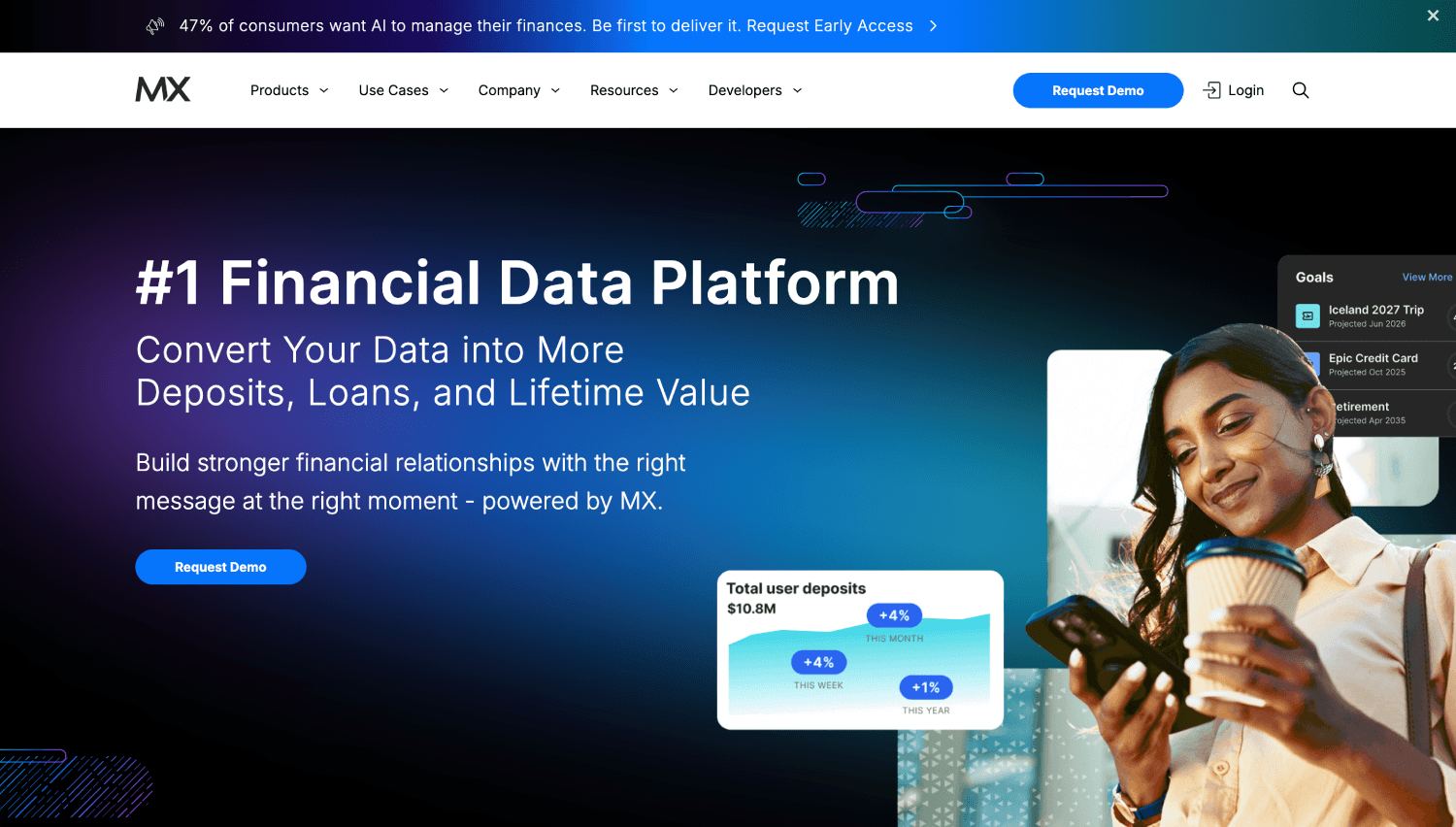
MX Technologies connects to over 16,000 US financial institutions, per its public product documentation, and has built its differentiation around data cleansing and transaction categorization rather than raw connectivity. Where Plaid returns a transaction description like “SQ *COFFEE ROASTERS,” MX returns a cleaned merchant name, category, and logo. For personal finance management (PFM) apps, budgeting tools, and wealth products, that enrichment layer eliminates significant post-processing work.
MX’s pricing is volume-tiered and requires a contract conversation , there is no self-serve pay-as-you-go option at production scale. That is a barrier for early-stage teams but a feature for mature products that want predictable billing. MX’s API documentation and developer sandbox are available without a sales call, which is better than many enterprise competitors.
Switch if: You are building a PFM, budgeting, or wealth product and Plaid’s raw transaction data requires too much cleaning on your end.
2. Finicity (Mastercard): Best for Lending and Income Verification
Finicity, acquired by Mastercard in 2020, has invested most heavily in the lending data stack. Its Verification of Assets (VOA) and Verification of Income and Employment (VOIE) products are built specifically for mortgage underwriting, personal lending, and income-based credit decisions. Fannie Mae and Freddie Mac have both approved Finicity data for digital mortgage applications, which matters for any lender touching GSE-backed loans.
Finicity covers over 15,000 US institutions, per its public documentation, and offers OAuth-based connections where banks support it, reducing reliance on credential-based scraping. Its per-event pricing model means you pay when users connect accounts or run verification reports, not on a flat monthly seat. For a lending product that runs high-value but infrequent verifications, that structure is cheaper than Plaid’s model.
Switch if: You are in lending, mortgage, or underwriting and need GSE-approved income and asset verification data that Plaid does not provide natively.
3. Envestnet Yodlee: Best for Enterprise Wealth and Broad Coverage
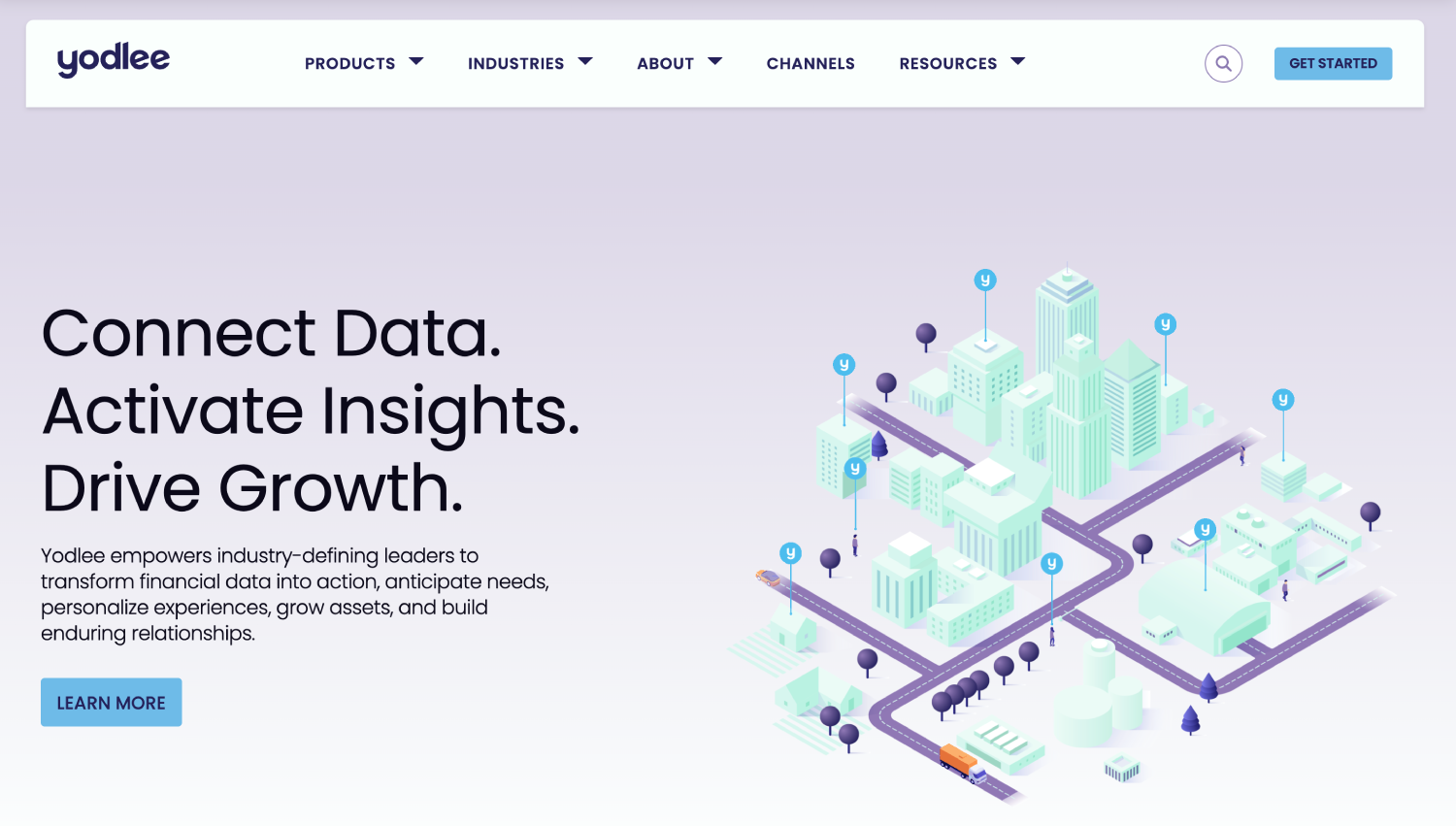
Envestnet Yodlee is the oldest aggregator on this list, and its age shows in two opposite ways. Coverage is unmatched , Yodlee’s public documentation claims over 17,000 data sources including investment accounts, insurance, and international institutions that Plaid does not touch. At the same time, its API design and documentation reflect an enterprise sales model more than a developer-first one. Getting a sandbox account requires registration, and pricing is negotiated by contract.
Yodlee’s clearest advantage is breadth of account types. Investment accounts, 401(k)s, HSAs, and insurance policies are first-class data objects in Yodlee’s schema. Plaid handles these inconsistently. For a financial wellness or full-spectrum wealth product that needs one aggregator to cover every account type a user might have, Yodlee is worth the enterprise sales friction.
Switch if: You need investment account data, retirement account balances, or insurance data alongside banking data, and you have the team to manage an enterprise vendor relationship.
4. Quiltt: Best for Running Multiple Aggregators Without Multiple Integrations
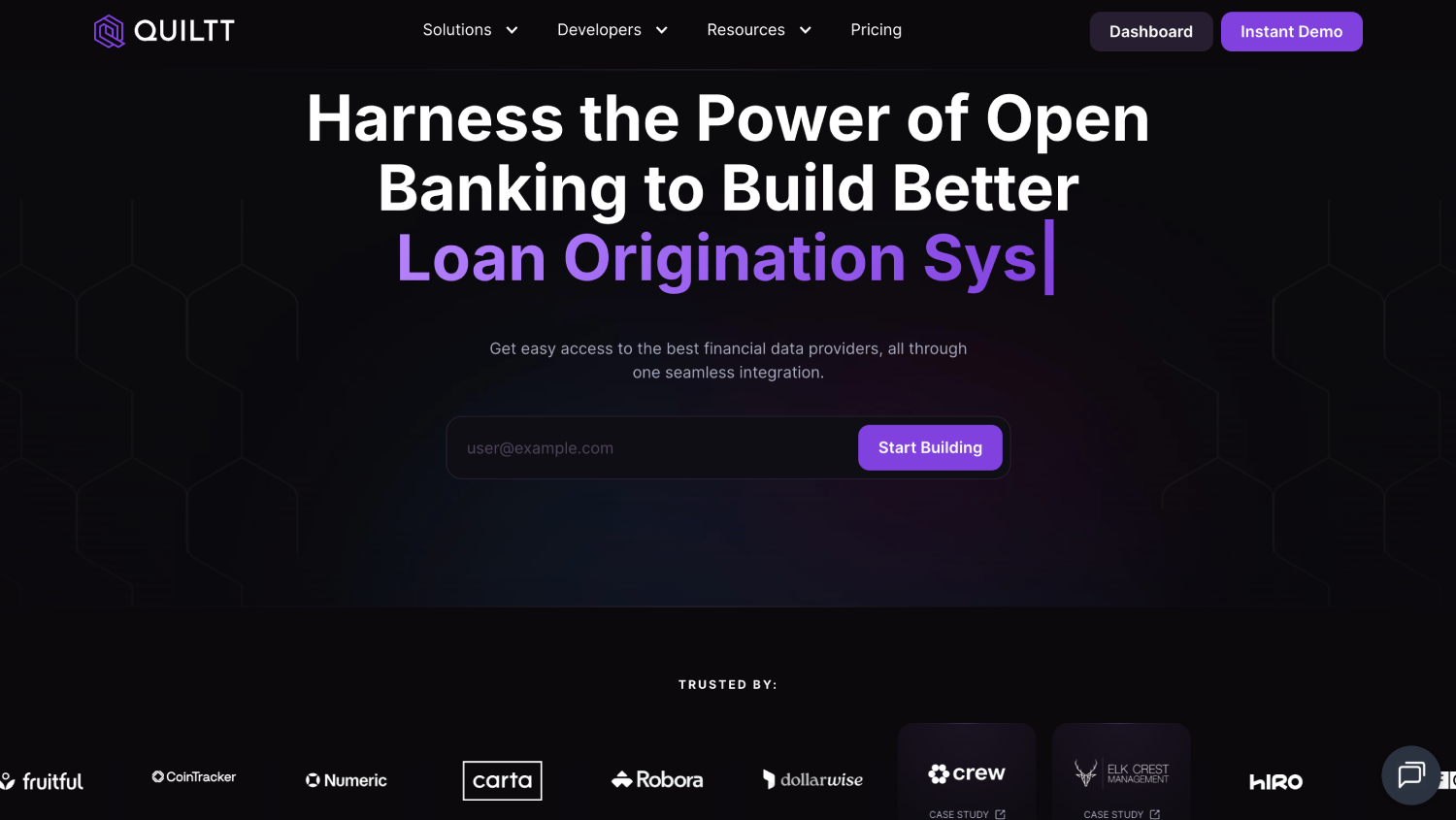
Quiltt is structurally different from every other entry on this list. It is not a data aggregator competing with Plaid on institution count. It is an abstraction layer that sits above aggregators , Plaid, MX, and others , and normalizes their data into a single GraphQL API. You integrate Quiltt once, then route users to whichever underlying aggregator connects their bank best.
This architecture solves two problems at once. First, it handles the coverage gaps that any single aggregator has. When Plaid fails to connect a credit union, Quiltt can fall back to MX automatically. Second, it eliminates aggregator lock-in. Swapping from Plaid to MX does not require rewriting your data models or UI components , Quiltt’s schema stays constant. For a product that has already been burned by a single-aggregator outage, or is anticipating one, Quiltt’s multi-rail approach is the most operationally sound architecture.
Quiltt’s pricing includes a flat monthly component plus per-connection fees. Sandbox access is self-serve and fast, which is relevant if you are evaluating it against a procurement-heavy alternative. The trade-off is that Quiltt’s underlying aggregators still have their own costs , you are not bypassing aggregator fees, you are layering Quiltt’s coordination cost on top. The math works when the fallback coverage or the single-integration efficiency is worth that overhead.
Switch if: You have been burned by single-aggregator downtime, you want coverage redundancy without maintaining two separate integrations, or you are building a product where bank connection success rate is a core metric.
5. Akoya: Best for OAuth-Only, Screen-Scraping-Free Connectivity
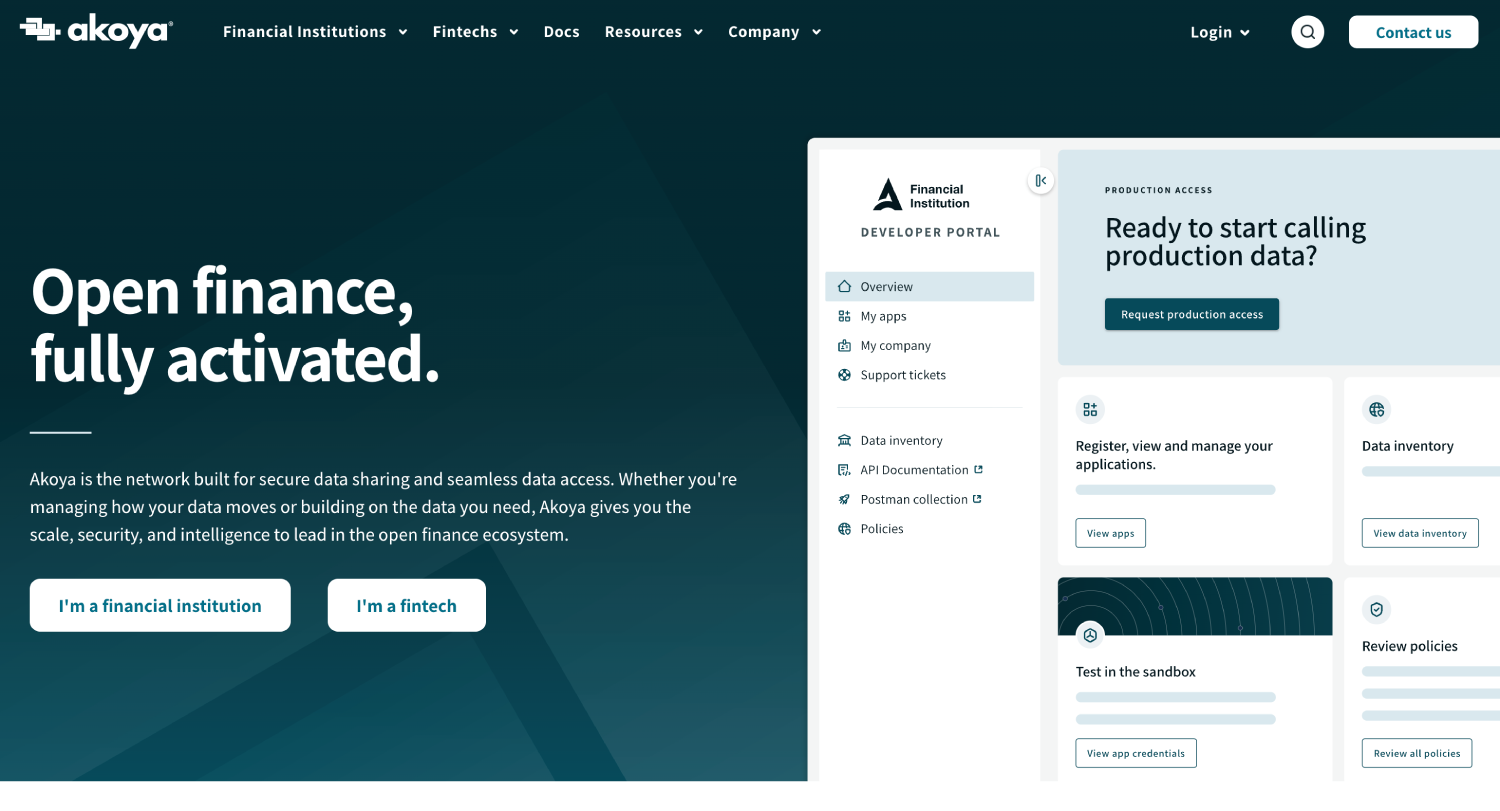
Akoya is a network founded by a consortium of major US banks including Fidelity, JPMorgan, and Wells Fargo. Every connection on Akoya is OAuth-based and direct , no credential storage, no screen scraping. That is the entire pitch and it is a meaningful one for products where credential handling creates security or compliance exposure.
The coverage limitation is real. Akoya connects to roughly 750 financial institutions as of its public network documentation, all of which have voluntarily joined the network. That number will grow as open banking regulation increases pressure on banks to provide API access, but today it is a fraction of Plaid’s or Yodlee’s coverage. Akoya works best as a primary aggregator if your user base is concentrated at major banks, or as a supplement to a broader aggregator for users at partner institutions.
Switch if: Your legal or compliance team has flagged credential-based scraping as a risk, and your users are primarily at large US financial institutions.
6. Stripe Financial Connections: Best for Stripe-Native Payment Products
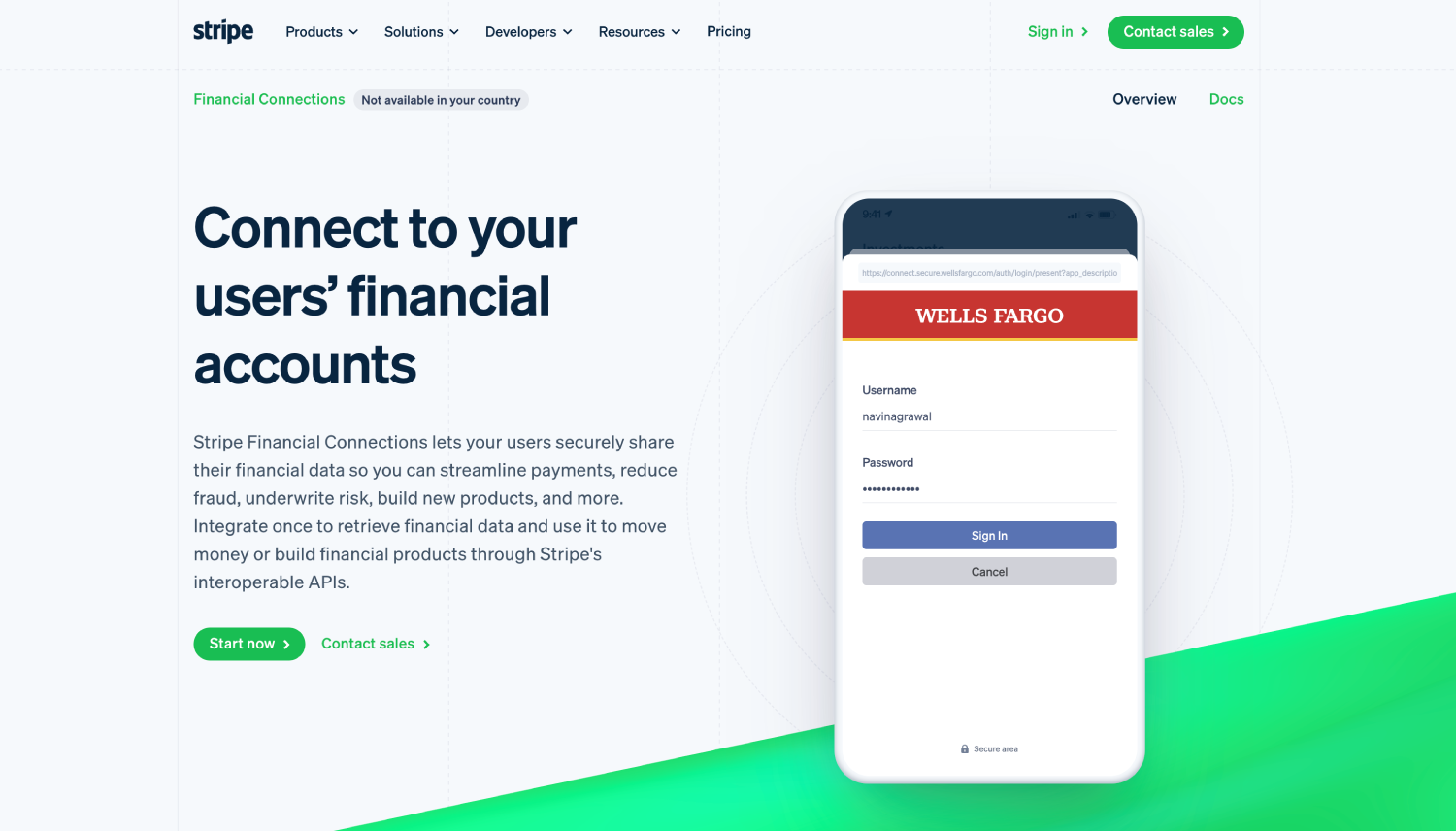
Stripe Financial Connections is the right answer for exactly one situation: you are already on Stripe and need bank account verification or ACH authorization as part of a Stripe-powered payment flow. Stripe’s per-session pricing is listed on Stripe’s public pricing page, the integration is one API call if you are already using Stripe Elements, and it just works.
Outside that situation, Stripe Financial Connections is the wrong tool. It does not expose transaction history as a primary product. It does not enrich data. It does not support multi-bank aggregation for PFM use cases. For a deeper breakdown of where Stripe Financial Connections ends and Plaid begins, the Stripe Financial Connections vs Plaid comparison covers the edge cases that matter for payment-focused products.
Switch if: You are on Stripe, you need bank account verification for ACH, and you do not need transaction history or enrichment.
7. Flinks: Best for US-Canada Coverage or Canadian-First Products
Flinks is a Canadian aggregator with meaningful US coverage, which makes it the only viable option if your product needs to connect bank accounts in both countries without running two separate aggregators. It covers major US banks and credit unions alongside Canadian institutions, and its data model is consistent across both markets.
Flinks positions itself as a lending-oriented aggregator, with products focused on cash flow analysis and income verification. Pricing is custom contract and requires a demo conversation, which adds friction for early-stage evaluation. For a purely US product, Flinks does not have a compelling advantage over Finicity or MX. For a product with cross-border user acquisition from day one, it does.
Switch if: Your product serves users in both the US and Canada, or you are a Canadian company expanding south.
8. Aeropay: Best for High-Risk Verticals and ACH Push Payments
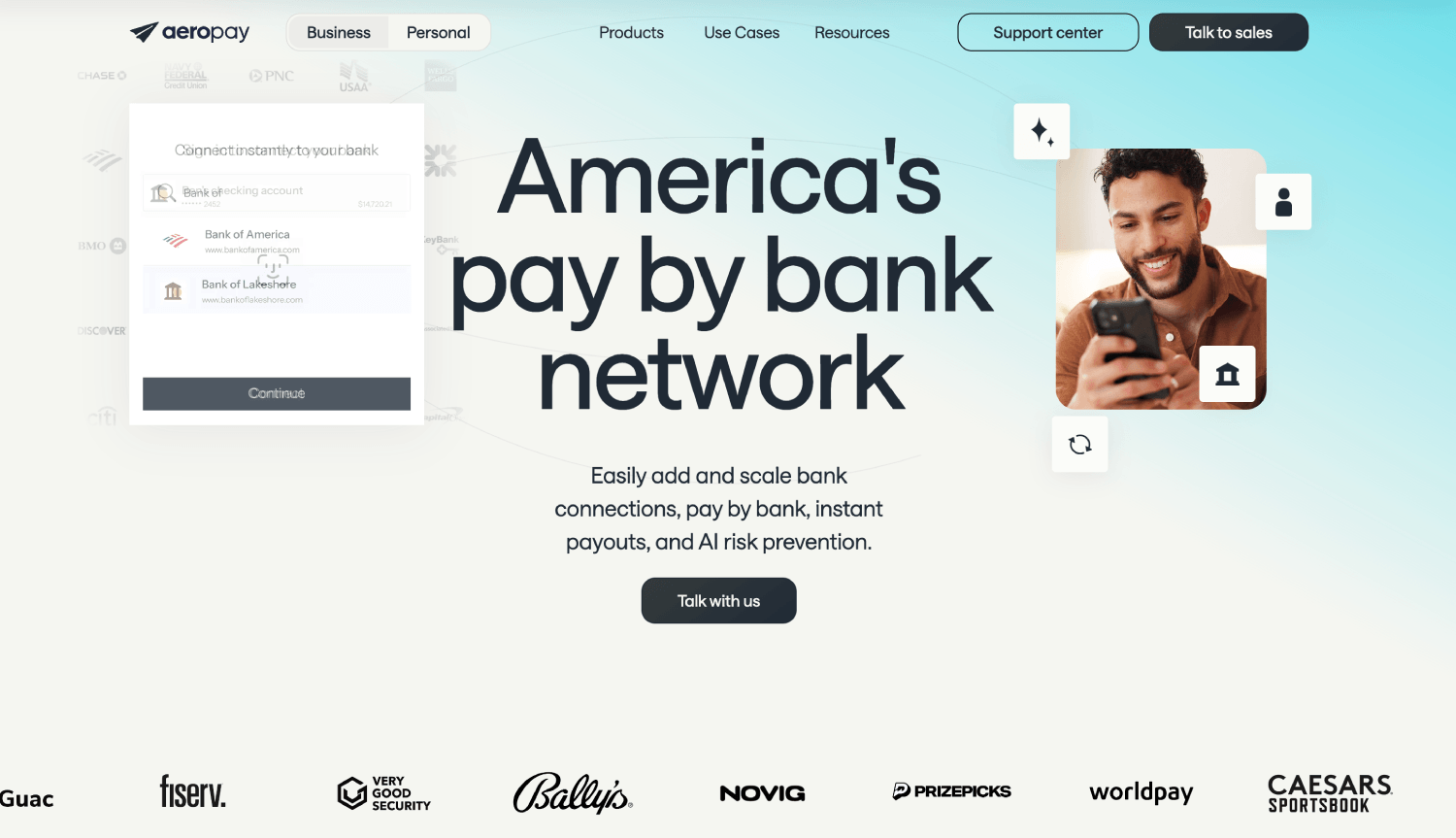
Aeropay is less an open banking aggregator than a bank-linked payment network built on top of ACH. It connects to US banks and credit unions specifically to move push payments, and its known deployment in cannabis retail and other high-risk verticals reflects a deliberate positioning away from traditional card networks. If your business operates in a vertical where card processing is restricted or expensive, Aeropay’s bank-to-bank payment model is worth evaluating.
Aeropay does not compete with Plaid on data breadth. It does not offer transaction history aggregation or PFM-grade enrichment. The use case is payments, not data. Comparing it to Plaid directly is a category error , but it belongs on this list because founders looking at alternatives often have an underlying payment problem, not a data problem.
Switch if: Your product needs bank-linked payments in a high-risk vertical and card processing is not available or too expensive.
9. Teller: Best for Developers Who Want Direct, Clean API Access
Teller connects directly to major US banks including Chase, Bank of America, Wells Fargo, and US Bank through direct integrations rather than screen scraping or data aggregation middlemen. Its API is REST-based, its documentation is developer-first, and its pricing is public on Teller’s website , a per-connection monthly fee with no minimum contract.
The coverage limitation is the same as Akoya’s: Teller supports a defined list of major banks, not the full 10,000-plus institution universe that Plaid or Yodlee covers. For a product whose users are almost entirely at the top 20 US banks by deposit share, that coverage gap is irrelevant. For a product with a diverse user base including credit unions and regional banks, Teller needs to be supplemented. Its sandbox is available immediately with a free account, which makes it the fastest aggregator to evaluate on this list.
Switch if: Your users are concentrated at major US banks, you want clean direct API access without scraping, and you are tired of enterprise sales processes.
How Much Does Switching Aggregators Actually Cost?
The direct API cost is only part of the calculation. Consider a hypothetical scenario for illustration: a Series A fintech with 25,000 monthly active users and an average of 1.5 bank connections per user. At Plaid’s standard per-call pricing , which Plaid does not publish publicly and varies by contract , the monthly bill scales with every new user and every sync cycle. Switching to a flat-rate aggregator or a lower per-connection model can reduce that line item significantly, but the engineering cost to re-integrate is real. The hypothetical is meant to show the cost structure, not quote a specific savings figure, since actual pricing requires a vendor conversation.
A clean aggregator swap on a well-architected codebase takes two to four weeks of engineering time. On a tightly coupled codebase where Plaid’s data schema is woven into the product logic, it can take two to three months. That engineering cost should be modeled against 12 months of pricing savings before making the switch purely on cost grounds. If the switch is driven by coverage gaps or reliability concerns, the calculus is different , connection failures have a direct user drop-off cost that is harder to model but usually larger than the engineering investment.
Founders evaluating aggregator costs alongside the rest of their fintech infrastructure should look at the broader picture of hidden costs that erode fintech SaaS margins , aggregator fees rarely appear in isolation.
Should You Run Multiple Aggregators at Once?
The short answer is yes, if your bank connection success rate is a product metric you track. A user who cannot connect their bank account is a churned or lost user , they do not usually retry. Running two aggregators in a waterfall (try Plaid first, fall back to Finicity or MX on failure) increases connection success rates measurably, particularly for users at smaller institutions or credit unions.
The operational challenge is data schema normalization. Each aggregator returns transaction data, balance data, and account metadata in slightly different formats. Without an abstraction layer, you are maintaining two separate data models and two sets of edge case handling. Quiltt exists specifically to solve this problem. For teams that want to build the abstraction layer themselves, it is achievable but it is not a weekend project.
Multi-aggregator architectures also affect your compliance posture. Each aggregator has its own data use agreements and end-user consent requirements. Running two aggregators means your privacy policy and user consent flows need to cover both. This is worth reviewing with counsel before implementation. The fintech product and compliance readiness checklist covers the data agreement requirements worth reviewing before adding a second aggregator to your stack.
Is Plaid an API? What Category Does This Market Actually Belong To?
Plaid is an API-based bank data aggregator. It provides a REST API that applications call to retrieve financial data from user-authorized bank accounts. “Open banking API” and “bank data aggregator” are both accurate descriptions depending on which layer you are describing. Plaid aggregates data using a combination of OAuth connections (where banks support it) and credential-based data access. The broader category , open banking aggregators , includes all the alternatives on this list.
The US does not have a mandated open banking standard the way the UK and EU do under PSD2 and the Consumer Financial Protection Bureau’s Section 1033 rulemaking. That means US aggregators built their networks primarily through screen scraping and bilateral data agreements, and the transition to OAuth-first connectivity is ongoing. Akoya and Teller are furthest along on direct OAuth connections. Plaid, MX, and Yodlee still mix methods depending on the institution.
Frequently Asked Questions
Is Plaid better than Stripe Financial Connections?
For most fintech applications, Plaid offers broader functionality , transaction history, data enrichment, income verification, and multi-institution aggregation. Stripe Financial Connections is faster to integrate if you are already on Stripe and need only account verification or ACH authorization. Outside of a Stripe-native payment context, Plaid has significantly more product surface area. The better question is whether your use case requires data beyond account verification. If yes, Plaid or one of its alternatives is the right tool, not Stripe Financial Connections.
What is the difference between Yodlee and Plaid?
Yodlee covers more data source types than Plaid, including investment accounts, retirement accounts, insurance policies, and international institutions. Plaid has a more developer-friendly API, faster sandbox access, and stronger brand recognition among startup teams. Yodlee is sold primarily through enterprise contracts and targets wealth management and financial wellness products. Plaid is more accessible for early-stage companies and consumer apps. For transaction data at US banks, both provide comparable coverage, but their go-to-market and data schemas differ substantially.
What is the best Plaid alternative for a personal finance app?
MX is the strongest alternative for personal finance apps. Its transaction enrichment layer cleans and categorizes raw bank data into merchant names, spending categories, and logos without requiring post-processing on your end. Plaid returns cleaner raw data than it used to, but MX’s enrichment pipeline is its core product and it shows. For a PFM or budgeting product where transaction categorization accuracy directly affects user trust, MX’s enrichment quality justifies the contract conversation.
How do I compare Quiltt to Finicity for a personal finance app?
Quiltt and Finicity solve different problems. Finicity is a data aggregator with direct connections to over 15,000 US institutions, strong lending data products, and GSE approval for mortgage workflows. Quiltt is an abstraction layer that can route connections through Finicity, MX, Plaid, or other aggregators depending on which has the best connection for a given institution. A PFM app would use Finicity as the data source and might use Quiltt to add redundancy or fallback routing. They are not direct substitutes.
Which aggregator has the best US bank coverage?
By institution count, Envestnet Yodlee claims the broadest coverage at over 17,000 data sources per its public documentation, followed by MX at 16,000 and Finicity at 15,000. Plaid covers over 12,000 institutions by its own documentation. Raw institution count is an incomplete metric , connection reliability, OAuth vs scraping ratio, and data freshness per institution matter more for production workloads. Teller and Akoya cover fewer institutions but do so through direct API connections, which typically produce more stable and reliable data than credential-based aggregation.
Can I run Plaid and MX at the same time?
Yes, and for products where connection success rate is a core metric, running both in a waterfall is a reasonable architecture. The challenge is data normalization , Plaid and MX return transaction data in different schemas, so your application layer needs to handle both. Quiltt’s abstraction layer resolves this by presenting a single normalized schema regardless of which underlying aggregator connected the account. Running Plaid and MX directly requires engineering investment in schema handling and dual consent flows.
What is the cheapest Plaid alternative for a small fintech startup?
Teller offers public per-connection pricing with no minimum contract, making it the most accessible option for early-stage products with users concentrated at major US banks. Stripe Financial Connections has public per-session pricing and is effectively free to evaluate if you already have a Stripe account. MX and Finicity both offer volume pricing that becomes competitive at scale, but require contract conversations to access production credentials. Aeropay is per-transaction and can be cost-effective for payment-first products.
What is the open banking aggregator market structure in the US?
The US open banking market is not mandated by regulation the way Europe’s is. Aggregators built coverage through bilateral bank agreements and screen scraping, and are now transitioning to OAuth-based direct connections as the CFPB’s Section 1033 rulemaking moves forward. The market has consolidated around a handful of players , Plaid, MX, Finicity, and Yodlee , with specialized entrants like Akoya (bank-owned network) and Teller (direct API) targeting segments where the dominant players have structural weaknesses. Mastercard’s acquisition of Finicity and Envestnet’s ownership of Yodlee signal that major financial networks view bank data aggregation as infrastructure worth owning.
Choosing the Right Aggregator Without Regretting It in 18 Months
The most common aggregator regret is not choosing the wrong vendor , it is choosing the right vendor for the wrong reason. Teams that switched from Plaid to MX purely on price often discover that the enrichment quality improvement is the more valuable outcome. Teams that switched for coverage reasons and did not model the schema migration cost found themselves mid-integration with no clear finish line.
The FintechSpecs Aggregator Selection Matrix points toward a decision sequence: define your use case first, price second, coverage third, and developer experience fourth. If you build that sequence backwards , starting with “what is cheapest” , you will end up with an aggregator that saves $800 a month and costs $40,000 in engineering rework. If you are evaluating your broader fintech API stack at the same time, the best fintech APIs for SaaS list provides context on where bank data connectivity sits relative to payment, identity, and compliance infrastructure.
One aggregator will probably not be the right answer forever. The US open banking market is moving toward standardized OAuth access under Section 1033, which will eventually reduce the differentiation between aggregators on raw coverage and push competition toward data quality and support. The teams that build against a clean abstraction layer today , whether through Quiltt or their own normalization code , will be able to swap underlying aggregators as the market shifts without rebuilding their product.