
- Merchant fees for consumer BNPL range from roughly 2% to 8% depending on the provider and your average order value, so the choice is never cost-neutral.
- Approval rate varies significantly by provider because each one underwrites differently. A shopper declined by Afterpay may be approved by Affirm or Zip.
- Klarna and Afterpay win on consumer reach; Affirm wins on high-ticket monthly installments; Sezzle and Zip win on approving thin-credit shoppers.
- Integration complexity is real. Some providers offer a one-day Shopify plugin; others require a custom API build that takes weeks and developer hours.
- The provider you pick shapes your refund flow, chargeback liability, and payout timing. Those are operational costs, not just checkout features.
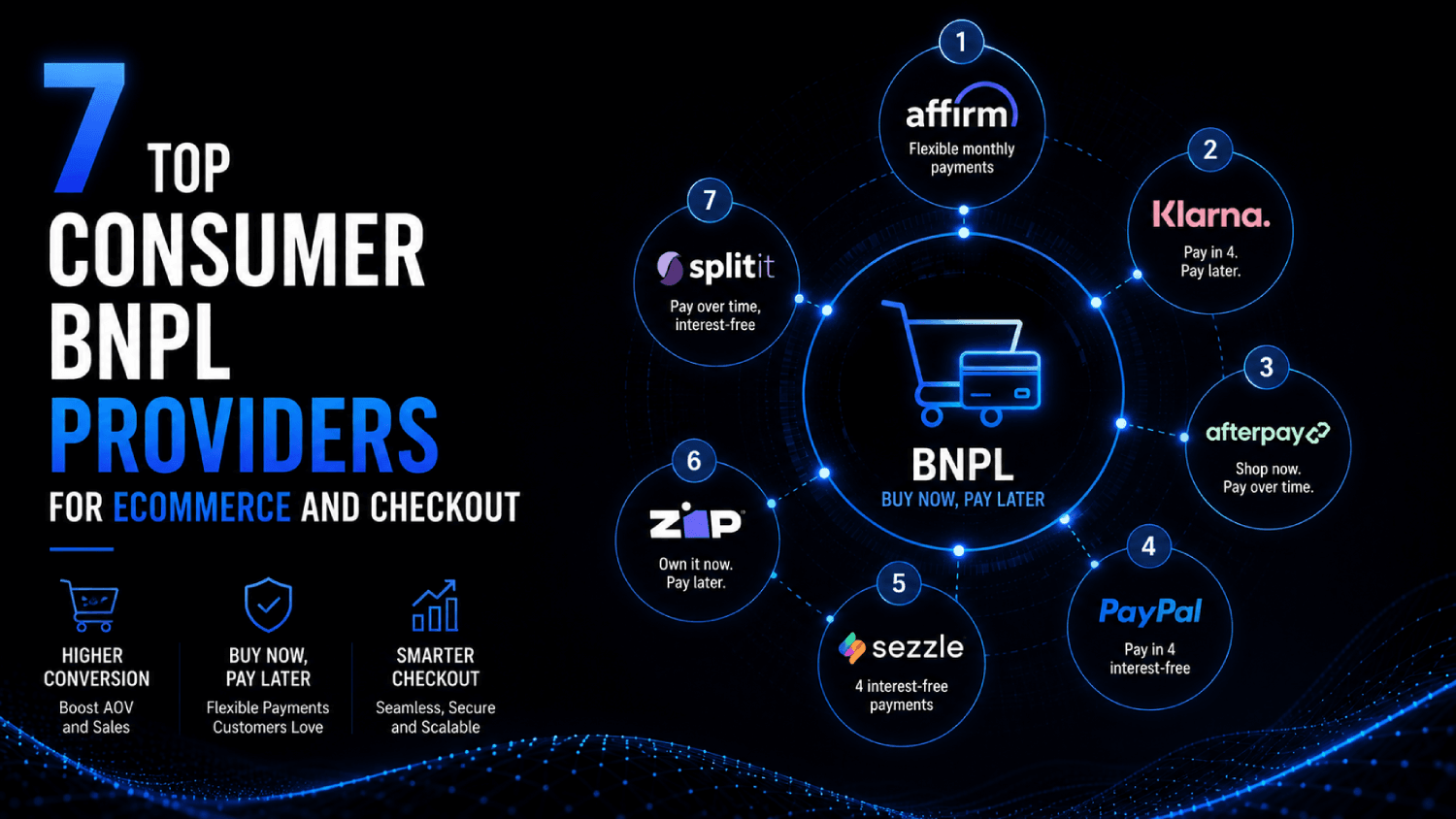
The top consumer BNPL providers for ecommerce checkout in the US are Affirm, Klarna, Afterpay, Sezzle, Zip, PayPal Pay Later, and Splitit. They differ on merchant fee structure (2% to 8%), approval logic, average order value fit, and integration effort. For most Shopify or WooCommerce merchants, Klarna or Afterpay offers the fastest setup and the widest consumer recognition. For high-AOV categories above $500, Affirm’s monthly installment option produces higher conversion. For merchants serving shoppers with thin or no credit history, Sezzle or Zip approve a broader slice of traffic.
Why BNPL Provider Choice Actually Moves Revenue
Most merchants treat buy now pay later as a commodity checkbox: pick one, bolt it on, done. That framing costs money. Two stores running identical products can see materially different checkout conversion because one provider’s approval model rejects a higher share of their specific customer demographic.
The mechanics matter. When a shopper clicks “Pay Later,” the BNPL provider runs an instant credit decision using its own model. That model weighs factors like email age, purchase history on its network, debit card linkage, and in some cases a soft credit pull. Affirm uses a fuller credit file; Afterpay and Sezzle lean more on behavioral history within their networks. A shopper with a thin credit file but a long Afterpay history gets approved by Afterpay and rejected by Affirm. Neither outcome is wrong. They just reflect different underwriting philosophies.
Merchant fees are the other variable nobody talks about until the invoice arrives. A provider charging 6% on a $150 average order value is costing you $9 per transaction. A provider charging 3% on the same order costs $4.50. Across 1,000 monthly BNPL transactions, that is a $4,500 monthly difference. At $12M annualized BNPL volume, picking the wrong fee tier is a $540,000 decision. If you want to understand how those fees layer into a broader payment stack, the payment infrastructure tools comparison on FintechSpecs maps the full cost picture.
How to Evaluate a Consumer BNPL Provider Before You Integrate
There is no single right answer across all merchants. The best provider depends on four specific variables: your average order value, your customer’s credit profile, your platform stack, and your tolerance for merchant fee structure. The FintechSpecs BNPL Fit Matrix below defines how to score each.
The FintechSpecs BNPL Fit Matrix scores providers across four axes: AOV fit (does the provider’s pay-in-4 or monthly plan match your typical cart size?), approval breadth (how aggressively does the provider approve shoppers outside prime credit?), integration effort (plugin versus API versus custom build?), and fee structure (flat rate, tiered, or negotiable at volume?). Run every provider you shortlist through all four before testing conversion.
| Provider | Best AOV Range | Pay-in-4 | Monthly Installments | Merchant Fee (Public Range) | Credit Check | US Consumer Network |
|---|---|---|---|---|---|---|
| Affirm | $50 to $30,000+ | Yes | Yes (3-60 months) | Not publicly disclosed; typically 5-8% per merchant forum reports and analyst coverage | Soft pull (always); hard pull on longer terms | Large, direct-to-consumer focus |
| Klarna | $35 to $10,000 | Yes | Yes (6-36 months on Financing) | Not publicly disclosed; competitive to Afterpay per merchant forum reports | Soft pull | Very large; strong in fashion, beauty, electronics |
| Afterpay | $35 to $2,000 | Yes (4 payments) | No | Not publicly disclosed; reported around 4-6% per merchant forum reports and analyst coverage | Internal scoring, no hard pull | Large; strong in fashion, apparel, beauty |
| Sezzle | $15 to $2,500 | Yes (6 weeks) | Via Sezzle Up upgrade | Not publicly disclosed; reported around 6% per merchant forum reports | Soft pull | Mid-size; strong thin-credit approval |
| Zip | $35 to $1,500 | Yes (4 payments) | No (standard) | Not publicly disclosed | Soft pull | Mid-size; strong sub-prime approval |
| PayPal Pay Later | $30 to $10,000 | Yes (Pay in 4) | Yes (Pay Monthly, 6-24 months) | No additional fee over standard PayPal rate per PayPal’s public pricing page | Soft pull | Very large; widest existing account base |
| Splitit | $100 to $50,000+ | Yes (card-linked) | Yes (up to 24 months) | Not publicly disclosed; card interchange plus platform fee | None (uses existing card limit) | Niche; no new credit line issued |
Note: Affirm, Klarna, Afterpay, Sezzle, and Zip do not publish their exact merchant fee rates. Fee ranges cited above are drawn from public merchant forums and analyst coverage, not from vendor pricing pages, and should be treated as directional. Your actual rate will depend on volume, category, and negotiation. Always confirm directly with each provider before signing.
Affirm: Best for High-AOV and Monthly Installment Carts
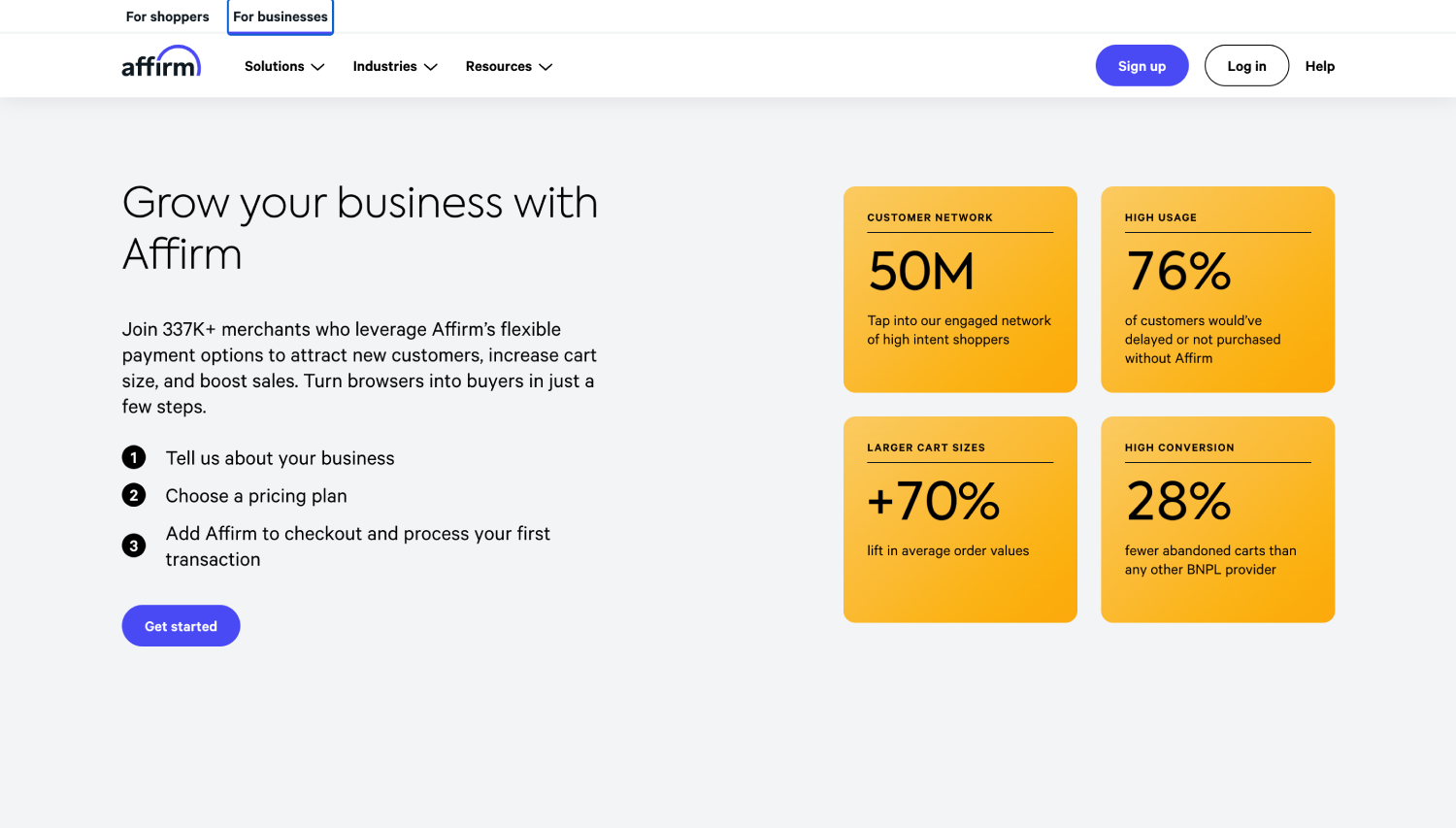
Affirm is the clearest choice for merchants selling big-ticket items. A $1,200 mattress or $3,000 home gym set is simply not a pay-in-4 purchase for most shoppers. Affirm’s ability to stretch payments across 3, 6, 12, 24, or up to 60 months at a range of APRs (including 0% promotional periods) makes it the only BNPL product that genuinely competes with a store credit card on high-consideration buys.
Affirm conducts a soft credit pull on every transaction and a hard pull on longer-term financing, which some shoppers find intrusive compared to pure behavioral underwriting. The tradeoff is that Affirm approves legitimate buyers across a wider credit spectrum on higher amounts than any pure pay-in-4 product. Merchants in furniture, fitness, travel, and electronics tend to see the strongest lift.
The integration path includes a Shopify app, WooCommerce plugin, and a direct API for custom storefronts. Affirm also offers a “Site-Wide” messaging widget that shows estimated monthly payments on product pages, which does a portion of the conversion work before the shopper even hits checkout.
Klarna: Best for Fashion, Beauty, and Broad European-Origin Shoppers
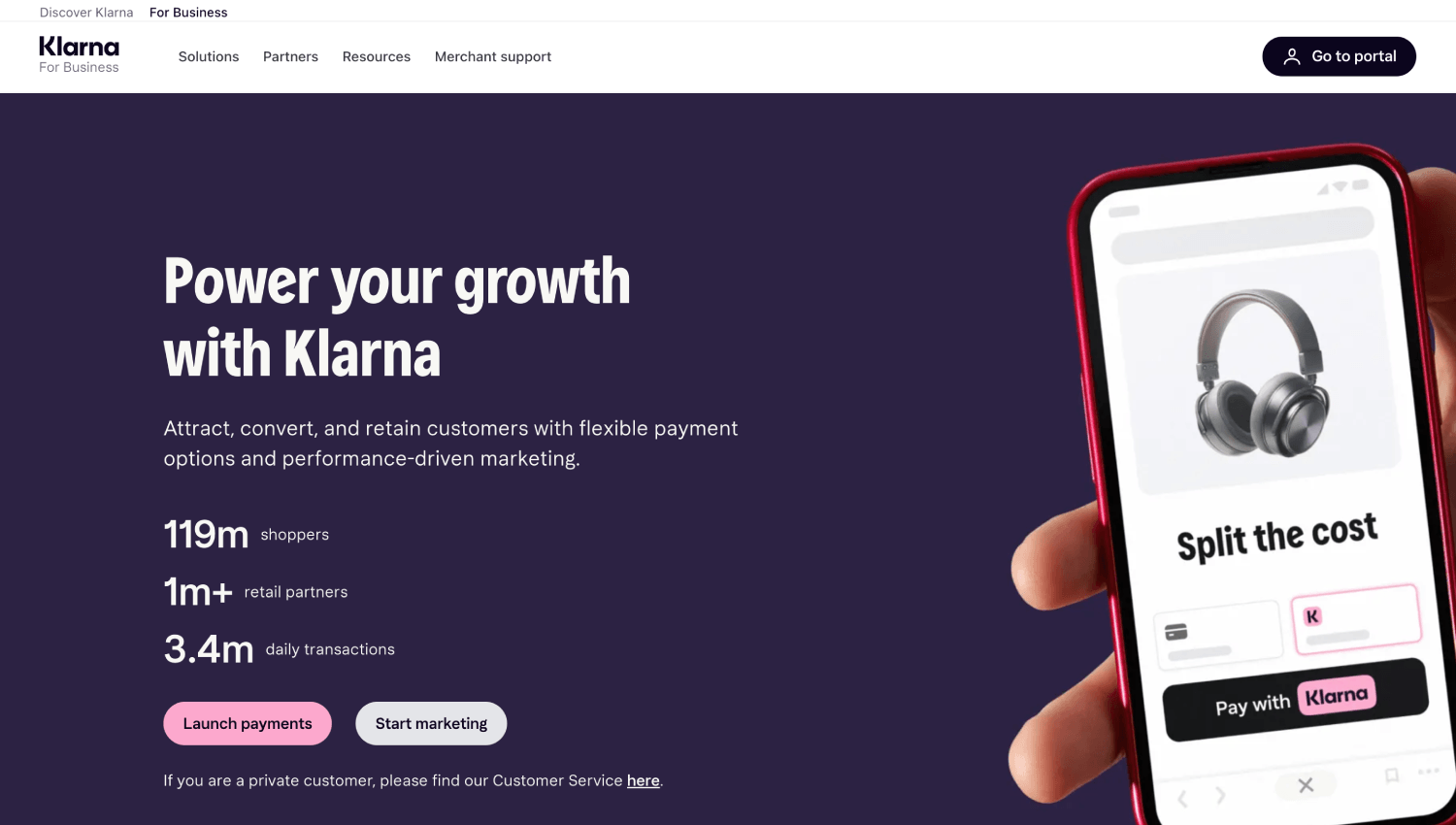
Klarna is the largest BNPL provider by consumer awareness globally and one of the two dominant players in US consumer ecommerce alongside Afterpay. Its product set includes Pay in 4 (biweekly installments), Pay in 30 days (a deferred payment used more in Europe), and Klarna Financing (monthly installments up to 36 months).
What differentiates Klarna from a merchant perspective is its shopping app and browser extension, which drives incremental traffic back to merchant storefronts. Klarna reports its app has tens of millions of active users who browse, save, and purchase directly through it. That means integrating Klarna is not just adding a checkout option, it is also gaining a distribution channel inside Klarna’s own consumer-facing interface.
Klarna’s approval rate is competitive but not the highest among BNPL providers. It uses its own internal risk scoring without a formal credit bureau pull on Pay in 4. The Financing product requires a hard pull. Merchants in fashion, home goods, and beauty consistently report strong performance with Klarna because its consumer base skews heavily toward those categories.
Afterpay: Best for Fashion and Apparel Merchants Targeting Millennial Shoppers
Afterpay, now owned by Block (formerly Square), runs a strict pay-in-4 model. There are no monthly installment options, no hard credit pulls, and no interest charged to consumers. Merchants absorb the full cost through the merchant fee.
Afterpay’s consumer base skews millennial and Gen Z, with particularly high penetration in fashion, apparel, beauty, and lifestyle categories. Its app drives significant organic traffic to merchants listed in its shop directory, similar to Klarna. Block’s ownership means Afterpay integrates natively with Square Point-of-Sale for merchants operating both online and in-store, which matters if your brand has a physical retail presence.
One operational detail merchants overlook: Afterpay caps spending limits per shopper, and new users start with low limits that increase over time. A first-time Afterpay user may only be approved for $150 on a $200 cart. That silent partial approval shows up as a failed BNPL transaction to the merchant, not as a declined user. Understanding this prevents misreading your BNPL conversion data.
Sezzle: Best for Merchants With Thin-Credit or Young Shoppers
Sezzle positions itself on higher approval rates for shoppers with limited or no credit history. Its pay-in-4 model splits the purchase into four interest-free payments over six weeks, and it offers a voluntary credit-building feature called Sezzle Up that reports payment behavior to credit bureaus when opted in by the consumer.
That credit-reporting angle is commercially meaningful for merchants in categories where younger shoppers are building credit for the first time. If your store sells electronics, gaming peripherals, or activewear to college-age customers, Sezzle’s approval model will capture a segment that Affirm or Klarna’s stricter underwriting would reject.
Sezzle integrates with Shopify, BigCommerce, WooCommerce, and Magento via official plugins. The company is headquartered in Minneapolis and is publicly traded on Nasdaq (SZL), which provides a degree of financial transparency that some privately held BNPL competitors do not. Its merchant footprint is smaller than Affirm or Klarna, so the traffic-referral benefit from Sezzle’s app is more limited.
Zip: Best for Sub-Prime Approval Rates Across General Merchandise
Zip (formerly Quadpay) operates a pay-in-4 model with a known-for-broad-approval philosophy. The company explicitly targets shoppers who might not qualify for traditional credit products, including those with thin credit files or past derogatory marks.
Zip charges consumers a small per-installment fee rather than interest, which keeps the product technically interest-free. For merchants, this broader approval net means higher BNPL conversion on traffic that other providers screen out. The tradeoff is that Zip’s consumer network is smaller than Klarna or Afterpay, so the net new customer acquisition angle is weaker.
Zip integrates via Shopify, WooCommerce, and direct API. It is particularly used by general merchandise retailers, electronics stores, and home goods merchants where the customer base includes a mix of prime and near-prime shoppers. If your store already has strong BNPL approval rates with Klarna or Afterpay, adding Zip as a secondary option to catch declined shoppers is a legitimate strategy several multi-provider merchants use.
PayPal Pay Later: Best for Merchants Already on PayPal Checkout
PayPal Pay Later covers two products: Pay in 4 (four biweekly interest-free payments) and Pay Monthly (6 to 24 month installments with APR). According to PayPal’s public pricing page, merchants pay no additional fee beyond the standard PayPal transaction rate for Pay in 4, which makes it the most cost-neutral BNPL option on this list for merchants already using PayPal Checkout.
The consumer reach advantage here is structural. PayPal has hundreds of millions of active accounts globally. A meaningful share of a given merchant’s traffic already has PayPal credentials saved, which collapses checkout friction to near zero for those buyers. The approval decision draws on PayPal’s extensive transaction history for existing account holders.
The limitation is that PayPal Pay Later only works within PayPal’s checkout flow. You cannot surface it as a standalone BNPL button alongside other checkout options without using PayPal’s buttons. Merchants using Shopify Payments or Stripe as their primary processor will need to manage PayPal as a separate payment method, which adds integration overhead.
Splitit: Best for High-Ticket Merchants Who Want Zero-Credit-Impact BNPL
Splitit works differently from every other provider on this list. It does not issue new credit. Instead, it splits an existing credit card charge into installments by placing a hold on the shopper’s available card balance. No application, no credit check, no new account. The consumer just needs an existing Visa or Mastercard with enough available credit.
That model has a specific use case: high-ticket merchants (jewelry, luxury goods, medical procedures, high-end electronics) where the customer base is creditworthy but psychologically resistant to applying for new credit at checkout. Splitit handles orders up to $50,000 or more in some configurations and supports up to 24 monthly installments.
The approval rate is functionally 100% for anyone with sufficient card availability, because there is no separate underwriting step. The downside is that approval is gated by existing card limits, not BNPL-specific credit. A shopper with a $500 card limit cannot use Splitit for a $1,200 purchase. For the right merchant category, that is an acceptable constraint in exchange for zero friction on qualified buyers. Splitit is also worth considering for its lack of chargeback complexity. Because the underlying charge is card-based, dispute resolution follows standard card network rules rather than BNPL-specific processes. If chargeback management already weighs on your operations, the chargeback management tools overview on FintechSpecs provides relevant context.
BNPL Merchant Integration: What the Technical Setup Actually Looks Like
Integration depth varies more than vendor sales decks suggest. There are effectively three tiers of integration across these providers.
Tier 1: Shopify and BigCommerce Plugin (1-3 days)
Affirm, Klarna, Afterpay, Sezzle, and Zip all maintain official Shopify apps. Installation is roughly a 30-minute task: install the app, connect your merchant account, and the provider’s widget appears on product pages and at checkout. No developer required for standard configurations. If you are on Shopify or BigCommerce and want BNPL live this week, any of these providers can do it.
Tier 2: WooCommerce / Magento Plugin (1-5 days)
All five providers above also offer WooCommerce plugins, though configuration is more involved than Shopify. Magento support exists but varies by provider version. Expect a developer to spend a few hours on setup and testing, particularly for checkout flow customization.
Tier 3: Direct API Integration (2-8 weeks)
Custom storefronts, headless commerce setups, and platforms outside the major plugin ecosystem require direct API integration. Affirm, Klarna, and Zip all offer well-documented REST APIs. Affirm’s developer documentation covers both the checkout widget and server-side payment confirmation flows. If your team is already comfortable building against payment APIs, the complexity is moderate, not high. For context on how BNPL APIs compare to other fintech API categories, the fintech API comparison on FintechSpecs covers BNPL alongside the broader integration picture.
Merchant Fee and Conversion-Lift Comparison
| Provider | Publicly Disclosed Merchant Fee? | Fee Range Reported | AOV Sweet Spot | Primary Conversion Lever | Shopify Plugin? |
|---|---|---|---|---|---|
| Affirm | No | Typically 5-8% (merchant forum reports and analyst coverage) | $200 to $30,000+ | Monthly installment option on high-ticket items | Yes |
| Klarna | No | Competitive range (merchant forum reports) | $50 to $5,000 | Consumer brand awareness + app distribution | Yes |
| Afterpay | No | Around 4-6% (merchant forum reports and analyst coverage) | $50 to $2,000 | Millennial/Gen Z consumer base in fashion | Yes |
| Sezzle | No | Around 6% (merchant forum reports) | $15 to $1,500 | Higher approval on thin-credit shoppers | Yes |
| Zip | No | Not publicly reported | $35 to $1,500 | Broad sub-prime approval | Yes |
| PayPal Pay Later | Yes (no added fee over standard PayPal rate) | Standard PayPal rate only | $30 to $10,000 | Zero marginal fee for existing PayPal merchants | Yes |
| Splitit | No | Card interchange + platform fee | $100 to $50,000+ | No credit check; 100% approval for card-eligible buyers | Yes |
No provider on this list publicly discloses a fixed merchant fee schedule except PayPal Pay Later. Every negotiation is individual, and volume is the primary lever. A merchant running $500,000 monthly through a BNPL provider has meaningful negotiating power. A merchant at $20,000 monthly generally takes the standard rate. Understanding where your fees fit into total payment costs connects directly to the hidden costs that erode fintech and ecommerce margins.
A Worked Scenario: Where Provider Choice Changes the Math
The following is a hypothetical scenario illustrating how approval rate and fee differences compound. Assumptions , $340 average order value, 40% BNPL penetration on total transactions, $150,000 in monthly BNPL volume , are illustrative and not drawn from any specific merchant. Your actual figures will vary by category, traffic mix, and provider negotiation.
At a 5% merchant fee on $150,000 monthly BNPL volume, the cost is $7,500/month. At 7%, it is $10,500/month. The $3,000/month difference is $36,000 per year in margin, all else equal.
Layer in approval rate. If Provider A approves 72% of BNPL applicants and Provider B approves 84% on the same traffic, Provider B captures 12% more BNPL-intent transactions. On the assumed $150,000 in attempted BNPL volume, that 12-point approval difference represents approximately $18,000 in additional monthly revenue that Provider A leaves on the table. Even if Provider B charges a slightly higher merchant fee, the net economics can still favor it.
Real-world approval rates shift by category, shopper demographic, and provider network overlap. But the principle holds: a 10- to 15-point approval rate difference between providers is commercially large enough that merchant fee alone should not drive the decision.
Should You Offer Multiple BNPL Providers at Checkout?
Some merchants display two or three BNPL options simultaneously, typically Klarna or Afterpay as the primary option plus Zip or Sezzle as a secondary to catch declined shoppers. This works on paper but introduces checkout friction. When shoppers see three BNPL buttons plus a credit card form plus PayPal, choice overload pushes some toward abandonment rather than selection.
The cleaner approach is to pick one primary BNPL provider that matches your AOV and customer profile, run it for 60 to 90 days, and measure approval rate and BNPL-attributed conversion. Only add a second provider if you can identify a specific segment of declined shoppers whose approval would meaningfully change revenue. Running two BNPL providers is an operational decision with real complexity: separate merchant agreements, separate payouts, separate dispute processes. The framework for monetizing payments without degrading checkout UX addresses exactly this kind of tradeoff.
Frequently Asked Questions
What is the best BNPL provider for ecommerce checkout?
For most US ecommerce merchants, Klarna or Afterpay offers the strongest combination of consumer brand recognition, Shopify integration ease, and proven conversion lift in fashion and lifestyle categories. For merchants selling high-ticket items above $500, Affirm’s monthly installment option outperforms pay-in-4 products. There is no single best option. The right provider depends on your average order value, customer demographics, and whether you need a plugin or API integration.
How much do BNPL providers charge merchants?
None of the major BNPL providers publish a fixed public merchant fee schedule except PayPal Pay Later, which charges no additional fee beyond its standard transaction rate. Ranges reported in merchant forums and analyst coverage for Affirm, Klarna, Afterpay, and Sezzle run from roughly 2% to 8% depending on volume, category, and negotiation. Merchants processing significant monthly BNPL volume can negotiate rates down from standard starting points. Always confirm your specific rate directly with the provider before going live.
What is the easiest BNPL to get approved for as a consumer?
Splitit has the highest technical approval rate because it requires no new credit application, only existing card availability. For consumers without existing card credit, Sezzle and Zip have broader approval models that approve thin-credit and near-prime shoppers more frequently than Affirm or Klarna. Afterpay also avoids hard credit pulls, though new users start with low spending limits that increase over time.
Does adding BNPL actually increase checkout conversion?
The evidence across merchants is directionally positive, particularly for average order values above $150 where paying in full creates friction. BNPL providers cite conversion lift data internally, but independently verified numbers vary significantly by category. The conversion impact comes from two sources: reducing the psychological cost of the total price at checkout, and enabling purchases that shoppers genuinely cannot afford to pay upfront. The latter group carries higher return and chargeback risk, which should factor into net conversion economics.
What is the difference between pay-in-4 and monthly installments?
Pay-in-4 splits the purchase into four equal payments over six weeks, typically biweekly, at zero interest to the consumer. Monthly installments extend repayment over 3 to 60 months, often with an APR charged to the consumer. Affirm and Klarna offer both structures. Afterpay, Sezzle, and Zip offer only pay-in-4. Monthly installments are more appropriate for high-ticket purchases where biweekly payments would still be too large for the shopper’s cash flow.
How does BNPL affect merchant chargebacks and disputes?
When a consumer disputes a BNPL purchase, the dispute goes to the BNPL provider first, not the card network directly. Each provider has its own dispute and refund process, which differs from standard card chargeback rules. Merchants should review each provider’s refund and dispute policy before integrating because a partial return on a BNPL transaction, where a shopper returns two of four items, can create payout reconciliation complexity that standard credit card refunds handle more cleanly.
Is BNPL regulated differently from credit cards in the US?
Yes, and the regulatory environment is shifting. The Consumer Financial Protection Bureau has examined whether pay-in-4 BNPL products fall under the Truth in Lending Act’s Regulation Z, which governs credit cards. As of recent CFPB guidance, BNPL providers that issue digital accounts may be treated more like credit card issuers under Regulation Z. Merchants do not bear direct compliance risk for the BNPL provider’s lending decisions, but understanding your provider’s regulatory standing matters for long-term partnership stability.
What to Decide Before You Sign a BNPL Merchant Agreement
The single most important variable before you sign is not the merchant fee. It is approval rate on your actual customer traffic. A provider can offer a compelling merchant fee and still underperform if its underwriting model systematically rejects a higher share of your specific demographic. Before committing to a primary provider, ask each shortlisted vendor for approval rate benchmarks in your specific vertical. Most will provide them. Cross-reference those benchmarks against your own customer profile.
Payout timing deserves equal attention. Most BNPL providers pay merchants within two to three business days regardless of when the consumer completes their installment schedule. That is a material cash flow benefit over net-30 invoicing or deferred settlement. But settlement timing, currency, and batch schedules vary by provider. A one-day difference in payout settlement across $2M in monthly BNPL volume is a working capital difference of roughly $65,000 in daily float. If you want a fuller view of how payment timing fits into SaaS and ecommerce financial operations, the analysis of fintech and ecommerce gross margin structures places settlement timing in the right financial context.
BNPL is not a commodity bolt-on. Approval logic, fee structure, payout timing, and consumer network size are each independently meaningful enough to move the revenue line. Running the FintechSpecs BNPL Fit Matrix against your top two or three candidates before signing takes less than a day and costs nothing. Signing the wrong agreement and renegotiating six months later is a different kind of cost entirely.