
TLDR
- Payment reconciliation confirms money moved correctly. It does not check whether your processor billed the rates written in your contract.
- Contracted-rate validation is a separate control that compares each billed fee line against your signed agreement and flags discrepancies with evidence you can act on.
- Merchant processing overcharges are common because interchange categories, assessment fees, and processor markups change frequently and processors do not self-correct billing errors.
- The three tools covered here approach processor fee audit differently: one focuses on statement audits against contract terms, one on real-time fee monitoring, and one on recoverable overcharge documentation.
- None of these tools replace your reconciliation stack. They sit beside it and cover the gap reconciliation cannot.
Payment processor fee audit software for merchants validates billed processor fees against contracted rates and flags overcharges with claim-ready evidence. The three leading tools in this category are Swipesum Audit, Bankcard Brokers Interchange Audit, and Acquired.com Analytics (formerly CardX Analytics). Each ingests your processor statements and contract terms, compares them line by line, and produces a discrepancy report you can send to your processor or acquiring bank. Pricing varies by tool and volume tier; only Swipesum publicly lists a starting rate.
Why Reconciliation Does Not Catch Processor Overcharges
Your reconciliation software confirms that the amount your processor settled matches the amount your bank received. That is a cash-flow check, not a contract compliance check. The two jobs sound similar but they test completely different things.
Processor fee validation asks a different question: did the processor apply the interchange category, assessment rate, and markup you agreed to in writing? A reconciliation tool has no access to your contract terms. It cannot know that your agreement specifies a 15-basis-point markup on Visa credit when the processor billed 22. The settlement amount still balances. The overage is invisible.
This gap matters most at volume. A merchant running $2 million per month through a processor paying even 7 basis points more than contracted pays roughly $1,400 extra per month without any error appearing in reconciliation. Multiply that across a year and you have a recoverable overpayment most finance teams never find because they assumed reconciliation covered it. It does not. Our article on payment reconciliation software for fintech finance teams covers what reconciliation actually does and does not do, which is a useful complement to the contract validation layer described here.
What Is the Contracted-vs-Billed Fee Table and Why Do You Need One?
The contracted-vs-billed fee table is the core output of any serious processor fee audit. It is a row-by-row comparison of every fee your processor charged against the corresponding rate or term in your signed merchant agreement. A proper table covers interchange categories (Visa, Mastercard, Discover, Amex), per-transaction fees, monthly fees, chargeback fees, PCI fees, batch fees, and any custom markup the processor added above interchange.
Without this table, overcharge claims are almost impossible to pursue. Processors respond to documented discrepancies, not verbal complaints. The table gives you the specific line, the contracted rate, the billed rate, the transaction volume it applied to, and the dollar difference. That is the evidence a processor’s billing disputes team needs to issue a credit.
Building this table manually is feasible once. It is not feasible monthly across multiple MIDs and processor relationships. The tools below automate it.
The FintechSpecs Fee Validation Signal Test
Before evaluating any processor fee audit tool, run what FintechSpecs calls the Fee Validation Signal Test: four checks that separate contract-aware audit tools from generic expense analyzers that happen to include processor fees.
Contract ingestion: Can the tool ingest your actual signed merchant agreement, not just default interchange tables? Default tables tell you what fees should theoretically be. Your contract tells you what fees were actually negotiated. These differ, sometimes by 20 or more basis points.
MID-level granularity: Does the tool operate at the merchant ID level? A company with five locations or five product lines often has five MIDs, each with different contracted terms. A tool that blends them will miss overcharges on individual MIDs even when the blended average looks correct.
Category-level mapping: Does the tool map billed interchange categories to their Visa and Mastercard published IRF tables? Processors sometimes bill a mid-qualified or non-qualified rate on a transaction that qualified for a lower interchange bucket. This requires the tool to know both the actual category and the contracted fallback rules.
Claim-ready export: Does the tool produce a formatted discrepancy report you can send directly to your processor? A tool that shows you the problem but requires manual reformatting to file a claim adds hours back to a process you are automating.
Any tool that fails two or more of these checks is a reporting tool, not a fee audit tool.
Tool 1: Swipesum Audit (Formerly Staitment)
What It Does
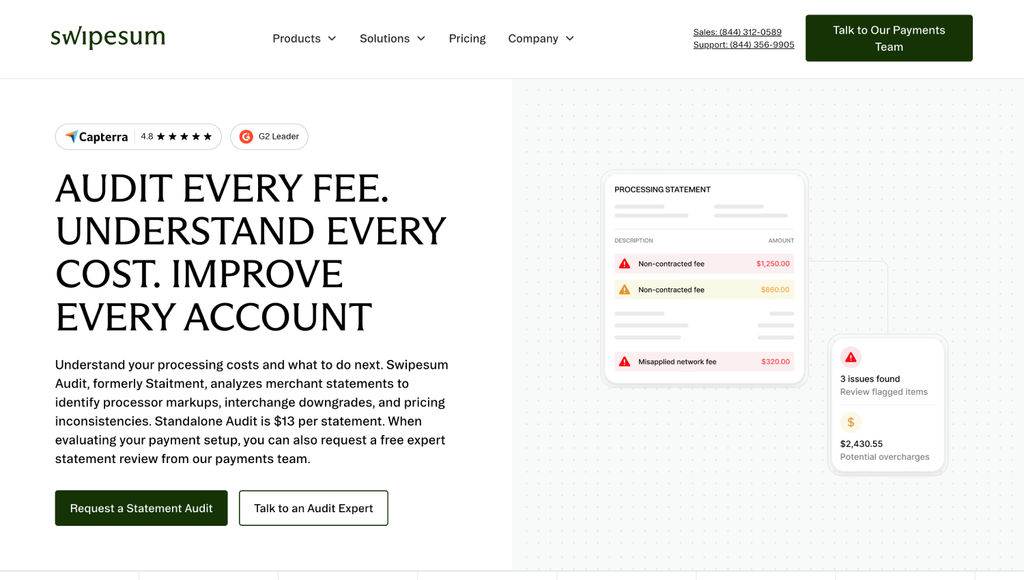
Swipesum Audit focuses on merchant statement analysis for businesses that want to check what their processor is charging. Merchants upload processing statements, and the audit reviews processor markups, interchange fees, interchange downgrades, and hidden or non-contracted fees, then compares processing costs against existing contract terms and expected pricing.
It works across multiple processors, merchant accounts, and locations. Swipesum also offers merchant accounts and payment processing, but an audit does not require switching providers.
Who It Fits
Swipesum Audit suits merchants, multi-location businesses, and finance teams that want detailed statement reviews, pricing comparisons, and cost-reduction guidance without necessarily switching providers. Audits are run per statement, so teams wanting continuous monitoring should confirm whether ongoing monitoring fits their needs.
Pricing and Limitations
Swipesum lists standalone statement audits starting at $13 per statement, with additional services and ongoing monitoring priced separately. A free expert statement review is available when evaluating a payment setup with Swipesum, not as part of every standalone audit.
Standalone Audit is software-based analysis, with expert review offered separately. Businesses looking for a fully self-service contracted-rate validation workflow should confirm the available automation features, reporting options, and service scope before purchasing.
Tool 2: Bankcard Brokers Interchange Audit
What It Does
Bankcard Brokers offers a processor fee audit service built around their in-house interchange expertise. Unlike software-first tools, this is a hybrid model: the company ingests your statements and contracts, runs the contracted-vs-billed analysis using their own methodology, and delivers a report with specific dollar-amount overcharge findings and claim language.
The service covers interchange downgrade analysis, which is one of the most common sources of overcharges. Interchange downgrades occur when a transaction qualifies for a higher-cost interchange category because of a data error or processing method, and the processor does not correct it. Bankcard Brokers examines whether downgrades are justified or indicate billing errors.
Who It Fits
This model fits merchants who want a human-reviewed audit rather than a self-serve software workflow. It is better suited to periodic reviews (quarterly or annually) than ongoing monthly monitoring. Merchants in retail, hospitality, and healthcare, where interchange category management is complex, tend to benefit most from the downgrade analysis component.
Finance teams who already understand their statement structure may find the hybrid model slower than a pure software tool. Teams who have never run a formal processor audit will likely find the guided service approach easier to act on.
Pricing and Limitations
Bankcard Brokers does not publish pricing as of October 2026. Fees for audit services in this category typically depend on processing volume and number of MIDs. Because this is a service rather than a subscription product, turnaround time varies and is not guaranteed the way a software platform’s reports are.
Tool 3: Acquired.com Analytics (Formerly CardX Analytics)
What It Does
Acquired.com is a payment platform that includes merchant analytics and fee monitoring as part of its broader infrastructure. The analytics module allows merchants using Acquired as their processor to view fee breakdowns at the transaction and category level, compare actual fees against expected rates, and identify patterns that suggest billing anomalies.
Unlike the other two tools, Acquired.com is a processor itself, not a third-party auditor. Its fee monitoring capability is embedded within the payment relationship rather than operating against an external processor’s statement.
Who It Fits
Acquired.com fits merchants who are either already using Acquired as their processor or who are evaluating a processor switch. If you are auditing your current processor and planning to stay with them, Acquired’s analytics are not the right fit. If you are considering a migration and want granular ongoing visibility into fee structures from day one, building the monitoring capability into the new processor relationship is a cleaner approach than bolting a third-party audit tool onto an existing one.
This distinction matters. Merchants evaluating their existing processor relationship need a tool that works against an external statement. Merchants restructuring their processing stack can build the audit function into the processor selection. Our comparison of Stripe versus Adyen for B2B SaaS payment stacks is relevant context for teams in that decision.
Pricing and Limitations
Acquired.com does not publish a public pricing page for its analytics module as of October 2026. The company targets enterprise and mid-market merchants. The main limitation is structural: the fee monitoring only covers transactions processed through Acquired, so it cannot audit a legacy processor relationship or validate a competitor’s billing.
How Do These Three Tools Compare on the Fee Validation Signal Test?
| Criterion | Swipesum Audit | Bankcard Brokers Audit | Acquired.com Analytics |
|---|---|---|---|
| Contract ingestion (custom terms, not defaults) | Compares against existing contract terms | Yes, human review of contract | Not applicable (Acquired is the processor) |
| MID-level granularity | Yes, across multiple merchant accounts | Yes | Yes, within Acquired’s platform |
| Interchange category mapping | Yes, including downgrade analysis | Yes, with downgrade analysis | Partial, focused on own fee transparency |
| Claim-ready export | Audit report (claim filing not confirmed) | Report includes claim language | Not designed for external processor claims |
| Works against external processor statements | Yes | Yes | No |
| Ongoing monthly monitoring vs. periodic audit | Periodic (per-statement audit) | Periodic (service engagement) | Ongoing (native to platform) |
| Public pricing available | Yes, from $13 per statement | No | No |
What Should a Contracted-Rate Validation Workflow Actually Look Like?
A processor fee audit is not a one-time event. It is a control. Here is a practical monthly workflow that any finance team can run, regardless of which tool they choose.
- Pull the prior month’s processor statement at the MID level. If your processor bundles MIDs, request a split statement. This is a standard right under most merchant agreements.
- Map each fee category in the statement to the corresponding line in your signed contract. Focus first on the markup (the spread above interchange), then on per-transaction fees, then on monthly fees. Interchange itself is set by Visa and Mastercard and is not negotiated, but your contract specifies how your processor passes it through.
- Run the contracted-vs-billed comparison using your chosen tool. Flag any line where billed exceeds contracted by more than one basis point (rounding errors below that threshold are common and not worth disputing).
- For each flagged line, calculate the dollar impact: volume in that category multiplied by the basis-point difference. Only pursue discrepancies above your internal materiality threshold, typically $100 to $500 per line depending on your team’s capacity.
- Send the discrepancy report to your processor’s billing team with the specific statement date, MID, fee category, contracted rate, billed rate, and dollar difference. Processors credit confirmed overcharges, usually within one to two billing cycles.
- Log the outcome. A pattern of repeated overcharges in the same category is a contract renegotiation signal, not just a billing correction issue.
Finance teams building out their broader payment operations stack will find this control fits naturally alongside the processes described in our coverage of payment infrastructure tools for SaaS founders.
What Makes Processor Fee Overcharges Hard to Catch Without Software?
Three mechanics make overcharges structurally easy to miss without dedicated tooling. First, interchange categories are numerous. Visa alone publishes dozens of interchange programs, and the category a transaction qualifies for depends on card type, merchant category code, data submitted with the transaction, and settlement timing. A processor billing at the wrong category may not be acting in bad faith; the category logic is genuinely complex. But the effect on your fees is real regardless of intent.
Second, processor statements are intentionally dense. Most statements list fees in aggregated line items rather than by transaction. A line reading “Non-Qualified Interchange: $4,218.00” does not tell you how many transactions were placed in that bucket or whether they belonged there. Auditing it requires either transaction-level data exports or a tool that can reverse-engineer the category from the aggregate.
Third, processor contracts renew and fee schedules sometimes change at renewal without explicit notification. A merchant who negotiated a 10-basis-point markup in year one and auto-renewed in year three may now be paying 15 basis points under new default terms they did not notice. This is a contract audit problem, not a reconciliation problem. Teams tracking this kind of cost leakage alongside other margin pressures will find the broader analysis in our piece on hidden costs killing fintech SaaS margins useful context.
Frequently Asked Questions
What is processor fee validation software and how does it differ from reconciliation?
Processor fee validation software compares the fees billed on your processor statement against the rates written in your signed merchant agreement, then produces a discrepancy report with the dollar impact of each variance. Reconciliation software confirms that money settled to your bank account matches what the processor reported. Reconciliation checks cash flow accuracy. Fee validation checks contract compliance. A business can have perfect reconciliation and still be systematically overcharged by its processor.
How common are merchant processing overcharges?
Exact industry-wide rates are not publicly published by any major card network or processor, so any specific percentage figure would be speculative. What is well-documented is that interchange downgrade errors, incorrect markup application, and stale contract terms after renewal are recurring sources of billing discrepancies that most merchants never audit. The absence of a systematic audit process is itself the most common reason overcharges persist undetected across multiple billing cycles.
Can I audit my processor fees without software, using just the statement and my contract?
You can, for a small number of MIDs and a simple fee structure. A merchant with one MID, a simple interchange-plus contract, and a processor that provides transaction-level data exports can build a contracted-vs-billed table in a spreadsheet. The manual approach breaks down at scale: multiple MIDs, tiered pricing models, bundled fee lines, and monthly recurrence all create enough complexity that software saves significant time and reduces the risk of missing overcharges in subcategories that received less attention.
What evidence do I need to dispute a processor overcharge?
You need four things: the specific statement date and MID, the fee category name as it appears on the statement, the contracted rate for that category from your signed agreement, and the billed rate. The dollar impact (volume times rate difference) is not strictly required but helps the processor’s billing team prioritize and calculate the credit. Processors generally do not credit undocumented verbal complaints. A written discrepancy report with these four elements gives the processor’s billing team everything they need to verify and correct the error.
Do these tools work for merchants on flat-rate pricing?
Contracted-rate validation is most valuable for merchants on interchange-plus or tiered pricing, where the relationship between interchange categories and the final billed amount is explicit and auditable against contract terms. Flat-rate pricing (where you pay a fixed percentage on every transaction regardless of card type) reduces the complexity of category-level validation but does not eliminate it entirely. Monthly fees, chargeback fees, and gateway fees remain negotiated terms on flat-rate contracts and are worth auditing.
How often should a merchant run a processor fee audit?
Monthly audits are the right cadence for merchants processing more than $500,000 per month, because a billing error that persists for three months before discovery compounds the total overcharge significantly. For smaller merchants, quarterly audits typically capture most material discrepancies without requiring a dedicated staff resource. Run a full audit whenever your processor contract renews, whenever you add a new MID, and whenever your processor notifies you of a rate change, even if the change is described as minor.
The Control Reconciliation Cannot Replace
Reconciliation is a mature control. Most finance teams running modern payment stacks have it. Contracted-rate validation is not mature in the same way, partly because processors have not historically made it easy to access the data needed to run it, and partly because most finance teams assumed reconciliation covered both problems. It does not.
The practical implication is that many businesses have been systematically overpaying their processors for years, not because processors are uniformly acting in bad faith, but because interchange category complexity, dense statement formats, and silent contract changes create an environment where overcharges accumulate without triggering any existing control. That is a recoverable problem, but only if you treat contracted-rate validation as a separate, permanent control rather than a one-time audit project.
The tools above differ in their approach, their depth of automation, and their fit for different merchant profiles. What they share is the ability to produce the contracted-vs-billed evidence a processor’s billing team needs to issue a credit. Getting that evidence is the job. Reconciliation was never designed to do it.