
TLDR
- Stripe dominates B2B SaaS payments by default, not because it is always the best fit , Adyen, Checkout.com, and Braintree each win on specific dimensions like interchange pricing, enterprise contracts, or global acquiring.
- The right Stripe alternative for SaaS depends on your volume, geography, and whether you need processing only, billing, or a full merchant of record , these are three different problems with three different solution sets.
- At scale (roughly $2M+ monthly processing volume), Braintree and Adyen both offer interchange-plus pricing that can undercut Stripe’s standard blended rate by meaningful margins.
- If your issue is billing complexity rather than processing costs, the solution is a billing layer on top of Stripe, not a Stripe replacement , that is a separate decision covered in the Stripe Billing alternatives guide.
- Merchant of record platforms like Paddle and Lemon Squeezy solve tax and compliance, not payment processing , those belong in a different evaluation, covered in the Stripe vs Paddle vs Lemon Squeezy vs Polar comparison.
The strongest Stripe alternatives for B2B SaaS are Adyen for enterprise volume and global acquiring, Braintree for interchange-plus pricing at mid-market scale, Checkout.com for international card acceptance and FX rates, Worldpay for large enterprise contracts, and Stripe itself with custom pricing for high-volume accounts. For vertical SaaS platforms embedding payments into their product, Payrix and Finix offer PayFac-as-a-service routes. Square, PayPal Braintree, and Amazon Pay address specific buyer contexts. Each alternative wins on a specific constraint, not across the board.
Why Are SaaS Founders Actually Looking for a Stripe Alternative?
Most teams land on this search after one of three triggers: a pricing conversation where the flat rate stopped making sense at volume, a failed payment in a geography Stripe does not support well, or an enterprise customer requesting an invoice-based flow that Stripe’s tooling handles awkwardly. These are genuinely different problems, and conflating them produces bad vendor decisions.
Stripe’s public pricing page lists different rates depending on card type and geography , there is no single universal rate that applies to all transactions. For B2B SaaS teams evaluating cost at scale, the operative question is what their blended effective rate actually is across their card mix, not what any one line item on a pricing page says. To illustrate the magnitude of the switching decision: at $500K monthly processing volume, a blended rate around 2.9% costs roughly $14,500 per month in percentage-based fees alone (illustrative, based on 2.9% × $500,000; actual fees depend on your card mix and per-transaction charges). At $2M monthly volume, a 30 basis point improvement from an interchange-plus arrangement represents approximately $6,000 per month in recovered margin (illustrative, based on 0.30% × $2,000,000). That math is why finance teams eventually start this search.
The other common trigger is geographic. Stripe’s card acceptance rates in Latin America, Southeast Asia, and parts of Eastern Europe trail what regional acquirers or locally-routed processors achieve. A SaaS company with meaningful revenue in Brazil or Indonesia will see meaningfully higher authorization rates with a processor that has local acquiring relationships in those markets.
What Is the FintechSpecs Processor-Fit Matrix for B2B SaaS?
Before listing alternatives, it helps to have a framework for evaluating them. The FintechSpecs Processor-Fit Matrix sorts payment processors across three axes that matter most for B2B SaaS: pricing model (flat-rate versus interchange-plus), geographic reach (US-only versus global acquiring), and integration model (hosted versus API-first versus PayFac). Every processor below lands somewhere specific on this matrix, and that position determines whether it fits your situation.
Flat-rate processors are operationally simple and predictable but increasingly expensive at scale. Interchange-plus processors reward volume but require more finance sophistication to reconcile. Global acquirers add authorization rate advantages internationally but typically require enterprise contracts with volume minimums. PayFac-as-a-service providers let you become the processor for your own customers, which changes your revenue model entirely.
The matrix also forces a scope question: are you replacing Stripe as a payment processor, as a billing engine, or as a merchant of record? This article covers processing replacements only , the stripe alternatives for saas decision specifically at the processor layer. If billing is the issue, the 21 best Stripe Billing alternatives covers that decision. If tax and compliance are the issue, the merchant of record comparison is the right starting point.
Which Stripe Alternatives Win at Enterprise Volume?
Adyen
Adyen is the most direct enterprise alternative to Stripe for B2B SaaS companies processing above $1M per month. Its pricing model is interchange-plus, meaning you pay the actual interchange cost plus a small processing markup, rather than a blended flat rate. For US card-present and card-not-present transactions, this structure consistently produces lower effective rates than Stripe’s standard pricing at meaningful volume.
Adyen’s real differentiator is its unified acquiring infrastructure. Rather than routing through third-party banks in each market, Adyen holds direct acquiring licenses in dozens of countries. This translates to materially higher authorization rates in markets like Germany, France, Brazil, and Australia, where locally-acquired transactions are approved more frequently than cross-border ones. For a SaaS company with significant European or APAC revenue, this authorization rate delta , sometimes 2 to 5 percentage points , directly recovers revenue that a cross-border processor loses to declines.
The trade-off is onboarding friction and contract complexity. Adyen does not publish self-serve pricing. Volume minimums and pricing are negotiated, and onboarding timelines for new merchants typically run several weeks. It is not the right tool for a seed-stage company doing $50K per month. For more on how Adyen compares to Stripe across both price and architecture, the Stripe vs Adyen analysis for B2B SaaS goes deeper on each dimension.
Worldpay
Worldpay (now operating independently after its separation from FIS) is the processor of record for many large enterprise SaaS companies, particularly those with complex multi-currency requirements and existing finance team relationships with legacy processors. Its card acceptance footprint spans over 146 currencies and payment methods across more than 140 countries, per Worldpay’s public documentation.
Worldpay’s pricing is negotiated, not public, and contracts tend to involve volume commitments. It earns its place on enterprise shortlists because of its payment method breadth, its ability to handle local payment types like iDEAL, SEPA, and Boleto natively, and its enterprise support model. For SaaS companies running complex payment operations across multiple markets, Worldpay’s implementation team and account management structure is a differentiator that Stripe’s largely self-serve model does not replicate.
Which Stripe Alternatives Win on Interchange-Plus Pricing at Mid-Market Scale?
Braintree
Braintree, owned by PayPal, is the most commonly cited Stripe alternative for SaaS companies in the $100K to $2M monthly processing range. Braintree’s pricing is not publicly disclosed on a verifiable pricing page at the time of writing; rates for standard accounts and interchange-plus arrangements should be confirmed directly with Braintree’s sales team. High-volume merchants typically negotiate interchange-plus arrangements that reduce effective rates relative to standard flat-rate tiers.
Braintree’s acceptance network includes PayPal and Venmo as native payment methods, which matters for B2C SaaS or B2B products where individual buyers prefer PayPal checkout. Its drop-in UI and client SDKs are mature and well-documented, and its vault for storing payment methods is a genuine strength for subscription businesses with high card-on-file rates. The developer experience is not as polished as Stripe’s, but it is functional and widely deployed.
The honest limitation is PayPal’s support reputation. Dispute resolution and account holds follow PayPal’s risk policies, which can be opaque and slower than Stripe’s. For SaaS companies with clean payment profiles and predictable revenue, this is rarely an issue. For anyone in a category PayPal’s risk team considers elevated, it is a real operational risk worth pricing in.
Checkout.com
Checkout.com occupies a specific position in the processor market: it performs best for SaaS companies with international revenue where card authorization rates are the primary optimization target. Its local acquiring in the UK, Europe, and select APAC markets produces authorization rate advantages similar to Adyen’s, and its pricing model is interchange-plus for enterprise accounts.
Checkout.com’s dashboard and reporting tooling is more sophisticated than Braintree’s and comparable to Stripe’s for payment analytics. Its FX conversion rates are competitive for companies collecting revenue in multiple currencies. The minimum volume threshold for favorable pricing is not publicly disclosed, but anecdotally from public forums and community discussions, meaningful negotiating leverage tends to start around $500K per month.
Which Stripe Alternatives Win for Vertical SaaS Platforms Embedding Payments?
Stripe Connect vs PayFac-as-a-Service Alternatives
Vertical SaaS companies embedding payments into their product face a different decision than those just accepting payments for their own subscriptions. The question shifts from “what is the cheapest processor” to “how do I become a payments company for my customers.” Stripe Connect is the default answer, but it comes with meaningful limitations: Stripe keeps the acquiring relationship, your platform earns a revenue share or markup, and your ability to control underwriting, pricing, and payouts is constrained by Stripe’s policies.
The alternative is PayFac-as-a-service, where a provider like Payrix or Finix allows the platform to register as a payment facilitator and take on the acquiring relationship directly. This produces higher payment revenue per transaction and more control over merchant onboarding, but it also adds compliance obligations including KYC, underwriting, and chargeback management. The PayFac-as-a-service provider comparison covers this decision in detail for vertical SaaS teams.
Finix
Finix is an API-first PayFac-as-a-service platform built specifically for software companies that want to monetize payments. Rather than acting as a payment aggregator (like Stripe does with Connect), Finix allows platforms to operate as their own payment facilitator with full control over sub-merchant onboarding, pricing, and settlement. Finix handles the sponsor bank relationship and compliance infrastructure, while the platform controls the customer experience and economics.
Finix’s pricing is not publicly listed and varies by platform volume and transaction mix. Its model suits companies that have identified payment monetization as a strategic revenue line, not those looking for a simple processor swap. Implementation timelines are longer than Stripe Connect, and the compliance lift is real. But for a vertical SaaS company processing $10M or more annually through its platform, the economics of owning the acquiring relationship typically outperform a revenue share arrangement.
Payrix
Payrix (part of Worldpay’s portfolio) targets similar territory to Finix but with more focus on specific verticals including field services, healthcare, and property management software. Its platform includes pre-built merchant onboarding flows, embedded reporting, and dispute management tooling designed to reduce the operational overhead of running a PayFac program. For vertical SaaS companies in those industries, Payrix’s vertical-specific playbooks are a faster path than building PayFac infrastructure from scratch.
Which Stripe Alternatives Win for Specific Payment Contexts?
Authorize.Net
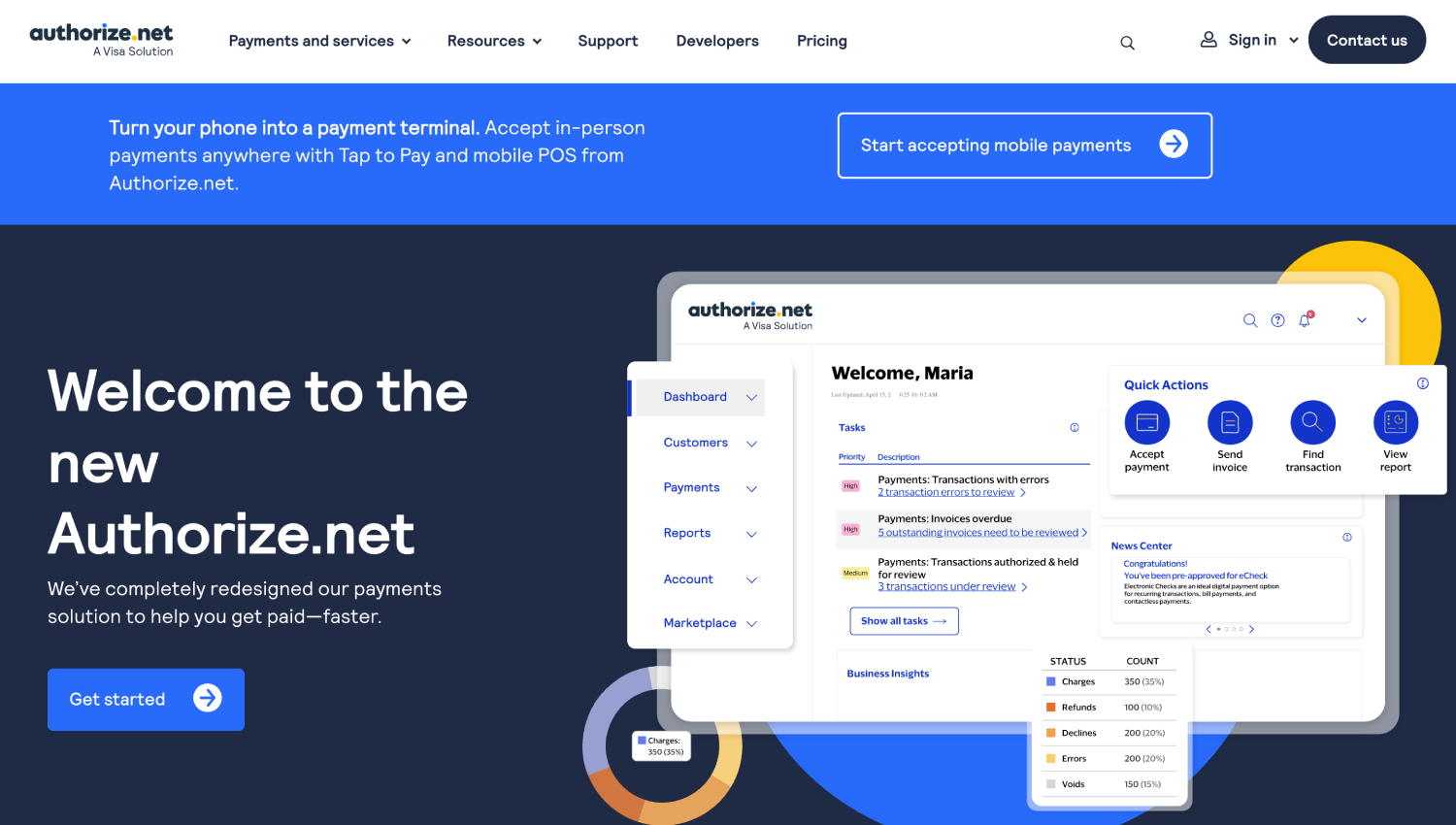
Authorize.Net, owned by Visa, processes over 1 billion transactions annually according to the company’s own marketing materials. Its payment gateway is long-established and deeply integrated with many legacy ERP and accounting systems. For B2B SaaS companies selling to mid-market or enterprise customers who require ACH, check payments, or specific gateway integrations that their own finance systems depend on, Authorize.Net is often the path of least resistance.
Authorize.Net’s pricing is not publicly verified in the source materials used for this article; rates should be confirmed directly on Authorize.Net’s pricing page before any procurement decision. The developer API is functional but older in design compared to Stripe’s. This is a processor for teams optimizing for compatibility with existing enterprise buyer workflows, not for teams optimizing for developer experience.
Square

Square belongs on this list with a clear caveat: it fits B2B SaaS companies with a point-of-sale or in-person payment component. Square’s processing rates vary by transaction type and account; confirm current rates directly on Square’s fees page before modeling your cost structure. For a purely software-first subscription business, Square offers no structural advantage over Stripe.
Where Square wins is for SaaS products built around service businesses , field services, fitness studios, home services , where the platform’s customers need card readers, appointment-based checkout, and simple reconciliation. Square’s hardware and its tightly integrated POS software make it the default for these use cases, and its flat-rate pricing is easy for end-customers to understand.
Amazon Pay
Amazon Pay serves a narrow but real B2B SaaS use case: checkout flows where your buyers are Amazon account holders who prefer to authenticate with Amazon credentials. Its authorization rates for US consumer buyers can exceed those of standard card checkout because buyers skip re-entering card details. For SaaS products with a prosumer or SMB buyer base that skews toward Amazon Prime households, the conversion lift at checkout can be meaningful.
Amazon Pay does not function as a full-stack payment processor replacement. It is a payment method, not an acquiring infrastructure. SaaS companies typically use it alongside a primary processor like Stripe or Braintree rather than instead of one.
PayPal

PayPal as a payment method (distinct from Braintree as a processor) remains relevant for B2B SaaS with SMB buyers. PayPal’s transaction rates vary by account type, transaction volume, and geography; current rates should be verified on PayPal’s merchant fees page rather than taken as fixed. Its inclusion on this list is not about pricing; it is about conversion. Some buyer segments, particularly in SMB markets outside the US, have higher trust in PayPal than in card checkout, and offering it as a payment option increases checkout completion rates.
Stripe Alternatives Comparison: Processor-Fit Matrix
| Processor | Pricing Model | Best Volume Range | Geographic Strength | Integration Model | Best For |
|---|---|---|---|---|---|
| Adyen | Interchange-plus (negotiated) | $1M+/month | Global, local acquiring in dozens of countries | API-first, enterprise onboarding | Global SaaS with high card decline rates |
| Worldpay | Negotiated, volume commitments | $2M+/month | 140+ countries, 146 currencies | Enterprise contract | Multi-currency enterprise SaaS |
| Braintree | Negotiated (verify with sales team) | $100K to $2M/month | US, EU, selective global | API, drop-in UI | Mid-market SaaS with PayPal buyers |
| Checkout.com | Interchange-plus (negotiated) | $500K+/month | Strong in UK, EU, APAC | API-first | International SaaS optimizing auth rates |
| Finix | Negotiated (PayFac model) | $500K+/month platform volume | US primary | PayFac-as-a-service API | Vertical SaaS monetizing payments |
| Payrix | Negotiated (PayFac model) | $500K+/month platform volume | US primary | PayFac-as-a-service, vertical templates | Field services, healthcare SaaS |
| Authorize.Net | Verify on Authorize.Net pricing page | Any | US, Canada primarily | Gateway, hosted forms | B2B with ACH or legacy ERP integrations |
| Square | Verify on Square fees page | Any | US, UK, Canada, Australia, Japan | Hardware + API | SaaS with in-person or POS component |
| Amazon Pay | Payment method add-on (verify with Amazon) | Any | US primary | Payment method overlay | Prosumer or SMB checkout conversion |
| PayPal | Verify on PayPal merchant fees page | Any | Global consumer coverage | Hosted checkout, API | SMB buyers preferring PayPal trust |
What Should You Evaluate Before Switching Payment Processors?
Switching a payment processor mid-flight is not a weekend project. The five failure modes that catch SaaS teams off guard are: payment method vault migration (stored card data must be moved via PCI-compliant token migration, which requires coordination between both processors), billing integration updates (every subscription, invoice, and retry logic tied to Stripe’s APIs must be re-mapped), analytics continuity (historical payment data formats differ between processors, making cohort-level analysis temporarily unreliable), chargeback history (new processors typically cannot import your historical dispute win rate, which affects how risk teams view your account), and customer-facing redirect flows (hosted checkout pages, email payment links, and self-serve portal flows all reference your current processor’s infrastructure).
A phased migration , running new payments through the alternative processor while maintaining Stripe for existing subscriptions until they renew , reduces risk substantially. Most enterprise processors including Adyen and Checkout.com have migration teams that manage token portability. For a detailed breakdown of infrastructure decisions at this stage, the 10 critical mistakes when choosing fintech infrastructure covers the most common errors SaaS founders make before they sign a new vendor contract.
How Do Payment Processing Fees Actually Add Up for a Typical B2B SaaS Company?
The following scenario is illustrative, based on publicly available information about how interchange-plus pricing works, and assumes a hypothetical but realistic B2B card mix. Actual fees will vary based on card type, issuing bank, industry code, and negotiated processor markup , treat this as a framework for structuring your own analysis, not a quoted rate from any specific processor.
Consider a B2B SaaS company processing $1M per month in card transactions, entirely card-not-present, with an average transaction size of $300. At a blended 2.9% flat rate (plus per-transaction fees), percentage-based monthly fees alone total approximately $29,000. At an interchange-plus arrangement with a 15 basis point markup over interchange , a rate that enterprise merchants at this volume sometimes negotiate with processors like Adyen or Checkout.com , the effective rate on a typical B2B corporate card mix runs closer to 2.3% to 2.5% blended. That is $23,000 to $25,000 monthly in percentage-based fees: a difference of $4,000 to $6,000 per month, or $48,000 to $72,000 annually, before accounting for per-transaction fees and any volume-based credits.
Card network assessment fees, monthly account fees, and chargeback fees all factor into true processing cost and are not captured in the blended rate figure above. Any processor negotiation should include a request for a full fee schedule, not just the markup rate. The 15 hidden costs killing your fintech SaaS margins breaks down the full fee anatomy that rarely appears in processor sales decks.
Is Stripe Still Worth Keeping at Scale?
Stripe offers custom pricing for high-volume merchants, and for companies with clean payment profiles and significant US revenue, a negotiated Stripe rate can remain competitive. Stripe’s developer tooling , its docs, testing environment, dashboard, webhook reliability, and depth of integrations , is genuinely ahead of most alternatives. Switching away from it carries a real productivity cost that does not appear in fee calculations.
The honest calculus is this: if Stripe’s pricing is the primary complaint and your team is US-focused with predictable volume, negotiate with Stripe before switching. If international authorization rates are the primary complaint, Adyen or Checkout.com are worth a formal evaluation. If you want to monetize payments inside your platform rather than just accept them, Finix or Payrix change the conversation entirely.
Payment orchestration is a third option worth knowing: platforms like those covered in the payment orchestration guide for SaaS allow you to keep Stripe as a primary processor while routing specific transaction types or geographies to alternative processors based on authorization rate performance. This avoids a full migration while recovering some of the revenue lost to declines and high blended rates.
Frequently Asked Questions
What is the best Stripe alternative for a small SaaS business?
Braintree is the most practical starting point for small SaaS businesses processing between $20K and $500K per month. Its PayPal payment method adds checkout conversion for SMB buyer segments, and its drop-in UI reduces integration time. Authorize.Net is a better fit if your buyers require ACH or if your accounting stack depends on a gateway integration. Neither requires volume minimums to get started, though pricing should be verified directly with each vendor.
Can I switch from Stripe to Adyen without migrating stored card data?
No. Stored card tokens are processor-specific and cannot be directly transferred. Switching requires a PCI-compliant token migration where both processors coordinate to re-tokenize stored cards without requiring customers to re-enter their payment details. Stripe and Adyen both support this process, but it requires advance coordination, typically several weeks of lead time, and a staged cutover plan. Plan for this in your migration timeline before signing a new processor contract.
What is the difference between a payment processor and a merchant of record?
A payment processor handles card authorization, settlement, and acquiring. A merchant of record (MoR) handles all of that plus sales tax calculation and remittance, VAT compliance, and legal liability for the transaction. For SaaS companies selling globally where tax compliance is the primary pain point, an MoR like Paddle or Lemon Squeezy solves a problem that switching processors does not. The merchant of record vs payment processor breakdown covers this distinction in full.
Does Braintree offer interchange-plus pricing?
Braintree offers interchange-plus pricing for high-volume merchants, but it is not available at the standard self-serve tier. Volume-based interchange-plus arrangements require a conversation with Braintree’s sales team. The exact volume threshold is not publicly disclosed; confirm current terms directly with Braintree.
Which payment processor has the best international card authorization rates?
Adyen and Checkout.com are consistently cited by operators as producing the highest international authorization rates, primarily because both hold direct acquiring licenses in multiple markets rather than routing cross-border. Local acquiring in a country where a card is issued reduces the transaction’s fraud risk score in the card network’s eyes, which raises approval rates. The improvement is most pronounced in markets like Germany, Brazil, Australia, and Singapore, where cross-border transaction declines are structurally higher.
What is PayFac-as-a-service and when should a SaaS company use it?
PayFac-as-a-service allows a software platform to register as a payment facilitator and earn revenue on every transaction its customers process, rather than just paying a processor to handle its own subscriptions. Providers like Finix and Payrix make this model available without requiring the platform to build its own sponsor bank relationship from scratch. It makes economic sense when a vertical SaaS company has identified payment processing as a core revenue opportunity and processes enough platform volume , typically $5M or more annually , to justify the compliance overhead of running a PayFac program.
Are there Stripe alternatives built specifically for SaaS billing?
Switching processors does not solve billing complexity. If the issue is usage-based pricing, complex subscription logic, or dunning automation, the right tool is a billing layer like Chargebee, Maxio, or Orb that sits on top of a payment processor rather than a different processor entirely. The Stripe Billing alternatives guide covers these options in detail.
The Decision Most Teams Get Wrong
Most teams evaluating Stripe alternatives for SaaS are solving for the wrong variable. They compare sticker rates without modeling the full cost of migration, the authorization rate impact of moving to a new processor with no account history, or the developer productivity loss of leaving Stripe’s tooling. The fee comparison is real, but it is one input in a multi-variable decision.
The teams that make good processor decisions start with a specific constraint: declining international authorization rates, pricing pressure at a particular volume threshold, or a strategic decision to monetize payments inside their platform. Each constraint points to a different set of solutions. Adyen for auth rates. Interchange-plus negotiation with Braintree or Checkout.com for pricing. Finix or Payrix for platform monetization. The worst outcome is running a processor search without first naming which of these problems you are actually trying to solve.
Stripe is not the only realistic processor for a SaaS company, but it earns its market position through tooling quality and integration depth that competitors have not fully replicated. The cases where switching produces clear ROI are real and specific. The case for switching in general, based on vague dissatisfaction or competitor marketing, rarely survives contact with a migration project.