
TLDR
- BVNK was acquired by Stripe in 2025, making it an increasingly closed infrastructure layer rather than a neutral one , that changes the switching calculus entirely.
- Bridge, Conduit, and Zero Hash dominate most shortlists, but Cybrid, Mural, Paxos, and Brale each cover corridors or compliance profiles those three do not.
- The right BVNK replacement depends on three variables: which payment corridors you run, whether you need a licensed entity or an API on top of yours, and how much on-chain exposure your compliance team will tolerate.
- Pricing across this category is almost entirely custom and undisclosed , any vendor quoting flat rates publicly is a floor, not a ceiling.
- The FintechSpecs Corridor-License-Exposure test (detailed below) cuts a typical 6-vendor shortlist to 2 in one afternoon.
The eight BVNK alternatives worth evaluating for B2B stablecoin payments are Bridge, Conduit, Zero Hash, Cybrid, Mural, Paxos, Brale, and Alchemy Pay. Each covers a different combination of payment corridors, licensing posture, and on-chain architecture. Bridge and Conduit suit US-first B2B flows; Zero Hash and Paxos are better fits for regulated entities that need a licensed counterparty; Cybrid targets Canadian fintechs with bank-account issuance; Mural covers contractor payouts in Latin America; Brale is purpose-built for stablecoin issuers; and Alchemy Pay bridges on-ramp and off-ramp across Asian corridors.
Why Are Teams Reconsidering BVNK Right Now?
Stripe’s acquisition of BVNK in 2025 was the clearest signal yet that stablecoin infrastructure is consolidating into larger payment stacks. For teams that chose BVNK precisely because it was independent and crypto-native, the acquisition reframes the risk profile. Stripe controls roadmap, pricing, and data access going forward, which is fine if you are already deep in Stripe’s stack and fine if you are not building a competing product. For everyone else, the calculus changed.
There is also a corridor gap problem. BVNK’s strongest coverage has historically been in Europe and select emerging markets. Teams running US-to-LatAm or US-to-Southeast-Asia B2B corridors often needed a second provider anyway. If you are rebuilding your stack, it is worth asking whether a single alternative can cover what BVNK covered plus the corridors it never did.
Before evaluating any replacement, it helps to know what you actually used BVNK for. Settlement rails, virtual account issuance, stablecoin-to-fiat conversion, and treasury management are four distinct products that different BVNK alternatives handle with different levels of depth. Our BVNK vs Bridge vs Conduit comparison covers the architectural differences in detail if you want the side-by-side before reading the full alternatives list.
How to Shortlist a BVNK Replacement: The FintechSpecs Corridor-License-Exposure Test
Most stablecoin infrastructure RFPs fail because teams evaluate features before constraints. The FintechSpecs Corridor-License-Exposure (CLE) Test reverses that order. Run these three checks before you look at any demo or pricing page.
Corridor: Map every source-destination currency pair you move today plus the ones you plan to add in the next 18 months. If a provider cannot settle in your two or three highest-volume corridors natively, not through a partner, remove it from consideration. “We can do that” in a sales call is not a corridor.
License: Decide whether you need a licensed counterparty or an API layer you operate under your own licenses. Regulated entities , banks, broker-dealers, money services businesses with state MTLs , often need a provider that holds its own licenses and absorbs regulatory counterparty risk. Early-stage fintechs building under a sponsor’s umbrella need the opposite: an API that does not force a licensing relationship they are not ready for. See our guide to stablecoin infrastructure licensing for the full breakdown by provider type.
Exposure: Quantify how much on-chain settlement your compliance and legal teams will approve. Some providers settle natively on-chain and pass that exposure to you. Others abstract the blockchain entirely and give you fiat-equivalent rails with stablecoin settlement happening behind the curtain. Your BSA officer and your board have opinions on this, and those opinions should determine shortlist position, not product marketing.
What Are the 8 Best BVNK Alternatives for B2B Stablecoin Payments?
| Provider | Best For | Key Corridors | Licensing Posture | On-Chain Exposure | Public Pricing |
|---|---|---|---|---|---|
| Bridge | US B2B stablecoin orchestration | US, EU, select EM | Stripe-owned; MSB registered | Abstracted | Not disclosed |
| Conduit | Cross-border B2B treasury | US, EU, LatAm | API layer; client holds licenses | Abstracted | Not disclosed |
| Zero Hash | Regulated fintechs needing licensed counterparty | US, EU, CA | Own MTLs + BitLicenses | Optional | Not disclosed |
| Cybrid | Canadian fintechs with USD/CAD needs | US, CA | FINTRAC registered | Abstracted | Not disclosed |
| Mural | LatAm contractor and vendor payouts | US, LatAm | MSB + FinCEN | Abstracted | Not disclosed |
| Paxos | Enterprise with strict regulatory requirements | US, EU, SG | NYDFS Trust Charter | Low (institutional grade) | Not disclosed |
| Brale | Teams issuing their own stablecoin | US | State MTLs | High (issuance-native) | Not disclosed |
| Alchemy Pay | Asian corridors and on/off-ramp volume | APAC, US, EU | Multiple APAC licenses | Medium | Not disclosed |
1. Bridge
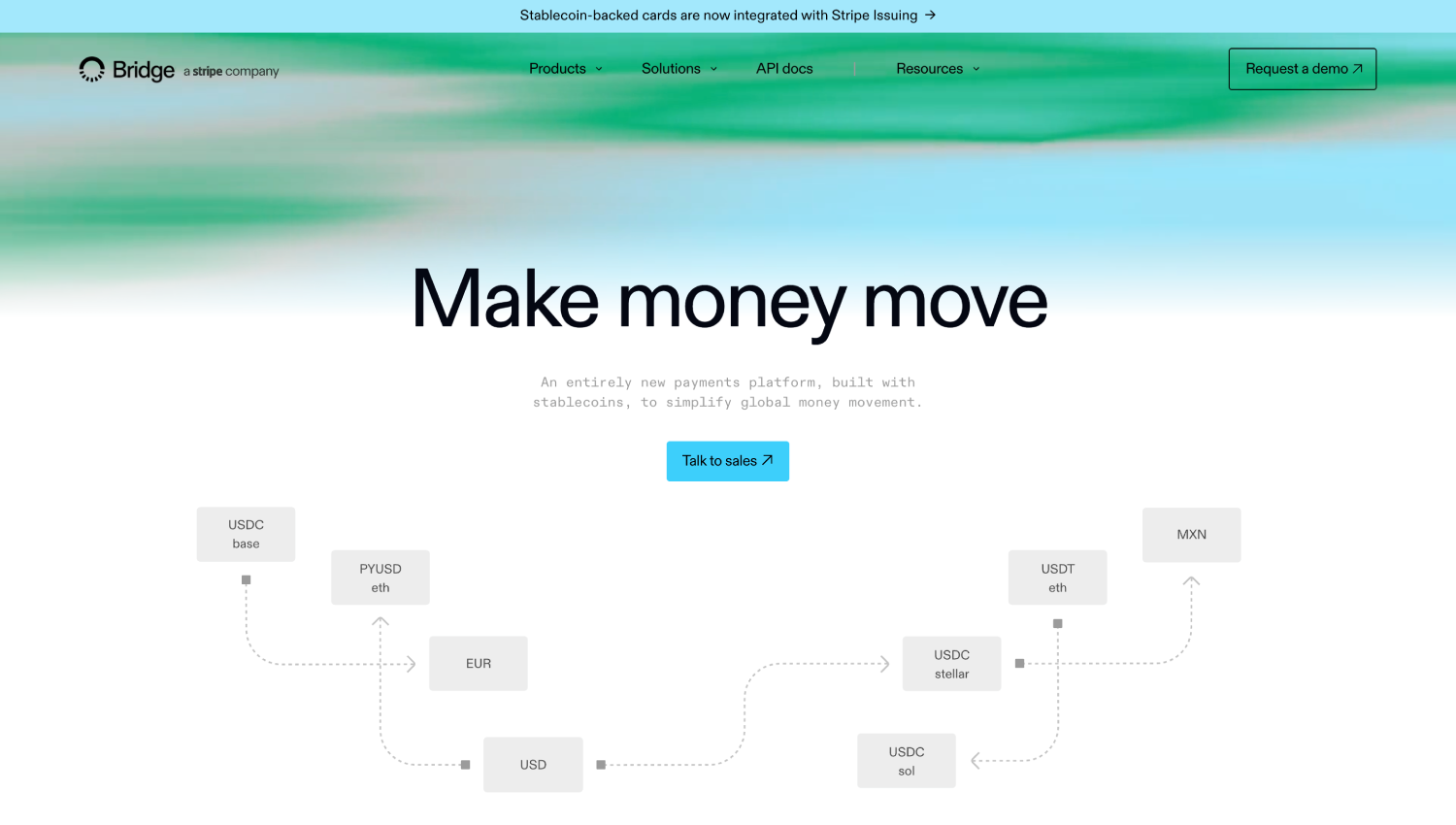
Bridge is the most direct functional replacement for BVNK’s core settlement and orchestration layer, which is ironic given that Stripe also owns Bridge. If you are migrating off BVNK after the acquisition and want to stay inside Stripe’s infrastructure orbit while gaining a more API-native stablecoin layer, Bridge is the logical next step. The product handles stablecoin issuance, cross-border settlement, and virtual account creation with a developer-first API surface.
The coverage gap to know: Bridge’s strongest corridors are US and EU. Teams with significant volume in Sub-Saharan Africa or Southeast Asia should pressure-test corridor depth before signing. Pricing is not publicly disclosed, so budget at least one sales cycle to get a real number. Our Bridge vs Zero Hash comparison covers where Bridge’s abstracted settlement model creates compliance clarity versus where it introduces opacity.
2. Conduit
Conduit positions itself as a stablecoin treasury and payments layer for B2B companies moving money across borders. Where Bridge abstracts the blockchain and delivers a fiat-adjacent experience, Conduit gives operators more direct visibility into settlement paths while still handling the compliance and liquidity plumbing underneath. That transparency is either a feature or a liability depending on your team’s sophistication.
Conduit’s Latin American corridor support is a genuine differentiator relative to BVNK, which historically underinvested in that region. For US companies paying suppliers or contractors in Mexico, Brazil, or Colombia, Conduit is worth a serious look. The downside is that Conduit operates as an API layer, which means you are responsible for the licensing stack sitting above it. Teams that want a licensed counterparty should look at Zero Hash or Paxos instead.
3. Zero Hash
Zero Hash is the answer when your compliance team asks “who holds the licenses?” rather than “which API is cleanest?” Zero Hash operates as a licensed entity across multiple US states with money transmitter licenses and BitLicenses, and it takes on the regulatory counterparty role explicitly. That matters for broker-dealers, neobanks, and any fintech that has already had a conversation with its banking partner about crypto exposure.
The trade-off is integration complexity. Zero Hash’s API surface is comprehensive but requires more configuration than Bridge or Conduit to get live. It also handles Canadian corridors and select EU markets, making it one of the broader coverage providers on this list. Pricing is custom and undisclosed. For a deeper look at how Zero Hash compares structurally, our stablecoin infrastructure provider overview covers the full field.
4. Cybrid
Cybrid fills a gap that Bridge, Conduit, and Zero Hash all underserve: Canadian fintechs that need USD and CAD digital asset rails under Canadian regulatory structure. Cybrid is FINTRAC-registered and handles bank account issuance, identity verification, and stablecoin settlement in a single API stack. For a team building in Canada or operating a cross-border US-Canada corridor, it eliminates the need to stitch together a Canadian banking partner with a separate stablecoin infrastructure provider.
Outside the US-Canada corridor, Cybrid’s coverage thins out considerably. It is not a global infrastructure play. Think of it as a regional specialist with depth rather than a general-purpose BVNK replacement. If your corridors are primarily US-Canada, it is probably the best fit on this list. If you need four or more global corridors, combine it with a broader provider or choose differently.
5. Mural
Mural (formerly known in the market as a contractor payout tool) has evolved into a full B2B stablecoin payment platform with particular depth in US-to-LatAm flows. The product handles vendor payments, contractor disbursements, and treasury operations in USDC and USDT across markets where traditional correspondent banking is slow and expensive. For a US company with a large supplier or contractor base in Latin America, Mural’s settlement speed and local payout rails are the strongest argument.
Mural is registered as a money services business with FinCEN. It is not a licensed counterparty in the same sense as Zero Hash or Paxos, so the same licensing caveat applies: you carry more of the compliance burden. Pricing is not publicly disclosed. The platform’s UX is notably more operator-friendly than pure-API providers, which matters if your payments team is not engineering-heavy.
6. Paxos
Paxos holds a New York Department of Financial Services trust charter, which puts it in a different regulatory category than almost every other provider on this list. NYDFS trust charters are among the most rigorous digital asset licenses available in the US, and Paxos leans into that positioning for enterprise clients , large banks, asset managers, and fintechs with institutional compliance requirements. It issues USDP, its own regulated stablecoin, and provides settlement infrastructure for B2B payments in the US, EU, and Singapore.
The trade-off is that Paxos is built for volume and complexity, not fast integration. Expect a longer sales and legal cycle than you would with Bridge or Conduit. For a Series B or later company with in-house compliance counsel and a genuine need for a regulated counterparty, that is an acceptable trade. For a seed-stage startup that needs to move fast, it is probably the wrong fit for this stage even if it will be the right fit in three years.
7. Brale
Brale occupies a specific niche that no other provider on this list targets directly: it is an infrastructure layer for companies that want to issue their own branded stablecoin rather than simply move USDC or USDT. If your roadmap includes a proprietary stablecoin for B2B settlement, rewards, or treasury management, Brale handles the issuance, reserve management, and redemption mechanics under state money transmitter licenses.
Most teams evaluating BVNK alternatives are not planning to issue their own stablecoin, which means Brale is a narrow recommendation. If you are evaluating it as a pure payment rail for moving third-party stablecoins, it is not the right fit. If your product roadmap includes a white-label or branded stablecoin, it is worth moving Brale to the top of your list and reading our stablecoin issuance platform comparison alongside this article.
8. Alchemy Pay
Alchemy Pay is the strongest option on this list for teams that need meaningful coverage in Asian markets. The company holds licenses across multiple APAC jurisdictions and has built on-ramp and off-ramp infrastructure across Southeast Asia, Northeast Asia, and select Middle Eastern markets where the other providers on this list have little to no presence. It also covers US and EU corridors, giving it the broadest geographic reach of any provider listed here.
The on-chain exposure is higher with Alchemy Pay than with the US-focused providers. Its model is more explicitly crypto-native, meaning your compliance posture needs to be comfortable with on-chain settlement visibility rather than expecting full abstraction. For a global B2B platform with APAC supplier payments as a primary use case, that is a reasonable trade. For a US-domestic operation, the added complexity is probably not worth it when Bridge or Conduit cover what you need.
Which of These BVNK Alternatives Scales Better for Enterprise B2B Payments?
The question that surfaces repeatedly in searches is how Cybrid, BVNK, and Conduit compare at enterprise scale. The honest answer: none of them are identical, and “enterprise scale” means different things in this context.
For raw transaction volume and uptime expectations, Paxos and Zero Hash have the longest track records at institutional scale with regulated counterparty accountability. Both have been audited, both hold top-tier licenses, and both have processed high-volume institutional flows. That does not make them automatically better for your use case, but it does mean the infrastructure risk is better documented.
For developer team velocity at seed-to-Series B, Bridge and Conduit have significantly faster integration paths. A team can get to a working integration in days rather than weeks, which matters if you are shipping a payment product rather than building one internally. The scalability question at that stage is less about raw throughput and more about whether the provider’s volume tiers and pricing structure survive a 10x growth event without requiring contract renegotiation. Neither Bridge nor Conduit publicly discloses those tiers, so that negotiation will happen during procurement.
Cybrid scales well within its corridor focus but is not an enterprise global play. If you are building a B2B product primarily for North America and your enterprise clients are in the US and Canada, Cybrid’s depth in that corridor is more useful than the broader but shallower coverage of a global provider.
What Licensing Do BVNK Alternatives Actually Hold?
This is the most under-examined variable in stablecoin infrastructure procurement. Most teams spend 80% of their evaluation on API documentation and 20% on licensing, when the ratio should be closer to the inverse for any company operating in a regulated space.
The licensing picture across these eight providers breaks into three tiers. Paxos sits alone at the top with an NYDFS trust charter, which provides the strongest regulatory coverage available from a non-bank US entity. Zero Hash holds state MTLs across a significant portion of the US plus BitLicenses, placing it in a strong second position. Bridge and Mural hold MSB registrations with FinCEN, which is a lower bar but sufficient for many US B2B use cases. Cybrid operates under FINTRAC in Canada. Brale holds state MTLs. Conduit and Alchemy Pay operate with their own license stacks that you should verify directly before contracting.
The compliance implications are real. If you are subject to BSA/AML requirements and your banking partners have specific expectations about your vendors’ regulatory standing, Paxos and Zero Hash are often the only acceptable counterparties. If you have more flexibility, the MSB-registered providers give you faster onboarding and more API flexibility in exchange for carrying more of the compliance burden yourself. Our fintech product and compliance readiness checklist walks through what you should verify from any stablecoin infrastructure vendor before signing.
Corridor Coverage by Provider: Where Does Each One Actually Work?
| Provider | US Domestic | US-EU | US-LatAm | US-Canada | US-APAC | US-Africa |
|---|---|---|---|---|---|---|
| Bridge | Yes | Yes | Partial | Limited | Limited | Limited |
| Conduit | Yes | Yes | Yes | Limited | No | No |
| Zero Hash | Yes | Yes | Partial | Yes | Partial | No |
| Cybrid | Yes | No | No | Yes | No | No |
| Mural | Yes | Limited | Yes | No | No | No |
| Paxos | Yes | Yes | Limited | No | Yes (SG) | No |
| Brale | Yes | Limited | No | No | No | No |
| Alchemy Pay | Yes | Yes | Partial | No | Yes | Partial |
Frequently Asked Questions
Is BVNK still an independent company?
No. Stripe acquired BVNK in 2025. BVNK continues to operate as a product, but it is now part of Stripe’s infrastructure stack. Teams evaluating BVNK as an independent, crypto-native infrastructure provider should factor in that Stripe controls the roadmap, pricing, and integration roadmap going forward. If you are already a Stripe customer, this may be a neutral or positive development. If you are not, the acquisition materially changes the vendor relationship.
What is the fastest BVNK replacement for a team that needs to migrate quickly?
Bridge and Conduit both offer developer-first APIs with faster integration timelines than licensed counterparty providers like Paxos or Zero Hash. If your corridors are US-EU or US-LatAm and you are not operating under a compliance regime that requires a licensed counterparty, either can support a migration in weeks rather than months. Bridge has an edge in developer documentation depth based on its publicly available documentation. Pricing for both is custom and undisclosed, so build time for a procurement cycle even if the integration itself moves fast.
Do any BVNK alternatives support stablecoin issuance in addition to payment rails?
Brale is the provider most explicitly built for stablecoin issuance as a primary product. Paxos also issues USDP and can support white-label stablecoin programs for institutional clients. Bridge supports stablecoin orchestration and some issuance functions, but that is secondary to its settlement and transfer infrastructure. If stablecoin issuance is a core product requirement rather than a nice-to-have, Brale and Paxos are the starting points. Most other providers on this list focus on moving existing stablecoins, not creating new ones.
How do these BVNK competitors handle KYB and AML compliance?
This varies significantly by provider and licensing tier. Paxos and Zero Hash handle KYB and AML as licensed entities and have their own compliance programs that cover transactions flowing through their infrastructure. Bridge and Conduit require clients to maintain their own KYB and AML programs, with the providers handling compliance for their own operations but not acting as compliance outsourcers for client-side obligations. For teams without strong in-house compliance, a licensed counterparty like Zero Hash or Paxos reduces vendor-side risk. Teams with existing compliance infrastructure may prefer the API flexibility of Bridge or Conduit. See our AML screening API comparison for tools that integrate alongside any of these providers.
What stablecoin assets do these providers support?
USDC is universally supported across all eight providers on this list. USDT support is broad but not universal , Paxos notably does not handle USDT given competitive positioning with its own USDP stablecoin. Bridge, Conduit, Mural, Zero Hash, and Alchemy Pay all handle USDT alongside USDC. Brale focuses on custom stablecoin issuance rather than third-party assets. Before assuming multi-stablecoin support, verify current asset coverage directly with each provider, as asset support changes with regulatory developments, particularly under the GENIUS Act framework taking shape in 2026.
How should a Series A fintech approach this procurement?
Run the Corridor-License-Exposure test described above before any vendor call. At Series A, the most common mistake is over-indexing on API quality and under-indexing on corridor depth and licensing fit. A beautiful API that cannot settle in your primary corridors is useless. A licensed counterparty that takes three months to onboard may be right for Series B but too slow for your current runway. Most Series A fintechs land on Bridge or Conduit for US-EU-LatAm work, or Cybrid if Canada is a primary market. Budget 60 to 90 days from first call to live transactions regardless of which provider you choose.
The Single Most Important Insight Before You Decide
Every provider on this list will tell you they handle cross-border B2B stablecoin payments. The differentiating variable is not the stablecoin support , that is table stakes. The differentiator is which entity holds the regulatory risk when something goes wrong in a specific corridor, and whether that entity is you, your provider, or a licensed third party sitting between you and the rails. That distinction is what the Corridor-License-Exposure test surfaces before you spend four weeks in a product demo cycle.
The acquisition of BVNK by Stripe and Bridge by Stripe before that signals where the market is heading: stablecoin infrastructure will increasingly be bundled into broader payment stacks rather than sold as standalone products. Independent specialists like Zero Hash, Paxos, and Brale are betting that regulated fintechs will pay a premium for independence and licensing clarity. The API-first providers like Conduit are betting on developer velocity. Both bets can be right simultaneously for different buyer profiles.
If you are using this list to shortlist a BVNK replacement, the clearest mental model is this: start with corridors, eliminate on licensing fit, then choose on integration speed. Any provider that survives all three filters is a viable choice. If more than two providers survive, the tiebreaker is your compliance team’s risk appetite for on-chain exposure, not any feature on a product roadmap. Our stablecoin infrastructure RFP question list gives you 35 specific questions to pressure-test any finalist before signing.