
TLDR
- Scraping individual Secretary of State websites is not a viable KYB strategy. Each state uses a different schema, update cadence, and access policy, making a DIY approach a full engineering project with ongoing maintenance costs.
- Business registry APIs normalize entity data across all 50 states, pulling formation records, registered agent details, filing histories, and status flags into a single structured response.
- The vendors in this list differ meaningfully on state coverage depth, SOS filing access, international reach, and how they handle stale data. Buying the wrong one means re-integrating later.
- Middesk and Baselayer own the US-native KYB segment. OpenCorporates and Dun and Bradstreet serve teams with cross-border exposure. Cobalt Intelligence is the right call for raw SOS API access at low volume.
- Pricing across this category ranges from per-lookup consumption to annual platform contracts. Only some vendors disclose pricing publicly.
The best business registry API for KYB depends on your onboarding volume and coverage needs. Middesk covers all 50 US states with normalized entity data and is the default choice for fintech teams running automated KYB at scale. Cobalt Intelligence offers direct Secretary of State scraping for teams that need raw filing access without a full KYB platform. OpenCorporates and Dun and Bradstreet extend coverage internationally. Baselayer and Enigma add business intelligence layers on top of registry data.
Why Secretary of State Data Is Harder to Consume Than It Looks
Every US state maintains its own business entity database. That is 50 separate schemas, 50 different update schedules, and 50 distinct rules about what data is public, machine-readable, or accessible at all. Some states offer bulk downloads. Some offer portals with no API. Some charge per-search fees. A few require account registration before any query is possible.
Even states with decent web portals often return inconsistent entity identifiers, partial registered agent records, and address formats that differ from county to county. Building a reliable internal SOS data layer from scratch is not a sprint. Teams at companies like Stripe and Brex that have done it report it as a multi-quarter investment with ongoing maintenance.
Registry APIs solve this by normalizing the output, handling state-level access logistics, and returning a consistent JSON response regardless of which state the entity was formed in. The trade-off is cost and control. For a team running thousands of KYB checks per month, the build-vs-buy calculus almost always favors buying. For teams evaluating that decision, the broader KYB provider comparison is worth reviewing alongside this list.
The FintechSpecs Registry API Coverage Matrix
Before comparing vendors, teams should understand what “coverage” actually means in this space. There are four distinct layers, and not every vendor provides all four.
Formation data is the base layer: entity name, state of formation, entity type (LLC, corp, LP), formation date, and status (active, dissolved, suspended). Registered agent data adds the name and address of the entity’s legal agent of service. Filing history captures annual reports, amendments, and dissolution filings over time. EIN and tax data is the hardest layer to get from state registries alone and usually requires a secondary source.
| Provider | US State Coverage | SOS Filing History | International | EIN Matching | Pricing Model |
|---|---|---|---|---|---|
| Middesk | All 50 + DC | Yes | No | Yes | Per lookup + platform fee |
| Baselayer | All 50 + DC | Yes | Limited | Yes | Per lookup + platform fee |
| Cobalt Intelligence | All 50 + DC | Yes | No | No | Per request (usage-based) |
| OpenCorporates | All 50 + DC | Partial | 140+ jurisdictions | No | Per lookup / volume tiers |
| Enigma | All 50 + DC | Partial | No | Yes | Not publicly disclosed |
| Dun and Bradstreet | All 50 + DC | Limited | 200+ countries | Yes | Contract-based |
| LexisNexis Risk Solutions | All 50 + DC | Yes | Yes | Yes | Contract-based |
| Wolters Kluwer (CT Corporation) | All 50 + DC | Yes | Yes | No | Contract-based |
Which Business Registry API Is Best for High-Volume Fintech KYB?
1. Middesk
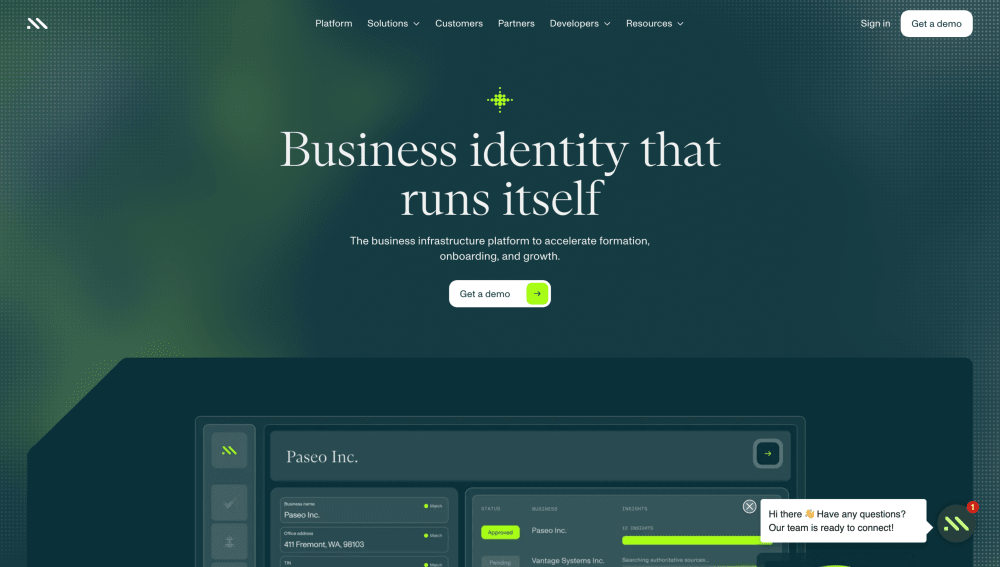
Middesk is the most widely adopted dedicated KYB platform among US fintechs, and its business registry API is the reason most teams evaluate it first. The platform pulls Secretary of State data across all 50 states plus DC and returns a normalized business object that includes entity status, formation details, registered agent, addresses, filing history, and EIN verification in a single response.
What separates Middesk from raw registry scrapers is the data enrichment layer on top. The API cross-references SOS records against IRS business databases, USPS address verification, and watchlist sources, so a single call can return a composite risk signal rather than just raw registry output. This matters for fintech teams running automated onboarding where a human review step would add latency.
Middesk does not publish its per-lookup pricing publicly. Teams report paying on a per-verification basis with an annual platform fee layered on top. Volume discounts apply at scale. The full KYB pricing breakdown across Middesk, Baselayer, Persona, and others has the clearest side-by-side available without requiring a sales call.
2. Baselayer
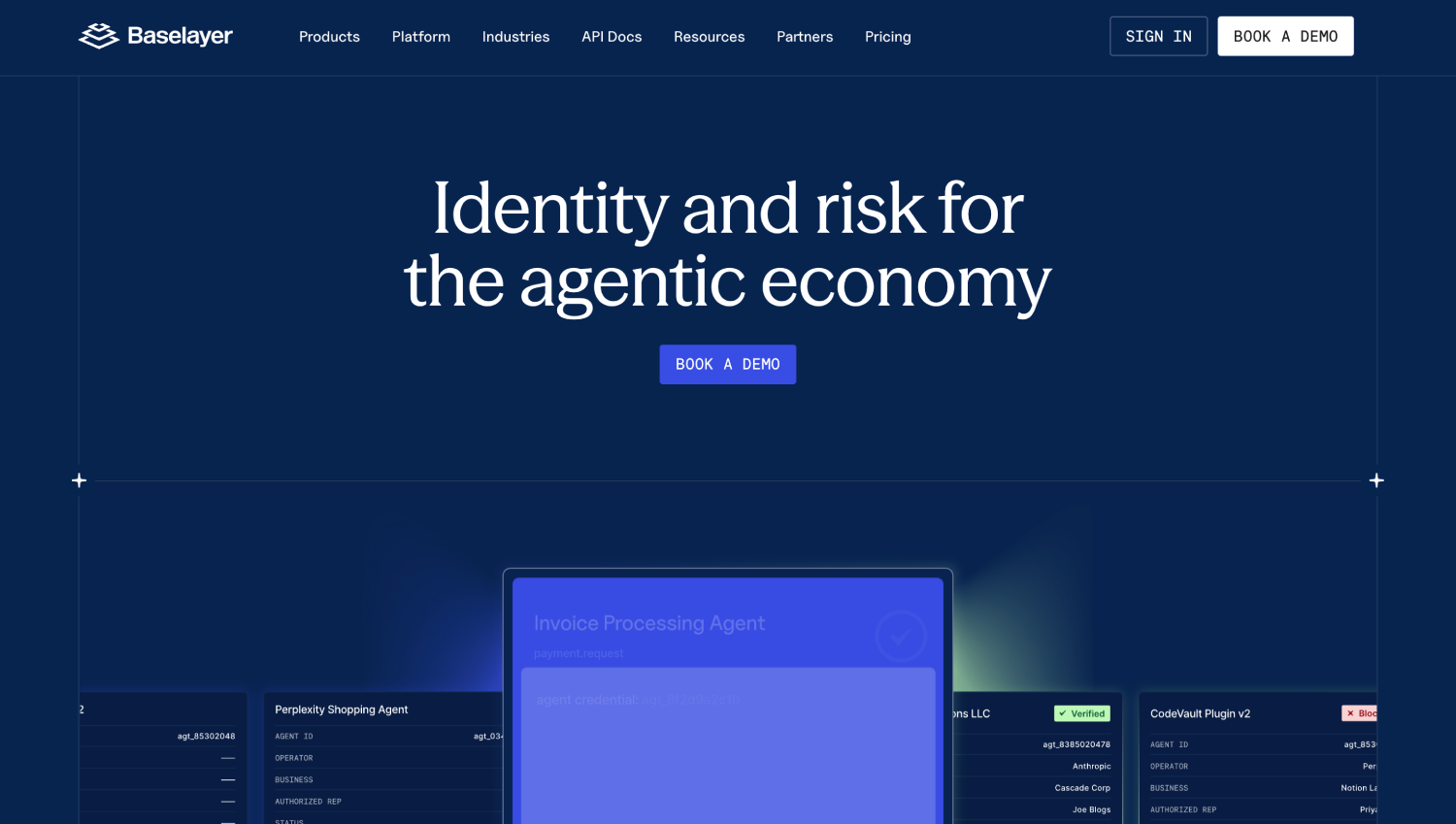
Baselayer is the direct competitor to Middesk in the US-native KYB segment and positions itself on coverage depth and data freshness. The platform claims same-day data from Secretary of State sources rather than relying on older cached datasets, which matters when you are verifying a newly formed entity or catching a recent dissolution.
Baselayer also emphasizes support for high-risk onboarding use cases, including cannabis businesses, money services businesses, and other verticals that see higher refusal rates from competitors. The API returns entity details, officer information, UBO structures, and registered agent data, and supports webhook-based monitoring for status changes after initial verification.
For teams weighing Middesk against Baselayer specifically, the Middesk vs Baselayer head-to-head covers the high-risk use case distinction in more detail. Pricing is not publicly listed and requires a demo request.
3. Cobalt Intelligence
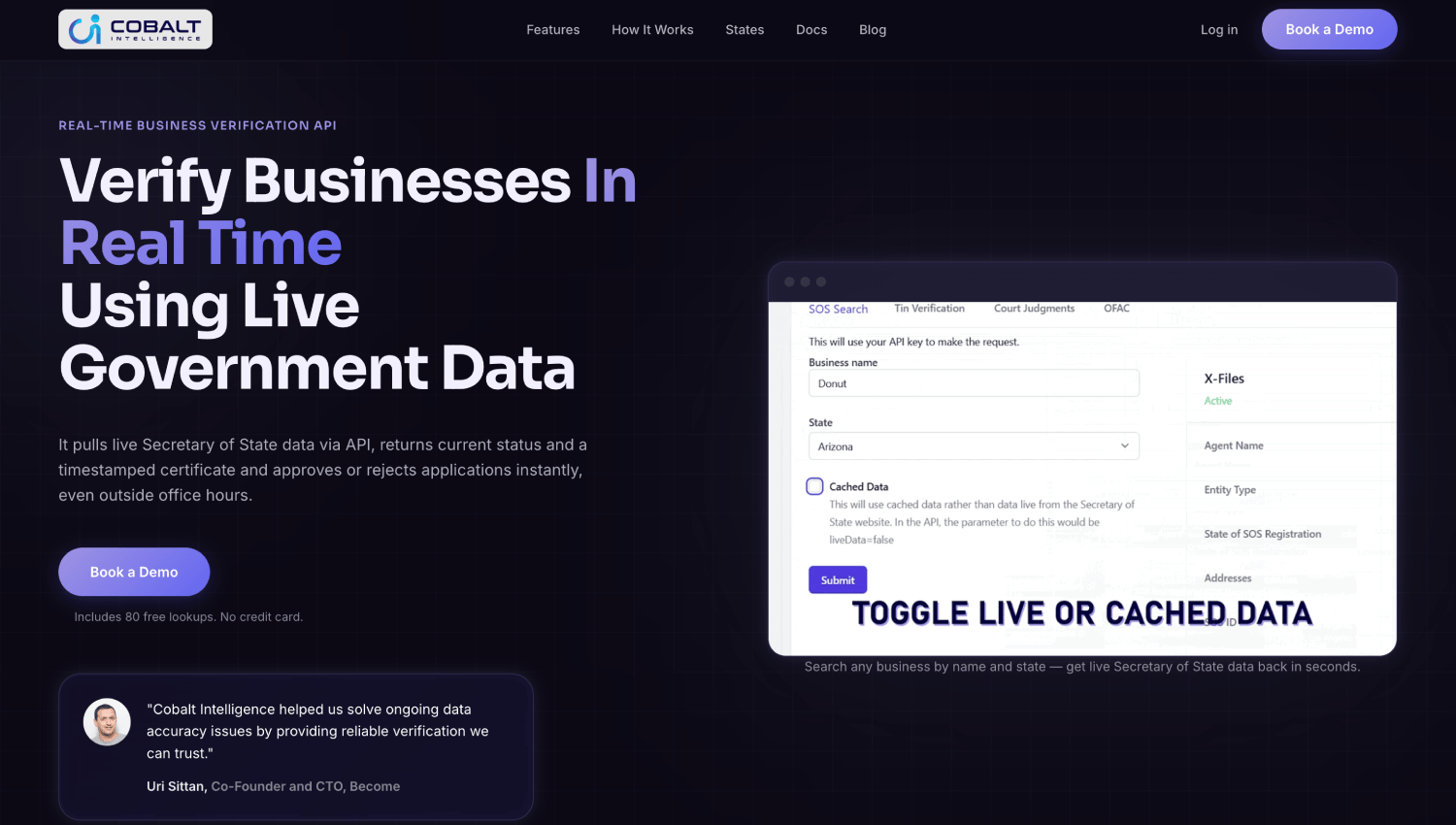
Cobalt Intelligence takes a different approach than the full KYB platforms above. It provides a direct API layer over Secretary of State websites across all 50 states, returning raw SOS data without the enrichment, EIN matching, or watchlist overlays that Middesk and Baselayer add. This makes it the right call for two specific scenarios: teams that want to build their own KYB logic on top of clean registry data, and teams that need access to state filing documents themselves, not just the metadata.
Cobalt’s API can return actual scanned filing documents from state records for states that make them available, which neither Middesk nor Baselayer provides out of the box. As of their public pricing page, Cobalt offers usage-based billing with no annual contract required, which makes it accessible for lower-volume teams or as a secondary source for edge-case states.
The limitation is intentional. Cobalt does not validate or enrich. If the state record has a typo, you get the typo. Teams building a full KYB pipeline on Cobalt alone will need to layer in their own EIN matching, address normalization, and risk scoring logic.
4. OpenCorporates
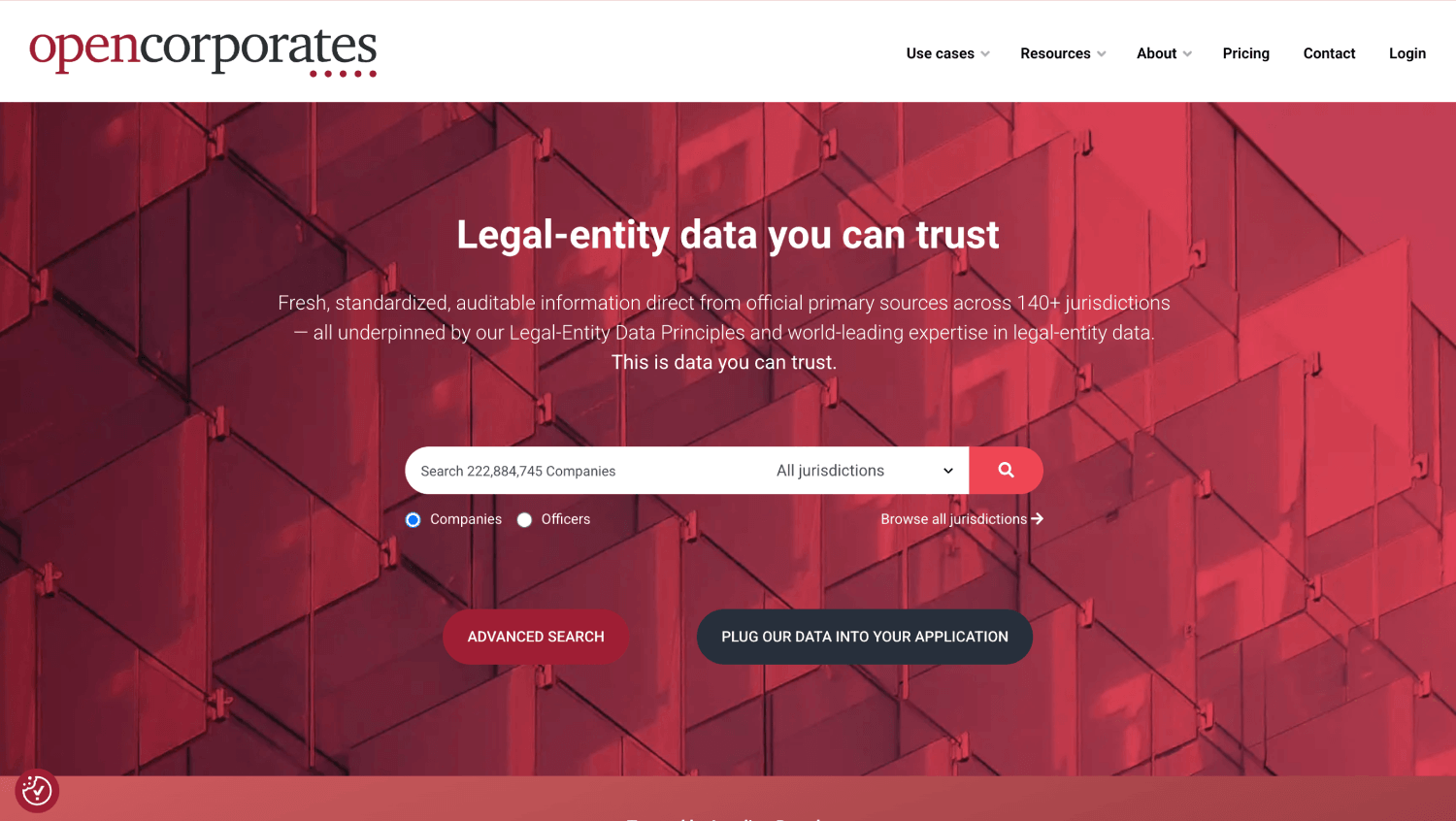
OpenCorporates holds the largest open database of corporate entities globally, covering over 140 jurisdictions including all 50 US states. It is the default registry API for teams that need to verify businesses formed outside the US or that operate cross-border. The data model is standardized across jurisdictions, meaning an API response for a Delaware LLC and a UK Ltd follow the same field structure.
For US-only use cases, OpenCorporates is not the strongest option. Filing history depth varies by state, EIN data is not included, and the enrichment layer is thinner than Middesk or Baselayer. The platform publishes a tiered pricing model for API access on its website, with a free tier for low-volume lookups and commercial tiers for production use. Teams with international exposure who need a single company data API should evaluate it seriously. Teams doing US-only KYB should treat it as a supplement rather than a primary source.
5. Enigma
Enigma approaches business data differently from the pure registry vendors. Its dataset combines SOS records with IRS business data, credit card transaction data, and other commercial signals to produce a business intelligence layer that goes beyond entity verification into business health indicators. For KYB purposes, this means Enigma can return not just “is this entity active” but also “is this entity generating revenue consistent with what the applicant claims.”
This makes Enigma particularly relevant for lending platforms and marketplaces that use KYB data for underwriting as well as identity verification. For teams using KYB purely to confirm entity existence and status, the additional signals are unnecessary overhead. Enigma does not publish pricing publicly.
6. Dun and Bradstreet
Dun and Bradstreet offers business entity data through its Data Cloud APIs, with coverage spanning over 200 countries and territories. The D-U-N-S Number system provides a persistent entity identifier that works across jurisdictions, which is the primary reason enterprise and cross-border teams reach for D&B over US-native alternatives.
For US Secretary of State data specifically, D&B pulls registration records but the filing history depth is generally thinner than Middesk, Baselayer, or Cobalt. Where D&B wins is in corporate hierarchy data: parent-subsidiary relationships, ultimate beneficial ownership structures, and corporate family trees are more complete in D&B’s dataset than in any SOS-native source. Pricing is contract-based and not publicly disclosed. Teams building for a US-only use case will find the cost-benefit skews toward D&B only when international coverage or corporate hierarchy data is a requirement.
7. LexisNexis Risk Solutions

LexisNexis Risk Solutions provides business entity verification through its Bridger and Business Instant ID products. Coverage spans all 50 US states plus international jurisdictions, and the platform integrates SOS records with court records, UCC filings, and sanctions screening in a single workflow. This makes it most relevant for regulated financial institutions running full KYB plus AML checks in one call.
The integration depth comes with pricing complexity. LexisNexis sells through enterprise contracts with custom pricing based on use case and volume. For a seed-to-Series B fintech, the contracting process and minimum commitments typically make it a harder fit than Middesk or Baselayer. For a bank or credit union adding API-driven KYB to an existing LexisNexis risk workflow, it is the lowest-friction option.
8. Wolters Kluwer (CT Corporation)
CT Corporation, a Wolters Kluwer company, has been the legal registered agent infrastructure layer for corporate America for decades. Its API access to SOS data is a byproduct of that infrastructure: CT Corp maintains direct integrations with Secretary of State offices in every state because it manages registered agent services for large enterprises.
This gives CT Corp an accuracy advantage on registered agent data specifically. Because CT Corp is itself a registered agent in many records, it knows immediately when agent information changes. For compliance teams at larger enterprises that need registered agent monitoring as part of ongoing KYB, this is a meaningful differentiation. For startups running initial entity verification checks, the enterprise contract model and legal-services-oriented sales process make it a slower and more expensive path than the pure API vendors on this list.
How to Choose: The FintechSpecs State Coverage Decision Stack
Most teams arrive at this decision having already ruled out building their own SOS scraper. The real question is which vendor fits the actual stack. Here is the decision logic organized by primary requirement.
If you need US-only KYB with enrichment and EIN validation at any meaningful volume, Middesk is the default. It is the most integrated with existing fintech onboarding stacks, has the clearest developer documentation, and the compliance team at most regulated fintechs will have already heard of it.
If you are onboarding high-risk verticals or need real-time SOS data rather than cached records, evaluate Baselayer against Middesk. The enterprise KYB vendor shortlist covers the Baselayer positioning in the high-risk context with more detail.
If you need raw SOS filing documents or want to build your own KYB logic on top of clean registry data at low cost, Cobalt Intelligence is the right starting point. It integrates in hours rather than days and does not require a sales conversation.
If you have international coverage requirements, start with OpenCorporates for breadth and D&B for corporate hierarchy depth. These are not mutually exclusive. Some teams run OpenCorporates for entity existence and D&B for beneficial ownership, which avoids paying for D&B’s full data package on every lookup.
| Use Case | Primary Recommendation | Secondary Option |
|---|---|---|
| Automated US KYB at scale | Middesk | Baselayer |
| High-risk or cannabis onboarding | Baselayer | Middesk |
| Raw SOS filing document access | Cobalt Intelligence | CT Corporation |
| International entity verification | OpenCorporates | Dun and Bradstreet |
| Corporate hierarchy and UBO | Dun and Bradstreet | LexisNexis |
| Business health for underwriting | Enigma | Dun and Bradstreet |
| Regulated FI full KYB plus AML | LexisNexis | CT Corporation |
What Does a Business Registry API Actually Return?
The response structure matters as much as coverage. A registry API that returns 50 fields but leaves registered agent addresses inconsistently formatted across states creates downstream normalization work that negates the value of buying rather than building.
A production-grade business registry API response should include: legal entity name, all registered DBA names, entity type, state of formation, date of formation, current status, registered agent name and address, principal office address, officer and director names, filing history with document dates, and a state-specific entity ID. Some vendors add a normalized entity identifier that persists even when state records change, which simplifies matching across multiple lookups of the same company over time.
Teams building KYB into a broader compliance stack should review the KYB onboarding automation platforms that sit above these registry APIs, since orchestration tools like Alloy and Persona consume registry data as one signal among many rather than as the sole verification source.
How Do Secretary of State Filing APIs Handle Stale Data?
This is the question most vendor comparison articles skip, and it matters operationally. SOS records are only as good as when the state last processed a filing. In some states, annual report processing runs several weeks behind. A company that dissolved 30 days ago may still show as active in the registry if the dissolution filing has not been processed yet.
Vendors handle this differently. Some, like Baselayer, claim near-real-time data by querying state systems directly at lookup time rather than serving from a cached internal database. Others, like D&B and LexisNexis, maintain proprietary databases that are updated on a cadence rather than live. The Middesk approach blends both: cached data for speed with real-time fallback for high-stakes verifications.
For ongoing monitoring use cases where you need to know when a previously verified business changes status, look specifically for webhook or event-based alerting in the API. Not all vendors offer this, and for teams running perpetual KYB and ongoing business monitoring, it is a prerequisite, not a nice-to-have.
Frequently Asked Questions
What is a business registry API?
A business registry API is a programmatic interface that returns business entity data from state Secretary of State databases and equivalent government registries. It normalizes registration records, entity status, filing histories, and officer information across multiple jurisdictions into a structured response. Fintech teams use these APIs to verify that a business legally exists as part of Know Your Business compliance workflows, replacing manual lookups across individual state portals.
Can a single API cover all 50 US Secretary of State databases?
Yes. Vendors like Middesk, Baselayer, and Cobalt Intelligence maintain integrations with all 50 US state SOS systems plus DC. The challenge is not accessing the states but normalizing the output, since each state uses different field names, entity type classifications, and update cadences. Purpose-built business registry APIs handle that normalization and return a consistent data structure regardless of state.
What is the difference between a business registry API and a full KYB platform?
A business registry API returns raw or lightly normalized SOS data: entity name, status, formation records, and filings. A full KYB platform like Middesk or Alloy takes that registry data and layers in EIN verification, beneficial ownership checks, sanctions screening, and risk scoring to produce a pass, fail, or review decision. Teams that want control over their decisioning logic buy registry access. Teams that want a complete KYB workflow buy a platform.
How much does a business registry API cost?
Pricing varies significantly by vendor and volume. Cobalt Intelligence offers public usage-based pricing for direct SOS queries. OpenCorporates publishes tiered API pricing on its website. Middesk, Baselayer, Enigma, Dun and Bradstreet, and LexisNexis do not publish per-lookup prices publicly and require a sales engagement. Enterprise contracts for high-volume users typically include annual minimum commitments. For a detailed side-by-side of KYB verification costs, the KYB pricing breakdown covers the per-check economics.
Does a business registry API include EIN verification?
SOS databases do not contain EIN data. EIN verification requires cross-referencing IRS records, which is a separate data source. Vendors like Middesk, Baselayer, and Enigma combine SOS data with IRS business records to return EIN matches alongside registry data. Cobalt Intelligence and OpenCorporates do not include EIN matching natively. If EIN verification is required for your KYB flow, confirm this capability explicitly before signing.
Which business registry API works best for international entity verification?
OpenCorporates covers over 140 jurisdictions and uses a consistent data model across countries, making it the most accessible option for international entity lookups. Dun and Bradstreet extends to over 200 countries and adds corporate hierarchy data that OpenCorporates does not provide at the same depth. For teams needing both US and cross-border coverage in one API, the KYB providers for cross-border business verification covers the international stack in detail.
How do I know if a Secretary of State data API is returning current information?
Ask vendors directly about their data refresh cadence and whether they query state systems in real-time or serve from a cached database. Baselayer positions on real-time SOS queries. D&B and LexisNexis maintain proprietary databases with update cadences that vary by state and entity type. Request documentation on each vendor’s data sourcing methodology and confirm their policy on data freshness guarantees before signing a contract.
What Most KYB Teams Underestimate About Registry Data
The Secretary of State record is the legal floor, not the ceiling. It tells you a business was formed and has not been dissolved. It does not tell you whether the business is operating, generating revenue, or controlled by the person claiming to represent it. Teams that treat a clean SOS record as sufficient KYB are leaving meaningful verification gaps open.
The smarter approach treats registry data as the first verification layer in a stack. SOS records confirm legal existence. EIN matching confirms tax identity. Beneficial ownership checks confirm who controls the entity. Adverse media and watchlist screening confirms that neither the entity nor its principals are flagged. The registry API is where that chain starts, and buying a good one means the rest of the stack has accurate inputs to work with. Teams reviewing their full compliance automation picture should read the Fintech Product and Compliance Readiness Checklist to see how entity verification fits into the broader regulatory posture.
The vendors that add the most value are the ones that have already done the normalization and enrichment work so your engineering team does not have to. For most growth-stage fintechs, that means Middesk or Baselayer as the primary source, with Cobalt Intelligence as a cost-effective fallback for edge cases. Pick the vendor whose coverage model matches your customer geography and whose pricing model matches your lookup volume, and treat the registry API as infrastructure rather than a feature.