
TLDR
- Most KYB tools are data providers. The platforms on this list are workflow engines that decide, route, and close cases automatically.
- The distinction that matters: auto-decisioning rate. Top platforms push 70 to 90 percent of incoming business applications to a pass or fail without a human touching the file.
- AI agent architectures (Parcha, Ondorse) now handle document extraction, registry lookups, and UBO graph construction in minutes, not hours.
- The right platform depends on whether you need orchestration across existing data vendors, full-stack replacement, or a case management layer on top of what you already built.
- Pricing is almost never public. Expect per-verification fees, platform minimums, and implementation costs that can triple the sticker price at low volume.
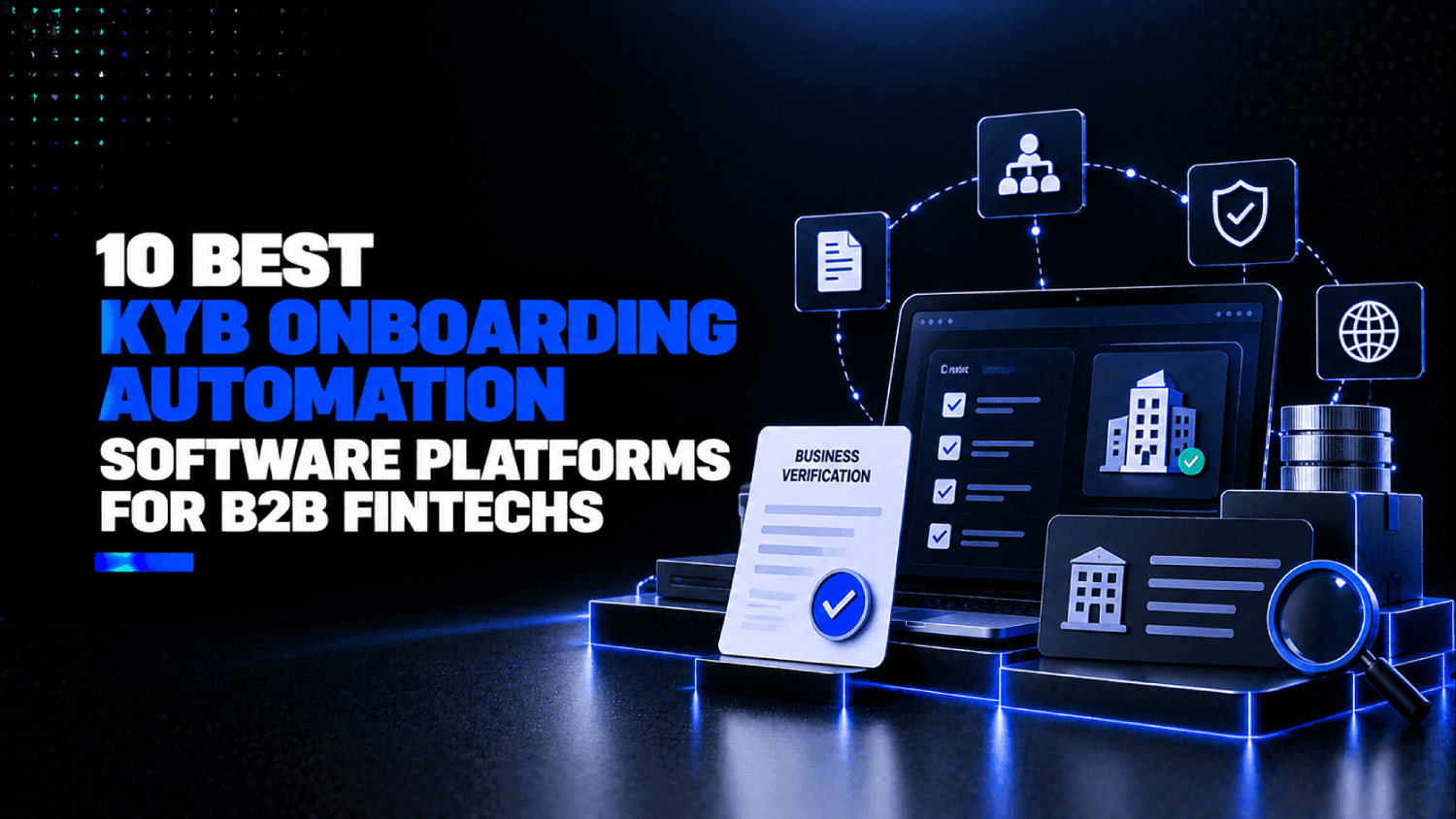
The best KYB onboarding software platforms for B2B fintechs are Ondorse, Parcha, Alloy, Sumsub, Persona, Ballerine, Sphinx, Middesk, Comply Advantage, and Oscilar. Each combines automated business verification with workflow orchestration, pushing most applications to an automated decision without manual analyst review. The right choice depends on whether you need a full-stack solution, an orchestration layer over existing data vendors, or an AI-agent that handles document reasoning end to end.
Why KYB Onboarding Software Is a Workflow Problem, Not a Data Problem
Ask most fintech compliance teams what slows down business onboarding and they will describe an analyst opening five browser tabs: a state registry, a EDGAR lookup, a sanctions screen, a document review queue, and a UBO spreadsheet. The data exists. The problem is that no single system assembles it into a decision.
That is what separates KYB onboarding software from KYB data providers. Data providers like Middesk, Baselayer, and LexisNexis return structured business information. Workflow platforms take that data, apply your policy rules, run it through a case management engine, and either auto-approve, auto-reject, or surface only the genuinely ambiguous cases to a reviewer. If you want to understand the data provider layer separately, our guide to the best KYB providers for B2B fintech onboarding covers that in full. This article is about what sits on top of that data layer.
The operational cost difference is real. A team relying on manual review at 50 business verifications per day needs multiple analysts full-time. A team running a properly configured workflow platform routes the majority of those applications to auto-decision and flags only the structural edge cases: shell company layering, UBO chains crossing four or more jurisdictions, or documents where the registered address does not match any state filing. That routing logic is the product.
What Does “Auto-Decisioning Rate” Actually Mean for KYB?
Auto-decisioning rate is the percentage of incoming KYB applications that the platform resolves with a pass or fail verdict without a human opening the case file. It is the most important operational metric in KYB onboarding software, and it is rarely disclosed in vendor marketing.
A platform claiming 80 percent auto-decisioning is saying that 4 out of 5 business applications your team receives will close without an analyst. The remaining 20 percent go to a review queue, typically because a document is missing, a UBO cannot be verified against a registry, or a watchlist hit requires human judgment. High auto-decisioning rates reduce time-to-onboard, lower cost per verification, and shrink the analyst headcount needed to scale.
The catch: auto-decisioning rate is meaningless without knowing the false-negative rate underneath it. A platform can push 95 percent of applications to auto-approve by setting loose rules. What you want is a high auto-decisioning rate paired with a low rate of post-approval fraud or compliance findings. No vendor publishes both figures together. You have to test this yourself in a proof of concept using a sample of your actual applicant population.
The FintechSpecs KYB Workflow Stack Test: How to Evaluate These Platforms
Before running a shortlist, evaluate each platform against four specific questions. We call this the FintechSpecs KYB Workflow Stack Test.
- Policy engine: Can you express your exact onboarding rules in the platform without writing code? Look for a visual rule builder, not just an API where your engineers hard-code logic.
- Data orchestration: Does the platform connect to your existing data vendors (Middesk, Dun and Bradstreet, Experian Business) or does it lock you into its own data layer? Vendor lock-in on data is expensive at scale.
- Case management: When an application flags for review, does an analyst get a complete assembled case file, or do they still have to pull data manually? The quality of the review queue directly determines how much time analysts spend per case.
- Audit trail: Does every automated decision produce a timestamped, examiner-ready audit log? Your sponsor bank or regulator will ask for this during an examination.
Platforms that pass all four checks are genuine workflow engines. Platforms that fail on policy engine or case management are essentially data APIs with a dashboard bolted on. The distinction matters for compliance readiness as your volume scales. Our fintech product and compliance readiness checklist covers what examiners actually look at when they audit an onboarding program.
Which KYB Automation Platforms Auto-Decision the Most Cases?
The table below maps each platform to its primary value layer, the stage of company it fits best, and its publicly disclosed or vendor-confirmed automation orientation. Pricing is not publicly listed for most of these platforms. Where figures appear, they are drawn from public pricing pages.
| Platform | Primary Layer | Best Fit Stage | AI Agent Capability | Public Pricing |
|---|---|---|---|---|
| Ondorse | AI agent + workflow | Seed to Series B | Yes (document + registry) | Not public |
| Parcha | AI agent layer | Series A to C | Yes (LLM-driven reasoning) | Not public |
| Alloy | Orchestration + decisioning | Series A to Series C+ | Partial (rule + ML hybrid) | Not public |
| Persona | Orchestration + case management | Seed to Series B | Partial (configurable flows) | Starter plan from $1,499/month (see note below) |
| Sumsub | Full-stack KYB/KYC | Seed to Series B | Partial | Not public; per-check model per company marketing |
| Ballerine | Open-source workflow | Seed to Series A | Emerging | Open-source core; enterprise pricing not public |
| Sphinx | Case management + review | Series A to C | No (human-in-loop focus) | Not public |
| Middesk | Data + workflow layer | Seed to Series B | No | Not public |
| ComplyAdvantage | AML screening + monitoring | Series A to enterprise | Partial | Not public |
| Oscilar | Risk decisioning engine | Series A to C | Yes (AI risk agents) | Not public |
1. Ondorse: AI-Native KYB Agent for European and US Markets
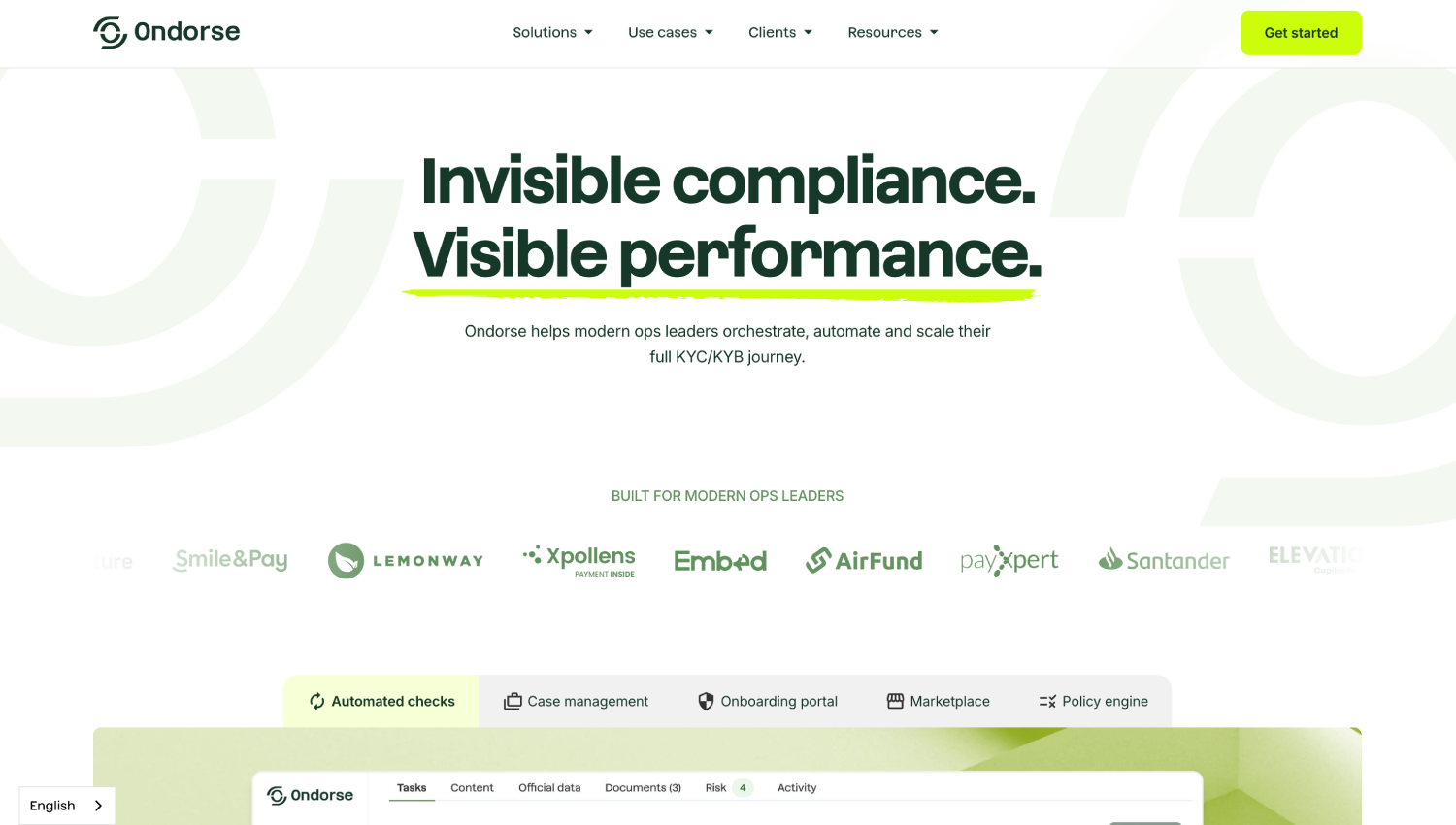
Ondorse was built specifically for KYB, not adapted from a KYC product. It runs an AI agent that queries business registries, extracts data from uploaded documents, constructs the UBO ownership graph, and applies your policy rules in a single automated sequence. Most applicants receive a decision within minutes of submission.
The platform connects to registries across Europe and the US, which gives it an edge for fintechs onboarding businesses across multiple jurisdictions. The rule builder is no-code, so your compliance team can modify risk thresholds without filing an engineering ticket. For a seed-stage fintech handling 10 to 200 business verifications per month, Ondorse significantly reduces the need for a dedicated KYB analyst from day one.
Pricing is not publicly listed. Ondorse operates on a per-verification model with a platform minimum. Request a quote directly for current figures.
2. Parcha: LLM-Driven KYB Agents That Reason Through Documents

Parcha takes a different approach from most vendors on this list. Rather than running structured data lookups through a rule engine, it deploys large language model agents that read documents, reason about ownership structures, and produce a written decision rationale alongside a pass or fail verdict. An analyst reviewing a flagged case sees not just a score but a prose explanation of why the application flagged.
That document reasoning capability matters most for complex cases: businesses with multi-layer holding structures, foreign-incorporated entities, or documents in languages other than English. Parcha handles these cases at a speed that is impossible with a human analyst and produces an audit trail that shows exactly what the AI reasoned through. It is positioned for Series A and above teams that already have compliance infrastructure and need to automate the hard middle cases, not just the easy approvals.
Pricing is not publicly disclosed.
3. Alloy: Full Orchestration for KYB and Broader Identity Decisioning
Alloy is the platform to evaluate if your onboarding flow combines KYB and KYC, or if you need a single orchestration layer over multiple data vendors. It connects to over 200 data sources and lets your compliance team build decision workflows in a visual editor without engineering support for each change. The platform handles business verification, UBO screening, AML watchlist checks, and individual KYC within the same workflow.
The tradeoff with Alloy is complexity. It is the most capable platform on this list in terms of data source breadth, but configuration takes time and an implementation effort. Companies going live in 30 days should look elsewhere. For a Series B fintech with an existing compliance team and a need to unify six separate data vendor relationships into a single policy engine, Alloy is purpose-built for that problem. Our detailed comparison of Alloy vs Middesk for KYB breaks down where each performs better.
Pricing is not publicly listed. Alloy uses a per-verification model with platform fees.
4. Persona: Configurable Onboarding Orchestration with Strong Case Management
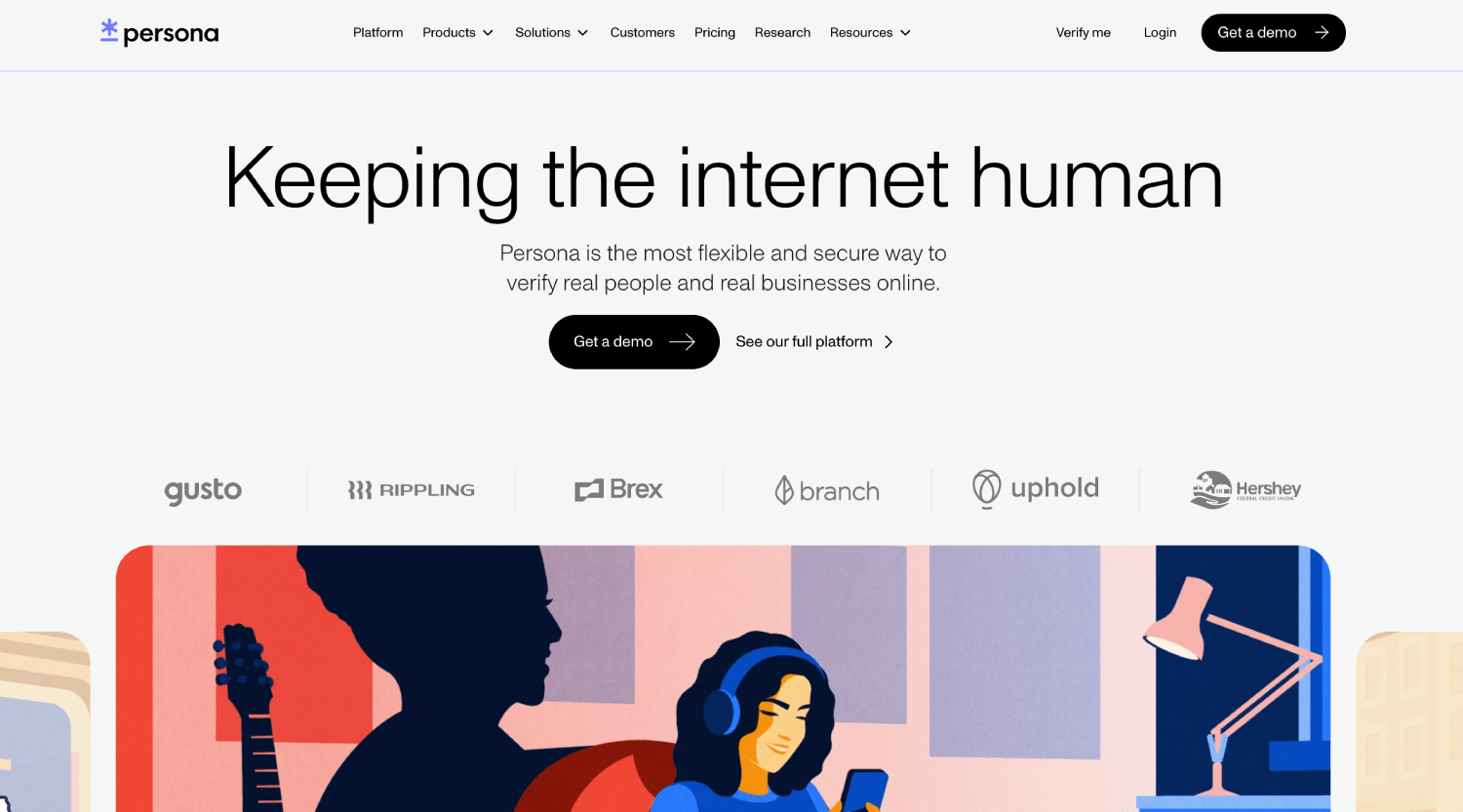
Persona is the most accessible platform on this list for teams without a dedicated compliance engineer. Its flow builder lets you construct a KYB verification sequence visually, connecting document collection, business registry checks, and individual KYC for UBOs into a single applicant-facing experience. The case management interface is well-designed, giving reviewers a complete assembled dossier rather than raw data fields.
Persona’s public pricing page lists a starter plan at $1,499 per month. Volume-based verification fees apply on top. Note that pricing pages change; verify current figures directly before budgeting. For a company doing fewer than 500 business verifications per month, Persona gives you a production-ready KYB flow without a long implementation cycle. The platform connects to external data vendors but has a more limited data source network than Alloy. Our broader comparison of Alloy vs Persona for identity orchestration covers the exact tradeoffs between the two.
5. Sumsub: Full-Stack KYB/KYC Platform with Global Coverage
Sumsub is a full-stack verification platform covering KYC, KYB, AML screening, and ongoing monitoring in a single product. For fintechs that need both individual and business verification and do not want to stitch together separate vendors, Sumsub eliminates the integration overhead. It handles document verification, liveness checks for UBOs, business registry lookups, and sanctions screening under one API.
Its geographic coverage is broad, with support for business entity verification across many jurisdictions, which benefits fintechs onboarding non-US businesses or SMBs with foreign parent entities. The workflow builder is functional but less flexible than Alloy or Persona for complex policy logic. Sumsub is strongest for companies that want a fast path to production on standard KYB flows rather than maximum configurability on edge cases. Sumsub does not publish pricing publicly; the company markets a per-check model, but confirmed rates require a direct quote. Our comparison of Trulioo vs Sumsub for fintech onboarding shows how it stacks up against a direct competitor.
6. Ballerine: Open-Source KYB Workflow Engine
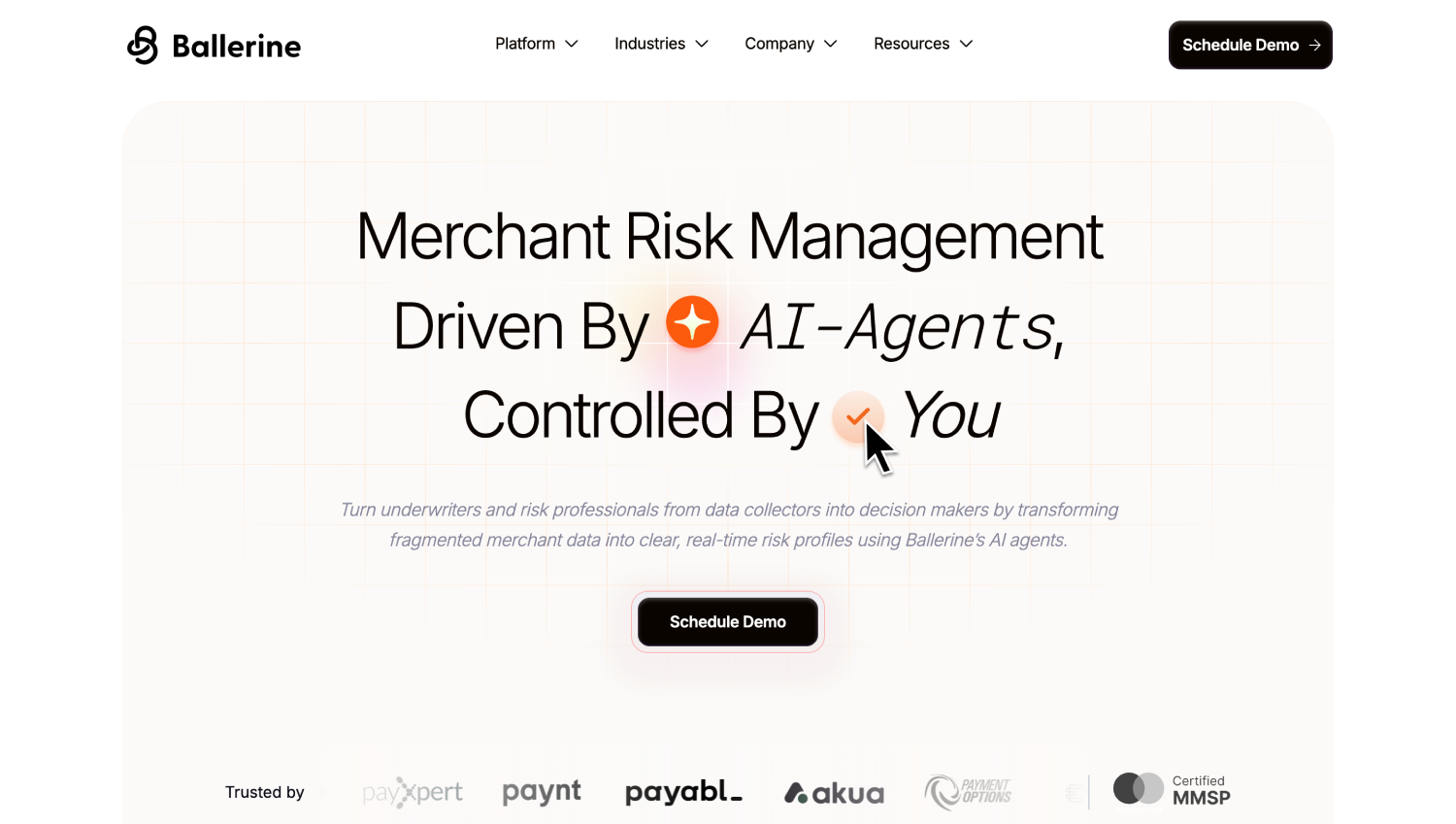
Ballerine is the only open-source platform on this list. Its core workflow engine is available on GitHub, which lets engineering teams inspect the code, modify the logic, and self-host the system. That matters for fintechs with specific data residency requirements or those that want to avoid vendor dependency on the workflow layer itself.
The tradeoff is implementation effort. You are not buying a turnkey solution. You are buying a foundation that your team builds on. Ballerine offers a managed cloud version with enterprise support, and that is where pricing enters the picture, though it is not publicly disclosed. For a seed-stage company with strong engineering resources and a compliance team that wants deep control over the onboarding flow logic, Ballerine is worth evaluating. For a company that needs to go live in six weeks, it is not the right call.
7. Sphinx: Structured Case Management for High-Volume Review Teams
Sphinx occupies a specific niche on this list. It is not trying to auto-decision everything. It is built to make human review faster and more consistent when a case does need an analyst. The platform structures the review queue, enforces decision documentation standards, and integrates with upstream data sources to pre-populate case files before an analyst opens them.
That positioning makes Sphinx most relevant for fintechs that already have a compliance team and are losing time to inconsistent review processes rather than raw volume. If your analysts spend 45 minutes per case because they are assembling information from multiple systems, Sphinx cuts that to 10 to 15 minutes by doing the assembly automatically. It works alongside, rather than replacing, other KYB data vendors. Pricing is not publicly disclosed.
8. Middesk: Business Verification with a Workflow Layer
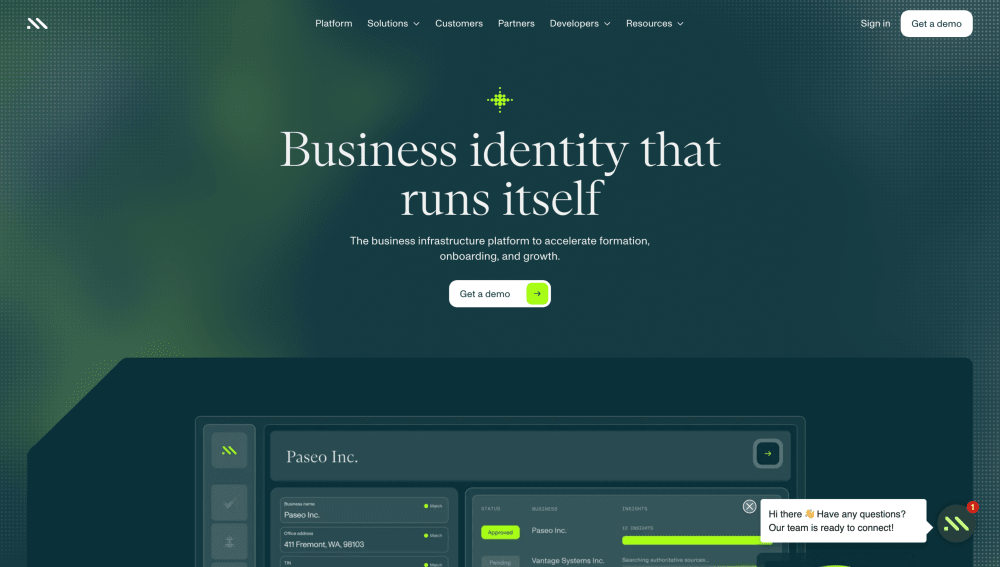
Middesk started as a business data provider and has added workflow functionality over time. It pulls data from state registries, the IRS, USPS, and other sources to return a structured business verification report. The workflow layer lets teams build auto-decisioning rules on top of those reports, routing clean applications to approval and flagging edge cases for review.
Middesk is strongest for US-focused fintechs verifying domestic businesses. Its international coverage is limited compared to Sumsub or Ondorse. For a company onboarding US-incorporated SMBs with relatively standard structures, Middesk delivers fast time-to-production on a well-documented API. For anything involving foreign entities, complex UBO chains, or cross-border structure analysis, it falls short. Our detailed head-to-head of Middesk vs Baselayer for high-risk onboarding covers where its data layer performs well and where it does not.
9. ComplyAdvantage: AML Screening and Monitoring Inside the KYB Flow
ComplyAdvantage is primarily an AML screening and adverse media monitoring platform, but it fits this list because sanctions and watchlist screening is a required step in any complete KYB flow. It maintains a continuously updated database of sanctions lists, PEPs, and adverse media signals, and its API can be embedded into a KYB workflow as the screening step before an auto-approval fires.
For fintechs already using Alloy, Persona, or Middesk as their orchestration layer, ComplyAdvantage is frequently integrated as a connected data vendor rather than deployed as a standalone platform , though it does offer direct access outside of orchestration tools. Its value is in the freshness and coverage of its screening data, particularly for adverse media signals that would not appear in a standard sanctions list. Pricing is not publicly listed. For a broader look at how ComplyAdvantage compares against an alternative in the AML screening space, our head-to-head of ComplyAdvantage vs Sardine covers the key differences.
10. Oscilar: AI Risk Decisioning Engine with KYB Coverage
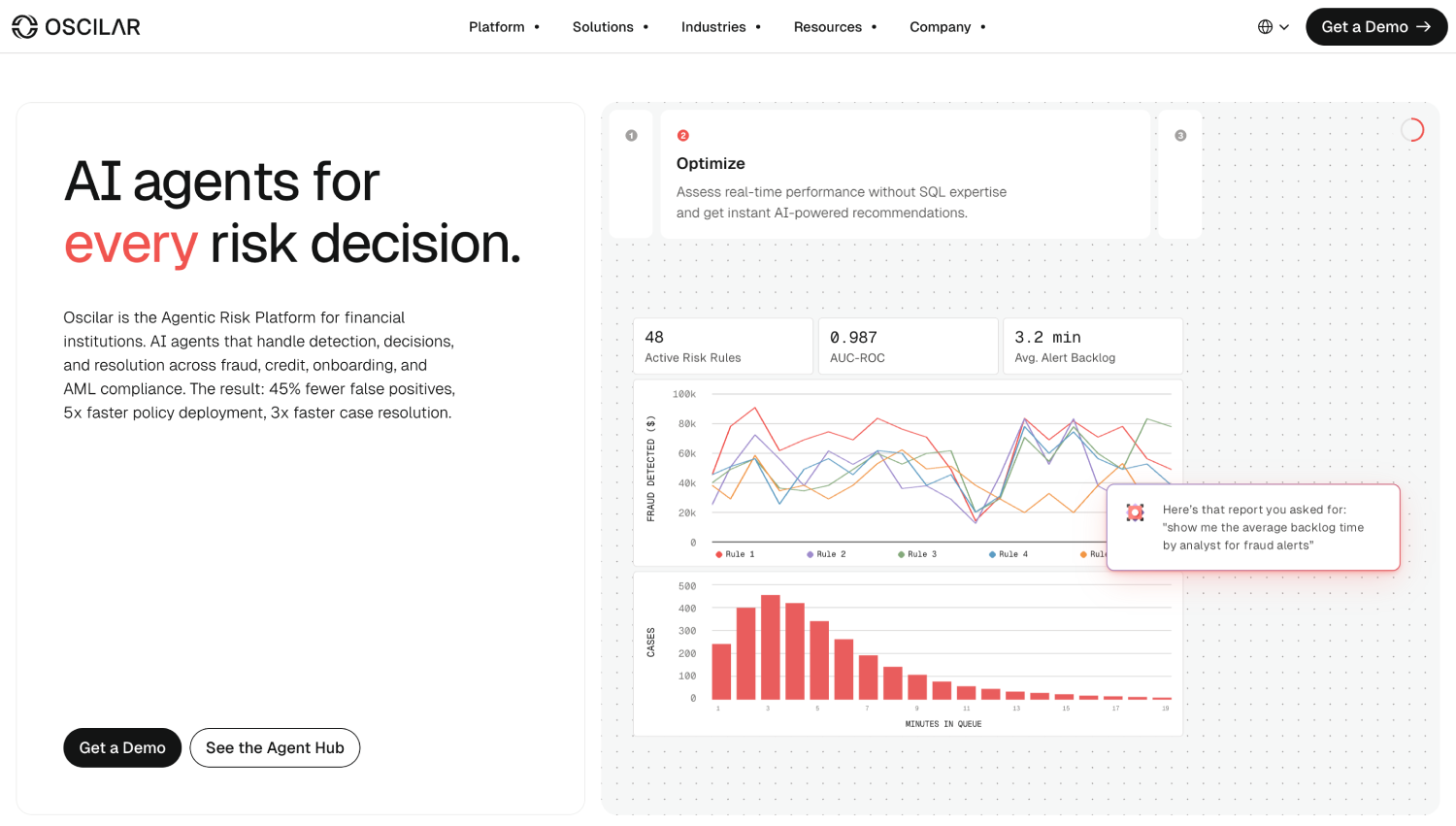
Oscilar is a risk decisioning platform that covers KYB as part of a broader fraud and compliance use case. Its AI agents analyze incoming applications against configurable risk models and produce an automated decision with an explainability trace. It sits closest to Alloy in its orchestration ambitions but is newer and more narrowly deployed in the market.
Oscilar is worth evaluating for Series A to C fintechs that want a single decisioning engine covering onboarding risk, ongoing transaction monitoring, and fraud detection without running separate systems for each. The integrated approach has a real operational advantage: a business that passes KYB onboarding feeds directly into an ongoing risk profile rather than starting from scratch in a separate monitoring system. Pricing is not publicly disclosed. Our comparison of Taktile vs Oscilar for credit decisioning covers how the decisioning logic compares across growth-stage use cases.
How to Automate KYB Verification: A Practical Workflow Architecture
To illustrate how automation changes the math, consider a hypothetical Series A lending platform onboarding 300 business applicants per month. Without automation, a team might spend roughly 2 hours per application across registry checks, document review, UBO mapping, and sanctions screening. At full manual processing, that is 600 hours of analyst time monthly , or three full-time employees doing nothing but KYB. This is a simplified illustration; actual time-per-application will vary by applicant complexity and team workflow.
A properly configured KYB workflow platform restructures that into three tiers. Tier one is auto-approval: applications where the business is registered, the UBO matches a verified identity, no sanctions hits appear, and the document set is complete. A well-tuned system sends 60 to 75 percent of applications through this path in under five minutes. Tier two is auto-flag for review: applications with a minor data mismatch, a UBO who shares a name with a sanctions list entry (but is not confirmed), or a document with a quality issue. An analyst gets a pre-assembled case file and closes the review in 10 to 20 minutes. Tier three is auto-reject: applications where the business does not appear in any registry, the document is confirmed fraudulent, or a hard sanctions hit fires. No human time spent.
In this scenario, roughly 50 to 60 applications go to human review, requiring 10 to 15 analyst hours per month rather than 600. Headcount requirements drop, time-to-onboard falls from days to minutes for most applicants, and the audit trail is cleaner because every auto-decision is logged with its rule reasoning. This kind of onboarding efficiency problem is directly related to why fintechs lose applicants mid-flow , a pattern our analysis of why fintech users drop off during onboarding breaks down in detail.
What Is the Difference Between KYB Onboarding Software and KYB Data Providers?
KYB data providers (Middesk, Baselayer, Dun and Bradstreet, LexisNexis, Experian Business) return structured data: business registration status, filing history, address records, UBO registry information. They answer the question “what do we know about this business?”
KYB onboarding software answers the question “what do we do with that information?” It applies your compliance policy rules, orchestrates calls to multiple data sources in sequence or parallel, assembles the complete case file, fires the auto-decision where your rules allow it, and routes exceptions to a review queue with context. The workflow layer is what makes onboarding automatable at scale. Most teams underestimate how much of their analyst time is spent on coordination and assembly rather than actual judgment.
Frequently Asked Questions
What is KYB onboarding software?
KYB onboarding software is a workflow and decisioning platform that automates business verification during client or partner onboarding. It connects to business registry data, document verification tools, and AML screening systems, then applies your compliance policy rules to produce an automated pass, fail, or review decision on each incoming application. It is distinct from KYB data providers, which only return raw business data without applying decision logic.
How much does KYB automation software cost?
Most KYB workflow platforms do not publish public pricing. Costs typically include a per-verification fee, a platform or minimum monthly fee, and often an implementation or onboarding charge. Persona is an exception: their public pricing page lists a starter plan at $1,499 per month, plus per-check fees on top. Verify current figures directly, as pricing pages change. For enterprise volumes, expect contract negotiations with minimums that vary significantly by vendor and use case. Our breakdown of how much KYC and KYB actually costs per verification provides additional context on how to model total cost.
Can AI agents fully automate KYB verification?
AI agents like those in Parcha and Ondorse can automate a large majority of KYB cases, including document extraction, registry cross-referencing, and UBO graph construction. Most platforms target 70 to 90 percent auto-decisioning rates for standard business structures. Complex cases involving multi-layer holding companies, foreign-incorporated entities, or ambiguous UBO chains still require human review, though AI agents dramatically reduce the time an analyst spends on each such case by pre-assembling the evidence.
What is the best KYB platform for an early-stage fintech?
Persona and Ondorse are the strongest options for seed-to-Series A fintechs. Persona offers transparent base pricing, a no-code flow builder, and fast time-to-production. Ondorse is more KYB-specific and better suited if your applicant base includes European businesses or you need AI-driven document reasoning from day one. Ballerine is worth considering if your team has engineering resources and wants full control over the workflow logic via an open-source foundation.
How do I measure whether my KYB automation is working?
Track three metrics: auto-decisioning rate (percentage of applications resolved without human review), median time-to-decision for auto-approved applications, and post-approval incident rate (businesses that passed KYB and later triggered a fraud or compliance event). A rising auto-decisioning rate paired with a stable or declining post-approval incident rate indicates your rules are calibrated correctly. A rising auto-decisioning rate with rising post-approval incidents means your rules are too permissive.
What should I check in an audit trail from a KYB platform?
A compliant audit trail should include a timestamp for every action, the data source queried at each step, the rule or model version that fired the decision, the outcome and reasoning, and the identity of any human reviewer who touched the case. Your sponsor bank and any state regulator will want to see that every decision is traceable to a specific rule, a specific data input, and a specific moment in time. Platforms that only log the final decision without the reasoning chain are insufficient for most regulated programs.
Is open-source KYB software viable for production use?
Ballerine’s open-source core is production-ready for engineering teams that are willing to own the deployment and maintenance. The benefit is full code transparency, the ability to audit every decision path, and no vendor lock-in on the workflow layer itself. The cost is implementation time, ongoing infrastructure management, and the absence of a dedicated support team unless you purchase the enterprise tier. For a company with two or more engineers dedicated to compliance tooling, it is a viable path. For a team of one, it adds risk.
Where Does KYB Onboarding Software Fit in the Broader Fintech Compliance Stack?
KYB is one layer in a compliance program that also includes transaction monitoring, ongoing business monitoring, beneficial ownership refresh cycles, and adverse media surveillance. A KYB workflow platform handles the front door. What happens after approval is a separate problem. Our guide to perpetual KYB and ongoing monitoring platforms covers what runs after initial onboarding closes.
The platforms that handle onboarding best are not always the platforms that handle ongoing monitoring best. Alloy bridges both reasonably well. Sumsub covers both in one product but with less depth on the monitoring side than dedicated tools. Building your stack requires understanding which vendors are genuinely strong on both sides and which are using “ongoing monitoring” as a marketing term for periodic re-runs of the same onboarding check.
The underlying infrastructure decisions you make here also connect to your broader fintech compliance costs. The real cost of KYB at scale is not the per-verification fee. It is the analyst headcount, the operational overhead of managing multiple vendor relationships, and the latency cost when slow onboarding causes applicants to abandon the process. Platforms that compress all three of those costs simultaneously are worth paying more for on a per-verification basis. That math almost always favors investing in the workflow layer earlier than most early-stage teams expect. For a fuller picture of how compliance spending scales by company stage, our analysis of the real cost of compliance in fintech SaaS breaks down where the budget goes.