
TLDR
- The per-payout fee is rarely the dominant cost in cross-border payouts. FX markup typically costs 2 to 10 times more than the flat transaction fee on a $5,000 payment.
- Wise uses the mid-market rate and charges an explicit percentage fee. Most competitors quote a “0 fee” or “low fee” while embedding margin in the exchange rate itself.
- Airwallex offers zero FX markup for conversions between held balances in its multi-currency wallet. Nium and Payoneer mark up the rate, though the degree varies by corridor and is not always disclosed upfront.
- The right comparison metric is total cost per corridor: flat fee plus FX markup on the send amount, calculated in the recipient’s currency.
- For high-volume B2B payouts, negotiating FX margin is more impactful than negotiating the per-transaction fee.
Cross-border payout fees consist of two components: a flat per-transaction fee and an FX markup embedded in the exchange rate. Wise charges a transparent percentage fee on top of the mid-market rate. Airwallex eliminates FX markup between held balances but charges conversion fees otherwise. Nium prices by contract and does not publish FX margins. Payoneer charges per-transaction fees that vary by payment method and embeds a spread in the exchange rate. Total cost per corridor, not the headline fee, is the number that determines which platform is cheaper for your specific use case.
Why Per-Payout Fees Tell You Almost Nothing
A $10 flat fee on a $5,000 international payout looks like 0.2% of the transaction. That math is clean. What it hides is the exchange rate spread, which on many platforms runs between 0.5% and 2.5% on the same transaction. On that $5,000 payment, 1% of FX markup costs $50. The flat fee is $10. The spread is five times bigger.
This is the core framing problem. Procurement teams and finance leaders shopping for payout infrastructure tend to anchor on the transaction fee because it appears on the invoice and in the pricing page. The FX spread is invisible unless you compare the rate offered to the mid-market rate at the moment of conversion. Most vendors do not make that comparison easy.
The FintechSpecs Total Corridor Cost framework collapses both components into a single number for an apples-to-apples comparison: Total Corridor Cost = Flat Per-Payout Fee + (FX Markup % × Send Amount). Run this for each platform, for each corridor you actually use, and the ranking often flips relative to the headline fee.
How Does Wise Price Cross-Border Payouts?
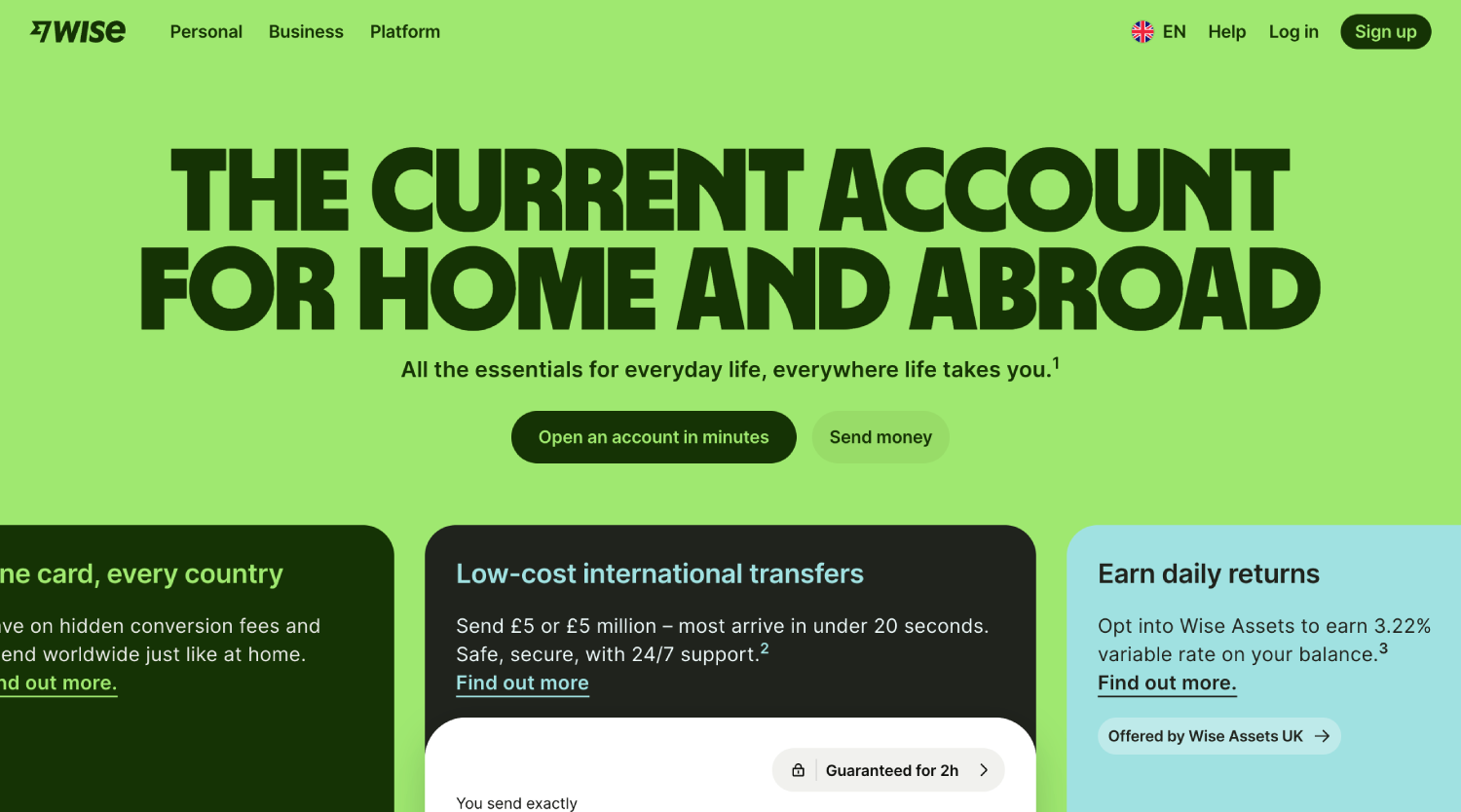
Wise Business is the most transparent option among the four platforms reviewed here. Wise converts at the mid-market exchange rate, which is the interbank rate with no spread added. The cost is an explicit fee expressed as a percentage of the send amount, which varies by currency corridor and payment method.
As of their public pricing page (last verified October 2024), Wise charges a variable fee that typically ranges from around 0.33% to 2% depending on the corridor, plus a small fixed component. USD to EUR payments fall toward the lower end. USD to currencies like Brazilian Real or Indonesian Rupiah carry higher fees, partly because local rail costs are embedded in that percentage rather than hidden in a spread. There is also a per-transfer fixed component that ranges from roughly $0.20 to a few dollars depending on the currency.
For a team sending $5,000 USD to a contractor in the UK, Wise’s total cost is the disclosed fee percentage on $5,000 plus the small fixed component. What you see quoted is what gets deducted. This makes Wise useful as a benchmark: if a competitor quotes a lower flat fee but does not disclose the FX spread, you can run the math against Wise’s all-in quoted cost at time of transfer.
Wise for Business also supports batch payouts, which matters operationally for platforms paying multiple recipients. The API pricing follows the same fee structure as the consumer-facing product.
How Does Airwallex Price Cross-Border Payouts?
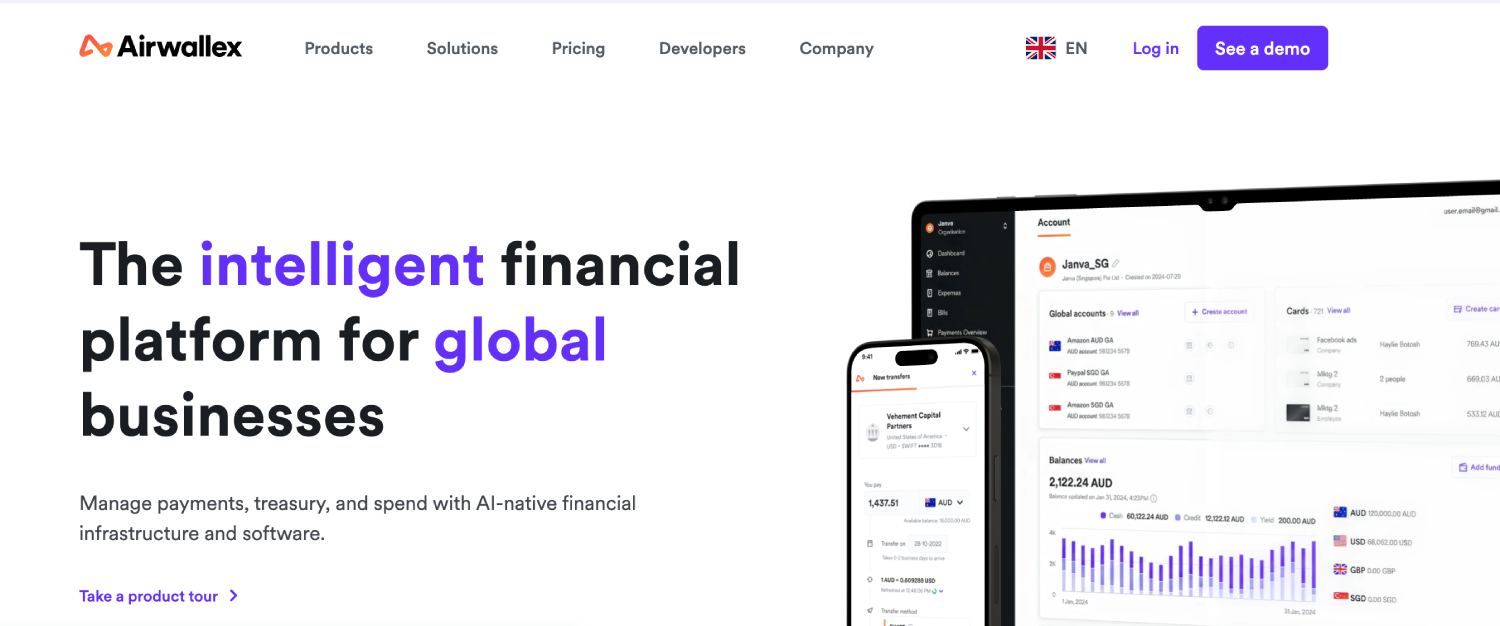
Airwallex operates differently depending on whether you hold balances in the source currency. If you fund a USD wallet and send a payment that requires AUD on the other side, Airwallex applies a conversion fee. According to Airwallex’s public pricing documentation (last verified October 2024), Airwallex charges 0.5% to 1% above the interbank rate for most currency pairs when converting at the time of payout, depending on the corridor.
The more favorable scenario is when you hold both source and destination currency in Airwallex wallets. In that case, Airwallex advertises zero markup on the interbank rate for balance-to-balance conversions. For companies that receive and hold revenue in multiple currencies before paying out, this is a meaningful structural advantage. A US SaaS company collecting EUR from European customers and paying EUR-denominated contractors avoids FX entirely if both sides are managed within Airwallex.
Airwallex does not publish a universal per-payout flat fee on its main pricing page. Local payouts via domestic rails in supported markets are generally free or very low cost. International SWIFT transfers carry fees that depend on whether the payment is SHA (shared), OUR (sender pays all), or BEN (recipient pays all). Their API documentation covers these distinctions more explicitly than the marketing site.
For a deeper comparison of how Airwallex and Wise stack up on multi-currency account structure, the Airwallex vs Wise for US Companies analysis on FintechSpecs covers account setup, FX, and local collection accounts in detail.
How Does Nium Price Cross-Border Payouts?
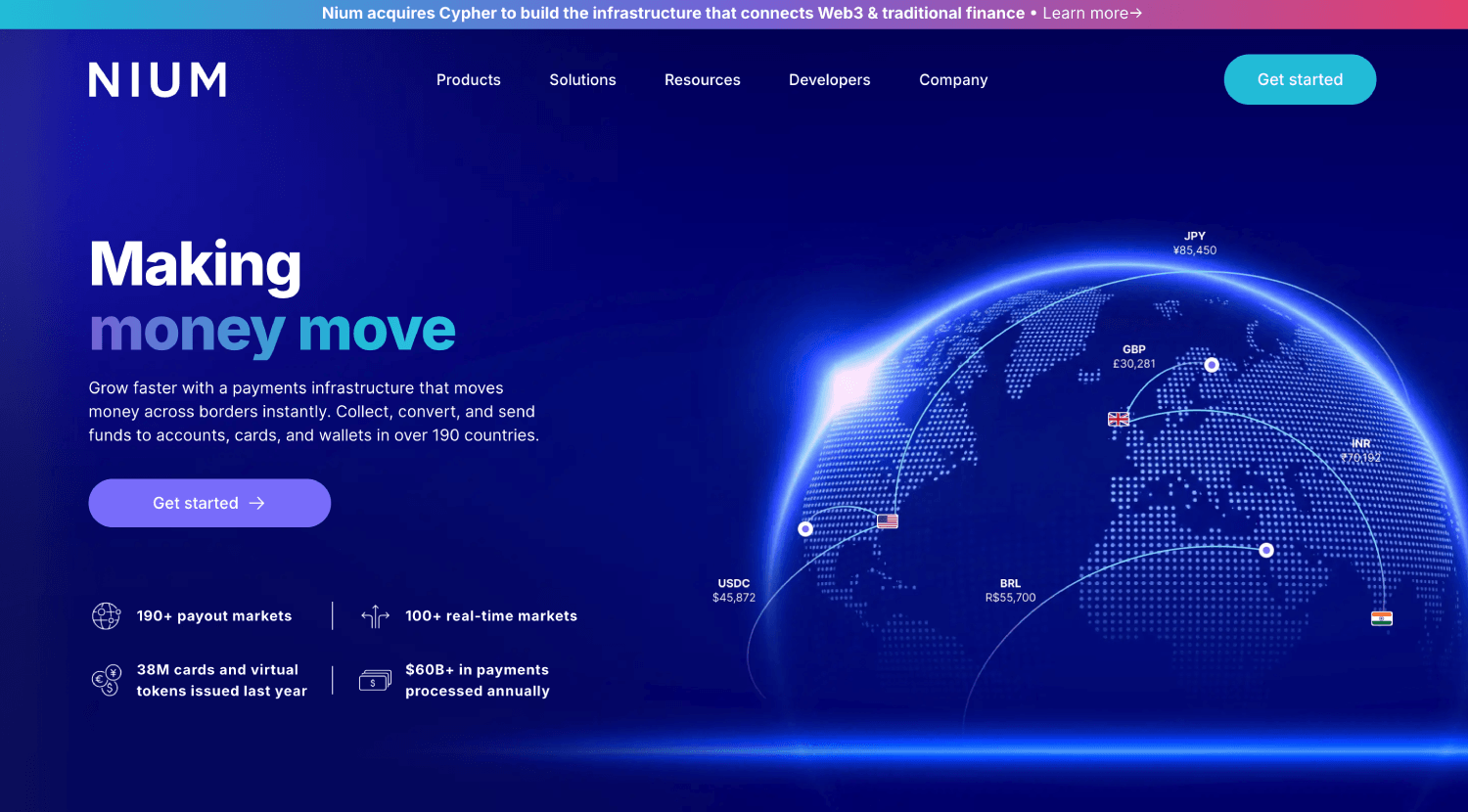
Nium is an enterprise-tier payout infrastructure provider. It does not publish per-transaction pricing or FX margin rates publicly. Pricing is negotiated by contract and depends on payout volume, corridor mix, and product scope. This positions Nium differently from Wise and Airwallex: it is not a self-serve platform with a pricing page you can read at midnight before a board meeting.
What Nium does disclose is its network reach, which as of their public product pages covers over 100 countries with local rail access in most markets. The platform supports mass payouts via API, which is its primary use case: marketplace platforms, gig economy apps, and B2B software companies distributing funds to sellers or contractors at scale. Their FX pricing is based on interbank rates plus a negotiated markup; the company does not publish these figures, and the actual rate available to any given customer depends entirely on contracted volume and corridor mix.
The practical implication is that Nium is not worth evaluating unless you have a conversation with their sales team. The lack of published pricing makes it impossible to build a total corridor cost model without a term sheet in hand. For companies processing under a few hundred payouts per month, the minimum volume requirements may rule Nium out before pricing is even discussed.
A full comparison of Nium’s payout network against its closest competitor is covered in the Nium vs Thunes global payout infrastructure breakdown, which addresses network depth, corridor reliability, and pricing structure.
How Does Payoneer Price Cross-Border Payouts?
Payoneer has one of the more complex fee structures of the four platforms. As of their public pricing page (last verified October 2024), Payoneer charges fees that vary by the source of funds and the payout method. Payments from a Payoneer balance to another Payoneer account are free. Payments to local bank accounts carry a fee, and the rate depends on geography.
On FX, Payoneer applies a spread above the mid-market rate. Payoneer’s pricing page discloses a currency conversion fee of approximately 2% for many corridors when converting between currencies, and notes that conversion rates are based on wholesale exchange rates plus a conversion fee, the standard framing for a spread-based model. The actual rate applied at conversion may differ by corridor; confirming current rates directly on their pricing page before modeling any specific corridor is advisable.
Payoneer’s primary audience has historically been freelancers and small marketplace sellers. Its mass payout product targets businesses distributing to contractors internationally. For that use case, the all-in cost per recipient depends heavily on whether recipients hold Payoneer accounts. Payoneer-to-Payoneer payouts are free on the sender side, which changes the math entirely if your recipients are already on the network. Sending to bank accounts outside the Payoneer network triggers both the flat payout fee and the FX spread.
Worked Example: $5,000 USD Payout to a Contractor in India
Consider a US company sending $5,000 USD to a software contractor in India (INR). The following table models approximate total corridor cost using publicly available or disclosed pricing as of October 2024. Note that FX rates fluctuate constantly; the markup percentages below are illustrative of each platform’s disclosed pricing structure, not a real-time quote.
| Platform | Flat Fee (USD) | FX Markup | Approx. FX Cost on $5,000 | Approx. Total Cost | Transparency |
|---|---|---|---|---|---|
| Wise | ~$2 to $5 (fixed component) | Mid-market rate, no spread; corridor fee ~0.5% to 1.5% | ~$25 to $75 | ~$27 to $80 | Quoted before confirmation |
| Airwallex | Varies (local rail or SWIFT) | ~0.5% to 1% above interbank (if converting), per public documentation | ~$25 to $50 | ~$25 to $60+ | Quoted at conversion step |
| Payoneer | Varies by payout method | ~2% disclosed conversion fee (per public pricing page) | ~$100 | ~$100 to $120+ | Partial disclosure on pricing page |
| Nium | Negotiated | Negotiated; not published | Not disclosable | Requires contract | Disclosed in term sheet only |
The table makes the core point visible. Payoneer’s ~2% FX conversion fee produces roughly $100 of cost on a $5,000 payout to India, before any flat transaction fee. Wise’s total cost on the same transfer, using published rates, often falls below $80 and can be as low as $27 depending on corridor-specific fees. Airwallex is competitive if you hold USD and can convert at their lower rate tiers. Nium could be the cheapest at volume, but you cannot know until you negotiate.
The FX markup is doing the heavy lifting in every scenario. The flat fee is noise by comparison.
Which Corridors Change the Ranking?
Not every corridor has the same FX dynamics. USD to EUR is a heavily traded pair with tight spreads across most platforms. USD to exotic currencies, including many African, Southeast Asian, and Latin American currencies, carries higher spreads everywhere, and the gap between platforms widens.
For USD to EUR payouts, Wise’s corridor fee drops toward its lower published range, making it very competitive. Airwallex holds USD and EUR balances natively, so a company with EUR inflows can pay EUR contractors at zero conversion cost on the Airwallex side. For USD to MXN or USD to BRL, Wise’s corridor fee rises, and Airwallex’s spread may also increase. Payoneer’s 2% conversion fee becomes more consistent across corridors, which means it is more competitive on difficult corridors only if alternatives quote higher than 2%.
If your payout mix is concentrated in two or three corridors, run the FintechSpecs Total Corridor Cost formula for those specific pairs before signing any contract. A platform that wins on USD to EUR may lose badly on USD to PHP.
What Fee Structure Fits Which Business?
Wise is the clearest choice for companies that value fee transparency above all else, send irregular volumes, and need no minimum commitment. The pricing is visible before every transfer, which makes it compatible with how finance teams at seed-to-Series B companies want to operate. No surprises on the month-end reconciliation.
Airwallex becomes more cost-effective as multi-currency balance management grows in importance. If your business collects revenue in multiple currencies and pays contractors or vendors in those same currencies, avoiding FX conversion entirely is worth more than the rate differential alone. It also has stronger API infrastructure for product teams embedding payouts into a SaaS platform. For more context on how payout APIs are evaluated beyond pricing, the best cross-border payout APIs for US platforms comparison covers API quality, speed, and coverage depth.
Payoneer fits when your recipients are already Payoneer users, which eliminates the FX conversion fee for those payouts. If you run a marketplace with a large base of freelancers in countries like Pakistan, Bangladesh, or the Philippines, Payoneer’s network density can outweigh its higher conversion costs for bank payouts. The platform’s recipient experience is also more developed for individual contractors than the others reviewed here.
Nium makes sense at the enterprise tier: high payout volume, dozens of corridors, API-first product integration, and the budget and timeline to negotiate a contract. Companies processing millions of dollars monthly in cross-border payouts can potentially achieve lower all-in costs than Wise or Airwallex through Nium’s negotiated margin structure, but the minimum complexity to engage is real.
How to Model Your True Cross-Border Payout Cost
The FintechSpecs Total Corridor Cost framework requires three inputs for each payout type you run: the average payout amount, the corridor, and your monthly payout count. From those, calculate two numbers: flat fee total (per-payout fee multiplied by count) and FX cost total (markup percentage multiplied by total send volume). Add them. That is your monthly cost per corridor per platform.
Most teams skip the FX side because they cannot easily find the markup percentage. Here is how to find it: get a live quote from the platform for a test transfer and compare the offered rate to the real mid-market rate at that moment (XE.com or Google’s rate is close enough for this test). The percentage difference is the FX spread. Do this for each corridor you use regularly.
For companies building payout functionality into a product rather than running operational payouts, pricing is only one variable. Settlement speed, API uptime, and local rail coverage matter as much as cost. The broader context of outbound payment infrastructure is covered in the best outbound payment and payout APIs for B2B SaaS overview, which includes providers beyond the four compared here.
Frequently Asked Questions
What is the cheapest platform for cross-border payouts?
Wise is generally the cheapest for small-to-medium volume payouts in major corridors because it charges no FX spread and its corridor fees are transparently low. Airwallex can be cheaper if you hold native currency balances and avoid conversion. Nium may be cheaper at enterprise volume through negotiated rates, but requires a contract. Payoneer is typically the most expensive for bank payouts outside its network due to its disclosed conversion fee.
What is FX markup and why does it matter for payout fees?
FX markup is the percentage difference between the mid-market exchange rate and the rate a platform actually offers you. A 1% FX markup on a $10,000 payout costs $100, which is often more than the flat per-transaction fee. Most platforms do not prominently disclose this markup. Comparing platforms only on flat fees while ignoring the FX spread produces misleading cost estimates for international payouts.
Does Airwallex charge an FX fee on cross-border payouts?
According to Airwallex’s public pricing documentation, Airwallex charges approximately 0.5% to 1% above the interbank rate when you convert between currencies at the time of payout. For conversions between currencies already held as balances in Airwallex’s multi-currency wallet, the company advertises zero FX markup on the interbank rate. The fee structure therefore depends heavily on whether you hold the source currency in your Airwallex account before initiating the payout.
How does Payoneer’s fee compare to Wise for international payouts?
Payoneer’s publicly disclosed currency conversion fee is approximately 2% above wholesale exchange rates, per their pricing page, which is materially higher than Wise’s typical corridor fees. On a $5,000 payout, Payoneer’s FX cost alone is roughly $100. Wise’s all-in cost on the same transfer is often $30 to $80 depending on the corridor. Payoneer becomes more competitive only when the recipient holds a Payoneer account, which removes the bank payout fee.
Does Nium publish its payout and FX pricing?
Nium does not publish per-transaction fees or FX markup rates publicly. Pricing is negotiated by contract and depends on payment volume, corridor mix, and integration scope. Companies cannot model Nium’s total corridor cost without engaging their sales team and receiving a term sheet. This makes Nium impractical for early-stage teams that need to compare pricing quickly before committing to a vendor.
What is the best way to compare cross-border payout fees across platforms?
Get a live quote from each platform for a transfer of your typical payout amount in your most-used corridor. Compare the recipient amount, not the fee line. Then check the mid-market rate at that moment and calculate the implied FX spread. Add the spread cost to the flat fee to get total corridor cost. Run this comparison for each corridor you use regularly, since rankings can change by currency pair.
Can I negotiate FX rates with these payout platforms?
Nium’s pricing is entirely negotiated. Airwallex and Wise offer volume-based pricing or custom terms for enterprise clients above certain monthly payout thresholds, though their standard rates are set. Payoneer’s conversion fees are generally fixed for standard accounts but may be negotiable at enterprise scale through their business development team. FX margin negotiation produces larger savings than flat-fee negotiation at any meaningful payout volume.
The Only Number That Actually Matters
Every payout platform markets on the fee that looks smallest. Wise leads with its mid-market rate promise. Airwallex highlights zero conversion between held balances. Payoneer promotes free Payoneer-to-Payoneer transfers. Nium signals cost efficiency through volume scale. Each claim is technically accurate and each claim obscures the full picture in a different way.
The FX spread is where real money moves. A company sending $500,000 per month in cross-border payouts and choosing a platform with a 1.5% embedded FX margin over a platform with 0.5% is spending an extra $5,000 per month, or $60,000 per year, on a line item that never appears on any fee schedule. That is the actual cost of not modeling total corridor cost before signing a contract.
For operators building payout functionality into a product, the compounding effect is even sharper because the cost is experienced by every end recipient and often attributed to your product’s quality rather than to an invisible treasury decision. Modeling hidden costs in fintech margins before locking in a payout vendor is not a finance exercise. It is a product decision.