
TLDR
- Most payout failures come from rail mismatch, not bad data. Sending a contractor ACH when they need same-day push to a debit card causes returns, not errors you catch at the API layer.
- Multi-rail platforms let the recipient choose their preferred payout method, which cuts support tickets and failed-payment rates more than any single-rail optimization can.
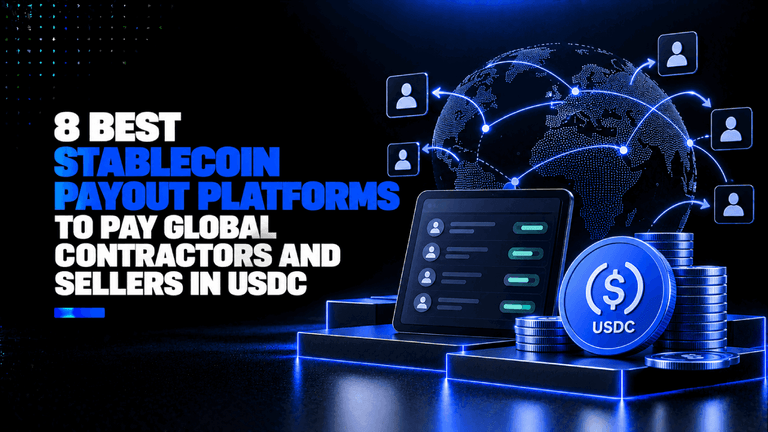
- The eight platforms worth evaluating for domestic US mass payouts are Dots, Tipalti, Trolley, Payoneer, Routable, Branch, Tremendous, and Stripe Connect. Each has a different sweet spot.
- Rail coverage and recipient UX matter more than raw API quality. A great developer experience on a single-rail platform loses to a mediocre API on a four-rail one, because your recipients do not care about your code.
- 1099 and tax compliance is the hidden differentiator. Platforms that collect W-9s, file 1099s, and withhold automatically cut month-end close time significantly for any company paying contractors or creators at scale.
The best mass payout platforms for domestic US payments are Dots (gig and creator platforms wanting recipient-choice rails), Tipalti (mid-market and enterprise AP teams paying global suppliers), Trolley (marketplaces and contractor platforms needing built-in 1099 filing), Branch (hourly workforce and earned wage access), Tremendous (rewards and incentives with gift card and ACH), Routable (B2B invoice payouts), Payoneer (freelancer networks), and Stripe Connect (product teams already on Stripe). Each platform differs on rail mix, tax handling, and pricing model.
Why “Payout API” Usually Means ACH-Plus-Dashboard, and Why That Falls Short
When a finance or engineering team searches for a payout API provider, they usually find ACH wrappers with a light dashboard bolted on. ACH works well for most bank-to-bank transfers, but it runs on a T+1 or T+2 settlement window, returns take three to five days to resolve, and it reaches only recipients with US bank accounts. That covers a lot of ground, but it leaves out a meaningful share of the workforce.
Gig workers frequently bank at neobanks or prepaid card providers that have spotty ACH return rates. Creators want same-day push to their debit card. Contractors in rural areas use PayPal or Venmo as their primary financial account. When your payout platform can only send standard ACH, you absorb all of those edge cases as failed transactions and support volume, not as a rail limitation.
Multi-rail platforms solve this by exposing ACH, RTP (The Clearing House’s Real-Time Payments network), push-to-debit (Visa Direct or Mastercard Send), PayPal, Venmo, and sometimes prepaid card load in a single API. The recipient picks what works for them. Failed payouts drop. Support tickets drop. And the platform operator does not have to build integrations to four different providers. For teams evaluating their outbound payment and payout API options, rail coverage is the first axis to stress-test.
The FintechSpecs Rail-Coverage Stress Test: How to Compare Mass Payout Platforms Before You Sign
Before looking at individual platforms, run every candidate through the same four checks. This framework, which FintechSpecs calls the Rail-Coverage Stress Test, keeps procurement conversations anchored to recipient outcomes rather than API elegance.
Rail completeness: Does the platform support ACH (standard and same-day), RTP, push-to-debit, PayPal or Venmo, and check? A platform missing RTP is acceptable for most B2B AP use cases but is a real gap for gig and creator payouts where speed expectations differ.
Recipient UX: Does the recipient get to choose their preferred rail through a hosted flow, or does your engineering team hard-code the rail selection? Platforms with hosted recipient onboarding reduce friction and collect bank account details, tax info, and rail preferences in a single flow you do not have to build.
Tax infrastructure: Does the platform collect W-9s at onboarding, generate 1099-NEC or 1099-MISC at year-end, and handle backup withholding automatically? If not, you need a separate vendor, and the 1099 and tax compliance API layer adds cost and integration work.
Pricing model alignment: Is the platform charging a percentage of payout volume, a flat per-transaction fee, or a monthly SaaS fee plus transaction costs? High-volume, low-dollar payouts (think $20 to a creator for a sponsored post) get expensive fast on percentage-of-volume pricing. High-dollar, low-frequency payouts (AP invoices) can absorb a percentage fee better than a flat monthly minimum.
Rail Coverage Matrix: What Each Platform Actually Supports
| Platform | ACH | Same-Day ACH | RTP | Push-to-Debit | PayPal/Venmo | Check | 1099 Filing |
|---|---|---|---|---|---|---|---|
| Dots | Yes | Yes | Yes | Yes | Yes | No | Yes |
| Tipalti | Yes | Yes | No | No | Yes | Yes | Yes |
| Trolley | Yes | Yes | No | No | Yes | Yes | Yes |
| Payoneer | Yes | No | No | No | No | No | No |
| Routable | Yes | Yes | No | No | No | Yes | No |
| Branch | Yes | Yes | No | Yes | No | No | No |
| Tremendous | Yes | No | No | No | Yes | Yes | No |
| Stripe Connect | Yes | Yes | No | Yes | No | No | No |
Note: Rail availability can depend on your account tier, US geography, and recipient account type. Verify current coverage directly with each vendor before finalizing architecture decisions.
Which Mass Payout Platforms Are Worth Evaluating?
1. Dots
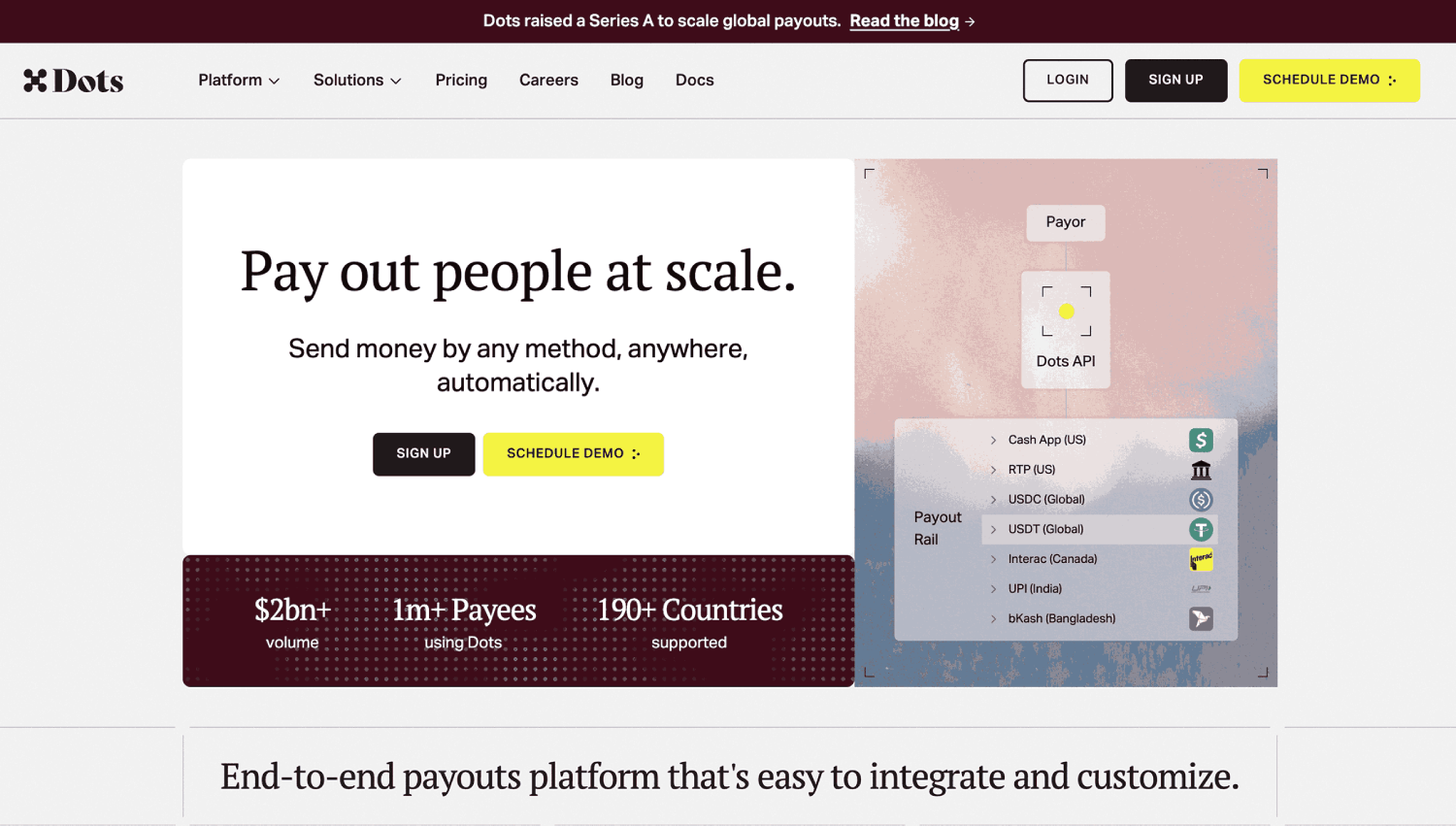
Dots is purpose-built for gig and creator platforms that need recipients to self-serve their own payout preferences. The platform provides a hosted onboarding flow that collects bank details, debit card numbers, PayPal handles, or Venmo accounts and then routes each payout to whichever rail the recipient selected. This is meaningful because it offloads the recipient UX entirely, something you would otherwise need to build and maintain.
Dots supports ACH, same-day ACH, RTP, push-to-debit, and PayPal and Venmo payouts. It also handles W-9 collection and 1099-NEC filing, which makes it one of the few platforms that genuinely covers the full contractor payment lifecycle in one integration. Pricing is not publicly listed on the Dots site. You will need to contact them for current rates based on volume.
Best for: Series A to Series C creator economy, gig, and marketplace platforms that want to minimize recipient support tickets and do not want to build a tax compliance layer separately.
2. Tipalti
Tipalti is the incumbent in mid-market and enterprise AP automation for mass payouts to suppliers and contractors. It covers ACH, same-day ACH, wire, PayPal, prepaid debit card, and physical check. The platform handles global payouts to 196 countries, though this review focuses on its domestic US capabilities, where its tax compliance infrastructure is particularly strong.
Tipalti collects W-8 and W-9 forms at onboarding, validates them against IRS standards, handles backup withholding, and generates 1099 and 1042-S filings at year-end. That compliance layer is what separates it from lighter-weight payout APIs. The tradeoff is cost and implementation time. Tipalti does not publish pricing publicly. Based on widely reported market positioning, it is aimed at companies running multi-million-dollar monthly payout volumes. For a closer look at how it stacks up against a bill pay alternative, see FintechSpecs’s Bill.com vs Tipalti comparison.
Best for: Finance and AP teams at companies with $1M or more in monthly payouts to suppliers or contractors who need full audit trails and tax compliance without building it internally.
3. Trolley
Trolley sits between Tipalti’s enterprise positioning and the lighter API-first tools. It is API-first, which means engineering teams can integrate it directly without going through a lengthy sales process for every feature. Trolley supports ACH, same-day ACH, PayPal, check, and wire transfers for US recipients, and it includes built-in W-9 and W-8 collection plus 1099-NEC, 1099-MISC, and 1042-S filing.
Trolley’s pricing model is transaction-based. Per their public pricing page, domestic ACH payouts start at $0.25 per transaction, same-day ACH at $1.00, and PayPal at 2% of the payout amount with a minimum fee. Check pricing varies. This makes it cost-predictable for platforms paying large numbers of small payouts via ACH, though PayPal volume costs can add up quickly.
Best for: Mid-sized marketplace and contractor platforms that need an API-first payout solution with built-in tax filing and do not want to pay enterprise minimums.
4. Payoneer
Payoneer started as a cross-border freelancer payment network and has grown into a broader payouts platform. For domestic US payouts, it is most relevant when your recipient base already uses Payoneer accounts, which is common in freelancing and staffing marketplaces.
Payoneer-to-Payoneer transfers settle instantly and at low cost, making it effective when both sides of the transaction are on the platform. Bank withdrawal to ACH is also supported, though settlement times and fees depend on the recipient’s account type. Payoneer does not support RTP or push-to-debit for US payouts. It is not the right fit for platforms that need recipients without existing Payoneer accounts to receive funds instantly. Pricing is not publicly itemized for platform integrations and requires direct inquiry.
Best for: Freelancer and staffing marketplace platforms whose recipient base already has a heavy concentration of Payoneer account holders, or platforms with significant cross-border payout volume alongside domestic needs.
5. Routable
Routable is built specifically for B2B AP payouts, not contractor or gig worker disbursements. It handles ACH, same-day ACH, wire, and check, with a focus on invoice-driven workflows. The platform integrates with accounting systems including NetSuite, QuickBooks, and Sage Intacct, which matters for finance teams that want payouts to reconcile automatically against open invoices.
Routable does not support PayPal, push-to-debit, or RTP. That is not a gap for its intended use case. An accounts payable team paying vendors does not need real-time push-to-debit. The strength is in approval workflows, multi-entity support, and the accounting integrations. Pricing is not publicly listed and requires a sales conversation. For AP automation context, Routable competes closely with tools covered in FintechSpecs’s accounts payable automation comparison.
Best for: Finance teams at Series B and later companies with high invoice volume and a need for payout-to-reconciliation automation, not platform-to-recipient disbursements.
6. Branch
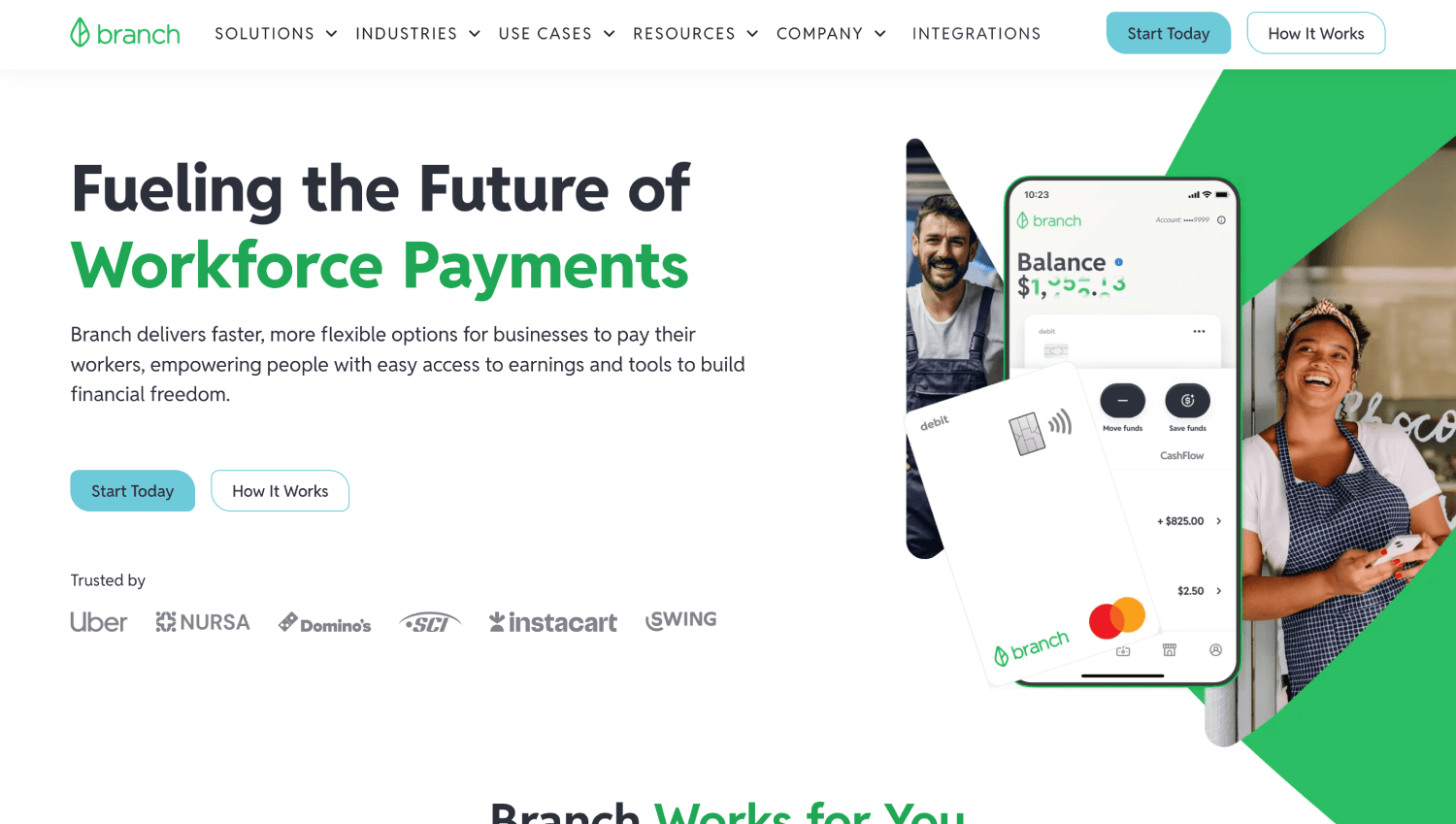
Branch targets hourly and shift-based workers, particularly in logistics, healthcare staffing, food service, and gig economy verticals. The platform combines earned wage access with instant payout capabilities, meaning workers can access pay before the standard payroll cycle ends.
Branch supports ACH, same-day ACH, and push-to-debit (Visa Direct). Recipients can receive funds to a Branch-issued debit card or their own bank account. The platform does not charge workers fees on payouts to Branch cards. Branch is one of the few payout platforms designed around the worker experience rather than the platform operator experience, which creates meaningfully higher adoption rates for hourly worker use cases. It does not support PayPal, Venmo, or check. Pricing for platform integrations is not publicly listed.
Best for: Workforce platforms, staffing agencies, and logistics operators paying hourly workers who want same-day or on-demand pay access without charging the worker.
7. Tremendous
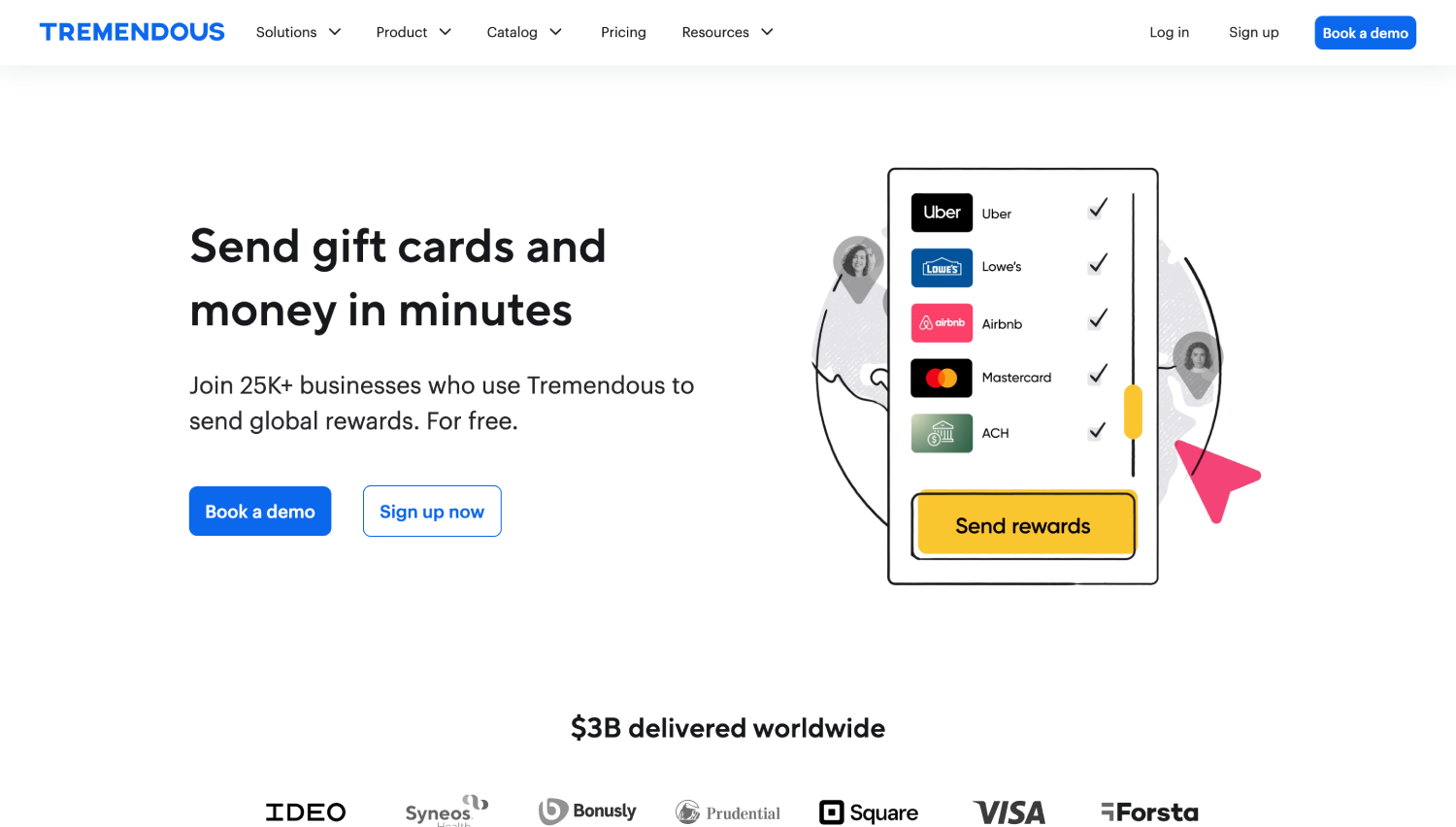
Tremendous is the only platform on this list designed for rewards, incentives, and research payouts rather than operational disbursements. It supports ACH bank transfers, PayPal, Venmo, prepaid cards, and a large catalog of gift cards including Amazon, Visa, and hundreds of retail brands.
Tremendous does not support RTP or push-to-debit. It does not file 1099s. For legitimate operational contractor payouts, Tremendous is not the right tool. Its strength is in sending $50 survey incentives or $200 employee bonuses where the recipient prefers a gift card over a bank transfer. Per their public pricing page, there is no platform fee for standard use. Recipients receive the stated reward amount. Senders fund a balance and pay per redemption, with ACH and PayPal payouts free and gift cards at face value plus a small handling fee depending on configuration.
Best for: Marketing, HR, and research teams running incentive or reward programs, not finance teams running contractor payouts.
8. Stripe Connect
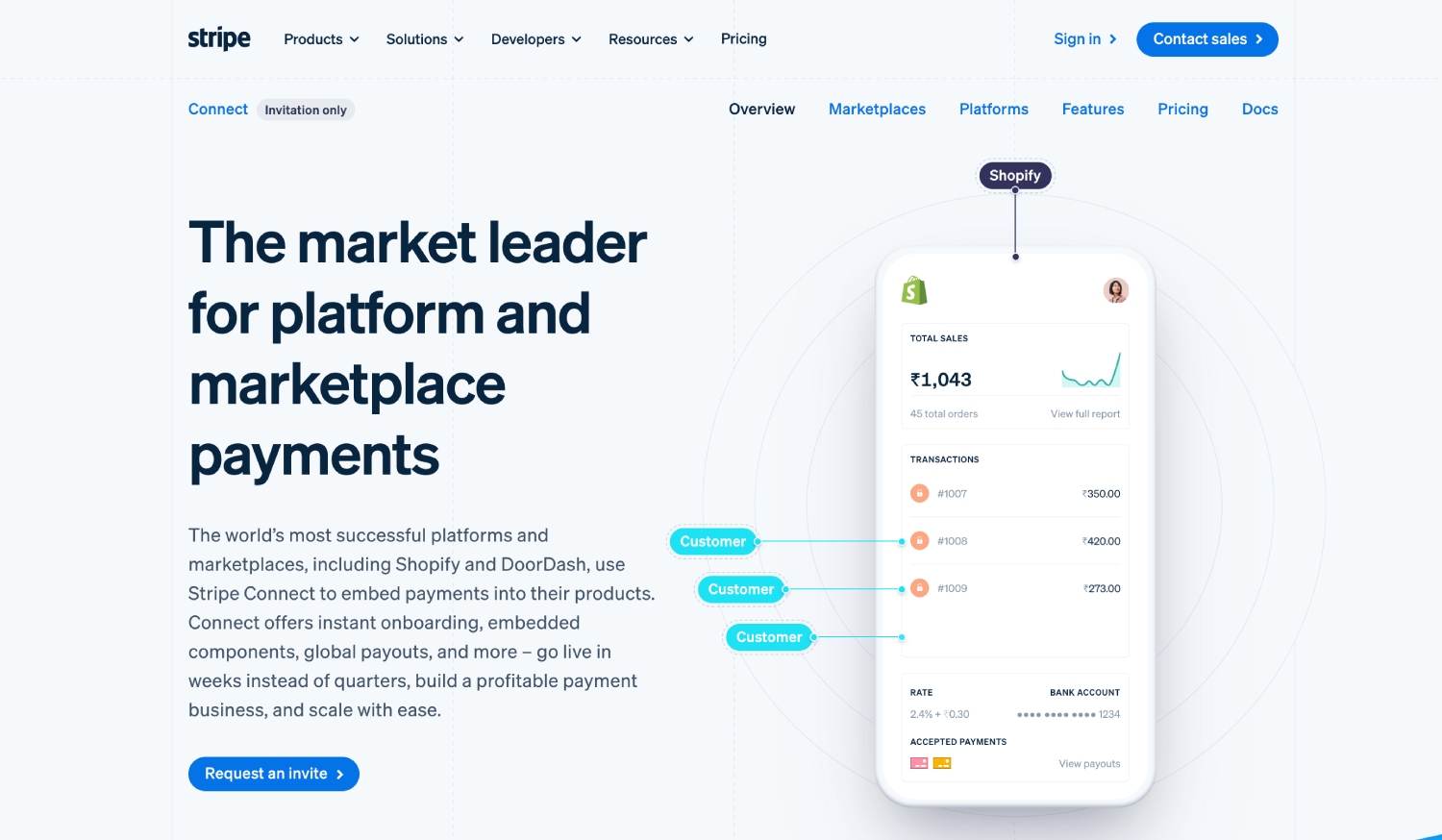
Stripe Connect is the default choice for product teams already running payments through Stripe. Payouts to connected accounts (sellers, drivers, or contractors on your platform) go via ACH, same-day ACH, or Instant Payouts, which push to a debit card via Visa Direct and settle in minutes.
Per Stripe’s public pricing page, Instant Payouts cost 1% of the payout amount, with a minimum of $0.50. Same-day ACH is available on certain account configurations. Standard ACH payouts are free for platform-initiated transfers to connected accounts. Stripe does not handle 1099 filing natively. Platforms using Stripe Connect for contractor payouts typically need a separate tax compliance integration, which is a meaningful gap at scale. The platform also lacks PayPal or Venmo as payout destinations.
The core advantage is integration depth. If you are already using Stripe for payment collection, adding Connect for payouts requires far less new infrastructure than integrating a separate payout API provider. For teams weighing Stripe against a more specialized payments stack, FintechSpecs’s Stripe vs Adyen comparison covers the broader infrastructure decision.
Best for: Product and engineering teams at marketplace and platform companies already on Stripe who want to add payouts without a new vendor relationship.
9. Modern Treasury (Payout Infrastructure Layer)
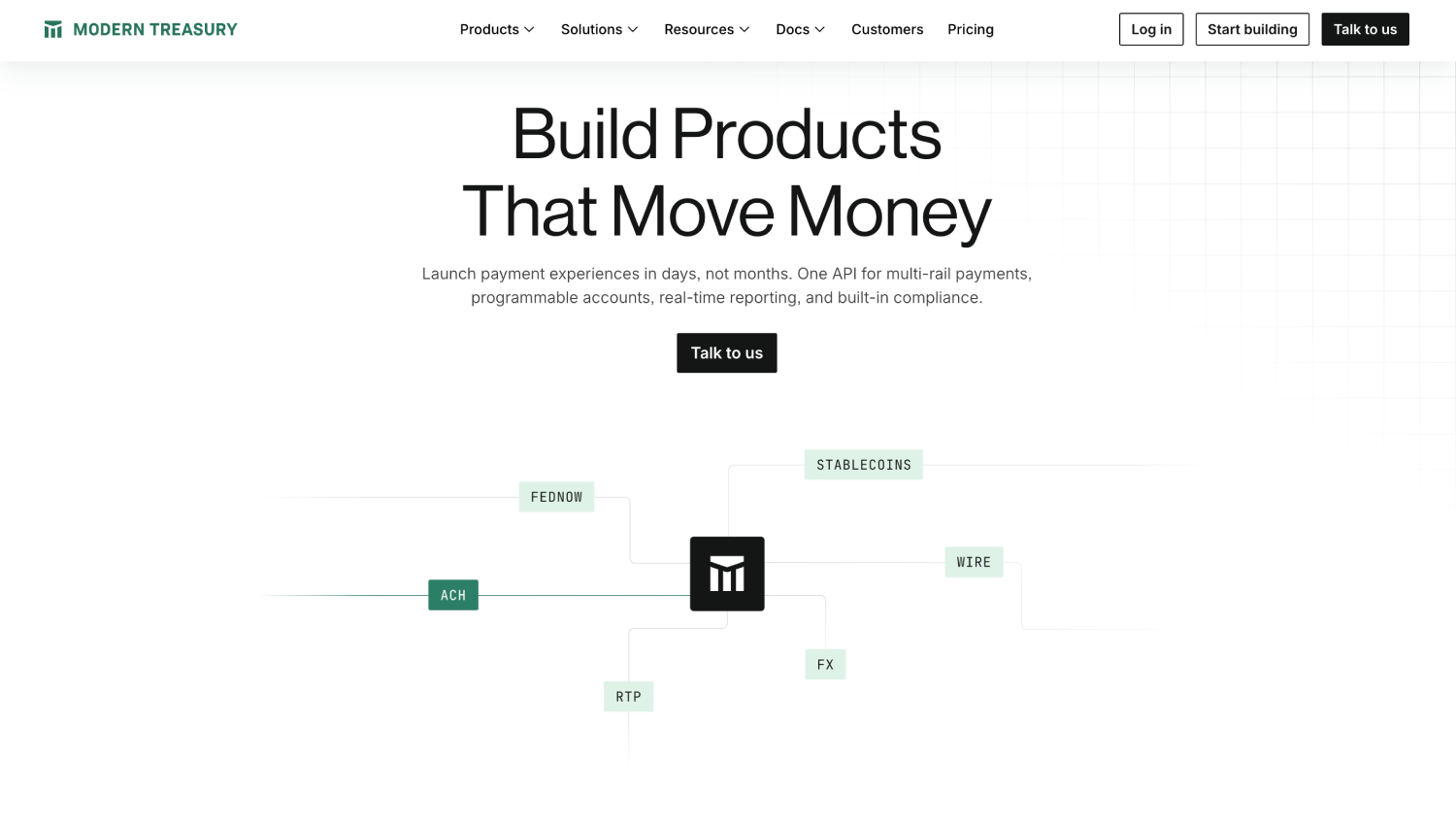
Modern Treasury is not a payout platform in the consumer sense. It is a payment operations layer that connects to your existing bank relationships and adds ledgering, reconciliation, approval workflows, and a unified API across ACH, wire, RTP, and FedNow. It is relevant here because teams running high-volume ACH or RTP payouts through a bank directly often hit operational limits that Modern Treasury solves.
Modern Treasury does not handle recipient onboarding, tax compliance, or multi-rail recipient choice. It is infrastructure for companies that already have a banking relationship and want programmatic control over their payout operations. Pricing is not publicly listed and is volume-based. For teams considering this layer, FintechSpecs’s Modern Treasury vs Increase comparison covers the direct-bank infrastructure decision in detail.
Best for: Fintech companies and large platforms with existing bank relationships that need an API orchestration layer over ACH and RTP, not a turnkey payout solution.
10. Hyperwallet (a PayPal Service)
Hyperwallet, now owned by PayPal, is a global payout platform supporting ACH, PayPal, prepaid card, wire, and check for US domestic recipients. It is one of the longer-established platforms in the mass payout space, particularly in insurance claims, gig economy, and marketplace disbursements.
Hyperwallet’s recipient onboarding is hosted, similar to Dots, and supports multiple payout destinations per recipient. It does not publicly disclose per-transaction pricing. The PayPal parent relationship gives it instant payout reach to PayPal’s global account base, which is the clearest differentiation for platforms where PayPal is a primary recipient destination. Tax form support varies by implementation tier and should be confirmed directly with Hyperwallet’s sales team before assuming it covers your 1099 requirements.
Best for: Large enterprise platforms running insurance, insurance claims, or marketplace payouts where PayPal as a recipient destination is a priority and where cross-border expansion is a near-term need.
How Do These Platforms Price Mass Payouts?
Mass payout platform pricing falls into three models, and the wrong model for your payout profile can add significant cost. Understanding which model applies before signing is more important than most buyers realize.
Percentage of payout volume: Common in consumer-facing platforms like Stripe Instant Payouts (1% per their public pricing page) and some Trolley configurations for PayPal. Advantageous for high-dollar, low-frequency payouts. Expensive for high-frequency, small-dollar payouts, such as $15 creator commissions paid weekly.
Flat per-transaction fee: Trolley’s ACH pricing at $0.25 per transaction (per their public pricing page) is the clearest example. Predictable, favors small-dollar high-volume payouts, but can feel expensive on a per-transaction basis for infrequent low-volume users.
SaaS platform fee plus transaction costs: Tipalti and most enterprise platforms bundle a platform subscription with per-transaction or per-payment fees negotiated at contract time. This model suits finance teams running structured AP processes more than it suits fast-moving startup platforms.
Consider a hypothetical Series B marketplace paying 5,000 contractors $75 each per week ($375,000 weekly payout volume). Under a 1% instant payout model, that is $3,750 per week in payout fees, or roughly $195,000 annually, for speed alone. Under a flat $0.25 ACH model with same-day ACH at $1.00 per transaction, the same volume costs between $1,250 and $5,000 per week depending on rail mix. The structural decision about which rail to default to, and how much optionality to give recipients, has direct P&L consequences at that scale. This is exactly the kind of infrastructure cost that contributes to the hidden margins erosion covered in FintechSpecs’s analysis of hidden fintech SaaS costs.
What Should You Prioritize When Choosing a Bulk Payout Software?
The single most underweighted factor in platform selection is recipient adoption rate. A platform can have excellent developer documentation and clean API design, but if your recipients consistently fail to complete the onboarding flow, failed payouts increase and support costs mount. Hosted recipient onboarding with progressive disclosure, mobile-friendly flows, and support for multiple ID types makes a measurable difference in completion rates.
Tax compliance is the second most underweighted factor. Any platform paying US contractors more than $600 annually has a 1099-NEC filing obligation. Platforms that automate W-9 collection, TIN validation, and year-end filing eliminate a category of compliance risk that finance teams otherwise absorb manually. For teams evaluating compliance exposure more broadly, the Fintech Product and Compliance Readiness Checklist covers the full range of obligations a growing platform faces.
Reconciliation is the third factor most teams discover too late. When a payout returns, how does the platform notify you, and what does the return data look like? Platforms that return structured error codes by return reason (R02 account closed, R03 no account, R10 customer advises not authorized) allow for intelligent retry logic. Platforms that return a generic failure require manual investigation per return.
Frequently Asked Questions
What is a mass payout platform?
A mass payout platform is software that lets a company send payments to hundreds or thousands of recipients simultaneously, typically via ACH, real-time rails, debit card push, PayPal, or check. Unlike standard bank transfers, mass payout platforms include batch processing, recipient onboarding flows, tax compliance tools, and return handling. They are used by gig economy companies, marketplaces, insurance carriers, and AP teams to replace manual wire or ACH file processes.
What is the difference between a payout API and a bulk payout software?
A payout API is a developer interface that lets you trigger payments programmatically, typically as part of your own product. Bulk payout software is often a standalone application with a dashboard where finance teams upload recipient files and manage payouts without writing code. Many platforms, including Trolley and Tipalti, offer both, so the distinction is less about the product category and more about whether your primary user is an engineer or a finance operator.
Which payout platforms support RTP for instant payouts?
Among the platforms reviewed here, Dots supports RTP. Most other platforms use push-to-debit (Visa Direct or Mastercard Send) for near-instant payouts rather than The Clearing House’s RTP network. Push-to-debit is faster to implement and reaches debit cards directly, but it requires the recipient to have a Visa or Mastercard debit card. RTP reaches bank accounts directly and settles in seconds, but bank participation in the RTP network is still growing. Confirm current RTP coverage with any vendor before building on it.
Do mass payout platforms handle 1099 filing?
Several do, but coverage varies by tier. Dots, Tipalti, and Trolley include 1099-NEC and 1099-MISC filing in their core offering. Stripe Connect and Branch do not file 1099s natively. Tremendous does not support 1099 filing at all, because it is designed for rewards and incentives rather than contractor compensation. Always confirm which form types (1099-NEC, 1099-MISC, 1042-S for foreign recipients) a platform supports before assuming full coverage.
How do payout platforms handle failed payouts and ACH returns?
The best platforms return structured NACHA return reason codes (R01 through R85), notify you via webhook in near real time, and optionally trigger an automatic retry or an alternative rail. Weaker implementations send a generic failure status and require manual review. Before choosing a platform, ask specifically how return data is structured in the API response and whether the platform supports automatic fallback to an alternative payout method when a primary rail fails.
Is Stripe Connect a good payout API for marketplaces?
Stripe Connect is a good payout API for marketplaces that are already processing payments through Stripe, because the integration cost is lower and the recipient (connected account) data is already in the Stripe environment. It becomes less compelling when your payout recipients include non-US bank accounts, when you need PayPal or Venmo as a payout destination, or when 1099 compliance at scale is a requirement. For those situations, a specialized payout platform like Dots or Trolley typically covers more ground.
What is the cheapest way to run mass payouts via ACH?
Standard ACH through a direct bank connection, using a payment operations platform like Modern Treasury, is generally the lowest per-transaction cost. The tradeoff is implementation complexity and the requirement of an existing bank relationship that supports API-driven ACH origination. For most seed to Series B companies, a platform like Trolley at $0.25 per ACH transaction (per their public pricing page) is more practical than building direct bank infrastructure, even if the per-transaction fee is higher than raw ACH origination costs.
Can one payout API platform handle both B2B vendor payments and contractor payouts?
Some can, but most are optimized for one use case. Tipalti handles both, with separate workflows for supplier AP and contractor disbursements. Trolley is built more for contractor and marketplace payouts. Routable is built for B2B AP and is not the right fit for gig worker disbursements. Running both use cases through one platform reduces vendor overhead and simplifies reconciliation, but only if the platform genuinely serves both workflows rather than stretching one UI to cover both inadequately.
The Payout Platform Decision Starts With the Recipient, Not the Developer
Engineering teams evaluating mass payout platforms tend to anchor on API design, documentation quality, and webhook reliability. Those factors matter, but they describe the platform’s relationship with your stack, not its relationship with your recipients. A gig worker who cannot complete the bank account onboarding flow in two minutes on a phone will request a manual payment from your support team. A contractor who receives a failed ACH return on a Friday afternoon will call to ask why their pay did not arrive. The platform that solves those moments is the one that reduces operational cost, not the one with the cleanest SDK.
Rail coverage and recipient UX are the two factors that determine payout platform success at scale. Multi-rail support, meaning real ACH plus at least one instant rail and one alternative destination like PayPal or push-to-debit, is now table stakes for any platform paying more than a few hundred recipients monthly. The gap between a single-rail ACH wrapper and a proper multi-rail payout platform shows up in reconciliation hours, support ticket volume, and contractor retention. Those costs are real even if they do not show up on the vendor invoice.
If your payout recipients are largely US-based, the shortlist comes down to use case. Gig and creator platforms belong on Dots. Contractor marketplaces needing 1099 coverage belong on Trolley. Enterprise AP teams belong on Tipalti. Hourly workforce platforms belong on Branch. Product teams on Stripe belong on Connect, at least until the 1099 gap or rail coverage gap forces a second vendor. The key is recognizing those gaps before you have 10,000 recipients onboarded and a contract renewal conversation in front of you.