
TLDR
- Stripe Tax works well when Stripe is your entire billing stack, but it has no native path to Chargebee, Maxio, NetSuite, or Zuora without custom middleware.
- Dedicated SaaS tax engines like Anrok, Kintsugi, and Zamp handle economic nexus tracking, product taxability logic for software, and filing across all 50 states regardless of your billing layer.
- The billing-stack compatibility question matters more than feature lists: a tax engine that cannot receive webhook events from your subscription platform creates reconciliation gaps at audit time.
- Pricing structures vary from flat-rate monthly fees to transaction-volume tiers to per-filing fees. A 200-transaction-per-month SaaS company will land on a different shortlist than one processing 50,000.
- Managed filing (the vendor files returns on your behalf) is not universal. Several engines calculate and report but stop short of remittance, leaving that step to your accountant.
The best sales tax software for SaaS depends on your billing stack, not your transaction volume alone. Anrok, Avalara, TaxJar, Zamp, Kintsugi, Numeral, Sphere, and Commenda all handle multi-state nexus tracking and filing for subscription businesses, but each integrates differently with Chargebee, Maxio, Stripe, and NetSuite. Stack-agnostic engines replace both the calculation layer and the filing layer, while lighter tools handle only one. The right choice is the one that connects natively to wherever your invoices originate.
Why Stripe Tax Is Not Enough for Most SaaS Billing Stacks
Stripe Tax calculates sales tax accurately inside Stripe Billing. If your entire revenue motion runs through Stripe invoices, it covers the calculation step cleanly. The problem starts when you add a subscription management layer.
Chargebee, Maxio, Recurly, and NetSuite generate their own invoices. Those invoices do not automatically inherit Stripe Tax logic. You either push calculated amounts back through a custom integration or you introduce a standalone tax engine that sits between your billing platform and your general ledger. Most teams discover this gap during their first multi-state audit, not before.
Economic nexus rules, adopted by 45 states following the 2018 South Dakota v. Wayfair Supreme Court decision, apply to digital services. A SaaS company selling into California, Texas, and New York simultaneously may owe sales tax in all three states based on revenue thresholds alone, with no physical presence required. Tracking those thresholds manually across a growing customer base is where spreadsheet-based approaches collapse. For a deeper look at how these billing layers interact, the Chargebee vs Recurly vs Maxio comparison on FintechSpecs covers how each platform handles tax data differently.
The Billing-Stack Compatibility Matrix
Before evaluating any tax engine on features, run what we call the Stack Handshake Test: confirm that the tax vendor can receive invoice data from your billing platform in real time, calculate tax on the line items as your billing platform understands them, and write the tax amounts back in a format your ERP or accounting system accepts without manual mapping. Any gap in that handshake creates either under-collection or reconciliation debt.
| Vendor | Stripe | Chargebee | Maxio | NetSuite | Zuora | Recurly | Managed Filing |
|---|---|---|---|---|---|---|---|
| Anrok | Yes | Yes | Yes | Yes | Yes | Yes | Yes |
| Avalara | Yes | Yes | Yes | Yes | Yes | Yes | Yes |
| TaxJar | Yes | Yes | Partial | Partial | No native | Yes | Yes (AutoFile) |
| Zamp | Yes | Yes | Yes | Yes | Varies | Yes | Yes |
| Kintsugi | Yes | Yes | Yes | Yes | Partial | Partial | Yes |
| Numeral | Yes | Yes | Varies | Varies | No native | Yes | Yes |
| Sphere | Yes | Partial | Partial | Partial | No native | Partial | Yes |
| Commenda | Yes | Partial | Partial | Partial | No native | Partial | Yes |
| Stripe Tax | Native | No | No | No | No | No | No |
| Vertex | Yes | Yes | Yes | Yes | Yes | Yes | Partial |
“Partial” in the table above means the integration exists but requires custom field mapping or does not support real-time calculation, only batch reconciliation. “Varies” means the vendor offers the integration only on higher pricing tiers. These distinctions matter at audit time.
Which Sales Tax Engine Is Best for SaaS Billing on Chargebee or Maxio?
1. Anrok
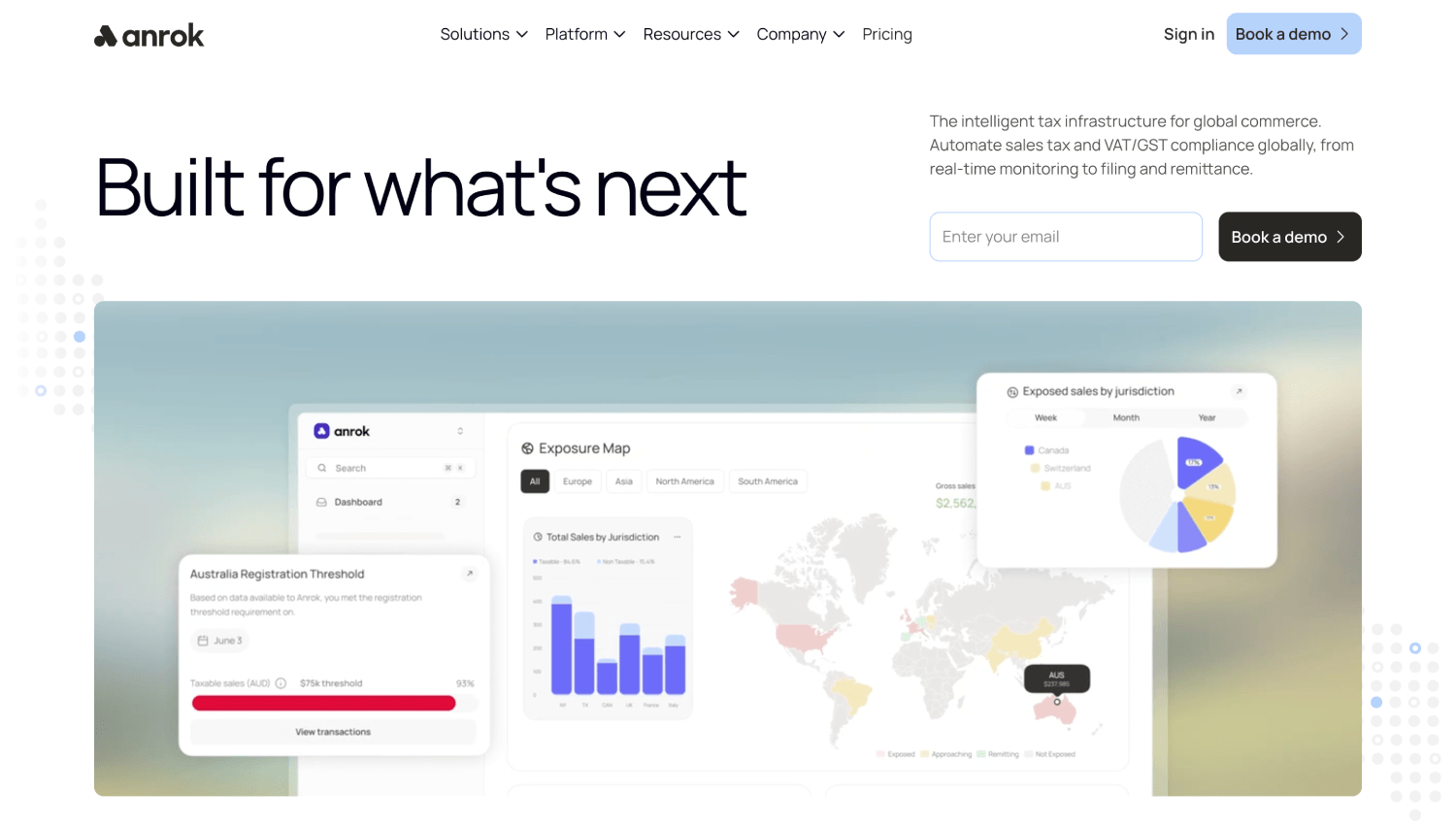
Anrok was built specifically for SaaS companies and subscription billing. It connects natively to Chargebee, Maxio, Stripe Billing, Salesforce, and NetSuite, and it treats software product taxability as a first-class concern rather than a mapping exercise.
The product tracks economic nexus thresholds by state in real time, registers you once a threshold is crossed, calculates tax on invoices, and files and remits returns on your behalf. The entire workflow is what most teams want when they say “I want to stop thinking about sales tax.” Anrok’s pricing is not publicly listed on their site, meaning you will need to request a demo to get numbers. For seed-to-Series B companies processing subscription revenue across multiple states, Anrok is the most purpose-fit option on this list.
2. Avalara AvaTax

Avalara is the largest dedicated tax compliance platform in the market and connects to more billing systems than any other vendor here. Its AvaTax engine covers SaaS product taxability across all US states, Canada, and most of Europe, which makes it the natural choice for companies selling internationally.
The trade-off is complexity. Avalara’s product surface is large. Setting up accurate product tax codes for SaaS line items requires configuration work upfront, and support quality varies by tier. Avalara does not publish standard pricing, but their public pricing page lists small business plans starting around $50 per month for basic calculation, with filing and compliance management products sold separately. Enterprise pricing is negotiated. Avalara fits best when you have a finance or ops person who will own the configuration.
3. TaxJar
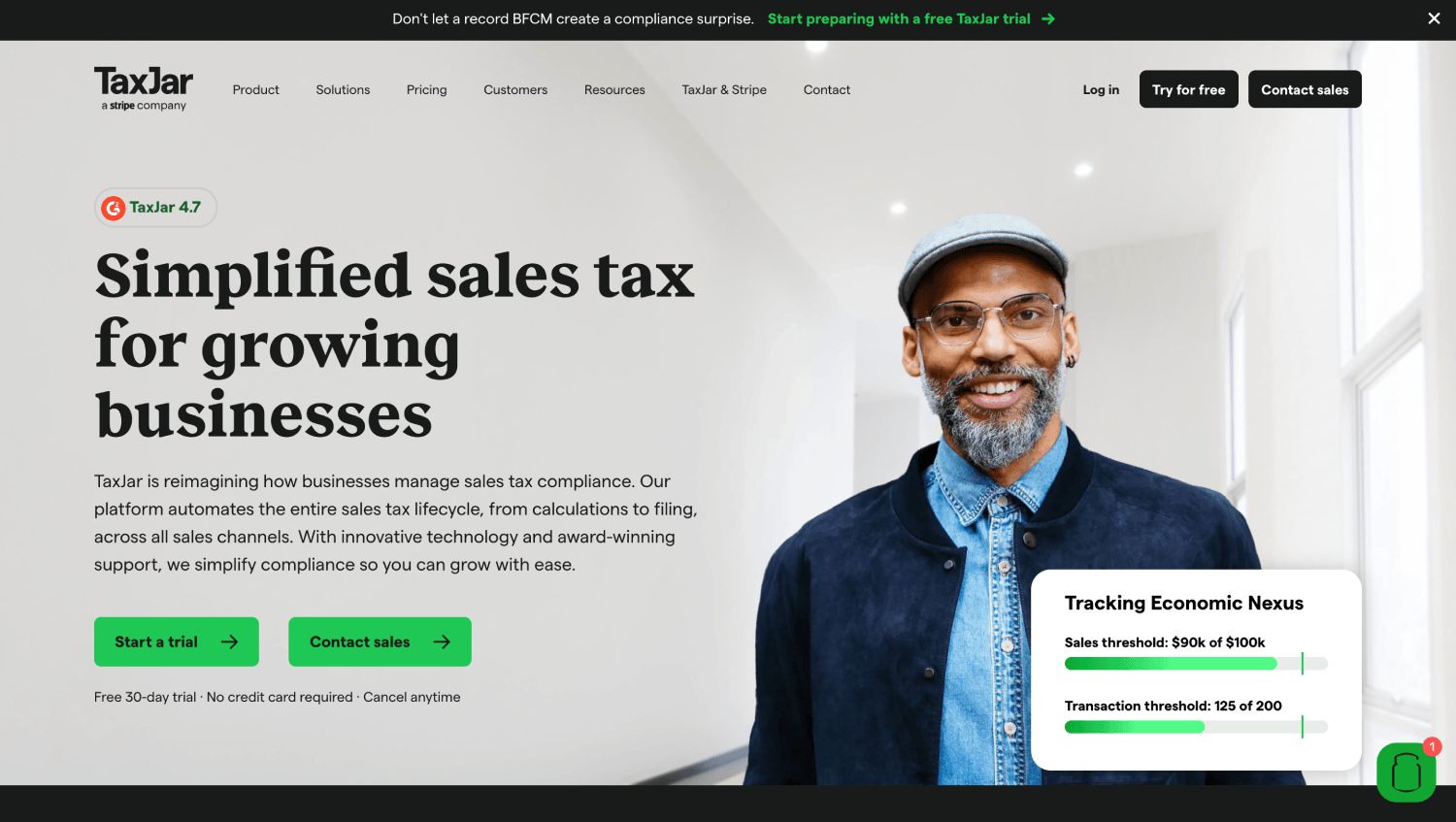
TaxJar, now a Stripe company, integrates tightly with Stripe Billing and also connects to Chargebee, Recurly, and WooCommerce. Its AutoFile product handles return filing in most US states automatically. As of their public pricing page, TaxJar’s Business plan starts at $19 per month for states reporting, with AutoFile costing an additional per-state fee per filing period.
TaxJar is a strong choice if Stripe or Chargebee is your billing platform and you operate primarily in the US. Its weakness is the same as Stripe Tax’s: NetSuite and Zuora integrations require third-party connectors. Teams on those platforms will hit mapping friction quickly. The acquisition by Stripe has also raised questions about long-term roadmap independence, though TaxJar continues to support non-Stripe billing systems as of this writing.
4. Zamp
Zamp positions itself as a fully managed solution: you connect your billing platform, and Zamp handles registration, calculation, filing, and remittance. The key differentiator is human support. Zamp pairs each customer with a tax analyst who owns the filing relationship, which appeals to CFOs who want a named person accountable for compliance rather than a dashboard to monitor.
Zamp connects to Stripe, Chargebee, Maxio, NetSuite, Shopify, and several others. Pricing is not publicly listed on their site. The model is structured as a flat monthly fee rather than per-transaction pricing, which benefits high-volume SaaS companies. For companies that have already accrued sales tax liability across past periods and need backfiling as part of onboarding, Zamp’s managed model handles that without a separate engagement.
5. Kintsugi
Kintsugi uses AI-driven product classification to determine taxability across states, which reduces the manual work of assigning tax codes to SaaS product lines. It integrates with Stripe, Chargebee, Maxio, QuickBooks, and NetSuite, and covers calculation, registration, filing, and remittance.
Where Kintsugi stands out is in its approach to product classification. SaaS taxability is genuinely complex: a professional services add-on may be taxable in Texas but exempt in California, while a software license is treated differently from a SaaS subscription in states like Louisiana. Kintsugi’s classification layer reduces the error rate on those determinations compared to manual tax code assignment. Pricing is not publicly disclosed. Companies evaluating Kintsugi should ask specifically about how it handles mixed-product invoices, because that is where most classification errors appear.
6. Numeral
Numeral is built for companies that need return filing automation above all else. It connects to accounting systems and billing platforms, pulls transaction data, prepares returns, and files them. The product is narrower than Anrok or Avalara in scope: it does not offer a real-time calculation API you would embed in your billing flow. Instead, it reconciles what you have already billed and handles the filing layer.
That narrowness makes Numeral a good fit for companies that already calculate tax correctly in their billing platform (or delegate that to Stripe Tax) but want a dedicated tool for the return preparation and filing step. Teams on Stripe Billing that want to separate the calculation and filing concerns sometimes pair Stripe Tax with Numeral rather than switching to an all-in-one engine. Pricing is not publicly listed.
7. Sphere

Sphere is a newer entrant aimed at early-stage SaaS companies that need sales tax handled without the implementation overhead of an Avalara or full-service Zamp engagement. It connects most cleanly to Stripe and handles registration, calculation, and filing. Integration with Chargebee and Maxio exists but with more limited real-time functionality than the Stripe connector.
Sphere’s differentiator is speed to activation. The setup process is designed to get a company from zero to compliant in a single working day for straightforward Stripe-based billing stacks. For companies that have just crossed an economic nexus threshold and need to register and file quickly, that fast path has real value. Pricing is not publicly listed on their site.
8. Commenda
Commenda focuses on international SaaS tax compliance alongside US sales tax, which makes it relevant for companies selling into the EU, UK, Australia, and Canada in addition to US states. It handles VAT, GST, and US sales tax under one platform, reducing the number of vendors a globally-selling SaaS company needs to manage.
The US sales tax coverage is solid but not as deep as purpose-built US tools like Anrok or Zamp. Commenda is the right choice for a company where international indirect tax is the bigger compliance burden and US sales tax is secondary. Pricing is not publicly listed.
9. Vertex

Vertex is the enterprise-grade option. It connects to every major ERP and billing system, handles US, EU, and APAC indirect tax, and is designed for companies with hundreds of thousands of monthly transactions and complex multi-entity structures. Its implementation requires professional services engagement and is not appropriate for a seed or Series A company.
For a SaaS company on NetSuite ERP that has outgrown TaxJar or Avalara’s mid-market tiers and is approaching $50M ARR or operating across multiple legal entities in different jurisdictions, Vertex is worth evaluating. Pricing is enterprise-negotiated and not publicly disclosed.
10. Stripe Tax
Stripe Tax earns a place on this list because it is genuinely the lowest-friction option for companies whose entire billing stack runs through Stripe. As of their public pricing page, Stripe Tax charges 0.5% of transaction volume for US transactions, with no monthly minimum, which makes it cost-competitive at low volumes.
The ceiling is clear: the moment you add Chargebee, Maxio, or NetSuite to the stack, Stripe Tax does not follow. It also does not file or remit returns; it calculates and reports only, leaving the filing step to the operator. Teams that start on Stripe Tax typically migrate to a full-service engine around Series A when multi-state nexus obligations grow beyond one or two states. For a more thorough comparison of Stripe against other billing infrastructure, the merchant of record decision guide for B2B SaaS covers how tax handling differs across payment models.
What Does SaaS Sales Tax Compliance Software Actually Need to Handle?
Most buying guides stop at “nexus tracking and filing.” The actual scope is wider, and the gaps matter.
Economic nexus monitoring watches your revenue and transaction count against each state’s thresholds. South Dakota’s threshold, which set the national standard, is $100,000 in annual sales or 200 transactions. Most states have adopted similar thresholds, though some differ. A tax engine that monitors these in real time prevents the scenario where you cross a threshold in March and only discover the liability in November.
Product taxability classification is where most SaaS companies make errors. Software-as-a-service is not universally taxable. Texas taxes SaaS. California generally does not tax SaaS but does tax electronically delivered software in some configurations. New York taxes SaaS sold to business customers differently from SaaS sold to consumers. A tax engine must know your product category and apply state-specific rules, not a one-size-fits-all taxable or exempt determination.
Registration and remittance are the operational steps most teams underestimate. Once nexus is established, the company must register with the state’s department of revenue, collect tax on future sales, file periodic returns, and remit collected tax. Some engines automate all four steps. Others stop at calculation and hand the remaining steps back to the operator. Knowing which category a vendor falls into before you sign is the single most important procurement question.
For teams building out the broader compliance stack, the fintech product and compliance readiness checklist covers how sales tax fits alongside other regulatory obligations at different growth stages.
How Much Does Sales Tax Software Cost for a SaaS Company?
Pricing models vary significantly across this space, and the total cost of compliance includes more than the software fee.
| Vendor | Pricing Model | Public Starting Price | Filing Included |
|---|---|---|---|
| Stripe Tax | % of transaction volume | 0.5% per transaction (as of public pricing page) | No |
| TaxJar | Monthly + per-state AutoFile fee | $19/mo Business plan (as of public pricing page) | Add-on |
| Avalara | Tiered by transaction volume | ~$50/mo for small business plans (as of public pricing page); enterprise pricing negotiated | Add-on product |
| Anrok | Not publicly disclosed | Not publicly listed | Yes |
| Zamp | Flat monthly fee (not publicly listed; contact for quote) | Not publicly listed | Yes |
| Kintsugi | Not publicly disclosed | Not publicly listed | Yes |
| Numeral | Not publicly disclosed | Not publicly listed | Yes |
| Sphere | Not publicly disclosed | Not publicly listed | Yes |
| Commenda | Not publicly disclosed | Not publicly listed | Yes |
| Vertex | Enterprise, negotiated | Not publicly listed | Partial |
Consider a hypothetical Series A SaaS company with $4M ARR, billing 800 customers per month across 12 states through Chargebee. At Stripe Tax’s 0.5% rate, the annual calculation cost alone would be $20,000, with no filing included and no native Chargebee integration. A managed engine at a flat $2,000 per month, a representative mid-market price point for this category, not a guaranteed quote from any specific vendor, would run $24,000 annually while covering calculation, filing, and remittance, and eliminating the ops work and integration gap. At that ARR level, the managed model is often cheaper when accountant time is factored into the comparison.
Hidden costs in this space include backfiling for periods where nexus existed but returns were not filed, voluntary disclosure agreement legal fees if you self-report prior liability, and implementation services for platforms like Avalara and Vertex that require professional configuration. These costs can easily exceed the first year of software fees for companies with multiple years of unaddressed nexus exposure. The hidden costs killing fintech SaaS margins article covers how compliance liabilities like this compound over time.
Which Vendor Is Best for Which Billing Stack?
The answer depends on where your invoices are generated, not where your payments are processed.
If your invoices come from Stripe Billing and you operate in fewer than five states with under $2M ARR, start with Stripe Tax and add TaxJar’s AutoFile for returns. The combined cost is manageable and the integration is native.
If your invoices come from Chargebee or Maxio, Anrok is the clearest choice. It was built for this exact configuration, handles multi-state SaaS taxability correctly, and manages the full compliance lifecycle without a separate filing vendor.
If you run billing through NetSuite ERP with a complex multi-entity structure, Avalara’s NetSuite connector is the most mature integration available. Vertex becomes relevant above $20M ARR or when cross-border tax complexity enters the picture.
If you need international VAT or GST coverage alongside US sales tax, Commenda or Avalara are the two vendors that handle both under one platform. Anrok and Zamp are US-focused, though their international coverage is expanding.
If your priority is speed to compliance with a Stripe-heavy stack and minimal ops involvement, Sphere’s fast-activation model is worth evaluating for early-stage companies.
What Is the Difference Between a Tax Engine and a Filing Service?
A tax engine calculates the correct tax amount on each transaction in real time and embeds that calculation into your billing flow. It needs to know your product’s tax code, the customer’s jurisdiction, and any applicable exemptions. The output is a tax amount that appears on the invoice.
A filing service takes your transaction data at the end of a filing period, prepares the return for each state, and submits it to the relevant tax authority along with remittance. It does not need to touch your billing system in real time.
Most modern SaaS tax platforms do both. Stripe Tax is the prominent exception: it is a calculation engine only. The distinction matters because teams that discover they need both capabilities often have to buy them from two separate vendors if they started with a calculation-only tool. When evaluating vendors, ask specifically whether managed filing and remittance is included in the base contract or sold as a separate product with additional fees.
Frequently Asked Questions
Is SaaS taxable in all US states?
No. SaaS taxability varies by state. States like Texas, New York, and Pennsylvania tax SaaS. California, Florida, and Virginia generally do not tax SaaS subscriptions, though rules differ for electronically delivered software. Some states apply sales tax only to SaaS sold to business customers, not consumers. This variation is the core reason manual tracking fails at scale and why SaaS-specific tax engines with built-in product taxability logic are worth the cost.
Does Stripe Tax work with Chargebee?
No. Stripe Tax is embedded inside Stripe’s payment infrastructure and applies only to invoices and subscriptions created directly within Stripe Billing. Chargebee generates its own invoices and does not inherit Stripe Tax calculations. Teams that use Chargebee for subscription management and Stripe as the payment processor need a standalone tax engine, such as Anrok, Avalara, or Zamp, that connects to Chargebee directly rather than relying on Stripe Tax.
What is economic nexus and when does a SaaS company trigger it?
Economic nexus is a tax obligation created when a company exceeds a state’s revenue or transaction threshold, regardless of physical presence. The most common threshold, adopted by most states following South Dakota v. Wayfair, is $100,000 in annual sales or 200 transactions in a state. A SaaS company selling to customers in multiple states can trigger nexus in each of those states independently. A tax engine monitors these thresholds automatically and alerts the company when registration is required.
What is the difference between sales tax calculation and sales tax filing?
Calculation happens at the invoice level in real time. Filing happens at the end of a reporting period (monthly or quarterly depending on the state) and involves submitting a return to the state’s department of revenue and remitting collected tax. Many tools do one but not both. Stripe Tax only calculates. Most all-in-one platforms marketed specifically to SaaS companies, including Anrok, Zamp, and Kintsugi, handle both under a single contract, which is the cleaner arrangement for companies without a dedicated tax team.
How do SaaS companies handle sales tax exemptions for resellers or nonprofits?
Exemption certificate management is a distinct workflow. When a customer provides a valid resale certificate or nonprofit exemption, you must collect, validate, and store that certificate, then confirm the customer is not charged tax on future invoices. Avalara’s CertCapture product handles this as a standalone module. Anrok and Zamp also manage exemption certificates within their platforms. Teams using TaxJar or Stripe Tax typically need a separate exemption management workflow, often handled manually or through a tool like CertCapture.
Should a $2M ARR SaaS company use a managed filing service or hire a tax accountant?
At $2M ARR operating across five or more states, a managed filing service is almost always cheaper than an accountant. A CPA handling multi-state SaaS filings typically charges $200 to $500 per state per filing period, plus engagement fees for registration and backfiling. A managed platform that handles the same scope usually costs less in total annual fees and reduces the ops burden on your finance team. The accountant adds value for complex situations like prior-period liability exposure, voluntary disclosure agreements, or contested audits, not for routine monthly or quarterly filing.
Can one tax engine handle both US sales tax and international VAT for SaaS?
Some can. Avalara, Vertex, and Commenda cover US sales tax and international indirect taxes (EU VAT, UK VAT, Australian GST, Canadian GST/HST) under one platform. Anrok, Zamp, and Kintsugi are primarily US-focused and are expanding international coverage. If your company collects meaningful revenue from the UK, EU, or Australia, confirm explicitly with any vendor whether international tax is included in the base contract or requires a separate module with additional cost. For a broader look at how billing complexity scales internationally, the fintech SaaS scale checklist covers the compliance checkpoints relevant at each revenue stage.
How to Choose: The Stack Handshake Test Applied
Run every vendor through three questions before evaluating further. First: does the vendor have a certified, maintained integration with the specific billing platform that generates your invoices? Not Stripe the payment processor. The platform that creates the invoice object. Second: does the vendor handle managed filing and remittance in the contract, or does it calculate only? Third: what is the path for backfiling periods where nexus existed but returns were not filed? That last question separates vendors with real compliance depth from those that onboard you for ongoing use only and leave historical liability unresolved.
The sales tax compliance market for SaaS has matured enough that no company should be doing this manually, but it has not matured enough that any single vendor is right for every stack. The distinction between a pure-play SaaS tax engine and a general-purpose indirect tax platform is real and meaningful. Anrok, Kintsugi, and Zamp were designed around the specific taxability logic that subscription software requires. Avalara and Vertex were designed for commerce broadly and adapted for SaaS. That design-origin difference shows up in how each platform handles SaaS product tax codes, exemption workflows, and subscription billing events. Know which category you are evaluating before you sit down for a demo.
The companies that end up paying the most for sales tax compliance are usually the ones that deferred the decision and then discovered three years of nexus exposure across eight states. The choice of vendor matters far less than making the choice before that liability accrues.