
TLDR
- Avalara’s per-transaction pricing and implementation overhead are built for e-commerce and manufacturing, not SaaS subscription billing with exemptions, mid-cycle upgrades, and multi-product bundles.
- SaaS-native tax engines like Anrok, Numeral, and Kintsugi handle subscription-specific logic out of the box: prorations, free trials, annual-to-monthly conversions, and software product taxability rules by jurisdiction.
- The real cost difference is not just per-transaction fees. It is the engineering time required to map Avalara’s product taxonomy to SaaS billing events and the ongoing maintenance when tax rules change.
- Teams running Stripe Billing, Chargebee, or custom billing infrastructure should evaluate tax engines that offer native connectors rather than generic API wrappers.
- The eight alternatives below vary significantly by pricing model, implementation lift, and which billing stack they actually integrate with natively versus nominally.
The best Avalara alternatives for SaaS companies are Anrok, Numeral, Kintsugi, Zamp, TaxJar, Sphere, Commenda, and Lovat. Anrok is the strongest fit for subscription-first companies on Stripe or Recurly. Numeral suits teams that want tax filing outsourced entirely. Kintsugi and Zamp use AI to reduce manual classification work. TaxJar remains a viable lower-cost option for earlier-stage companies. Sphere, Commenda, and Lovat fill specific gaps in European VAT, marketplace compliance, and multi-entity structures.
Why Do SaaS Teams Leave Avalara?
Avalara was designed for product-based commerce. Its AvaTax engine excels when SKUs map cleanly to physical goods, where taxability is determined at point of sale and the transaction is done. SaaS billing does not work that way. A customer who upgrades mid-cycle, pauses a subscription, adds a seat, or moves from a monthly to an annual plan creates tax events that Avalara handles awkwardly, often requiring custom code to translate your billing system’s events into Avalara’s expected input format.
The setup burden compounds this. Implementing Avalara for a SaaS billing stack typically requires mapping your product catalog to Avalara’s tax codes, configuring exemption certificates, and building custom logic for recurring billing edge cases. Engineering teams at Series A and Series B companies have reported this taking weeks of dedicated engineering time, with ongoing maintenance required when product lines change or new jurisdictions trigger economic nexus.
Pricing is the other pressure point. Avalara does not publicly disclose transaction-level pricing on its website, contract negotiations can go in unexpected directions, especially for companies with high transaction volumes from monthly subscriptions. Companies scaling past $5M ARR often find that their actual per-transaction blended cost surprises them at renewal. If you are evaluating the full cost of compliance infrastructure, the real cost of compliance in FinTech SaaS goes well beyond licensing fees once implementation and maintenance hours are included.
The FintechSpecs Subscription Tax Fit Test
Before evaluating any Avalara replacement, run your candidates through what we call the Subscription Tax Fit Test: four criteria that separate genuinely SaaS-native engines from general-purpose tax tools relabeled for SaaS.
- Proration handling: Does the engine calculate tax on prorated amounts automatically, or does your billing system need to send the correct prorated figure and hope the tax engine applies the right rate?
- Exemption certificate workflow: Can B2B customers upload exemption certificates in a self-serve flow, and does the engine store and apply them automatically to future invoices?
- Software product taxability rules: Does the engine maintain jurisdiction-specific rules for SaaS versus downloaded software versus API access? These three categories are taxed differently in dozens of US states.
- Billing platform native connector: Is there a true native integration with your billing stack (Stripe, Chargebee, Recurly, Maxio), or does “integration” mean a webhook-based workaround that your team maintains?
A tool that passes all four criteria is genuinely built for recurring revenue. One that passes two or three is a general-purpose engine with SaaS aspirations. The distinction matters because the ongoing engineering cost of compensating for gaps in criteria one through four is where the real TCO diverges from the quoted per-transaction price.
Which Avalara Alternatives Are Actually Built for Subscription Billing?
1. Anrok
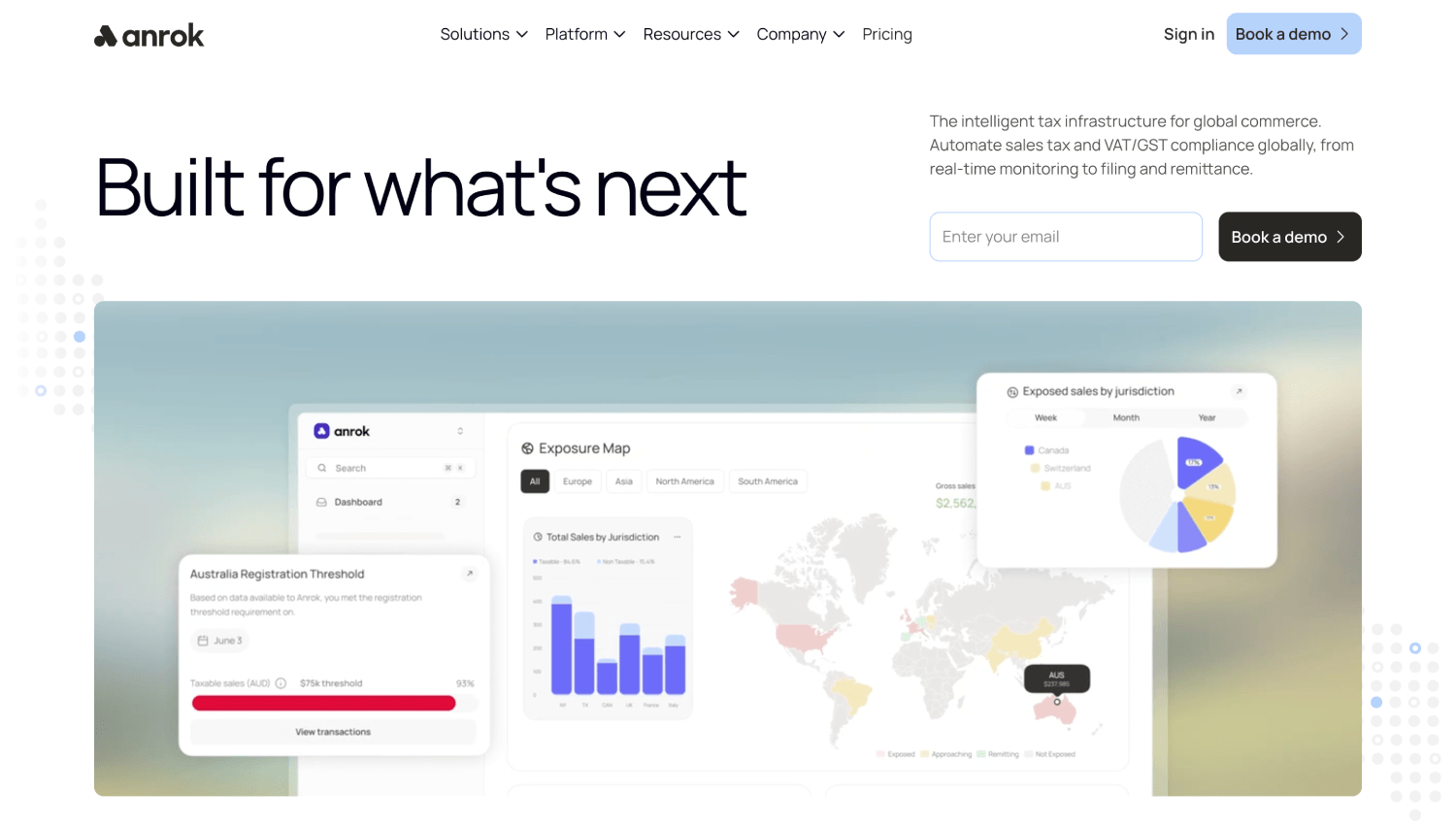
Anrok is the clearest purpose-built alternative for SaaS companies. It was built specifically for subscription businesses and integrates natively with Stripe Billing, Stripe Invoicing, Chargebee, and Recurly, pulling billing events directly rather than requiring your team to push formatted transactions. Nexus monitoring is included: Anrok tracks your economic nexus thresholds by state automatically and alerts you before you cross them, which removes the manual spreadsheet that most finance teams use to approximate this.
Product taxability for SaaS is baked into the engine rather than bolted on. Anrok maintains rules for software products across US states, EU VAT jurisdictions, and Canadian GST/PST, including the distinctions between SaaS, downloaded software, and professional services that many engines treat identically. Pricing is not publicly listed on their website; direct contact is required for a quote. The trade-off compared to Avalara is the narrower coverage of non-software product types, which matters only if your catalog includes physical goods or mixed-product bundles.
Best for: Series A to Series C SaaS companies on Stripe or Chargebee that want a tax engine requiring minimal ongoing engineering maintenance.
2. Numeral
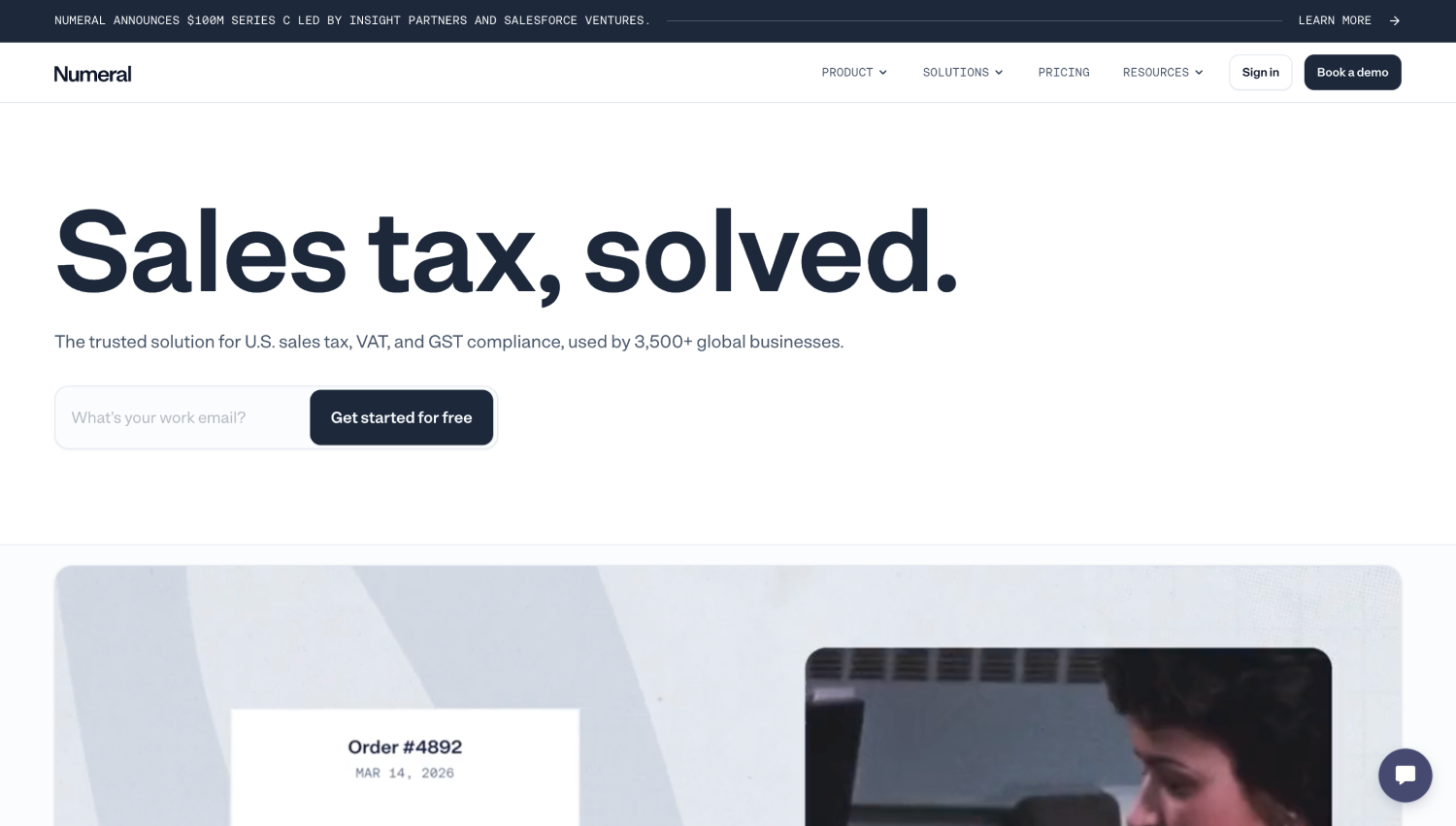
Numeral positions itself as a tax compliance co-pilot rather than a pure API engine. The product handles both calculation and filing, meaning your team does not need to separately manage returns through a filing service. For SaaS finance teams without a dedicated tax hire, this matters: Numeral’s managed-filing model means a human team at Numeral handles state registrations, prepares returns, and files on your behalf, with software doing the calculation layer underneath.
The integration story is solid for Stripe-first companies, with native connectors for Stripe and QuickBooks. Pricing is not publicly listed on their website; engagements are typically scoped to company size and filing volume. The main limitation versus Anrok is that Numeral’s managed model works better for teams that want to hand off compliance entirely rather than teams that want programmatic control over tax logic from within their billing infrastructure.
Best for: Seed to Series B SaaS companies without an in-house tax function that want calculation and filing bundled under one vendor.
3. Kintsugi

Kintsugi uses AI to automate product classification and nexus determination, which reduces the manual setup work that typically consumes engineering hours during an Avalara implementation. Their engine ingests your existing transaction data to classify products automatically rather than requiring your team to map SKUs to tax codes manually. This is particularly useful for SaaS companies with complex product catalogs that include professional services, implementation fees, and support tiers alongside core subscription revenue, all of which carry different taxability rules.
Kintsugi connects to Stripe, Chargebee, NetSuite, and QuickBooks. Pricing is not publicly listed on their website. The AI-classification approach carries one meaningful trade-off: automated classification is not infallible, and companies in higher-risk industries or with unusual product structures should plan to review classifications manually rather than trusting the engine without audit.
Best for: SaaS companies with mixed product catalogs who want to reduce setup time for product classification and are comfortable with AI-assisted rather than manually configured tax logic.
4. Zamp
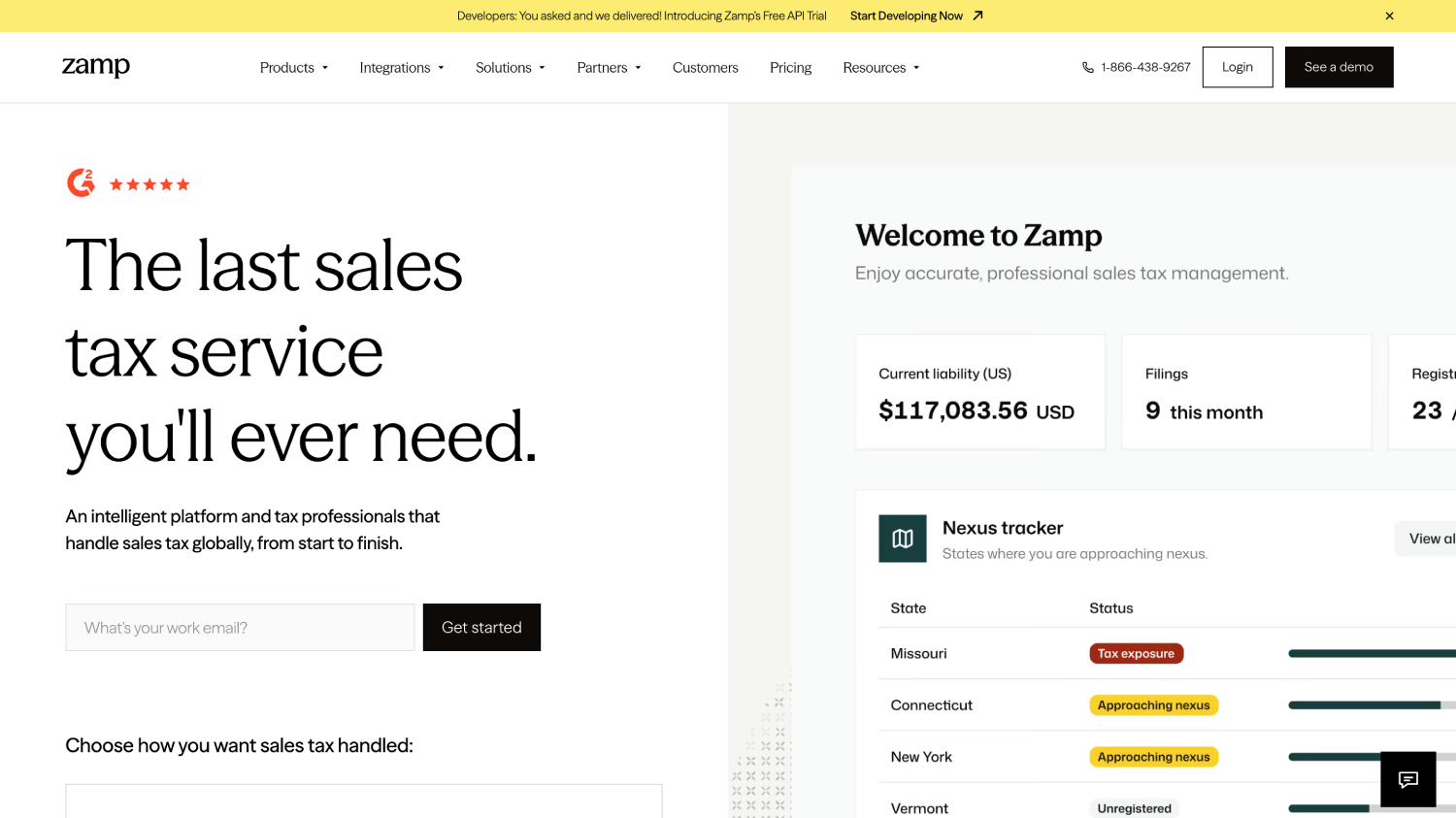
Zamp is a fully managed sales tax service that handles registration, calculation, and filing. Unlike API-first engines, Zamp assigns a dedicated compliance team to each customer and positions the relationship as advisory rather than purely software. For SaaS companies that have already had a compliance surprise, an unexpected nexus trigger, an audit notice, a missed registration, Zamp’s managed model offers a higher-touch alternative to self-service tools.
The integration layer covers major billing and e-commerce platforms. Pricing is not publicly listed on their website. The managed model means expert human oversight, but it also means less real-time programmatic flexibility for engineering teams that want to test tax logic in staging environments or run compliance checks within CI/CD pipelines.
Best for: Mid-market SaaS finance teams that have had compliance problems and want a managed, human-backed service rather than another software tool to maintain.
5. TaxJar
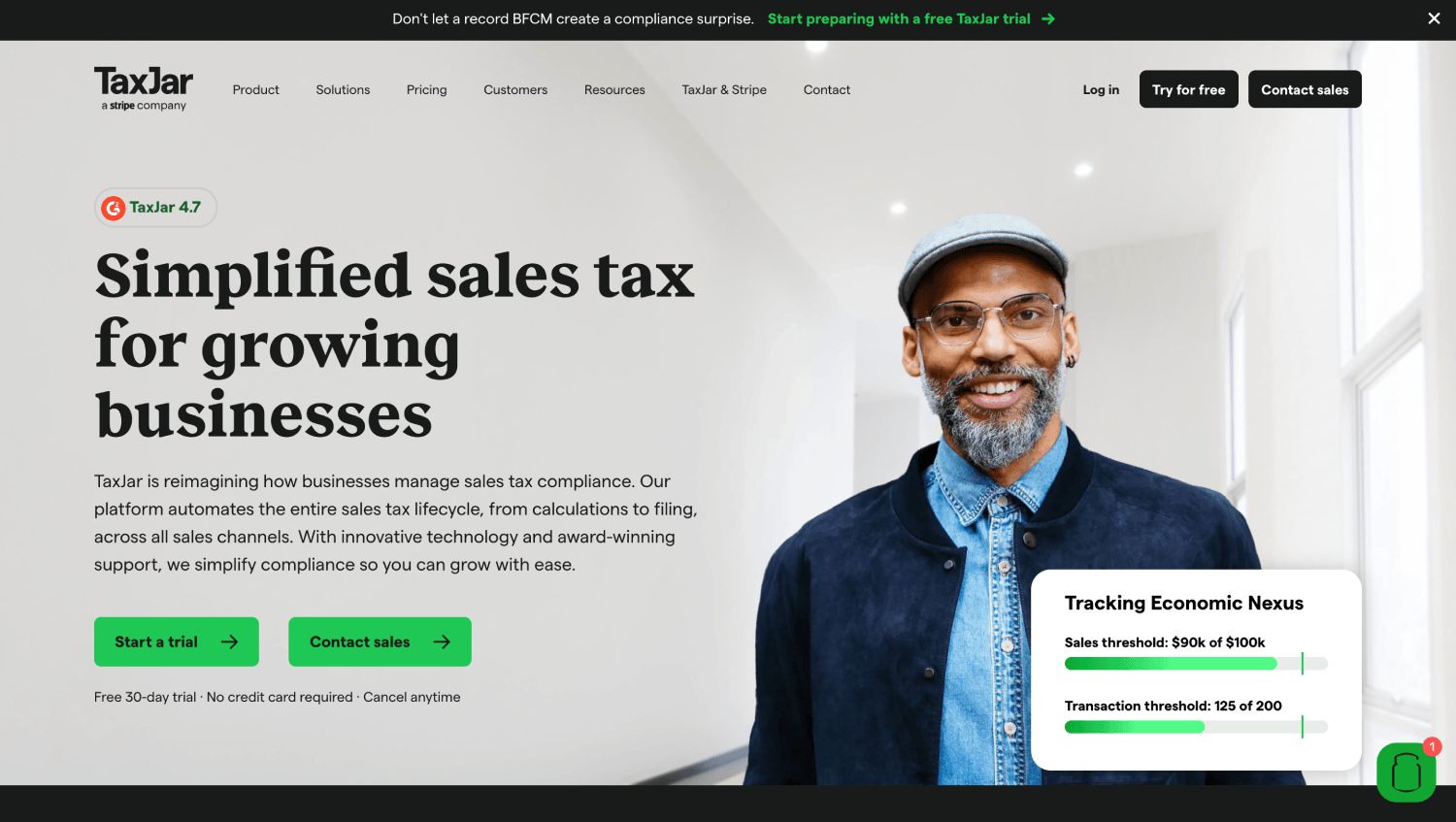
TaxJar (acquired by Stripe in 2021) is the most established lower-cost alternative for earlier-stage SaaS companies. Its SmartCalcs API handles real-time tax calculation, and the filing automation product handles state returns. TaxJar’s Starter plan is listed at $19 per month on their public pricing page (verified October 2024) for basic filing, with higher tiers for API access and multi-channel use.
The Stripe ownership creates obvious integration advantages, though TaxJar works across billing platforms. For SaaS-specific edge cases, TaxJar is more capable than it used to be but is still better suited to product-based or simpler subscription models than to complex B2B SaaS with heavy B2B exemptions and multi-product bundles. If you are already evaluating how tax compliance fits within a broader Stripe-based tax compliance stack, TaxJar’s native Stripe positioning is a meaningful advantage.
Best for: Seed to early Series A SaaS companies with simpler billing structures that need a proven, lower-cost calculation and filing solution with transparent pricing.
6. Sphere

Sphere focuses on global indirect tax compliance, with particular depth in EU VAT, UK VAT, and GST jurisdictions across APAC. For SaaS companies with significant European revenue, Sphere addresses a meaningful gap in most US-centric tax engines: the distinction between B2B and B2C VAT treatment, the OSS (One-Stop Shop) filing regime, and the digital services tax rules that apply differently across EU member states.
Sphere integrates with Stripe and offers API-first implementation. Pricing is not publicly listed on their website. For North American SaaS companies without EU revenue, Sphere is not the right shortlist candidate. For companies with $500K or more in EU ARR, the gap in EU tax handling between Sphere and a US-focused alternative can represent real audit risk.
Best for: SaaS companies with meaningful EU or UK revenue that need a tax engine with genuine depth in VAT rules rather than a US-first engine with nominal international support.
7. Commenda
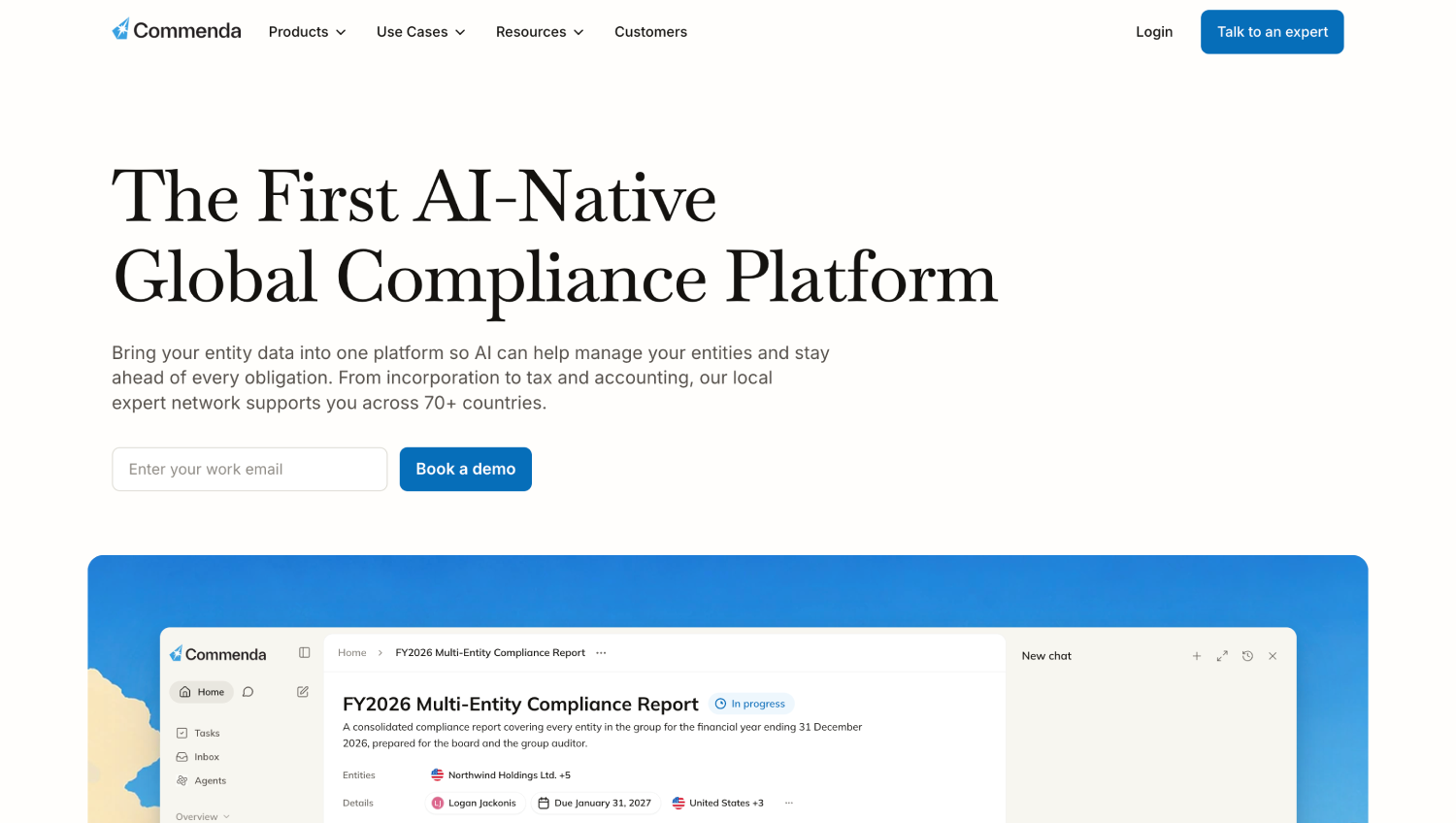
Commenda covers global sales tax, VAT, and GST compliance with a focus on automating registrations and filings across jurisdictions. For SaaS companies entering new international markets, Commenda handles the registration workflows that most tax engines treat as out of scope, including VAT registration in EU countries, GST registration in Australia and Canada, and the ongoing filing calendar management across multiple jurisdictions simultaneously.
The platform connects to major billing and e-commerce platforms. Pricing is not publicly listed on their website. Commenda’s competitive position is specifically strong for companies in international expansion phases where the registration and filing complexity across 15 or 20 jurisdictions exceeds what an internal finance team can manage with a US-centric tool. Teams evaluating multi-entity structures for international expansion may also find relevant context in how merchant of record providers handle cross-border tax liability as an alternative path.
Best for: SaaS companies actively expanding into international markets who need jurisdiction registration and filing automation, not just calculation.
8. Lovat
Lovat is a European-headquartered compliance platform covering VAT, GST, and sales tax across more than 100 countries. Its particular strength is in EU OSS compliance and the VAT filing workflows for digital services sold cross-border. For SaaS companies that are EU-based or that have EU as their primary market, Lovat’s filing infrastructure is broader than most US-headquartered alternatives.
API integration is available for calculation, with filing handled through the platform’s managed services layer. Pricing is available on request. For US-first SaaS companies with limited EU exposure, Lovat’s feature set is more than necessary, and an Anrok or TaxJar approach will be simpler to implement. The tool earns its spot on this list specifically for companies where EU and cross-border VAT is the primary compliance problem rather than US state sales tax.
Best for: EU-based SaaS companies or US companies where EU VAT and global GST compliance is a larger operational burden than US state sales tax.
How Do These Avalara Alternatives Compare on Core SaaS Features?
| Tool | SaaS-Native? | US Sales Tax | EU VAT | Filing Included? | Native Stripe Integration | Pricing Model |
|---|---|---|---|---|---|---|
| Anrok | Yes | Strong | Yes | Yes | Native | Custom (not public) |
| Numeral | Yes | Strong | Limited | Yes (managed) | Native | Custom (not public) |
| Kintsugi | Mostly | Strong | Limited | Yes | Native | Custom (not public) |
| Zamp | Managed | Strong | Limited | Yes (managed) | Yes | Custom (not public) |
| TaxJar | Partial | Strong | Limited | Yes | Native | From $19/mo (public) |
| Sphere | Yes | Moderate | Strong | Yes | Native | Custom (not public) |
| Commenda | Partial | Moderate | Strong | Yes (multi-jurisdiction) | Yes | Custom (not public) |
| Lovat | Partial | Moderate | Strong | Yes (100+ countries) | Yes | On request |
What Does the Switch from Avalara Actually Involve?
The mechanics of switching deserve more attention than most vendor comparison articles give them. The practical steps are not about the new tool; they are about what you owe to the old one and what you need to carry forward.
Start with exemption certificates. If your B2B customers have uploaded certificates into Avalara’s CertCapture system, those certificates need to be exported and re-ingested into the new engine before go-live. Failing to do this means your existing exempt customers get taxed on their next invoice, which creates both customer friction and potential audit exposure. Most SaaS-native engines have an import workflow for certificate data, but the format compatibility varies and this step often takes longer than teams anticipate.
Historical transaction data is the second migration task. For audit defensibility, you want your new tax engine to have access to transaction history, or you need to retain Avalara access for historical lookups post-migration. A clean 90-day parallel-run period (where both engines calculate and you reconcile the difference) is the most defensible approach, though it requires engineering bandwidth. Given how often compliance readiness gaps surface during vendor transitions, structuring this migration with an explicit audit trail is worth the extra time.
Nexus registrations are the third piece. If Avalara was managing your state tax registrations, confirm which states you are currently registered in before you close the account, and verify that the new engine either maintains those registrations or hands them off to a filing service. Unintentional lapses in registration create back-filing obligations.
Which Avalara Alternative Fits Which SaaS Stage?
For companies under $2M ARR with simple billing and US-only revenue, TaxJar offers the lowest implementation lift and the only publicly transparent pricing on this list. The engineering integration is well-documented and the Stripe connector is mature.
For Series A and Series B SaaS companies with B2B customers, exemption certificate management, and subscription billing complexity, Anrok is the strongest default. The subscription-specific logic built into the engine means less custom code, and the nexus monitoring removes a manual compliance task. Kintsugi is worth evaluating if your product catalog is complex enough that manual tax code mapping would take more than a week of engineering time.
For mid-market companies that have already experienced a compliance incident or that want a human team accountable for their filing calendar, Numeral and Zamp are the right conversation. Both offer managed filing rather than DIY automation. The distinction between the two is largely in how much programmatic control your engineering team wants over the calculation layer during implementation.
For companies with substantial EU or international revenue, Sphere handles the VAT complexity that US-first engines approximate rather than solve. Commenda and Lovat are appropriate when the compliance burden is primarily about multi-country registration management rather than US state calculation logic. Teams building on broader international payment infrastructure may also want to understand how merchant of record models handle tax liability differently at each growth stage, which can change the build-versus-buy calculus entirely.
What Should a SaaS Company Ask Before Choosing an Avalara Replacement?
Three questions separate a thorough evaluation from a surface-level vendor comparison. First, ask each vendor for a live demonstration using your actual billing scenarios, not their demo data. Request specifically that they show how their engine handles a mid-cycle upgrade, a partial-period refund, and a B2B customer with an exemption certificate. These three scenarios expose gaps faster than any feature checklist.
Second, ask for the integration architecture documentation before the sales process concludes. Understanding whether their Stripe or Chargebee connector is event-driven (pulling data directly from billing webhooks) or batch-based (requiring periodic syncs) changes your engineering estimate significantly. Batch integrations introduce timing gaps that can result in invoices going out without tax applied if the sync window is missed.
Third, ask explicitly about pricing structure for high-volume recurring subscription billing. Some engines price per transaction and treat each recurring invoice as a separate billable event. At 10,000 active subscriptions on monthly billing, that is 10,000 taxable events per month before upgrades, downgrades, or trials are counted. Understanding the pricing model at your current volume and at 3x your current volume before you sign matters. The same analysis applies to understanding your broader hidden SaaS margin costs, where compliance tooling often appears underweight in budget models.
Frequently Asked Questions
Is Anrok better than Avalara for SaaS?
For subscription-billing SaaS companies, Anrok handles recurring revenue edge cases that Avalara requires custom engineering to address. Anrok maintains SaaS-specific product taxability rules natively, offers genuine nexus monitoring with automatic alerts, and integrates with Stripe and Chargebee at the billing event level rather than requiring transaction formatting. Avalara has broader coverage of non-SaaS industries and more name recognition in enterprise procurement. If your business is pure SaaS with subscription revenue, Anrok requires less ongoing engineering maintenance. If your catalog includes physical goods or non-software products alongside SaaS, Avalara’s breadth may justify the complexity.
What is the cheapest Avalara alternative for a small SaaS company?
TaxJar has the only publicly posted pricing among the alternatives on this list, with the Starter plan listed at $19 per month on their public pricing page (verified October 2024) for basic state filing. The SmartCalcs API for real-time calculation is available on higher tiers. For companies under $1M ARR with straightforward US-only subscription billing and few B2B exemptions, TaxJar represents the lowest total cost of ownership on this list. All other alternatives on this list require direct contact for pricing, with custom contracts typical.
Can these tools handle SaaS taxability rules across US states?
SaaS taxability across US states is genuinely complex: some states tax SaaS as tangible personal property, some treat it as a service, some exempt it entirely, and several have specific rules distinguishing SaaS from downloaded software from API access. Anrok, Kintsugi, and Sphere explicitly maintain these jurisdiction-specific SaaS product taxability rules. TaxJar handles the major categories but has historically been more e-commerce oriented. Numeral and Zamp handle this through their managed service teams rather than pure automated logic. Before committing to any engine, confirm with the vendor specifically how they handle SaaS taxability in Texas, New York, and Pennsylvania, three states with meaningfully different treatment.
How long does it take to switch from Avalara to a SaaS-native tax engine?
The honest range is two to eight weeks, depending on three factors: the complexity of your product catalog, the volume of exemption certificates that need migrating, and whether you run a parallel period. Simple Stripe-billing companies with few exempt customers can migrate Anrok or TaxJar in two to three weeks with one engineer. Companies with hundreds of exemption certificates, multiple billing platforms, or complex multi-product catalogs should budget for four to eight weeks. The parallel-run validation period, where both engines calculate and you reconcile differences before full cutover, adds time but is worth it for audit defensibility.
Do any Avalara alternatives handle both US sales tax and EU VAT?
Anrok covers US sales tax and EU VAT, including the B2B versus B2C VAT treatment distinctions relevant for SaaS. Sphere and Lovat have deeper EU VAT capabilities, particularly for OSS filing. Commenda handles multi-jurisdiction registration and filing across both US and EU regimes. TaxJar’s EU VAT coverage is limited compared to its US sales tax strength. If your company collects revenue from both US and EU customers, Anrok is typically the default recommendation unless EU revenue represents the majority of your business, in which case Sphere or Lovat offer more depth on the European side.
What happens to my Avalara exemption certificates when I switch?
Avalara stores exemption certificates in its CertCapture module. Before canceling your contract, export all certificates in a standard format (PDF plus the structured data). Most SaaS-native alternatives have an import workflow for certificate data, though format compatibility varies by vendor. Confirm the import process with your new vendor before you begin the migration, and verify that imported certificates are applied automatically to future invoices for the corresponding customers. Missing this step results in previously exempt customers being charged tax on their next billing cycle, which requires credits, corrections, and customer communication.
The Core Decision
Most SaaS teams treat their tax engine as a back-office utility and evaluate it accordingly: lowest price, familiar brand, check the compliance box and move on. Avalara wins that evaluation because it is the familiar name. The problem surfaces six months later when an engineer spends a week debugging why mid-cycle upgrades are calculating tax on the full new-plan price instead of the prorated difference, or when a B2B customer’s exemption certificate applies inconsistently across invoice types.
The SaaS-native engines on this list were built by people who experienced those debugging sessions. The architecture decisions they made, pulling billing events directly rather than requiring formatted transaction pushes, maintaining software product taxability rules as a first-class data model rather than a lookup table, treating exemption certificate management as a core workflow rather than an afterthought, reflect that experience. These are not abstract product philosophy differences. They show up as engineering hours saved or spent during implementation and every quarter afterward. Understanding where these tools fit within your broader compliance and billing infrastructure is easier when you have a clear picture of your full fintech infrastructure stack and what each layer is expected to own.
Where your compliance pain is concentrated determines which replacement fits. US state sales tax complexity with B2B exemptions points to Anrok or Kintsugi. A preference for fully managed filing without internal tax headcount points to Numeral or Zamp. International VAT as the primary problem points to Sphere, Commenda, or Lovat. TaxJar earns its place for teams that want proven, lower-cost automation at earlier stages. None of these are wrong answers in isolation. They are wrong only when matched to the wrong stage or the wrong compliance profile.