
TLDR
- A payout API does more than move money. It manages funding source selection, rail routing, payee verification, sanctions screening, and post-settlement reconciliation, and each of those layers has its own failure modes and cost implications.
- The rail you choose (ACH, RTP, wire, push-to-card, or international correspondent) determines speed, cost, reversibility, and who bears fraud liability.
- Funding mechanics matter as much as rail choice. Pre-funded wallets, pull-and-push flows, and credit-backed disbursements all carry different liquidity risk and pricing structures.
- Compliance is not a one-time check. Ongoing OFAC screening, 1099/W-9 collection, and KYB on payees are operational requirements, not setup tasks.
- Payout reconciliation is where most platform margins leak. Unmatched settlements, failed returns, and FX rounding errors compound silently until they surface in a monthly close.
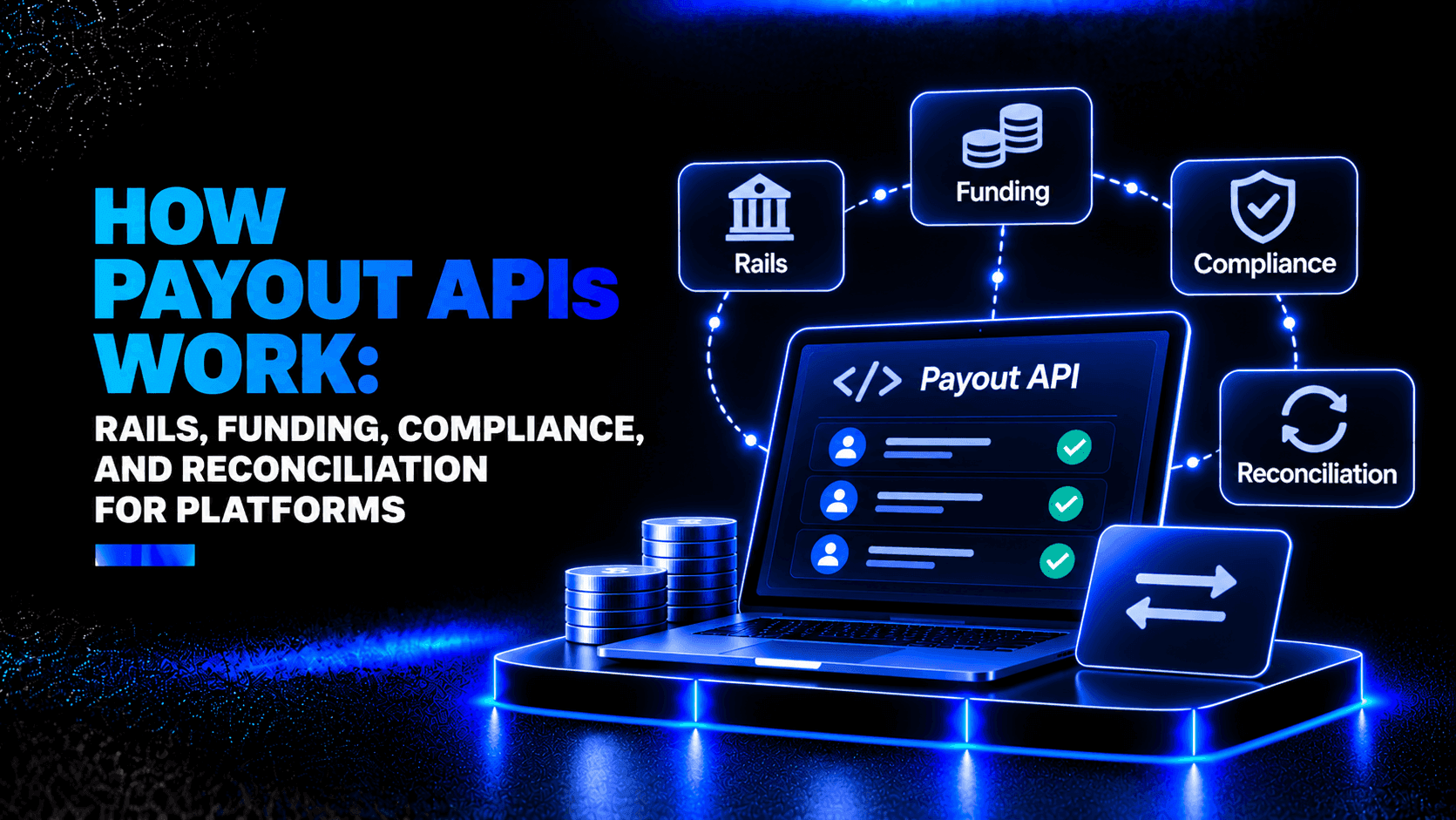
A payout API is a programmatic interface that lets a platform initiate outbound money movement to sellers, contractors, gig workers, or any third-party payee. It is not a single bank transfer command. A complete payout stack includes four coupled layers: a funding mechanism that loads money into the disbursement account, a rail selection layer that routes each transaction over ACH, RTP, wire, or card networks, a compliance layer that screens payees and collects tax documentation, and a reconciliation layer that matches initiated transactions to settled funds. Each layer adds cost and failure risk if misconfigured.
What Is a Payout API and How Is It Different from a Payment API?
A payment API handles inbound money movement. A customer pays a merchant, a cardholder funds a wallet, a buyer checks out. The platform is the receiver. A payout API inverts that: the platform is the sender, distributing funds to sellers, freelancers, insurance claimants, or affiliate partners.
The distinction matters operationally. Payment APIs operate in a pull model where the platform requests funds from a cardholder’s bank. Payout APIs operate in a push model where the platform’s ledger funds outbound transfers. That reversal changes who holds float, who bears return risk, and which compliance obligations apply.
Platforms that conflate the two typically discover the gap when a seller disputes a missed payout. The payment processor received the buyer’s funds, but the payout layer failed silently because payee bank details were invalid. The money sits in the platform’s settlement account while the seller files a support ticket. A dedicated payout API surfaces that failure as a webhook event rather than a reconciliation mystery three weeks later.
How Do Payout Rails Work?
Rail selection is the routing decision that determines how funds physically move from the platform’s account to the payee’s account. There is no universally correct rail. Each option trades speed against cost, reversibility, and geographic reach.
ACH (Automated Clearing House)
ACH is the US standard for bank-to-bank transfers. Standard ACH settles in one to two business days. Same-day ACH settles within the business day but requires submission before specific cutoff windows, and not every bank fully supports it on the receiving side. ACH is inexpensive, typically a few cents to under a dollar per transaction, but it is reversible for up to 60 days on consumer accounts, which creates return risk for platforms paying untrusted payees. ACH is the default rail for contractor payroll, insurance disbursements, and marketplace seller settlements where same-day speed is not required.
RTP and FedNow
RTP (The Clearing House’s Real-Time Payments network) and FedNow (the Federal Reserve’s instant payment rail) both settle in seconds, 24 hours a day, 365 days a year. Funds are final and irrevocable on arrival, which eliminates return risk but also eliminates the ability to reverse a fraudulent or erroneous payout. Per-transaction fees are higher than ACH, and receiving bank participation is still expanding. For gig platforms paying workers after a shift or insurance companies disbursing claims, the premium is often worth it. For a detailed look at instant payment API providers, the best instant payment APIs for FedNow and RTP breakdown covers provider capabilities and pricing.
Push-to-Card (Visa Direct, Mastercard Send)
Push-to-card routes funds directly to a debit card number rather than a bank account number. Visa Direct and Mastercard Send enable near-instant delivery to eligible debit cards. The rail is particularly useful for gig economy platforms where workers have a debit card on file but have not provided bank routing details. Per-transaction costs are generally higher than ACH, and not all debit cards are eligible. International push-to-card coverage varies significantly by country.
Wire Transfers
Wires are high-value, same-day transfers settled through the Fedwire system. They are final and irrevocable. Per-wire fees can run $15 to $35 or more on the sending side, and receiving banks often charge their own incoming wire fees. Wires are appropriate for large single-payee disbursements, not mass payouts. A marketplace sending $50 to 2,000 sellers via wire would spend more on fees than many sellers would receive.
International and Cross-Border Rails
Cross-border payouts layer FX conversion and correspondent banking on top of the domestic rail decisions. Providers like Wise Business, Airwallex, Nium, and Payoneer aggregate local payment networks in dozens of countries to deliver payouts in local currency without requiring the platform to hold accounts in each jurisdiction. FX markup is where cross-border payout costs often hide. For a full breakdown of what each provider actually charges, the cross-border payout fees comparison across Wise, Airwallex, Nium, and Payoneer details markup rates and per-payout pricing.
How Does Payout Funding Work?
Before a payout can go out, money has to be in the platform’s disbursement account. Funding mechanics determine who holds float, when funds are available, and what happens if a payout is initiated against insufficient balance.
Pre-funded Wallets
The most common structure. The platform loads funds into a wallet or virtual account held at the payout provider, then initiates payouts against that balance. This model gives the payout provider certainty that funds exist before releasing transfers. The platform bears the float cost: money sitting in the wallet earns nothing or minimal yield while waiting to be distributed. Pre-funding requirements can be substantial for high-volume platforms.
Pull-and-Push Flows
Some providers support a two-step model where the platform pulls funds from its bank account via ACH debit, waits for settlement, then releases outbound payouts. The gap between pull and push introduces settlement lag. If the inbound ACH returns (due to insufficient funds or a closed account), the payout provider may have already released the outbound transfer, creating a negative balance. Providers typically mitigate this with reserve requirements or credit facilities.
Credit-Backed Disbursement
A small number of enterprise payout providers extend intraday or multi-day credit against expected incoming settlements. The platform can pay out sellers today against receivables that will settle tomorrow. This eliminates float cost but adds credit underwriting to the vendor relationship and typically requires minimum volume commitments. Modern Treasury is a payment operations platform that helps finance teams track ledger positions and cash balances across funding structures in real time; whether a specific vendor supports credit-backed disbursement is worth confirming directly with their team, as capabilities vary by customer tier. For a broader look at how Modern Treasury compares on payment operations features, the Modern Treasury vs Increase comparison covers both platforms in detail.
What Compliance Requirements Apply to Payout APIs?
Compliance in payout flows is where the “just a bank transfer” mental model breaks down hardest. Three distinct regulatory obligations apply, and each operates on a different cadence.
Sanctions Screening (OFAC)
Before any outbound transfer, the platform must screen the payee against OFAC’s Specially Designated Nationals and Blocked Persons list and other applicable watchlists. This is not optional, and it is not a one-time check at onboarding. A payee who was clean at signup can be added to the SDN list months later. Platforms with real-time screening run a check on every payout initiation. Those relying on periodic batch screening carry the gap risk. For a detailed look at how platforms operationalize this, payout sanctions screening for OFAC compliance covers the vendor options and screening cadence decisions.
KYB and KYC on Payees
A marketplace or platform sending money to sellers is not just a software company. Depending on payment volume and business model, it may be operating as a money transmitter, which triggers Know Your Business and Know Your Customer obligations on the payee side. Collecting a business’s EIN, verifying a beneficial owner, or confirming a sole proprietor’s identity before enabling payouts is the minimum. The thresholds and requirements vary by state and by how the platform is structured legally. Getting this wrong is not a compliance technicality; it can trigger money transmitter license violations.
Tax Documentation: W-9, W-8BEN, and 1099 Filing
Any US platform paying contractors or sellers more than $600 in a calendar year must file a 1099-NEC or 1099-K, depending on the payment structure. That requires collecting a W-9 from domestic payees or a W-8BEN from foreign payees before payouts begin. Platforms that skip this step and collect documentation reactively at year-end face high failure rates: payees move, ignore requests, or provide incorrect TINs, which triggers backup withholding at 24% on future payouts. Automating W-9 and W-8BEN collection at onboarding is not optional for any platform with meaningful payout volume. The payee tax compliance tools for W-9, W-8BEN, and 1099 automation overview covers the vendor options for this.
What Does Payout Reconciliation Actually Involve?
Reconciliation is matching what the platform’s ledger says should have happened to what the bank and network say actually happened. For payout operations, that means four specific matching problems.
The Four-Layer Payout Reconciliation Problem
Consider an illustrative scenario, not based on published industry data but representative of the reconciliation complexity platforms encounter at this volume: a Series A marketplace initiates 3,000 ACH payouts on Monday. By Thursday, the majority have settled, a small number are still pending, and some have returned with reason codes covering invalid account numbers, insufficient funds at the payee’s bank, and closed accounts. The platform’s ledger shows 3,000 debits. The bank statement shows net settlement amounts that do not map one-to-one to individual transactions because some processors batch-settle. The FX conversion on the international payouts added rounding differences. And a handful of payees have contacted support claiming they did not receive funds.
Reconciling this requires matching on four layers simultaneously: the initiation record in the platform’s database, the provider’s transaction-level ledger, the bank statement entries, and the payee-reported receipt status. Most platforms underestimate this problem early on, then discover it at scale when the monthly close takes a week instead of a day. Investing in dedicated payment reconciliation software early is significantly cheaper than building a manual matching process that fails at 10x volume.
Return Handling
ACH returns are the most common reconciliation complication. A return code like R01 (insufficient funds) or R03 (no account/unable to locate account) arrives hours or days after the original debit posts. The platform must reverse the payout in its internal ledger, notify the payee, and decide whether to retry. Retry logic matters: retrying an R03 will fail again and waste a transaction fee. Retrying an R01 may succeed if the payee funded their account. The payout API vendor’s webhook schema determines how cleanly this data flows into the platform’s systems.
FX Reconciliation
Cross-border payouts introduce currency conversion between initiation and settlement. The FX rate applied at initiation and the rate reflected in the settlement statement often differ, sometimes by several basis points, sometimes more, depending on the provider’s rate lock mechanics and how long the transaction takes to settle. Platforms that do not explicitly track the rate applied per transaction will find their payout ledger and bank statement diverging in ways that are difficult to explain to auditors. At high payout volumes, these differences accumulate into a real margin leak, not just a bookkeeping nuisance. The hidden costs killing fintech SaaS margins covers how FX rounding and similar silent costs compound across payment operations.
Payout API vs Payment API: A Direct Comparison
| Dimension | Payment API (Inbound) | Payout API (Outbound) |
|---|---|---|
| Money direction | Customer to platform | Platform to payee |
| Primary rail types | Card networks, ACH debit, bank redirect | ACH credit, RTP, wire, push-to-card, SWIFT |
| Float holder | Payment processor until settlement | Platform (pre-funded) or provider (credit-backed) |
| Fraud liability | Chargeback risk to platform | Return and unauthorized transfer risk |
| Compliance triggers | PCI DSS, Reg E (for consumer ACH) | OFAC screening, KYB/KYC, 1099/W-9 collection, MTL |
| Reconciliation complexity | Moderate (chargebacks add complexity) | High (returns, FX rounding, batch netting) |
| Speed options | Auth instant, settlement T+1 to T+2 | ACH T+1, RTP/FedNow instant, wire same-day |
The FintechSpecs Payout Stack Audit: Four Checks Before You Build or Buy
When evaluating a payout API vendor or designing an internal payout stack, most teams focus on pricing and rail coverage. Those matter, but they are the last things to evaluate, not the first. The FintechSpecs Payout Stack Audit runs four prior checks.
Check 1: Funding model fit. Does the vendor’s funding model match your cash flow pattern? A platform that collects weekly from buyers and pays sellers daily needs a provider that can handle intraday float or extend credit, not one that requires a 5-day pre-funding cycle.
Check 2: Return handling depth. Ask how many ACH return codes the API surfaces as distinct webhook events. A vendor that maps all returns to a single “failed” status forces your engineering team to build secondary lookup logic. A vendor that passes through granular NACHA return codes lets you build intelligent retry logic at the application layer.
Check 3: Compliance handoff clarity. Who is responsible for OFAC screening: the vendor or the platform? Some payout APIs screen on your behalf and block flagged payees automatically. Others provide a lookup API and require the platform to implement the block logic. Misunderstanding this creates regulatory exposure.
Check 4: Reconciliation data format. Request a sample settlement report before signing. If the report does not include a unique transaction identifier that maps to your initiation record, you are committing to a reconciliation process that will break at scale. This is a contractual data requirement, not an engineering preference.
Which Platforms Handle Payout APIs?
Several vendors cover the full payout stack. Stripe Connect handles split payments and seller payouts natively for marketplaces, with built-in KYC, tax document collection, and multi-rail disbursement. Tipalti and Trolley focus on mass payee onboarding, tax compliance, and multi-currency payouts for contractor and partner networks. Adyen for Platforms covers split settlements and payouts for large marketplace operators with global volume. Dwolla focuses on ACH-native payout infrastructure for US platforms. For a ranked comparison of these and others, the best outbound payment and payout APIs for B2B SaaS covers capabilities, pricing structures, and which vendor fits which platform profile.
For marketplace-specific payout needs covering split payments and seller onboarding, the payout APIs for online marketplaces goes deeper on how escrow, split logic, and seller verification interact at the API layer.
Frequently Asked Questions
What is a payout API?
A payout API is a programmatic interface that lets a software platform initiate outbound money transfers to sellers, contractors, gig workers, or other third-party payees. It handles rail selection (ACH, RTP, wire, push-to-card), payee verification, sanctions screening, tax document collection, and settlement reconciliation. It is distinct from a payment API, which handles inbound money movement from customers to the platform.
What is the difference between a payout API and a payment API?
A payment API moves money from a customer to the platform (inbound). A payout API moves money from the platform to a payee (outbound). The compliance requirements differ significantly: payment APIs trigger PCI DSS obligations, while payout APIs trigger OFAC screening, KYB/KYC on payees, 1099 filing obligations, and in some cases, money transmitter licensing. The reconciliation process also differs because payout returns are more complex than payment chargebacks.
How do platforms pay out sellers?
Platforms pay out sellers by collecting buyer payments into a held balance or sub-ledger, then initiating outbound transfers to seller bank accounts or debit cards on a scheduled or triggered basis. The payout API routes each transfer over the appropriate rail (ACH for standard payouts, RTP for instant, push-to-card for debit delivery), applies any applicable splits or fee deductions, and posts the result to the platform’s reconciliation ledger. Payee bank account details are verified at onboarding to reduce return rates.
What is payout reconciliation?
Payout reconciliation is the process of matching each initiated outbound transfer to its settled state in the bank statement, handling returned or failed transactions, and resolving any discrepancies between the platform’s internal ledger and the provider’s settlement data. For cross-border payouts, it also includes reconciling FX rates applied at initiation against rates reflected in settlement. Unreconciled payouts create accounting gaps that compound at month-end close.
What rails are used for payouts?
The primary payout rails in the US are ACH (standard 1-2 day settlement, inexpensive, reversible), same-day ACH (same business day, higher per-transaction cost), RTP via The Clearing House (instant, irrevocable, 24/7), FedNow (instant, Federal Reserve-operated, expanding bank participation), Fedwire (same-day high-value, expensive per transfer), and push-to-card via Visa Direct or Mastercard Send (near-instant to eligible debit cards). International payouts add local clearing networks, SWIFT, and FX conversion layers.
Do platforms need a money transmitter license to use a payout API?
It depends on the platform’s business model and the payout vendor’s structure. If the platform holds customer funds before disbursing them, it may be acting as a money transmitter and need state-level MTLs. Many payout API vendors structure their products so the licensed entity sits between the platform and the banking rails, allowing the platform to operate under the vendor’s licenses. This needs to be confirmed in writing with the vendor and reviewed by a payments attorney, not assumed from marketing materials.
What causes payout failures?
The most common causes of payout failures are invalid or closed bank account numbers, mismatched account holder names, insufficient funds in the payee’s account at settlement time (for ACH), OFAC screening holds, and pre-funding shortfalls on the platform’s side. ACH return codes specify the failure reason, and a good payout API surfaces these as distinct webhook events rather than a generic failure status. Retry logic should be conditional on the return code, not automatic.
How does 1099 reporting work for payout platforms?
US platforms that pay sellers or contractors via payout API must collect a W-9 (for domestic payees) or W-8BEN (for foreign payees) before disbursing funds. If a domestic payee receives more than $600 in a calendar year, the platform files a 1099-NEC or 1099-K with the IRS and sends a copy to the payee. Failure to collect TINs upfront triggers backup withholding at 24% on subsequent payouts, which is operationally disruptive. Most payout-focused vendors provide hosted tax document collection flows to automate this at payee onboarding.
The Part Most Platform Teams Learn Too Late
Payout infrastructure gets specced like a feature and operates like a bank. The engineering estimate covers the API integration. It rarely covers the operations model: who handles failed payee onboarding, who reviews OFAC screening queues, who investigates a settlement discrepancy at 11pm when a seller is threatening to churn. Those are not edge cases at scale. They are weekly operations.
The platforms that build payout infrastructure well treat the compliance and reconciliation layers as first-class requirements from day one, not retrofits after launch. Choosing a payout API vendor is partly a technology decision and partly a decision about which operational burden you are willing to own versus outsource. A vendor that handles OFAC screening, 1099 collection, and return code routing programmatically costs more per transaction than a bare-bones ACH API. That premium is the price of not building a payments operations team.
Rail choice, funding structure, compliance scope, and reconciliation data quality are each independent variables with compounding effects on margin and failure rate. Getting one right and ignoring the others produces a payout stack that works in demo and breaks in production.