
TLDR
- A daily cash forecast tells you where money is going. Your actual cash position tells you what you have right now, by entity, across every bank account.
- Trovata pulls live bank data via direct bank API connections and delivers intraday balance visibility without manual imports, making it the stronger choice for US-headquartered companies with multi-bank setups at two to ten banking relationships.
- Nomentia serves treasury teams that need a single platform spanning cash positioning, payments, netting, and hedging, particularly for European multi-entity structures where SWIFT connectivity and local bank coverage matter more than API freshness speed.
- Balance freshness, entity rollup granularity, and workflow routing between treasury and accounting determine which platform actually solves the daily positioning problem. Feature counts do not.
- Neither platform publishes public pricing as of the time of publication. Both require a demo and custom quote, so total cost of ownership depends on entity count, bank count, and module selection.
Trovata vs Nomentia cash positioning comes down to a structural choice, not a feature checklist. Trovata is better for US-centric treasury teams that need intraday balance freshness from direct bank API connections and want to run daily cash positioning across multiple banks without manual data handling. Nomentia is better for European or globally distributed treasury teams that need a broader workflow suite covering payments, netting, and hedging alongside cash positioning, and whose banking relationships are better served by SWIFT and host-to-host connectivity.
Why Cash Forecasts Do Not Tell You What You Have Today
Most finance teams conflate two distinct functions: knowing where cash will be and knowing where it is right now. A forecast projects next week’s balances based on payables, receivables, and historical patterns. A daily cash position is a point-in-time snapshot of confirmed, available balances across every account, every entity, every bank.
The gap between those two things matters most on days when it matters most. A wire deadline, a margin call, an unexpected payroll debit, an intercompany settlement. At that moment, a forecast is irrelevant. What you need is a confirmed balance, by entity, that is current as of the last bank data refresh.
Balance freshness, entity rollup structure, and workflow routing are the three variables that separate a genuinely usable daily cash position from a dashboard that looks good in a demo. That is the frame this comparison uses. If you are evaluating Trovata and Nomentia specifically for current-day positioning, those three dimensions are where the real differences show up.
How Does Trovata Handle Intraday Balance Freshness?
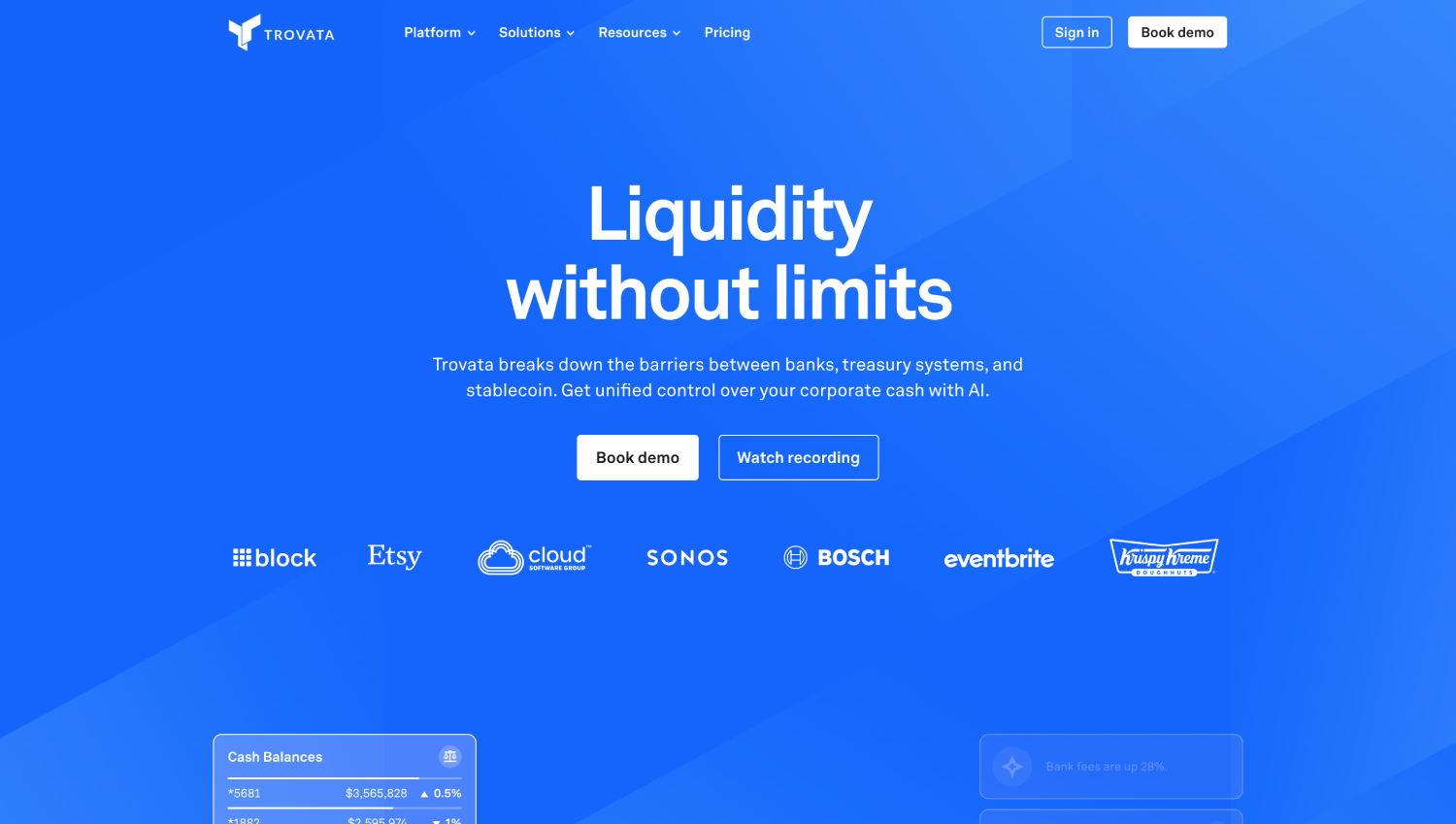
Trovata connects to banks directly via bank APIs rather than through SWIFT or host-to-host file transfers. Its banking partners include Bank of America, JPMorgan Chase, Wells Fargo, Citibank, and others in the US and internationally, pulling balance and transaction data on a schedule that reflects each bank’s API refresh cadence. For many major US bank connections, that means multiple intraday updates rather than a single end-of-day file.
The practical outcome is that treasury teams do not need to log into each bank’s portal, export a file, and import it into a spreadsheet or TMS. Trovata’s data pipeline handles that automatically. When a transaction posts at 10 a.m., the balance reflected in Trovata updates within the next data pull window rather than waiting for end-of-day SWIFT MT940 or BAI2 file delivery.
Trovata also processes BAI2 and MT940 files for banks that do not support API connectivity, so it accommodates mixed bank environments. Teams running three API-connected banks and two file-based community banks can position all of them in a single view. The API-connected accounts will simply show fresher data than the file-based ones, which is a meaningful distinction when you are deciding which account to draw from before a noon wire cutoff.
How Does Nomentia Handle Intraday Balance Freshness?

Nomentia is a European-origin treasury platform that covers cash management, payments, bank connectivity, netting, and hedging within a single system. Its bank connectivity model relies primarily on SWIFT, host-to-host file transfers, and local bank integration methods common across European and Nordic markets. MT940, MT942 (intraday statements), and CAMT.053/054 formats are all supported, and Nomentia’s intraday positioning can consume MT942 data where banks provide it.
MT942 intraday balance messages are a standard that many European banks support, but their delivery frequency is bank-dependent. Some banks push MT942 files every hour; others send them twice a day. This means intraday freshness in Nomentia is real, but the ceiling on how fresh your data gets depends on your banks and their SWIFT messaging schedules rather than on-demand API pulls.
For treasury teams whose banks are predominantly European or who already operate within a SWIFT connectivity model, this is not a disadvantage in practice. The MT942 cadence matches what their banks actually offer. For teams expecting always-on intraday polling of US bank APIs, the SWIFT file model is a structural difference worth understanding before shortlisting.
How Do the Two Platforms Handle Entity Rollup for Daily Cash Positioning?
Entity rollup is where multi-entity treasury teams often hit the wall. A platform can aggregate balances across accounts. The harder task is aggregating them correctly across legal entities, in multiple currencies, with the right intercompany eliminations and position hierarchies for how your CFO actually wants to see the number.
Trovata structures cash positioning around a customizable entity hierarchy. Teams map bank accounts to legal entities, then group entities into regional or functional buckets for rollup. The resulting position view can show global cash, then move to region, then to entity, then to account. Currency conversion for the rolled-up view uses rates that Trovata pulls from public FX sources. The workflow is designed around the idea that a VP of Treasury wants to see one consolidated number at the top and can click down when a discrepancy appears.
Nomentia offers entity-level cash positioning as part of its cash management module, with structure that supports complex multi-entity, multi-currency corporate groups. Given its heritage serving large European corporations with in-house banking and netting center structures, Nomentia’s entity model is built for scenarios where intercompany flows, pooling, and netting must be reflected in the position rather than just gross bank balances. That depth is a genuine advantage for treasury teams that run physical or notional pooling arrangements.
Intraday Balance Freshness, Entity Rollup, and Workflow: Side-by-Side
| Dimension | Trovata | Nomentia |
|---|---|---|
| Primary connectivity model | Direct bank APIs (BAI2/MT940 fallback) | SWIFT, host-to-host, local bank formats (MT940, MT942, CAMT) |
| Intraday balance updates | Multiple intraday pulls via API for supported banks | Intraday via MT942 where banks provide it; cadence is bank-driven |
| US bank coverage | Strong; direct API connections with major US banks | Available via SWIFT; less native API depth for US banks |
| European bank coverage | Growing; some direct connections, file-based for others | Strong; built for European and Nordic banking infrastructure |
| Entity rollup | Customizable hierarchy; supports multi-entity, multi-currency | Deep multi-entity support; built for pooling and netting structures |
| Intercompany / pooling support | Not purpose-built for in-house banking or netting | Native support for notional and physical pooling, netting center |
| Workflow routing (treasury to accounting) | Tagging, categorization, and export workflows; Erp integrations | End-to-end payment workflow, approval chains, and accounting integration |
| Adjacent modules | Forecasting, reporting, bank fee analysis | Payments, FX hedging, netting, guarantees, in-house banking |
| Target buyer | US-centric treasury, seed to large-cap; strong mid-market fit | European or globally distributed treasury; mid to large enterprise |
| Pricing | Not publicly disclosed; custom quote required | Not publicly disclosed; custom quote required |
What Is the FintechSpecs Position Reliability Test?
The FintechSpecs Position Reliability Test is a four-check framework for evaluating whether a cash positioning tool actually delivers a reliable daily number. Generic feature lists do not surface these gaps. Apply it before shortlisting any platform.
Check 1: Confirm balance age at the moment of decision. Ask the vendor what the maximum lag is between a transaction posting at a bank and that balance appearing in the platform, for each of your specific banks. For API-connected banks in Trovata, this is a function of the bank’s API refresh schedule. For SWIFT-based connections in Nomentia, it is the MT942 delivery schedule. Get the actual answer for your bank list, not a generalized claim.
Check 2: Verify entity mapping fidelity. Build a test scenario using your actual legal entity structure. Run a position that includes at least one intercompany payable outstanding. See whether the platform presents gross balances or net-of-intercompany balances by default, and whether you can toggle between them. If the platform cannot show both views, your rolled-up number is structurally misleading for entities with high intercompany volumes.
Check 3: Test same-day workflow from position to payment. Start with an identified shortfall in the morning position. Trace every step required to initiate a funding transfer, get it approved, and execute it, within the platform. Count the clicks and the people. A platform that surfaces the gap but routes approval through email is not a closed-loop system. Nomentia’s integrated payment workflow closes that loop natively. Trovata’s workflow depends more on how you have configured your ERP and banking integrations.
Check 4: Audit the FX rate source and timing for multi-currency rollups. Ask where the FX rates come from, how often they update, and whether you can lock in a snapshot rate for a specific time each morning. A position calculated at 8 a.m. using yesterday’s closing rates and another calculated at the same moment using live mid-market rates will show different numbers. For treasury teams with material multi-currency exposure, this discrepancy is not cosmetic.
Which Companies Are Best Suited for Trovata vs Nomentia?
A US-based Series B or Series C company with four to eight bank accounts at major US banks and a treasury team of one to three people is Trovata’s natural fit. The API-first connectivity model means less implementation overhead than a traditional SWIFT-based TMS, and the forecasting and reporting features address the full scope of what a lean treasury team needs daily. If you have an existing relationship with one of Trovata’s directly connected bank partners, the time-to-value on positioning is measurably shorter than a SWIFT onboarding process.
A corporate treasury team managing a European or globally distributed entity structure, running physical or notional pooling, and needing payment approval workflows and FX hedging in the same system is Nomentia’s natural fit. Nomentia is not trying to be a lightweight tool. It is a full treasury management system with cash positioning as one pillar among several. Buying it for daily positioning alone and ignoring the adjacent modules is a mismatch that will generate implementation cost without proportional value. If you need those adjacent modules, the depth becomes an asset rather than overhead.
Consider a hypothetical mid-market manufacturing company with nine legal entities across Germany, the Netherlands, and the UK running a notional pool through a European cash management bank. That company’s daily position depends on knowing gross bank balances by entity plus the net pool position. Nomentia’s pooling support and SWIFT connectivity is purpose-built for that structure. Trovata’s API model would surface the gross bank balances faster but would require manual or ERP-driven adjustment to reflect the pool. That is a meaningful difference in the operational burden on the treasury team every single morning.
How Does Workflow Routing Differ Between the Two Platforms?
Getting the position right is only half the job. What happens after a shortfall is identified determines whether the platform actually reduces risk or just surfaces it. This is where the workflow architecture diverges most sharply between Trovata and Nomentia.
Trovata’s workflow is oriented around categorization, tagging, and visibility. Teams can annotate transactions, run variance commentary, and push reports to stakeholders. Payment execution is not native inside Trovata. Teams typically act on a Trovata-identified shortfall by going to their bank portal or ERP to initiate a transfer. For treasury teams with straightforward funding needs, this is acceptable because the positioning work is the hard part. For teams with complex approval chains or multi-entity funding decisions, the lack of a native payment workflow means more handoff risk.
Nomentia includes payment initiation, payment approval workflows, and bank transmission natively. A treasury analyst who identifies a shortfall in the morning position can initiate a funding transfer, route it through an approval chain, and transmit it to the bank from within the same platform. The audit trail runs from position identification through payment execution without leaving the system. For companies where compliance and control over payment authorization is a board-level concern, that closed-loop architecture carries real weight. This matters particularly for finance teams already thinking about accounts payable automation tools that connect approval workflows to payment execution.
What Should You Ask Both Vendors Before Signing?
Both Trovata and Nomentia require custom quotes and sales conversations before you see pricing or implementation details. These seven questions will cut through demo theater and surface the real constraints for your use case.
- For each of my specific banks, what is the actual data refresh cadence for intraday balances, and can you show me that refresh history in a live environment?
- What is the exact implementation timeline from signed contract to live daily positioning, including any bank onboarding steps that are outside your control?
- Can my entity hierarchy be changed after go-live without a professional services engagement, and who controls that configuration?
- How are FX rates sourced for the multi-currency position rollup, and can I set a fixed snapshot time each day?
- What does a confirmed intercompany payable look like in the position view, and can I toggle between gross and net-of-intercompany?
- If a bank API or SWIFT connection drops for four hours midday, what does the platform show, and what is the notification mechanism?
- What ERP and accounting integrations are live today (not on the roadmap), and what does that integration cover beyond a journal export?
Procurement teams evaluating both platforms alongside a broader treasury management system RFP process should also read FintechSpecs’ coverage of treasury management system RFP questions and scoring matrices before entering final negotiations.
How Do Trovata and Nomentia Compare on Implementation Complexity?
Trovata’s direct bank API model generally produces faster time-to-live-data for US bank connections than a traditional SWIFT onboarding process. SWIFT connectivity requires a Service Bureau or direct SWIFT membership, BIC registration, and bilateral agreements with each bank. That process typically takes weeks to months depending on the bank’s onboarding queue. Trovata’s direct API connections with major US banks are pre-built, which shifts the implementation work from bank connectivity to entity mapping and configuration.
Nomentia’s implementation reflects the breadth of the platform. A company buying Nomentia’s full suite, including cash management, payments, and hedging, is running a larger implementation project than a company deploying Trovata for positioning and forecasting. Nomentia serves enterprise treasury teams that often have dedicated IT resources and external implementation partners for a reason. Teams that have been through the experience of building out treasury technology infrastructure will recognize the tradeoffs here, particularly around the hidden costs that come with complex multi-module configurations.
The relevant risk for each platform is different. With Trovata, the risk is that a specific bank you rely on is not yet API-connected and you are running file-based imports for that account longer than expected. With Nomentia, the risk is implementation scope creep and a longer runway to realize positioning value because payment and connectivity modules consume early project bandwidth. Either risk is manageable with clear contract terms and a phased implementation plan.
Frequently Asked Questions
Does Trovata support intraday cash positioning or only end-of-day balances?
Trovata supports intraday balance updates for banks where it maintains direct API connections. For those banks, balances refresh multiple times throughout the day as the bank’s API delivers updated data, rather than waiting for a single end-of-day BAI2 or MT940 file. For banks not yet on a direct API connection, Trovata falls back to BAI2 or MT940 file processing, which is typically end-of-day. The specific intraday capability depends on which of your banks are covered by Trovata’s current API bank partnerships.
Can Nomentia show cash position by legal entity across multiple currencies?
Nomentia supports multi-entity, multi-currency cash positioning as a core function of its cash management module. The platform is built for complex corporate structures with subsidiary entities across multiple countries and currencies. It can present a rolled-up position in a base currency using configurable FX rates, while also showing entity-level positions in local currency. For companies running notional or physical pooling, Nomentia supports pool-aware positioning that reflects net positions rather than gross bank balances alone.
Which platform is better for a company with banks in both the US and Europe?
It depends on where your banking density sits. If the majority of your balances and your most time-sensitive daily funding decisions are in US accounts, Trovata’s API connectivity with major US banks gives you fresher intraday data for the accounts that matter most. If your European accounts are equally material and your banks support SWIFT MT942 intraday statements, Nomentia covers both regions within a single system without requiring separate connectivity infrastructure. Mixed environments sometimes use Trovata for US accounts and a separate SWIFT-connected tool for European accounts, though that creates a consolidation problem the team then has to solve manually.
Do either Trovata or Nomentia publish pricing?
Neither Trovata nor Nomentia publicly discloses pricing as of the time of publication. Both platforms operate on custom quotes based on factors including the number of legal entities, bank account count, number of users, and which modules are included in the contract. Any pricing figure circulating in secondary sources should be treated as outdated or unverified. The only reliable way to get a number is through a direct sales conversation with each vendor.
What is the difference between a cash forecast and a daily cash position?
A cash forecast projects future balances based on expected inflows, outflows, and patterns over days, weeks, or months ahead. A daily cash position is a confirmed, point-in-time view of actual bank balances across accounts and entities as of the most recent data refresh. The position answers the question “what do I have right now?” A forecast answers the question “what will I have on Thursday?” Both are necessary for effective treasury management, but they draw on different data sources and serve different operational decisions. Confusing the two leads teams to make funding decisions based on projected rather than confirmed balances.
Can Trovata initiate payments directly from the platform?
Trovata is primarily a cash visibility and forecasting platform rather than a payment initiation system. Payment execution is not a core native function, based on how the product is currently positioned and what Trovata’s own product pages describe. Teams using Trovata for daily cash positioning typically act on the information by initiating payments through their bank portals or ERP systems. This is a meaningful architectural difference from platforms like Nomentia, which include native payment initiation and approval workflow as part of the treasury system. Teams for whom the gap between “identifying a shortfall” and “initiating a funding transfer” is a friction point should weight this difference heavily. Finance teams exploring related workflow automation can find additional context in FintechSpecs’ coverage of accounts payable automation tools.
How does entity rollup work in Trovata for a company with 15 subsidiaries?
Trovata allows users to build a customizable entity hierarchy, mapping bank accounts to legal entities and grouping entities into regions or functional categories for rollup. A company with 15 subsidiaries can configure the hierarchy to show a global consolidated position at the top, then move down by region or entity. Currency translation for the consolidated view uses FX rates pulled by the platform. The configuration is managed within Trovata’s interface rather than requiring external professional services for every change, which is an advantage for treasury teams that restructure frequently or add entities as they grow.
Trovata vs Nomentia: Which Platform Actually Solves the Daily Positioning Problem?
The daily cash position problem is narrower than it looks. Getting the number right requires three things happening reliably every morning: fresh data from every bank account, a rollup structure that maps to your legal entity reality, and a workflow that takes the team from position to action without leaving the platform. No single platform does all three perfectly for every treasury team, and the tradeoffs are structural rather than cosmetic.
Trovata earns its place for treasury teams whose banks are API-connected, whose entity structure is not dominated by intercompany pooling complexity, and whose daily workflow does not require payment initiation inside the treasury tool. The freshness advantage from direct bank APIs is real for teams with major US bank relationships, and the lighter implementation footprint matters for companies that cannot staff a six-month TMS implementation. Teams evaluating their broader treasury technology stack alongside cash positioning should also consider how Trovata compares to Kyriba for a full TMS evaluation, and how the financial consolidation requirements of multi-entity companies factor into the tool selection, as covered in FintechSpecs’ analysis of financial consolidation software for multi-entity companies.
Nomentia is the stronger answer when the treasury team needs daily positioning and payments and hedging and netting to coexist in one audit trail, and when the banking infrastructure runs on SWIFT or European local connectivity. The depth that makes Nomentia feel heavy for a lean US startup is exactly what makes it the right answer for a European treasury team managing a pooling structure across nine entities. The question to settle before shortlisting is not which platform has more features. It is which platform’s connectivity model matches your bank list and which workflow architecture matches what your team actually does after the position is confirmed.