
- ChartMogul and Baremetrics are not interchangeable. They diverge on billing-stack compatibility, dunning functionality, and how they handle trial-to-paid conversion tracking.
- Baremetrics bundles revenue recovery (dunning) and cancellation insights natively. ChartMogul does not, making it a pure analytics product.
- ChartMogul handles multi-source billing better, connecting Stripe, Chargebee, Recurly, Paddle, and custom data sources in one view. Baremetrics is strongest for Stripe-only stacks.
- For a Stripe-only startup that wants dunning plus analytics without buying a second tool, Baremetrics wins on simplicity. For a company with multiple billing systems or investor-grade reporting needs, ChartMogul is the clearer choice.
- Pricing is closer than most founders expect. The right tool is determined by your billing stack and whether you need recovery built in, not by sticker price alone.
ChartMogul is the stronger choice for companies with multiple data sources, deep segmentation needs, or investor reporting requirements. Baremetrics fits Stripe-native stacks that want analytics and failed-payment recovery in one product. Both compute the same core SaaS metrics, but they diverge sharply on billing integrations, dunning, and how accurately each handles edge cases like upgrades, pauses, and trials. Picking the cheaper option without checking those differences typically means buying the wrong tool.
Why Most Founders Get This Decision Wrong
The typical framing is: “Both show MRR, churn, and LTV. Pick whichever is cheaper.” That logic holds until you hit a discrepancy between your billing system and your dashboard. A metric that looks right but is computed differently than what your investors expect creates problems at the worst time, usually during a fundraise or a board meeting.
Community feedback from SaaS operators on Reddit indicates that Baremetrics is notably conservative in how it computes revenue figures. That conservatism matters because overestimating MRR inflates LTV projections and produces a false read on retention. ChartMogul takes a more configurable approach to revenue recognition, which gives finance teams more control but requires more deliberate setup.
The second thing founders miss: Baremetrics is not just an analytics tool. It ships with dunning (automated failed-payment retry logic) and cancellation flow tools baked into the platform. ChartMogul does not. If you need dunning, you either pay for Baremetrics or you buy a separate tool like Stunning or ProfitWell Retain. That comparison belongs in your total cost calculation, not just the line-item price.
How Do ChartMogul and Baremetrics Connect to Your Billing Stack?
Billing-stack fit is the first filter. Get this wrong and every metric the tool produces is suspect.
ChartMogul integrations
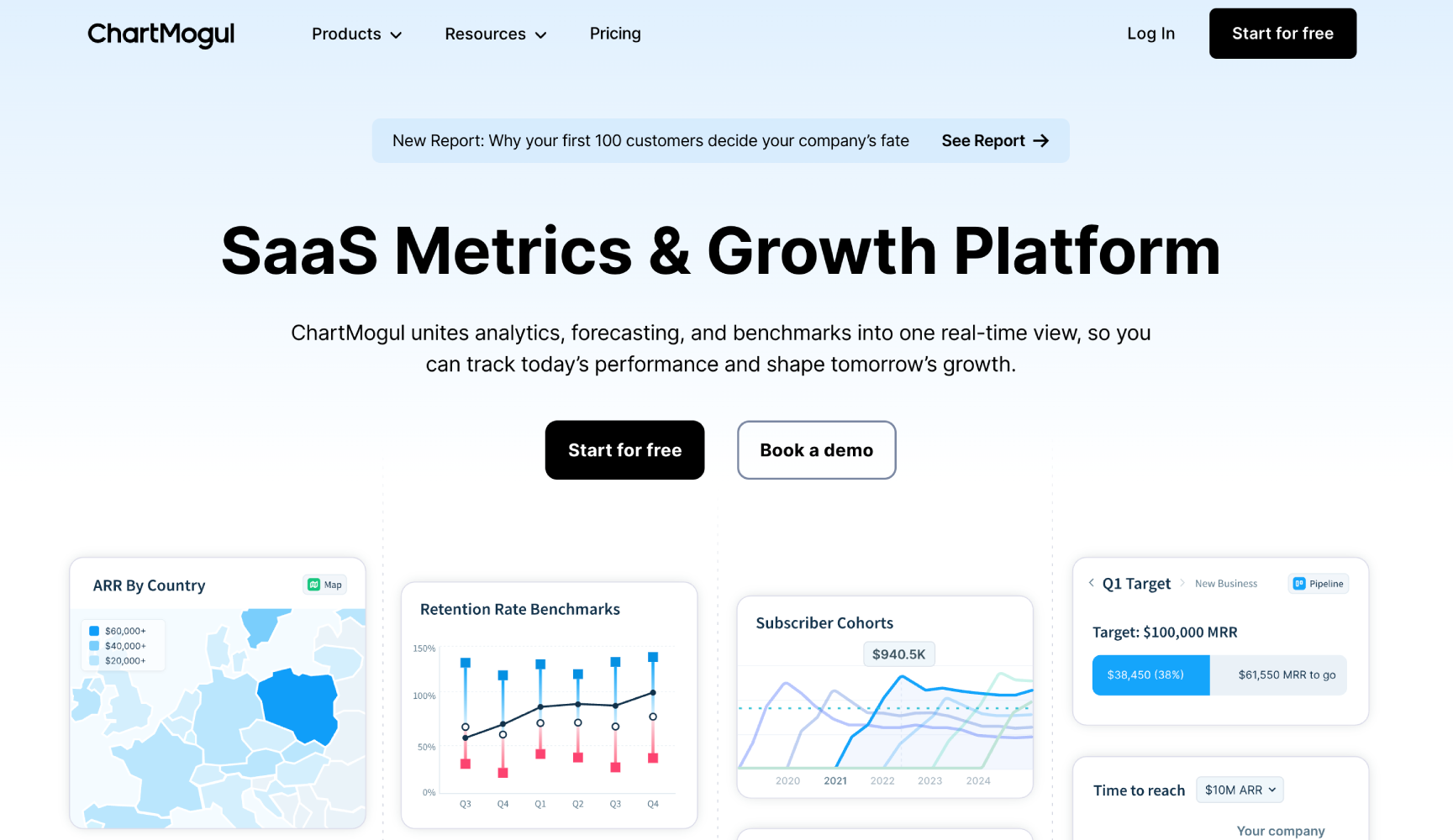
ChartMogul connects natively to Stripe, Chargebee, Recurly, Paddle, Braintree, and PayPal. It also accepts data via its Import API, so teams running custom billing systems or homegrown invoicing logic can push data in and get the same analytics output. This makes ChartMogul the practical choice for any company running more than one billing system or planning to migrate between processors. If your stack is even slightly complex, this flexibility matters.
Baremetrics integrations
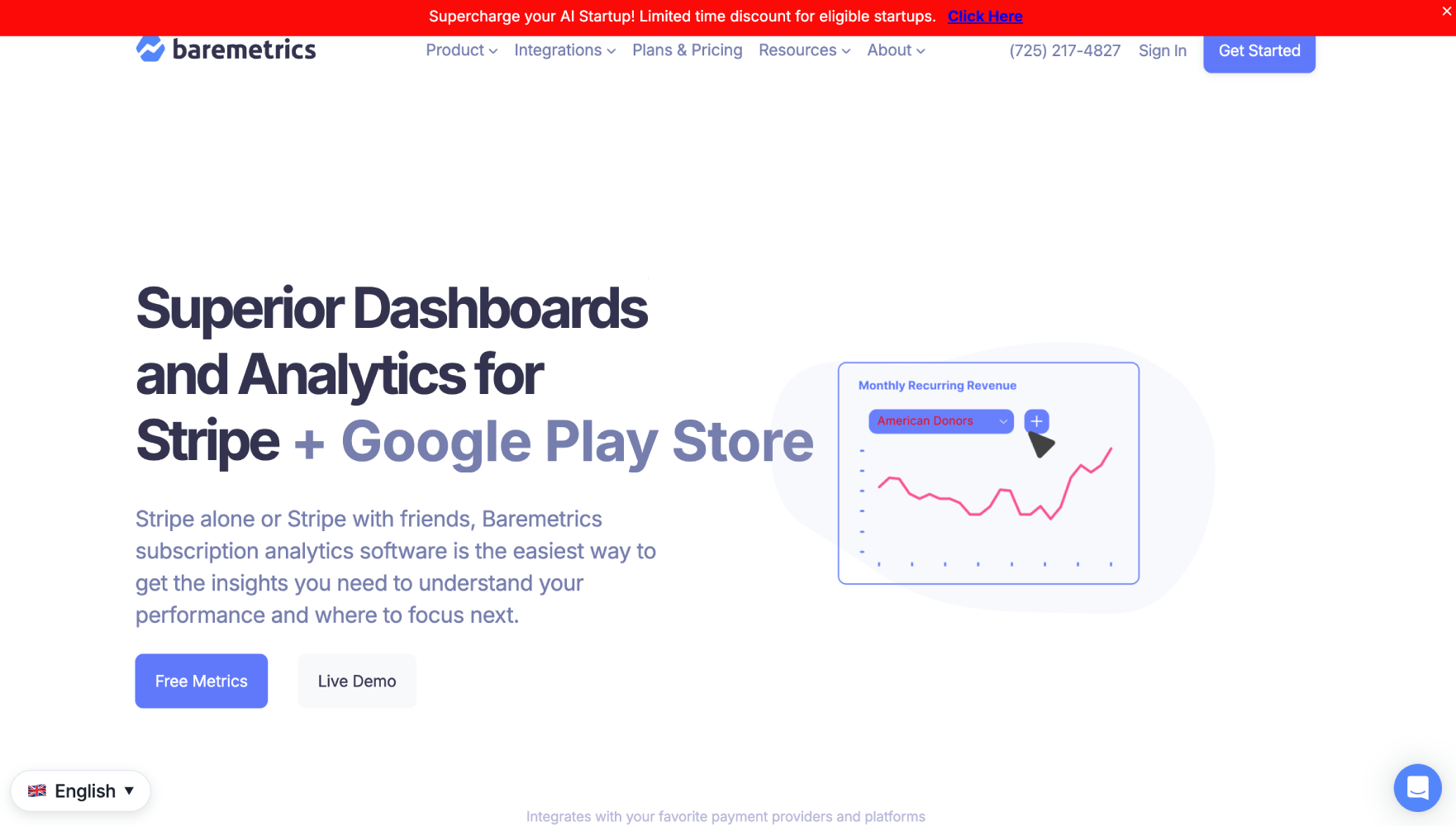
Baremetrics connects to Stripe, Braintree, Recurly, and Paddle. It added Chargebee support, though Stripe remains the integration that works most reliably in practice. The Import API exists but is less documented than ChartMogul’s. For a pure Stripe shop, Baremetrics connects in minutes and surfaces usable dashboards almost immediately. That speed of setup is a genuine advantage for early-stage teams.
If you are deciding which payment infrastructure to build on before locking in an analytics tool, the merchant of record comparison for B2B SaaS founders on FintechSpecs covers the billing architecture tradeoffs in detail.
Which Tool Computes SaaS Metrics More Accurately?
Both tools calculate MRR, ARR, churn rate, LTV, ARPU, and net revenue retention. The difference is in how they handle the messy middle: plan upgrades mid-cycle, paused subscriptions, free trials converting to paid, and failed payments that eventually recover.
Trial-to-paid tracking
ChartMogul tracks trial conversions at the subscription level, letting you segment conversion rate by plan, acquisition source, or cohort. Baremetrics shows trial data but with less segmentation depth by default. For product-led growth companies where trial conversion is a primary lever, ChartMogul’s segmentation tools give you a more granular view.
Churn accuracy
Churn calculation methodology is where tools quietly diverge. ChartMogul gives operators control over how cancelled-then-reactivated subscriptions are counted, which prevents double-counting churned revenue. Baremetrics applies a more conservative default methodology, which some teams prefer for its simplicity and others find limiting. Neither approach is wrong, but they produce different numbers from identical data, which is worth knowing before you start comparing metrics across tools or periods.
Multi-currency handling
ChartMogul converts multi-currency revenue using configurable exchange rate logic. Baremetrics handles this more simply. For companies with meaningful revenue outside USD, ChartMogul’s approach is less likely to produce exchange-rate artifacts in MRR trends.
Does Baremetrics Do Dunning and ChartMogul Does Not?
Yes, that is correct, and it has real budget implications.
Baremetrics includes Recover, its dunning module, as part of the platform. Recover handles smart payment retry scheduling, customer-facing payment update pages, and automated email sequences for failed charges. For a Stripe-native SaaS recovering even a fraction of failed payments, this functionality pays for itself quickly. The module does not require any separate billing or configuration outside the Baremetrics dashboard.
ChartMogul does not include dunning. If you need recovery tooling alongside ChartMogul, you are buying a second product. Dedicated dunning tools like Stunning or ProfitWell Retain add cost and integration work. That said, ChartMogul pairs cleanly with any dunning tool because its analytics remain independent of recovery logic, which some finance teams prefer for separation-of-concerns reasons.
For teams that want to go deep on dunning options regardless of which analytics tool they choose, the best dunning tools for SaaS payments and failed renewals comparison covers 12 options with pricing.
ChartMogul vs Baremetrics Pricing: What You Actually Pay
Pricing for both tools scales with tracked monthly recurring revenue, not seat count. The structure is similar. The specifics differ.
| Plan | ChartMogul | Baremetrics |
|---|---|---|
| Free / Entry | Free up to $10K MRR (limited features) | No permanent free tier |
| Starting paid tier | See ChartMogul pricing page for current figures | See Baremetrics pricing page for current figures |
| Mid-tier (with more MRR) | Scales with MRR; multiple plan tiers | Scales with MRR; Recover add-on or bundled |
| Dunning included | No | Yes (Recover module) |
| Custom/enterprise | Yes, contact sales | Yes, contact sales |
Both companies adjust tiers periodically. Check ChartMogul’s pricing page and Baremetrics’ pricing page directly before making a purchase decision.
The more important comparison: if you add a standalone dunning tool to a ChartMogul subscription, your combined cost likely meets or exceeds what Baremetrics charges with Recover included. Run both scenarios before assuming ChartMogul is cheaper. Total cost of the analytics-plus-recovery stack is the relevant number, not the analytics invoice alone.
The FintechSpecs Billing Stack Fit Test
Rather than rating features in isolation, the more useful frame is asking four specific questions about your stack. We call this the FintechSpecs Billing Stack Fit Test. Each question routes you to a clear direction.
- How many billing sources does your company use? One Stripe account, go either way. Stripe plus Chargebee, or any custom billing logic, use ChartMogul.
- Do you need failed-payment recovery in the same platform? Yes, Baremetrics. No, either tool works and you can add a dedicated dunning tool if needed.
- Does your finance or investor reporting require cohort-level segmentation or custom metric definitions? Yes, ChartMogul’s segmentation depth is meaningfully stronger. No, both tools cover standard board-level metrics.
- Are you pre-$10K MRR and resource-constrained? ChartMogul’s free tier makes sense to start. Baremetrics requires a paid plan from day one.
This test eliminates most decision ambiguity. If you answer “multiple billing sources” or “deep segmentation,” ChartMogul wins. If you answer “Stripe only” and “want recovery included,” Baremetrics wins. The scenarios where the answer is genuinely unclear are narrow.
Which Tool Is Better for Investor Reporting and Board Metrics?
ChartMogul produces cleaner output for investor-grade reporting. Its cohort analysis, revenue segmentation by plan or source, and customizable dashboards align more closely with what seed-to-Series B investors expect to see. The ability to define custom segments means a CFO can build a view that matches the specific retention question a board member will ask, rather than exporting raw data and reformatting in a spreadsheet.
Baremetrics serves this use case adequately for earlier-stage companies but starts to show limits when reporting requirements grow specific. The built-in benchmarks tool, which compares your metrics against anonymized Baremetrics customer data, is genuinely useful for early-stage founders who want a sanity check on their numbers, even if it lacks the depth ChartMogul provides at the segmentation level.
If you are building toward metrics that matter to growth investors, the 13 fintech metrics that actually matter beyond vanity growth piece outlines which numbers sophisticated investors weight most heavily.
Can I Use Both ChartMogul and Baremetrics at the Same Time?
Some teams run both during an evaluation period. This is how you catch methodology differences before they cause problems. Connect the same Stripe account to both tools simultaneously and compare MRR, churn, and LTV over the same period. Discrepancies expose how each platform handles edge cases in your specific data.
Running both long-term does not make sense. The overhead of maintaining two analytics sources creates confusion rather than clarity, especially when numbers diverge and your team cannot agree on which is authoritative. Pick one, document its methodology, and use it consistently. Consistency in measurement matters more than perfection in calculation.
Worked Scenario: Choosing Between the Two at $50K MRR
Consider a B2B SaaS company at $50K MRR, billing entirely through Stripe, with a 7% monthly involuntary churn rate driven by failed payments. This is a hypothetical illustrative scenario, not a real company’s data.
At $50K MRR, 7% involuntary churn represents $3,500 in monthly revenue at risk from payment failures alone. Hypothetically, if a dunning tool recovered somewhere between 30% and 40% of those failures , a range used here purely for illustration, not drawn from a published benchmark , that would return $1,050 to $1,400 per month. Baremetrics with Recover included costs more than ChartMogul alone, but less than ChartMogul plus a standalone dunning tool. Under this illustrative scenario, the recovery module could offset its cost premium within the first month, depending on actual recovery rates for your specific payment mix and customer base.
Now adjust the scenario: the same company switches to usage-based billing with Stripe and Chargebee running in parallel for different customer segments. Baremetrics’ multi-source handling becomes a liability. ChartMogul’s Import API and Chargebee integration consolidate the view cleanly. Add a dedicated dunning tool, and the total cost is comparable to Baremetrics but with better data integrity across both billing systems.
The scenario shifts based on billing complexity, not company size. That is the core insight this comparison should leave you with.
Two Verdicts by Use Case
Use ChartMogul if you are on multiple billing systems, need investor-grade cohort reporting, run usage-based or hybrid pricing, or want the flexibility to connect custom data sources. It is the right call for finance-led teams at Series A and beyond, or any company where the billing stack is expected to grow more complex.
Use Baremetrics if you are Stripe-native, want analytics and dunning in one product without integration work, and are at a stage where simplicity and speed of setup matter more than segmentation depth. Early-stage founders who want to see real numbers fast without configuring multiple tools will get more value from Baremetrics sooner.
For a broader look at the subscription analytics category beyond these two, the best subscription analytics tools for SaaS finance teams covers 11 options including ProfitWell, Maxio, and Stripe’s native reporting.
Frequently Asked Questions
Is ChartMogul or Baremetrics better for a Stripe SaaS?
For a Stripe-only SaaS, both tools work well technically. The deciding factor is whether you need dunning. Baremetrics includes failed-payment recovery natively, which makes it the stronger single-product choice for Stripe-native teams. ChartMogul is the better pick if you anticipate connecting additional billing systems or need more advanced segmentation for investor reporting. Neither is a wrong choice for a pure Stripe setup.
How does ChartMogul vs Baremetrics pricing compare for a small startup?
ChartMogul offers a free tier up to $10K MRR, which gives early-stage startups access to core analytics without any cost. Baremetrics requires a paid subscription from day one. At higher MRR levels, both tools scale with revenue and pricing becomes comparable, especially once you factor in a standalone dunning tool for ChartMogul users who need recovery functionality. Check both public pricing pages directly before committing, as tiers change.
Which subscription analytics tool produces more accurate churn numbers?
Both tools can produce accurate churn numbers if configured correctly, but they use different default methodologies. Baremetrics is known for conservative revenue and churn calculations, which reduces the risk of overstating retention. ChartMogul offers more configurability in how cancelled and reactivated subscriptions are counted. Neither produces a universally “correct” answer, but ChartMogul’s configurability is useful when your investors or board have specific methodological preferences.
Do I need a separate dunning tool if I use ChartMogul?
ChartMogul does not include dunning functionality. If recovering failed payments is a priority, you will need to integrate a separate tool such as Stunning, ProfitWell Retain, or a similar product. This adds cost and a second integration to maintain. Baremetrics includes its Recover dunning module natively, which simplifies the stack for teams that want both analytics and recovery in one place without additional vendor relationships.
Which tool is better for a SaaS with multiple billing systems?
ChartMogul is the clear choice for multi-billing-system setups. It integrates natively with Stripe, Chargebee, Recurly, Paddle, and Braintree, plus offers an Import API for custom billing data. Baremetrics is strongest when Stripe is the primary or only billing system. Running two billing sources through Baremetrics introduces reliability questions that ChartMogul’s architecture handles more cleanly.
Can Baremetrics or ChartMogul replace Stripe’s native analytics?
Both tools go significantly beyond what Stripe’s native reporting provides. Stripe’s dashboard shows revenue and payment data but does not compute SaaS-specific metrics like net revenue retention, cohort churn, or LTV with the depth needed for finance reporting. ChartMogul and Baremetrics both pull Stripe data and layer on subscription analytics that Stripe itself does not surface natively. For any SaaS team managing subscription revenue seriously, either tool is worth the cost over relying on Stripe’s built-in reports.
Is Baremetrics conservative in how it calculates MRR?
According to community feedback from SaaS operators, yes. Baremetrics applies a conservative methodology for revenue recognition, which means its MRR figures are less likely to overstate performance. This is generally a feature rather than a flaw, since optimistic MRR figures produce misleading LTV calculations and give founders a false picture of retention health. If you want numbers that match your actual collected revenue more closely, Baremetrics’ conservatism is an argument in its favor.
What is the best SaaS metrics tool beyond ChartMogul and Baremetrics?
ProfitWell (now part of Paddle) offers a free analytics tier that competes directly with both tools at the entry level. Maxio (formerly SaaSOptics and Chargify) targets mid-market companies with more complex billing and revenue recognition requirements. For teams already embedded in the Chargebee or Recurly platforms, native reporting within those tools may reduce the need for a separate analytics layer. The full subscription analytics tools comparison covers all major options with use-case verdicts.
What This Decision Actually Comes Down To
The assumption that ChartMogul and Baremetrics are interchangeable collapses once you map either tool against your actual billing stack. They compute the same metrics from different architectures, with different defaults, and with one tool offering recovery and the other offering depth. Both of those differences have direct cost and accuracy implications.
The right mental model: treat this as a billing-stack decision disguised as an analytics decision. If your billing is simple and Stripe-native, Baremetrics bundles more value per dollar. If your billing is complex, multi-source, or investor-scrutinized, ChartMogul’s architecture earns its cost. The tool that fits your stack produces trustworthy numbers. The one that does not will cause you to spend hours explaining why your dashboard says something different from your bank account.
If you are still working out which billing infrastructure to build before choosing an analytics layer, the Chargebee vs Recurly vs Maxio billing comparison covers how each billing system exports data and which analytics tools pair most cleanly with each one. Choosing the analytics tool and the billing system together, rather than sequentially, saves a migration later.