
TLDR
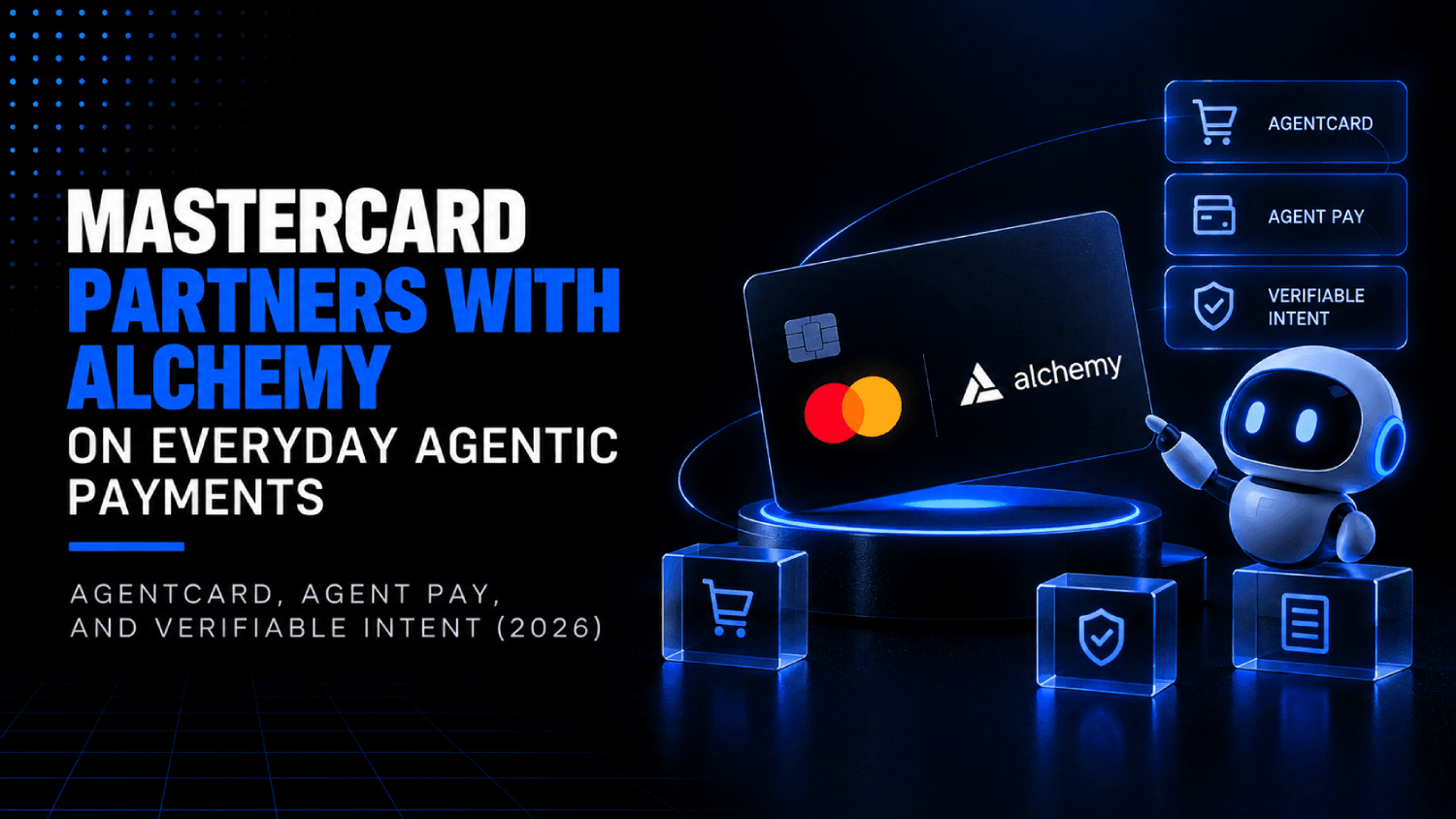
- On Sept. 17, 2026, Alchemy announced that AgentCard will support Mastercard payment credentials through an integration with Mastercard Agent Pay, giving AI agents a path to buy online wherever Mastercard is accepted.
- The stack is framed for everyday commerce: one-time-use, tokenized Mastercard credentials linked to a user’s existing card, plus identity (email/phone) and a stablecoin wallet for emerging agent rails.
- AgentCard is designed to support Mastercard Verifiable Intent, so payments can carry what the user approved (merchant, amount, conditions) while the everyday card stays protected.
- This is Alchemy’s second major card-network push in 2026. AgentCard launched with Visa Intelligent Commerce on June 18, 2026. Mastercard is not an exclusive lane.
- For operators: the news is distribution and trust plumbing, not a “best agent payment providers” list. Ask how Verifiable Intent maps to disputes, issuer controls, and your existing fraud stack.
If you build or buy payments for AI agents, Sept. 17, 2026 is a network-rail signal, not a niche crypto demo.
Alchemy said AgentCard will integrate Mastercard Agent Pay so developers can provision agents with identity, a wallet, and one-time-use Mastercard credentials usable at online merchants that already accept cards. PYMNTS and PaymentsJournal both frame the rollout as aimed at everyday purchases, with The Wall Street Journal covering Mastercard joining Visa in AI shopping bots the same week.
FintechSpecs readers should care because this sits on the same operator surface as card issuing APIs, fraud and risk tooling, and the agentic payment protocol stack. The question is no longer “can an agent recommend a product?” It is “who authorizes spend, what proof travels with the payment, and who eats the dispute when the agent is wrong?”
What happened
On Sept. 17, 2026, Alchemy published a PR Newswire release stating that AgentCard will support Mastercard payment credentials through Mastercard Agent Pay.
Verified product claims from that release (vendor-stated):
- Agents can transact with one-time-use, tokenized Mastercard credentials linked to a user’s existing Mastercard.
- Existing rewards, credit lines, and card benefits are intended to carry over without opening a new account for the agent.
- Users and issuers can set controls including purchase limits, merchant categories, and where transactions are allowed.
- Setup is pitched as a CLI flow under a minute, provisioning a dedicated email address, phone number, stablecoin wallet, and payment credentials.
- AgentCard is designed to support Verifiable Intent, Mastercard’s framework for proving an agent acted within authorized instructions.
Alchemy CEO and co-founder Nikil Viswanathan said: “By working with Mastercard, AgentCard can help developers bring agentic commerce into the mainstream with the security and reliability people expect from modern payments.”
Mastercard EVP of Digital Commercialization Sherri Haymond said: “Mastercard Agent Pay brings the trust, safeguards and consumer control needed to help agentic commerce move from experimentation to everyday use.”
PYMNTS reported that Mastercard would roll the option out that week, citing Alchemy’s X post and the AgentCard site. PYMNTS also attributes Mastercard Chief Product Officer Jorn Lambert (via WSJ coverage) as saying: “We believe it’s not about if, it’s about when and how quickly.”
PaymentsJournal adds two operator-relevant network claims (Mastercard-attributed via that coverage): issuing banks are already enrolled to handle the new tokens at launch, and Mastercard is still working to bring additional AI providers into the ecosystem.
Flag: volume, dispute win rates, issuer SLA details, and merchant liability shifts were not spelled out in the Alchemy release. Treat “everyday agentic payments” as a product thesis until issuers publish operating rules.
What AgentCard, Agent Pay, and Verifiable Intent actually do
AgentCard (Alchemy)
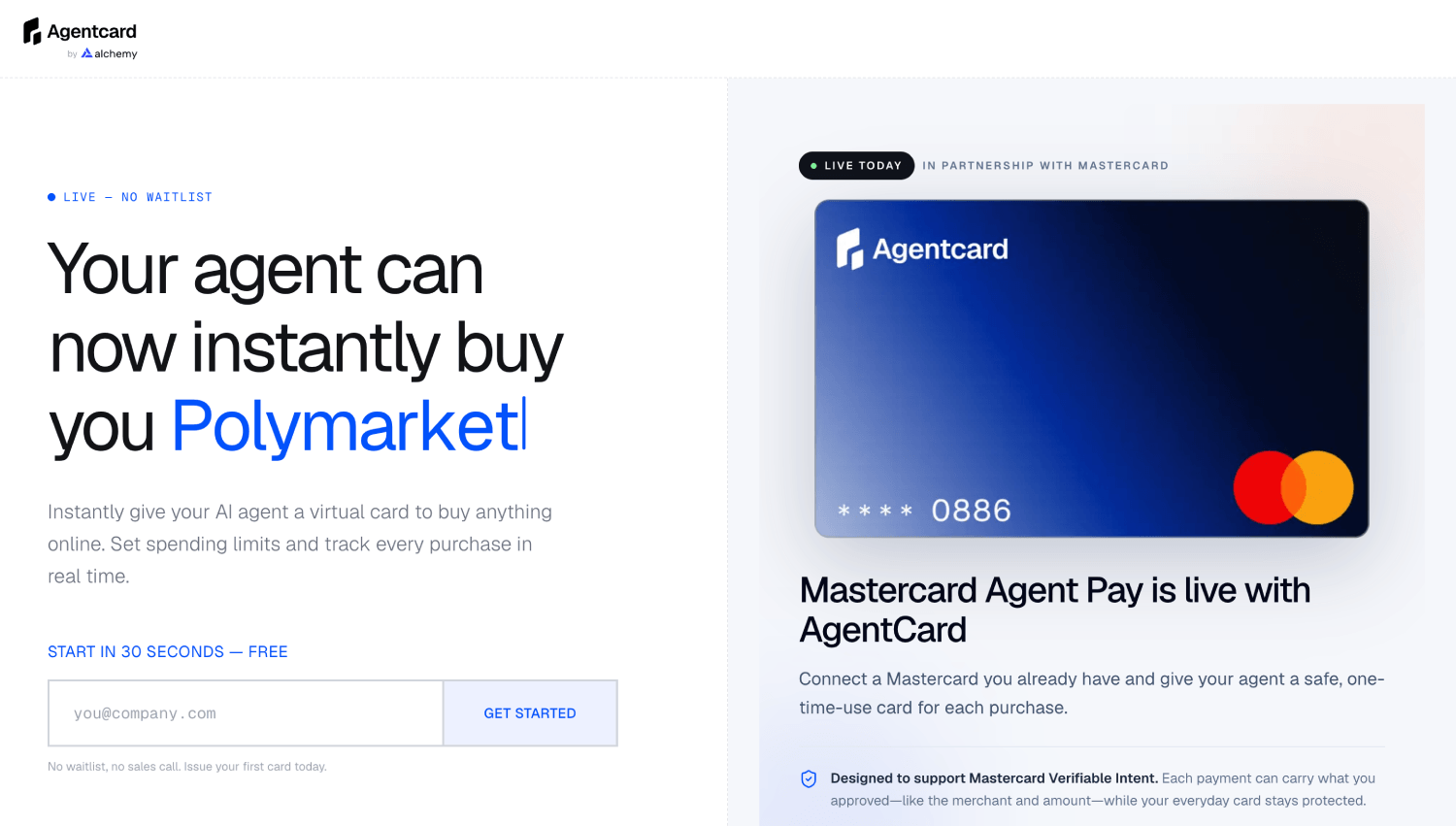
AgentCard is Alchemy’s identity-and-payments product for AI agents. The public site positions it as virtual cards for agents, with spend limits and real-time tracking, live with Mastercard Agent Pay.
Per Alchemy’s Sept. 17 release and site copy:
- Identity layer: dedicated email and phone so agents can complete flows that still assume a human contact path.
- Wallet layer: stablecoin wallet for emerging agentic payment protocols.
- Card layer: one-time-use Mastercard credentials for the long tail of online merchants still on card rails.
- Controls: budgets, merchant categories, geography, and (per PaymentsJournal) the option to require the agent to check back before completing a purchase.
Alchemy also positions AgentCard for developers (CLI/API integration) and for end users who can ask an agent to sign up at AgentCard.ai. Pricing messaging on the site is “fund each card as you use it,” with no subscription called out on the public page. Flag: AgentCard-specific payment volume and customer counts are not in the launch materials.
Mastercard Agent Pay

Mastercard launched Agent Pay in April 2025 as its agentic AI-driven payment program for trusted agent commerce (PYMNTS timeline). In June 2026, Mastercard separately introduced Agent Pay for Machines (AP4M) for high-frequency, low-value machine and agent payments. Alchemy was named among more than 30 initial AP4M participants alongside Adyen, Cloudflare, Coinbase, Crossmint, Skyfire, Stripe, and others (Mastercard investor news).
The Sept. 17 AgentCard news is about Agent Pay credentials for everyday online purchases, not a rewrite of the micro-payment AP4M thesis. Operators should keep those lanes distinct in roadmap conversations.
Verifiable Intent
In March 2026, Mastercard introduced Verifiable Intent as an open, standards-based trust layer for agentic commerce, co-developed with Google and described as aligned with Google’s Agent Payments Protocol (AP2) and Universal Commerce Protocol (UCP), while remaining protocol-agnostic (Mastercard Verifiable Intent story; also summarized by PYMNTS).
What builders should take from the public description:
- It creates a tamper-resistant record of what a user authorized when an agent acts on their behalf.
- It links identity, instructions, and transaction outcome into one evidence object consumers, merchants, and issuers can rely on.
- Spec and reference implementation were open-sourced (GitHub / verifiableintent.dev per Mastercard’s March framing).
- Mastercard planned to integrate Verifiable Intent into Agent Pay intent APIs over subsequent months.
AgentCard’s site says each payment can carry approved details such as merchant and amount while the everyday card stays protected. That is the product promise. What is still thin in public materials: exact dispute workflows, chargeback evidence packaging, and how conflicting natural-language instructions are resolved when the agent and the merchant disagree.
How this sits vs Visa agentic commerce and the protocol stack
Do not treat this as a replacement for FintechSpecs’ protocol comparisons. Use those posts for depth; use this section for context.
Card-network lane
- June 18, 2026: Alchemy launched AgentCard with Visa Intelligent Commerce, provisioning Visa tokens plus email, phone, and crypto wallet (PR Newswire).
- Sept. 17, 2026: AgentCard adds Mastercard Agent Pay credentials.
Alchemy is collecting networks so one agent identity stack can route across Visa and Mastercard acceptance. PaymentsJournal notes that shared underlying infrastructure could make authorization and control more consistent for users across networks. That is an industry hypothesis, not a proven interchange outcome.
Protocol lane (ACP / AP2 / x402)
Verifiable Intent is explicitly aligned with AP2 and positioned as protocol-agnostic. That matters because builders already juggle:
- ACP vs AP2 vs x402 (how agents negotiate and settle intent)
- x402 payment providers (HTTP-native machine payments)
- Skyfire vs Payman vs Natural (agent payment infrastructure vendors)
Practical operator map:
| Layer | What Sept. 17 mainly moves | What it does not replace |
|---|---|---|
| Card credentials + token controls | Mastercard reach via AgentCard + Agent Pay | Issuer program policy and your BIN sponsorship model |
| Proof of authorization | Verifiable Intent as an evidence object on Agent Pay | Your product’s UX for consent, budgets, and human override |
| Agent-native rails | Stablecoin wallet as a bridge to emerging protocols | Merchant adoption of x402 / ACP-class checkout |
| Vendor infrastructure | Alchemy’s provisioning CLI/API | Specialist agent payment infra shortlists (Skyfire, Payman, etc.) |
In short: Mastercard/Alchemy expand where an agent can pay today. Protocol posts explain how intent and settlement negotiate. Keep the URLs separate.
Risk, controls, and fraud implications for platforms issuing agent cards
Agentic cards are virtual issuing under a new threat model: the “cardholder” is software that can be prompt-injected, tool-hijacked, or given ambiguous instructions.
Controls called out in launch materials
- One-time-use / tokenized credentials (blast-radius limit if a PAN-like secret leaks)
- Spend limits, merchant category, and geo rules
- Optional confirmation before purchase (per PaymentsJournal)
- Verifiable Intent as post-hoc and in-flight proof of what was approved
What operators should still design for
- Instruction mismatch: user said “buy the cheapest flight under $400,” agent books a non-refundable fare that fits the literal budget but not the policy. Verifiable Intent helps reconstruct approval; it does not invent your refund policy.
- Agent identity theft / takeover: if email, phone, and wallet are provisioned for the agent, treat them like privileged credentials. Pair with your ATO prevention stack, not card tokenization alone.
- Velocity and MCC gaming: category locks help, but agents that chain merchants (marketplace to gift card to cash-out) need velocity, device, and behavioral signals from your fraud detection layer.
- Dispute evidence: RuntimeWire correctly notes the Alchemy announcement does not fully specify chargeback handling. Ask issuers how Verifiable Intent objects attach to representments.
- Dual-network complexity: Visa + Mastercard paths through one AgentCard product means dual control schemas, dual token lifecycles, and dual network rulebooks. Your ops runbook must name which network owns each failure mode.
If you already issue cards via card issuing APIs, treat Agent Pay tokens as another credential type in the same control plane: budgets, allowlists, kill switches, and human escalation paths.
Who should care, and what to ask
Prioritize a deep read if you:
- Build AI shopping, procurement, or subscription agents that need card acceptance today
- Run an issuer, BIN sponsor, or card program evaluating agent tokens
- Own risk, disputes, or payments product for a fintech SaaS platform
- Are choosing between network Agent Pay / Intelligent Commerce integrations and specialist agent payment infra
Concrete questions for Mastercard / Alchemy / issuer partners
- Is Verifiable Intent required, optional, or phased for AgentCard Mastercard credentials in your market?
- What fields are cryptographically bound (merchant ID, amount, SKU, time window, agent ID), and what is only advisory metadata?
- How do issuer controls interact with AgentCard user controls when they conflict?
- What is the dispute packet for “agent bought the wrong thing within approved limits”?
- Are rewards and credit-line preservation guaranteed at the network level, or dependent on issuer participation?
- How does Agent Pay for Machines (micro/machine payments) relate to this everyday Agent Pay credential path in pricing and risk scoring?
- For dual Visa + Mastercard AgentCard setups: one consent UX or two network-specific authorization objects?
The take: distribution won the week, trust still owns the P&L
Mastercard partnering with Alchemy on AgentCard is a distribution and credibility event. Everyday merchants already take Mastercard. Tokenized one-time credentials plus issuer-style controls are the pragmatic bridge while agent-native protocols (x402 and peers) climb merchant adoption.
The operator lesson is sharper: agentic commerce fails on ambiguity, not on PAN entry. Verifiable Intent is the right class of fix (shared proof of what was authorized). It is not yet a substitute for product-level consent design, fraud tooling, and dispute playbooks.
If you are shipping an agent that spends, integrate for reach, then instrument for blame. Know which system can prove the user’s intent, which system can stop the next spend in under a second, and which team owns the chargeback when the model hallucinates a “great deal.”
FAQ
When did Mastercard and Alchemy announce the AgentCard integration?
Sept. 17, 2026, via Alchemy’s PR Newswire release, with same-day coverage from PYMNTS, PaymentsJournal, and the Wall Street Journal.
What is AgentCard?
AgentCard is Alchemy’s payments and identity product for AI agents. It provisions email, phone, a stablecoin wallet, and payment credentials so agents can operate in online checkout flows built for humans.
What is Mastercard Agent Pay?
Agent Pay is Mastercard’s program for trusted agentic commerce, launched in April 2025. The AgentCard integration uses Agent Pay so agents can spend with tokenized Mastercard credentials under user and issuer controls.
What is Verifiable Intent?
Verifiable Intent is Mastercard’s open, standards-based framework (introduced March 2026, co-developed with Google) that creates a tamper-resistant record linking user identity, authorized instructions, and transaction outcome for agentic purchases.
Did Alchemy already work with Visa?
Yes. On June 18, 2026, Alchemy launched AgentCard with Visa Intelligent Commerce. The Mastercard integration is a second network path, not a replacement announcement.
Does this replace ACP, AP2, or x402?
No. Verifiable Intent is aligned with AP2 and described as protocol-agnostic. Card credentials solve acceptance at merchants on card rails. Protocol stacks solve agent-native negotiation and settlement. See FintechSpecs’ ACP vs AP2 vs x402 explainer for the comparison layer.
Are dispute and chargeback rules fully public?
Not in the Alchemy launch materials. Public sources describe proof-of-authorization goals but do not publish a complete chargeback operating guide. Confirm with your issuer and Mastercard program contacts.