
TLDR
- Alloy is not the only platform that orchestrates KYC, KYB, and fraud checks in a single workflow. Persona, Sumsub, Footprint, Oscilar, Taktile, Middesk, and Socure all offer comparable or overlapping orchestration depth.
- The real differentiator between these platforms is not feature parity. It is where in the stack they sit: some are orchestration layers first, some are data vendors with orchestration bolted on, and some are decisioning engines that happen to include identity checks.
- Alloy’s pricing model, which is volume-tiered and not publicly disclosed, creates friction for early-stage teams. Several alternatives publish per-verification pricing or offer flat-rate plans that are easier to model at seed and Series A.
- Switching identity orchestration platforms mid-scale carries real risk. The decision to move should hinge on three things: workflow flexibility, data source coverage, and how deeply the vendor is embedded in your current onboarding stack.
- Most teams evaluating Alloy alternatives are not replacing Alloy entirely. They are looking for a layer that handles a specific gap, whether that is richer KYB for US business onboarding, faster international coverage, or a more accessible decision engine for non-compliance-specialist teams.
Alloy, Persona, Sumsub, Footprint, Oscilar, Taktile, Middesk, and Socure are the primary identity orchestration and KYB platforms competing in the US fintech market. The strongest Alloy alternatives for most growth-stage fintechs are Persona for consumer plus business workflows, Sumsub for international coverage, Middesk for US business verification depth, and Footprint for teams that want onboarding, vault, and decisioning in a single contract. The right choice depends on whether your bottleneck is data coverage, workflow flexibility, or per-check cost.
What Is Identity Orchestration and Why Does It Matter for Fintech Teams?
Identity orchestration is the layer that sequences, routes, and combines outputs from multiple identity data vendors, document checks, liveness tools, and fraud signals into a single pass/fail decision. Without it, each vendor sits in a separate silo and someone on your compliance team manually reconciles the results.
Alloy popularized this framing for fintech. The platform connected to dozens of data sources and let teams build decision trees through a no-code editor, which meant a risk analyst could add a Socure check or an Experian pull without writing code. That was genuinely differentiated in 2019 and 2020.
The market has caught up. At least seven credible platforms now offer comparable orchestration depth, several at a lower price point or with a more accessible onboarding experience. Understanding which one belongs in your stack requires being precise about what kind of orchestration problem you actually have.
The FintechSpecs Orchestration Depth Score: How to Compare These Platforms
Before the list, a framework. When evaluating any identity orchestration platform, there are five dimensions that actually differentiate vendors in production environments. We call this the FintechSpecs Orchestration Depth Score.
- Workflow logic flexibility: Can a non-engineer build branching logic with fallback rules, or does every change require a developer ticket?
- Data source breadth: How many third-party data sources does the platform connect to natively, and how easy is it to add a custom source?
- KYB depth: Can the platform verify beneficial ownership, UBO chains, and registered agent data for US LLCs and corps, not just pull a Secretary of State record?
- Decisioning transparency: Does the platform surface the reason a case failed, or does it return a score with no attribution?
- Vault and data residency: Does the platform store PII on your behalf, and can it satisfy SOC 2 Type II, GDPR, or state-level data residency requirements out of the box?
Run every vendor on this list through these five checks before engaging their sales team. The answer to each one will expose mismatches faster than any sales call.
Who Should Actually Consider Switching Away from Alloy?
Alloy works well for fintech companies that need a proven, wide-coverage orchestration layer and have the contract size to justify its pricing. It is a strong fit for Series B and later companies processing high verification volumes with a dedicated compliance team that can manage the platform.
Teams that run into friction with Alloy tend to fall into three categories. First, early-stage companies that cannot get transparent per-check pricing and find the contract negotiation process slow. Second, teams with heavy B2B onboarding needs who find Alloy’s KYB coverage thinner than dedicated KYB platforms like Middesk. Third, product teams that want to embed identity into a non-compliance workflow and find Alloy’s interface assumes a compliance-first operator.
If none of those describe you, Alloy may still be the right tool. This list is not an argument against Alloy. It is a map of what exists when Alloy is not the right fit.
9 Best Alloy Alternatives for Identity and KYB Orchestration
1. Persona
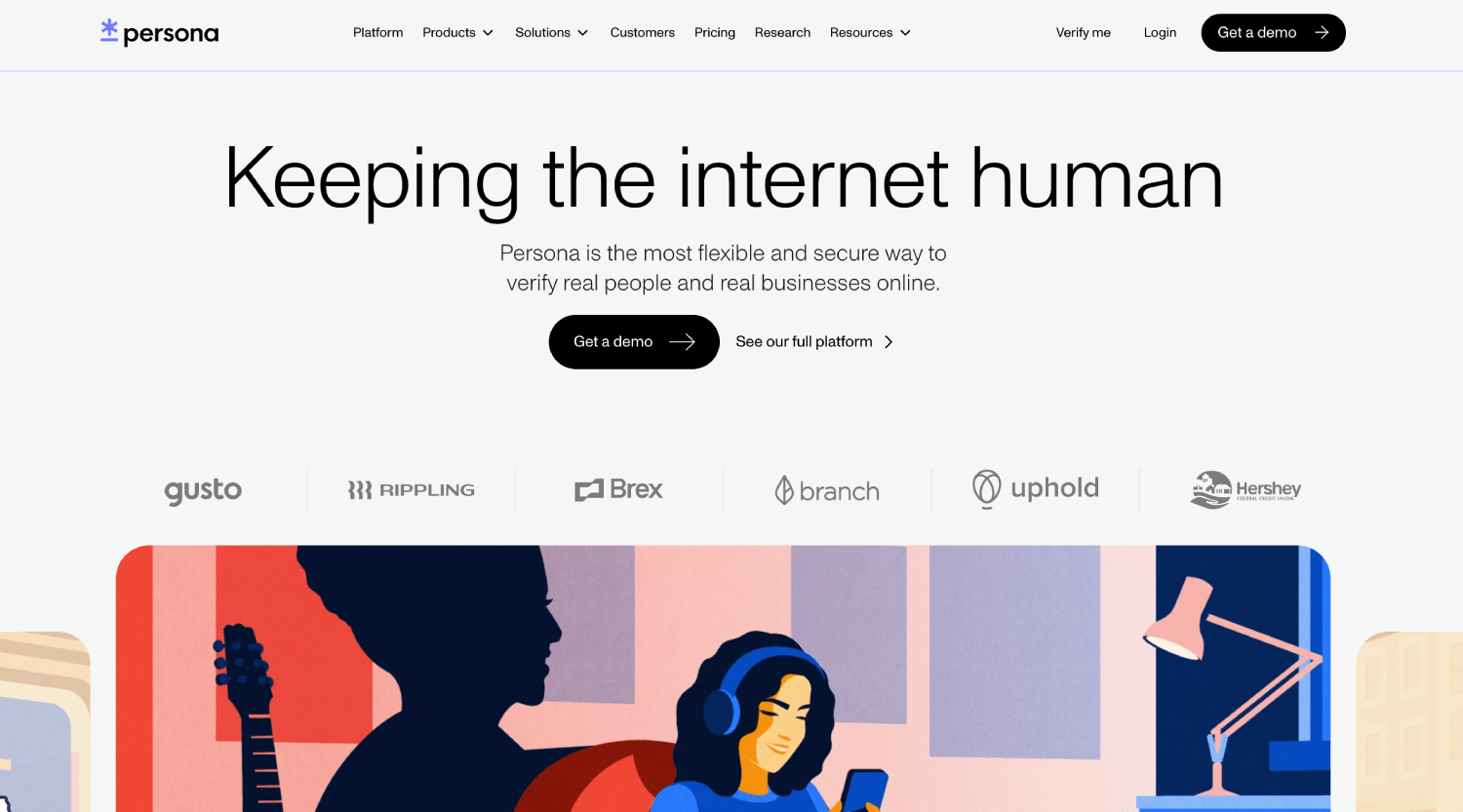
Persona is the most direct Alloy competitor in terms of positioning. Both platforms offer a no-code workflow builder, multi-vendor data source connections, and a case management layer for manual review. Persona’s differentiator is its developer experience and the flexibility of its Flow product, which lets teams embed verification into a product interface rather than redirecting users to a hosted page.
For KYB, Persona connects to business registry data, EIN verification, and beneficial ownership checks. It is not as deep as Middesk on US business data alone, but for teams that need a single platform handling consumer KYC, business KYB, and fraud signals without stitching three vendors together, Persona covers the most ground. Persona does not publish per-verification pricing publicly. Pricing is negotiated based on volume and use case.
Persona fits best for growth-stage consumer fintech products that are beginning to add business onboarding and want one vendor relationship. See our detailed Alloy vs Persona comparison for a side-by-side breakdown of workflow logic, data sources, and pricing structure.
2. Sumsub
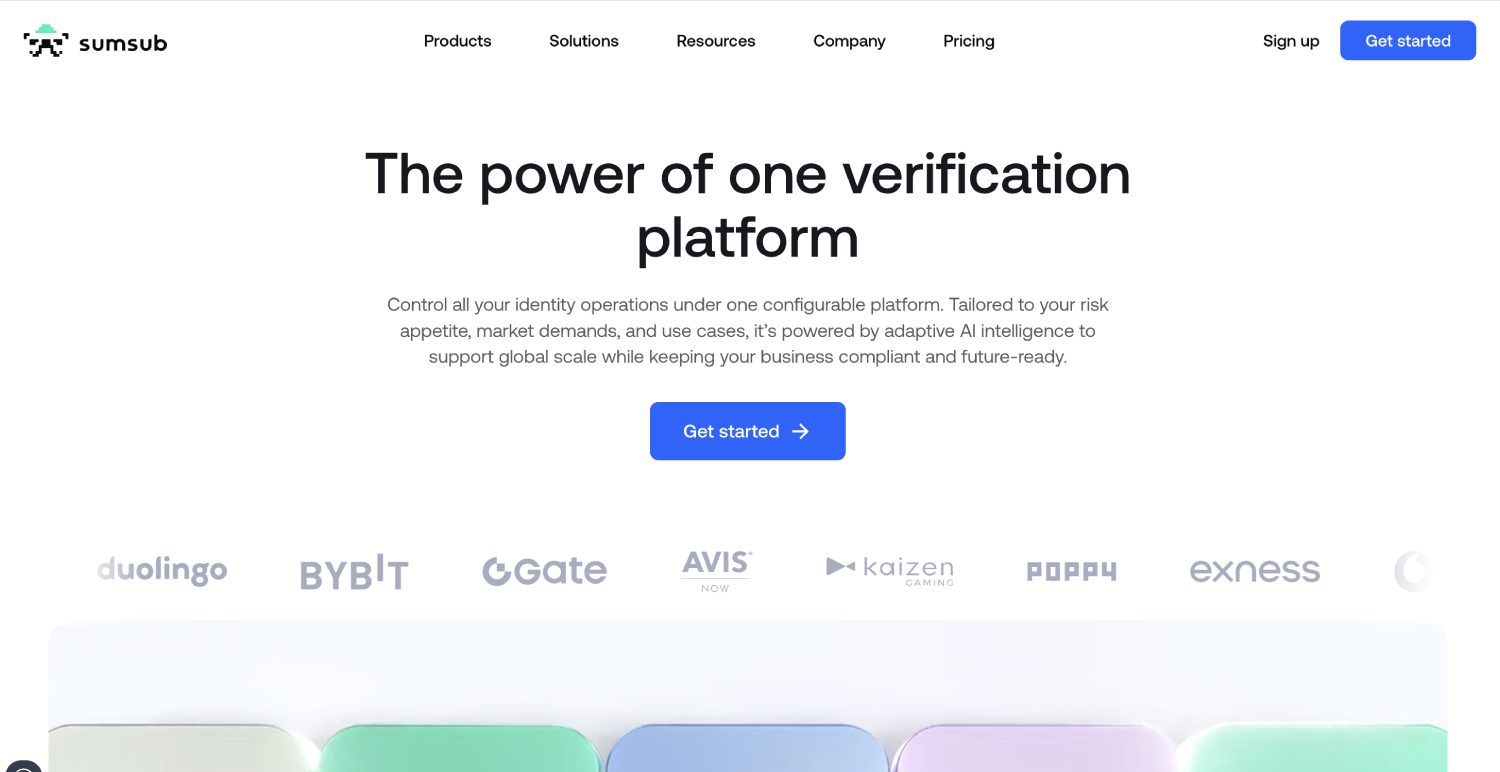
Sumsub is the strongest option on this list for companies with meaningful international user volumes. Its document verification coverage spans more than 220 countries and territories, which is broader than most US-first competitors. For a company onboarding users in Southeast Asia, Latin America, or Eastern Europe alongside the US, Sumsub removes the need to stitch in a separate international document vendor.
Sumsub includes KYC, KYB, AML screening, and transaction monitoring under one contract. The platform’s KYB product covers business verification in multiple jurisdictions, including company registry lookups, UBO checks, and sanctions screening for international entities. Workflow logic is configured through a no-code editor similar to Alloy’s.
The trade-off is US business data depth. For teams with primarily US-based business customers, Sumsub’s KYB coverage is less granular than Middesk or Alloy’s US-specific data connections. Sumsub’s pricing is not publicly listed and varies by product module and volume.
3. Footprint
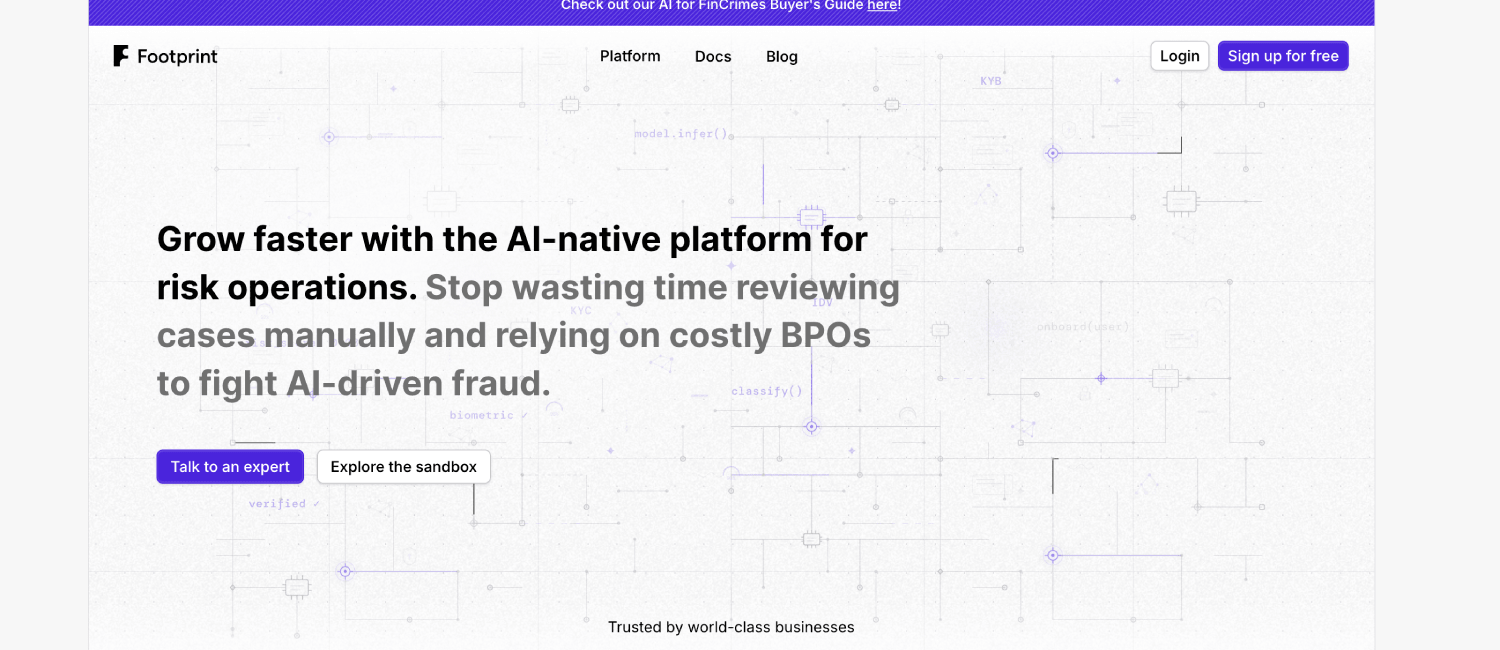
Footprint takes a different architectural approach than most platforms on this list. Rather than being an orchestration layer that sits on top of identity vendors, Footprint functions as a portable identity vault: it stores verified user data and lets users carry that verification from one Footprint-enabled company to another, reducing re-verification friction.
For fintech teams, this matters in two situations. If you are onboarding users who may have already verified with another Footprint customer, you can inherit that verification instantly. If you are building a product where re-verification at account recovery or step-up authentication is a friction point, Footprint’s vault model solves that without additional checks.
Footprint includes KYC, document capture, liveness checks, and a decisioning layer. KYB is available but less mature than dedicated KYB platforms. Footprint is a strong fit for consumer fintech companies prioritizing user experience at onboarding and looking for a vendor that combines verification, vaulting, and ongoing authentication in one contract. Pricing is not publicly disclosed.
4. Oscilar
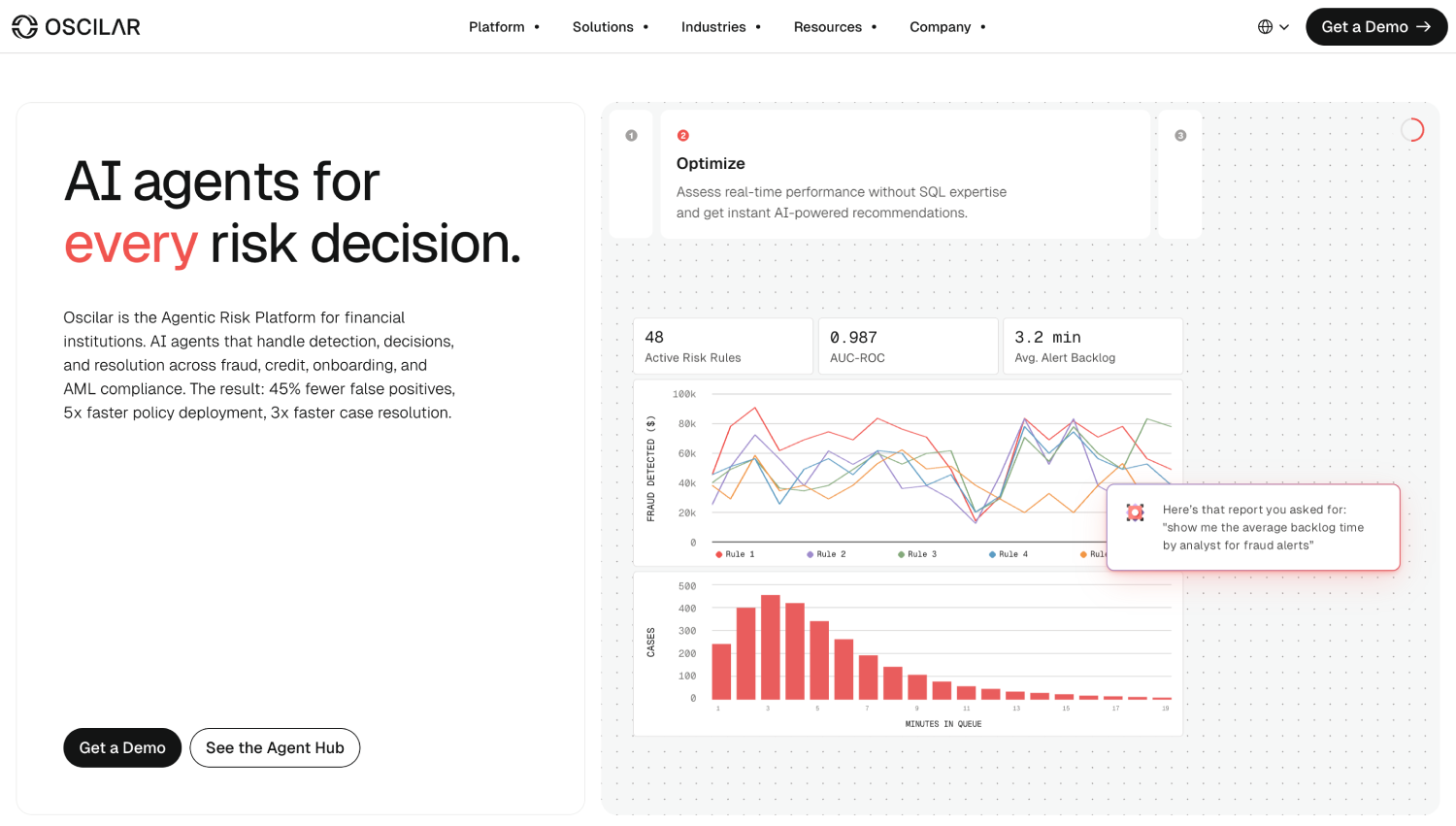
Oscilar approaches identity orchestration from the fraud risk side rather than the compliance side. The platform centers on an AI-native rules engine that sequences KYC checks, fraud signals, and behavioral data into a real-time decisioning workflow. For teams that find Alloy’s rules editor too manual, Oscilar’s AI-assisted rule suggestions are a meaningful time saver.
Oscilar covers KYC and KYB verification, device intelligence, and transactional fraud signals in a single workflow. The case management layer includes an AI co-pilot that surfaces the most relevant signals for a manual reviewer, which reduces review time for edge cases. This makes it particularly well suited for lending platforms where onboarding and ongoing transaction monitoring need to share context.
Oscilar is less well known than Alloy or Persona and carries more integration risk for teams without an existing fraud infrastructure. It is a better fit for Series A and later fintech companies with a dedicated risk team than for early-stage teams looking for a plug-and-play solution. Pricing is not publicly disclosed. For a direct comparison, see our Taktile vs Oscilar breakdown on decisioning architecture.
5. Taktile
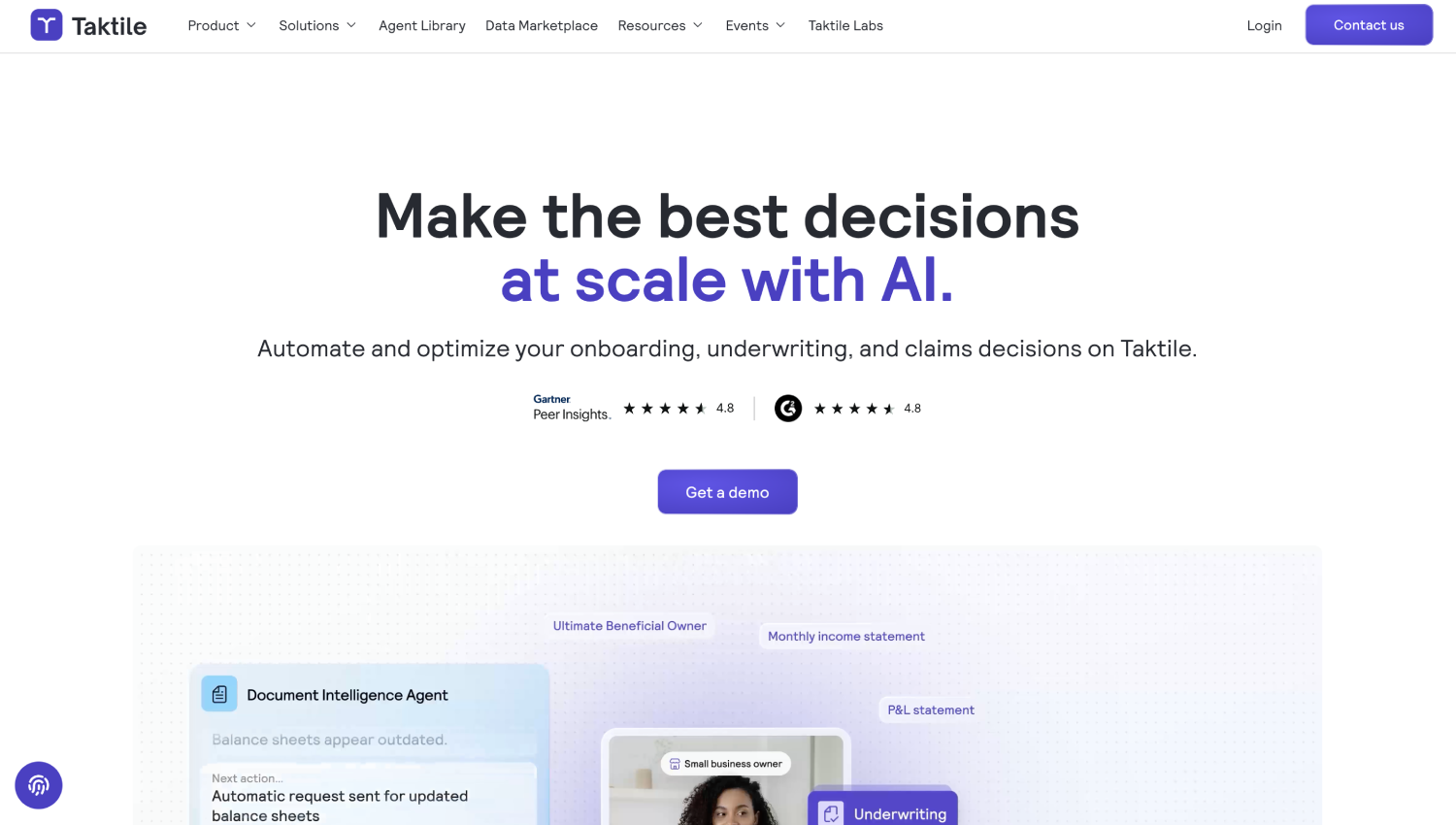
Taktile is primarily a decisioning platform that has expanded into identity orchestration. The platform’s core strength is its decision flow builder, which is designed for credit and risk decisions rather than identity compliance. Teams can connect KYC and KYB data sources alongside credit bureau data, bank account verification, and custom scoring models into a single automated decision.
For fintech companies where KYB is one input into a broader underwriting or credit decision rather than a standalone compliance gate, Taktile handles both in one workflow. A B2B lender that needs to verify a business entity, check its financials, and issue a credit limit can do all three steps in Taktile without exporting data between platforms.
Taktile is a weaker fit for companies whose primary need is consumer identity or document verification. It does not have the depth of document capture and liveness tooling that Persona or Sumsub offer. It shines when the decisioning complexity is high and the identity check is one node in a larger automated flow. Taktile pricing is not publicly listed.
6. Middesk
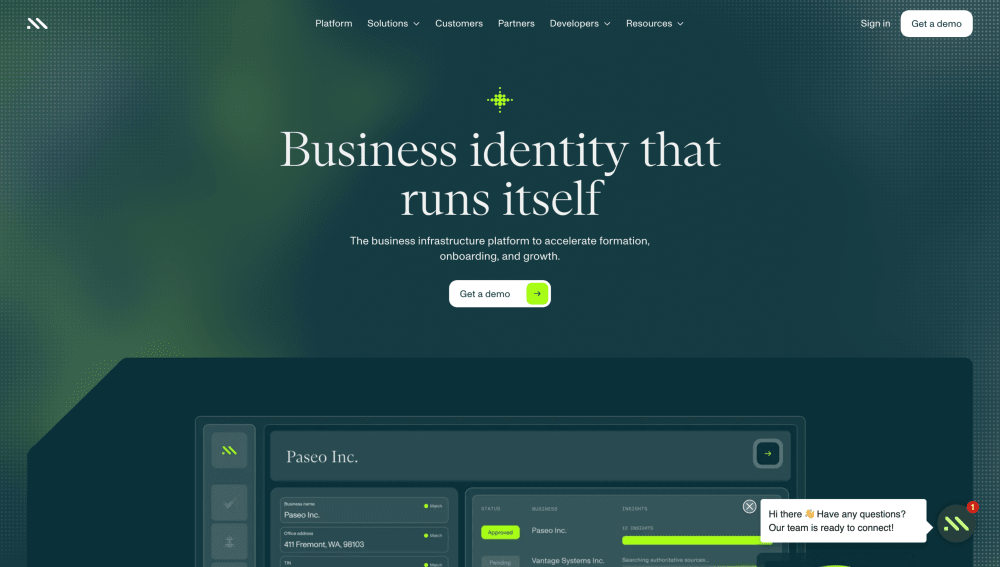
Middesk does fewer things than Alloy, but it does US business verification better than almost any platform on this list. Its data coverage for US entities includes Secretary of State filings, EIN validation, registered agent lookups, UCC liens, business credit data, and beneficial ownership verification across all 50 states. For teams onboarding US small businesses, this depth is difficult to replicate by connecting general-purpose data sources through Alloy.
Middesk is not a full identity orchestration platform. It does not handle consumer KYC, document capture, or liveness checks. Teams typically use it alongside a KYC platform rather than as a replacement. Its API is clean, its documentation is well maintained, and its verification results are structured in a way that feeds naturally into a decisioning layer.
For B2B fintech products, embedded finance platforms, and marketplace onboarding workflows where the bottleneck is business entity verification rather than consumer identity, Middesk is often the highest-value addition to an existing stack. Pricing is not publicly listed. Our Alloy vs Middesk analysis covers the KYB coverage gap in detail.
7. Socure
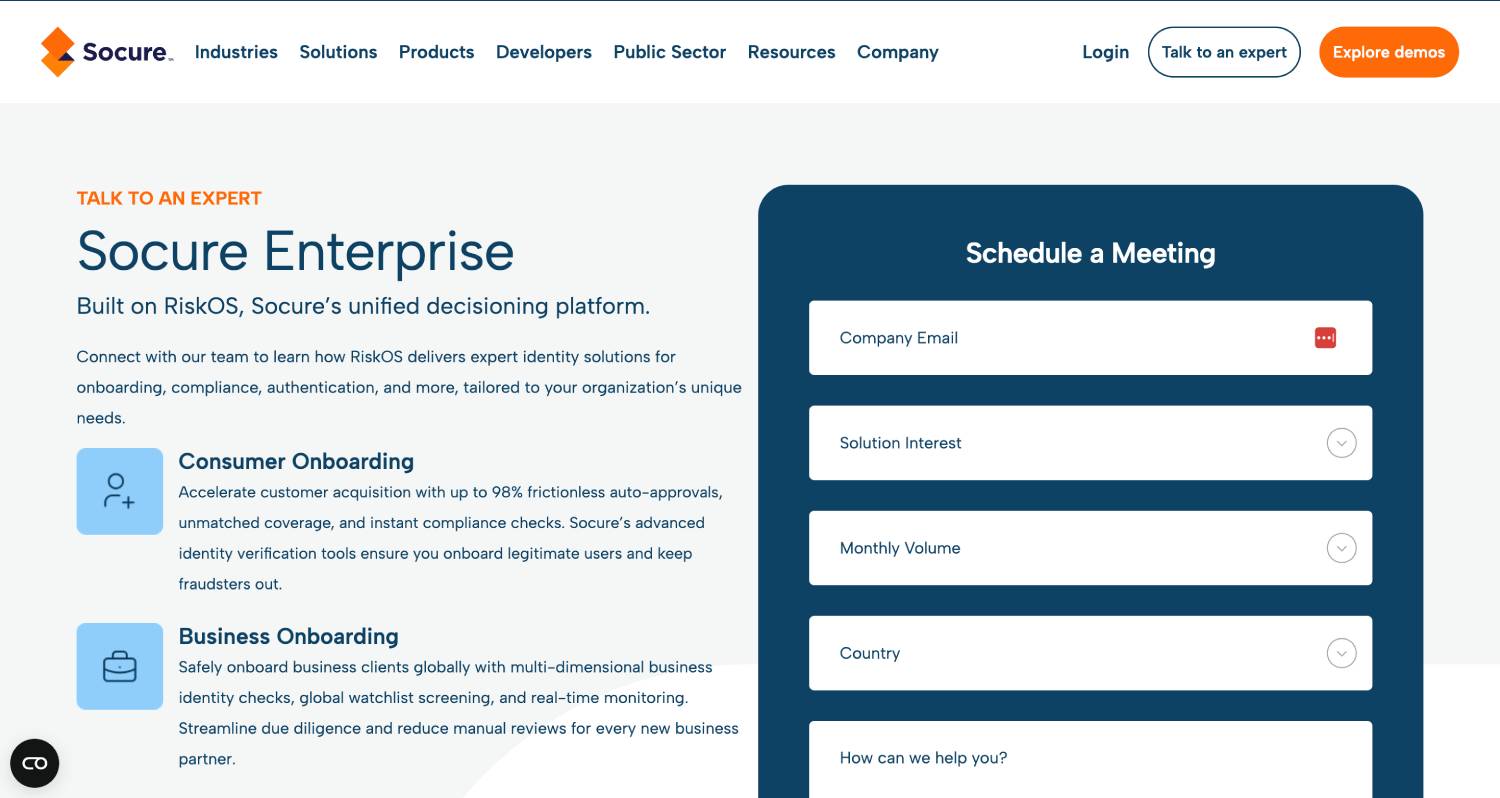
Socure is an identity verification and fraud detection platform whose primary strength is its predictive model accuracy for consumer identity. According to Socure’s own product positioning, the company’s models are trained on consortium data from a network of financial institution customers, using graph-based identity linking to improve fraud and synthetic identity scores for thin-file and hard-to-verify consumers beyond what most point-in-time data lookups can achieve.
Socure’s KYB product is a more recent addition and covers US business entity verification. Its orchestration capability is more limited than Alloy or Persona. Socure works best as a high-accuracy data source plugged into an orchestration layer, rather than as the orchestration layer itself. Teams that are already using Alloy and find its consumer identity accuracy lacking often add Socure as a data source rather than replacing Alloy entirely.
Socure is enterprise-oriented and minimum contract sizes reflect that. It is not a practical option for pre-revenue or seed-stage companies. Pricing is not publicly disclosed. For teams evaluating Socure’s synthetic identity detection specifically, see the Socure vs SentiLink comparison.
8. Sardine
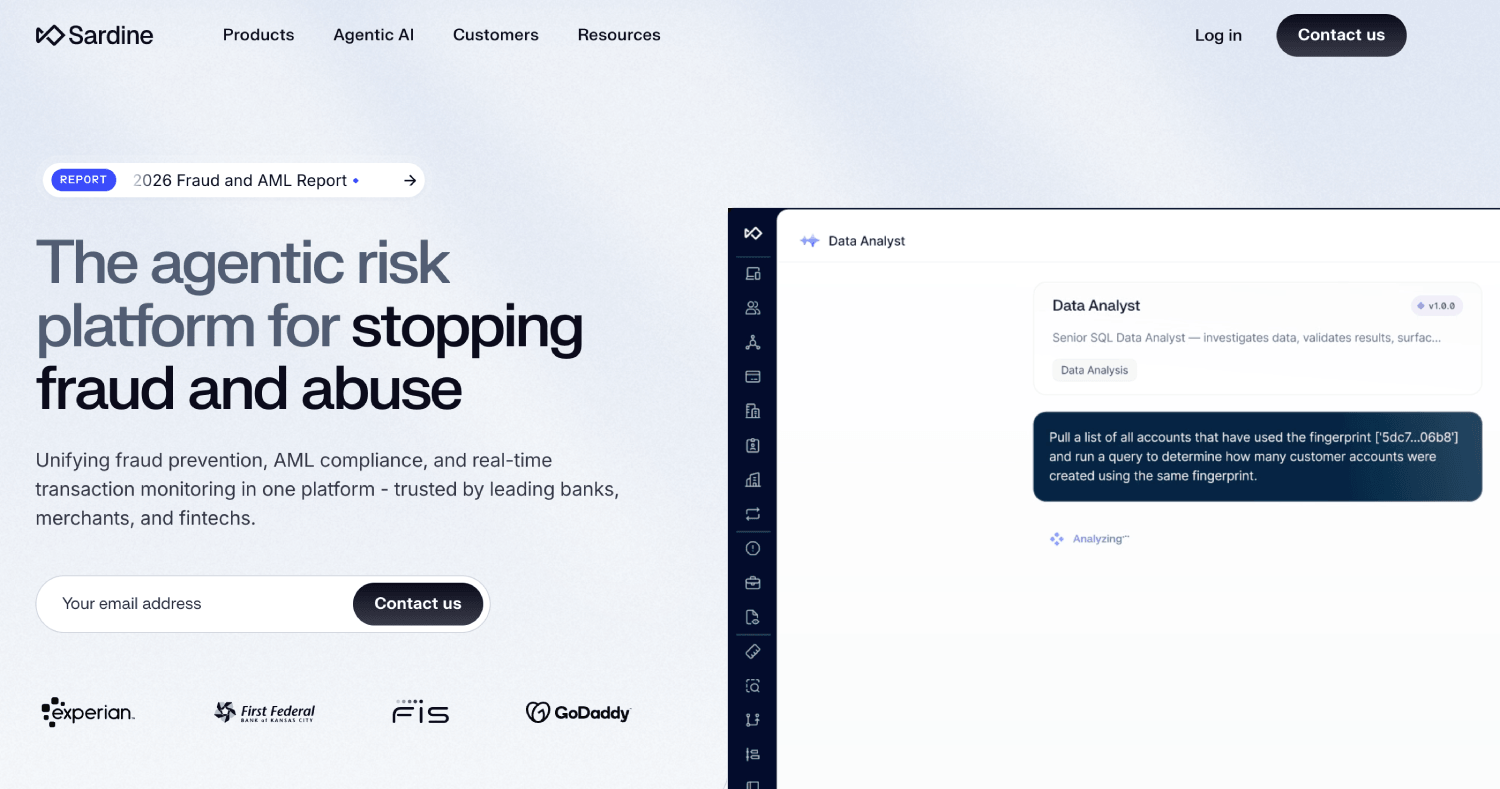
Sardine combines device intelligence, behavioral biometrics, bank account verification, and fraud decisioning in a platform originally built for crypto onboarding but now widely used in neobanking and payments. Its signal breadth during a session, including keystroke dynamics, scroll behavior, and device fingerprinting, is deeper than what most KYC-first platforms surface at account opening.
Sardine’s KYC coverage connects to identity verification and AML screening, but its orchestration layer is less mature than Alloy or Persona for teams that need complex branching logic across multiple identity vendors. Where it wins is in the gap between account opening and the first transaction, a window where most identity platforms stop collecting signals and Sardine keeps running.
Sardine is a natural fit for fintech companies where fraud risk is highest during the first 30 days after onboarding, particularly crypto exchanges, payment apps, and neobanks with high ACH debit exposure. It complements a KYB platform rather than replacing one. Pricing is not publicly disclosed.
9. Trulioo

Trulioo is a global identity verification platform with one of the broadest international data source networks available through a single API. Its coverage spans consumer identity verification and business registry data in markets across North America, Europe, Asia-Pacific, and Latin America.
For US-only teams, Trulioo’s breadth is a feature they are paying for and not using. For platforms with meaningful international expansion plans, the ability to verify a business entity in Brazil, Germany, and Indonesia through the same API that handles US verification is worth the added complexity. Trulioo’s orchestration layer is functional but less polished than Persona or Alloy for teams building complex branching workflows.
Trulioo sits most naturally in the stack of mid-market to enterprise companies that need international KYC and KYB coverage and are willing to pair it with a more capable decisioning layer. Pricing is not publicly disclosed. For a direct Trulioo comparison, see Trulioo vs Sumsub for KYB and KYC.
Side-by-Side Comparison of Alloy Alternatives
| Platform | Orchestration Layer | KYB Depth (US) | International Coverage | Consumer KYC | Best Fit |
|---|---|---|---|---|---|
| Persona | Strong (no-code builder) | Moderate | Moderate | Strong | Growth-stage consumer + SMB fintech |
| Sumsub | Strong (no-code builder) | Moderate | Strong (220+ countries) | Strong | International-first products |
| Footprint | Moderate (vault-native) | Moderate | Limited | Strong | Consumer fintech prioritizing re-use |
| Oscilar | Strong (AI-native rules engine) | Moderate | Moderate | Moderate | Lending and fraud-heavy workflows |
| Taktile | Strong (decisioning-first) | Moderate (via connectors) | Moderate | Limited | Credit and underwriting decisioning |
| Middesk | Limited (data vendor) | Best-in-market (US) | None | None | US B2B onboarding as a data layer |
| Socure | Limited (model output) | Moderate | Limited | Strong (graph-model) | High-accuracy consumer fraud scoring |
| Sardine | Moderate (fraud-first) | Limited | Moderate | Moderate | Post-onboarding session fraud |
| Trulioo | Moderate | Moderate | Strong (global registry) | Moderate | Enterprise international KYB and KYC |
What Does Alloy Actually Do That Competitors Do Not?
Alloy’s genuine advantages over most platforms on this list are its data source network size, its established presence in bank and credit union compliance programs, and its case management tooling for high-volume manual review teams. Banks and sponsor banks that have already approved Alloy in their third-party risk programs can onboard fintech programs faster because the due diligence on the vendor is already done.
This is a real moat, though it matters less for fintechs building directly on sponsor bank programs than for banks deploying their own compliance stack. For a seed-stage fintech, Alloy’s bank relationships are invisible. For a Series B fintech that is itself becoming a program manager or launching its own BaaS product, those relationships have direct procurement value.
Alloy also offers a transaction monitoring product that sits alongside onboarding orchestration and shares the same case management interface. Teams that have unified onboarding and ongoing monitoring in Alloy find the context continuity valuable: a reviewer working an account alert can see the original onboarding decision in the same screen. Most alternatives on this list require stitching those two contexts together manually. Alloy’s transaction monitoring product page describes how the two surfaces share case data.
How Should You Evaluate KYB Coverage Before Switching Platforms?
KYB coverage is the most commonly misrepresented dimension in vendor sales conversations. A platform that claims to verify US businesses may be pulling a single Secretary of State dataset. A platform with genuinely deep KYB coverage will surface beneficial ownership chains, flag discrepancies between state registration and IRS EIN data, check UCC lien filings, and flag registered agent anomalies that often appear in shell company onboarding.
Before switching, run a set of test entities through any new platform that includes at least three edge cases: a single-member LLC with a foreign owner, a multi-entity holding company, and a business with a name that differs from its DBA. The output quality on those three cases will tell you more than any feature checklist. Our article on top KYB providers for B2B fintech onboarding covers the test methodology for these edge cases in more depth, including scoring criteria and what good output actually looks like.
For companies onboarding high-risk merchant categories, also check whether the platform’s KYB output integrates with your existing sanctions and adverse media screening. Some platforms include this natively. Others return a verification result and leave AML screening to a separate vendor, which requires you to build the handoff logic yourself.
What Does Switching Identity Orchestration Platforms Actually Cost?
The hard cost of switching is engineer time. Moving from one orchestration platform to another means rebuilding webhook handlers, rewriting decision logic, re-mapping data field outputs, and re-testing every onboarding variant across user types. For a platform with five distinct onboarding flows, a realistic engineering estimate is four to eight weeks of focused work, not counting QA and compliance sign-off.
The soft cost is approval rate disruption. Every identity platform has subtly different pass rates on the same population because they query different data sources in different orders. Swapping platforms without a parallel run period often produces a temporary approval rate dip of two to five percentage points as the new platform calibrates to your population. Build that parallel run into your migration timeline.
For detailed guidance on managing this transition without hurting compliance metrics, the KYC provider switching guide on FintechSpecs covers the specific steps for parallel runs, data migration, and approval rate benchmarking.
Frequently Asked Questions
Is Persona a direct Alloy replacement?
For most growth-stage fintechs, Persona covers enough of the same ground to be a viable replacement. Both offer no-code workflow builders, multi-vendor data source connections, and case management. Where Persona differs is in its developer experience and its embedded verification flow, which is more product-forward than Alloy’s compliance-first interface. Persona’s KYB coverage is moderate for US businesses, so teams with complex business onboarding may still need a dedicated KYB vendor alongside it.
What is the best Alloy alternative specifically for KYB in the US?
Middesk offers the deepest US business verification data of any platform on this list. It covers Secretary of State filings, EIN validation, UCC liens, registered agent data, and beneficial ownership across all 50 states. Middesk is not a full identity orchestration platform, meaning teams will need to pair it with a KYC platform for consumer checks. For teams whose primary problem is the quality of US business verification rather than orchestration complexity, Middesk is the right starting point.
Which platforms publish pricing without a sales call?
None of the nine platforms on this list publish full pricing publicly as of publication. All of them require a sales conversation to get a quote. Pricing structures vary: some charge per verification, some charge a platform fee plus per-check, and some bundle by product module. Teams should ask for a per-check breakdown, a minimum monthly commitment figure, and an overage rate during the first call to enable apples-to-apples comparisons.
Can I use more than one of these platforms together?
Yes, and many fintech teams do. A common stack is a consumer KYC platform like Persona or Sumsub for individual identity, Middesk for US business entity verification, and a transaction monitoring tool like Sardine or a standalone AML platform for ongoing monitoring. The orchestration layer, whether Alloy, Persona, Taktile, or Oscilar, typically ties these together. The risk of multi-vendor stacks is integration maintenance cost as each vendor ships API changes.
Is Sumsub better than Alloy for international markets?
For teams onboarding users outside the US, Sumsub’s international data coverage is broader than Alloy’s. Sumsub verifies documents and business entities across more than 220 countries and territories, while Alloy’s coverage is stronger in North America. For a product that is US-primary with some international users, the difference may not justify a switch. For a product with meaningful volume in Europe, Southeast Asia, or Latin America, Sumsub’s international depth is a genuine advantage.
How do I know if I need orchestration or just a better data source?
If your problem is that a specific check fails too often or returns stale data, you probably need a better data source, not a new orchestration layer. If your problem is that adding a new check requires an engineering sprint, that your decision logic is hard-coded and inflexible, or that your compliance team cannot modify onboarding rules without a developer, you have an orchestration problem. Most teams that contact Alloy alternatives are solving one of the two, but conflate them. Diagnose which one before you start vendor conversations.
What compliance certifications should I verify before choosing an alternative?
At minimum, verify SOC 2 Type II certification, which all platforms on this list should carry. For consumer data, confirm FCRA compliance if you are using the platform’s outputs in credit decisions. For international teams, confirm GDPR data processing agreements are in place and ask specifically about data residency options. For any platform that stores PII on your behalf, request their most recent penetration testing report and ask where data is stored at rest.
Which Alloy Alternative Should You Actually Choose?
Most of the teams reading this article have a KYB problem, a pricing problem, or an orchestration flexibility problem. Those are three different diagnoses that point to three different vendors. If your onboarding passes on obvious businesses but fails on edge cases, Middesk is the fix. If you are paying for Alloy’s breadth but only using 30% of it, Persona or Footprint will cover your actual use case at lower complexity. If you need to add credit decisioning logic alongside identity checks without building a second platform integration, Taktile or Oscilar is worth a serious look.
The platforms that are genuinely hardest to replace are not the most feature-rich. They are the ones embedded deepest in your existing compliance program documentation, your sponsor bank’s approved vendor list, and your engineering team’s muscle memory. That stickiness is worth auditing honestly before you start a migration. A platform that solves 80% of your problems with half the integration surface is often better than a theoretically superior platform that takes nine months to fully deploy.
Identity orchestration is increasingly a commodity layer. The meaningful differentiation is now in data quality, decision explainability, and how well a platform scales with your regulatory obligations as you add products and markets. Choose the vendor whose constraints match where you are going, not just where you are.