
TLDR
- CardinalCommerce and Ravelin are not interchangeable 3DS services. One is a pure-play EMV 3DS server embedded inside Visa’s acquiring infrastructure; the other is a fraud intelligence platform that added a 3DS server on top of behavioral and machine learning signals.
- The core trade-off is control: CardinalCommerce gives you a certified 3DS 2.x server with deep processor integration, while Ravelin lets you feed real-time risk scores into authentication decisions before the challenge is ever triggered.
- Merchants who process through Clover or Fiserv-connected processors will encounter CardinalCommerce as the default 3DS path and may never need to evaluate an alternative unless their fraud model demands it.
- Ravelin makes most sense for merchants or PSPs who already run Ravelin’s fraud detection and want authentication data and risk signals to share a single decisioning loop, reducing unnecessary challenges without swapping acquirers.
- Neither vendor publicly discloses per-transaction pricing. Budget conversations require a direct quote in both cases.
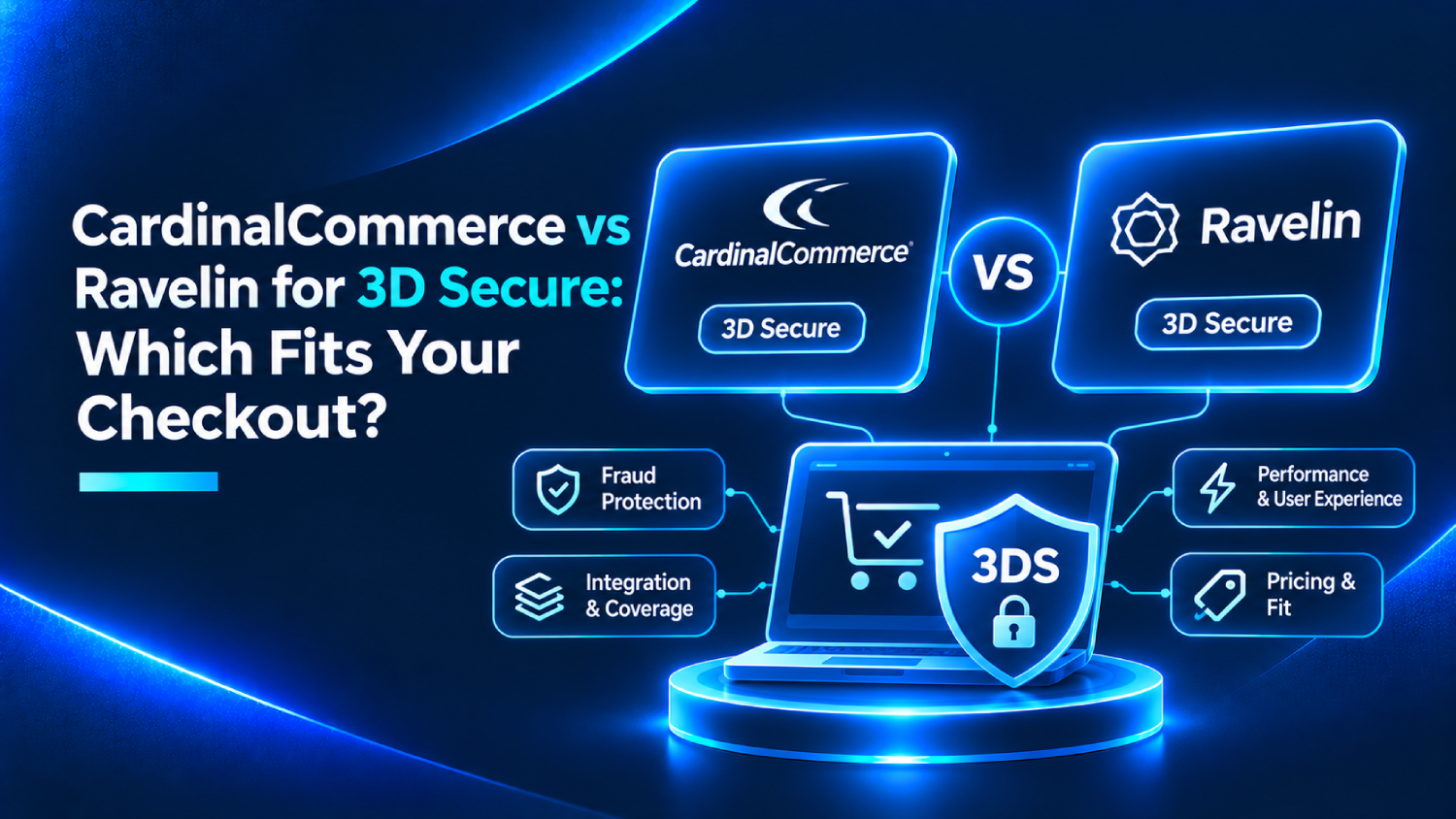
CardinalCommerce is Visa’s 3DS server provider, certified for EMV 3DS 2.1 and 2.2, and is the default authentication path for many Fiserv and Clover-connected merchants. Ravelin is a fraud detection platform with its own certified 3DS server, designed to let risk signals from device intelligence and behavioral analysis directly influence whether a cardholder is challenged. For most merchants evaluating these two, the real question is whether they need a standalone 3DS server that works reliably inside their existing processor stack, or an authentication layer that is tightly coupled to a fraud decisioning engine they already run or plan to run.
What Is a 3DS Authentication Provider and Why Does the Provider Choice Matter?
A 3DS server is the merchant-side component in the EMV 3DS protocol. It packages transaction data, communicates with the card network’s directory server, and receives the authentication response that determines whether a cardholder gets a frictionless pass or a full challenge. Every merchant running 3D Secure is running a 3DS server somewhere, whether they own it or whether it sits inside their payment processor’s infrastructure.
The provider choice matters because 3DS authentication is not purely a network function. The data you send in the authentication request, the risk-based decisioning you apply before the request fires, and the exemption logic you use to avoid challenges all sit inside or alongside the 3DS server. A thin server that just handles protocol mechanics gives you compliance. A server embedded in a fraud platform can suppress a meaningful share of unnecessary challenges before the cardholder ever sees a prompt, based on real-time risk context, though the actual lift varies by merchant vertical, issuer mix, and how richly the transaction data payload is populated.
This distinction matters most for merchants operating across multiple geographies where Strong Customer Authentication rules are enforced, for PSPs building 3DS into a managed payments product, and for any team that has already invested in a fraud orchestration stack and does not want authentication signals siloed from fraud signals. For background on how these layers connect in a broader fraud stack, the FintechSpecs overview of top fraud orchestration platforms for high-growth fintech teams covers how 3DS fits alongside device intelligence and rules engines.
What Is CardinalCommerce and How Does It Work as a 3DS Server?
CardinalCommerce, now a Visa company, is one of the longest-tenured 3DS server and authentication service providers in the market. Its Consumer Authentication Service handles the EMV 3DS 2.x protocol flow, communicates with Visa’s directory server, and returns authentication values that processors accept for liability shift.
The integration path most merchants encounter is not a direct API relationship with CardinalCommerce. Instead, CardinalCommerce is embedded in the payment processing infrastructure of Fiserv and its point-of-sale brand Clover. When a Clover-connected merchant processes a card-not-present transaction, CardinalCommerce is the 3DS server handling authentication behind the scenes. This is a meaningful architectural fact: for many merchants in that stack, switching 3DS providers means switching processors, not just changing an API endpoint.
CardinalCommerce supports 3DS 2.1 and 2.2, passes the full set of transaction data elements to issuers, and handles the frictionless versus challenge routing logic. Its major strength is breadth: it processes authentication across a very high transaction volume globally and is network-trusted by Visa. Its limitation from a merchant engineering standpoint is that issuer challenge controls and exemption logic sit inside CardinalCommerce’s configuration, not inside a merchant’s own risk model. Teams who want fine-grained control over when to request a Transaction Risk Analysis exemption, or who want to suppress 3DS on low-risk segments based on their own behavioral data, will find CardinalCommerce less configurable than a fraud-native 3DS server.
What Is Ravelin’s 3DS Server and How Is It Different?
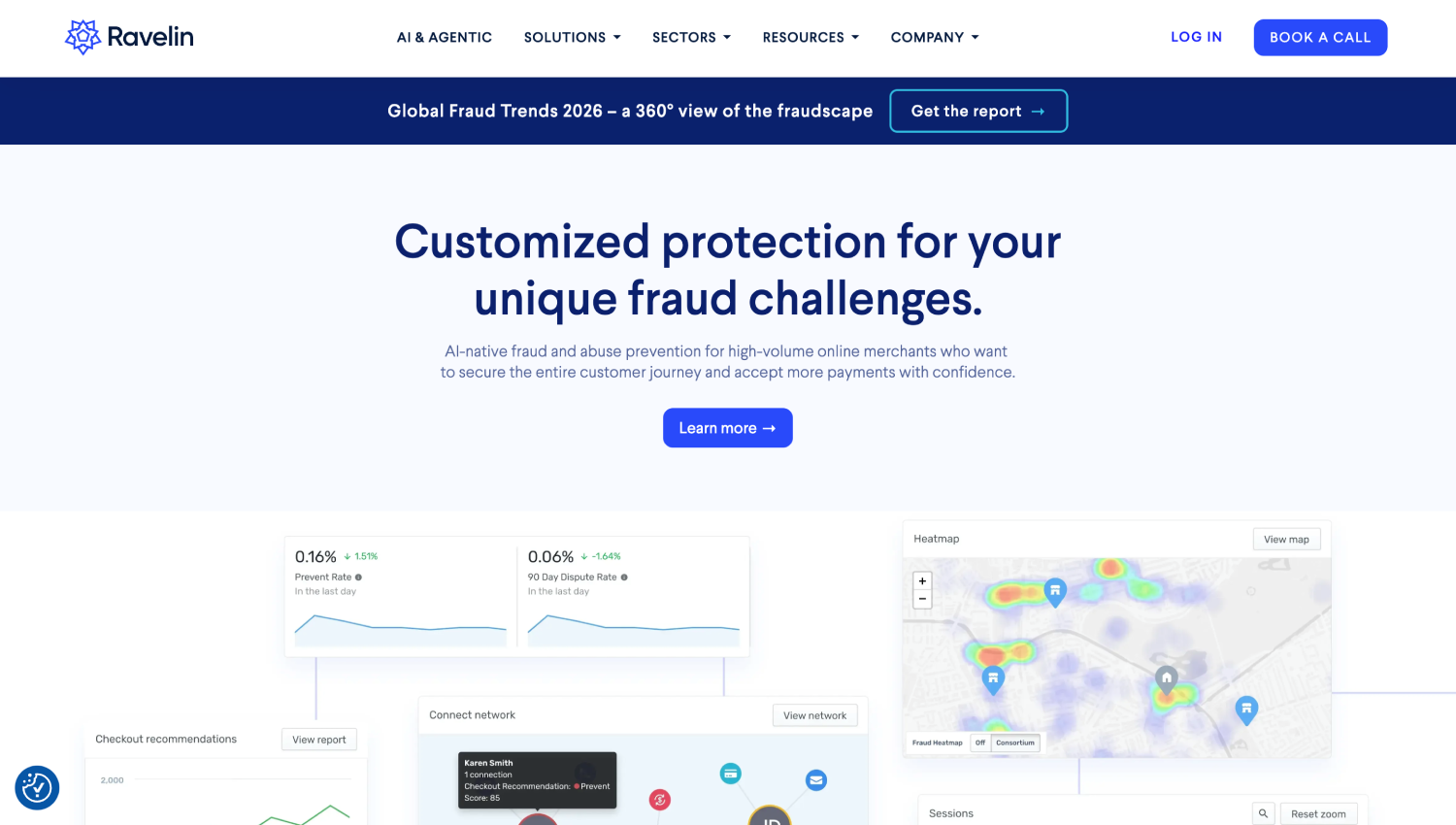
Ravelin is a fraud detection company that added a certified 3DS server to its platform, making it a full 3DS authentication provider for merchants who want authentication and fraud signals to share a single data layer. The Ravelin 3DS server is EMV 3DS 2.x certified and handles the standard protocol mechanics, but its differentiation is upstream: before the authentication request fires, Ravelin’s machine learning models score the transaction using device fingerprinting, behavioral biometrics, and historical cardholder data.
That pre-authentication risk score feeds directly into the exemption and challenge strategy. If Ravelin’s fraud model rates a transaction as low-risk, the merchant can request a Transaction Risk Analysis exemption from the issuer, aiming for a frictionless flow. If the model flags elevated risk, the challenge is triggered proactively. This closed loop between fraud scoring and 3DS decisioning is what separates Ravelin from a pure-play 3DS server like CardinalCommerce, where the fraud model and the authentication layer are typically separate systems that share limited data in real time.
Ravelin’s 3DS server is most naturally adopted by merchants who already use Ravelin’s fraud detection product. Teams running a different fraud tool but wanting Ravelin only for 3DS would add an integration dependency without getting the signal-sharing benefit that justifies the platform. For merchants evaluating the broader fraud-and-authentication market, the FintechSpecs comparison of fraud detection and risk tools for fintech startups provides context on how vendors in this space differ structurally.
CardinalCommerce vs Ravelin 3D Secure: Feature and Architecture Comparison
| Dimension | CardinalCommerce | Ravelin 3DS |
|---|---|---|
| EMV 3DS version support | 3DS 2.1, 3DS 2.2 | 3DS 2.1, 3DS 2.2 |
| Primary use case | Protocol-compliant 3DS server for processor stacks | Fraud-native 3DS with integrated risk scoring |
| Integration model | Often embedded in processor (Fiserv, Clover) infrastructure | Direct API integration; works across processors |
| Pre-authentication risk scoring | Not natively integrated; external fraud tools operate separately | Native ML risk score feeds exemption and challenge decisions |
| Exemption logic control | Configured within CardinalCommerce; limited merchant-side override | Merchant-influenced via Ravelin risk model outputs |
| Issuer challenge controls | Standard; issuer decides based on data elements sent | Risk score aims to reduce issuer-triggered challenges on low-risk txns |
| Processor dependency | High for Fiserv/Clover merchants; default path | Processor-agnostic; integrates via API |
| Standalone fraud detection | Not included | Included; core product is fraud detection |
| Public pricing | Not publicly disclosed | Not publicly disclosed |
| Best-fit buyer | Fiserv/Clover-stack merchants; PSPs needing certified 3DS | Merchants already using Ravelin fraud; PSPs wanting unified risk and auth |
How Do Issuer Challenge Controls Differ Between CardinalCommerce and Ravelin?
Issuer challenge controls determine who decides whether a cardholder completes a step-up authentication. In EMV 3DS, the merchant sends data, the directory server routes the request, and the issuer’s access control server decides: frictionless approval, challenge, or decline. The 3DS server and the data it sends directly influence that issuer decision.
CardinalCommerce sends the full set of required and optional data elements to the issuer, including device channel, browser data, and transaction history fields. The issuer uses that data inside its own risk model. CardinalCommerce does not apply a pre-request merchant risk score that attempts to steer the issuer toward a frictionless outcome. The exemption strategy, such as requesting a TRA exemption or a low-value exemption, is configured in CardinalCommerce but is not dynamically adjusted based on a live merchant-side fraud signal for that specific transaction.
Ravelin’s approach applies its fraud score before the 3DS request is built. For a transaction Ravelin rates as low-risk, it can request a TRA exemption in the authorization message, shifting the liability decision to the issuer with a signal that the merchant’s model vouches for the transaction. For a transaction Ravelin flags as suspicious, it can force a full challenge before that cardholder ever reaches payment capture. This dynamic exemption strategy is the clearest functional difference between the two providers on challenge controls, and it matters most in markets where SCA is enforced and unnecessary challenges cause measurable checkout abandonment.
The FintechSpecs 3DS Stack Fit Test: Four Checks Before You Choose
Most merchants reach for the first 3DS provider their processor surfaces. The FintechSpecs 3DS Stack Fit Test runs four structured checks against the actual constraints of your stack before that decision is made. Each check maps to a failure mode we see repeatedly: merchants locked into a processor default they didn’t know was negotiable, teams that added a second vendor contract to get 3DS features their existing fraud tool already supported, and SCA-exposed platforms that left frictionless rate improvement on the table by defaulting to a static exemption config.
Check 1: Processor lock-in
If your acquiring stack runs through Fiserv or Clover, CardinalCommerce is likely already handling your 3DS. Replacing it means either negotiating an external 3DS provider integration with your acquirer or switching processors. Confirm with your acquiring bank whether your contract allows a third-party 3DS server before evaluating Ravelin as an alternative. Integration timelines for an external 3DS server on a Fiserv stack can run 8 to 16 weeks depending on your PayFac layer and contract terms, that overhead should be in the cost model, not discovered after a vendor is selected.
Check 2: Existing fraud tool
If you run Ravelin’s fraud detection today, adding Ravelin 3DS collapses two integration surfaces into one and lets the ML model that already knows your transaction patterns control the challenge strategy. If you run a different fraud tool, Kount, Sift, or a custom rules engine, Ravelin 3DS requires a separate integration with limited signal-sharing benefit unless you are willing to migrate your fraud detection too. That migration adds scope that most engineering teams underestimate. The FintechSpecs guide on fraud detection and risk tools for fintech startups is a useful reference for mapping what a stack migration actually involves.
Check 3: SCA exposure
Merchants with significant European card volume face mandated SCA requirements where frictionless rates directly affect conversion. Dynamic exemption logic, Ravelin’s core 3DS differentiator, has the highest value in SCA-heavy markets. For primarily domestic US-focused merchants where 3DS is optional and issuer challenge rates are lower, a certified server like CardinalCommerce covers the requirement without the added complexity. As a rough calibration: if European card volume is under 15 percent of total transactions and your average order value is below the low-value exemption threshold (€30 under PSD2), the incremental benefit of Ravelin’s ML-driven TRA exemption logic narrows significantly.
Check 4: Engineering bandwidth for integration
CardinalCommerce’s processor-embedded path requires minimal merchant-side engineering for Fiserv/Clover stacks. Ravelin’s 3DS API requires a direct integration, event data piping, and configuration of the exemption and challenge strategy in the Ravelin dashboard. Teams without a dedicated payments engineer should factor in roughly four to eight weeks of integration work for a clean Ravelin 3DS deployment, more if the fraud detection layer also needs to be migrated simultaneously.
Which Merchants and PSPs Should Choose CardinalCommerce?
CardinalCommerce is the right default for merchants whose acquiring relationship runs through Fiserv or Clover and who do not have a custom fraud model they want to couple with authentication. It is also a reasonable choice for PSPs building a managed payments product who need a certified 3DS server with high transaction volume capacity and network-level trust from Visa. The integration path is known, the certification is current, and the operational burden of running a 3DS server is absorbed by the processor relationship.
PSPs embedding payments into vertical SaaS products, where the underlying acquiring infrastructure is typically provided by a PayFac-as-a-service platform, often inherit CardinalCommerce by default through that platform’s processor stack. Understanding that default is important: it means your 3DS configuration options are bounded by what CardinalCommerce exposes through your PayFac’s integration. For teams evaluating that layer, the FintechSpecs guide to payment infrastructure tools for SaaS founders covers how 3DS fits into the broader payment stack decision.
Which Merchants and PSPs Should Choose Ravelin 3DS?
Ravelin 3DS fits merchants who already operate Ravelin’s fraud detection, who have significant SCA-exposed volume, and who have the engineering capacity to run a direct API integration. The platform-native signal sharing between the fraud model and the 3DS server is the entire value proposition. Without that signal sharing, Ravelin 3DS is a capable but comparably priced certified 3DS server without the volume and acquirer integration depth of CardinalCommerce.
E-commerce platforms with European card volume above a meaningful threshold, where frictionless rate differences translate directly into revenue, are Ravelin’s clearest use case. So are fintech-native card programs and lending platforms where behavioral signals from account history should influence whether a cardholder is challenged. Teams building fraud orchestration into a custom payment stack will find Ravelin’s unified approach reduces the number of vendor handoffs in the authentication flow. The FintechSpecs article on the fraud prevention versus user experience trade-off in fintech is directly relevant here, as 3DS challenge rates sit at the center of that tension.
What Does a 3DS Integration Decision Look Like in Practice?
Consider a Series B e-commerce platform processing card-not-present transactions across the US and Western Europe. Their acquiring relationship runs through a mid-market processor that is not Fiserv. They already use Ravelin for transaction fraud detection. Their European volume is roughly 35 percent of total transactions, all SCA-mandated. This scenario is worth walking through in detail because it illustrates the architectural difference in concrete terms that an abstract feature comparison obscures.
Adding Ravelin 3DS in this setup means the same behavioral model scoring for fraud also sets the exemption strategy for SCA. A transaction where Ravelin’s model returns a low fraud score requests a TRA exemption. The issuer, receiving a well-structured 3DS 2.2 request with a TRA flag, may grant frictionless. The merchant avoids a step-up challenge on a legitimate transaction. That frictionless rate improvement directly maps to fewer checkout abandonment events on European cards. CardinalCommerce could serve this merchant’s US volume, but connecting it to their existing Ravelin fraud signals would require custom middleware that the Ravelin-native integration avoids entirely. The integration engineering for that middleware, building a real-time data bridge between CardinalCommerce and an external fraud tool, typically adds four to ten weeks of scope and ongoing maintenance overhead that is not visible in a vendor comparison spreadsheet.
Now take the inverse: a mid-market retailer running their entire acquiring and point-of-sale stack through Clover. Their card-not-present volume is US-focused. They have no existing fraud vendor contract. CardinalCommerce is already running their 3DS. Layering Ravelin on top means a new vendor contract, a new integration, migrating fraud detection, and negotiating whether their Fiserv acquiring relationship allows an external 3DS server. The incremental frictionless rate benefit from Ravelin’s ML layer, on US-only volume where SCA is not mandated, does not justify that overhead.
How Does GEO Affect Which 3DS Provider You Need?
Geography is the clearest forcing function in the 3DS provider decision. EMV 3DS is mandatory under PSD2 for card-not-present transactions in the European Economic Area. The UK maintained its own SCA rules post-Brexit. Canada, Australia, and India have varying levels of 3DS adoption driven by card network mandates rather than law.
In the US, 3DS is optional for most card-not-present merchants. Issuers can and do request 3DS authentication on specific BINs, but there is no federal mandate equivalent to PSD2 SCA. This creates a split reality: a merchant with US-only volume can use CardinalCommerce’s processor-embedded path with minimal configuration and meet their compliance requirements cleanly. A merchant with European volume who wants to minimize SCA-triggered challenges needs a 3DS server that can dynamically apply exemptions based on real-time risk signals, which is Ravelin’s structural advantage.
For teams building a payments product that needs to work across multiple geographies, understanding this matrix before choosing a 3DS server matters as much as the technical evaluation. Getting the 3DS provider wrong for your geographic exposure means either over-engineering a simple domestic need or under-investing in an SCA-heavy international one. The FintechSpecs guide to payment infrastructure tools for SaaS founders and the fintech product and compliance readiness checklist both cover how geographic payment rules interact with infrastructure choices.
Frequently Asked Questions
What is the difference between a 3DS server and a 3DS authentication provider?
A 3DS server is the technical component that implements the merchant side of the EMV 3DS protocol, packaging transaction data and communicating with the card network’s directory server. A 3DS authentication provider is typically a vendor that operates a 3DS server as a service, handling certification, maintenance, and protocol compliance on behalf of merchants or PSPs. CardinalCommerce and Ravelin are both 3DS authentication providers operating certified 3DS servers. The distinction matters when evaluating whether a provider is a pure protocol implementation or a fraud-enriched authentication service.
Can a Fiserv or Clover merchant use Ravelin for 3DS instead of CardinalCommerce?
Technically possible but practically complex. Fiserv-connected and Clover-stack merchants typically have CardinalCommerce embedded in their acquiring relationship. Using an external 3DS server like Ravelin requires confirming with your acquiring bank or PayFac that third-party 3DS is supported under your contract, then integrating Ravelin’s API into your checkout flow outside the processor’s default path. For most Fiserv merchants, this adds contract, engineering, and certification overhead that is only justified when the fraud model integration benefit from Ravelin is substantial enough to offset it.
Does using Ravelin 3DS require also using Ravelin for fraud detection?
No, Ravelin’s 3DS server is a separate product that can be contracted independently. However, the primary differentiation of Ravelin 3DS over a standard certified 3DS server is the integration with Ravelin’s machine learning risk scores to inform exemption and challenge strategy. Using Ravelin 3DS without Ravelin fraud detection means you get a certified EMV 3DS 2.x server but without the dynamic pre-authentication risk scoring that separates it architecturally from CardinalCommerce. Teams evaluating Ravelin 3DS in isolation should weigh whether the certification and API match their needs at the price point offered.
How does TRA exemption logic work in practice with these providers?
A Transaction Risk Analysis (TRA) exemption allows a merchant or PSP to request that the issuer grant frictionless authentication on the basis that the merchant’s fraud model has assessed the transaction as low-risk. The exemption must be requested in the authentication or authorization message. CardinalCommerce can be configured to request TRA exemptions, but the merchant’s fraud model data is not natively wired into that decision. Ravelin’s approach applies its ML fraud score to each transaction before the 3DS request is built, using that score to determine whether to request a TRA exemption, potentially reducing unnecessary challenges on verified low-risk transactions.
What data elements should a merchant send through a 3DS server to improve frictionless rates?
EMV 3DS 2.x defines a set of optional data elements that issuers use to improve their own risk decisioning. Sending a richer data set, including browser fingerprint data, shipping address match signals, account age and transaction history, and device channel details, gives the issuer more signal to approve frictionlessly. Both CardinalCommerce and Ravelin support passing the full optional data element set. Ravelin’s fraud-native approach enriches this payload further with its own device intelligence data. Merchants who send minimal data elements will see higher issuer-triggered challenge rates regardless of which 3DS server they use.
Is 3D Secure required for US merchants?
No federal mandate in the US requires 3D Secure for card-not-present transactions, unlike the PSD2 SCA requirement in the European Economic Area. Card networks can require 3DS on specific programs or BIN ranges, and some issuers request authentication on certain transaction types. US merchants typically use 3DS voluntarily for liability shift: when a transaction passes 3DS authentication, chargeback liability shifts to the issuer for fraud disputes. The absence of a mandate means US-only merchants have more flexibility in whether and how they deploy a 3DS server, which affects the cost-benefit analysis of a fraud-enriched provider like Ravelin versus a processor-embedded path like CardinalCommerce.
The Decision in Plain Terms
CardinalCommerce and Ravelin solve the same protocol requirement but from different architectural starting points. CardinalCommerce is infrastructure: a certified, high-volume 3DS server embedded in a major acquiring stack that handles the protocol correctly and reliably. Ravelin is a platform bet: a fraud detection engine that extended into 3DS so its risk signals and authentication decisions share a single loop. Choosing between them is not a comparison of two equivalent products. It is a decision about where your authentication layer lives in relation to your fraud layer.
Merchants who have already chosen their acquiring stack and have no existing Ravelin relationship should start with whether their processor exposes CardinalCommerce as the default path. If it does, the switching cost to an alternative 3DS server must be weighed against a concrete, measurable frictionless rate improvement, not a theoretical one. For teams building multi-geography payment products from scratch, Ravelin’s integrated fraud-and-auth approach is worth a proof of concept if SCA compliance and challenge suppression are live business problems, not future ones.
The mistake most merchants make is treating 3DS as a commodity checkbox. It is a live variable in checkout conversion, chargeback liability, and fraud exposure. The right provider depends on where in your payment stack you have the most control and where your fraud signals actually live. That answer is different for a Clover retailer and a Series B fintech platform, and no single certification mark resolves it for you.